Tag: Pashinyan

  • Now is the time to act with due speed and determination

    Now is the time to act with due speed and determination

    Peace under normal circumstances have no losers, but if it is utilized wisely will benefit all involved and beyond. Now that the crucial step has been taken, both Azerbaijan and Armenia and all the relevant partners should use this momentum and lay the needed foundations for a lasting peace, cooperation and prosperity in the Caucasus and our region. Sitting on the signed memorandum(s) and accords or becoming complacent, can undermine and squander the created good conditions and opportunities for constructive actions. This in turn, can encourage the opponents and the ill-wishers to move in again and infest the region again for many more decades.

    Now is the time to act with due speed and determination.

    Ekin Altunbay,

  • Pashinyan and Partner Use Vulgar Slanders to Smear the Armenian Church

    Pashinyan and Partner Use Vulgar Slanders to Smear the Armenian Church

    In recent months, Prime Minister Nikol Pashinyan has exhibited frequent episodes of erratic behavior that raise serious questions about his mental stability. During parliamentary appearances, he screams at those who question him, wildly flailing his arms, and even threatens to jail his political opponents. Such conduct is both bizarre and wholly inappropriate for the head of Armenia’s government.

    Whatever Pashinyan’s mental state was before the Artsakh war, it has clearly deteriorated since the catastrophic defeat Armenia suffered in 2020 under his leadership. Typically, political leaders responsible for disastrous outcomes, generals who suffer major battlefield losses and corporate heads whose mismanagement drives their companies into bankruptcy swiftly resign or are replaced by a more competent person who can take over and do damage control. Regrettably, Pashinyan’s refusal to resign only deepens Armenia’s precarious situation.

    Pashinyan displayed another example of his irrational behavior during last week’s cabinet session, when he launched an unprovoked tirade against the Armenian Apostolic Church and its clergy. “I officially say our churches are storage rooms. S-t-o-r-a-g-e-r-o-o-m-s. Inside the church, there are piles of garbage, bags of cement, shoes, old clothes, old bed, leftover materials, and rusty rebar.” This statement constitutes a false and unwarranted attack on the Armenian Church, especially considering that he did not identify a single church in such a condition. The Prime Minister may have seen construction materials that are stored during church renovations.

    Pashinyan’s unnecessary outburst ignited a bitter exchange between himself joined by Anna Hakobyan (his partner, since they are not married), and several clergymen.

    In a series of inappropriate Facebook posts, Pashinyan asserted that “all clergymen who have violated their oath of celibacy must leave spiritual service.” This is none of the Prime Minister’s business. His statement clearly oversteps his authority and infringes upon the constitutional separation of church and state.

    Pashinyan then wrote on his Facebook page: “The Republic of Armenia must have a decisive vote in the election of the Catholicos of All Armenians. Candidates for Catholicos must pass a background check.” This too represents an unwarranted intrusion into the church’s internal affairs, violating the Constitution.

    The dispute worsened when Pashinyan used a shockingly vulgar remark to respond to a bishop who had called his earlier statement “disgraceful.” Incredibly, the Prime Minister posted on his Facebook page: “Srpazan [Eminence], go back to banging your uncle’s wife, what business do you have with me?” Such language is unbecoming of Armenia’s leader and more appropriate for a street thug.

    17 non-governmental organizations issued a joint statement condemning Pashinyan for exploiting women as sexual objects to attack his opponents. In my opinion, what Pashinyan wrote is libelous, providing ample grounds for legal action by the bishop. I have filed a complaint with Facebook against Pashinyan for violating its Community Standards by posting this defamatory statement.

    Not to be outdone, Anna Hakobyan, Pashinyan’s partner, escalated the conflict further. On her Facebook page, she proclaimed inappropriately: “The country’s main pedophiles are demonized by the word ‘storeroom.’ Of course, that’s how it should be. Aren’t storerooms the dark corners of the lives of black-vested maniacs? After all, it is in storerooms that perversions take place….” She also lambasted the World Council of Churches conference on Artsakh held last week in Switzerland, which was attended by Catholicos Karekin II and other dignitaries, by asking: “What are you doing in Switzerland?” She then ridiculed the efforts to assist Artsakh Armenians: “Whom are you sending securely to their native cradle, whom do you immediately free from captivity? Do you know what spirituality is? That’s news for you. The country’s chief spiritual mafia leader [referring to Catholicos Karekin II] is clearly indignant that a conversation has been opened about storerooms. Otherwise, why would they attack the elected leader of the state?” It appears that Anna was incensed by Catholicos’s attempts to reverse Pashinyan’s surrender of Artsakh.

    Anna Hakobyan then posted a vulgar and libelous statement on Facebook about an Armenian journalist who had criticized her. She wrote: “According to reliable information, [journalist] Boris Murazi is providing sexual services to [former President] Serzh Sargsyan and some of his favorite bishops. I have been told about this for several years. I did not believe it. Now it is obvious. I think the relevant agencies already have video recordings in the drawers.” This vicious attack crosses all red lines of morality and decency. Murazi should file a lawsuit for libel. I have already reported her falsehoods to Facebook.

    Had Pashinyan and Hakobyan expressed their disagreements with the Catholicos in a civilized language, it would have been somewhat understandable. However, using such vulgar language is utterly deplorable. Over the years, I have engaged in numerous disagreements with various high-ranking clergymen and former and current political leaders of Armenia, but I have never resorted to using abusive language. One can disagree without being disagreeable.

    Pashinyan ascended to power in 2018 by falsely assuring the Armenian public that he would lead a movement for “love and tolerance.” Yet, seven years later, it is evident that he has done the exact opposite. He has abused his authority to spread hatred and intolerance. Azerbaijan’s media gleefully reported the Prime Minister’s attacks on the Armenian Church, aligning him with Pres. Ilham Aliyev and Allahshukur Pashazade, the Grand Mufti of Azerbaijan, in their denunciation of the Church.Ultimately, Pashinyan and his partner appear to use these vulgar statements to divert the public’s attention from the regime’s array of damaging, anti-Armenian policies. After ceding Armenian control of Artsakh and parts of the Republic of Armenia to Azerbaijan and attacking the sacred symbols of Armenia’s statehood, this couple is now intent on undermining the 1,700-year-old religious institution that is central to Armenian identity.

    To get rid of this national scourge before he destroys Armenia, I suggest that Karekin II and Aram I Vehapars order all Armenian churches — in Armenia and the Diaspora — to toll their bells, urging hundreds of thousands of Armenians to gather in front of the Prime Minister’s building and remain until Pashinyan resigns.

  • Pashinyan Shouldn’t Have Invited Turkish Journalists to Yerevan for an Interview

    Pashinyan Shouldn’t Have Invited Turkish Journalists to Yerevan for an Interview

    Prime Minister Nikol Pashinyan made yet another mistake last week by inviting 10 journalists from Turkey to Yerevan and speaking to them for one and a half hours.

    Before we go into the substance of Pashinyan’s remarks, I would like to point out some of the basic problems with his statements and those of his spokesperson.

    First of all, the spokesperson revealed that the Turkish journalists had been invited to Yerevan at the Armenian government’s expense. This violates journalistic ethics. Professional journalists are not offered and do not accept payment for their travel and accommodation to maintain their independence from the subject of the interview.

    Secondly, the spokesperson for Pashinyan said that Armenia had invited Turkish journalists from all sides of the political spectrum, including pro-government, opposition, and independent media. Anyone who follows the Turkish media knows that there are hardly any opposition journalists left in Turkey. President Recep Tayyip Erdogan has either taken over all the opposition media or shut them down and jailed the dissenting journalists. The invited journalists to Armenia were from: T24, Sozcu TV, Anadolu Agency, Hürriyet Daily News, Turkish Radio and Television, Medyascope, NTV, Agos Armenian newspaper, Ihlas News Agency, and CNN Turk. Only two out of the 10 invited Turkish news outlets, Sozcu TV and Agos, can be considered independent news outlets.

    Thirdly, Pashinyan proudly told the Turkish journalists that his meeting with them was an unprecedented event. A usual, his statements are not based on facts.

    The meeting with Turkish journalists in Yerevan was NOT unprecedented. There were several past meetings between Armenian officials and Turkish journalists. I remember one particular interview that took place in 2001 when prominent Turkish journalist Mehmet Ali Birand of ‘CNN Turk’ came to Yerevan and interviewed Pres. Robert Kocharyan. That interview created a lot of controversy because Birand distorted what Kocharyan had told him by mistranslating his words from Armenian into Turkish. I wrote an article in 2001 pointing out Birand’s distortions and criticized Pres. Kocharyan for agreeing to give an interview on sensitive political topics which he and his advisors should have known was going to be distorted by the Turkish journalist. Besides Birand, many other Turkish journalists have come to Armenia to interview Armenian officials in the past. In addition, a large number of Armenian and Turkish journalists visited each other’s countries as part of the “Armenia-Turkey Team Reporting Project” in 2007-08.

    Turkish journalists are notorious for distorting the words of the people they interview. For that reason, over the past 40 years, I have refused all Turkish requests for an interview.

    Fourthly, Pashinyan falsely claimed that during previous Armenian governments, there were no direct contacts between Armenian and Turkish officials. He cited his invitation to attend Pres. Erdogan’s inauguration in Ankara and meeting him in New York. He also mentioned the visits of Foreign Minister Ararat Mirzoyan to Ankara. He said that previously, Armenian and Turkish officials only learned of each other’s views through third parties. Pashinyan mentioned as “a concrete example of cooperation,” Armenia’s recent extradition to Turkey of two Turks accused of committing a crime.

    Pashinyan’s claims that before him there were no official contacts between Armenia and Turkey are completely false. He wants to leave the impression that nothing happened in Armenia before he assumed power in 2018. There have been dozens of contacts between the officials of the two countries long before Pashinyan became Prime Minister. Here are some of them:

    1) Foreign Minister Raffi Hovannisian went to Istanbul in 1992 to participate in the Black Sea Economic Cooperation Conference.

    2) Presidential Advisor Gerard Libaridian went to Ankara in 1992.

    3) Pres. Levon Ter Petrossyan met with Alpaslan Turkesh, the founder of the ultra-nationalist Grey Wolves group and member of the Turkish Parliament, in Paris in 1993.

    4) Pres. Ter Petrossyan, accompanied by Foreign Minister Vahan Papazyan and Presidential Advisor Gerard Libaridian, went to Ankara in 1993 to attend the funeral of Turkish Pres. Turgut Ozal. On that occasion, Ter Petrossyan met with Prime Minister Suleyman Demirel. During that visit, Ter Petrossyan also met with Azerbaijan’s Pres. Abulfaz Elchibey.

    5) Turkish Pres. Abdullah Gul came to Yerevan to watch with Pres. Serzh Sargsyan the football match between Armenia and Turkey in 2008.

    6) Pres. Serzh Sargsyan travelled to Bursa, Turkey, to watch the return football game between Armenia and Turkey with Turkish President Abdullah Gul in 2009.

    7) Foreign Minister of Armenia Eduard Nalbandyan and Turkish Foreign Minister Ahmet Davutoglu met in Zurich in 2009 to sign the Armenia-Turkey Protocols.

    8) Turkish Foreign Minister Ahmet Davutoglu came to Yerevan in 2013.

    9) Foreign Minister Nalbandyan went to Ankara in 2014 to attend the inauguration of Pres. Recep Tayyip Erdogan.

    Therefore, Pashinyan is not correct that in the past Armenian and Turkish officials had no direct contacts and communicated only through third parties.

    In my next article, I will comment on Pashinyan’s statements to the Turkish journalists who visited Yerevan last week.

  • Voting Against the New Constitution Is the Best Way to Get Rid of Pashinyan

    Voting Against the New Constitution Is the Best Way to Get Rid of Pashinyan

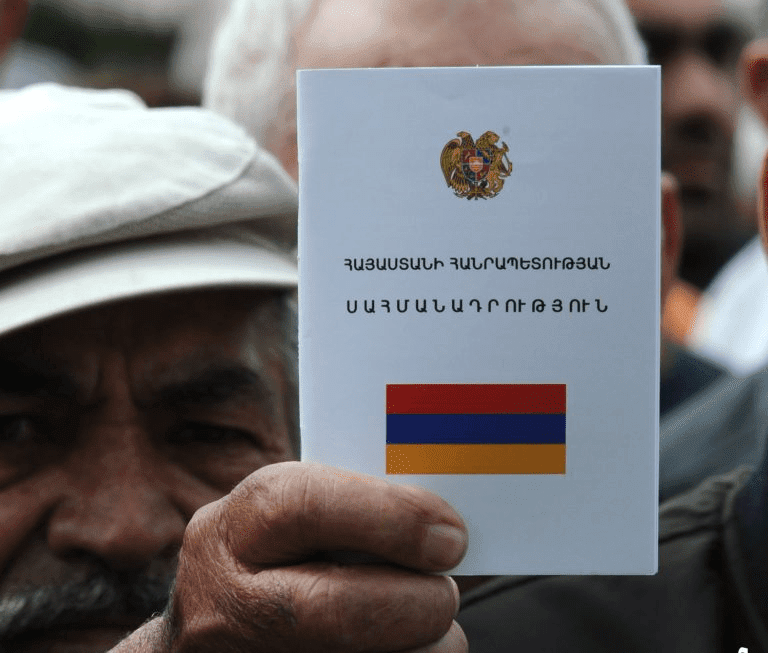
    Prime Minister Nikol Pashinyan announced last week that he has ordered the preparation of a new constitution which will need the approval of the citizens of Armenia in a referendum.

    I hope the majority of Armenian voters will reject the new constitution, thereby compelling him to resign. This is a golden opportunity to get rid of him. All previous efforts to remove him from office have failed over the past seven years because:

    1)  The split among the opposition groups has prevented them from forming a coalition large enough to remove Pashinyan from office. Even though his popularity has considerably decreased in recent years from 80% seven years ago to less than 10% now, nevertheless, his ruling party’s political rating is larger than any single opposition group. Many excuses have been made for not uniting, but none of these reasons are more important than the need to save the country. Regrettably, by being disunited, the opposition is the one that is keeping Pashinyan in power.

    2)  To form a successful anti-Pashinyan coalition, no one group should try to dominate it. The leadership of the coalition should be rotated until new elections are held.

    3)  A shadow government should be composed of all the opposition groups based on professional expertise.

    4)  The groups should temporarily set aside all of their internal differences and unite to save the nation. Should Armenia no longer exist, none of these groups’ ideologies will matter. Once they save the country, they can go back to pursuing their own goals.

    Knowing Pashinyan’s egotistical modus operandi, he will crisscross Armenia to ensure that the citizens vote for the new constitution. He will leave no stone unturned to achieve his objective by pressuring and threatening them. He has the resources of the government at his disposal to carry out such a vast campaign and resort to vote tampering or collecting a large amount of campaign contributions that exceed the legal limit, just as his party did during the last Yerevan City Council elections. This is a critical goal for Pashinyan because Pres. Aliyev has made it clear that without a new Armenian constitution, he will refuse to sign the “Peace Treaty” that Pashinyan has been begging for. Pashinyan needs that signed piece of paper to fool the voters in the 2026 elections into thinking that he has brought them “peace” even though it will not last long.

    Initially, Pashinyan dismissed Aliyev’s demand to change the constitution as interference in Armenia’s internal affairs. Furthermore, Pashinyan said that there is no such need as the draft of the peace treaty contains a clause that both countries agree to recognize each other’s territorial integrity. In the case of a dispute, the terms of the peace treaty will take precedence over their respective constitutions. Pashinyan added that Azerbaijan’s constitution itself contains indirect references to demanding territories from the Republic of Armenia. However, Pashinyan said that he will not ask Azerbaijan to revise its constitution!

    In addition to changing Armenia’s constitution, Pashinyan has accepted the following demands from Aliyev:

    — Armenia turning over certain villages located inside Armenia to Azerbaijan.

    — Allow Azeris who formerly lived in enclaves inside Armenia to return and live there.

    — To disband the OSCE Minsk group.

    — The departure of EU monitors from Armenia.

    — Armenia to drop its international lawsuits against Azerbaijan.

    — The road from the Eastern part of Azerbaijan to Nakhichevan to be a Corridor under Azeri sovereignty rather than a mere road. While objecting to the Corridor, Pashinyan has agreed to facilitate the access.

    — Even though the 2020 Agreement allows both Armenia and Azerbaijan to cross each other’s territory, Pashinyan has repeatedly said that Azeris are welcome to cross Armenia, without once stating that the agreement should be implemented reciprocally.

    Armenia’s Justice Minister Srbuhi Galyan said last week that the new constitution will be ready before the June 2026 parliamentary elections. It is not clear if the electorate will be asked to vote on the constitution at the same time as voting for the parliament members or after that election.

    There is nothing wrong with amending the constitution from time to time as the need arises, but to be compelled to write a brand new one at the enemy’s demand is totally unacceptable.

    It is critical that Armenian voters reject the new constitution. A no vote is a vote of no confidence in the Prime Minister. He can no longer continue to remain in his position after having been rejected by the people on his key initiative. He will have no choice but to resign.

  • Pashinyan Falsely Claims Former Leaders Recognized Artsakh as Part of Azerbaijan

    Pashinyan Falsely Claims Former Leaders Recognized Artsakh as Part of Azerbaijan

    The Ambassador of France to Armenia, Olivier Decottignies, who had been taking strong pro-Armenian positions, surprised everyone last week by falsely telling Armenia’s Public Radio that Prime Minister Nikol Pashinyan was not the first Armenian leader to recognize that Artsakh belonged to Azerbaijan.

    Decottignies added: “Armenia has accepted, recognized that Nagorno Karabagh is part of Azerbaijan ever since the adoption of the Alma Ata Declaration [in 1991] because Nagorno Karabagh was a region of Soviet Azerbaijan. Therefore, those who claim that Nagorno Karabagh was recognized as part of Azerbaijan in 2022 in Prague are lying, because Nagorno Karabagh has been recognized by Armenia as part of Azerbaijan since the Alma Ata Declaration.”

    This is an undiplomatic and false statement from the representative of a country friendly with Armenia. Why would the French Ambassador make such a wrong claim? There may be three reasons:

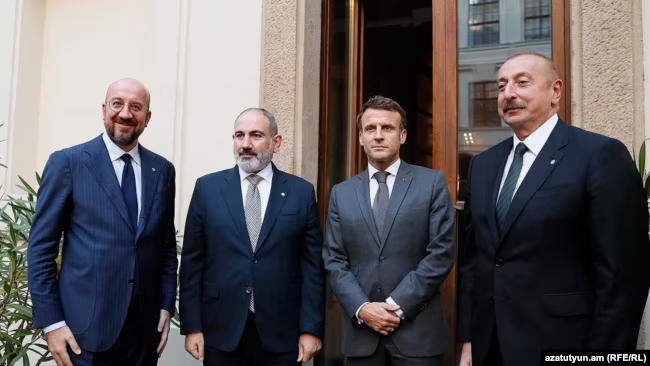
    1) To absolve French President Emmanuel Macron of blame for mediating along with then President of the European Council Charles Michel talks in Prague on October 6, 2022, with Pashinyan and Azerbaijan’s President Ilham Aliyev, where Pashinyan recognized the territorial integrity of Azerbaijan, accepting that Artsakh is part of Azerbaijan based on the Alma Ata Declaration of 1991.

    2) To justify and support Pashinyan’s teetering rule against his domestic opponents after handing over Artsakh to Azerbaijan.

    3) To improve the damaged Azerbaijan-France relations.

    The statement issued after the quadrilateral 2022 Prague meeting confirmed that Armenia and Azerbaijan, according to the Alma Ata 1991 Declaration, “recognize each other’s territorial integrity and sovereignty,” meaning that Artsakh belongs to Azerbaijan. Subsequently, Pashinyan explicitly and falsely claimed multiple times that based on the Alma Ata Declaration Artsakh is part of Azerbaijan.

    By making such a statement, Pashinyan’s intent was to shift the blame onto Armenia’s former leaders for giving away Artsakh to Azerbaijan in 1991, long before he came to power in 2018.

    There are several errors in the statements of the French Ambassador and Pashinyan:

    — The Alma Ata Declaration of December 21, 1991, did not include any reference to Artsakh. It stated that the 11 former Soviet Republics, including Armenia and Azerbaijan, “recognize and respect each other’s territorial integrity and the inviolability of the existing borders.”

    — Pres. Levon Ter Petrosyan, on his way back from Alma Ata in 1991 told Soviet Television that when the Declaration is ratified by the Supreme Council of Armenia, a reservation would be added regarding the status of Nagorno-Karabakh’s autonomy “so that we can obtain solid guarantees for the existence of Nagorno-Karabakh as an autonomous entity.”

    — On February 18, 1992, the Supreme Council of the Republic of Armenia ratified the December 8, 1991 Minsk Agreement on the Creation of the Commonwealth of Independent States (CIS), which was the precursor to the Alma Ata Declaration. Given the fact that Artsakh had held a referendum on Dec. 10, 1991, declaring the establishment of the Republic of Nagorno Karabagh, the Supreme Council of Armenia added the following reservation which applied to Artsakh: All former autonomous entities of the USSR, which had previously held a referendum declaring their independence, can join the CIS.

    — The Supreme Council of Armenia reaffirmed its position on Artsakh in a Decision on July 8, 1992, stating that it considers unacceptable any document that mentions the Republic of Nagorno Karabagh as part of Azerbaijan.

    — On April 15, 1994, the President of Armenia refused to sign the “Declaration on the Preservation of Sovereignty, Territorial integrity, and Inviolability of Borders of the Participant States of the Commonwealth of Independent States,” out of concern that Azerbaijan would use that document against Artsakh.

    — The Preamble of the 1995 Constitution of Armenia contains a reference to the Declaration of Independence, which in turn refers to the 1989 joint decision of the Soviet Armenia’s Supreme Council and the Artsakh National Council on the “Reunification of the Armenian SSR Supreme Council and the Mountainous Region of Karabagh.”

    — Finally, during the 1996 OSCE Lisbon Summit, the Armenian government vetoed a resolution which would have given the highest degree of self-government to Nagorno Karabagh within Azerbaijan.

    After all the above references to the separate status of Artsakh from Azerbaijan, how can Pashinyan claim that the former leaders of Armenia had given Artsakh to Azerbaijan? If that were the case:

    — Why did Azerbaijan not occupy Artsakh from 1991 to 2020?

    — Why did Azerbaijan launch a major war in 2020 to conquer Artsakh, losing thousands of soldiers?

    — Why did Armenian soldiers battle Azerbaijani troops after 1991?

    — Why did the Armenian government for decades, including during Pashinyan’s rule, station soldiers of the Armenian Army in Artsakh?

    — Why did the Armenian government contribute hundreds of millions of dollars to Artsakh’s budget, if Artsakh was part of Azerbaijan?

    — Why did the EU foreign policy chief Josep Borrell state in the European Parliament in 2023 that “Armenia has recognized Nagorno Karabagh as an integral part of Azerbaijan, and Nikol Pashinyan is the first Armenian leader to make such a statement?”

    — Why did Pashinyan stand in front of the people of Artsakh in Stepanakert on August 5, 2019 and declare: “Artsakh is Armenia, period,” if Artsakh had been given to Azerbaijan?

    — Why did the Minsk Group of mediators, co-headed by France, Russia and the United States, tried for decades to find a solution to the status of Artsakh, if it was recognized by Armenia to be part of Azerbaijan since 1991?

    The answer to all of these questions is that Armenia’s former leaders did not hand over Artsakh to Azerbaijan. Pashinyan was the first Armenian leader to recognize Artsakh as part of Azerbaijan.
  • Pashinyan Rejects Committing The Crime of Armenian Genocide Denial

    Pashinyan Rejects Committing The Crime of Armenian Genocide Denial

    Ever since Prime Minister Nikol Pashinyan’s disgraceful attempt to raise unnecessary questions about the facts of the Armenian Genocide to a group of Swiss-Armenians in Zurich last month, he and his blind followers have been making excuses for his deplorable remarks.

    Pashinyan casually told the Swiss-Armenian group: “We need to also return to the history of the Armenian Genocide. We need to understand what happened and why?” It is shocking that 110 years after the Armenian Genocide, the Prime Minister of Armenia pretends not to know “what happened and why.” I don’t think it is because of his lack of knowledge. He knows exactly what he is saying and why.

    He continued with more fabricated questions: “How is it that in 1939 there was no agenda for the Armenian Genocide? And how is it that in 1950 the Armenian Genocide agenda appeared? And how did we perceive it, through whom did we perceive it?” Pashinyan must be told that long before 1950 and 1939, all the way back in 1921, the Catholicos of All Armenians Kevork V Surenyants designated April 24 as the Day of Remembrance for the victims of ‘Meds Yeghern.”

    Pashinyan has made similar questionable statements in the past. To confuse the public, he regularly denies his earlier statements and claims that he was misunderstood. One thing is sure, Azeris and Turks were elated that the Prime Minister of Armenia agrees with them on “questioning the genocide.”

    Justifiably, Pashinyan was condemned by prominent Armenians and organizations all over the world. He was harshly criticized by Catholicoi Karekin II and Aram I, various historians and experts on the Armenian Genocide, the Lemkin Institute, and Armenian organizations in Switzerland, Belgium and Armenia.

    Given the fact that Pashinyan has denigrated all sacred symbols of the Armenian nation from Mt. Ararat to Armenia’s coat of arms, and has repeatedly claimed that commemorations of the Armenian Genocide were prompted by external forces, meaning the Soviet Union, he has come very close to denying the facts of the Armenian Genocide which is a crime in Armenia punishable by 2-5 years of imprisonment.

    Pashinyan’s statement, as to why the Armenian Genocide was not on the agenda in 1939 and that it appeared on the agenda only in 1950, has a very simple explanation. There is no need for conspiracy theories. After the demise of Stalin’s dictatorial regime, which punished manifestations of nationalism with imprisonment, exile and even execution, the repressive environment began to soften gradually which allowed the construction of the Sardarabad and Armenian Genocide Memorials in Soviet Armenia.

    In the meantime, both prior to 1939 and after 1950, Armenians in the Diaspora commemorated the Armenian Genocide, asking for its recognition and the return of occupied Western Armenia from Turkey. Memoranda and petitions were presented to the United Nations and major powers in the late 1940’s. Tens of thousands of Armenians marched in various Middle Eastern, European and American cities demanding their historical rights.

    On August 20, 2009, Pashinyan wrote in his “Prison Diary: the mechanics of genocide” and reposted on his Facebook page last week: “Traditional Armenian thinking equates the concept of ‘genocide’ with the hostile actions of the outside world, ‘the Turk,’ meaning, the enemy. The new Armenian thinking tries to perceive the phenomenon through self-realization, tries to perceive the internal causes of the phenomenon, which are hidden behind the genocided people’s thinking, meaning, our own thinking.” Strangely, Pashinyan shifts the blame for the genocide from the perpetrators to the victims.

    There are two key documents that I would like to bring to Pashinyan’s attention:

    1) The law adopted by the Supreme Council of the Armenian Soviet Socialist Republic on Nov. 22, 1988: We “condemn the 1915 Genocide of the Armenians in Ottoman Turkey as a grave crime against humanity, and declare April 24 as a day of remembrance for the Armenian victims.”

    2) Article 136 of the Criminal Code of the Republic of Armenia: “Public denial, justification, propaganda or belittling the danger of Genocide or Crimes against Humanity:

    a) Public denial, justification, propaganda or belittling the danger of Genocide or Crimes against Humanity, where those have been committed on the basis of racial background, skin color, national or ethnic origin or religious background, for the purpose of provoking hatred, discrimination or violence against a person or a group of persons — shall be punished by a fine in the amount of twenty-fold to forty-fold, or public works for a term of one hundred fifty hours to two hundred fifty hours, or by restriction of liberty for a maximum term of three years, or by short-term imprisonment for a term of one to two months, or by imprisonment for a maximum term of four years.

    b) The act provided for in part (a) of this Article, which has been committed:

    i) through publicly exhibited artworks, mass media or using information or communication technologies;

    ii) by use of official or service authority or influence conditioned thereby — shall be punished by imprisonment for a term of two to five years.

    Regrettably, Pashinyan’s statements parallel the denialist strategy of the Turkish government. Turks raise similar questions to cast doubt on the veracity of the Armenian Genocide.

    Because Armenia’s judicial system is currently under Pashinyan’s control, no judge will dare to find him guilty. But when he is no longer in power, an independent judge will punish him for violating the law on genocide denial.