Tag: New world order

  • Is the Global Balance of Power Shaking? Debates on a New World Order Centered on the Middle East

    Is the Global Balance of Power Shaking? Debates on a New World Order Centered on the Middle East

    Global power dynamics have never been static; throughout history, empires have risen, peaked, and then entered periods of decline. What is happening today is being recorded in history as the newest and most striking link in this cycle. Following the approximately thirty-year hegemony of the unipolar system that began with the end of the Cold War, an irreversible fracture is now occurring in international relations. Especially recently, the maneuvers of Iran and the Axis of Resistance in the region have inflicted an unexpected defeat on the US and Israel, not only militarily but also politically, economically, and diplomatically. This defeat has a unique character and justifies all discussions about the reshaping of the global system.

    The Middle East stands out as the geography where this transformation is most intensely experienced. Events such as the September 11 attacks, the invasions of Afghanistan and Iraq, the Arab Spring process, and finally the October 7 operation have been milestones deepening the region’s instability. However, the defining development has been the multi-dimensional victory of Iran and the Axis of Resistance against the US-Israel front. This victory has not been limited to military successes on the ground; it has been integrated with military, political, economic, and diplomatic blows directed at the US and Israel from all around the world. Today, America’s global patronage is being questioned, and Israel is suffering the heaviest reputational loss in its history.

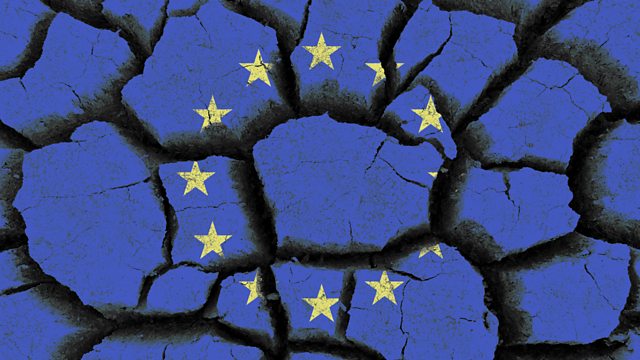
    The internal disintegration within the Western world completes this picture. The deep disagreements emerging in the relations between European countries and the United States show that the Western bloc is no longer as homogeneous as it once was. The chasms over energy policies, security strategies, and economic interests have created irreparable cracks in transatlantic relations. Tensions within NATO strengthen assessments that the alliance is fundamentally shaken, and comments about Europe and the US entering a divorce process are increasingly gaining supporters.

    Developments in the Gulf region present one of the most concrete indicators of this entire transformation. Despite the American military presence and guarantees in the region, Gulf countries are increasingly pursuing an independent line. The defeat the US is experiencing in the Gulf is comparable in nature to its historic debacle in Vietnam. Similarly, a much heavier version of Israel’s 2000 withdrawal from Lebanon is manifesting on all fronts today. Israel has become a country hiding underground day and night, living in fear.

    All these developments reveal the reality that imperialism and Zionism have lost politically, militarily, diplomatically, economically, and strategically. There is no longer any possibility of hiding this defeat; the world public is personally witnessing the humiliation of the US and Israel and the shattering of their prestige. The emerging new picture shows that the transition from a unipolar world to a multipolar and just order is inevitable, and confirms that the Axis of Resistance is one of the most important actors in this process.

    Geopolitical and Military Dynamics: The Heavy Defeat of the US and Israel

    The military and strategic maneuvers of Iran and the Axis of Resistance in the region have a character that completely transcends classical war doctrines. Iran’s direct and indirect actions have been integrated with military blows directed at the US from all around the world, especially from Europe, not just Israel. Attacks on US military bases in the region, missiles targeting warships in the Red Sea, operations on US facilities in Iraq and Syria have revealed how vulnerable the US military is. The US’s ineffectiveness and indecisiveness in the face of these attacks show that its deterrence capacity has completely collapsed.

    The situation on the Israeli front presents an even more dire picture. The October 7 operation showed the world the bankruptcy of Israel’s intelligence, military, and defense systems. The piercing of the Iron Dome, the neutralization of border security systems, and the unpreparedness of the Israeli army for war have revealed how fragile this country is. With Iran’s direct attack, Israel experienced the biggest security crisis in its history; the violation of its airspace, and the missile and drone attacks led to a state of complete panic. Israel has now become a country hiding underground, fleeing to shelters, and breathing in fear both day and night.

    Despite the unconditional military support the US provides to Israel, it has been seen that this support means nothing on the ground. The aircraft carriers, warships, and military units the US sent to the region could neither protect Israel nor limit the operational capacity of the Axis of Resistance. The US army, defined as the world’s largest military power, has become almost helpless in the fight against proxy forces; the fear of direct engagement has tied Washington’s hands. This situation has once again proven that military superiority alone means nothing, and that will and strategic patience are the real determinants.

    The Gulf region has turned into a Vietnam-style debacle for the US. Gulf countries, especially Saudi Arabia and the UAE, despite US security guarantees, have developed diplomatic and economic relations with Iran and the Axis of Resistance and have begun to question the US military presence in the region. US military bases in the Gulf are no longer centers of power projection; on the contrary, they have become symbols of US vulnerability. The normalization process of Gulf countries with Iran is the clearest sign that the US is even losing its allies in the region.

    The military successes of the Axis of Resistance have not been limited to the defense domain; they have also paralyzed the offensive capacity of the US and Israel. Israel’s operations in Gaza have not achieved the expected military success; on the contrary, they have caused the Israeli army to suffer heavy losses and become completely isolated in the international arena. Hezbollah’s threat on the northern border, the Houthis’ operations against commercial ships in the Red Sea, resistance groups in Iraq and Syria targeting US bases have eliminated the possibility of concentrating on a single front and have dragged the US and Israel into a multi-front war. This multi-front war has exhausted all the resources of the enemy and driven it into a strategic impasse.

    Political and Diplomatic Reflections: US-Israel Friendship is Decreasing, the World is Changing

    One of the most prominent effects of the changes in the international system is the rapid erosion of political and diplomatic support for the US and Israel. Diplomatic blows directed at the US and Israel from all around the world show how isolated these two countries have become internationally. Resolutions against the US and Israel adopted in the UN General Assembly and Security Council reveal that not only the non-Western world but also countries within the West are moving away from these two countries. Despite US vetoes, the near-unanimity of the international community in resolutions condemning Israel is proof of how weak the West’s hand has become.

    The deep divisions emerging in relations between European countries and the US show that the transatlantic alliance is fundamentally shaken. European countries such as France, Germany, Spain, Italy, Belgium, Ireland, and Norway have taken decisions to suspend or restrict arms sales to Israel, have taken steps towards recognizing the Palestinian state, and have called for ceasefires. This situation has caused diplomatic tensions between the US administration and its European allies; some European countries have begun to openly criticize US Middle East policies. It is now clear that US influence over Europe is broken, and Europe is taking steps to define its own strategic interests.

    The creaking within NATO seriously threatens the future of the alliance. Although French President Macron’s statement that “NATO is experiencing brain death” was temporarily pushed into the background by the pandemic and the Ukraine war, the underlying problems have not been resolved but have deepened. European countries are increasingly uncomfortable being under the US security umbrella, and the concept of European Strategic Autonomy is gaining more and more supporters. The US’s “pivot to Asia” strategy has reduced Europe to a secondary priority; this has strengthened the discourse of “self-determination” and “strategic independence” in Europe. Comments that Europe and the US are entering a divorce process are no longer a marginal view but have become central to mainstream discussions.

    The rise of Global South countries and their growing self-confidence against the West are reinforcing the diplomatic isolation of the US and Israel. Major southern countries like Brazil, South Africa, India, and Indonesia are making statements condemning Israel, expressing support for Palestine, and forming anti-US and anti-Israel blocs on international platforms. The expansion of the BRICS group, its institutionalization as a non-Western power platform, poses a serious alternative to the US-led global order. The sympathy and respect that Iran and the Axis of Resistance have gained in these countries have completely collapsed the Western narrative of the “oppressor.”

    Serious cracks have also appeared in the relations of the US with its traditional allies. Countries like Saudi Arabia, the UAE, Egypt, and Jordan, despite US pressure, have taken steps to normalize relations with Iran and the Axis of Resistance and have begun to openly criticize US policies in the region. Gulf countries that were in the normalization process with Israel froze this process after the October 7 operation, stood by the Palestinian cause, and made statements condemning Israel. This situation is the clearest indicator of how much US influence in the region has weakened and that even its allies can resist Washington’s pressure.

    Economic and Strategic Effects: Blows from All Around the World

    In the economic field as well, the US and Israel are receiving heavy blows from all around the world. The ineffectiveness of sanctions, the acceleration of de-dollarization, the loss of control over energy markets signal the collapse of US economic hegemony. Years of sanctions on Iran have neither stopped the country’s nuclear program, nor led to regime change, nor limited the regional activities of the Axis of Resistance. On the contrary, sanctions have led to the development of alternative economic networks in Iran, increased import-substitution industrialization efforts, and the formation of an economic structure specialized in evading sanctions.

    The de-dollarization process is one of the biggest economic blows directed at the US. Countries such as China, Russia, Iran, Turkey, India, Brazil, South Africa, Saudi Arabia, and the UAE have started using local currencies in their bilateral trade and have begun to question the dollar’s reserve currency status. Discussions within BRICS about creating a common payment system and a common reserve currency have the potential to break the US monopoly on the global financial system. Efforts to create alternatives to the SWIFT system (Russia’s SPFS, China’s CIPS, Europe’s INSTEX) are concrete steps towards neutralizing US financial weapons. The US’s excessive use of sanctions as a weapon is preparing the end of the dollar’s hegemony in the long run.

    It is seen that the US and Israel have completely lost control in energy markets. Despite the increase in US LNG exports to Europe following the Russia-Ukraine war, Europe’s energy crisis has not been resolved; on the contrary, Europe’s energy dependency has merely shifted from one form to another. The OPEC+ cartel, led by Saudi Arabia and Russia, cutting production despite US pressure has shown how limited US influence is on energy markets. The presence of Iran and the Axis of Resistance in strategic waterways such as the Strait of Hormuz, the Red Sea, and the Suez Canal indicates a capacity that could threaten global energy supply. The US’s inability to counter these threats reveals its incompetence regarding energy security.

    The Israeli economy is taking blow after blow. The direct cost of the war reaching tens of billions of dollars, the departure of reserve soldiers from the workforce, tourism revenues coming to a halt, labor shortages in agriculture and construction, the halt of foreign investments, the downgrading of credit ratings, and the devaluation of the shekel have deeply shaken the Israeli economy. Although the high-tech sector is the locomotive of the Israeli economy, it has suffered a serious blow due to the mobilization of reservists, disruptions in the supply chain, and increased uncertainty. The near-closure of the Red Sea route, which holds an important place in Israel’s foreign trade, due to Houthi attacks, has added an additional cost to the Israeli economy.

    Economic blows directed at the US and Israel from all around the world are increasing the costs for these two countries exponentially. Europe halting arms sales to Israel, international companies withdrawing from Israel, investors losing confidence in Israeli markets, and the spread of boycott campaigns are bringing the Israeli economy to the point of suffocation. The US’s effort to provide simultaneous military and economic support to Ukraine and Israel has placed a heavy burden on the US budget; the sustainability of this support is being seriously questioned. The US debt crisis, budget deficit, and inflation pressures are signaling the collapse of its economic hegemony.

    The Crumbling of NATO and the Western Alliance: Europe and the US Are About to Divorce

    The current situation within NATO shows that the alliance is fundamentally shaken. The Western alliance, which united against the Soviet threat during the Cold War, no longer even has a common threat definition. While the US defines China as its primary strategic rival, European countries prioritize the Russian threat and are directly affected by instability in the Middle East. These differing threat perceptions cause serious disagreements over strategic priorities within the alliance. The US’s focus on Asia has fueled discussions that Europe should ensure its own security.

    Although the commitment of European countries to increase defense spending (the 2% of GDP target) has been met by many countries, it is seen that this spending falls far short of US expectations. Moreover, European countries tend to use increased defense spending to develop their own defense industries rather than buying weapons from the US. This situation has the potential to break the US monopoly on the European arms market and constitutes a new source of tension in transatlantic relations. Projects developed under the leadership of France and Germany, such as the European fighter jet, tank, and aircraft carrier, continue despite US discomfort.

    Although the Ukraine war temporarily allowed NATO to re-consolidate, it is understood that this consolidation is not permanent. The prolonged war has depleted the stocks of European countries, strained their economies, and eroded public support. The US signaling a reduction in its support for Ukraine has put European countries in a difficult position; some European countries have started to argue that the war should be resolved through diplomatic means. This situation shows that there is a serious disagreement between the US and Europe over Ukraine policy. Countries like Hungary, Slovakia, and Austria questioning support for Ukraine reveals that the divisions within the alliance are deepening.

    The events during the Israel-Gaza war have exposed the chasm between the US and Europe. While the US provides unconditional support to Israel, many European countries have called for a ceasefire, taken steps towards recognizing the Palestinian state, and decided to suspend or restrict arms sales to Israel. Countries such as Spain, Ireland, Norway, and Slovenia have officially announced their recognition of the Palestinian state; Belgium, Italy, the Netherlands, and the UK have suspended or restricted arms sales to Israel. The US’s efforts to veto or block these steps have drawn the reaction of European countries and caused a deep confidence crisis in transatlantic relations. It is now clear that the US cannot direct Europe according to its own interests and that Europe is taking determined steps to chart its own course.

    All these developments show that Europe and the US are entering a divorce process. Of course, this divorce will be a gradual process of separation taking years, rather than an abrupt break overnight. But the direction and speed are working against the US. Europe’s effort to gain strategic autonomy is one of the most important factors preparing the end of US global hegemony. Europe diversifying its relations with countries like China, Russia, and Iran, not participating in sanctions against these countries despite US pressure, or efforts to circumvent sanctions, are giving signals of the dissolution of the transatlantic alliance. NATO becoming completely dysfunctional in the near future or transforming into a European-centered defense organization, and the end of the US military presence in Europe, are no longer seen as distant possibilities.

    General Assessment: Imperialism and Zionism Have Lost, There is No Way to Hide It

    In light of all these developments, the truth reached is this: Imperialism and Zionism have lost politically, militarily, diplomatically, economically, and strategically. The US is no longer the global patron; it can no longer direct anyone as it wishes, cannot intervene in any country as it wishes, cannot impose any sanction as it wishes. The debacle in Afghanistan, ineffectiveness against Russia in Ukraine, the heavy defeats suffered against Iran and the Axis of Resistance in the Middle East have displayed the weakness of the US in all its nakedness. It is an undeniable reality that the US is no longer the determining actor, that the world is evolving into a multipolar structure, and that Iran and the Axis of Resistance are important actors in this new structure.

    Israel is experiencing the heaviest defeat in its history. The October 7 operation showed the bankruptcy of Israel’s legendary intelligence, army, and defense systems. Israel’s helplessness in the face of Iran’s direct attack, its inability to even announce who struck it, its fear of retaliation, have revealed how fragile Israel is. Israel has now become a country hiding underground, fleeing to shelters, and breathing in fear both day and night. In the international arena, Israel has been accused of committing genocide, faced demands for its leaders to be tried at the International Criminal Court, been diplomatically isolated by many countries, and even abandoned by its allies. Israel’s prestige has been shattered, its nose has been rubbed in the dirt, and it has been humiliated before the world public.

    Friends of the US and Israel are decreasing, and fronts are forming against these two countries all around the world. The rise of Global South countries, the increase in anti-Western sentiment, the revisionist stance of China and Russia, the awakening of the Islamic world – all of these are working against the US and Israel. The US veto, pressure, threats, and sanctions no longer work as they used to. Countries can comfortably take steps that the US does not want, showing that they have the capacity to resist US pressure. The US’s dogmatic discourse of “you are either with us or with them” has lost its function; countries can now say “neither the US nor China, our own way.”

    The Gulf region has been a repetition of the Vietnam debacle for the US. After hundreds of thousands of soldiers, trillions of dollars, and decades of engagement, the US could not achieve what it wanted in the Gulf; on the contrary, it has largely lost its influence. Gulf countries now act according to their own interests, not America’s; they develop relations with countries like China, Russia, Iran, and Turkey; they view US security guarantees with suspicion. For Israel, a much heavier version of the 2000 Lebanon debacle is being experienced today. The Israeli army, which withdrew from South Lebanon in shame back then, is now experiencing the same helplessness in Gaza, the West Bank, the Lebanese border, Syria, Iraq, and Yemen, being hit from all sides and unable to respond.

    There is no longer any possibility of hiding this defeat. Even if the US and Israeli media, state officials, and military commanders do not accept this defeat, the facts are obvious. The world public is personally witnessing that the US and Israel have been humiliated, their prestige shattered, that they have weakened, that they are afraid, that they are desperate. Denying this reality would only be self-deception. A new world order is being established; the foundation of this order is not imperialism and Zionism, but justice, equality, sovereignty, independence, and resistance. In this new order, Iran and the Axis of Resistance will continue to be the hope of all the oppressed who stand by their just cause.

    Bibliography

    · Amin, S. (2018). Empire of Chaos. New York: Monthly Review Press.
    · Chomsky, N., & Pappe, I. (2024). The Seven October Crimes: Israel’s Genocide in Gaza. London: Pluto Press.
    · Finkelstein, N. (2023). Gaza: An Inquest into Its Martyrdom. Oakland: University of California Press.
    · Halper, J. (2024). Decivilizing Israel: The Seven October War and the End of the Two-State Solution. Chicago: Haymarket Books.
    · Khalidi, R. (2024). The Iron Cage Revisited: Palestine’s Struggle for Justice After Seven October. Boston: Beacon Press.
    · Mearsheimer, J. J., & Walt, S. M. (2024). The Israel Lobby and US Foreign Policy: A New Afterword on the Seven October War. New York: Farrar, Straus and Giroux.
    · Pappe, I. (2024). The Ethnic Cleansing of Gaza: A History of the Seven October War. London: Oneworld Publications.
    · Prashad, V. (2024). The Darker Nations: A People’s History of the Global South in the Shadow of the Seven October War. New Delhi: LeftWord Books.
    · Roy, S. (2024). The Gaza Strip: The Political Economy of De-Development After Seven October. Washington, D.C.: Institute for Palestine Studies.
    · Said, E. W. (2024). The Question of Palestine: The Seven October Edition. New York: Vintage Books.
    · Shlaim, A. (2024). The Iron Wall: Israel and the Arab World Since Seven October. New York: W.W. Norton & Company.
    · Smith, R. (2024). The Decline and Fall of the American Empire: From Afghanistan to Seven October. Cambridge: Cambridge University Press.
    · Walt, S. M. (2024). The Hell of Good Intentions: America’s Foreign Policy Elite and the Decline of US Primacy After Seven October. New York: Farrar, Straus and Giroux.

    Sefa Yürükel

    Danish ethnographer and social anthropologist (MA)
    Aarhus University, 1997
    Independent Researcher
    Fields of Research: International Politics, Public International Law, Geopolitics, Sociology, Psychology, Cultural Studies, Systems and Structures
  • The struggle for power and energy between the old world and the modern world

    The struggle for power and energy between the old world and the modern world

    Yalman Hacıroğlu writes: The struggle for power and energy between the old world and the modern world

    🖲️What we are witnessing in the unfolding events on the world political stage is a struggle for power and energy. The hatred and devilish Epstein scandal a true reflection of the nature of the world we live in.🖲️

    The global political arena is witnessing increasingly perilous turning points and operations, sometimes marked by mutual threats, and at other times by the deployment of warships and naval vessels to convince the world that the situation has reached a dead end. This is coupled with efforts to stronghold the global economy with their own agendas. These successive events will not be the first nor the last. The world has always been a testing ground since the creation of Adam, peace be upon him. Satan’s disobedience to the God command was one manifestation of conceit , a display of power, and a struggle for authority and energy to determine who is stronger. In essence, it is an arena of conflict between good and evil.

    Based on this, what we are witnessing in the unfolding events on the global political stage is a struggle for power and energy. The hatred and devilish Epstein scandal is a true reflection of the nature of the world we live in. Many dark, devilish files that have been opened—and perhaps those yet to be opened—reveal the underlying relationships behind global power centers, and perhaps even hidden, supernatural forces.

    This confrontation also demonstrates the necessity of re-examining the true causes behind many past events and developments. Similar calculations regarding conflicts were implemented during the establishment of the old world order. We must re-analyze collapsed states more carefully. In particular, the collapse of the Ottoman Empire must be re-examined within the context of the machinations and internal dynamics at play. The new world order has not yet been established, and the old is dying.

    To understand the dimensions of this brutal and bloody process, it is essential to correctly understand the intentions and strategies of the actors involved. Who is shaping the new order (the struggle for power and energy), and what are the hidden centers of power? Who are the overt and covert actors?

    These questions have long been dismissed as “conspiracy theories.” Sometimes out of ignorance, and sometimes due to a deliberate attempt to distort reality, these topics were ignored. Today, however, much is clearer. Therefore, we must re-examine the First and Second World Wars. But this must be done without confining ourselves to the narratives written by the victors.

    (Tensions Among Dominant Powers in the Old World)

    As the old world order took shape, Britain was a key player in dominating nations through economic and military occupation, playing a quiet yet influential role. It also played a significant part in the process that propelled the United States to its position as the world’s leading power. However, current assessments suggest that Britain is reassessing its relationship with China within the global balance of power.

    (Changes in Agreements and Alliances)

    Several assessments have been made regarding the possibility of the United States and Russia reaching agreements in certain areas. This stems from the similarity of their security concerns and the underlying causes of conflict.

    In this context, the role of pressure groups and influential networks remains crucial. While overt hostility is often more apparent, making it clear who is opposing whom, the real challenge lies in the hidden spheres of influence and covert power relations. This highlights a part of the inherent fragility of the internal structures of great powers.

    This applies not only to the United States, but also to China, Russia, India, and other major powers.

    Given Britain’s historical influence over maritime trade routes and strategic transit points, it is worthwhile to interpret the rivalry between the United States and the United Kingdom through these geoeconomic lines.

    (Old Friends, New Rivals)

    The new era is disrupting established norms. A picture is emerging where former allies are fiercely competing. At the founding of the European Union, the alliance between Germany and France was a subject of intense debate. Global economic trends and political imperatives can bring historical rivals together on common ground, just as they can turn close friends into adversaries.

    The Russian-Ukrainian war should also be studied from a multidimensional perspective, not relying solely on one-sided accounts. Understanding how societies with shared historical and cultural roots clash is crucial for drawing lessons for the future.

    (The World and the Search for New Alliances)

    We are entering an era where yesterday’s enemies may become tomorrow’s friends, as rigid ideological frameworks gradually lose their function. The new era opens the door to more productive scenarios.

    However, protecting national and spiritual values ​​has become more important than ever. We are witnessing a rise in influences that undermine the value system. Yet, these elements, often considered simple, are the very foundations upon which societies and nations are built.

    Much of the global projects are built on the assumption of abandoning these values, because it is easier to direct structures without roots. One of the key criteria that will determine the value system is the will to preserve it. This foundation will largely determine the course of alliances. The world is not a permanent home, but a transit point. The fate of nations is like the fate of humanity. Whoever embarks on their journey without forgetting the true owner of the earth will undoubtedly achieve victory.

  • THE UNITED STATES’ ILLEGAL INTERVENTION REGIME AND THE COLLAPSE OF THE GLOBAL ORDER

    THE UNITED STATES’ ILLEGAL INTERVENTION REGIME AND THE COLLAPSE OF THE GLOBAL ORDER

    No Longer an “Allegation,” but an Open Reality

    The Debate Is Over

    The Open Violation of International Law

    The Use of Force and Threats: Happening Openly

    The United Nations system was established after the Second World War to prevent arbitrary uses of force by states. Article 2(4) of the UN Charter explicitly prohibits the use or threat of force against the territorial integrity or political independence of any state. This provision constitutes a cornerstone of international law, and its binding nature is beyond dispute.

    The rhetoric and practices of the United States toward Venezuela, Iran, the Caribbean, and several other regions constitute clear violations of this prohibition. Calls for regime change, insinuations of military intervention, naval deployments, and official statements containing explicit threats go far beyond the limits of diplomatic language. In international law, such actions are defined as the threat of force.

    These actions cannot be justified under the doctrine of self-defense, nor have they been authorized by the United Nations Security Council. Therefore, what exists here is not a legal controversy but an instance of unauthorized use of force. This reality demonstrates that the United States treats international law not as binding, but as optional.

    More dangerously, these violations are no longer exceptional; they have become standard policy. Law is treated as a flexible instrument shaped by power relations. This approach not only legitimizes U.S. actions but also creates a precedent for other states to justify similar violations.

    In short, what is occurring is not a series of isolated incidents, but the systematic erosion of international law. Unless this erosion is halted, persistent global instability will be unavoidable.

    Unilateral Sanctions: Economic Warfare

    Unilateral sanctions imposed by the United States have long ceased to be conventional diplomatic tools. Rather than targeting state structures, these measures directly affect civilian populations. Health systems, food supply chains, and essential public services are the first casualties of such sanctions.

    Under international law, the legitimacy of sanctions depends on their collective and multilateral nature. Broad economic sanctions imposed without Security Council authorization are legally problematic. Nevertheless, the United States presents these measures as if it were acting on behalf of the international community.

    Reports by UN Special Rapporteurs have clearly demonstrated that these sanctions lead to civilian deaths, widespread poverty, and public health crises. Despite this, sanctions have not only continued but have been expanded. This reflects a conscious disregard for human rights.

    Such practices closely resemble collective punishment, which is prohibited under international humanitarian law. Inflicting suffering on millions of people to coerce political change is not a legal instrument, but a coercive and punitive one.

    Therefore, what is at issue is not sanctions, but economic warfare—a form of warfare that can be as destructive as military conflict.

    From the Perspective of the U.S. Constitution: A Clear Usurpation of Authority

    Congress Is Being Bypassed

    The U.S. Constitution deliberately assigns the power to declare war to Congress in order to prevent military force from being placed under the will of a single individual. Yet in modern U.S. history, this principle has been effectively suspended.

    Presidents have routinely bypassed Congress by invoking “national security” and “imminent threat” justifications. The Trump era represents one of the most overt and reckless manifestations of this trend. Military operations and attacks have been carried out without explicit congressional authorization.

    The War Powers Resolution of 1973 was enacted to limit such abuses. However, it has been systematically violated by the executive branch. Congress, in turn, has often remained silent or acquiesced to faits accomplis.

    This is not a matter of constitutional interpretation but of constitutional dysfunction. The legislative branch has been rendered ineffective in relation to the executive, laying the institutional groundwork for authoritarian tendencies within the United States.

    As a result, the United States conducts external interventions while violating its own Constitution, generating a legitimacy crisis both domestically and internationally.

    What Does “Parallel State” Mean? The Real Definition

    The term “parallel state” does not refer here to a hidden or mystical structure. Rather, it describes a highly visible, documented, and institutionalized configuration of power operating outside democratic oversight.

    Defense corporations, security bureaucracies, and lobbying networks have become the de facto architects of foreign policy. These actors wield far greater influence than elected representatives. Decisions are made beyond public scrutiny and legislative control.

    The media functions as a complementary component of this structure. Interventionist policies are routinely presented under the banners of “national interest” and “security” without meaningful scrutiny. Public opinion is thus kept in a permanent state of perceived threat.

    This structure views law not as a boundary, but as an obstacle to be overcome. International agreements are abandoned when interests shift. Diplomacy is replaced by coercion.

    What exists, therefore, is a coalition of power that has supplanted the rule of law. This coalition is operational, and its consequences are global.

    The Consequences of This Regime

    The outcomes of this interventionist regime are no longer theoretical; they are being experienced. Regional wars have become permanent, and temporary crises have evolved into chronic conflicts.

    Nuclear armament has regained momentum. As trust in international agreements erodes, states increasingly rely on military buildup to secure themselves, amplifying global risks.

    In the Global South, opposition to U.S. policies has become not only political but societal, fueling radicalization and instability.

    Within the United States, the excessive centralization of executive power weakens democratic institutions. The principle of the rule of law is displaced by appeals to “security.”

    Ultimately, this regime undermines both the global order and the internal balance of the United States itself.

    What Must Be Done? Clear and Concrete Solutions

    At the International Level

    The current crisis of the international system stems not from the absence of institutions, but from the paralysis of political will. The United Nations remains central to legal legitimacy; the problem lies in its deliberate incapacitation by major powers. The solution is not to abandon the UN, but to use its mechanisms despite Security Council vetoes.

    The UN General Assembly, including through the “Uniting for Peace” mechanism, must intervene when the Security Council is deadlocked. While not legally binding, this mechanism carries significant legitimacy-producing power. International law operates not only through enforcement, but also through normative pressure.

    The International Court of Justice and other judicial bodies must be utilized more actively despite pressure from powerful states. Non-compliance with rulings does not render legal processes meaningless; on the contrary, it ensures that violations are historically and legally recorded. Law operates in the long term, not the short term.

    Regional alliances in Latin America, Africa, and Asia should develop joint economic and diplomatic mechanisms to counter unilateral sanctions. Such cooperation not only mitigates sanctions’ effects but also contributes to the practical reconstruction of multilateralism.

    Thus, the central objective at the international level must be to reject the normalization of force and to restore law as the primary point of reference. This is not idealism, but a vital necessity.

    Within the United States

    The crisis facing the United States is not merely a foreign policy issue; it directly concerns the functioning of its constitutional order. Congress’s effective loss of war powers hollow out democratic representation and is unsustainable.

    Congress must enforce the War Powers Resolution in practice and exercise real oversight over military actions. Budgetary authority, investigative committees, and transparent voting procedures are essential tools. Otherwise, Congress risks becoming a symbolic institution.

    Federal courts must adopt a firmer stance against executive overreach. “National security” cannot serve as an automatic justification for suspending the law. Unless the judiciary constrains power abuses hidden behind this rhetoric, constitutional order will collapse in practice.

    The role of the media is decisive. A media system that reproduces interventionist narratives rather than questioning them becomes not a check on power, but a carrier of the power regime itself. Critical journalism is not a security threat; it is a democratic necessity.

    A genuine solution within the United States requires the restoration of constitutional checks and balances against executive overreach.

    Peoples and Civil Society

    Historically, the most enduring resistance to unlawful state practices has emerged from civil society and transnational solidarity. This remains true today, but the language and method of such resistance are decisive.

    Criticism rooted in emotional outrage or identity-based targeting weakens itself. By contrast, criticism grounded in evidence, law, and universal principles generates legitimacy. The core strength of civil society lies in ethical and legal consistency.

    Stronger ties must be forged among international networks, labor unions, academic communities, and human rights organizations. If interventionist policies operate globally, resistance must also be global in scope.

    Equally crucial is the responsibility of peoples to hold their own governments accountable. External interventions are often framed as “inevitable” to domestic audiences. Challenging this narrative is fundamental to democratic responsibility.

    Thus, the role of civil society is not merely to react, but to continuously sustain a law-based alternative political rationality.

    Conclusion: This Is a Regime of Collapse

    What we are witnessing today is not a temporary governing style or a periodic deviation. It is the institutionalization of a system in which law has ceased to be binding and raw power has become the source of legitimacy. This system affects not only U.S. foreign policy but the global order as a whole.

    Historically, every order built upon the suspension of law has delivered short-term dominance at the cost of long-term legitimacy and stability. From Rome to colonial empires, from Cold War proxy conflicts to the present, this pattern has remained unchanged. When law retreats, violence and chaos expand.

    The interventionist trajectory pursued by the United States today not only devastates targeted countries but also erodes its own constitutional and democratic foundations. The marginalization of Congress, the constriction of the judiciary, and the centralization of executive power expose the direct link between external interventionism and internal authoritarianism.

    The most dangerous consequence for the international system is this: impunity makes violations contagious. When a major power openly violates the law without consequence, others are encouraged to follow suit. This produces a permanent condition of global insecurity.

    This is not a matter of “anti-Americanism” or geopolitical alignment. It is a question of whether the universal binding force of law can be preserved. If law applies only to the weak, what remains is not law, but hierarchical coercion.

    There is no way out through romantic appeals. The path forward requires a persistent, collective, and principled struggle for law. Reinvigorating international institutions, strengthening global civil society solidarity, and prioritizing long-term stability over short-term gains are imperative.

    Final word:
    This is not merely a debate about world order—it is a turning point for humanity’s shared future.
    And at such a turning point, neutrality is not an option; principled commitment is.

    REFERENCES
    1. United Nations. Charter of the United Nations, 1945.
    2. International Court of Justice. Military and Paramilitary Activities in and against Nicaragua (Nicaragua v. United States of America). Judgment, 1986.
    3. United Nations General Assembly. Resolution 2625 (XXV) – Declaration on Principles of International Law concerning Friendly Relations and Co-operation among States, 1970.
    4. United Nations General Assembly. Resolution 377 A (V) – Uniting for Peace, 1950.
    5. United Nations Human Rights Council. Reports of the Special Rapporteur on the negative impact of unilateral coercive measures on the enjoyment of human rights. (Particularly Venezuela, Iran, and Cuba reports).
    6. Douhan, Alena. Impact of Unilateral Sanctions on Human Rights. United Nations, Office of the High Commissioner for Human Rights.
    7. United States of America. The Constitution of the United States.
    8. United States Congress. War Powers Resolution, Public Law 93–148, 1973.
    9. Congressional Research Service. Presidential War Powers: History, Legal Analysis, and Practice.
    10. Harvard Law Review. Executive Power and the Use of Military Force. Various issues.
    11. Yale Law Journal. National Security, Executive Power, and Constitutional Limits. Various articles.
    12. Chomsky, Noam. Who Rules the World? New York: Metropolitan Books, 2016.
    13. Chomsky, Noam. Hegemony or Survival: America’s Quest for Global Dominance. New York: Henry Holt, 2003.
    14. Bacevich, Andrew J. The New American Militarism: How Americans Are Seduced by War. Oxford University Press, 2005.
    15. Kinzer, Stephen. Overthrow: America’s Century of Regime Change from Hawaii to Iraq. New York: Times Books, 2006.
    16. Blum, William. Killing Hope: U.S. Military and CIA Interventions Since World War II. London: Zed Books, 2003.
    17. Mills, C. Wright. The Power Elite. Oxford University Press, 1956.
    18. Hudson, Michael. Super Imperialism: The Economic Strategy of American Empire. Pluto Press, 2003.
    19. Kaldor, Mary. New and Old Wars: Organized Violence in a Global Era. Stanford University Press, 2012.
    20. Moyn, Samuel. Humane: How the United States Abandoned Peace and Reinvented War. New York: Farrar, Straus and Giroux, 2021.
    21. Herman, Edward S., & Chomsky, Noam. Manufacturing Consent: The Political Economy of the Mass Media. Pantheon Books, 1988.
    22. RAND Corporation. U.S. Military Posture and Coercive Diplomacy. Various reports.
    23. Foreign Affairs. Sanctions, Executive Power, and U.S. Global Strategy. Various articles.
    24. Foreign Policy. Unilateral Sanctions and International Order. Various analyses.

  • The New US and Europe, the Collapse of the Neocons, and the Rise of Asia: The Dawn of a Multipolar World Order

    The New US and Europe, the Collapse of the Neocons, and the Rise of Asia: The Dawn of a Multipolar World Order

    From World War I to the present, the global order shaped by the US and Europe has undergone a significant transformation, especially in the post-Cold War era, with the collapse of neocon policies and the rise of Asia. This shift has accelerated the transition to a multipolar world order, leading to the redefinition of military, economic, and geopolitical dimensions in international relations. In this context, Turkey’s strategic position and historical legacy also play a crucial role.

    1. World War I, the Foundations of the Modern International System, and the Atlantic Order

    World War I marked a turning point in modern international relations, reshaping global power dynamics. The post-war order sought international cooperation and balance of power following the devastating effects of the war (Demir, 2020). In the second half of the 20th century, the Atlantic Order, led by the United States, emerged as a global system within the framework of mutual deterrence policies with the Soviet Union (Brzezinski, 1997). However, the dissolution of the Soviet Union in the 1990s altered the fundamental parameters of this order. The rise and fall of neoconservative policies paved the way for new strategic orientations (Mearsheimer, 2001; Özdemir, 2025).

    1. Historical Process: From World War I to the Cold War

    2.1 World War I and Reconstruction

    World War I profoundly altered Europe’s political landscape, leading to the collapse of old empires and the emergence of new state systems. The conflict laid the foundation for future international relations by shaping the power struggles and alliance policies of the 20th century (Aras & Yılmaz, 2019). Post-war treaties and reconstruction efforts positioned the United States as an emerging economic and military power.

    2.2 World War II and the Formation of the Atlantic Order

    World War II restructured the global order, with the United States emerging as the leader of the Atlantic Order through its military and economic dominance. The Bretton Woods system and international financial regulations solidified the US dollar as the global reserve currency, establishing a cornerstone of the capitalist world system (Kissinger, 2014; Nye, 2004).

    2.3 The Cold War and Bipolar Order

    During the Cold War, the ideological and geopolitical rivalry between the US and the Soviet Union structured global politics into a bipolar system. This period was defined by military alliances such as NATO and the Warsaw Pact, reinforcing the importance of balance-of-power strategies in international relations (Ikenberry, 2011).

    1. The Post-1990 Period and the Evolution of Neocon Policies

    3.1 The Transformation of the Post-Cold War Era

    The collapse of the Soviet Union in 1990 radically changed the global order. Under a unipolar system, the US pursued neoconservative policies, particularly in the Middle East, through military interventions and NATO expansion, aiming to reshape geopolitical routes (Mearsheimer, 2001; Zakaria, 2008). However, the implementation of these strategies resulted in economic and political costs over time.

    3.2 The Collapse of Neocon Policies and Alternative Approaches

    By the late 2000s, neocon policies in the US and Europe began to face increasing scrutiny. Economic crises and unsuccessful military interventions led to a shift towards more pragmatic foreign policy approaches (Walt, 2018; Cook, 2025). This transformation contributed to the decline of the US-led global paradigm and the emergence of new power centers—particularly China and Russia.

    1. The Rise of Asia and the Multipolar World Order

    4.1 China’s Industrial Rise and Strategic Moves

    The current international system is being reshaped by China’s rapid economic and industrial expansion. China’s dramatic increase in production capacity has surpassed the US’s post-1945 manufacturing dominance. Additionally, strategic initiatives such as the Belt and Road Initiative have strengthened China’s regional and global influence (Allison, 2017; Kaplan, 2012).

    4.2 Russia’s Repositioning

    Since 2008, Russia has pursued military modernization and strategic projects such as the Arctic Northern Route to redefine old power balances. Operations in Ukraine and regional security initiatives have reinforced Russia’s role as a key actor in Eurasia (Ersoy, 2018; Bremmer, 2012).

    1. Turkey’s Strategic Position: A Historical Perspective

    5.1 World War I and Its Aftermath

    Turkey’s geopolitical position was shaped by the dissolution of the Ottoman Empire and the challenges of post-World War I reconstruction. The Treaty of Lausanne and the Turkish War of Independence laid the foundation for Turkey’s foreign policy strategies, emphasizing independence and neutrality (Aras & Yılmaz, 2019).

    5.2 The Cold War and Beyond: Active Neutrality Policy

    During the Cold War, Turkey remained under NATO’s security umbrella while maintaining its geopolitical balance. The Montreux Convention and regional strategic initiatives enabled Turkey to develop balanced relations with both Europe and Eurasia (Ersoy, 2018).

    1. Conclusion

    The historical trajectory from World War I to the present illustrates the continuous evolution of the global order. The Atlantic Order, shaped by the US and Europe, initially expanded through neocon policies after the Cold War. However, the subsequent rise of Asia and Russia’s strategic maneuvers have challenged the unipolar system, signaling the emergence of a multipolar world order.

    References
    • Allison, G. (2017). Destined for War: Can America and China Escape Thucydides’s Trap? Houghton Mifflin Harcourt.
    • Aras, B., & Yılmaz, A. (2019). “Geopolitical Transformation and Regional Power Balances in Turkey.” Journal of International Relations, 14(3), 45–68.
    • Bremmer, I. (2012). The J Curve: A New Way to Understand Why Nations Rise and Fall. Simon & Schuster.
    • Brzezinski, Z. (1997). The Grand Chessboard: American Primacy and Its Geostrategic Imperatives. Basic Books.
    • Cook, R. (2025). “The British Financial Empire: Aiming to Destroy the US.” Retrieved from: https://hvodinali.wordpress.com/2025/03/14/british-financial-empire-aims-to-destroy-us/
    • Cox, M. (2012). Power Shifts, Economic Change and the Decline of the West? International Relations Journal, 26(4), 369–388.
    • Demir, Ö. (2020). “The New World Order: Geopolitical and Economic Perspectives.” Strategic Analysis Journal, 9(2), 105–123.
    • Ersoy, G. (2018). “Multipolar World Order and Turkey’s Strategic Choices.” Ankara University Journal of Political Science, 22(1), 89–112.
    • Fukuyama, F. (1992). The End of History and the Last Man. Free Press.
    • Huntington, S. P. (1996). The Clash of Civilizations and the Remaking of World Order. Simon & Schuster.
    • Ikenberry, G. J. (2011). Liberal Leviathan: The Origins, Crisis, and Transformation of the American World Order. Princeton University Press.
    • Kissinger, H. (2014). World Order. Penguin Press.
    • Mearsheimer, J. J. (2001). The Tragedy of Great Power Politics. W. W. Norton & Company.
    • Nye, J. S. (2004). Soft Power: The Means to Success in World Politics. Public Affairs.
    • Walt, S. M. (2018). The Hell of Good Intentions: America’s Foreign Policy Elite and the Decline of U.S. Primacy. Farrar, Straus and Giroux.
    • Zakaria, F. (2008). The Post-American World. W. W. Norton & Company.

    (.) Sefa Yürükel, MA ( Master of Arts) University of Aarhus , 1997.
    Anthropologists and Ethnographer

  • THE HIDDEN EMPIRE

    THE HIDDEN EMPIRE

    Most US citizens believe that the US is a country & the President is the most powerful man on earth. The US is not a country. It is a corporation. And the president is President of the Corporation of the United States. He & his elected officials work for the corporation, not for the American people. Since the US is a corporation, who owns the corporation of the United States?

    *WARNING* FB have BANNED ALL LINKS to this text. Circulate by way of photo and text.

    (We’ll see if they take this down)

    THE HIDDEN EMPIRE:

    1. City States.

    Did the world wars, revolutions & big events of human history happen naturally or coincidentally, or were they calculated & pre-planned? If they were pre planned, who planned them?

    The answer to this question can be found within the boundaries of 3 of the worlds most powerful cities. Those 3 cities belong to no nation & pay no taxes. They are Washington’s District of Columbia, which is not part of the City of Washington or the US. The inner city of London, which is not part of London or England & Vatican City, which is not part of Rome or Italy.

    These cities, called City States, have their own independent flag, their own separate laws & their own separate identity.

    2. Vatican City – Spiritual Capital.

    Gracing the walls of St Peter’s Basilica is the Vatican-approved image of God. An angry bearded man in the sky, painted by Michael Angelo. Cruel/violent images of God’s tortured son, suffering, bleeding & dying with thorns gouged through his skull/nails pounded through his feet & hands are on display throughout the Vatican. These images serve as reminders that God allowed his son to be tortured & killed to save the souls of human beings who are all born sinners.

    The Vatican rules over approximately 2bn of the worlds 6.2bn people. The colossal wealth of the Vatican includes enormous investments with the Rothschilds in Britain, France, USA, with giant oil & weapons corporations like Shell & General Electric. The Vatican solid gold bullion, worth billions is stored with the Rothschild controlled Bank of England & the US Federal Reserve Bank.

    The Catholic Church is the biggest financial power, wealth accumulator and property owner in existence, possessing more material wealth than any bank, corporation, giant trust or government anywhere on the globe.

    While 2/3 of the world earns less than $2 a day & 1/5 of the world is underfed or starving to death, the Vatican hoards the world’s wealth, profits from it on the stock market & at the same time preaches about giving.

    So how did the Vatican accumulate all that wealth over the millennium? One method was to put a price-tag on sin. Many bishops & popes actively marketed gilt, sin & fear for profit, by selling indulgences. Worshippers were encouraged to pre-pay for sins they hadn’t yet committed & get pardoned ahead of time. Those who didn’t pay-up risked eternal damnation. Another method was to get wealthy land owners to hand-over their land/fortune to the church on their death bed, in exchange for a blessing which would supposedly enable them to go to heaven.

    Pope Leo the fifth rebuilt St Peter’s Basilica, by selling tickets out of hell & tickets to heaven.

    During the dark ages, the Catholic Church not only hoarded the wealth they collected from the poor, but they hoarded knowledge. They kept the masses ignorant & in the dark by denying them a basic education. They also prohibited anyone from reading or even possessing a Bible, under pain of death.

    Between 1095-1291 AD the Pope launched 7 blood baths called the Christian Crusaides, torturing, murdering, beheading & mass murdering hundreds of thousands of Muslims & Jews in the name of God. The Pope’s brutal solders were called Knights Templar or Knights of the Temple of Solomon & evolved into today’s secretive brotherhood called the Freemasons.

    Between 1450-1700 AD the Catholic Church followed up their holy terror with the inquisition. Based on rumours of practicing witchcraft, the Catholic Church hunted down, tortured & burned-alive 10’s of 1000’s of innocent women at the stake.

    During WWII the Vatican was criticized for supporting Hitler & his Nazi regime. To this day, the Vatican is still under investigation for plundering Nazi gold from the Swiss bank accounts of Jewish holocaust victims.

    Over the past 5 decades more than 1,500 priests & bishops have been identified in the sexual assault of tens of thousands of boys & girls in their trusting congregations & orphanages.

    Why is the filthy rich institution preaching spiritual values of poverty & chastity while cardinals, bishops & priests cover-up their crimes of sexual abuse? Why has the church fought & resisted the compensation claims of their sexually, emotionally & spiritually traumatised victims?

    3. The City of London – Economic Capital.

    Like Vatican city, London’s inner city is also a privately owned corporation or city state, located right in the middle of greater London. It became a sovereign state in 1694 when King William III of Orange privatised & turned the Bank of England over to the bankers. Today, the City State of London is the world’s financial power centre & the wealthiest square mile on the face of the Earth. It houses the Rothschild controlled Bank of England, Lloyds of London, the London stock exchange, all British banks, the branch offices of 385 foreign banks & 70 US banks. It has its own courts, its own laws, its own flag & its own police force. It is not part of greater London, or England, or the British Commonwealth & pays no taxes. The City State of London houses Fleet Street’s newspaper & publishing monopolies. It is also the headquarters for world wide English Freemasonry & headquarters for the world wide money cartel known as The Crown.

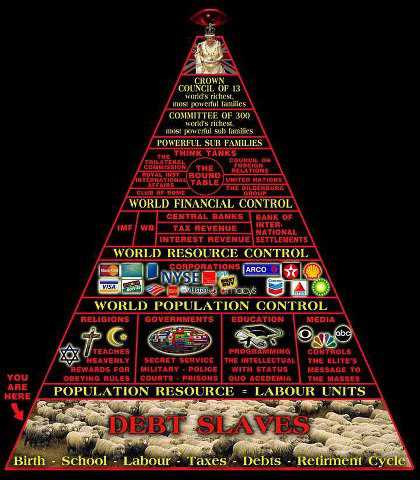
    Contrary to popular belief, The Crown is not the Royal Family or the British Monarch. The Crown is the private corporate City State of London. It has a council of 12 members who rule the corporation under a mayor, called the Lord Mayor. The Lord mayor & his 12 member council serves as proxies or representatives who sit-in for13 of the worlds wealthiest, most powerful banking families, including the Rothschild family, the Warburg family, the Oppenheimer family & the Schiff family. These families and their descendants run the Crown Corporation of London.

    The Crown Corporation holds the title to world wide Crown land in Crown colonies like Canada, Australia & New Zealand. British parliament & the British prime minister serve as a public front for the hidden power of these ruling crown families.

    4. The District of Columbia – Military Capital.
    Like the City States of London & the Vatican, a third city state was officially created in 1982. That city state is called the District of Columbia & is located on 10sq miles of land in the heart of Washington. The District of Columbia flies its own flag & has its own independent constitution.

    The constitution for the District of Columbia operates under a tyrannical Roman law known as Lex Fori, which bares no resemblance to the US Constitution. When Congress passed the act of 1871 it created a separate corporation known as THE UNITED STATES & corporate government for the District of Columbia. This treasonous act allowed the District of Columbia to operate as a corporation outside the original constitution of the United States & outside of the best interests of American Citizens.

    Although geographically separate, the city states of London, the Vatican & the District of Columbia are one interlocking empire called Empire of the City.

    The flag of Washington’s district of Columbia has 3 red stars. One for each city state in the 3 city empire. This corporate empire of 3 city states controls the world economically, through London’s inner city, militarily through the District of Columbia & spiritually through the Vatican.

    5. The U.S.A. – A Crown Colony.

    A sobering study of the signed treaties & charters between Britain & the US exposes a shocking truth. The US has always been & still is a British Crown colony.

    King James I was famous not for just translating the Bible into the King James version. But for signing the first charter of Virginia in 1606. That charter granted America’s British forefathers a licence to settle & colonise America. The charter also guaranteed that future Kings/Queens of England would have sovereign authority over all citizens & colonised land in America, stolen from the Indians.

    After America declared its independence from Great Britain, the Treaty of 1783 was signed. That treaty specifically identifies the King of England as the Prince of the United States & contradicts the belief that America won the War of Independence.

    Although King George III of England gave up most of his claims over American colonies, he kept his right to continue receiving payment for his business venture of colonising America.

    If America had really won the War of Independence, they would never have agreed to pay debts & reparations to the King of England.

    America’s blood soaked War of Independence against the British bankrupted America & turned its citizens into permanent debt slaves of the King. In the War of 1812, the British torched & burned to the ground the Whitehouse & all US government buildings. Destroying ratification records of the US constitution.

    Most US citizens believe that the US is a country & the President is the most powerful man on earth. The US is not a country. It is a corporation. And the president is President of the Corporation of the United States. He & his elected officials work for the corporation, not for the American people. Since the US is a corporation, who owns the corporation of the United States?

    Like Canada & Australia whose leaders are Prime Ministers of the Queen & whose land is called Crown Land, the US is just another crown colony. Crown colonies are controlled by the Empire of the 3 City States.

    6. Obelisks

    At the centre of each city state is a towering phallic shaped stone monument called an obelisk that points skyward. In DC city state, the obelisk known as the Washington monument was dedicated to the Freemason George Washington by the Freemason Grand Lodge of the District of Columbia. 250 Masonic lodges financed the Washington obelisk monument, including the Knights Templar Masonic order.

    At the heart of London City State, is a 187 ton 69 foot tall Egyptian obelisk called Cleopatra’s Needle. It was transported from Egypt & erected on the banks of the river Thames.

    In Vatican city, another Egyptian obelisk towers high above St Peter’s square.

    Obelisks are phallic shaped monuments honouring the pagan sun god of ancient Egypt called Amen Ra. The spirit of this pagan god is said to reside within the obelisk.

    For more info check out this video: watch?v=oYJzXkcJgEU

  • Growing ties between Egypt, Turkey may signal new regional order

    Growing ties between Egypt, Turkey may signal new regional order

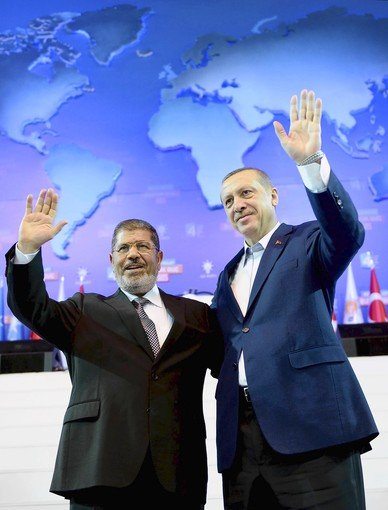
    The emerging alliance between Egypt’s Mohamed Morsi and Turkey’s Recep Tayyip Erdogan reflects two Islamist leaders maneuvering to reshape the Middle East.

    Egyptian President Mohamed Morsi, left, and Turkish Prime Minister Recep Tayyip Erdogan in Ankara, Turkey, in September. (Kayhan Ozer /Turkish Prime Minister’s Office / November 13, 2012)

    By Jeffrey Fleishman, Los Angeles Times

    November 13, 2012, 5:46 p.m.

    CAIRO — Egypt and Turkey are forging an alliance that showcases two Islamist leaders maneuvering to reshape a Middle East gripped by political upheaval and passionate battles over how deeply the Koran should penetrate public life.

    The relationship may foreshadow an emerging regional order in which the sway of the United States gradually fades against Islamist voices no longer contained by militaries and pro-Western autocrats.

    Each country has a distinct vision of political Islam, but Turkey, which straddles Europe and Asia, and Egypt, the traditional heart of the Arab world, complement each other for now. Turkey’s strong economy may help rescue Egypt from financial crisis, while Cairo may further Ankara’s ambition to rise as a force among Islamic-backed governments.

    What bonds and rivalries may ensue is unclear, but they are likely to affect what rises from the bloodshed in Syria, the influence of oil nations in the Persian Gulf, future policies toward Israel and the volatile divide between moderate and ultraconservative Islamists. The nations offer competing story lines playing out between the traditional and the contemporary.

    “Turkey has done a good job so far of balancing the relationship between the religion and state. It is secular,” said Ahmed Abou Hussein, a Middle East affairs analyst in Cairo. “This is not the case in Egypt. We haven’t found the balance between religion and state yet. We’re all confused, not only the Islamists.”

    The two countries recently conducted naval exercises in the Mediterranean Sea. Egyptian President Mohamed Morsi visited Ankara in September and Turkish Prime Minister Recep Tayyip Erdogan is expected to arrive in Cairo this month with promises of closer cooperation and a financial aid package that may reach $2 billion.

    “Our history, hopes and goals bind us together to achieve the freedom and justice that all nations are struggling for,” Morsi said on his trip.

    The nations’ deepening ties come amid international and domestic pressure emanating from revolutions that are recasting political rhythms in the Middle East and North Africa.

    Erdogan is moving to fashion Turkey’s democracy into a model for Arab governments even as he has been criticized by human rights groups for the arrest of thousands of Kurdish activists. Morsi is seeking to restore Egypt’s global stature after years of diminishment under deposed leader Hosni Mubarak.

    Turkey’s diplomatic finesse and economic allure have allowed it to deftly exert its regional influence. But the civil war in Syria has shredded relations between Ankara and Damascus and left Erdogan, who has threatened Syrian President Bashar Assad with wider military action, searching for a plan to end the conflict on his border.

    Turkey has also drawn the ire of Iran, a Syrian ally, for signing on to a U.S.-backed missile shield. And Iraqi Prime Minister Nouri Maliki this year called Turkey a “hostile state” and accused it of agitating sectarian tension in his country.

    Erdogan, who learned his wiles as a boy selling sesame buns on the streets of Istanbul, is more flamboyant than Morsi, the son of a peasant farmer. But Morsi has proved a canny politician: In a visit to Tehran in August, he signaled a thaw in Egyptian-Iranian relations while at the same time angering Iran by condemning Assad’s crackdown on dissent.

    Egypt’s deeper problems bristle on the home front, including unemployment, poverty, crime and decrepit state institutions that became more glaring after last year’s overthrow of Mubarak. Both Morsi and Erdogan, who rose to power nearly a decade ago, curtailed the political influence of their nations’ generals, but each has been accused by secularists as having authoritarian streaks tinged with Islam. The countries have a tendency to harass and arrest dissidents and journalists.

    A closer fusion of Cairo and Ankara stems in part from the influence Egypt’s Muslim Brotherhood had on Islamist organizations across the region, including Erdogan’s Justice and Development Party. While the Brotherhood was being persecuted by Mubarak, a brash Erdogan riveted the “Arab street” with his populism and chiding of leaders, such as Mubarak, for their compliance toward the West.

    The question is, how will Erdogan and Morsi maneuver the politics of a Middle East that both want to influence, and which Egypt regards as its historic and strategic territory?

    “I don’t think Egypt even under the Muslim Brotherhood would appreciate a Turkey that would nose around on Egypt’s political turf,” said Kemal Kirisci, a professor of political science and international relations at Bogazici University in Istanbul.

    But Turkey offers Egypt a pragmatic — some analysts suggest modern — approach to the West, the global economy and stability. A member of NATO, Turkey is aspiring to join the European Union. Its talks with the EU have been strained, but the process forced economic and social reforms that have benefited Erdogan as he increasingly looks to the Middle East and North Africa to expand commercial interests. Arab news media have reported that Turkey’s trade with the Arab world is targeted at $100 billion over next five years.

    “What is interesting about Turkey’s success is its commitment to practical visions and plans,” said Seif Allah el Khawanky, a political analyst. “Morsi’s administration doesn’t have this.”

    Both countries are working toward new constitutions. Turkey’s politics spring from a secular democracy and a history of defined political parties that have tempered the influence of Islam. Turkish women who wear hijabs are banned from political office. Egypt’s Islamist-dominated government, however, is pushing for a constitution firmly rooted in sharia, or Islamic law, and there is little inclination among conservatives to import the Turkish model.

    That difference is partly defining the immediate aftermath of the Arab Spring. Islamist groups long suppressed by Mubarak and other autocrats are imposing their political and religious visions on nations with underdeveloped or divided secular parties.

    “The Islamist parties in Turkey are past implementing religious ideologies. They’re working more on economic policies and reform,” Hussein said. “The Muslim Brotherhood and Salafis will have to change their rhetoric to fit the needs of Egypt and the world…. The Turks refer to their example as the Turkish experience. They are brilliantly trying to sell this so-called experience in Syria, Egypt and other Arab countries.”

    [email protected]

    Special correspondent Reem Abdellatif contributed to this report.