Tag: Kirkuk

  • Iraq’s Kurds Lose Political Dominance In Kirkuk

    Iraq’s Kurds Lose Political Dominance In Kirkuk

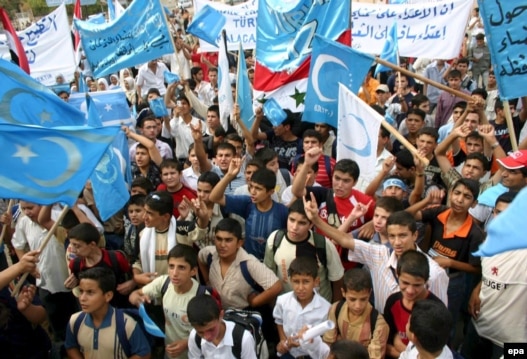
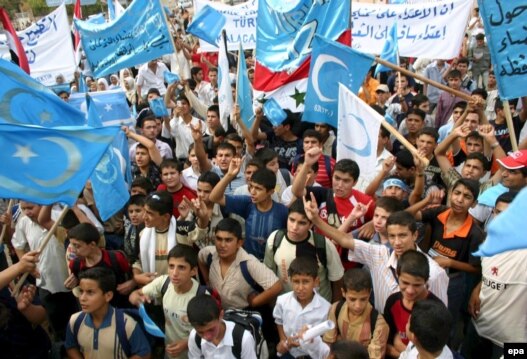
    Turkomans demonstrate in Kirkuk in 2006, demanding recognition of their ethnic group’s status in the disputed region.

    March 19, 2010
    By Charles Recknagel
    Before the March 7 parliamentary elections in Iraq, there was no question of who dominated politics in mixed-population Kirkuk — it was the two main political factions in the neighboring Kurdish autonomous region.

    But with the vote count from Kirkuk city and its surrounding Tamin Province about 80 percent complete, it is clear that the political landscape is dramatically changing.

    The partial vote count shows the secular Al-Iraqiyah coalition and the Kurdistan Alliance in a virtual tie, with the balance between them shifting by only wafer-thin differences as the vote tally rises.

    If the current balance holds, it means that the divided province’s Turkoman and Arab populations will have a much louder political voice than before. That in turn could complicate Kurdish hopes of one day incorporating oil-rich Kirkuk into their autonomous region.

    Turkoman politicians in Kirkuk make no secret of the fact that they competed in the parliamentary contest precisely with that goal in mind.

    United Against Kurdish Ambitions

    Hicran Kazanci head of the foreign relations department of the Iraqi Turkoman Front, tells RFE/RL’s Turkmen Service that Turkoman candidates enlisted in a variety of coalitions for the March 7 race. But he says they all agree on one thing.

    “Despite the fact the Turkomans went into the election with different coalitions, on major and essential subjects they are united,” Kazanci says. “For example, about the future status of Kirkuk, all of them are united in opposition toward annexing Kirkuk into any federation. And they are united in making Turkoman one of Iraq’s official languages.”
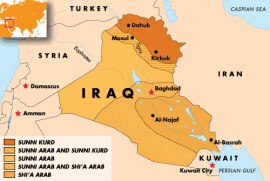
    A map Iraq’s ethnic makeup

    Turkoman and Arab politicians made up the vast bulk of Al-Iraqiyah’s candidates in the local race, coming for the first time under a single political umbrella in the divided province. That is in sharp contrast to much of Kirkuk’s recent history, where the three main population groups — Kurdish, Turkoman, and Arab — have all competed against each other.

    In the years immediately following the United States’ toppling of Saddam Hussein, both Turkomans and Arabs boycotted attempts to form a provincial government. They expressed anger over what they said were Kurdish efforts to appropriate the province de facto after moving Kurdish peshmerga fighters into the area to support the U.S. invasion.

    The Turkomans and Arabs only agreed to take part in the running of the province after a power-sharing deal in 2008. Under that deal, the provincial governor is a Kurd while his two deputies are an Arab and a Turkoman.

    But Kirkuk’s provincial parliament is still disputed after Arabs and Turkomans largely stayed away from the first election in 2005, handing the Kurds a majority. The Iraqi government excluded Tamin Province from the January 2009 provincial elections due to fears of sparking sectarian unrest.

    Given this background, the fact that this month’s elections for deputies to the national parliament went peacefully in Tamin Province is a major surprise. To ensure security, the Iraqi police fielded 56 mobile patrols in Kirkuk city on election day, while Kurdish peshmerga also spread out less obtrusively across the provincial capital.

    Simira Balay, a correspondent for RFE/RL’s Radio Free Iraq, says the Kurdish coalition was caught unawares by the election results, after it “had expected to dominate the election, but it seems the Kurdish vote split among a number of Kurdish parties, including Goran.” She says Kurdish bloc “now is neck and neck with the Iraqiyah list, which got most of the Turkoman and Arab vote.”

    The Kurdish coalition comprises the Kurdistan Democratic Party and Patriotic Union of Kurdistan. Goran, a recently created Kurdish opposition party, scored well in recent elections by running on an anticorruption platform.

    Resolving Kirkuk Issue

    In the aftermath of the elections, Kurdish political leaders — like their Turkoman counterparts — are stressing unity in their position over Kirkuk.

    The Kurds see the city as the natural and historic capital of the Kurdish region in northern Iraq. And they insist upon holding a referendum in the province to determine its future status.

    “The issue of Kirkuk is [already] in the Iraqi political arena to be solved in accordance with Article 140 of the Iraqi Constitution,” says Rizgar Ali, the Kurdish head of Kirkuk’s provincial council.

    Major steps under Article 140 include resolving property disputes created by Hussein’s policy of “Arabizing” Kirkuk, the holding of a census and conducting a referendum to decide the province’s future status.

    To date, progress on all these steps has been painfully slow. Most property disputes remain unresolved and unrest in northern Iraq has prevented a census. The referendum, originally planned for no later than the end of 2007, has slipped accordingly.

    That limbo is unacceptable to the Kurds, who are sure to use their full representation in the Baghdad parliament, including deputies from the Kurdish region, to continue to press for swift implementation of Article 140.

    But it is likely that both the Turkomans and Arabs will use their new voice in the federal legislature to try to subject Article 140 to further negotiation.

    According to Rakan Said, the Arab deputy governor of Kirkuk, the election results “laid the ground for dialogue.” He adds that now there are “two parties to the issue of Kirkuk: one is Al-Iraqiyah and the other is the Kurdish coalition. So the platform [for dialogue] has become clear and without interference.”

    New Political Landscape

    Al-Iraqiyah, headed by former Prime Minister Iyad Allawi, ran on a nonsectarian, nationalist platform. Its success on the national level as a joint front-runner with Prime Minister Nuri al-Maliki’s State of Law coalition has appeared to realign Iraqi politics by relegating sectarian- and ethnic-based parties to the background.

    With some 80 percent of the vote counted nationwide, the Shi’ite religious parties’ Iraqi National Alliance are in third place and the Kurdistan Alliance in fourth. Still, Iraqi parliamentary politics is all about making coalitions and in the past the Kurds have proved adept at playing the role of kingmakers.

    Whether the Kurdish parties can continue to do so now, or are relegated to a less prominent role, will directly affect Kirkuk’s eventual status. The Kurds want it to be part of Iraqi Kurdistan. And the newly empowered Kirkuk Turkoman-Arab bloc is just as determined to play the spoiler.

    Kurds, Arabs, and Turkomans all claim the province around Kirkuk based on a long historical presence in the area.

    The Turkic-speaking Turkomans, who claim to be the second-largest group in northern Iraq after the Kurds, trace their presence to the time of the Seljuk Empire, when migrating Turkic tribes conquered a vast expanse of territory stretching from modern Iran to Turkey.

    Muhammad Tahir of RFE/RL’s Turkmen Service contributed to this report
     
    https://www.rferl.org/a/Iraqs_Kurds_Lose_Political_Dominance_In_Kirkuk/1988609.html
  • A CALL TO THE FREE PEOPLE OF THE WORLD

    A CALL TO THE FREE PEOPLE OF THE WORLD

    Turkistan Newsletter Mon, 22 Jun 2009 16:55:27
    Turkistan Bulteni ISSN:1386-6265
    Uze Tengri basmasar asra yer telinmeser, Turk bodun ilining torugin
    kem artati, udaci erti. [Bilge Kagan in Orkhon inscriptions]
    <<>><<>><>><<>><<>><<>><<>><<>><<>><<>><<>><<>><<>><

    A CALL TO THE FREE PEOPLE OF THE WORLD

    There has been another vicious attack on the peaceful Turkmen people of Iraq.  On Saturday June 21, 2009, a truck bomb exploded in the busiest center of the town of Tuz Khurmatu (pop. 15000), 10 miles south of Kerkuk, at noon, killing more than 75 and wounding more than 200.

    This has been the latest in the chain of attacks against the Turkmens in
    Telafer, Kerkuk, Tuz Khurmatu and Amirli. Those attacks are particularly
    are directed upon the armless and defenseless Turkmens who are not allowed by the governing circles in Iraq to have any defense forces, where others have. The Iraqi police and army failed to stop these attacks in past and it will not be able to achieve that in the future.

    We are asking the President of Iraq, Mr. Talabani, the Prime Minister, Mr.
    Maliki and all political parties and members of the Iraqi parliament, to
    allow the Turkmens their right to defend themselves and form the law
    enforcement units of each locality from the local Turkmens.  In small communities, local police members, usually recognize outsiders, who might be suspected terrorists.

    We in the Union of the Diaspora Turkmens (UDT) ask all the free peoples and
    organizations of the world to help us by putting pressure from their side,
    upon the Iraqi government and the parliament to grant the Turkmens their
    right to defend themselves and form the law enforcement units of each
    locality from the local Turkmens.

    Otherwise these tragedies and the human suffering will continue.

    UNION OF THE DIASPORA TURKMENS
    (UDT)
    [email protected]

  • Report for Obama: How to Disarm the PKK

    Report for Obama: How to Disarm the PKK

    Academic Barkey from Lehigh University has prepared a report on conflict prevention in Kurdistan for the Carnegie Endowment for International Peace.

    Bıa news centre – Washington

    12-02-2009


    Erhan ÜSTÜNDAĞ

    Professor Henri J. Barkey, chair of the International Relations department at Lehigh University, USA, has prepared a report entitled “Preventing Conflict over Kurdistan” for the Carnegie Endowment for International Peace.

    The report tells the new Obama administration that the Kirkuk issue is pressing. However, the priority must be the solution of Turkey’s domestic Kurdish issue.

    Kurdish issue needs to be handled with care

    The website of the Carnegie Endowment introduces the report, saying:

    “The invasion of Iraq has surfaced long-suppressed nationalist aspirations among the Kurds, most notably the emergence of the federal Kurdistan Regional Government (KRG). If ignored or mishandled, Kurdish aspirations have the potential to ignite violence and instability in Iraq, as well as the region, at a particularly delicate time.”

    In the report, Barkey warns that US influence in the region will decrease if US forces withdraw from Iraq, one of the main promises of Obama’s election campaign. The academic suggests the following policies:

    • Break the deadlock between the Iraqi government and the KRG over oil and gas revenue sharing and refugee resettlement. This will go a long way toward rebuilding trust and preventing Kirkuk from becoming a flashpoint—the first priority for the United States.
    • Continue to support the federal system outlined in Iraq’s constitution and avoid any suggestion that Iraq be partitioned.
    • Solidify the dialogue between Turkey and the KRG through U.S. involvement. Warming relations between Turkey and the KRG would stabilize the region and aid in a smooth U.S. troop withdrawal.
    • Demobilize the Kurdistan Workers’ Party (PKK) and encourage its fighters to disarm or defect under a joint political and military effort coordinated by the KRG, Turkey, and the United States.
    • Work with European allies to resolve Turkey’s internal Kurdish disputes. Supporting Turkey’s counterterrorism program and its bid for EU accession, and providing development assistance in Turkey’s Kurdish regions would allow the U.S. and Europe to address problems from both sides.

    Barkey warns that the leftist and rightist nationalist movements in Turkey, as well as the army, need to be convinced to accept Iraq’s federal structure.

    Amnesty and disarmament in Turkey

    As far as PKK disarmament is concerned, Turkey must issue an amnesty. PKK militants should hand their arms over to the US, with Turkey monitoring the process. He believes that a transparent disarmament process would help to get public opinion to support it. As for the leadership of the PKK, they must be allowed to leave the region safely.

    Following these steps, so Barkey, Iraqi Kurds would have to announce that they would not tolerate any remaining PKK presence, and the KRG must control the area. US military support might be available at this point.

    Barkey argues that Europe must also take part in this process, and that the PKK must dissolve PJAK, the Iranian branch of the PKK.

    He also believes that US and European leaders should have direct contact with nonviolent Kurdish leaders in Turkey.

    The report was introduced at a panel moderated by Marina Ottaway. Barkey discussed the report with Qubad Talabani, a representative of the KRG, and Ian Lesser of the German Marshall Fund.(EÜ/AG)

    Source: bianet.org, 12.02.2009

    Full text is HERE

  • INTERNATIONAL CRISIS GROUP – NEW REPORT Oil for Soil: A Grand Bargain on Iraq and the Kurds

    INTERNATIONAL CRISIS GROUP – NEW REPORT Oil for Soil: A Grand Bargain on Iraq and the Kurds


    Kirkuk/Brussels, 28 October 2008: Rising acrimony over disputed territories will undermine still fragile progress in Iraq unless a package deal is reached over oil, revenue sharing, federalism and the constitution.

    Oil for Soil: Toward a Grand Bargain on Iraq and the Kurds,* the latest report from the International Crisis Group, offers a bold proposal for resolving the long-festering conflict over Kirkuk and other disputed territories that threatens to disrupt Iraq’s relative peace.

    “In its ethnically-driven intensity and its ability to drag in regional players such as Turkey and Iran, the Kirkuk issue can have a devastating impact on efforts to rebuild a fragmented state”, says Joost Hiltermann, Crisis Group’s Middle East Deputy Program Director. “This conflict potentially matches or even exceeds the Sunni-Shiite divide that spawned the 2005-2007 sectarian war”.

    Despite some progress, Iraq’s legislative agenda is bogged down primarily by a dispute over territories claimed by the Kurds as historically belonging to them territories that contain as much as 13 per cent of Iraq’s proven oil reserves. Stymied in their quest to incorporate these territories into the Kurdistan region by constitutional means, due mainly to the suspicions of Iraq’s Arab majority that their real goal is independence, Kurdish leaders have signalled their intent to hold politics in Baghdad hostage. At the same time, the Iraqi government’s growing military assertiveness is challenging the Kurds’ de facto control over the territories.

    The current piecemeal approach should be discarded in favour of a grand bargain involving all core issues: Kirkuk and other disputed territories, revenue-sharing and the hydrocarbons law, as well as federalism and constitutional revisions. A sober assessment of all sides’ core requirements suggests a possible package deal around an “oil-for-soil” trade-off: in exchange for at least deferring their exclusive claim on Kirkuk for a decade, the Kurds would obtain demarcation and security guarantees for their internal boundary with the rest of Iraq, as well as the right to manage and profit from their own mineral wealth.

    This package demands painful concessions from all sides, which they are unlikely to make without strong international involvement. The UN mission (UNAMI) will need stronger backing from the U.S. and its allies. Washington should make it a priority to steer politicians toward the grand bargain, while securing it through political, financial and diplomatic support.

    “There is little time to waste. As U.S. forces are set to draw down, Washington’s leverage will diminish, as will chances for a workable deal”, warns Robert Malley, Crisis Group’s Middle East & North Africa Program Director. “The likeliest alternative is a new outbreak of violent strife over unsettled claims in a fragmented polity governed by chaos and fear”.


    Contacts: Andrew Stroehlein (Brussels) +32 (0) 2 541 1635
    Kimberly Abbott (Washington) +1 202 785 1601

    To contact Crisis Group media please click here
    *Read the full Crisis Group report on our website: http://www.crisisgroup.org

    The International Crisis Group (Crisis Group) is an independent, non-profit, non-governmental organisation covering some 60 crisis-affected countries and territories across four continents, working through field-based analysis and high-level advocacy to prevent and resolve deadly conflict.