Tag: Israeli Expansionism

  • In the Shadow of the Cartel State: The Israeli Mafia, Former Mossad Operatives, and Allegations of a State-Corporate Criminal Alliance in Mexico

    In the Shadow of the Cartel State: The Israeli Mafia, Former Mossad Operatives, and Allegations of a State-Corporate Criminal Alliance in Mexico

    Decades-long drug wars in Mexico have predominantly been explained in academic literature through variables such as inter-cartel competition, deficiencies in state capacity, and drug demand from the United States. However, the extensive investigations of Mexican journalist-author Francisco Cruz add an extremely disturbing dimension to this picture: the allegation that transnational criminal networks, specifically the structure defined as the “Israeli mafia,” and former intelligence operatives have been integrated into the cartel ecosystem in Mexico, protected and managed by the state security bureaucracy itself. Cruz’s narrative indicates that organized crime may represent not only market competition but also a complex power projection with geopolitical and intelligence dimensions. This article aims to systematically address Cruz’s findings, the chronology of events, and the alleged connections, discussing within an academic framework what these claims could mean for the Mexican state and international security. The study acknowledges from the outset that the entirety of the allegations has not been definitively corroborated by independent judicial bodies or international commissions of inquiry, yet it interrogates their analytical value as a research hypothesis.

    Conceptual Framework: The Israeli Mafia and Transnational Crime Networks

    Francisco Cruz particularly emphasizes that the Israeli mafia is not an ordinary criminal organization. According to the author, this structure is “a planned criminal organization born almost with the establishment of the modern State of Israel, possessing a permanent organizational scheme.” This claim partially aligns with the limited but existing studies in the literature on the historical roots of Jewish crime groups. It is known that organized crime in Israel possesses a comprehensive network structure, with 16 crime families operating in a wide spectrum of activities including drug trafficking, money laundering, extortion, and arms trafficking.

    Specifically, with the mass immigration of Soviet Jews to Israel in 1989, Russian organized crime elements began to view Israel as an ideal center for money laundering. Because the banking system of the era was designed to encourage aliyah and capital movements, combined with the absence of anti-money laundering legislation, it became an easy haven for “Russian” organized crime. In 2005, Israeli police estimated that Russian organized crime had laundered between 5 and 10 billion dollars in the fifteen years following the dissolution of the Soviet Union. Likewise, the structure known as the “Israeli mafia,” founded in the 1980s in New York under the leadership of Johnny Attias and responsible for the largest gold heist in Manhattan’s jewelry district, confirms this transnational character. Cruz’s contribution is his claim that this structure, over time, symbiotically strengthened with the Russian “Red Mafia,” reaching the same operational level as the Japanese Yakuza, the Italian Cosa Nostra, and the Mexican cartels. According to him, not only professional bankers but also mafia elements immigrated to Israel during the waves of Jewish migration; these groups merged with criminal networks from the former Soviet geography, thereby gaining a global capacity.

    Entry into Mexico: The 2000s and Initial Detections

    According to Cruz’s chronology, the presence of the Israeli mafia in Mexico dates back to the early 2000s. Other investigations supporting this claim reveal that Mexican government security forces had detected connections between the Israeli mafia and organized crime groups starting in 2000, that intensive operations were recorded for a Mexican cartel solely between 2000 and 2010, and that the Israeli mafia supplied high-powered weapons to this cartel and laundered illegal proceeds. Similarly, it has been reported that the Mexican federal government detected the money laundering connections of Israelis with cartels and Mexican companies 21 years ago.

    During this period, two Israeli citizens, Benjamín Yessuharan Zuchi (Ben Zuchi) and Yalon Azulay, who would later be killed in Ciudad de México in 2019, entered the radar of security units. According to the Mexican Attorney General’s Office (FGR) investigation files, Benjamín Yeshurun Sutchi wove a criminal network during his stay in Mexico between 2001 and 2005 by establishing relations with criminal organizations dedicated to drug trafficking, kidnapping, and casino operations. Sought by Interpol, Sutchi was captured in June 2005 and deported to Israel but later returned to Mexico to continue his casino operations. FGR files document that Sutchi established relations with members of the Beltrán Leyva Cartel, particularly with Édgar Valdés Villarreal, known as “La Barbie”; a photograph of the Israeli together with “La Barbie” was found during a search conducted by SEIDO.

    Genaro García Luna: From Security Chief to Protector of Criminal Networks

    The central figure of the article is undoubtedly former Secretary of Public Security Genaro García Luna. According to the official indictment of the U.S. Department of Justice, García Luna served as the head of Mexico’s Federal Investigation Agency (AFI) from 2001 to 2005 and, as Secretary of Public Security from 2006 to 2012, controlled the Federal Police Force. Arrested in Dallas, Texas in December 2019, he was found guilty by a jury in February 2023 after a four-week trial in Brooklyn federal court of engaging in a continuing criminal enterprise, international cocaine distribution conspiracy, and making false statements. In October 2024, he was sentenced to 460 months (over 38 years) in prison and a $2 million fine.

    Judge Brian M. Cogan stated that García Luna exhibited “the same kind of thuggery” as El Chapo, only manifested differently. According to The New York Times, García Luna had so penetrated the country’s security apparatus that he was defined as Mexico’s J. Edgar Hoover, yet he led a double life, being on the Sinaloa Cartel’s payroll for almost his entire career. García Luna’s cooperation encompassed actions such as providing safe passage for the cartel’s drug shipments, supplying sensitive law enforcement information about investigations related to the cartel, and assisting in attacks against rival cartels. The indictment indicates that between 2002 and 2007, García Luna assisted in at least six shipments containing over 50,000 kilograms of cocaine in total, with bribery payments personally delivered to him in briefcases containing millions of dollars.

    Kidnapping, Extortion, and “Manhunt” Operations

    According to the allegations, the main sphere of activity of the Israeli mafia in Mexico consists of extortion and kidnapping-for-ransom operations targeting wealthy Jewish businessmen. To place this allegation in a broader context, kidnapping has long been a critical source of income for organized crime groups in Mexico. Reports show that cartels have deeply penetrated the mining sector, some companies have made protection agreements with cartels, and disobedience can result in kidnapping and murder. Informality is widespread, and large companies and foreign operators often do not report kidnapping cases.

    Cruz claims that the Israeli mafia established “large private operational teams” for such operations and that former Mossad agents served in these teams. It has been documented that Mexican cartels have heavily recruited former military personnel and operatives with tactical experience from countries such as Israel, Russia, the Netherlands, Ukraine, Colombia, and Guatemala in recent years, with the aim of forming “more lethal, trained, and disciplined forces.” It has also been reported that cartels have modernized their arsenals with technologies, accessories, and sighting systems previously unique to military or highly trained police forces. Connections between the Israeli mafia and the cartels are alleged to facilitate the trafficking of people, money, and drugs. In fact, authorities have documented the money-laundering activities of the Israeli mafia and the participation of members of ETA and the Revolutionary Armed Forces of Colombia (FARC) as well as Los Zetas in training camps.

    The Florence Cassez and Israel Vallarta Case: The Visible Face and Deep Connections

    In Cruz’s analysis, the Florence Cassez and Israel Vallarta case is a “scapegoat” operation covering up this multi-layered network of relationships. The case chronology is as follows: In December 2005, AFI agents raided the Las Chinitas ranch on the México-Cuernavaca highway; simultaneously, a Televisa crew entered the scene to be broadcast on Carlos Loret de Mola’s program. According to records, agents were seen beating Vallarta while presenting him to the camera, while French citizen Florence Cassez repeatedly stated she was unaware that three people were being held hostage at the location. Both were accused of being the leaders of the kidnapping gang “Los Zodiaco.”

    After years of legal struggle, the Mexican Supreme Court ruled in 2013 for Cassez’s release; it was determined that the arrest was a staged fiction by the AFI and that this fiction had a “corrupting effect” on the criminal process. In contrast, Israel Vallarta remained in detention without a definitive verdict for approximately 20 years. Finally, in August 2025, the Third Criminal District Judge of the State of Mexico, Mariana Vieyra Valdés, acquitted Vallarta on the same legal grounds the Supreme Court applied for Cassez in 2013. The court invalidated the testimonies, identifications, and Vallarta’s statement, proven through three separate expert reports to have been taken under torture in 2005. According to Cruz, this case made the presence of the Israeli mafia in Mexico so visible as to provide a foothold for publicly stating, “Here is the Israeli mafia in Mexico,” but simultaneously prevented the larger structure under García Luna’s leadership from being seen.

    The 2019 Murders and the Network Becoming Visible

    All of this alleged structure remained largely in the dark until two murders committed in Ciudad de México in July 2019. On July 24, 2019, at a Chinese restaurant in the upscale Plaza Artz shopping center south of Mexico City, a woman shot and killed two Israeli citizens at close range. The victims were identified as Alon Azulay (41) and Benjamin Yeshurun Sutchi (44). Although the female suspect, initially identified as “Esperanza N.,” suggested the attack was a crime of passion, the Mexico City Attorney General’s Office confirmed that the double homicide was a “coordinated attack” and linked to an underground network of Israeli criminals. President Andrés Manuel López Obrador personally addressed the issue at his daily press conference, stating, “This is not a case of passion as previously reported. This is related to organized crime, and I close the matter here.” Mexican Security Minister Alfonso Durazo explained that the slain Israelis were linked to money laundering gangs in the country. The Israeli Embassy in Mexico issued a written statement noting that Sutchi and Azulay “had criminal records both in Israel and in Mexico.”

    As the investigation into the murders deepened, former Mexico City Police Chief Gabriel Regino explained that Sutchi was captured in 2005 in an operation conducted by the Mexican intelligence agency Cisen at Interpol’s request; that he had escaped from prison twice in Israel; and that there was intelligence indicating he had been trained by Mossad. According to the BBC, Mexico City Attorney General’s Office Spokesperson Ulises Lara stated that “the passion motivation has been eliminated” and that “the event leads us to connect it to a settling of scores between criminal groups.” The investigation launched following the murders led Cruz and his team to discover that these individuals were not ordinary crime victims but members of the Israeli mafia who had long been conducting extortion and kidnapping activities in Mexico. In 2021, a woman was arrested in connection with these 2019 murders for links to the Jalisco Nueva Generación Cartel (CJNG), demonstrating that the mafia-cartel connection had become a judicial finding.

    Mossad Connections: The Most Controversial Link in the Allegation

    The most speculative and hardest-to-verify part of Cruz’s narrative concerns the role of former Mossad agents within these structures. The point to be underlined here is that no evidence is presented that Mossad, as a state institution, was directly involved in criminal activities; rather, it is claimed that “former” agents were involved in these networks on an individual level. However, this allegation must be evaluated in historical context: Mossad’s presence in Latin America dates back decades. The most famous example is the capture of Nazi war criminal Adolf Eichmann by Mossad agents in Buenos Aires in 1960. A more controversial example is the close relationship between former Mossad special operations commander Mike Harari and Panamanian dictator Manuel Noriega. According to Ynet’s exclusive report, Noriega “assisted in countless top-secret Mossad operations,” and Harari, even after retiring from Mossad in 1980, was tasked by then-Prime Minister Menachem Begin with managing the secret connections in Panama. During the U.S. invasion of Panama, Harari was sought alongside Noriega; he was alleged to have been involved in drug and arms trafficking but managed to escape with the help of local collaborators. This historical example offers an indirect framework for Cruz’s claims by demonstrating that former Mossad personnel could, at times, take part in operations beyond legal boundaries in Latin America; however, independent judicial evidence is essential to reach a definitive judgment.

    Operational Symbiosis Model and Theoretical Assessment

    When we expand and analyze Cruz’s claims, the following operational symbiosis model emerges: The Israeli mafia targets the wealthy Jewish community in Mexico using technical expertise provided by former intelligence operatives (surveillance, target profiling, kidnapping, and negotiation); transfers a portion of the proceeds from these activities as bribes to García Luna and his network; and in return gains logistical protection and operational space through strategic partnerships established with the cartels (particularly Beltrán Leyva, Sinaloa, and Jalisco Nueva Generación). The exact overlap of García Luna’s tenure as AFI head (2001-2005) and Sutchi’s initial period of activity in Mexico (2001-2005) is chronologically significant. Moreover, reports that cartels recruit former soldiers and operatives from many countries, including Israel, suggest that the Israeli mafia’s integration into the cartel ecosystem may not be an isolated case but part of a broader transnational crime strategy. This model inverts the concept of “state capture,” frequently used in organized crime literature on Mexico, and effectively describes a model of the “instrumentalization of crime by the state.”

    Conclusion

    When the allegations put forward by Francisco Cruz are combined with the García Luna corruption proven in U.S. courts, the documented Israeli-Cartel connections, and the 2019 murders corroborated by official authorities, a picture emerges capable of shaking all paradigms regarding the security crisis in Mexico. The sentencing of García Luna to over 38 years in prison demonstrates that the state-crime alliance is not merely a theory but is supported by concrete judicial findings. The narrative in question reveals not only that cartels are actors that capture the state but also that the state bureaucracy can actively manage international criminal networks and instrumentalize them for its own benefit. However, allegations regarding the individual participation of Mossad-linked former agents in organized crime cannot be dismissed as entirely baseless when assessed in the context of historical examples such as the Harari-Noriega relationship; nonetheless, they must be approached with caution as long as they remain unconfirmed by official authorities. Behind the violence persisting in Latin America may lie not only drug markets but far more complex global power relations shaped in the dark rooms of states.

    References

    · Beittel, J. S. (2022). Mexico: Organized Crime and Drug Trafficking Organizations. Congressional Research Service.
    · Cruz, F. (various publications). Investigative journalism files and interviews.
    · Serrano, M. (2012). “State-Crime Relations in Mexico.” Journal of Latin American Studies, 44(3), 543-568.
    · Viano, E. C. (Ed.) (2020). Transnational Organized Crime: Yesterday and Today. Routledge.
    · U.S. Department of Justice, Eastern District of New York. (2023, February 21). Ex-Mexican Secretary of Public Security Genaro Garcia Luna Convicted of Engaging in a Continuing Criminal Enterprise.
    · U.S. Department of Justice, Eastern District of New York. (2024, October 16). Ex-Mexican Secretary of Public Security Genaro Garcia Luna Sentenced to Over 38 Years’ Imprisonment.
    · U.S. Department of Justice, Eastern District of New York. (2020, July 30). Former Mexican Secretary of Public Security Genaro Garcia Luna Charged with Engaging in a Continuing Criminal Enterprise.
    · U.S. Department of Justice, Eastern District of New York. (2019, December 10). Former Mexican Secretary of Public Security Arrested for Drug-Trafficking Conspiracy and Making False Statements.
    · The New York Times. (2023, February 21). “Mexico’s Ex-Top Security Official Is Convicted of Cartel Bribery.”
    · The Guardian. (2024, October 16). “Mexican official who led war on drugs jailed for 38 years for accepting bribes.”
    · BBC News Mundo. (2019, July 25). “Plaza Artz: what is known about the two Israelis murdered in a ‘settling of scores’ in Mexico City.”
    · BBC News. (2019, July 26). “Israeli ‘underworld’ figures shot dead in Mexico City ‘hit’.”
    · CNN. (2019, July 26). “Woman shoots two Israelis dead in Chinese restaurant in Mexico City.”
    · Instituto Nacional de Migración (Mexico). (2019, July 25). “Israeli wove criminal network in Mexico.”
    · El Imparcial. (2025, August 2). “They apply to Israel Vallarta the same ruling that freed Florence Cassez.”
    · Infobae. (2025, August 2). “Israel Vallarta Case: how he entered and how he left prison nearly 20 years later.”
    · Los Reporteros MX. (2026, April 30). “Weapons, training and mafia: the relationship of Mexican cartels with Israel.”
    · Ynetnews. (2017, June 1). “Former Panama dictator’s secret ties to Israel.”
    · NCFGT. (2021, September 7). “Israeli mafia.”
    · S-RM Inform. (2026, March 30). “Qtr 1, 2026 | The cost of business: Organised crime in Mexico.”
    · Amos News. (2025, September 27). “Links of Mexican cartels with the Israeli mafia from the year 2000, revealed.”
    · Mexico Daily Post. (2025, September 4). “From Israel to Mexico: Galil rifles end up in the hands of cartels.”

    Sefa Yürükel

    Danish ethnographer and social anthropologist (MA)
    Aarhus University, 1997
    Independent Researcher
    Fields of Research: International Politics, Public International Law, Geopolitics, Sociology, Psychology, Cultural Studies, Systems and Structures
  • Britain ready to back Palestinian statehood at UN

    Britain ready to back Palestinian statehood at UN

    Mahmoud Abbas pledge not to pursue Israel for war crimes and resumption of peace talks are UK conditions

    Ian Black, Middle East editor

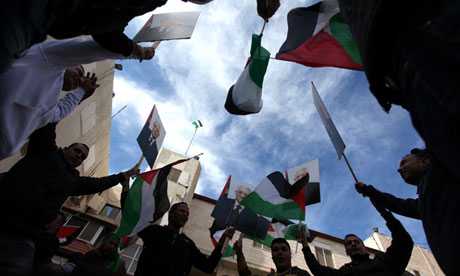
    Palestinians hold posters of President Mahmoud Abbas during a rally supporting the UN bid for observer state status, in the West Bank city of Ramallah. Photograph: APAimages/Rex Features

    Britain is prepared to back a key vote recognising Palestinian statehood at the United Nations if Mahmoud Abbas pledges not to pursue Israel for war crimes and to resume peace talks.

    Abbas, president of the Palestinian Authority, has called for Britain’s backing in part because of its historic responsibility for Palestine. The government has previously refused, citing strong US and Israeli objections and fears of long-term damage to prospects for negotiations.

    On Monday night, the government signalled it would change tack and vote yes if the Palestinians modified their application, which is to be debated by the UN general assembly in New York later this week. As a “non-member state”, Palestine would have the same status as the Vatican.

    Whitehall officials said the Palestinians were now being asked to refrain from applying for membership of the international criminal court or the international court of justice, which could both be used to pursue war crimes charges or other legal claims against Israel.

    Abbas is also being asked to commit to an immediate resumption of peace talks “without preconditions” with Israel. The third condition is that the general assembly’s resolution does not require the UN security council to follow suit.

    The US and Israel have both hinted at possible retaliation if the vote goes ahead. Congress could block payments to the Palestinian Authority and Israel might freeze tax revenues it transfers under the 1993 Oslo agreement or, worse, withdraw from the agreement altogether. It could also annex West Bank settlements. Britain’s position is that it wants to reduce the risk that such threats might be implemented and bolster Palestinian moderates.

    France has already signalled that it will vote yes on Thursday, and the long-awaited vote is certain to pass as 132 UN members have recognised the state of Palestine. Decisions by Germany, Spain and Britain are still pending and Palestinians would clearly prefer a united EU position as counterweight to the US.

    Willian Hague, the foreign secretary, discussed the issue on Monday with Abbas and the French foreign minister, Laurent Fabius, offiicals said.

    Palestinian sources said Hillary Clinton, the US secretary of state, raised the issue with Abbas at his Ramallah headquarters last week, shortly before a ceasefire was agreed in the Gaza Strip, as had Tony Blair, the Quartet envoy.

    Abbas has been widely seen to have been sidelined by his rivals in the Islamist movement Hamas, as well by his failure to win any concessions from Israel. Abbas, whose remit does not extend beyond the West Bank, hopes a strong yes vote will persuade Israel to return to talks after more than two years.

    Officals in Ramallah have opposed surrendering on the ICC issue so it can be used as a bargaining chip in future, but views are thought to be divided. Abbas said at the weekend: “We are going to the UN fully confident in our steps. We will have our rights because you are with us.”

    Leila Shaid, Palestine’s representative to the EU, said: “After everything that has happened in the Arab spring, Britain can’t pretend it is in favour of democracy in Libya, Syria and Egypt but accept the Palestinians continuing to live under occupation. As the former colonial power, Britain has a historic responsibility to Palestine. Britain is a very important country in the Middle East, it has extensive trade relations, and David Cameron should know he risks a popular backlash from Arab public opinion if he does not support us.”

    Palestinians have rejected the claim that they are acting unilaterally, calling the UN path “the ultimate expression of multilateralism”. Israel’s apparent opposition to unilateralism has not stopped it acting without agreement to build and expand settlements, they say.

    guardian.co.uk, 

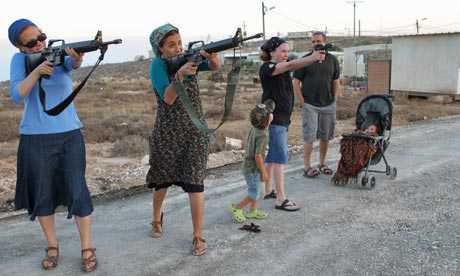
  • Jewish women settlers learn how to use guns

    Jewish women settlers learn how to use guns

    While the diplomats haggle, deadly tensions are mounting in the nascent Palestine

    The quest for Palestinian statehood at the UN has worsened a climate of fear on the ground in the West Bank

    Harriet Sherwood in Qusra

    Women at the Jewish settlement of Pnei Kedem practise firing pistols and high-powered rifles. Photograph: Nati Shohat/Flash90

    The settlers come down the hill from the outpost, mostly on foot, but occasionally on horseback or in tractors or 4x4s. They carry Israeli flags, and sometimes bring guns, shovels and dogs. There may be as few as three or as many as 40. They taunt the local villagers and sometimes attack them. Often the Israeli army arrives and trains its weapons on the villagers.

    In Qusra, deep among the terraced hills of the West Bank, fear is on the rise. “The settlers are provoking us continuously,” said Hani Abu Reidi, head of the village council. “They uproot olive trees, kill our sheep, burn our mosques and curse our prophet. They want to drag us into the sphere of violence. We do not want to go there.”

    As the Palestinian quest for statehood looks set to be mired in diplomatic back rooms for weeks or months, tension on the ground is mounting. Both Palestinian villagers and Jewish settlers say each other is responsible for a spike in attacks over the past fortnight; mostly small-scale incidents such as throwing stones, molotov cocktails and insults. Both sides claim the other is preparing to invade their communities and attack their people. It has created an edgy climate of fear and menace, and is a forewarning of potential battles to come if the struggle for the land moves up a gear with impending Palestinian statehood.

    The request by the Palestinians to be admitted to the United Nations as a full member state, formally submitted on Friday, will now be considered by the security council for an undefined period, during which efforts to get both sides back to the negotiating table will intensify.

    If no progress is made, the Palestinians will press for a vote at the security council, a move the US has pledged to veto. The Palestinians would then have the option of asking the 193-member general assembly for enhanced status, albeit short of full statehood. As this process inches forward, anger on the ground is rising.

    On Friday, violence between settlers from the outpost of Esh Kodesh and around 300 Qusra villagers ended in a haze of teargas and bullets fired at the villagers by Israeli troops, two of which struck Issam Odeh, 33, killing the father-of-eight.

    Qusra set up a defence committee earlier this month after one of the village’s four mosques was vandalised in a settler attack condemned by the US and the European Union. Up to 20 unarmed men patrol the mosques from 8pm to 6am every night, and Abu Reidi claims they have already foiled at least one attack. Other Palestinian villages have followed suit.

    On the hilltops, preparations for clashes have also been under way for weeks. Security around settlements and outposts has been reinforced with extra barbed wire, CCTV cameras, security guards and dogs. And the settlers themselves are armed and primed in anticipation of what they believe will be incursions by Palestinians intent on making their hoped-for state a reality on the ground.

    This week, photographs were published on a pro-settler news website,Arutz Sheva, showing women from Pnei Kedem, an outpost south of Bethlehem, learning to shoot. In Shimon Hatzadik, a Jewish enclave in the midst of the Palestinian neighbourhood of Sheikh Jarrah, in east Jerusalem, settlers are preparing to invoke a law allowing self-defence against intruders. “We are talking about shooting at their legs and if that doesn’t work, and our lives are in danger, we won’t be afraid to shoot straight at them. Most of the residents here are armed,” spokesman Yehonatan Yosef told parliamentarians two weeks ago.

    Activists in the settlement of Qiryat Arba, on the edge of Hebron, have distributed clubs, helmets and teargas to nearby outposts. “They’ve been given all of the tools we could provide for them in order to protect themselves,” Bentzi Gopstein, a member of Qiryat Arba’s council, told theYnet news website. “But we must remember that the best defence is offence. We can’t stay close to our fences. If the Arabs can come to us, they must learn we can come to them.”

    The settlers believe Israeli soldiers will be hampered by restraints imposed by commanders fearful of negative publicity. “They are not receiving the right orders,” said radical activist Itamar Ben-Gvir from Qiryat Arba. “There’s no state in the world that would allow the enemy to cross its lines and enter its communities. If the IDF will not act properly, we will have to defend ourselves.”

    Women and children would take part in defensive action, he said. “We want to present an equation: women against women; children against children. The Arabs are intending to use their children and we will not sit still.”

    Shaul Goldstein, mayor of the Gush Etzion settlement bloc south of Bethlehem, expects the focus in the coming weeks to “move from hypothetical issues in New York to practical terror here in Judaea and Samaria [the biblical term for the West Bank]”. Gush Etzion had a comparatively good relationship with its Palestinian neighbours, he said. “We are trying to talk to them to reduce friction and tension. But if the Palestinians march towards the settlements, there is a red line. If they try to cross, to penetrate our communities, it will be a big problem.”

    As well as fighting on the ground, many settlers believe they must also wage a political battle against the Israeli government. “Netanyahu is a weak leader, not standing for the values he was elected for,” said Goldstein. “The [settlement] construction freeze was the first in history – and this from a rightwinger. So we have to push him, to press him, to keep him to hold the line.”

    The settlers are not just fighting to hold on to the land they already occupy; they intend to expand and grow – as they see it, reclaiming the land that has been willed to them by God.

    “Our purpose is to build new towns and communities, new outposts in Judaea and Samaria,” said veteran activist Daniella Weiss. “It’s our role as Jews to build the land of the Jews.”

    In Qusra, Abu Reidi agreed the land is at the heart of confrontations between Jewish settlers and Palestinian villagers. “Their ultimate goal is to drive us from our land,” he said. “Defending the land is a holy task. If we let them succeed, they will take more and more.”

    www.guardian.co.uk, 24 September 2011

  • Israel Isolates Itself

    Israel Isolates Itself

    OP-ED COLUMNIST

    by Roger Cohen

    LONDON — Here’s what the United Nations report on Israel’s raid last year on the Turkish-flagged Mavi Marmara had to say about the killing of a 19-year-old U.S. citizen on board:

    “At least one of those killed, Furkan Dogan, was shot at extremely close range. Mr. Dogan sustained wounds to the face, back of the skull, back and left leg. That suggests he may already have been lying wounded when the fatal shot was delivered, as suggested by witness accounts to that effect.”

    The four-member panel, led by Sir Geoffrey Palmer, a former prime minister of New Zealand, appears with these words to raise the possibility of an execution or something close.

    Dogan, born in upstate New York, was an aspiring doctor. Little interested in politics, he’d won a lottery to travel on the Gaza-bound vessel. The report says of him and the other eight people killed that, “No evidence has been provided to establish that any of the deceased were armed with lethal weapons.”

    I met Dogan’s father, Ahmet, a professor at Erciyes University in Kayseri, last year in Ankara: His grief was as deep as his dismay at U.S. evasiveness. It’s hard to imagine any other circumstances in which the slaying in international waters, at point-blank range, of a U.S. citizen by forces of a foreign power would prompt such a singular American silence.

    Senior Turkish officials told me Prime Minister Recep Tayyip Erdogan had raised Dogan’s fate with President Obama. But of course no U.S. president, and certainly no first-term U.S. president, would say what Prime Minister David Cameron of Britain said: “The Israeli attack on the Gaza flotilla was completely unacceptable.” Even if there’s an American citizen killed, raising such questions about Israel is a political no-no. So it goes in the taboo-littered cul-de-sac of U.S. foreign policy toward Israel, a foreign policy that is in large measure a domestic policy.

    The Palmer report, leaked to The New York Times last week, is a split-the-difference document, with the Israeli and Turkish members of the panel including notes of dissent. My rough translation of its conclusion would be this message to Israel: You had the right to do it but what you did was way over the top and just plain dumb.

    It found that Israel’s naval blockade of Gaza is legal and appropriate — “a legitimate security measure” — given Hamas’s persistent firing of thousands of rockets from the territory into Israel; that the flotilla acted recklessly in trying to breach the blockade; that the motives of the flotillas organizers raised serious questions; and that the Israeli commandos faced “organized and violent resistance.”

    But it also called the raid — 72 nautical miles from land — “too heavy a response too quickly.” The flotilla, it says, was far from representing any immediate military threat to Israel. Clear prior warning should have been given. The decision to board “was excessive and unreasonable.” It criticizes Israel for providing “no adequate explanation” for the nine deaths or explaining “why force was used to the extent that it produced such high levels of injury.” The panel is left dismayed by Israel’s inability to give details on the killings. It calls Israel’s policy on land access to Gaza “unsustainable.”

    Overall, the panel finds that Israel should issue “an appropriate statement of regret” and “make payment for the benefit of the deceased and injured victims and their families.”

    Yes, Israel, increasingly isolated, should do just that. An apology is the right course and the smart course. What’s good for Egypt — an apology over lost lives — is good for Turkey, too.

    Israel and Turkey have been talking for more than a year. Feridun Sinirlioglu, a senior Turkish foreign ministry official, has met with numerous Israeli officials. At times agreement has been close. Ehud Barak and Dan Meridor, Israel’s defense and intelligence ministers, have argued the case for an apology; Foreign Minister Avigdor Lieberman has led the hawks saying Israel never bends; Prime Minister Benjamin Netanyahu has had his finger to the wind. In the end, Lieberman and the far right have won, as they tend to with this abject Israeli government.

    “It’s a typical case where coalition considerations trumped strategic thinking, and that’s the tragedy,” Shlomo Avineri, an Israeli political scientist, told me. “Given the Palestinian issue at the U.N., and relations with the new Egypt, we could use strategic wisdom.”

    That’s right. Instead, locked in its siege mentality, led by the nose by Lieberman and his ilk — unable to grasp the change in the Middle East driven by the Arab demand for dignity and freedom, inflexible on expanding settlements, ignoring U.S. prodding that it apologize — Israel is losing one of its best friends in the Muslim world, Turkey. The expulsion last week of the Israeli ambassador was a debacle foretold.

    Israeli society, as it has shown through civic protest, deserves much better.

    “We need not apologize,” Netanyahu thundered Sunday — and repeated the phrase three times. He’s opted for a needless road to an isolation that weakens Israel and undermines the strategic interests of its closest ally, the United States. Not that I expect Obama to raise his voice about this any more than he has over Dogan.

    www.nytimes.com, September 5, 2011

  • Israeli army arms Jewish settlers in preparation for Palestinian unrest

    Israeli army arms Jewish settlers in preparation for Palestinian unrest

    Jewish settlers across the West Bank are being armed and trained by the Israeli military in anticipation of unrest and violence leading up to a Palestinian demand for statehood at the United Nations in three weeks.

    On Monday morning, a Palestinian man from Nablus drove a stolen taxi into a police blockade outside a Tel Aviv nightclub before stabbing several onlookers Photo: AP

    Phoebe Greenwood in Tel Aviv

    The Israeli Defence Force fears that demonstrations ahead of the UN debate on September 20 will bring violent confrontations between Palestinians and Israeli settlers living illegally in settlements across territory occupied by Israel.

    Leaked documents have outlined Israeli plans to arm security guards working on the Jewish settlements with riot gear, including tear gas and stun grenades.

    In a statement issued on Tuesday, an Israeli army spokesperson confirmed that the military is training “community leadership and security personnel throughout Judea and Samaria” but refused to comment on whether they were also being provided with additional arms.

    An Israeli security source told the Daily Telegraph: “These security officers are employed by the Ministry of Defence and have to be able respond to any security threat, like the murders in Itamar. It would be irresponsible if we did not prepare them for every eventuality.”

    In March this year, five members of the Jewish Fogel family were killed while they slept in their home in the West Bank’s Itamar settlement by two Palestinian teenagers from a neighbouring village.

    Mata Vilnai, the Israeli home affairs minister announced on Tuesday that a terror cell based in the Sinai Peninsula is preparing to carry out a series of attacks in Israel over the coming weeks.

    On Monday morning, a Palestinian man from Nablus drove a stolen taxi into a police blockade outside a Tel Aviv nightclub before stabbing several onlookers. Eight people, including several teenagers, were injured.

    Gill Kosover, who owns a car workshop outside where the attack took place, said Israelis are braced for more violence.

    “This is nothing,” he said. “This will happen more and more as we head towards September. This is just the beginning. Things are starting to boil here.”

    But Palestinians are also victims of the growing communal violence in the West Bank.

    B’Tselem, the Israeli human rights agency, has reported 42 cases of Jewish settler violence for police investigation since the beginning of 2011, including the murder of two Palestinian teenagers.

    Chris Gunness, a spokesman for the UN Relief and Works Agency for Palestine Refugees, accused Israeli soldiers of turning a blind eye to settler assaults on Palestinians: “The close relationship between the IDF and the illegal settlement project in the West Bank is confirmed by the many reports we see of the most violent settlers forcing Palestinians of their ancestral land under the noses of the IDF, sometimes with their protection if not connivance,” he said.

    www.telegraph.co.uk, 30 Aug 2011

  • U.S. Group Stirs Debate on Being ‘Pro-Israel’

    U.S. Group Stirs Debate on Being ‘Pro-Israel’

    By ETHAN BRONNER


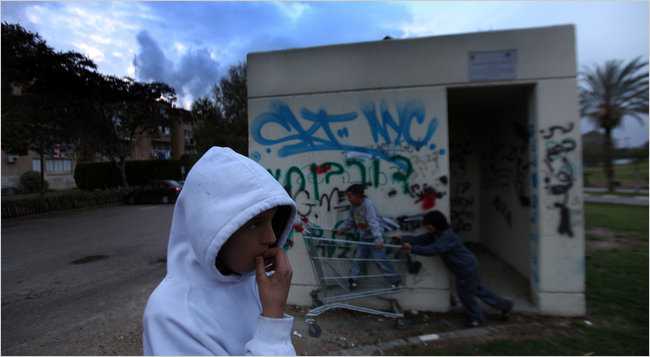
    Rina Castelnuovo for The New York Times – A fortified shelter in Sderot, Israel. Israelis are feeling increasingly insecure about any criticism they believe could help enemies.

    JERUSALEM — On one side were members of the Israeli Parliament and advocates who argued that there was only one legitimate way to support Israel from abroad — unconditionally. On the other were those who insisted that love and devotion did not mean withholding criticism.

    For an electric two hours on Wednesday, the sides fought bitterly inside a parliamentary hearing room. As they spoke, tensions on the Gaza border rose and turmoil spread across the Middle East; hours later a bomb went off in Jerusalem, killing one person and wounding dozens. Israelis are feeling increasingly insecure about any criticism they believe could help their enemies.

    At the center of the parliamentary debate was a three-year-old American advocacy group, J Street, which calls itself pro-Israel and pro-peace, a left-leaning alternative to the American Israel Public Affairs Committee, or Aipac, the pro-Israel lobbying group in the United States. J Street opposes Israeli settlements in the West Bank and urged President Obama not to veto an antisettlement resolution in the United Nations Security Council recently.

    The conveners of Wednesday’s hearing, a hawkish Likud legislator named Danny Danon and a conservative colleague from the centrist Kadima party, Otniel Schneller, wanted to expose J Street for what they believed it to be — a group of self-doubting American Jews more worried about what their neighbors say than what is good for the state of Israel.

    “This is a dispute between those who care what non-Jews will say and those who believe in being a light unto nations, between the mentality of exile and that of redemption,” Mr. Schneller said. “J Street is not a Zionist organization. It offers love with strings attached. They say, ‘We love you only if you behave the way we like.’ ”

    Jeremy Ben-Ami, J Street’s founder, came from Washington to defend his group, which claims about 170,000 supporters.

    “We should work through our differences with respect, vibrant discussion and open dialogue,” he told the legislators. “It only weakens Israel and the Jewish people to make differences of opinion into something greater and to accuse those who criticize Israeli policy of being anti-Israel or worse.”

    The committee meeting, which drew a crowd and often descended into shouting matches, was unprecedented, according to many Israelis. No one could recall a debate inside Israel’s Parliament examining whether an American group calling itself pro-Israel was living up to the name.

    But another parliamentary committee hearing is planned on a similar topic — whether the foreign news media are covering Israel fairly. The focus of that debate will be a comparison of news media coverage of the recent killings of five members of a settler family with the coverage of the Israeli takeover last year of a Gaza-bound flotilla in which nine activists were killed by commandos.

    Both hearings are part of a larger trend in this year’s Parliament — a turn rightward. Two laws passed this week have been widely condemned by civil liberty groups and advocates on the left. The first is known as “the Nakba bill,” in reference to the Arabic word for “catastrophe” commonly used by Arabs to describe the birth of Israel in 1948. Arabs who are Israeli citizens often commemorate Israeli independence by noting their losses — the destruction of hundreds of villages and the exile of hundreds of thousands of Palestinians.

    The new law allows the Finance Ministry to remove funds from municipalities or groups if they commemorate Independence Day here as a day of mourning or reject Israel as a Jewish and democratic state. The original bill, which produced much alarm and was altered, would have imposed prison sentences.

    The second new law that has drawn criticism from the left establishes admissions committees for small communities in the Negev and Galilee, areas with large Arab populations. The new law says that communities with 400 or fewer families may set up committees to screen potential residents for whether they fit in socially. At the last minute, a rider was added barring discrimination based on race, gender or nationality, but critics contend it will still serve to keep Arabs out of Jewish communities.

    It is precisely such developments in Israel that J Street leaders say are driving many American Jews, especially younger ones, from devotion to Israel. Therefore, they say, J Street has a vital role in advocating its views here and in bridging the gap between liberal American Jews and an increasingly nationalistic Israeli society.

    David Gilo, who is the chairman of J Street, said in the hearing that the contract that had long existed between Israel and Jews abroad — one of unconditional support — was expiring and a new one was being drafted. He argued that the new contract was good not only for those abroad but for Israel as well, since it would bring into the fold those who would otherwise be alienated. “The new contract cannot be based on unilateral dictation of what is right, who is right and who is wrong,” he said. “Only agreement on common values and a genuine attempt to understand where each party comes from can reinstate an Israeli-American Jewish partnership.”

    Nachman Shai, a member of Parliament from Kadima, said at the hearing that J Street represented an important part of American Jewry, and that Israel should not turn a blind eye to it.

    Shlomo Avineri, a political scientist at Hebrew University who did not attend the hearing, said J Street was in a problematic position because “it is very difficult to be an advocacy group while criticizing the subject of your advocacy. It is difficult to say we are the greatest supporters of Israel but on every issue that arises we are on the other side.”

    He added that the extreme right in Israel had always insisted that criticism of Israeli policy was unpatriotic. Now, the extreme right has more power than ever in the country’s history, he said, giving its views a greater platform.

    Mr. Danon, the Likud chairman of the committee holding the hearing, said he would put to a vote in the coming two weeks a resolution calling J Street pro-Palestinian, asking it to “purge from its ranks” anti-Zionist elements and urging Israeli government officials to refrain from contact with it.

    Prime Minister Benjamin Netanyahu has consistently refused to meet with J Street officials.

    Mr. Ben-Ami of J Street said afterward: “This is a time of real uncertainty and threat in Israel, and what we saw at the hearing is part of a larger trend of Israel turning in on itself. It is redefining who is a Jew, redefining who is a citizen and now redefining who is a friend.”

    www.nytimes.com, 24 March 2011

    More on J Street: