Tag: Energy

  • The Great Pipeline Opera

    The Great Pipeline Opera

    Inside the European pipeline fantasy that became a real-life gas war with Russia.

    www.foreignpolicy.com
    August 24, 2009

    BY DANIEL FREIFELD
    Daniel Freifeld is director of international programs at New York University’s Center on Law and Security.

    When Joschka Fischer’s lucrative new job as the “political communications advisor” to a consortium of European energy companies was leaked to a German business publication this summer, there was one comment that stood out. “Welcome to the club,” said Gerhard Schröder, an even more highly paid advocate for the other side in Europe’s increasingly politicized energy war.

    Schröder’s remark was short, snide — and very much to the point. For eight years, the two men had led Germany together, with Schröder ruling as its center-left chancellor and Fischer as his foreign minister. Their long-running partnership had survived a particularly complicated era in post-Cold War Europe, and publicly Fischer had always been supportive, even telling Der Spiegel that Schröder “will go down in the history books as a great chancellor.”

    But since their coalition government collapsed in 2005, Schröder’s controversial work has led to an ever-more-public breach between the former allies. Less than one month before leaving the chancellorship, Schröder used his office to guarantee a $1.4 billion loan (later turned down) for a Kremlin-backed natural gas pipeline that would connect Russia to Germany via the Baltic seabed. Then, just days after stepping down, Schröder accepted a senior post with the pipeline consortium run by Russia’s state gas monopoly Gazprom. The deal was a huge scandal inside Germany, where Schröder had already been known for years as Genosse der Bosse — “comrade of the bosses.”

    The chancellor’s move to the Kremlin energy payroll inspired a wave of alarm in Europe over its potentially dangerous dependence on Russia for natural gas. Moscow supplies about a third of the European Union’s gas — Europe’s preferred heating source — and some of its countries are 100 percent dependent on Russia. What’s more, Europe’s annual gas consumption is set to rise 40 percent by 2030, further stoking those fears about Russia. Several times in recent years, the Kremlin has abruptly cut off gas deliveries after disputes with key transit countries such as Ukraine, leaving millions of Europeans shivering in the winter cold.

    Schröder had been reliably pro-Russia while in office, even famously calling the KGB-spy-turned-president Vladimir Putin a “flawless democrat.” Although Fischer did not criticize his boss publicly at the time, more recently he has been openly dismissive. Schröder’s idea of Putin as a democrat, Fischer told the Wall Street Journal, “was never my position.” Asked later by Der Spiegel what he found “most objectionable” about Schröder’s tenure, Fischer replied succinctly: “His position on Russia.”

    This summer, Fischer made the breach with Schröder official: He signed up with a rival consortium — energy companies from Turkey, Bulgaria, Romania, Hungary, and Austria that have joined together to build the $11 billion Nabucco natural gas pipeline. Nabucco would bring gas from Middle Eastern and Caspian fields across Turkey’s Anatolian plateau, and north into Europe. The pipeline is backed and partly funded by the EU and is strongly supported by the United States. Perhaps most importantly, Nabucco would completely bypass Russia. Such an energy strategy, Fischer has argued, is urgently needed to stop Moscow’s “divide-and-conquer politics.”

    Moscow, not surprisingly, is pulling out all the stops to scuttle the project. It is seducing pliant politicians and resorting to old-fashioned bullying, especially in the states that Nabucco transits. It is acquiring stakes in European energy companies, often through questionable shell companies, that could complicate Nabucco’s completion. It is buying up natural gas in Central Asia and the Caspian, even paying up to four times more than in previous years, to deny supplies to Nabucco. And it has proposed a rival pipeline, called South Stream, which would flow from Russia across the Black Sea to Bulgaria and the Balkans and fork, with one spur running west to Italy and the other north to Austria.

    In many ways, Schröder and Fischer personify the intense struggle — some call it a war — over Europe’s energy future. On one side are those countries most worried about their dependence on Moscow, especially the former communist countries of Central and Eastern Europe. On the other are countries such as Italy and Germany and leaders such as Schröder, who see closer ties with Russia as both a mercantilist opportunity and a strategic imperative. When I caught up with Schröder at a conference in Houston earlier this year, he was quick to brush aside concerns about Moscow. “There is no reason to doubt the reliability of Russia as a partner,” Schröder said. “We must be a partner of Russia if we want to share in the vast raw material reserves in Siberia. The alternative for Russia would be to share these reserves with China.”

    This gas war is especially hard-fought because of the physical nature of the prize itself. Unlike oil, which can be put onto tankers and shipped anywhere, gas is generally moved in pipelines that traverse, and are thus tethered to, geography. Because a pipeline cannot be rerouted, producers and consumers sign long-term agreements that bind one to the politics of the other, as well as to the transit states in between. In this way, today’s gas war is a zero-sum conflict similar to the scramble for resources that divided Eurasia in the 19th century. And now, as then, commerce is taking a back seat to politics.

    That is what I found when I set out this spring to travel the pipeline routes, encountering along the way a rogue’s gallery of cynical politicians, murky middlemen, insistent executives, and innumerable technocrats, each eager to shape the decision. But the real question that will determine Nabucco’s future — a question vividly on display in every country the pipeline will touch — is whether Europe has the stomach to fight as hard for its interests as Russia does for its own.

    One evening in 2002 in Vienna, a small group of Austrian energy executives took their colleagues from Turkish, Hungarian, Bulgarian, and Romanian firms to see a rarely performed Verdi opera. It recounted the plight of Jews expelled from Mesopotamia by King Nebuchadnezzar. The officials had spent the day sketching out a plan for a 2,050-mile pipeline that could transport up to 1.1 trillion cubic feet of natural gas every year across their countries and into European markets. The sources of this gas would not be Russia, but Azerbaijan, maybe Iran one day, and with a U.S.-led war against Saddam Hussein looking increasingly likely, possibly the gas fields of northern Iraq. The opera they attended that night was called Nabucco, and that is the name they gave their pipeline.

    The original impetus for the project was just business: The Turks and Austrians saw it as a way to get new supplies of gas from the Caspian and Middle East — not to mention lucrative transit fees for moving it across their territories into Europe. But politics soon entered into it, as Nabucco won early moral support from Russia skeptics in Central and Eastern Europe. They saw the pipeline as a historic opportunity to build a new lifeline to the West while weakening Russia’s grip on them. Many worried, as former Estonian Prime Minister Mart Laar wrote, that “Russian leaders regard their energy assets as tools of foreign-policy leverage and envisage a future in which resource competition may be resolved by military means.” The main energy firms in Bulgaria, Romania, and Hungary — all countries that would host Nabucco — signed on to help build the pipeline.

    The big powers of Western Europe, however, were less dependent on Russian gas and far less willing to antagonize Moscow by bringing non-Russian gas into Europe through former Soviet satellites. Italy, under Silvio Berlusconi, and Germany, under both Schröder and his successor Angela Merkel, dragged their feet on Nabucco. France, with its nicely diversified supply of energy, had little appetite for changing the status quo. Together, these countries blocked any effort within the European Union to allocate funding for Nabucco or even make support for the pipeline a common policy. This resistance infuriated the European Union’s newest members, and it still rankles. “The EU role has been weak,” Mihaly Bayer, Hungary’s special representative for Nabucco, told me. “The EU coordinator for Nabucco, Jozias van Aartsen, simultaneously serves as the mayor of The Hague!” Bayer thundered when we talked in his Budapest office. “When I assumed my post, I sent him multiple letters offering my assistance. I even spent two days in The Hague trying to meet with him. He ignored me.”

    This east-west deadlock held until 2006, when events started to push in Nabucco’s favor. The reason had everything to do with Ukraine, which has clashed repeatedly with Russia in recent years.

    Eighty percent of natural gas from Russia travels to Europe through Ukraine, across an energy infrastructure built by the Soviet Union after the 1956 Hungarian uprising. The main pipelines converge in Ukraine before fanning out into Eastern Europe, and were key to the Kremlin’s strategy of controlling its Warsaw Pact satellites. The route went through Ukraine because Soviet planners never imagined a day when Ukraine would not be ruled by Moscow. But when that day did arrive, on Aug. 24, 1991, Russia’s hold on Ukraine did not end. It just grew more complex, and gas remained a central means of control.

    How this unfolded was explained to me in Kiev by Bohden Sokolovsky, an energy advisor to Ukrainian President Viktor Yushchenko, over a breakfast of vodka, blintzes, and cigarettes. It all came down to two things, Sokolovsky said, “Otkat and deriban” — roughly translated, kickbacks and theft. As Soviet assets and state-run energy companies were privatized in Ukraine in the 1990s, apparatchiks and businessmen on both sides of the border concocted elaborate schemes to get in on the action. They manipulated prices and parceled out kickbacks. The deals were “obviously corrupt,” recalled a senior advisor to former Ukrainian President Leonid Kuchma. “But it was a great deal for Ukraine.”

    Many Europeans disliked their dependence on Ukraine. “The very basis of the gas business in Ukraine is graft,” Vaclav Bartuska, the Czech Republic’s ambassador at large for energy security, told me. But the desire to do something about it only really materialized with the gas disputes that broke out between Ukraine and Russia after the 2004 Orange Revolution. Ukrainian protesters had just successfully contested an election marred by fraud and voter intimidation, ultimately preventing the Kremlin-favored candidate from taking power. Soon after, the new president, Yushchenko, sought to steer Ukraine into a Euro-Atlantic orbit. This was a direct threat to Russia’s influence over its main point of entry into European gas markets. So Putin countered that if Ukraine wanted to be a Western country, it would have to pay the far higher Western price for gas. When Kiev refused to pay those higher prices in the winter of 2006, Moscow shut off gas shipments to its neighbor for four days, denying fuel to millions of other Europeans as well.

    “It wasn’t until the 2006 gas crisis that the rest of Europe actually started to care about what was going on in Ukraine,” recalled Bartuska, who mediated yet another dispute between Russia and Ukraine this January. Many more Europeans began to view Russia not as a reliable supplier of gas but as an aggressive petrostate that privileged its political organizations over its commercial obligations.

    Almost overnight, support for Nabucco grew dramatically throughout Europe. But the gas shut-offs also added new impetus to Nabucco’s Russian-backed rival, South Stream. Whereas Nabucco’s supporters saw warning signs in Ukraine about Russian aggression, others saw a corrupt, untrustworthy transit state disrupting Russia’s reliable supply of gas. As Dmitry Rogozin, Russia’s ambassador to NATO, put it: “It’s clear that if Europe wants to have guaranteed natural gas supplies, as well as oil in its pipelines, then it cannot fully rely on its wonderful ally, Mr. Yushchenko.” The Italian energy company Eni led the way, signing on to South Stream in 2007.

    And then, of course, there is Germany, where Gerhard Schröder is hardly Russia’s only friend. At the same Houston conference where I saw Schröder, I attended a small breakfast for energy company officials and experts. At the first mention of transit security, Reinier Zwitserloot, a spry German of about 60, shot up and shouted, “The most reliable transit state is the Baltic!” He went on: “As far as I am concerned, Nabucco is nothing but an opera!” I later learned that Zwitserloot had recently been awarded the Order of Friendship of the Russian Federation, Moscow’s highest honor for non-Russian citizens.

    In this opera, Turkey has been cast in one of the leading roles. With its indispensable geographic position between the oil and gas reserves of Iraq, Iran, and the Caspian, it is an absolute certainty that Turkey will host major pipelines sooner or later. If Nabucco succeeds, Turkey could be the biggest winner, both economically and geopolitically — a fact not lost on Russia or Europe. Or Turkey.

    Until the gas wars began, Turkey had a weak hand: It had been rebuffed for EU membership and depended on Russia for a majority of its natural gas. But now, with the country’s gas demand skyrocketing and Turkish supply contracts with Russia set to expire, Turkey has not been shy in reminding Europe that it has options. “What is important is to gain natural gas,” said Taner Yildiz, Turkey’s minister of energy. But doing it through Nabucco, he added, “is not obligatory.” Turkey’s ambassador to the United States has pointedly called the EU “the biggest impediment to progress on Nabucco’s development.”

    When I sat down in late April with Cuneyd Zapsu, a founding member of Turkey’s ruling Justice and Development Party and a longtime counselor to Prime Minister Recep Tayyip Erdogan, he was openly frustrated with Europe’s wavering about the pipeline. “Turkey has been ready to sign the deal,” he told me. “But every time the consortium agrees, [our Nabucco partners] throw a new term in.”

    Zapsu understands Turkey’s delicate but fortuitous position. “Everyone is trying to make Turkey the enemy,” he said. But shifting his gaze out the window and down onto the Bosporus where Europe and Asia meet, Zapsu just smiled. “Everyone loves us.”

    The mood is less one of love than of fear in several other countries where Nabucco would run, as Russia has aggressively stepped up its efforts to block the pipeline. Next door to Turkey in Bulgaria — the poorest member of the EU and a transit state for both the Nabucco and South Stream pipelines — Ognyan Minchev, head of the Institute for Regional and International Studies, told me how Moscow threatened the Bulgarians in 2006. Scrap an agreement with Gazprom and sign a new contract with higher prices for Russia and lower transit fees for Bulgaria, they were told, or else the gas would be cut off. “The Bulgarian government is obedient to Russia,” Minchev said. “Bulgaria has put the entire energy system in Russian hands.”

    Further along the Nabucco route, in Hungary, Laszlo Varro has similar fears. At dawn one day in April, the tall Hungarian led his small dog around a hilltop park overlooking Budapest, recounting how the Russian energy giant Surgutneftegaz had recently acquired a decisive stake in the Hungarian energy firm MOL, where Varro is head of strategy. “It is one of the least transparent energy companies — in Russia,” he said. Varro’s concern, he explained, is that no one really knows who is behind Surgutneftegaz — or rather, he quickly added, that “everyone knows who is behind the company since no one knows.” Others in Hungary suspect the same, and one major newspaper spelled it out in a recent headline: “Mr. Putin, Declare Yourself.”

    Surgutneftegaz is run by Vladimir Bogdanov, an oligarch who managed Putin’s 2000 presidential campaign in western Siberia. The secretive Surgutneftegaz has offered almost twice the market value for its shares in MOL. Varro and others see a sinister reason for this seemingly illogical behavior: MOL is a Nabucco consortium member, and by buying this stake, Surgutneftegaz can cut off funding for the pipeline and cripple it in Hungary.

    Russian firms are making similar acquisitions in Austria, which is the proposed end of the road for both Nabucco and South Stream. Centrex Europe Energy & Gas, an opaque gas trading firm with ties to Gazprom, makes its money buying cheap gas from Russia and reselling it for profit in Austria. The German magazine Stern recently traced Centrex’s profits back to a company registered to a phony address at a drab Soviet-style housing block in Russia. And yet, Centrex recently entered into a partnership with Gazprom Germania to take a 20 percent stake in Austria’s Baumgarten trading platform and storage facilities, where the two rival pipelines will literally terminate. Considering that Gazprom already holds a 30 percent share in Baumgarten, this means that Russia’s state-run energy company now controls half of the most important gas storage and distribution system in central Europe — and the future terminus of Eurasia’s competing southern pipelines.

    Not every country in Europe is so concerned about Russia, however. In Serbia, I was installed at the far end of a conference table opposite Mrakic Dusan, the state secretary for energy and mines. After an initial back and forth, Dusan interrupted me. “Where are the hard questions?” he demanded. So I asked him if Serbia is inviting unacceptable risks by signing a partnership with Gazprom. “We have a great contract with Russia,” Dusan insisted. I asked him if he worries that Gazprom has an unsound financial and strategic position. “After 2030, only Russia, Qatar, Iran, and Turkmenistan will still have gas. With Russia in control, this ‘gas-OPEC’ will control world supplies.” Dusan rubbed his chin as he spoke, revealing a large fancy watch. I asked where he got it. Smirking, he responded before the translator could finish.

    “Putin.”

    For the last few years, veteran U.S. diplomat Steven Mann, the State Department’s coordinator for Eurasian energy diplomacy, watched as Americans and Europeans struggled to turn Nabucco from grandiose idea to gas-delivering reality. But when he finally left the job earlier this year, he told author Steve LeVine to beware “Nabucco hucksterism” — a condition he defined as occurring when political enthusiasm for an energy deal gets out too far ahead of its commerical viability. “There have been quite a number of officials who know very little about energy who have been charging into the pipeline debate,” Mann told LeVine. “Nabucco is a highly desirable project, don’t get me wrong. But there are other highly desirable projects besides Nabucco,” he added. “And the overriding question for all these projects is, Where’s the gas?”

    For Nabucco to be initially viable, most energy experts agree, the gas will need to come from the former Soviet state of Azerbaijan — 283 billion cubic feet of gas per year, to be precise, roughly 25 percent of the pipeline’s capacity. Indeed, without Azerbaijan and its major natural gas supplies, Nabucco is a non-starter.

    Russia knows this too, so it has been doing everything in its power to deny Nabucco gas from Azerbaijan, buying it to replenish Russia’s declining production. In April, Russian President Dmitry Medvedev hosted Azeri President Ilham Aliyev in Moscow to discuss Russian purchases of Azerbaijan’s gas. And then in June, they inked an agreement in which Azerbaijan promised to sell Russia up to 500 million cubic feet of gas — at well over market rate — from its offshore gas field, Shah Deniz.

    If there were still any doubt about how far Russia would go to fight for its interests in the Caucasus, Azerbaijan need only look at Georgia, which is still reeling from Russia’s invasion last summer. It is the key transit state between Azerbaijan and Turkey, hosting two pipelines that bring oil and gas from the Caspian to Turkey. By attacking its small neighbor, Russia effectively warned not only Georgia but the whole neighborhood.

    But in recent months, Nabucco’s European supporters have started to get their acts together, and Azerbaijan has begun to take notice of that, too. In May, the EU signed a deal of its own with Azerbaijan, which committed to building energy and trade links directly with Europe. This was arguably a more valuable agreement than the one Azerbaijan later signed with Gazprom, which offered not money but only vague pledges that may or may not be met.

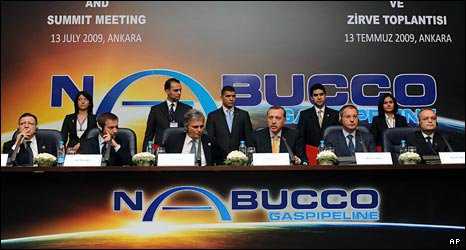
    Then, on July 13, beneath the crystal chandeliers of an Ankara hotel ballroom, the prime ministers of Turkey, Bulgaria, Romania, Hungary, and Austria signed a Nabucco treaty describing exactly how the pipeline would operate and how tariffs would be calculated. Several days after the announcement that Nabucco had hired Joschka Fischer, who is beloved by many in Turkey for his passionate support for its EU membership, Turkey had dropped a major demand that it had insisted on for months, and the path to the deal was cleared. This was a major breakthrough, and it led Natig Aliyev, Azerbaijan’s energy minister, to remark: “I am sure that the project will be realized successfully.” When that day comes, Azerbaijan will enjoy both higher prices for its gas and a lifeline to the West.

    Also in attendance in Ankara was Iraqi Prime Minister Nuri al-Maliki, whose country looks increasingly likely to play a large role in supplying Nabucco — possibly larger than that of Azerbaijan. By some estimates, Iraq could provide more than 500 billion cubic feet of natural gas per year by 2014, when Nabucco is expected to be up and running. All of the major players — Arab Iraqis, Kurdish Iraqis, and the Turks next door — want to see Iraqi gas heading north through Turkey and into Europe. Recently, a Hungarian and an Austrian energy firm, both Nabucco consortium members, made deals to take 10 percent apiece in the $8 billion Pearl Petroleum gas project in Iraqi Kurdistan. It now seems distinctly possible that a pipeline named after Nebuchadnezzar, the ancient ruler of Babylon, might ultimately owe its success to Iraq.

    When Gerhard Schröder signed on with Gazprom in 2005, the smart money in the gas war was on Moscow. Now that picture is changing, if slightly. There is a sense that the Kremlin overplayed its hand both in the gas shut-offs to Ukraine and in the Georgia war last summer. Indeed, U.S. Vice President Joe Biden recently echoed this view of Russia’s energy power play. “[Russia’s] actions relative to essentially blackmailing a country and a continent on natural gas, what did it produce?” he pointed out. “You’ve now got an agreement [Nabucco] that no one thought they could have.” At the same time, the global recession has hit Russia particularly hard, and Gazprom’s profits fell 84 percent in the fourth quarter of 2008, making it Russia’s biggest debtor, rather than the world’s biggest company, as it once bragged it would become.

    And Nabucco’s European supporters finally seem to be taking their own side in this fight. They now have a heavyweight rainmaker in Fischer, who is going toe to toe with his old boss Schröder in the struggle for influence in the path of the pipelines. The recent EU agreement with Azerbaijan and the fanfare-laden treaty signing in Turkey are contributing to the sense that Europe is leveling the playing field with Russia. “We have started to confound the skeptics, the unbelievers,” European Commission President José Manuel Barroso said in July. “Now that we have an agreement, I believe that this pipeline is inevitable rather than just probable.”

    And yet, if recent experience teaches anything, it is not to count Russia out, especially when so much is at stake. When I raised this issue with Russian Energy Minster Sergei Shmatko at a meeting in Bulgaria in April, he shot me a threatening glare and cautioned against planning for an energy future without Russia, unless the Europeans were fully prepared to deliver it. “We have an expression in Russia,” Shmatko told me. “Don’t sell the skin off a bear before you kill it.”
  • Turkey bumps Ukraine as transit nation?

    Turkey bumps Ukraine as transit nation?

    ANKARA, Turkey, Aug. 17 (UPI) — An energy agreement between Moscow and Ankara puts Turkey above Ukraine as the top transit nation for Europe, an analyst says.

    Russian Prime Minister Vladimir Putin emerged from an Aug. 6 meeting in Ankara with a document that secured Turkish approval for the construction of the South Stream natural gas pipeline in its territorial waters in the Black Sea.

    South Stream would travel from the Russian port city of Novorossiysk to Varna, Bulgaria, and on to Italy and Austria through the Balkans. It would expand the gas pipeline network in Europe, adding diversity to a market dependent on transit nations.

    Jeffrey Mankoff, an adjunct fellow of Russian studies at Yale University, told Turkish daily Today’s Zaman that Putin’s visit was meant to find a viable alternative to Ukrainian transit options.

    A January row between Kiev and Moscow over gas debts and contracts resulted in regional gas disruptions as 80 percent of all Russian gas bound for Europe travels through Soviet-era pipelines in Ukraine.

    “Given the problems between Moscow and Kiev, Russia’s position toward the Europeans carries the purpose of finding a way to not have to rely on Ukraine as a transit country, hence Russia’s agreement with Turkey,” he said.

    South Stream will carry as much as 35 percent of the Russian gas for Europe. Prior to the Ankara agreement, Moscow had considered building South Stream through Ukrainian waters.

    Mankoff says that now, however, the Turkish concessions “would reduce Ukraine’s ability to disrupt the transit of Russian gas, though Kiev could still cut gas through the onshore pipelines, which are much larger than South Stream is planned to be.”

  • The call of the pipes: Putin in Turkey

    The call of the pipes: Putin in Turkey

    15:48 07/08/2009

    MOSCOW. (RIA Novosti political commentator Andrei Fedyashin) – Things are now so mixed up in the pipe and gas business that it is difficult to see where pipes begin and politics ends.

    Vladimir Putin’s one-day visit to Ankara was balanced on precisely such pipe and politics considerations. Plus the peaceful atom: Russia will now be building for Turkey its first nuclear power plant near Akkuyu on the Mediterranean coast.

    To judge from the scale and trend of the documents signed, Ankara will soon turn into a huge energy-handling hub between Russia and the European Union in the southern sector. Now in the north we have Germany and Nord Stream, and in the south, Turkey and South Stream. Two friendships, Nordic and Ottoman.

    Turkey has long been a regional heavyweight, and Porte’s added “gas weight” will only strengthen it in this role. In recent years Ankara has been increasingly urging Russia to join in a regional forum it conceived for solving crucial Caucasian issues.

    The Caucasus war greatly puzzled Ankara, which has close economic ties both with Georgia and Russia. As a NATO country, Turkey “quietly” supported Georgia, to which it sent its military instructors and is now supplying equipment. But Turkey does not want to lose, let alone reduce or weaken, its ties with Russia either, especially in the current hard economic times. After all, Moscow satisfies 64% of Turkey’s requirements in gas, and can deliver even more.

    If that is not enough, let us bear in mind that more than one million Russians visit Mediterranean Turkish resorts every year, leaving more than $1.42 billion there. Moscow is Turkey’s top foreign economic partner – last year Turkey’s trade with Russia totaled $38 billion. In the next four years, Ankara hopes to bring the figure to $100 billion. One should not mess about with such things.

    By offering itself as a regional platform for settling Russia’s “Caucasian problems,” Ankara is perfectly aware that the Kremlin will not conduct parleys with Mikheil Saakashvili.

    But the Turks, offering their mediating services, very much hope to get Russia’s help in an area where such help cannot be dispensed with: That is a settlement in Nagorny Karabakh and normalization of relations with Armenia. In its turn, this means the involvement of Azerbaijan, which Turkey is also proposing to include, “on the kinship principle,” in the membership of the Caucasian regional forum. Unless the Nagorny Karabakh issue is settled, Turkey will be unable to normalize its relations with Armenia.

    Turkey is being prodded in the same direction by the European Union, or rather Turkey’s hope for admission to the EU (one of Brussels’ conditions is settlement of relations with Armenia), and its own regional economic interests. But the way to a Turkish-Armenian diplomatic thaw is blocked by Azerbaijan, which has long staked out its claim: It will not welcome Turkish diplomatic overtures to Armenia as long as the Nagorny Karabakh issue remains unsolved.

    Only Russia, and this is something everyone realizes, can push Armenia to a softer stance on Nagorny Karabakh. True, Russia will never nudge Armenia to surrender all its interests in Nagorny Karabakh, implying its return to Azerbaijan with broad autonomy rights. That is especially true in the wake of recognizing Abkhazia’s and South Ossetia’s independence. So, whether we like it or not, our friendship will only thrive on gas, oil and the peaceful atom.

    South Stream will make Russia and its customers less dependent on transit countries, in particular, Ukraine, because Turkey will not be a transit country technically. In 2013, the pipe will transport 63 billion cubic meters of gas. Investments in the project are estimated at 25 billion euros. Contractors are Russia’s Gazprom and Italy’s ENI, acting on a parity basis. In fact, South Stream’s inauguration ceremony was an affair for three: Italian Prime Minister Silvio Berlusconi also arrived for the occasion.

    The opinions expressed in this article are the author’s and do not necessarily represent those of RIA Novosti.

  • Media ponder ‘energy chess game’

    Media ponder ‘energy chess game’

    Turkish writers were pleased about the Nabucco gas pipeline deal signed by Turkey, Austria, Hungary, Bulgaria and Romania on Monday in Ankara. They saw it as placing their country in an excellent position strategically, particularly with regard to Europe.

    But a commentator in one Turkish paper, as well as writers in several Romanian dailies, wanted to know from where the gas for the pipeline would come. This point was also not lost on Iran’s hard-line daily Hezbollah, which believes Europe will have to approach Iran.

    Further east, commentators wondered whether Russia’s rival pipeline project, South Stream, would now be scrapped.


    SAMI KOHEN IN TURKEY’S MILLIYET

    The inter-governmental agreement on Nabucco that was signed in Ankara yesterday deals a new “strategic card” to Turkey… through this project Turkey once again shows that it acts as a bridge between the East and West… This strengthens Turkey’s hand in international relations, particularly regarding Europe.


    ISMAIL KUCUKKAYA IN TURKEY’S AKSAM

    If the Nabucco project is realised and the gas to be carried by this pipeline can be found, our country will further strengthen its “strategic importance” in the eyes of the West. This “new move” by the European Union and US against Russia in the “energy chess game” will bring very important developments politically in terms of the Middle East and Caucasus.


    FATIH ALTAYLI IN TURKEY’S HABERTURK

    A big pipeline is being built in order to reduce Europe’s dependency on Russian gas. But it is not clear who will provide gas for this pipeline. Iran has gas, but the US has prevented Tehran from joining Nabucco. Russia does not permit the countries in its backyard to participate. In the current situation, it seems that only half of the capacity of the pipeline will be used.


    IRAN’S HEZBOLLAH

    Many experts believe that the gas sources of Central Asia, the Caucasus and even Iraq are not enough to fulfil the demands of the European countries and Turkey for a year, and that sooner or later they must use Iran’s gas sources. That’s why the Turkish prime minister emphasised Iran’s presence during the signing ceremony.


    IRAN’S HAMSHAHRI

    Why should the situation be such that the head of a country, which is merely on the gas pipeline route, is at the focal point of the project; managing and hosting the contract and more importantly, feeling sorry for the second largest holder of gas reserves of the world, i.e. Iran and talking about lobbying to include Iran?


    RAZVAN CIUBOTARU IN ROMANIA’S COTIDIANUL

    Politically, the deal is an indisputable success. However, beyond the jubilation of a good start, the Ankara deal is still only just on paper and does not eliminate the competition represented by the rival South Stream plan initiated by Russia.


    ELIZA FRANCU IN ROMANIA’S GANDUL

    Russia controls all the resources in the region – not only its own but also those of its former satellite states. Or, when it does not have this control, it has the money to buy it. By overpaying for Azeri gas, Russia left this project without any supplier.


    FLORENTINA CIOACA IN ROMANIA’S ADEVARUL

    The fact that Nabucco project is a priority for the European Union does not solve the main problem: the lack of gas supply.


    UKRAINE’S GAZETA PO-KIYEVSKI

    It is all too obvious that Europe and Asia want an end to threats with the “gas club”. What can you expect? Moscow should not have displayed it so insistently.


    UKRAINE’S EKONOMICHESKIYE IZVESTIYA

    Observers suggest that Azerbaijan will blackmail Europe with gas sales to Russia, and Russia with co-operation with Europe.


    UKRAINE’S DELO

    There is still a high likelihood that Russia, which is not interested in alternative supplies, will have an influence on Turkmenistan’s decision to co-operate with Nabucco.


    AZERBAIJANI’S ZERKALO

    Moscow’s attempts to hinder the implementation of this project… have failed. Baku expressing its readiness to participate in the Nabucco project, and also Turkmenistan’s statement that it is ready to consider this project as a way to diversify supply routes for its gas, can be viewed as the failure of Moscow’s plans to hinder the construction of this gas pipeline.


    AZERBAIJAN’S YENI MUSAVAT

    The signing ceremony in Ankara can be viewed as the start of a new stage in the years-long geostrategic struggle for Caspian energy.


    COMMENTARY ON BELARUSIAN RADIO

    The latest major foreign policy failure – and the re-orientation of Azerbaijan and Turkmenistan towards Nabucco cannot be described in any other way – is entirely due to the short-sightedness of the Russian gas monopolist, which aims only at making immediate profits.


    RUSSIA’S VEDOMOSTI

    In the game between Nabucco and South Stream, the EU team has gone forward into the next round. The state of play might still change, but Gazprom’s goals seem less realistic than those of the European Union.


    MIKHAIL ZYGAR IN RUSSIA’S KOMMERSANT

    The US and Europe believe that the signing of the agreement will force Russia to give up South Stream… After the agreement was signed, it has become clear that Nabucco is significantly ahead of South Stream, owing to the fact that the project has the consolidated political support of practically the whole of Europe… Gazprom’s brainchild, South Stream, cannot boast such consolidated support.


    MIKHAIL SERGEYEV IN RUSSIA’S NEZAVISIMAYA GAZETA

    Gazprom’s refusal to purchase Turkmen gas in the amount agreed upon last year and the current total suspension of purchasing has forced Ashgabat to look for a substitute for Russia as the major buyer… Analysts say that the Turkmen-Iranian deals are bad news for Gazprom, which is losing its monopolistic position in the transit of gas from Central Asia.


    PAVEL ARABOV IN RUSSIA’S IZVESTIYA

    Nabucco has been officially launched in Ankara. If everything goes as planned, Europe will get a long-awaited gas pipeline bypassing Russia in four years’ time.

  • Xinjiang Energy Risk Rises

    Xinjiang Energy Risk Rises

    2009-07-13

    China’s energy risk grows with reliance on Xinjiang.

    AFP

    The sun rises over the Tazhong oilfield in China’s Xinjiang Uyghur Autonomous Region, Oct. 12, 2006.

    BOSTON–China’s growing energy reliance on Xinjiang has raised risks for China’s government as it tries to control unrest in the far northwestern region, experts say.

    The outbreak of deadly riots in Urumqi on July 5 has been linked to the killing of two Uyghur migrant workers in an ethnic attack at a toy factory in southern Guangdong province on June 26.

    But the violence also follows years of tension over the government’s “Develop the West” program, focusing on Xinjiang’s energy resources and strategic links to Central Asia.

    Projects like the massive West-to-East gas pipeline have brought waves of Han workers to thinly-settled Xinjiang since 2000, when former President Jiang Zemin launched the investment policy for western provinces and autonomous regions.

    Xinjiang’s gas has been tapped to fuel distant Shanghai since the 4,000-kilometer (2,500-mile) pipeline opened in 2004. A second West-to-East project is under way to bring gas from Turkmenistan on a 7,000-kilometer route through Xinjiang to China’s east coast.

    Gas reserves

    Oil has also been flowing across Xinjiang through a 1,000-kilometer pipeline from Kazakhstan since 2005.

    In addition to the energy funnelled through Xinjiang, China has been exploiting the region for its own resources. Xinjiang contains gas reserves of 1.4 trillion cubic meters, more than any other region or province, the official China Daily reported in February.

    Gas production from Xinjiang’s Tarim Basin field accounted for more than a fifth of China’s total output last year.

    In 2008, the region produced 27.4 million tons of oil (550,000 barrels per day), or over 14 percent of China’s output, making it the country’s second-biggest oil center.

    Xinjiang also has 40 percent of China’s coal reserves, the official Xinhua news agency reported. The region has at least 11 rail projects in progress and 3.5 billion yuan ($512 million) in highway work scheduled this year.

    Strategic importance

    These broad energy and investment interests have heightened the Chinese government’s determination to suppress Uyghur autonomy in Xinjiang, said S. Frederick Starr, chairman of the Central Asia-Caucasus Institute at the Washington-based Johns Hopkins University’s School of Advanced International Studies.

    “This is one of the true red lines of Chinese policy, as much as Taiwan, and it’s certainly of more strategic importance to them than Tibet,” Starr told Radio Free Asia.

    “This is the case not only because of the resources–oil and gas and other resources–of Xinjiang itself, but also because it’s a transit point for energy from the west.”

    Starr said that Uyghur citizens are aware that the benefits of energy development are distributed very differently in neighboring Kazakhstan since the breakup of the Soviet Union.

    “The money is going to the new Kazakh state and its people. It’s not going off to Moscow anymore,” Starr said.

    By contrast, the mostly-Muslim Uyghurs of Xinjiang see little of the region’s energy wealth. And the unequal distribution of Xinjiang’s energy benefits has deepened Uyghur resentment and raised resistance to exploitation by Beijing, said Starr.

    “This is not going to be dealt with simply with the fist, as the Chinese have so far tried to do,” he said.

    Vulnerability

    Robert Ebel, senior adviser to the energy and national security program at the Center for Strategic and International Studies in Washington, agrees that the government’s “Develop the West” plan could turn into a vulnerability if it increases China’s reliance on Xinjiang energy and transit routes.

    “That’s going to raise the stakes to make sure that the region is kept quiet and keep the people from going out into the streets whenever they think they have a reason to do so,” said Ebel.

    China is also developing a variety of energy import routes from Russia and southeast Asia, reducing the risk of a strategic crisis with energy supplies over time, Ebel said. But the long stretches of pipeline through Xinjiang’s vast mountains and deserts would be impossible to protect if they become targets.

    “You cannot protect a pipeline along its entire length,” Ebel said, though he believes China will try to minimize the risk of disruption by threatening harsh punishments.

    Starr said the best course for Beijing to protect its energy investments in Xinjiang would be to address Uyghur complaints.

    True Autonomy

    “The easiest thing for the Chinese to do would be to acknowledge that they’re not dealing with separatists, they’re not dealing with Islamic extremists,” he said.

    Granting true autonomy to Xinjiang in keeping with its designation as the Xinjiang Uyghur Autonomous Region, first made by former Chairman Mao Zedong, would likely satisfy the demands of the majority of Uyghurs, Starr argued.

    “It would guarantee the security of energy transit through the region and the extraction industries including oil and gas that are based there,” he said.

    Starr said that Uyghurs’ main complaints are that they do not have enough voice in government, feel outnumbered by incoming Han Chinese and do not get a fair share of the region’s wealth.

    “If China addresses [these complaints], it will increase its energy security, not decrease it,” Starr said.

    Original reporting by Michael Lelyveld. Edited for the Web by Richard Finney.

    https://www.rfa.org/english/commentaries/energy_watch/energy-risk-07132009103219.html

  • Equal Partners or Equal Rivals?

    Equal Partners or Equal Rivals?

    By Aaron Mulvihill
    Special to Russia Profile

    July 6, 2009

    As Europe and Russia Manoeuvre for Control of Energy Routes Across the Caucasus and the Black Sea, Turkey Has Emerged as a Key Broker

    As the jet carrying Turkish Foreign Minister Ahmet Davutoglu and Energy Minister Taner Yildiz took off from Moscow after a meeting with their Russian counterparts, reports were already circulating about the conclusion of a deal on the Nabucco gas pipeline, which is to pump gas from the Caspian Sea into Europe, bypassing Russia. A coincidence? Or a sign, perhaps, that the meetings could have gone a little better for the Kremlin?

    The dossiers on energy and foreign relations are never far apart when Russian and Turkish delegations meet. The foreign minister was officially visiting to discuss relations with Armenia and Azerbaijan, and the energy minister was to negotiate the building of Turkey’s first nuclear power plant – but the Nabucco pipeline is central to both issues, and it is unlikely to have been left off the agenda.
    The planned 3,300km Nabucco pipeline, which is to pump natural gas from the Caspian Sea into Europe as far as Austria, is designed to reduce European dependence on Russian energy. The final agreement on the construction of the $7.9 billion conduit is to be signed on 13 July in Ankara, it was revealed last Friday.

    Determined to maintain what the media has termed its “energy weapon,” Russia put forward a rival project: South Stream, which would pump Russian gas through the Black Sea to Bulgaria and beyond, also as far as Austria. Turkish representatives earlier in the year hinted that the country would put its full support behind Nabucco only if given guarantees on EU accession. The plausible alternative of South Stream, then, allowed both Russia and Turkey to exert leverage on Europe: Turkey could hold out for an EU quid-pro-quo, while Russia had time to put obstacles in Nabucco’s path, such as buying up its intended sources of gas. Turkey was last week formally invited to take part in the South Stream project, but it was not announced what form this might take, as the pipeline does not pass through Turkish land in its current draft form.

    It is unclear whether, by dragging its heels, Turkey has secured any EU promises (11 of 35 negotiation “chapters” are now open, but the one on energy, significantly, remains blocked), but it certainly has not damaged relations with the Kremlin.

    Since then-President Vladimir Putin’s landmark visit to Ankara in 2004 – the first by a Russian head of state – trade turnover has multiplied, reaching a total volume of $38 billion dollars in 2008, and with increasing frequency observers began referring to a “special relationship” between the two countries. Turkish President Abdullah Gul paid a state visit to Moscow as recently as February 2009.
    Is the Turkey-Russia “equal partnership” more equal than others, as officia1 announcements from both sides would have observers believe? Or do Russia and Turkey regard each other as equally-matched rivals in a shared exclusion from Europe, as did the Russian and Ottoman Empires? 
    Sinan Ogan, the chairman of the Turkish Centre for International Relations and Strategic Analysis, argues that Russo-Turkish relations exhibit a special character. “Our economic structures complement each other and few countries in the world economy have such a feature. The other interesting thing in this relation is that both cooperation and competition exist at the same time within these relations, especially in the field of energy,” said Ogan.

    Energy

    The construction of Nabucco will not only mean that Europe becomes less reliant on Russian imports – the same applies to Turkey itself. Russia currently supplies Turkey with the bulk of its gas imports. In 2007, Russia overtook Iran to become Turkey’s top oil supplier as well. Turkey has few hydrocarbon resources of its own, yet its domestic demand for energy has risen sharply in recent years. Ankara’s latest answer to energy security is a balanced one: it has demanded that a percentage of the Nabucco capacity be made available for domestic distribution, and even possible re-sale, while at the same time is enlisting Russian help in constructing the republic’s first nuclear plant. Neither plan has yet been officially confirmed.

    Turkey’s role as an energy hub makes it politically perilous to accept overtures from one neighbour over another. Ankara’s balancing act is complicated by its simultaneous membership of several, sometimes conflicting, groups.

    Turkey’s NATO allies frown upon its purchase of Russian military hardware, while conscious that the secular Muslim democracy and leading member of the Organisation of the Islamic Conference is a vital partner in Afghanistan and in the fight against Islamic extremism. Russia and Turkey found themselves on the same side in vocal opposition to the U.S. invasion of Iraq, and Turkey reversed years of close cooperation with the United States by refusing to cooperate in the offensive. But in August 2008, Turkey aggravated the Kremlin by allowing U.S. warships to pass through the Bosporus en route to Georgia, which was then struggling to regain control over the Russian-backed breakaway province of South Ossetia.

    NATO and Russia cut off ties as a result of the Georgia crisis, and formal co-operation resumed only in late June 2009. The continuing thaw, and possible resumption of military cooperation, is heavily dependent on internal lobbying from Turkey, though it has not prevented Russia from expressing its irritation by erecting barriers to trade.

    Trade

    In an almost immediate retaliation for the Georgian incident, in September 2008 Russia turned away convoys of Turkish trucks at its border, claiming the Turkish produce was of poor quality. According to Sinan Ogan, Turkish exporters are still facing problems with customs officials, despite the fact that “measurements made by Turkish official institutions have proved that there is nothing harmful in these products.” Turkish convoys, he added, are singled out for lengthier checks, and “Turkish trucks have to wait for days and sometimes for weeks [before clearing customs].” 

    In trade, as well as energy, Russia holds the trump cards. Turkey’s trade deficit against Russia reached a colossal $18 billion in 2008, giving its northern neighbour significant economic leverage. The three million Russians who holiday in Turkey annually are perhaps the most visible indicator of this booming trade. Turkish companies are key players in the Russian construction market – Terminal 3 of Moscow’s Sheremetyevo airport, due to open shortly, is only the most prominent example of Turkish firms’ appetite for major Russian government tenders.

    But Moscow’s continuing dominance in trade is not assured. Its main exports to Turkey are in the volatile sectors of energy and tourism, while it imports durable goods and foodstuffs from Turkey, the demand for which is more stable in the long term even if it has recently fallen. Analysts and rating agencies such as Fitch and Barclays Capital have tipped Turkey as the first country in the “emerging Europe” region, which includes Russia, to buck the economic downturn with strong growth in 2010. They point to its large domestic consumer base and robust banking system.

    Security

    The need for close cooperation between Ankara and Moscow, if not a “special relationship,” is vividly apparent in the sphere of national security. Chechen terrorist cells are thought to be still active in Turkey, and the armed wing of the Kurdish Workers’ Party (PKK) is known to use Russian territory as a safe haven. It has almost become a ritual to accompany each official state visit with a raid on the respective terrorist group’s hideout and a joint declaration of cooperation in the fight against terror. But Moscow has so far declined to add the PKK to its official list of terrorist organisations, despite token pledges of support.

    Tangible security cooperation on a larger scale in the Caucasus region is fraught with complexity. Turkey and Russia de facto support opposite sides in the Nagorno-Karabakh conflict, which flared up between Armenia and Azerbaijan when they achieved independence from the Soviet Union in 1991. Armenia is Russia’s lone ally in the region, and the republic enjoys generous military support from Moscow. Azerbaijan, whose citizens consider themselves Turkish, rather than Turkic, is the source of much of the crude oil flowing through Turkey, carried by the Baku-Tbilisi-Ceyhan pipeline.
    After a long and bloody stalemate, both Russia and Turkey have begun to promote the OSCE Minsk Group peace process. Pipeline politics certainly have their part to play. The Georgian crisis demonstrated how violence in the Caucasus can play havoc with energy distribution, and consequently Turkey is anxious to normalise its strained relations with Armenia. In its turn, Russia’s state-owned gas giant Gazprom signed a deal with its Azeri counterpart in June 2009 to import 500 million cubic metres of gas in 2010 for eventual resale in Europe.

    Caucasus battleground

    Backers of the Nabucco pipeline are anxious that, with Russia snapping up large chunks of Caspian gas production, they will struggle to fill the pipeline when it opens in 2014. As far as energy competition is concerned, the Caucasus and Black Sea region has become as significant a battleground as it ever was during the rivalry of the Russian and Ottoman Empires.

    Accordingly, the historical logic of Turkey and Russia as “equals apart from Europe” is perhaps as useful now as it was during the 16th century.