Tag: Ataturk

Mustafa Kemal Atatürk, the founder of the Turkish Republic and itsfirst President, stands as a towering figure of the 20th Century. Among the great leadersof history, few have achieved so much in so short period, transformed the life of a nationas decisively, and given such profound inspiration to the world at large. The Greatest Leader of ALL Time: ATATURK Soldier, Diplomat, Statesman, Orator, Teacher, Scholar, Genius Proactive Ataturk Community

  • Başbuğ questions media perception

    Başbuğ questions media perception

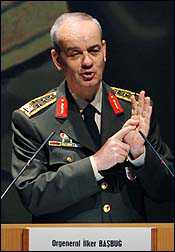
    ANKARA – Chief of General Staff Gen. İlker Başbuğ poses questions to well-known foreign scholars of history on the perception of Turkey in the West. ’Today, we see very strong prejudice against Turks is still there,’ replies historian Justin McCarthy.

    Well-known scholars of Turkish history received a flurry of questions at a two-session panel held by the General Staff to commemorate the 90th anniversary of the Turkish War of Independence on May 19.

    During his presentation, historian Justin McCarthy said the Western media largely labeled the Turks before the War of Independence as barbarians and tyrants, but that the situation began changing after the victory by the forces of Mustafa Kemal Atatürk, the founder of the Turkish Republic.

    In the question-and-answer part of the session, Chief of General Staff Gen. İlker Başbuğ, who was in the audience, asked McCarthy about the reason for these differing perceptions. Gen. Başbuğ also posed a second question, which he warned could be provocative, about how the Western press covers Turkey today. “Is it like before the war, or after the war?” he asked.

    In response, McCarthy said the negative coverage of Turks mostly stemmed from ignorance and strong prejudices in the West that developed as a result of the World War I-era killings of Armenians at the hands of the Ottoman Empire.

    ’Prejudice against Turks is still there’
    “Today, we see very strong prejudice [against Turks] is still there,” he said, adding that the New York Times was one of the most anti-Turkish newspapers in the United States, both during the war years and today. As an example, he cited the paper’s language referring to the Armenian killings as “genocide.”

    McCarthy also said the newspaper once printed an article about Turkish lobbying groups in the United States fighting against genocide claims, while mentioning nothing about the Armenian side.

    Another panelist, Prof. Salahi Sonyel, said he had advised the Turkish government to give up on the Armenian diaspora and instead concentrate on the Armenians of Armenia. In his opinion, the Armenian diaspora will never come to good terms with Turkey, but it is important for Turkey to normalize ties with neighboring governments, including the one in Yerevan.

    Following the panel, Gen. Başbuğ inaugurated a statue of Atatürk that had been crafted by Sait Rüstem. The statue, decorated with quotes from the Turkish leader, stands 4 meters tall and weighs 2.3 tons.

    Source:  www.hurriyet.com.tr, May 20, 2009‎

  • Simon says…Meds Yeghern

    Simon says…Meds Yeghern

    April 25, 2009

    That segment of the statement, in three languages, is “The Great Disaster,” in English, “Meds Yegherni Hishadage,” in Armenian; and “Buyuk Felaket,” in Turkish. This is how Meds Yeghern gives a glimmer of hope to Armenians [1]

    Mavi Boncuk |

    THE WHITE HOUSE

    Office of the Press Secretary |For Immediate Release | April 24, 2009
    Statement of President Barack Obama on Armenian Remembrance Day

    Ninety four years ago, one of the great atrocities of the 20th century began. Each year, we pause to remember the 1.5 million Armenians who were subsequently massacred or marched to their death in the final days of the Ottoman Empire. The Meds Yeghern must live on in our memories, just as it lives on in the hearts of the Armenian people.

    History, unresolved, can be a heavy weight. Just as the terrible events of 1915 remind us of the dark prospect of man’s inhumanity to man, reckoning with the past holds out the powerful promise of reconciliation. I have consistently stated my own view of what occurred in 1915, and my view of that history has not changed. My interest remains the achievement of a full, frank and just acknowledgment of the facts.

    The best way to advance that goal right now is for the Armenian and Turkish people to address the facts of the past as a part of their efforts to move forward. I strongly support efforts by the Turkish and Armenian people to work through this painful history in a way that is honest, open, and constructive. To that end, there has been courageous and important dialogue among Armenians and Turks, and within Turkey itself. I also strongly support the efforts by Turkey and Armenia to normalize their bilateral relations. Under Swiss auspices, the two governments have agreed on a framework and roadmap for normalization. I commend this progress, and urge them to fulfill its promise.

    Together, Armenia and Turkey can forge a relationship that is peaceful, productive and prosperous. And together, the Armenian and Turkish people will be stronger as they acknowledge their common history and recognize their common humanity.

    Nothing can bring back those who were lost in the Meds Yeghern. But the contributions that Armenians have made over the last ninety-four years stand as a testament to the talent, dynamism and resilience of the Armenian people, and as the ultimate rebuke to those who tried to destroy them. The United States of America is a far richer country because of the many Americans of Armenian descent who have contributed to our society, many of whom immigrated to this country in the aftermath of 1915. Today, I stand with them and with Armenians everywhere with a sense of friendship, solidarity, and deep respect.

    ###

    [1] A Letter on Pres. Obama’s Statement on The Armenian Genocide:

    President Obama Takes A Strong Stand In Solidarity, Uses The Armenian Word For Genocide “Meds Yeghern”

    In using the Armenian phrase for what the Turkish government inflicted upon our nation in 1915, President Obama has taken a strong stand in solidarity with our community on April 24th. By using the words for Genocide in Armenian “Meds Yeghern,” the language of a people the Turks attempted to wipe off the face of the earth to describe what was inflicted upon our families, he has delivered a powerful message to Ankara that the Armenian people have triumphed.

    It’s time now for us to move forward in the pursuit of the ultimate justice for our fallen nation, the return of our ancestral homeland.

    William M. Paparian

  • A Bigger, Bolder Role Is Imagined For the IMF

    A Bigger, Bolder Role Is Imagined For the IMF

    Alert: IMF are exploiting financial crisis towards one world currency

    –HD

    Changes Suggest Shift in How Global Economy Is Run

    By Anthony Faiola
    Washington Post Staff Writer
    Monday, April 20, 2009

    Inside a cavernous assembly hall in downtown Washington, dignitaries gather twice a year for routine meetings of the International Monetary Fund. Before long, though, the room could take center stage in the IMF’s transformation into a veritable United Nations for the global economy.

    Surrounded by blond wood paneling and a digital screen the size of a cinema’s, central bankers and finance ministers would meet to convene a financial security council of sorts. Serving almost as ambassadors to the IMF, they would debate ways to put out the world’s economic fires and stifle reckless policies before they ignite new ones.

    Bowing to a new economic world order, the IMF would grant fresh powers to the likes of China, India and Brazil. It would have vastly expanded authority to act as a global banker to governments rich and poor. And with more flexibility to effectively print its own money, it would have the ability to inject liquidity into global markets in a way once limited to major central banks, including the U.S. Federal Reserve.

    That image of a radically transformed IMF — whose role in the global economy had turned largely advisory in recent years — is now coming together through internal IMF documents, interviews and think-tank reports. Finance ministers from major nations will begin grappling with the formidable details of the IMF’s makeover this weekend when they converge in Washington for the fund’s biannual assembly.

    The changes, broadly outlined by President Obama and other leaders of the Group of 20 nations in London earlier this month, could take months, even years to take shape. But the IMF is all but certain to take a central role in managing the world economy. As a result, Washington is poised to become the power center for global financial policy, much as the United Nations has long made New York the world center for diplomacy.

    The IMF’s mission is expanding so broadly that its managing director, Dominique Strauss-Kahn, said in an interview that the organization — which underwent deep cuts last year before the financial crisis swept the globe — may boost staffing in coming months, potentially creating dozens of high-paying jobs in the District.

    “The IMF is changing, and with it, there will be a sea change in the way the world economy is run,” said C. Fred Bergsten, director of the Peterson Institute for International Economics. “Their role will dramatically shift. You’re talking about monitoring fiscal stimulus, moving toward tighter regulations for financial institutions. You’re talking about global economic management in a way we have never seen.

    Already, the economic crisis is triggering a profound cultural shift, with the IMF moving away from its long-held mission to spread the gospel of capitalism around the globe.

    Founded at the end of World War II to maintain stability in global currency markets, it later became known as the lender of last resort for nations in crisis, particularly as financial fires raced across Asia and Latin America in the 1990s. Its bailouts, however, were the bane of many poor countries; they often came with demands for fiscal austerity and free-market reform as the cures for developing nations — even if that meant nations had to cut back on programs for health care and schools.

    The IMF, Strauss-Kahn suggested, will become less ideological. Critics maintain the fund is still attaching too many restrictions to its longer-term bailouts for poor countries. But the IMF has signed off in recent weeks on no-strings-attached credit lines for countries with solid economic track records, offering $47 billion to Mexico and $20.5 billion to Poland.

    “If the fund is considering a country and is technically convinced that privatization of any enterprise is needed to fix the country today, let’s privatize. But if it’s a general idea of privatization that has nothing to do with the problem, let’s forget it,” Strauss-Kahn said. “At the same time, if nationalization will help, let’s do it.”

    Developing nations — including some that were once down-and-out clients of the fund — are now coming to the IMF’s rescue as part of the pledge made by leaders in London to beef up the organization’s war chest to $1 trillion. In exchange for better representation on the governing board, China, which has fewer voting rights than Belgium, is set to give more than $40 billion. Brazil, which received a massive IMF bailout in the late 1990s, is pledging $4.5 billion.

    There is even talk that the next managing director — traditionally a European, while an American ran its sister organization, the World Bank — may come from the developing world. “Why not?” Strauss-Kahn said.

    For an organization long demonized by the developing world, such changes were once unthinkable. “I spent 20 years of my life carrying posters that said ‘IMF out,’ “ Brazilian President Luiz Inácio Lula da Silva, a former union leader, said last week in Rio de Janeiro. “Now the minister of finance says we are going to lend money to the IMF.”

    The IMF is also moving toward taking the lead role as the global economic watchdog. An intense debate, however, remains over the scope of the edicts it may issue as well as the power it will be granted to enforce them.

    Along with the Switzerland-based Financial Stability Board, the IMF is set to develop benchmarks for financial governance, from guidelines on executive pay to methods to prevent the spread of toxic assets through global banks. But no one is talking seriously about allowing the IMF to impose sanctions to force compliance as the United Nations does. There is even a strong reluctance to grant the IMF powers such as those held by the World Trade Organization in Geneva, which issues binding rulings on violations of global trade law.

    Instead, the IMF is likely to wield what Strauss-Kahn called “the strength of truth telling.” Put another way, the organization’s public pronouncements would carry the force of the nations seated at its table, including the world’s most powerful industrialized and developing economies.

    Some critics, however, say that may not be enough. A case in point: An internal IMF document recently called for Eastern European nations to adopt the euro as their currency to stabilize their economies, even without the approval of euro-zone nations. But stiff opposition from Western Europe has thus far prevented that document from being made public.

    Additionally, some smaller European and low-income nations remain skeptical about the creation of a financial security council, arguing they would not be well represented. Even within the IMF, there is a debate over the council’s purview and makeup. Some see the council turning into a venue to hash out major economic disputes, such as U.S. and European charges that China is keeping its currency artificially weak.

    Others say it should steer away from country-specific rulings. Another camp argues the fund should not exist at all. Even Strauss-Kahn has sought to dispel the notion of too grand a role for the IMF, saying its primary mission should remain monitoring and surveillance rather than enforcement.

    “The fund is supposed to take on a more regulatory role, holding accountable even wealthy countries,” said Moshin Khan, the IMF’s former Middle East and Central Asia director. “But I will have to see that happen to believe it. Whenever I’ve seen them going after the bigger countries, if the countries don’t like what the fund has to say, the fund doesn’t say it.”

    Source:  The Washington Post, April 20, 2009

  • Turkey’s top general offers new vision of military, democracy and secularism

    Turkey’s top general offers new vision of military, democracy and secularism

    Turkish General Ilker Basbug is offering a new take on the military’s support for pluralistic democracy.

    By Ayhan Simsek for Southeast European Times in Ankara — 16/04/09

    Turkish General Ilker Basbug at the War Academy in Istanbul on Tuesday (April 14th). [Getty Images]
    Turkish General Ilker Basbug at the War Academy in Istanbul on Tuesday (April 14th). Getty Images
    Chief of Staff General Ilker Basbug offered a new vision of the military’s role in Turkish society during a speech at Istanbul’s War Academy on Tuesday (April 14th). Addressing a largely academic audience, which included Turkey’s future military leaders, Basbug redefined secularism and rejected an ethnically based definition of Turkish citizenship.

    He also reaffirmed the military’s strong commitment to a “pluralistic” democracy and pledged to look into “civil-military relations, the fight against terrorism, democracy and secularism from an academic perspective”.

    Because the military views itself as the ultimate guardian of Turkey’s secular system, it has had an uneasy relationship with the Islamist-rooted ruling Justice and Development Party (AKP). Following the AKP’s electoral victory in 2002, the military’s rhetoric intensified. It opposed AKP candidate and current President Abdullah Gul’s nomination in 2007.

    However, its strident rhetoric proved counterproductive; the AKP made gains in the 2007 early elections.

    Complicating the military’s position is the ongoing Ergenekon probe, which has led police to detain nearly 200 suspects, including retired generals and active military, for allegedly plotting against the AKP government. Illegal wiretaps leaked to government-friendly media have added to the atmosphere of fear.

    Basbug’s remarks echo secularists’ concerns about the AKP’s increasing “authoritarian” tendencies after its 2007 electoral victory. They argue the Ergenekon case has turned into a tool for intimidating AKP opponents.

    To address these concerns, Basbug emphasised the importance of the separation of powers, the rule of law and an independent judiciary as pillars of pluralistic democracy. In past statements, generals unceasingly underlined the threat of fundamentalism and expressed determination to protect secularism at all costs.

    But Basbug said the military “has never been and will never be against religion”. He differentiated between devout Muslims and religion-centred groups who use Islam for their personal or political interests.

    “The thought that religion may become a tool to attain objectives is the greatest injury to be inflicted on religion itself,” Basbug said. He vowed the general staff would not fail, within the bounds of the law, to resist efforts to damage the military.

    Milliyet columnist Fikret Bila interpreted Basbug’s remarks as aiming to change perceptions of the military among devout Muslims. But they are also a warning to religion-centred interest groups.

    Basbug said such groups have orchestrated a media campaign to feed “prejudices” against the military. To counteract that alleged effort, it has loosened its accreditation rules. Present at the War Academy were journalists who previously could not gain accreditation.

    “This speech represents a paradigm shift in the Turkish General Staff. These openings are the first steps. It is better to support them with constructive criticism rather than simply looking down on them,” CNN Turk TV commentator Ali Saydam said.

    This content was commissioned for SETimes.com
    Source:  www.setimes.com, 16.04.2009
  • Obama’s Strategy and the Summits

    Obama’s Strategy and the Summits

    Dr. George Friedman
    Chairman, STRATFOR

    The weeklong extravaganza of G-20, NATO, EU, U.S. and Turkey meetings has almost ended. The spin emerging from the meetings, echoed in most of the media, sought to portray the meetings as a success and as reflecting a re-emergence of trans-Atlantic unity.The reality, however, is that the meetings ended in apparent unity because the United States accepted European unwillingness to compromise on key issues. U.S. President Barack Obama wanted the week to appear successful, and therefore backed off on key issues; the Europeans did the same. Moreover, Obama appears to have set a process in motion that bypasses Europe to focus on his last stop: Turkey.

    Berlin, Washington and the G-20

    Let’s begin with the G-20 meeting, which focused on the global financial crisis. As we said last year, there were many European positions, but the United States was reacting to Germany’s. Not only is Germany the largest economy in Europe, it is the largest exporter in the world. Any agreement that did not include Germany would be useless, whereas an agreement excluding the rest of Europe but including Germany would still be useful.

    Two fundamental issues divided the United States and Germany. The first was whether Germany would match or come close to the U.S. stimulus package. The United States wanted Germany to stimulate its own domestic demand. Obama feared that if the United States put a stimulus plan into place, Germany would use increased demand in the U.S. market to expand its exports. The United States would wind up with massive deficits while the Germans took advantage of U.S. spending, thus letting Berlin enjoy the best of both worlds. Washington felt it had to stimulate its economy, and that this would inevitably benefit the rest of the world. But Washington wanted burden sharing. Berlin, quite rationally, did not. Even before the meetings, the United States dropped the demand – Germany was not going to cooperate.

    The second issue was the financing of the bailout of the Central European banking system, heavily controlled by eurozone banks and part of the EU financial system. The Germans did not want an EU effort to bail out the banks. They wanted the International Monetary Fund (IMF) to bail out a substantial part of the EU financial system instead. The reason was simple: The IMF receives loans from the United States, as well as China and Japan, meaning the Europeans would be joined by others in underwriting the bailout. The United States has signaled it would be willing to contribute $100 billion to the IMF, of which a substantial portion would go to Central Europe. (Of the current loans given by the IMF, roughly 80 percent have gone to the struggling economies in Central Europe.) The United States therefore essentially has agreed to the German position.

    Later at the NATO meeting, the Europeans – including Germany – declined to send substantial forces to Afghanistan. Instead, they designated a token force of 5,000, most of whom are scheduled to be in Afghanistan only until the August elections there, and few of whom actually would be engaged in combat operations. This is far below what Obama had been hoping for when he began his presidency.

    Agreement was reached on collaboration in detecting international tax fraud and on further collaboration in managing the international crisis, however. But what that means remains extremely vague – as it was meant to be, since there was no consensus on what was to be done. In fact, the actual guidelines will still have to be hashed out at the G-20 finance ministers’ meeting in Scotland in November. Intriguingly, after insisting on the creation of a global regulatory regime – and with the vague U.S. assent – the European Union failed to agree on European regulations. In a meeting in Prague on April 4, the United Kingdom rejected the regulatory regime being proposed by Germany and France, saying it would leave the British banking system at a disadvantage.

    Overall, the G-20 and the NATO meetings did not produce significant breakthroughs. Rather than pushing hard on issues or trading concessions – such as accepting Germany’s unwillingness to increase its stimulus package in return for more troops in Afghanistan – the United States failed to press or bargain. It preferred to appear as part of a consensus rather than appear isolated. The United States systematically avoided any appearance of disagreement.

    The reason there was no bargaining was fairly simple: The Germans were not prepared to bargain. They came to the meetings with prepared positions, and the United States had no levers with which to move them. The only option was to withhold funding for the IMF, and that would have been a political disaster (not to mention economically rather unwise). The United States would have been seen as unwilling to participate in multilateral solutions rather than Germany being seen as trying to foist its economic problems on others. Obama has positioned himself as a multilateralist and can’t afford the political consequences of deviating from this perception. Contributing to the IMF, in these days of trillion-dollar bailouts, was the lower-cost alternative. Thus, the Germans have the U.S. boxed in.

    The political aspect of this should not be underestimated. George W. Bush had extremely bad relations with the Europeans (in large part because he was prepared to confront them). This was Obama’s first major international foray, and he could not let it end in acrimony or wind up being seen as unable to move the Europeans after running a campaign based on his ability to manage the Western coalition. It was important that he come home having reached consensus with the Europeans. Backing off on key economic and military demands gave him that “consensus.”

    Turkey and Obama’s Deeper Game

    But it was not simply a matter of domestic politics. It is becoming clear that Obama is playing a deeper game. A couple of weeks before the meetings, when it had become obvious that the Europeans were not going to bend on the issues that concerned the United States, Obama scheduled a trip to Turkey. During the EU meetings in Prague, Obama vigorously supported the Turkish application for EU membership, which several members are blocking on grounds of concerns over human rights and the role of the military in Turkey. But the real reason is that full membership would open European borders to Turkish migration, and the Europeans do not want free Turkish migration. The United States directly confronted the Europeans on this matter.

    During the NATO meeting, a key item on the agenda was the selection of a new alliance secretary-general. The favorite was former Danish Prime Minister Anders Fogh Rasmussen. Turkey opposed his candidacy because of his defense on grounds of free speech of cartoons depicting the Prophet Mohammed published in a Danish magazine. NATO operates on consensus, so any one member can block just about anything. The Turks backed off the veto, but won two key positions in NATO, including that of deputy secretary-general.

    So while the Germans won their way at the meetings, it was the Turks who came back with the most. Not only did they boost their standing in NATO, they got Obama to come to a vigorous defense of the Turkish application for membership in the European Union, which of course the United States does not belong to. Obama then flew to Turkey for meetings and to attend a key international meeting that will allow him to further position the United States in relation to Islam.

    The Russian Dimension

    Let’s diverge to another dimension of these talks, which still concerns Turkey, but also concerns the Russians. While atmospherics after the last week’s meetings might have improved, there was certainly no fundamental shift in U.S.-Russian relations. The Russians have rejected the idea of pressuring Iran over its nuclear program in return for the United States abandoning its planned ballistic missile defense system in Poland and the Czech Republic. The United States simultaneously downplayed the importance of a Russian route to Afghanistan. Washington said there were sufficient supplies in Afghanistan and enough security on the Pakistani route such that the Russians weren’t essential for supplying Western operations in Afghanistan. At the same time, the United States reached an agreement with Ukraine for the transshipment of supplies – a mostly symbolic gesture, but one guaranteed to infuriate the Russians at both the United States and Ukraine. Moreover, the NATO communique did not abandon the idea of Ukraine and Georgia being admitted to NATO, although the German position on unspecified delays to such membership was there as well. When Obama looks at the chessboard, the key emerging challenge remains Russia.

    The Germans are not going to be joining the United States in blocking Russia. Between dependence on Russia for energy supplies and little appetite for confronting a Russia that Berlin sees as no real immediate threat to Germany, the Germans are not going to address the Russian question. At the same time, the United States does not want to push the Germans toward Russia, particularly in confrontations ultimately of secondary importance and on which Germany has no give anyway. Obama is aware that the German left is viscerally anti-American, while Merkel is only pragmatically anti-American – a small distinction, but significant enough for Washington not to press Berlin.

    At the same time, an extremely important event between Turkey and Armenia looks to be on the horizon. Armenians had long held Turkey responsible for the mass murder of Armenians during and after World War I, a charge the Turks have denied. The U.S. Congress for several years has threatened to pass a resolution condemning Turkish genocide against Armenians. The Turks are extraordinarily sensitive to this charge, and passage would have meant a break with the United States. Last week, they publicly began to discuss an agreement with the Armenians, including diplomatic recognition, which essentially disarms the danger from any U.S. resolution on genocide. Although an actual agreement hasn’t been signed just yet, anticipation is building on all sides.

    The Turkish opening to Armenia has potentially significant implications for the balance of power in the Caucasus. The August 2008 Russo-Georgian war created an unstable situation in an area of vital importance to Russia. Russian troops remain deployed, and NATO has called for their withdrawal from the breakaway Georgian regions of South Ossetia and Abkhazia. There are Russian troops in Armenia, meaning Russia has Georgia surrounded. In addition, there is talk of an alternative natural gas pipeline network from Azerbaijan to Europe.

    Turkey is the key to all of this. If Ankara collaborates with Russia, Georgia’s position is precarious and Azerbaijan’s route to Europe is blocked. If it cooperates with the United States and also manages to reach a stable treaty with Armenia under U.S. auspices, the Russian position in the Caucasus is weakened and an alternative route for natural gas to Europe opens up, decreasing Russian leverage against Europe.

    From the American point of view, Europe is a lost cause since internally it cannot find a common position and its heavyweights are bound by their relationship with Russia. It cannot agree on economic policy, nor do its economic interests coincide with those of the United States, at least insofar as Germany is concerned. As far as Russia is concerned, Germany and Europe are locked in by their dependence on Russian natural gas. The U.S.-European relationship thus is torn apart not by personalities, but by fundamental economic and military realities. No amount of talking will solve that problem.

    The key to sustaining the U.S.-German alliance is reducing Germany’s dependence on Russian natural gas and putting Russia on the defensive rather than the offensive. The key to that now is Turkey, since it is one of the only routes energy from new sources can cross to get to Europe from the Middle East, Central Asia or the Caucasus. If Turkey – which has deep influence in the Caucasus, Central Asia, Ukraine, the Middle East and the Balkans – is prepared to ally with the United States, Russia is on the defensive and a long-term solution to Germany’s energy problem can be found. On the other hand, if Turkey decides to take a defensive position and moves to cooperate with Russia instead, Russia retains the initiative and Germany is locked into Russian-controlled energy for a generation.

    Therefore, having sat through fruitless meetings with the Europeans, Obama chose not to cause a pointless confrontation with a Europe that is out of options. Instead, Obama completed his trip by going to Turkey to discuss what the treaty with Armenia means and to try to convince the Turks to play for high stakes by challenging Russia in the Caucasus, rather than playing Russia’s junior partner.

    This is why Obama’s most important speech in Europe was his last one, following Turkey’s emergence as a major player in NATO’s political structure. In that speech, he sided with the Turks against Europe, and extracted some minor concessions from the Europeans on the process for considering Turkey’s accession to the European Union. Why Turkey wants to be an EU member is not always obvious to us, but they do want membership. Obama is trying to show the Turks that he can deliver for them. He reiterated – if not laid it on even more heavily – all of this in his speech in Ankara. Obama laid out the U.S. position as one that recognized the tough geopolitical position Turkey is in and the leader that Turkey is becoming, and also recognized the commonalities between Washington and Ankara. This was exactly what Turkey wanted to hear.

    The Caucasus is far from the only area to discuss. Talks will be held about blocking Iran in Iraq, U.S. relations with Syria and Syrian talks with Israel, and Central Asia, where both countries have interests. But the most important message to the Europeans will be that Europe is where you go for photo opportunities, but Turkey is where you go to do the business of geopolitics. It is unlikely that the Germans and French will get it. Their sense of what is happening in the world is utterly Eurocentric. But the Central Europeans, on the frontier with Russia and feeling quite put out by the German position on their banks, certainly do get it.

    Obama gave the Europeans a pass for political reasons, and because arguing with the Europeans simply won’t yield benefits. But the key to the trip is what he gets out of Turkey – and whether in his speech to the civilizations, he can draw some of the venom out of the Islamic world by showing alignment with the largest economy among Muslim states, Turkey.

    00000000000000000

    Dr. George Friedman
    Chairman, STRATFOR
    George Friedman, Ph.D., is an internationally recognized expert in security and intelligence issues relating to national security, information warfare and computer security. He is founder,  chairman and Chief Intelligence Officer of STRATFOR, (Strategic Forecasting Inc.) a private intelligence company that provides customized intelligence services for its clients and provides an internationally acclaimed Web site, www.stratfor.com, that analyzes and forecasts trends in world affairs. Friedman’s column, Intelligence Brief, is syndicated by Tribune Media Services.
    Friedman is the author of many publications in international affairs and business intelligence, including the books, “The Intelligence Edge: How to Profit in the Information Age” (The Crown Publishing Group, 1997) and “The Future of War: Power, Technology and American World Dominance in the 21st Century” (The Crown Publishing Group, 1997), an examination of the impact of new military technologies on the international system. He is presently at work on a new book, “America’s Secret War”, to be published by Doubleday in the Fall of 2004.Friedman has appeared as a national security and intelligence expert on all major television networks, including CNN’s “Moneyline” and ABC’s “This Week with Sam Donaldson and Cokie Roberts.” He is frequently a guest on National Public Radio and has been featured in numerous publications, including Time, The Wall Street Journal and The New York Times Magazine. In October 2001, Friedman was featured in a cover story interview in Barron’s. He also has been the keynote speaker at many security and industry-specific conferences for private organizations and government agencies.Friedman graduated with a B.A. from the City College of the City University of New York and holds a Ph.D. in Government from Cornell University. Prior to entering the private sector in 1996, Friedman was a professor of political science for almost 20 years and was an early designer of computerized war games. During his years in academics, Friedman briefed widely on security and national defense matters, including senior commanders in all armed services, the Office of Net Assessments, SHAPE Technical Center, the U.S. Army War College, National Defense University and the RAND Corporation. In 1994 Friedman founded the Center for Geopolitical Studies at Louisiana State University, which engages in integrated economic, political and military modeling and forecasting and was the only non-DOD/non-governmental organization granted access to Joint Theater Level Simulation (JTLS) by the Joint Warfighting Center.Friedman is married with four children (two in the military) and currently lives in Austin, Texas.
  • Why Turkey belongs to the EU

    Why Turkey belongs to the EU

    Sigurd Neubauer
    Friday 27 March 2009 – 07:30

    With its geographical location, at the crossroads of an East-West and North-South axis, Turkey has played a dominating geopolitical role from the days of the Ottoman Empire to the present. In recognition of Turkey’s strategic position, President Harry S. Truman was quick to incorporate Turkey into the North Atlantic Treaty Organization (NATO). As the alliance is celebrating its 60th anniversary, Turkey is again at a crossroad. This time, the choice facing the Turkish Republic is whether Ankara should continue its path towards becoming a full fledged member of the European Union, or if Turkey should adopt a “neo Ottoman” foreign policy brokering conflicts between Israel and Syria and between the United States and the Islamic Republic of Iran.

    Beyond its broad foreign policy implications, Turkey is also facing a significant internal identity crisis where traditional urban pro-Western elite are being challenged by a new and emerging conservative bourgeoisie originating from the Anatolian heartland. At the center of this power struggle, is the current ruling Islamic Development Party (AKP) led by Prime Minister Recep Tayyip Erdoğan vis-à-vis the Turkish military establishment.

    Turkey’s powerful generals have long seen themselves as the “guardians” of secularism as they adhere to the principals of “Kemalism,” laid out by the Republic’s founder, Mustafa Kemal Ataturk (1881-1938). “Ataturk,” or “father Turk,” as his people called him, emerged on the political stage during the vanishing days of the Ottoman Empire. During these turbulent times, as pockets of Turkish populated settlements were threatened by increasing nationalism in the various regions of the empire, the young and ambitious army officer, Mustafa Kemal, was to become one of the most notable military leaders and statesmen of his generation.

    Transition from Empire to Republic

    From a small principality on the frontiers of the Islamic world at the turn of the 14th century, the Ottoman Empire became the most powerful state in the Islamic world stretching from central Europe to the Indian Ocean under the reign of Suleiman the Magnificent (1520-1566). Following the long wars of the 17th century, the Ottoman Empire declined as a world power in favor of the European mercantile powers. By the mid 18th century, what was left of the once mighty empire became known as the “sick man of Europe.” Despite countless reforms of the civil and bureaucratic structure, Ottoman political life continued under European tutelage.

    Recognizing Turkey’s state of decay, Ataturk envisioned a strong, independent, and secular republic. According to noted Ataturk biographer, Lord Kinross: “Ataturk differed from the dictators of his age in two significant respects: his foreign policy was not based on expansion but on retraction of frontiers; his home policy on the foundation of a political system that could survive his own time.” Some of the republic’s early reforms were instituting a constitutional parliamentary system in 1923, followed by the introduction of the Swiss Civil Code in 1926. From a legal perspective, the Swiss Civil Code replacing traditional Sharia laws was an important step in the direction of westernization of personal, family, and inheritance laws. Other significant changes promoted by the Kemalists were adopting the Latin alphabet, western numerals, weights and measures, and gender equality.

    Military and Democracy

    The political system during the early Kemalist era remained a one party state, where no legal opposition was active until after World War II. Turkey has since come a long way in its democratization effort, despite brief military interventions in 1960, 1971, and 1980. Each time, the generals provided important exit guarantees that enhanced the military’s position, yet civilian control of the Republic has prevailed, as Turkey has become a competitive multiparty system.

    With the reelection of the AKP in 2007, Prime Minister Erdogan has secured his base as he openly challenges Turkey’s ancient regime, on a verity of issues from the headscarf ban to, as the only NATO ally, inviting Iran’s controversial President Mahmoud Ahmadinejad to Istanbul. The notion that “Turkey has to follow an integrated foreign policy and cannot have priority with the EU at the expense of its relations with the Middle East—as advocated by senior AKP officials—is a clear break with Kemalist foreign policy. Yet at this critical juncture, it is important for Europe to fully embrace Turkey. Because of its strategic location and economic ties to continental Europe, the Balkans, the Caucasus, the Mediterranean, and the Black Sea region, Turkey can fully complement the EU on a variety of issues from trade to security. In particular, Turkey can provide the European markets access to rich energy resources from the Middle East and Eurasia.

    The battle for Eurasia

    On the other hand, the Turkish government has shown increasing frustration, not only with U.S. policies towards the Middle East but also with the EU’s refusal to seriously consider its bid. Should Europe fail to embrace Turkey, this could be a fatal push of Turkey into the Russian orbit. Despite historical mistrust, Turkish-Russian economic ties have greatly expanded over the past decade, reaching $32 billion in 2008, making Russia Turkey’s largest trading partner. By taking advantage of cooling relations between Ankara and Washington, Moscow is determined to expand its sphere of influence over the black sea region and Eurasia. Through an aggressive trade and investment policy, Russia skillfully outmaneuvered the United States by closing its airbase in Manas, Kyrgyzstan.

    In the great powers struggle for influence, Turkey is an indispensable piece, too precious for the West to lose. Instead of remaining a “Christian Club,” the European Union should overcome its historical fear of “the Turks” and recognize that as a NATO member, Turkey will prioritize its ties with the United States and the West; as an EU member, Turkey will continue to cherish democracy, liberalism, and secularism. Europe turning its back on Turkey could be the nail in the coffin for an occidental oriented foreign policy and a secular national identity.

    Source: The Diplomatic Courier (USA), 25-03-2009