Tag: Armenians in Turkey

  • Aunty Eliz: “We moved to Istanbul for the kids”

    Aunty Eliz: “We moved to Istanbul for the kids”

    Edik Baghdasaryan

    12:40, June 6, 2011
    Eliz is a woman from Saritagh, a Yerevan neighborhood, who moved to Istanbul eleven odd years ago. She’s a veritable “ball of fire”.

    Sitting on the sofa like a mother hen, she gathers up her disabled brother’s kids under her protective arms and tells me her story. Eliz says she made the move to take care of her brother and his kids.

    Eliz resembles a traditional Armenian grandmother; barking out orders to those in the house. No one dares do anything without consulting her first.

    Hakob, her brother, needed an operation and the children had to be fed and clothed. She says there were no options left but to move.

    “My brother was disabled in a car accident. Hovo was one and a half years-old, Elizik was two and a half and Zhanna was a year older. We had no way of making a living back in Armenia. Eleven years ago, it was impossible to find any live in Yerevan. You probably remember how it was like. I worked and raised the kids. I wanted to give them a good education but it didn’t work out,” Eliz recounted.

    Eliz is a woman in her mid-forties. Five days a week she cleans the home of her Turkish employer. She also serves as a nanny. She’s been working for the same family for the past seven years.

    Eliz sleeps over at the house and returns home on Friday night. She told me her employer is the editor at some Turkish newspaper but didn’t wish to say more.

    As I said, Eliz is a bundle of energy, but I detected a morose side to her as well. She appeared worn-out inside from her work and life in Turkey. It was something in her eyes.

    During our conversation she said, “Please help to get my brother’s house back.”

    Eliz’s seventy year-old mother is blind and resides in Yerevan along with her brother’s other daughter.

    Eliz’s older brother had been renting for twenty years before returning to the family home. It was impossible for all of them to live together in that 54 square meter house.

    The two brothers wound up suing each other in the courts. Hakob was left high and dry and soon became despondent. Life had ceased to have any meaning for him.

    “In a word, they were thrown out due to the decision of the court. So I brought them here to Istanbul,” says Eliz.

    Trying to shed a little humor on the subject, Eliz told me to write down her life story. “I’ll translate it into Turkish. We’ll publish a book and get rich,” she chuckled.

    “No matter, just as long as the kids are OK. I’m a victim of my own destiny. It’s my fault and the fault of the government back in Armenia that my Hovo serves tea in an Istanbul cafe. At least Zhanna works in a textile factory and is learning to sew. She can return to Armenia and find a job. But what about the boy?” Eliz asked.

    Then, as if I was an official representative from Armenia, she bellowed, “We want our homeland. We want the government to take care of us. Sick people shouldn’t be thrown out on the streets.”

    One evening, at around 9, I followed twelve year-old Hovik home from his job at the cafe. There was another Armenian, a jeweler, escorting us. I asked the man to find the boy another job; so that he would no longer have to serve tea for his Kurdish boss. The jeweler promised me that he would teach the boy the trade.

    “I make about 100 Turkish Lira ($70) a week. What’s hard is being on my feet all day. You can’t take a moment to sit down. The customers want their tea. My junior boss really is a chatterbox who gives me a headache, always saying I did this or that wrong,” Hovik told me afterwards at home.

    The boy used to attend P.S. 167 in Yerevan. He said he had many friends there whom he misses a lot. When Hovik’s father asked the boy what he wanted to be as a child, his answer was “a soldier”.

    Zhanna, Hovik’s fourteen year-old sister, was uncomfortable and said nothing at our first meeting. During our next conversation, she confessed that she always aspired to be a painter. Her work was displayed in the Yerevan school she was attended.

    “When I was younger I wanted to become a painter but now who knows?” Zhanna confided. She makes around 50 Lira ($30) a week at work. The teenager leaves for work at eight in the morning and returns at nine.

    “We sew dresses and blouses and attach buttons. I mostly work with Turkish and Kurdish children. There aren’t other Armenians at the factory.”

    Aunt Eliz tried to get Zhanna enrolled at a painter’s club but one has to be a Turkish citizen.

    “All four of us work here and get by somehow. The kids are little dolls. I have to keep my eyes on them amidst all these Turks. I don’t know whether to stay or go back to Yerevan. God willing, we can save up enough to buy a small place back home in order to return,” Eliz says.

    Hakob’s wife also works as a house cleaner five days a week. He used to receive a 10,000 AMD disability pension in Armenia.

    His wife used to work at the Rossiya marketplace as a floorsweeper. She made 30,000 AMD per month.

    “The family income was 40,000. You do the math. That’s 8,000 per person. Deduct all the utility payments and what’s left is just enough for a loaf of bread every day. You ask why we moved here, so I’ll tell you. It was for the children. It was a tough decision. There was no alternative,” says Hakob. “It’s like a prison here sitting inside all day. At least in Yerevan I’d get around. There’s no place to go to here.”

    via Aunty Eliz: “We moved to Istanbul for the kids” (video) | Hetq online.
  • Non-Muslims demand equal citizenship rights in new constitution

    Non-Muslims demand equal citizenship rights in new constitution

    The new constitution of Turkey should embrace all of its citizens and elevate individual rights and freedoms equally for all as opposed to the 1982 Constitution, which reinforced state and military authority and introduced substantial restrictions to the exercise of individual rights and freedoms, non-Muslim Turkish citizens indicate.

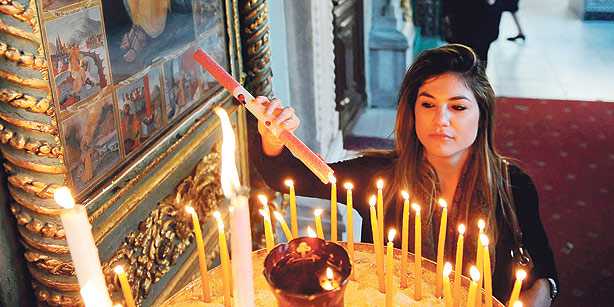
    A member of Turkey’s Greek Orthodox community in an İstanbul church. Non-Muslims demand equality for minorities in the new constitution.
    A member of Turkey’s Greek Orthodox community in an İstanbul church. Non-Muslims demand equality for minorities in the new constitution.

    A member of Turkey’s Greek Orthodox community in an İstanbul church. Non-Muslims demand equality for minorities in the new constitution.

    When asked by Sunday’s Zaman if Turkey needed a new constitution, most of the non-Muslim “minority” citizens of Turkey were no different than the majority of the voices in Turkey in their demands for a new, democratic and civilian constitution, and they always made references to the 1982 Constitution, which was drafted in the aftermath of the Sept. 12, 1980 military takeover.

    “Instead of the 1982 Constitution, which blesses and protects the state and also says that rights can be restricted, a new constitution should be made to put emphasis on human rights, provide social justice and give people rights to live in accordance with their identity,” said Arus Yumul, a professor of sociology and a Turkish citizen of Armenian origin.

    Laki Vingas, representative of several minority foundations and a Turkish citizen of Greek origin shares the same opinion. “Making a new constitution is important for every Turkish citizen. It is utterly disturbing that we still have the constitution of the 1980 military coup,” Vingas says.

    Researcher and writer Nail Güleryüz, a Turkish citizen of Jewish background, is of the same opinion, and Zeki Basatemir, a member of the board of directors of the Syriac Catholic Church Foundation in Turkey, added that Turkish citizens of Syriac origin also demand a constitution which would emphasize individual rights and freedoms.

    The Sept. 12 coup d’état was the third coup in Turkey’s history which came after a period of ideological armed conflict on Turkey’s streets during the second half of the 1970s. An estimated 5,000 people were killed during the political violence. Some 600,000 were reportedly detained, more than 200,000 were tried, over 10,000 were stripped of their citizenship and 50 people were executed while hundreds of thousands were tortured and went missing during the military coup administration.

    But should a new constitution have special provisions for non-Muslims in Turkey, where they are supposed to have safeguards under the “Protection of Minorities” clause of the 1923 Treaty of Lausanne? According to Güleryüz, a constitution should “justly embrace” all individuals of the country and should not give special privileges, even positive discrimination, to any individuals or institutions. “Therefore, there should not be special clauses for Turkish citizens of Jewish origin,” he said. “It would be adequate for Turkey’s Jewish people — even though they can be considered a ‘minority numerically’ from the perspective of religion — to have equal rights and responsibilities.”

    He also recalled that the chief rabbi and the Jewish community leaders of the 1920s relinquished many special privileges provided to minorities by the Treaty of Lausanne.

    Vingas regards the special clauses of the Lausanne Treaty regarding minorities as a thing of the past. “I don’t want to tell my children who will be born in 2020 that they are bound by the rules of 1923,” he said. “I am a normal citizen in this country, not separate or apart.”

    The number of Turkish citizens of Jewish and Syriac origin has been estimated to be around 25,000 each, while this number is around 3,000 for the Turkish citizens of Greek origin. The Turkish-Armenian community is the largest of the minority groups in Turkey with a population of approximately 60,000, mostly in İstanbul. Despite protections, non-Muslims faced injustices in Turkey, a fact which has been recently stated by a government official. Ruling Justice and Development Party’s (AK Party) Deputy Chairman Hüseyin Çelik had told Sunday’s Zaman that “the deep state” and the “pro-single-party spirit of the Republican People’s Party [CHP]” lies behind the injustices that were done to non-Muslims in Turkey. The single-party period of Turkey begins with the CHP being the only party after the founding of the republic on Oct. 29, 1923 and ends in 1946 with the establishment of the National Development Party (MKP).

    “Serious injustices were done to all these groups during the single-party era in Turkey; however, the injustices done to the non-Muslims were more severe. The wealth tax was a disgrace. The closure of the Greek seminary was a great shame. The Sept. 6-7 incidents were an inhumane conspiracy that humiliated Turkey in the eyes of the world,” Çelik said.

    He was referring to the tax which was levied on the wealthy citizens of Turkey in 1942, with the stated aim of raising funds for the country’s defense in the event of eventual entry into World War II. Those who suffered most severely from this tax were non-Muslims: Jews, Greeks, Armenians and Levantines. Established on Oct. 1, 1844, on Heybeli Island — or Halki in Greek — in the Marmara Sea, the Halki Seminary was the main school of theology for the Eastern Orthodox Church’s patriarchate in İstanbul until its closure by Turkish authorities in 1971. The unfortunate events of Sept. 6-7, 1955 started after a newspaper headline said the home of the nation’s founder, Atatürk, in Greece had been bombed by Greek militants. Fired up by the media, mobs killed and harassed non-Muslims and non-Turkish minorities in a massive campaign.

    “Republican governments always wanted to destroy minorities,” said Turkish-Armenian journalist Pakrat Estukyan, adding that a good portion of non-Muslims still do not trust the state because of what happened in the past.

    “Since 1923, even Lausanne has been subject to being run over,” he said. “We are in the process of democratization but there is not a consensus in society about how a more democratic constitution should be.”

    Like most people in society, non-Muslims also stress the need for a wide-ranging consensus in society for making the new constitution, and that a new constitution should be made by the new Parliament, but not only by the ruling party even if it garners enough votes on June 12.

    “Unions, civil society groups, institutions and businesses should agree on the principles. Even parties which remained out of Parliament as a result of the election should be consulted in the process of making a new constitution,” Vingas said, pointing out the 10 percent election threshold.

    “For the constitution not to be an arena of power-sharing among the powerful, citizens’ participation into the process is essential, especially in societies that have a tendency to resort to violence,” Yumul said, adding that no matter how well-written, no constitution would provide equal citizenship for non-Muslims if it doesn’t go hand-in-hand with a general understanding for the meaning of equal citizenship.


    In that regard, Basatemir stressed that non-Muslims will feel their “equality” if de facto practices disappear.


    “Although there are not written rules, I am not allowed to have a career in the police, military and in high levels of the bureaucracy because I am a Christian,” he said. “We appreciate recent reforms in Turkey but we should have an understanding that non-Muslims are Turkish citizens, too.” In addition, Güleryüz emphasized the prevention of the hate crimes.


    Some civil society groups have been raising their voices against hate speech and hate crimes, which are serious problems in the country, and emphasizing that there is a need for legislation to combat them. The cases they give include the 2007 murder of journalist Hrant Dink, who was the editor-in-chief of the Turkish-Armenian weekly Agos; in Malatya, the Zirve murders of 2007 when three people who had sold Christian literature were brutally killed; and the murder of Catholic priest Father Andrea Santoro in Trabzon.

  • ‘Jamanak’ Armenian language paper of Istanbul is 100 years old

    ‘Jamanak’ Armenian language paper of Istanbul is 100 years old

    ‘Jamanak’ Armenian language paper of Istanbul is 100 years old

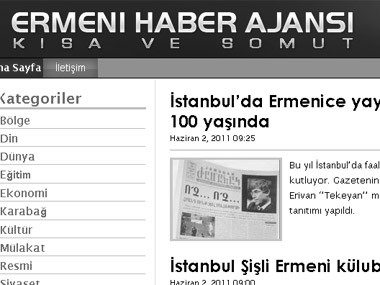
    “Jamanak” (Times) Armenian daily being published in Istanbul is 100 years old. Ara Gochunyan, the Editor-in-chief of the daily, who has recently arrived in Yerevan told “Ermenihaber.am” news website “Jamanak” is the oldest Armenian language paper published in Turkey and generally in the world, as well as among the papers of national minorities.

    Due to its 100-year-old experience “Jamanak” has its special place and role in the culture of Turkey and particularly Armenians of Polis.

    “The paper passes into another century. Naturally, new terms and conditions appear. If we look through the hundred-year-old history of the paper we can see each period has its specifications, its conflicting issues and scope of interests. This is changing through time. Globalization changes the world and makes it transparent, hence the paper also changes its plans,” Ara Gochunyan said.

    Referring to the Armenian-Turkish relations, Gochunyan said South Caucasus region is a very fragile point subjected to globalization, and the perspectives of Armenian-Turkish relations both from the view point of regional and international aspect signify the role of Armenian community in Turkey.

    “Armenian community in Turkey has great defensive potential and can have important role in mending Armenian-Turkish relations. Now, Armenian community seems waiting and defending themselves. They preferred to protect their identity and mother tongue; at the same time they try hard not to contradict Turkish citizenship and Armenian ethnic identity.”

    Source: Panorama.am


  • Sibil Pektorosoglu took Istanbul by her Armenian song

    Sibil Pektorosoglu took Istanbul by her Armenian song

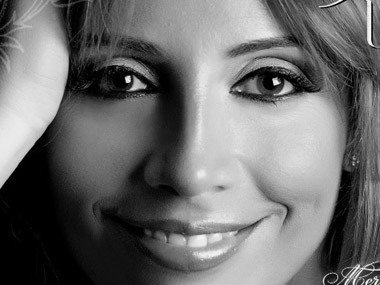
    Turkish Armenian singer Sibil Pektorosoglu has performed a poem by renowned Armenian writer Hovhannes Shiraz called “Letter” and attracted thousands of Turkish and Armenian fans.

    Sibil, who is of Armenian origin, was born in Istanbul and lives there. The song has a video which is being televised by Turkish leading musical TV stations and aired in Istanbul.

    Armenian singer has had an exclusive interview with “Ermenihaber.am” news website.

    “I started from St. Vardanants choir. I remember Armenian songs and music happened little in Turkey, thus I entered the choir in order not to starve for Armenian music. The choir has had a great contribution in the development of my singing,” Sibil says.

    Last year the singer released an album called “Sibil”, where some Armenian songs, including “Ter voghormya”, “Cilicia”, “Letter” could be found.

    “This album is the dream of my life. I’ve always dreamed to release an Armenian album. Due to my relatives, I managed to implement my dream.”

    To the question if she has any problems in Turkey because of her Armenian origin, Sibil says; “I’ve not had any yet. When the video was produced, it was positively assessed. Many people say they listen to Armenian music.”

    Sibil says many listen to “Letter” by Hovhannes Shiraz, though they say they don’t understand a single word.

    “When we were working on the video, the staff was singing that song. People asked the song written in Latin letters in order they could sing it with me.”

    This talented Armenian singer visited Armenia in 2001. She has planned to visit our country again and to stage for her Armenian fans.

    via Sibil Pektorosoglu took Istanbul by her Armenian song – Culture – Panorama | Armenian news.

  • Erasing traces of Armenian presence: Turkey accused of misrepresenting history of monuments

    Erasing traces of Armenian presence: Turkey accused of misrepresenting history of monuments

    By Gayane Abrahamyan

    Armenian experts are warning that in Turkey almost everywhere panels telling about Armenian monuments present distorted information, which shows a consistent attempt by Turks to erase Armenian traces inside what now is within the borders of their state.

    “While generally signs and notices placed near monuments are designed to inform tourists, in Turkey their special purpose is to mislead them and present a totally different history,” says specialist in Oriental studies Raffi Kortoshyan, who works as an expert for Research on Armenian Architecture NGO.

    One of such outrageous examples cited by Armenian experts is the huge information panel near the ruins of Ani that presents the history of the area beginning from the Stone Age and chronologically presents almost everything, except its Armenian period, while the royal Armenian dynasty of the Bagratunis is presented as the Bagratoglu emirate.

    “Perhaps they did not have enough space for Armenians,” Kortoshyan comments with irony, adding that such cases aren’t inadvertent omissions but rather amount to a consistent policy in Turkey.

    “Often we see that when a brazen lie is written on a panel, it only has one variant, in Turkish, while in English this passage is omitted, because they realize that the lie is too blatant,” he says.

    Experts at the monuments studying NGO highlight the important of the joint initiative of the Turkish government and the World Monuments Fund to restore the St. Savior Church and the Cathedral of Ani, but they believe the results of the restoration work will be questionable unless Armenian specialists are engaged in the projects.

    NGO head Samvel Karapetyan says that under the guise of restoration work they also distort the original Armenian architectural form.

    “They try to restore it, but in reality we see wrong restoration and distortions. A visual image distortion is committed and it seems to me that there is no desire and their professional ability is not enough to implement proper restoration,” says Karapetyan.

    He says according to his information there is no desire yet to engage Armenian specialists in the restoration project in Ani.

    via Erasing traces of Armenian presence: Turkey accused of misrepresenting history of monuments – News | ArmeniaNow.com.

  • Hovik’s Fate – Boy Serves Tea in Istanbul

    Hovik’s Fate – Boy Serves Tea in Istanbul

    During a recent trip to Istanbul, I was constantly taking notes of the people I met along the way.These were Armenians, both locals and those from Armenia, Kurds, Turks… Here’s a sample few:

    Hovik Shahinyan – 13 years-old

    Eliza – Hovik’s aunt

    Zhanna – Hovik’s sister; 15 years-old

    Hakob – Hovik’s father, who is physically disabled and can hardly move around

    Most Armenians from the RA are located in Istanbul. It’s easier to find work here than in other Turkish cities. Then again, you have the local “Bolsahay” community with its churches, schools and other institutions.

    I assume it creates a security blanket of sorts.

    While the exact number of Armenians from Armenia now residing in Turkey is unknown, rest assured that the Turkish security agencies know where each lives.

    Arayik, whose been living in Istanbul for the past 13 years told me, “They can round us up at any time. Arayik has had his share of run-ins with the cops. Each month he returns to Moscow in order not to violate his visa requirements. The next day he returns to Turkey.

    Many follow Arayik’s example. Others make the trip to Georgia. Most return the following day.

    The bulk of Armenians from the RA reside in Turkey illegally. Turkish Prime Minister Erdogan periodically threatens to expel them. They serve as convenient “hostages” to be used when convenient.

    In fact, Erdogan can be said to remember these non-documented Armenians more frequently than any official from Armenia.

    When RA Minister for Diaspora Affairs Hranoush Hakobyan visited Turkey in early May, these Armenians got a bit irked.

    “She came to Istanbul. There are 80 pupils at our school. The minister should have visited and seen the conditions we operate in,” said an illegal teacher at a non-registered Armenian school.

    But Minister Hakobyan is little interested in the plight of these Armenians from Armenia.

    They just don’t fit the parameters of the “Ari Toun” (Come Home) program launched by the ministry. What would the minister tell them – to come back home?

    Had Minister Hakobyan told them something to this effect, she would have gotten an earful from tens of families from Gyumri still living in “tomiks” (huts) twenty years after the earthquake.

    Go home – to what exactly?

    The minister had next to nothing to offer these Armenians.

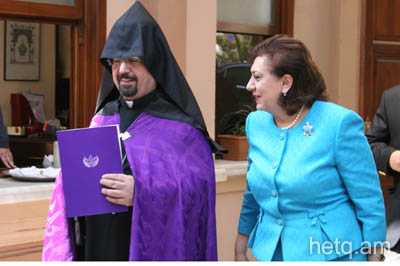
    She came, awarded medals to the elite of the Bolsahay community, and left. On the plus side however, such visits from Armenian officials are a rarity for the Istanbul-Armenian community. It was celebrated with a great deal of pomp and circumstance.

    It seems that I can’t get 12 year-old Hovik out of my mind.

    I met him while walking through the narrow streets of KumKapi. The boy was serving tea to customers from a large silver tray. The shop he works for is owned by some Kurds.

    When I pulled out my camera to take a picture, the Kurds seemed out of sorts and started to yell at the boy. He muttered something back in Turkish.

    I asked them for permission to photograph the boy carrying the tray. One of the Kurds refused, saying it would create problems.

    Hovik then telephoned his Aunt Eliza. She spoke with the Kurd and then to me. That’s how we were introduced. We arranged to meet later that day.

    Hovik took us on a meandering path through the district till we reached their home located atop a small factory. Work was still going on as the sun set.

    After the 1915 Genocide, surviving Armenians were scattered around the world, many ending up in tiny spaces like this. Now, 100 years later, the progeny of a family who had returned to that little slice of Armenia that survived, have now returned to Turkey to earn a living. Some irony…

    It turns out that this family traces its roots back to Marash. The survivors found refuge in Syria and then relocated to Armenia. Not being able to make a go of it in Armenia, they’ve left.

    To be honest, whenever I write stories on this topic I get thrown off-track. I’m always looking for people to blame for the fact that thousands of RA Armenians have wound up in Turkey.

    I feel somewhat guilty as well when I see scores of Armenian kids working here in Istanbul. Kids who have been stripped of the childhood back in Armenia.

    Hovik has been working since the age of eleven. He’s been serving tea on the streets of Istanbul for the past year and a half.

    The day after meeting Hovik, Minister Hakobyan was at a ceremony awarding medals only a few hundred meters away at the Armenian Patriarchate.

    Hovik’s Kurdish boss waited at the door of the store while Hovik returned with the empty tea tray.

    Here was a boy who will no longer attend school and who’s already substituting Turkish words for Armenian ones.

    As I watched him, I thought to myself what will happen to this 12 year-old boy who leaves his house at 7:30 every morning for the walk to KumKapi, considered a dodgy Istanbul neighbourhood.

    Will Hovik still be here in years to come, making and serving tea to customers seated in the street outside?

    via Hovik’s Fate – Boy Serves Tea in Istanbul | Hetq online.