Category: Regions

  • Iran-Turkey: dueling demagogues

    Iran-Turkey: dueling demagogues

    Benny Avni

    Here’s a tip for Lee Bollinger, the Columbia University president: If you want to hobnob with the most outrageous guest in town for next week’s UN extravaganza, get hip and call the Turkish mission — because Iran’s Mahmoud Ahmedinejad may no longer be your man. The up-and-comer is Turkey’s prime minister, Recep Tayyip Erdogan.

    They’re rivals in another important sense: Both non-Arab Mideasterners dream of resurrecting glorious empires of yore; both are using hostility to Israel to win regional favor — and both are jockeying for position in Syria, now the region’s weakest link.

    Democratically elected and popular, since his pro-market policies have turned Turkey into an economic powerhouse — Erdogan is eclipsing Ahmadinejad — reviled for mismanagement, economic decline and cruel oppression. (But beware the declining power: Mideasterners often turn to adventurism when they’re pressured at home — and Iran is closing in on an atomic-missile capability.)

    Erdogan this week launched a triumphant Mideast tour, preaching to adoring crowds in Egypt, Tunisia and Libya about the evils of Israel and the West. He also threatened a naval confrontation with Israel, scaring American, European and NATO officials, all of whom are begging Ankara to chill out a bit.

    Meanwhile, the attention-starved Ahmadinejad made a grand “concession” to America, gallantly announcing that he’d free the two US hostages (Shane Bauer and Josh Fattal) long held on flimsy espionage charges — then had to lock horns with Tehran’s judiciary, which no longer fears his authority, in an effort to make good on his promise.

    But the Iran-Turkey power game spreads far beyond such gestures. The most important arena of confrontation is Syria.

    Iran has long propped up President Bashar al-Assad, but has started to distance itself from his rule. Tehran needs Syria too much — especially as a conduit to Hezbollah, its proxy army in Lebanon. Relying solely on the Assads is too risky a bet, so the mullahs are preparing for the morning after.

    As Tehran watcher Meir Javedanfar wrote this week, if Assad falls and a civil war ensues — the now-ruling minority Allawites against the majority Sunnis — “Iran is extremely unlikely to play the part of spectator.”

    Neither is Turkey. Its southern border is bustling with activity as businessmen, troops and opportunity seekers prepare for the day Syria becomes a Turkish protectorate.

    Yet Erdogan after some tough recent statements against Assad, his former ally, is zigzagging again.

    On his first appearance in Cairo this week, Erdogan all but ignored the Syria situation. Even worse, anti-regime Syrian activists accuse Ankara of handing over former Syrian Army Lt. Col. Hussein al-Harmoush to Damascus.

    Harmoush fled Syria months ago and was making tough anti-regime statements from the relative safety of a Turk-protected refugee camp near Syria’s border. Yesterday, Syria announced his detention in Damascus. (Ankara denies sending Harmoush, or any Syrian, back “against their will.”)

    Is Turkey with Assad or against him? Is it backing the pro-democracy rebels or just the Islamists? The answer is that — like Tehran — Ankara’s playing all sides against the middle.

    Incidentally, so does Saudi Arabia: Riyadh is hoping to use its petrodollars to prop up a powerful political ally in post-Assad Syria. But money isn’t enough. In Syria, as in the rest of the Arab Mideast, the dominant powers are once more non-Arabs: The Persians and the Turks.

    Conspicuously missing from this high-stakes Syrian poker table are America and the Europeans — still hiding behind feckless diplomacy and meaningless moralistic statements.

    To his great credit, Robert Ford, the US ambassador to Syria, is constantly siding with pro-democracy forces. But that won’t buy us a seat at a table where everyone else antes up with real resources.

    And the Mideast region is too volatile to leave to the graces of the increasingly dangerous Turks and Persians.

    [email protected]

    www.nypost.com, September 16, 2011
  • Immigration and Islam Raise Questions of Dutch Identity

    Immigration and Islam Raise Questions of Dutch Identity

    Amid Rise of Multiculturalism, Dutch Confront Their Questions of Identity

    By STEVEN ERLANGER

    AMSTERDAM — Anders Behring Breivik, the Norwegian who admitted to mass killings last month, was obsessed with Islam and had high praise for the Netherlands, an important test case in the resurgence of the anti-immigrant right in northern Europe.

    Herman Wouters for The New York Times

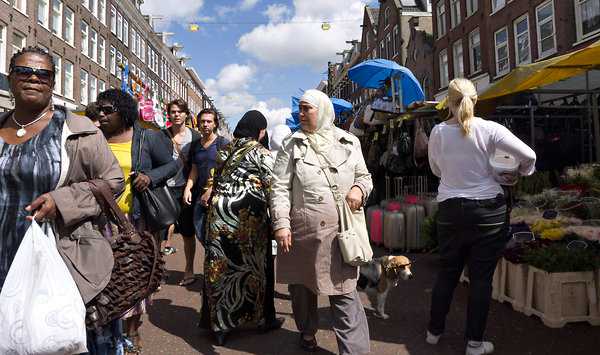
    Albert Cuyp Market, on a popular street in Amsterdam. In light of the mass killings in Norway, the Netherlands’ population of Muslim immigrants from Morocco and Turkey has stirred debate.

    The sometimes violent European backlash against Islam and its challenge to national values can be said to have started here, in a country born from Europe’s religious wars. After a decade of growing public anger, an aggressively anti-immigrant and anti-Muslim politician, Geert Wilders, leads the third-largest party, which keeps the government in power.

    In Slotervaart, a majority immigrant neighborhood in southwestern Amsterdam, Maria Kuhlman and her friends watched Muslim families stroll by on a Ramadan afternoon, some of the men in robes and beards, the women wearing headscarves. A large blond woman shouted, “Go Wilders!”

    Mr. Wilders’ Freedom Party, which combines racist language with calls for more social spending, won 15.5 percent of the vote in June 2010. He was recently acquitted of charges of hate speech for comparing the Koran to “Mein Kampf” and calling mosques “palaces of hatred.” Mr. Wilders has said that immigrant Muslims and their children should be deported if they break the law, or engage in behavior he has described as “problematic, ” or they are “lazy.” He also warns of the supposed Muslim plot to create “Eurabia.” He declined repeated interview requests.

    While many Dutch recoil at his language, he touches on real fears. “Sometimes I’m afraid of Islam,” Ms. Kuhlman said. “They’re taking over the neighborhood and they’re very strong. I don’t love Wilders. He’s a pig, but he says what many people think.”

    Now, after Norway, the Dutch are taking stock. The killings frightened everyone, said Kathleen Ferrier, a Christian Democrat legislator born in Surinam, who had objected to her party joining a Wilders-supported government. “Norway makes it clear how much Dutch society is living on the edge of its nerves,” she said. “Wilders says hateful things and no one objects. We have freedom of speech, but you also have to be responsible for the effect of your words.”

    Taboos about discussing ethnicity and race — founded in shame about delivering Dutch Jews to the Nazis — are long gone.

    via Immigration and Islam Raise Questions of Dutch Identity – NYTimes.com.

  • Turkey’s Neo-Ottoman Foreign Policy

    Turkey’s Neo-Ottoman Foreign Policy

    Turkey’s Neo-Ottoman Foreign Policy

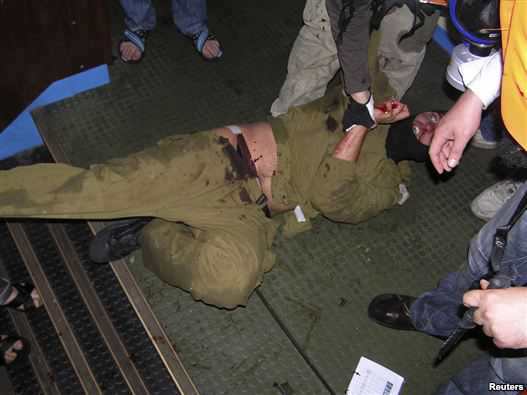
    Pro-Palestinian activists hold down an Israeli commando on the Gaza-bound Turkish ship “Mavi Marmara.” Nine Turkish nationals were killed when Israeli forces boarded the ship in international waters in 2010.

    September 15, 2011
    By Michael Weiss

    How does Turkey’s ruling Islamist party react when it gets a report it doesn’t like from the United Nations?

    By yanking diplomats, threatening military conflict with a neighbor, and menacingly eyeing that neighbor’s new yield of natural resources.

    If the General Assembly ever does something really provocative and votes on a resolution recognizing the Armenian genocide or the right of Kurdish self-determination, you can bet that Turkish Prime Minister Recep Tayyip Erdogan will make the prison guard in “Midnight Express” look like Florence Nightingale.

    Reacting to the leaked UN Palmer Report on the 2010 flotilla fiasco, which found that Israel’s naval blockade of the Gaza Strip is legal and that the passengers aboard the “Mavi Marmara” were cruising for a bruising, Erdogan’s government has taken to issuing thuggish pronunciamentos.

    At issue is the fact that Israel refused to apologize to Turkey for killing nine Turkish nationals in the Mediterranean.

    Israel reckons that to do so would be an insult to the commandos who abseiled onto the “Mavi Marmara” only to be bludgeoned, stabbed, and shot.

    Erdogan’s Justice and Development Party (AKP) has tried to have it both ways on the flotilla. It banned its own members from participating in order to distance itself from what was obviously a blockade-running provocation.

    Yet ranking AKP members are on the board of IHH, the Turkish “charity” that organized the event.

    Anatolian Chest-Poundings

    And Erdogan’s refusal to let the 2011 flotilla start out from Istanbul — at the urging of Washington — complicates the government’s claims of having no control over a supposedly independent NGO. Needless to say, bilateral relations with Israel have gone from lousy to dire.

    “The eastern Mediterranean will no longer be a place where Israeli naval forces can freely exercise their bullying practices against civilian vessels,” one Turkish official said, promising a military escort for all future “aid” ships to Gaza — assuming, that is, that these ships can outfox the savvy Israeli lawyers who made the sequel set-sail a busted flush.

    From the sound of it, Turkey now wants to become the chief maritime bully. Part and parcel with its “more aggressive strategy” in the eastern Mediterranean is its attempt to stop Israel from mining its huge natural gas and oil fields, recent discoveries which some experts predict will make the Jewish state one of the largest — and wealthiest — energy exporters in the world.

    The threat by a NATO member to skirmish on the high seas with a major U.S. ally follows other Anatolian chest-poundings.

    Turkish Prime Minister Recep Tayyip Erdoganyrian (left) had done “happy business” in the past with Syrian President Bashar Assad

    Earlier in the week, Turkish Foreign Minister Ahmet Davutoglu, whose foreign policy vision used to be known as “no problems with the neighbors,” announced that Ankara would be expelling all Israeli Embassy officials above the rank of second secretary.

    Erdogan wants to visit Gaza in the coming days to increase “international attention” on Israel’s siege of the strip.

    This from the man who previously said that he doesn’t think Hamas is a terrorist group.

    Erdogan’s visit is sure to impress upon Palestinian President Mahmoud Abbas which  party the AKP would like see ruling the Palestinian state the UN is about to recognize.

    A Dirty Little Secret

    Finally, Erdogan vowed to suspend all military relations and defense industry trade between Turkey and Israel.

    Years ago, this might have been significant. Yet here’s a dirty little secret: Greece, which diplomatically facilitated the second flotilla’s deep-sixing, is fast replacing Turkey as Israel’s favorite regional military partner.

    Not only is flight distance between Israel and Greece the same as that between Israel and Iran, but the Hellenes have got S-300 antiaircraft missiles that the mullahs have been itching to buy from Russia in order to deter an Israeli attack on Iran’s nuclear weapons program. Joint Israeli-Greek military exercises are therefore seen as very valuable at the moment.

    The Israelis and Palestinians have had their share of Turkish strong-arming, but so have the Syrians.

    Indeed, the reason that a Syrian National Council was hastily announced on Al-Jazeera late last month, following weeks of oppositionist wrangling and backbiting at a conference in Istanbul, is that a faction of Syrian youth activists had grown tired of seeing the AKP trying to make their revolution a Muslim Brotherhood-led affair. (What better way to minimize the Islamists than to appoint a secular French sociologist chairman of a transitional body, as the Syrian National Council voted last month?)

    Erdogan did happy business with Bashar al-Assad while he could, but he now wants to make sure that any post-Assad state consists of loyal Sunni ideologues.

    That’d be one way to undercut Iran’s influence in the Middle East, and never mind that the people bleeding and dying in Syria are mostly apolitical kids who don’t trust neo-Ottoman power brokers any more than they do former regime apologists.

    Turkish intelligence and the Muslim Brotherhood are also trying to co-opt the Syrian Free Army of rebel soldiers, according to Syrian sources.

    “They are the only ones connected to them,” one opposition activist told me recently. “I’d rather the Syrian Free Army connect to the CIA. Tell your NATO friends that I extend them an open invitation to Syria.”

    Michael Weiss is the communications director of The Henry Jackson Society, a foreign policy think tank based in London. The views expressed in this commentary are the author’s own and do not necessarily reflect those of RFE/RL

  • Turkey Beats Israel in Politically Charged Soccer Match

    Turkey Beats Israel in Politically Charged Soccer Match

    By JOE PARKINSON

    ISTANBUL—Fiyapi Inonu Stadium on Thursday showcased the latest sign of the deteriorating diplomatic relationship between longtime allies Turkey and Israel: 12 Israeli soccer fans.

    Engulfed by a sea of empty white seats in the 32,000-capacity stadium and vastly outnumbered by battalions of riot police, the solitary Israelis had traveled to cheer their team, Maccabi Tel Aviv, against Istanbul’s Besiktas in a politically charged Europa league match.

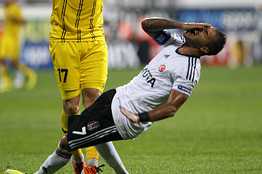
    Ricardo Quaresma of Besiktas reacted as he was stopped by Savo Pavicevic of Maccabi Tel Aviv during their match.

    When the tournament schedule was announced, Istanbul authorities had expected thousands of Israeli supporters to attend, but just a dozen made it there amid rapidly escalating tensions between Ankara and Jerusalem and fears of violence.

    Israeli fans were shepherded into the visitors’ stand at the far end of the stadium, which is covered by a special fireproof netting to shield spectators from projectiles.

    “I’ve been to games between Israeli and Turkish teams many times and we usually see hundreds or thousands of visiting fans,” said Joseph Perez-Ari, a commentator for Tel Aviv Radio broadcasting at the stadium. “Today there’s so few. It’s because people are scared, because of the situation.”

    Late Thursday, the match appeared to have passed largely without incident as Besiktas, the pre-game favorites, romped to a 5-1 victory.

    But the dramatically increased police presence and sporadic protests by anti-Israeli demonstrators in the center of the city underscored that the relationship between the countries is being redefined.

    Tensions escalated after Israel refused to apologize for a raid on a Gaza-bound ship last year that killed nine activists, prompting Turkey to expel top Israeli diplomats, cut military ties with the country and vow to send navy vessels to escort aid ships in the future.

    That coincided with Turkey showing signs of trading its vaunted “zero problems with neighbors” foreign policy for a more muscular approach, bidding to become the leading power in the Middle East and North Africa. The shift, on display as Prime Minister Recep Tayyip Erdogan approved a major aerial bombing campaign against Kurdish rebels in northern Iraq and pressed Egypt to let him visit Hamas-run Gaza, could trigger clashes with Jerusalem and force Washington to choose between its closest allies in the region, analysts said.

    At Thursday’s match, fans said Besiktas’s on-field domination may have diminished the potential for violence, which could have further fueled tensions.

    Still, Thursday saw an escalation of diplomatic tensions in the eastern Mediterranean.

    Turkey’s foreign ministry warned that it would sign a continental-shelf delimitation agreement with Turkish-backed Northern Cyprus if the Greeks of the divided island move ahead, following a December maritime-demarcation deal with Israel, to develop offshore natural-gas fields.

    Athens responded by calling on Turkey to drop threats to Cyprus, warning the dispute could prove “dangerous” to the already tense eastern Mediterranean basin.

    In Tunis, Prime Minister Erdogan, following a meeting with his Tunisian counterpart Beji Caid Essebsi, reiterated that Turkish warships would be deployed in the Mediterranean, stressing that Israel would “no longer be able to do what it wants” in those waters.

    The buildup to Thursday’s match also reflected heightened diplomatic tension.

    Before the evening kickoff, several hundred protesters gathered in Istanbul’s landmark Taxim Square, chanting anti-Israel and anti-American slogans and briefly halting traffic at one on the city’s busiest intersections.

    The Israeli team arrived at Istanbul’s Ataturk Airport on Wednesday under tight security and were escorted from the stadium by riot police after the match.

    Istanbul police tried to calm fears, stressing that they had taken measures to thwart protests that were organized on social-networking websites, including possible plans to invade the pitch.

    Amid fears over their citizen’s security, Israeli authorities had petitioned UEFA, European soccer’s governing body, to reschedule the game at a neutral venue, but Turkey’s government refused, last week offering guarantees for players’ and fans’ safety.

    Turkish Sports Minister Suat Kilic told reporters at a televised news conference last week that “various issues” existed between Turkey and Israel, “but it is not a situation that could prevent this match. “The game would be played in the “highest level of [Turkish] hospitality,” and that Israeli players would “safely” return home, he added.

    Write to Joe Parkinson at [email protected]

    via Turkey Beats Israel in Politically Charged Soccer Match – WSJ.com.

  • Turkey’s Prime Minister Hails Arab Democracy Efforts in Tunisia

    Turkey’s Prime Minister Hails Arab Democracy Efforts in Tunisia

    Turkish Prime Minister Recep Tayyip Erdogan said Thursday that Islam and democracy are not contradictory.

    Tunisian Prime Minister Beji Caid Essebsi, right, shakes hands with his Turkish counterpart Recep Tayyip Erdogan at the prime minister office in Tunis, September 15, 2011.

    On the second leg of his North Africa tour, Erdogan spoke in Tunis where the “Arab Spring” protest movement began this year. After meeting with Tunisian prime minister Beji Caid Essebsi, Erdogan said “a Muslim can run a state very successfully.”

    Tunisians are set to vote on October 23 in assembly elections, the first since Tunisian protests helped depose longtime ruler Zine el-Abidine Ben Ali.

    In Turkey, Erdogan’s party has Islamist roots and its election success has served as a model for political groups spreading in the Arab world. Turkey is 99 percent Muslim.

    In comments to reporters, Erdogan also slammed Israel for saying Turkey is ready to deploy warships “at any time” if a feud with Israel over its blockade of Gaza escalates.

    Erdogan’s visit to Tunisia comes after a stop in Egypt.

    On Wednesday, Erdogan spoke with leaders of Egypt’s Muslim Brotherhood after receiving a hero’s welcome from Egyptians for his pro-Palestinian stand.

    Erdogan’s four-day diplomatic visit to North Africa is aimed at expanding Turkey’s growing influence in a region full of political upheaval.

    He goes next to Libya, and is expected to meet with the head of Libya’s National Transitional Council Friday.

    Some in Israel have expressed concern that Erdogan’s “Arab Spring” diplomatic tour will stoke anti-Israel tensions, as it comes while Turkish-Israeli relations have hit new lows.

    The two countries have been in a dispute over Turkey’s demand for an apology for Israel’s deadly raid on a Gaza-bound Turkish aid ship last year. Turkey recently expelled the Israeli ambassador and other top diplomats from Ankara, and has suspended military trade and cooperation with Israel.

    Some information for this report was provided by AP, AFP and Reuters.

    via Turkey’s Prime Minister Hails Arab Democracy Efforts in Tunisia | Middle East | English.

  • Angry activists say Turkey handed deserted officer to Syria

    Angry activists say Turkey handed deserted officer to Syria

    Angry activists say Turkey handed deserted officer to Syria

    By Ivan Watson, CNN
    September 15, 2011 — Updated 1820 GMT (0220 HKT)
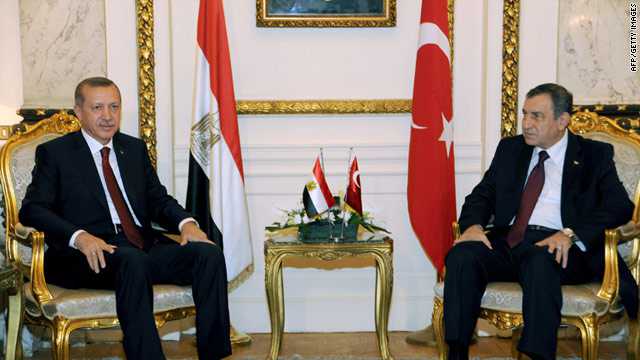
    Activists tried to confront the Turkish Prime Minister, pictured here with Egyptian PM Essam Sharaf, while in Egpyt.
    STORY HIGHLIGHTS
    • NEW: In his “confession,” al-Harmoush says he was not ordered to fire on civilians
    • Lt. Col. Hussein al-Harmoush of the Syrian army defected to Turkey
    • There’s no explanation from the Turkish side about his reappearance in Syria
    • Activists say they feel betrayed by Turkey

    Istanbul (CNN) — Syrian activists are denouncing the Turkish government in the wake of the Syrian regime’s announcement that it has a deserted army officer in custody.

    Lt. Col. Hussein al-Harmoush defected months ago and began broadcasting video statements denouncing the Syrian government, before eventually fleeing to neighboring Turkey.

    News of his detention by Syria comes amid persistent international consternation with that country’s regime for its fierce crackdown on anti-government protesters, a six-month outpouring that has resulted in more than 2,600 deaths.

    “Enough is enough,” U.N. Secretary-General Ban Ki-Moon said Thursday, urging “some coherent measures” against President Bashar al-Assad’s regime.

    Omar al-Muqdad, a prominent Syrian opposition activist who is now in exile in Turkey applying for refugee status, said the Turks handed al-Harmoush over to the Syrian secret police.

    “The Turkish government is directly responsible for Harmoush’s destiny, because Harmoush was a refugee on their territory. They have to be honest about him. …under international rules, any country that receives him has to protect him,” al-Muqdad said.

    Al-Harmoush had called on all Syrian soldiers to defect and mobilize against al-Assad. Eventually he fled Syria to Turkey.

    Two weeks ago, al-Muqdad called CNN in a panic, saying al-Harmoush had gone missing from the refugee camp in Turkey where he’d been living. At the time, he suspected Syrian security agents had kidnapped the defecting officer.

    “I talked to him on the morning of August 29th,” al-Muqdad said.

    “He said ‘I have a meeting with a Turkish security man. When I finish I will call you.’ I waited for three days and didn’t hear from him. Then after that we discovered that the security man took him and didn’t send him back to the camp. They sent him to Syria directly. The Turks made a trick with Harmoush. They caught him in Turkey and sent him to Syria.”

    The Syrian Arab News Agency said Syrian TV broadcast an interview or what it called a “confession from al-Harmoush” on Thursday night.

    Al-Harmoush said he defected because of bloody incidents, but he was not ordered to open fire on civilians.

    He said opposition members, including members of the Muslim Brotherhood, contacted him while he was in Turkey. He discussed talk of weapons and money. He said he didn’t get the kind of support he was promised. The interview didn’t indicate how he returned to Syria.

    Another Syrian activist, Omar Idilbi of the Local Coordination Committees of Syria, said that from what Syrian TV is showing, there are signs that al-Harmoush has been tortured.

    CNN has previously asked the Turkish Foreign Ministry about al-Harmoush, but Turkish diplomats said they were not familiar with his case.

    Turkish Foreign Ministry officials were accompanying Turkish Prime Minister Recep Tayyip Erdogan on a tour of Egypt, Tunisia and Libya.

    One official who requested anonymity told CNN the government “on principle” never hands over people who came to Turkey on humanitarian grounds.

    There are more than 7,600 Syrian refugees in six Turkish refugee camps and there is daily traffic back and forth across the borders.

    In Egypt, the first stop on the Turkish delegation’s trip, Syrian activists tried to confront Erdgoan about al-Harmoush. When Erdogan emerged from the headquarters of the Arab League in Cairo on Tuesday, a crowd of angry Syrian activists stood outside the gates chanting “Erdogan coward” and “Erdogan, where is Harmoush?”

    Erdogan waved to the crowd, apparently not understanding the question. But one Syrian activist cornered a senior Turkish official next to the government motorcade and demanded to know al-Harmoush’s whereabouts.

    The Turkish official had no idea what he was talking about. Turkey is critical to the Syrian opposition movement. Dissidents have fled to Turkey to escape the ongoing government crackdown in Syria and have been holding opposition meetings in Turkish cities.

    On Thursday, a Syrian opposition council is announcing its creation in Istanbul, the latest in a number of groups claiming to represent the opposition in Syria and abroad.

    But now, with Syria announcing it has al-Harmoush in custody, opposition activists said they feel betrayed by the Turkish government.

    “I can’t trust the Turks any more. They are hypocrites,” said al-Muqdad.

    “There are a lot of questions that the Syrian government and the Turkish government should answer,” said Idilbi, who is based in Beirut, Lebanon.

    The importance of al-Harmoush to the Syrian regime became evident September 8, when opposition activists and residents inside Syria called CNN to report Syrian security forces had attacked the village of Ibleen, where al-Harmoush’s brother Mohammed lived.

    According to the London-based Syrian Observatory for Human Rights, a number of Syrian army defectors had taken shelter in Ibleen while awaiting the chance to smuggle themselves across the nearby border to Turkey.

    Video filmed of the aftermath of the Syrian government raid showed blood-spattered houses, burned-out cars and trucks, and a ransacked home.

    At least five people were killed in the raid, including al-Harmoush’s brother. His corpse was shown in another video released by opposition activists. Thousands of people attended his funeral.

    Syria’s state news agency claimed responsibility for the raid on Ibleen, saying Syrian security forces had killed a number of “armed terrorists” who had been residing there.

    Violence continued Thursday. The Syrian Observatory for Human Rights said security forces killed one person and wounded five others in the Damascus countryside. A volunteer Red Crescent medic who was wounded in the western city of Homs last week has died of his injuries at a Lebanese hospital, the group said.

    Last month, al-Assad told the U.N. secretary general that military operations in the country had been halted. The regime has indicated that it wanted to end the fighting and foster stability.

    “These promises have been broken promises,” Ban said said Thursday.

    CNN’s Yesim Comert and Tracy Doueiry contributed to this report