Blog

  • U.S. Falls Out of Favor With NATO Ally

    U.S. Falls Out of Favor With NATO Ally

    By Marc Champion

    Associated Press

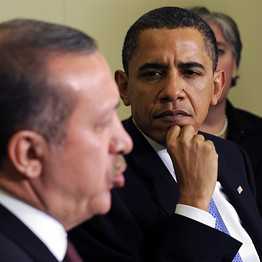
        Associated Press     President Barack Obama listens to Turkish Prime Minister Recep Tayyip Erdogan during their 2009 meeting in the Oval Office.
    Associated Press President Barack Obama listens to Turkish Prime Minister Recep Tayyip Erdogan during their 2009 meeting in the Oval Office.

    President Barack Obama listens to Turkish Prime Minister Recep Tayyip Erdogan during their 2009 meeting in the Oval Office.

    The latest global poll by the Pew Research Center released Wednesday makes grim reading for U.S. diplomats trying to turn the Arab Spring to Washington’s advantage, and most of all anyone tasked with improving relations with NATO ally Turkey.

    Of the six Muslim nations polled in the region, not one showed a majority of opinion in favor of the U.S. And in every nation but Egypt, the popularity of the U.S. fell since a year ago.

    The U.S. gets close to majority approval in Lebanon, at 49%, while Egypt was next with 20% — after all, the U.S. eventually did the right thing in the eyes of Egyptians by calling for the ouster of former President Hosni Mubarak.

    But this year the lowest approval rating of all for the U.S. was in Turkey — at just 10%, down from 17% last year. U.S. President Barack Obama, who is due to give a major speech on the Middle East Thursday, didn’t fare much better. Only 12% of Turks said they had confidence in President Obama, against 73% who didn’t.

    The image of the U.S. has declined significantly across the Middle East since the lead-up to the 2003 Iraq war. Washington continues to be seen as acting without concern for the interests of other nations in the region and is widely seen as a potential military threat by those who live in the region — including 91% of Palestinians and 59% of Turks, according to the survey.

    It isn’t hard to figure out why U.S. popularity might have dwindled further in Turkey over the past year. Since the last Pew poll, the U.S. — in the view of most Turks — failed to support Ankara when Israeli commandoes boarded a mainly Turkish aid flotilla for Gaza, killing eight Turkish citizens and one American of Turkish descent. The U.S. also rejected a deal that Turkey and had Brazil agreed with Iran to swap low enriched Iranian nuclear fuel for fuel rods, which was seen here as a snub.

    But Turks may also see the U.S. as a competitor for leadership in the region as Ankara claims an increasing role across the Middle East. Only 8% of Turks approved of the way the U.S. handled the Arab uprisings, compared to 45% of Egyptians, 31% of Jordanians and 33% of Palestinians.

    There is good news in the data for anyone worried about Turkish Islamism, though. Turks were by far the least likely of the nations polled to say that the country’s laws should be based on the teachings of the Quran — at just 8%. That compares with 78% in Pakistan and 70% in Jordan.

    And while Turks are strongly anti-Israel and opposed to U.S. policies on the Palestinian question, only 10% say they approve of Hamas (compared with 45% of Egyptians), while just 5% of Turks approve of Hezbollah and 4% of al Qaeda.

    The poll of roughly 1,000 people in each country was conductaed before the U.S. shooting of Osama bin Laden.

    via U.S. Falls Out of Favor With NATO Ally – Emerging Europe Real Time – WSJ.

  • Turkey and Middle Eastern democracy

    Turkey and Middle Eastern democracy

    By Eli Martin

    Harvard Political Review, Harvard U. via UWIRE

    Dani Rodrik is the Rafiq Hariri professor of International Political Economy at the John F. Kennedy School of Government. His father-in-law, Cetin Dogan, is a lead defendant in Turkey’s Sledgehammer trial.

    Harvard Political Review: How has Turkey responded to the recent events and uprisings in the Middle East?

    Dani Rodrik: Turkey was caught unaware by the Middle East revolutions. Turkey’s relationship with the countries of the Middle East was largely based on a strategy of establishing good relationships with the existing political leadership. To that extent, I think that Turkish leadership was at a loss as to how to respond and they did so in a relatively ad-hoc manner.

    HPR: Do you think Turkey would like to see democracy throughout the Middle East, in an ideal situation?

    DR: I think ultimately Turkey would like to see itself as a leader in a broadly democratic Middle East. There are a couple of things mitigating against that: Some economic interests with existing governments played a conflicting role. Part of the reason Turkey was behind the ball in Libya was that a significant amount of Turkish investment existed in Libya, and Turkey wanted to ensure the safety of those investments, thus delaying their willingness to be on the side of popular protests.

    I think the second important factor that’s going to make it hard for Turkey to lead is that if Egypt does become a democratic country, it is going to be a much more central focus in a democratic Middle East, given its size and importance. Turkey could find itself in competition with Egypt if Egypt, as one hopes, emerges as a robust democracy.

    HPR: You published a book in December on the trials of a broad range of individuals allegedly part of the “Sledgehammer plot” to overthrow the Turkish government. You wrote on your blog that you never imagined yourself having to write this book. Is this a sign of how much Turkey has changed recently?

    DR: Turkey faces huge problems in terms of its political system. I think it is unfortunately going in an authoritarian direction, just as the rest of the region is going in the opposite direction.

    I was hopeful until two years ago that the current government was interested in deepening democracy in Turkey and in strengthening the rule of law. Unfortunately, having watched the ongoing political and military trials closely, it is clear that the rule of law is being systematically undermined and that this would be impossible without the support of the government behind the scenes. Therefore, I see that the government is moving Turkey in a direction that is increasingly authoritarian rather than more democratic. I think the Western media missed this because of Turkey’s story—it looked like a straightforward and appealing narrative of a popularly elected government finally prevailing and enabling the judiciary to address the transgressions of the secular old guard. However, these trials are much closer to show trials.  Look at them closer, and what you find is that the evidence used to lock defendants up ranges from the circumstantial to the demonstrably fabricated. Their real purpose seems to be to demonize the opposition, mobilize domestic support and ensure that state institutions remain under the control of the government for a very long time, rather than to enforce the rule of law.

    HPR: Could you describe Turkey’s current political situation in greater detail?

    DR: There are three groups you need to consider to understand Turkish politics. The first are the representatives of the old order—the military, and the ultra secular groups of the past, which tended to dominate the universities, state institutions, and the higher courts until recently. This group has been the big loser during the last decade.

    That leaves the other two groups in charge. One is the governing party, the Justice and Development Party (AKP), led by Prime Minister Recep Erdogan.

    And the third group, which very few people know much about, is a religious network—the Gulen network—directed by an Islamic preacher, Fetullah Gulen, who lives in Pennsylvania. This is a vast network, very wealthy and very influential, which runs an educational and media empire. Its representatives occupy key positions in the national police and the judiciary. The Gulenists and the AKP have made common cause against the old guard. But given that the old guard has now lost its power, it may turn out that the tension between these two groups will come out into the open in the form of direct competition. I see neither Erdogan nor the Gulenists as a force for democracy.

    HPR: Does the AKP have an Islamist agenda to turn Turkey into an Islamic state? Is that something that people should fear, either about the AKP, or about the Gulenist movement?

    DR: I’m more worried about the Gulen movement, because it lacks transparency and much of the dirty tricks in Turkish politics and judiciary seem to be linked to it. Gulenist police and prosecutors have mounted sham trials under the guise of cleansing the system from coup plotters.  Gulenist media are engaged in systematic disinformation about these trials. These activities are very difficult to reconcile with the moderate, liberal and humane version of Islam that the movement preaches. As for the AKP, I worry less about its Islamist leanings, and more about an ingrained authoritarianism. My worry is less that Turkey will become the next Iran, but that Turkey will become a worse version of Russia, where the media and the judiciary are effectively controlled and manipulated by pro-government forces.

    HPR: Do you think the central tenets of your most recent book, The Globalization Paradox—that economic globalization, national sovereignty and democracy are incompatible—can be applied to the current situation of the Turkey and the Middle East?

    DR: The Middle East crisis reminds us of the centrality of national governments in people’s lives, in economic, political and social affairs, and of the need to have good governance at the national level.

    Despite all the talk about how the world has become “flat” and national borders don’t matter anymore, the well-being of people by and large still revolves around what national governments do and don’t do. The countries that are in the best position to reap the rewards of economic globalization are in fact the ones that have strong, well-governed states and national governments.

    This interview has been edited and condensed.
    Read more here:

    Copyright 2010 Harvard Political Review

  • On Site: Turkey’s Newest Tourism Strategy

    On Site: Turkey’s Newest Tourism Strategy

    At a formal dinner hosted by the Izmir Development Agency on May 16, Izmir Governor Cahit Kıraç announced the development of a new tourism strategy targeted toward increasing tourism to Izmir, Turkey’s third largest city and securing its position as the host city of the 2020 World Expo.

    During his opening speech, Kıraç noted that while Turkey as a whole saw some 27 million tourists in 2010, only 1 million of those tourists visited Izmir. Izmir, formerly known as Smyrna, is a port city located along the eastern Aegean coast; it boasts a long history of more than 8,000 years and played an important role in the Hellenistic, Roman, Byzantine and Ottoman periods.

    Today, while the city is frequented often by Turkish travelers, it has yet to capture the attention of international tourists, which is why the Turkish Ministry of Culture and Tourism, in cooperation with the Izmir government and the Izmir Development Agency, is working hard to promote the city as a world-class destination.

    The dinner welcomed Kıraç and other tourism and municipal officials, including more than 70 different journalists from 26 countries worldwide, including Travel Agent, whom the agency hopes will promote the region through various forms of international media.

    “We want to introduce more of ourselves and our cultural heritage to the rest of the world,” said Kıraç.

    During a conversation with Kıraç’s translator, Travel Agent learned that the new strategy, while still in development, has a tentative slogan that will promote Izmir as “the most rewarding Mediterranean city.” The government and the Ministry of Culture and Tourism are also planning to host numerous fam trips that will introduce travel agents to the region, which they believe is rich in its history, culture, gastronomy and beaches.

    Currently, Izmir is an official candidate for the 2020 World Expo, running on the theme, “New Routes to a Better World–and Health for All,” which emphasizes the region’s naturally occurring thermal sources, vegetation and history.

    via On Site: Turkey’s Newest Tourism Strategy | Travel Agent Central.

  • Israel Matzav: Turkey fears losing its best friend

    Israel Matzav: Turkey fears losing its best friend

    Turkey has stepped on the toes of its best friend, Bashar al-Assad. And now, it is trying to figure out what it will do if Bashar should fall.

    But what annoyed the Syrians was Erdogan’s remarks in Turkey against the use of force and the fear of “a new Halabja and Hama,” referring to the use of chemical weapons by Iraq against the Kurds, and the massacre of 10,000 residents of Hama in 1982 by Assad’s father, Hafez Assad.

    The Syrian newspaper Al-Wattan, which is owned by Rami Makhlouf, Bashar Assad’s cousin and the richest man in the country, launched an unprecedented attack against the Turkish declarations.

    “Since the start of the recent events in Syria, the official Turkish echelon has demonstrated haste and improvisation,” the paper wrote. “It seems that the preaching in favor of reforms that is being manifested vociferously by Erdogan on every possible stage in Europe, and that of the new Ottoman engineer, the foreign minister Davutoglo, do not provide any special means of bringing about solutions to the invented difficulties so as to deal openly and clearly with these events.”

    Makhlouf’s paper didn’t stop there. “If the political and economic prosperity that Turkey enjoys must be attributed to its secular history and to the strategic corrections made by Davutoglo, then the way it is being conducted in the face of the Syrian question is likely to cause it to take a step back,” it continued.

    Erdogan, who attributes Turkey’s economic prosperity to himself – and justly so – was surely not happy to read the translation of these remarks, especially since the volume of Turkish trade with Syria stands at some $2 billion.

    Last week a representative of the Muslim Brotherhood from Syria, Mohammed Riad Shafeka, visited Istanbul and told the Turkish media that his movement was indeed the moving force behind the protests in Syria. By doing so, he actually played straight into the hands of Assad’s regime, which has claimed all along that the disturbances were being caused by Islamic extremists and separatists.

    Syria does not understand why Ankara allowed Shafeka to go to Istanbul from his exile in Yemen and why its media were allowed to interview him. And indeed Erdogan hastened to declare through his foreign ministry spokesman, that “Turkey will not allow any initiative on the part of the Muslim Brotherhood to harm the execution of reforms in Syria.”

    According to reports from Turkey, Syria has sent information to the head of Turkish Intelligence, Hakan Fidan, showing that the Muslim Brotherhood was involved in shooting at Syrian security forces during the protests, so as to counter the declarations by Erdogan that “there are no armed gangs in Syria,” contrary to what the Syrian regime claimed.

    Erdogan explained that what is happening in Syria cannot merely be considered an internal Syrian affair, or merely a matter for Turkish foreign policy.

    Turkey is concerned both by the possibility that the Assad regime will fall and by the fact that it does not see who could possibly replace it. Meanwhile it seems that Erdogan and his regime are mainly worried that the all-embracing foreign policy started by his government could crash and have an effect on the results of the elections to be held on June 12.

    This policy, which has the slogan “Zero problems with all neighbors,” is now coming up against the unexpected reality in which Turkey, despite all its efforts, finds itself floating on stormy waters, without being able to influence the course of events, and being seen as a supporter of the Assad dictatorship.

    One day the Turks might even come to regret befriending Iran and shunning Israel. One day. But not now.

    via Israel Matzav: Turkey fears losing its best friend.

  • Turkey’s Show TV up for sale? | Advanced Television

    Turkey’s Show TV up for sale? | Advanced Television

    By Chris Forrester

    Turkey’s Cukurova Holdings, which also controls pay-TV platform Digiturk, is looking to sell a 49 per cent stake in its popular general entertainment channel Show TV.

    Reports suggest that the stake could be sold to US private equity players in order to reduce Cukurova’s heavy tax debts. KKR and Texas Pacific are both named as potential buyers.

    Show TV is said to be worth at least $800 million, and could top $1 billion in value on a typical multiple of 12-times earnings, say local reports.

    Cukurova might not be finished with its tax-paying efforts suggest local reports, with sources suggesting that elements of DigiTurk itself, or telco Turkcell which it controls might also be sold off.


  • IMF’s New Chief, New York Times and Turkey’s Crab Mentality

    IMF’s New Chief, New York Times and Turkey’s Crab Mentality

    While Dominique Strauss-Kahn is waiting in jail, Treasury Secretary Geithner suggested DSK to step aside. There are a few leading candidates for this position. One of them is Turkey’s Kemal Dervis. He is the former head of United Nations Development Programme, and the Vice-President for Poverty Reduction and Economic Management at the World Bank. He is qualified for the position but his chances are really slim.

    This didn’t stop the Turkey’s ruling party and its finance minister, Mehmet Simsek, from sabotaging Kemal Dervis’ slim chances of becoming IMF’s next president. This is the crab mentality at its rawest form. A decade ago Turkey got into a Greek-style budget deficit problem where almost everybody expected Turkey to default. Turkish Prime Minister asked Dervis to leave his post at the World Bank and help him with the budget and debt crisis. Dervis cut a deal with the IMF and went on to implement the plan. He was so successful that Turkey didn’t default on its debt and started to grow at a very healthy pace again. However, Erdogan’s AKP won the elections in 2002 and reaped all the benefits of Dervis’ hard work. Between 2002 and 2007, the Turkish economy grew by more than 7% annually, thanks to declining interest rates and the implementation of an IMF-backed programme that was struck by Dervis. Turkish economy went back to its mediocre performance after the IMF agreement ended in early 2008.

    Erdogan’s AKP doesn’t have any credible alternatives in Turkey and they are expected to win the 2011 elections. However, they are worried that if Dervis becomes the next chief of the IMF, he will probably be an unbeatable candidate in 2015. That’s why they are trying to pull him down like crabs pulling down other crabs in a boiling pot. That’s why Mehmet Simsek, who was just a managing director at Merrill Lynch before he became Turkey’s finance minister and Erdogan’s puppet, announced his candidacy to run the IMF.

    The New York Times didn’t waste this opportunity and made fun of Mehmet Simsek by saying “Among some potential candidates, modesty was not a characteristic widely on display.” The funny thing is Dani Rodrik, a Turkish economist at Harvard, published an article yesterday supporting Kemal Dervis’ candidacy. It’s well known that Rodrik doesn’t like the Erdogan government and he saw this as an opportunity to make a jab. Unfortunately Simsek announced his ridiculous candidacy to give the Germans and the French enough ammunition to shot Dervis’ slim chances down.

    via IMF’s New Chief, New York Times and Turkey’s Crab Mentality – Insider Monkey.