BEIRUT: Showers that poured heavily Monday morning after a month of drought helped contain fires that raged across Lebanon over the weekend.
Rains put out a major fire in the Jbeil town of Fitri, which came over swathes of woodland and threatened residences. The Lebanese government sought the help of Turkey and Jordan to extinguish the 120 fires that broke out over the weekend.
But after Monday morning’s showers, the country’s helicopters did not fly to Lebanon, according to a security source.
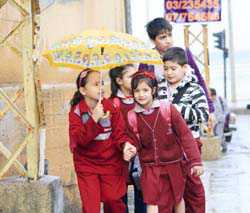
The much-awaited rains flooded streets and caused heavy congestion. Meteorological reports Monday, however, said showers would not resume over the course of the week.
Meanwhile, Prime Minister Saad Hariri headed a meeting at the Grand Serail to discuss the management of forest fires.
The meeting was by Interior Minister Ziyad Baroud, Agriculture Minister Hussein Hajj Environment Mohammad Rahhal, the Secretary General of the Higher Council of Defense Major General Adnan Merheb, the Director General of Civil Defense General Darwish Hobeika, head of Beirut Fire Brigade general Mounir Mkhalalati, the prime minister’s adviser for developmental affairs Fadi Fawwaz, and Head of the disaster risk reduction Unit at the Presidency of the Council of Ministers Nathalie Zaarour.
According to a statement by Hariri’s press office, discussions tackled weekend fires, and a national strategy approved by Cabinet in May 2009 to fight fires. The meeting discussed implementation mechanisms. Hariri reminded attendees of his decision issued to establish a national committee that includes all concerned administrations, tasked to prepare a comprehensive national plan for disaster management.
Hariri also stressed the need to detail sub-plans for each type of disaster as well as plans for individual governorates.
Another meeting headed by Merheb is expected to take place Thursday to discuss an integrated plan for the management of forest fires fighting and to discuss the needs of the relevant bodies including the army, the civil defense, the internal security forces and Beirut fire brigade, said the statement by Hariri’s office.
“We stressed during the meeting the need to recruit more members for civil defense and update the equipment,” Hajj Hassan told reporters.
“There are elements included in the 2010 budget, such as the recruitment of new members for the civil defense, but in the end we must secure the necessary funding for these issues,” the agriculture minister added.
The eastern-Mediterranean region has witnessed unseasonably high temperatures over the past two months, threatening crops and heralding serious water shortages. Thermometers scored a high of 28 degrees Celsius in Lebanon over the weekend, a temperature rarely if ever witnessed in the country during the month of December.
Lebanon’s southern neighbor Israel succeeded Sunday in containing fires that erupted in the Carmel hills above the Mediterranean port of Haifa. Aircraft were brought in from several countries, including Greece, Britain, Cyprus, Turkey, Russia and France to help contain the deadly blazes which claimed the lives of at least 42 people. – The Daily Star
via The Daily Star – Politics – Rain helps douse fires across country.
Americans dismissed ‘bureaucratic’ Foreign Office concern that Lebanese Hezbollah suspects might be tortured
Richard Norton-Taylor and David Leigh
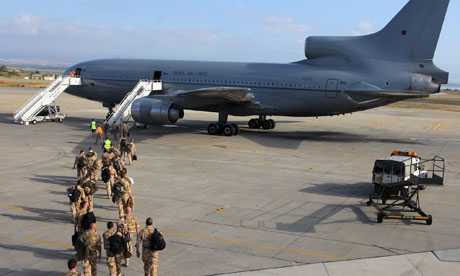
RAF Akrotiri at Limassol, Cyprus. WikiLeaks cables claim the US brushed aside British objections about secret spy flights from the base Photograph: Matt Cardy/Getty Images
American officials swept aside British protests about secret US spy flights taking place from the UK’s Cyprus airbase, the leaked diplomatic cables reveal.
Labour ministers said they feared making the UK an unwitting accomplice to torture, and were upset about rendition flights going on behind their backs.
The use of RAF Akrotiri in Cyprus for American U2 spy plane missions over Hezbollah locations in Lebanon – missions that have never been disclosed until now – prompted an acrimonious series of exchanges between British officials and the US embassy in London, according to the cables released by WikiLeaks. The then foreign secretary David Miliband is quoted as saying, unavailingly, “policymakers needed to get control of the military“.
Ministers demanded a full “audit trail” of covert operations, codenamed Cedar Sweep, amid growing public concern in the UK about unacknowledged CIA rendition flights and alleged UK complicity in torture. The planes gathered intelligence that was then allegedly passed to the Lebanese authorities to help them track down Hezbollah militants. In the past, such flights have also been carried out on Israel’s behalf by the Americans.
As the 2008 row escalated, the US rejected the British concerns over torture in unequivocal terms, with one senior official at the embassy in London baldly stating in one cable: “We cannot take a risk-avoidance approach to CT [counter-terrorism] in which the fear of potentially violating human rights allows terrorism to proliferate in Lebanon.”
The cables disclose that as well as the Lebanon missions, U2s from Akrotiri were gathering intelligence over Turkey and northern Iraq.The information was secretly supplied to the Turkish authorities in an operation codenamed Highland Warrior. The British protested that “in both cases, intelligence product is intended to be passed to third-party governments”.
On 18 April 2008, Britain demanded the US embassy provide full details of all flights so ministers could tell whether they “put the UK at risk of being complicit in unlawful acts … This is a very important point for ministers”.
A US diplomat, Maura Connelly, cabled: “We understand that these additional precautionary measures stem from the February revelation that the US government transited renditioned persons through Diego Garcia without UK permission and HMG’s [her majesty’s government’s] resultant need to ensure it is not similarly blindsided in the future.”
She complained to Washington that the demands were “burdensome” and “an unnecessary layer of bureaucracy”.
Will Jessett, then director of counter-terrorism at the ministry of defence, had sent a letter warning that “the use of UK bases for covert or potentially controversial missions” on behalf of Lebanon or Turkey meant it was “important for us to be satisfied that HMG is not indirectly aiding the commission of unlawful acts by those governments”.
The letter warned that other states, particularly Cyprus, might well object should they find out. Ministers therefore wanted the US to submit each time “an assessment of any legal or human rights implications”.
On 24 April, the embassy sent a cable to Washington entitled: “Houston, we have a problem”. It stated: “HMG ministers are adamant.”
The embassy “pushed back hard” on demands for a full “audit trail” of spy flights. But in what appears to have been a heated dispute, the British responded by detailing other US “oversights”.
“Contacts cited instances in which operations Highland Warrior and Cedar Sweep had been conducted from the UK sovereign base areas of Akrotiri without the proper ministerial approvals … In addition, Highland Warrior had raised tensions with the Cypriots, jeopardising the UK’s hold on Akrotiri.”
There were “other lapses that proved embarrassing to HMG (ie renditions through Diego Garcia and improperly documented shipments of weaponry through Prestwick airport)”.
The US used Prestwick in 2006 as a staging post to ship laser-guided bombs to Israel, causing British protests. The Israelis wanted the munitions to attack Hezbollah bunkers in Lebanon.
The US embassy concluded: “A new element of distrust has crept into the US-UK mil-mil relationship.
“The renditions revelation proved highly embarrassing for the Brown government. The British proposal … may be disproportionate but is almost certainly an indication of the Brown government’s sensitivity … at a time Brown is facing increasing domestic political woes.”
A month later Britain was still, according to the US, “piling on concerns and conditions” about human rights, saying that although junior minister Kim Howells was making the decisions, Miliband was being kept informed.
British officials warned that ministerial concerns “could jeopardise future use of British territory”.
US patience finally snapped when a Foreign Office official, John Hillman, passed on the message that “even the [US] state department’s own human rights report had documented cases of torture and arbitrary arrest by the Lebanese armed forces”.
Hillman urged the US to ensure the welfare of prisoners in Lebanon “if there were any risk that detainees captured with the help of Cedar Sweep intel could be tortured”.
At this point Richard LeBaron, charges d’affaires at the London embassy, cabled Washington that human rights concerns could not be allowed to get in the way of counter-terrorism operations. Britain’s demands were “not only burdensome but unrealistic”, he said, proposing “high-level approaches” to call the British to heel.
“Excessive conditions such as described above will hinder, if not obstruct, our co-operative counter-terrorism efforts,” he said.
Senior Bush administration official John Rood stepped in and the Foreign Office’s director general for defence and intelligence, Mariot Leslie, hastened to placate him.
The clash was “unnecessarily confrontational”, she told him. “Leslie expressed annoyance at the additional conditions conveyed by the FCO working level,” the cable states. “She had not been aware beforehand that such a message would be conveyed. In fact she regretted the tenor of the discussions had turned prickly, and underscored HMG appreciation for US-UK military and intelligence co-operation.”
She reassured him that US was not actually expected to check on detained terrorists.
“Ministers had merely wanted to impress upon the US government that they take the human rights considerations seriously.
“She noted that HMG ‘desperately needs’ [Cyprus] for its own intelligence gathering and operations and was committed to keeping them available to the US (and France).
“However, the Cypriots are hypersensitive about the British presence there, she said, and could ‘turn off the utilities at any time’. That, combined with the ‘toxic mix’ of the rendition flights through Diego Garcia, has resulted in tremendous parliamentary, public and media pressure on HMG.”
Leslie stuck to her guns on one point, saying the US embassy would still have to put in full written applications for future spy missions because “Miliband believed that ‘policymakers needed to get control of the military’.” The cable stated: “Leslie … was very frank that HMG did object to some of what the US government does (eg renditions).”
British ministers loyally kept these objections about the US to themselves, however, despite coming uinder repeated attack from the UK media for alleged complicity in the dispatch of Islamist prisoners to places where they would be tortured.
US use of Cyprus has always been controversial. Relations between London and Washington were strained at the time of the attacks on Israel during the 1973 Yom Kippur war by Ted Heath’s decision to adopt a policy of strict neutrality. The then prime minister refused to allow the US to use Britain’s electronic intercept and air bases on Cyprus .
https://www.theguardian.com/world/2010/dec/01/wikileaks-cables-cyprus-rendition-torture, 2 December 2010
‘Does Israel think it can enter Lebanon with most modern aircraft and tanks to kill women and children, use cluster bombs to kill kids in Gaza, and expect us to remain silent?’ asks Turkish prime minister on visit to Beirut
Erdogan: We will support justice Photo: Reuters
Turkey will not remain silent if Israel attacks Lebanon or Gaza, Prime Minister Recep Tayyip Erdogan said in Beirut on Thursday, as ties between the longtime allies remained at an all-time low.
“Does (Israel) think it can enter Lebanon with the most modern aircraft and tanks to kill women and children, and destroy schools and hospitals, and then expect us to remain silent?” Erdogan said at a conference organised by the Union of Arab Banks.
“Does it think it can use the most modern weapons, phosphorus munitions and cluster bombs to kill children in Gaza and then expect us to remain silent? “We will not be silent and we will support justice by all means available to us.”
Turkey was once Israel’s closest military and diplomatic ally in the Middle East but ties began to deteriorate when Ankara criticised Israel’s December 2008 to January 2009 offensive against Gaza.
Relations then nosedived on May 31, 2010 when Israeli naval commandos stormed a Turkish-registered protest ship, the Mavi Mara, part of a flotilla attempting to break the Israeli blockade of the Palestinian territory. Nine Turkish activists were killed in the operation.
Erdogan has said his country will not begin to restore relations with Israel until it apologizes for its “savage attack” on the vessel. Thursday was the final day of the Turkish premier’s two-day visit to Lebanon.
Hundreds of Lebanese of Armenian descent have clashed with army troops during a protest over a visit to Beirut by the Turkish prime minister.
Recep Tayyip Erdogan is on a two day trip during which he met with officials and visited the north and south of the country.
He was inaugurating a hospital in the southern port city of Sidon Thursday as hundreds of protesters gathered in the capital’s Martyrs’ Square.
When demonstrators tore up a large poster of Erdogan and pelted troops with rocks, security responded by beating up a number of them.
There were no reports of major injuries.
Lebanon has 150,000 Armenians, or nearly 4 percent of its population, which harbors deep animosity toward Turks over the 1915 killing of up to 1.5 million Armenians.
AFP and AP contributed to the story
via Turkey ‘will not be silent’ if Israel attacks – Israel News, Ynetnews.
For the second time in two months, a regional leader has addressed Israel in Lebanon.
This time, however, the words were a lot less harsh.
In a speech delivered in northern Lebanon on Wednesday, Turkish premier Recep Tayyip Erdogan called on the tiny country’s neighbor Israel to embrace peace and stop “provocations,” for its own good.
“The Israeli government has to see and understand this: if there is peace in this region, Israel wins as much as the region. If there is war and clash in this region, Israeli citizens are harmed as much as the people in the region,” he was quoted as saying by Turkey’s semiofficial Anatolia news agency during his official visit to Lebanon. “Thus, we, one more time, invite Israel to peace, return from its mistakes and apologize both for the interest of Israel and the people in the region.”
Erdogan’s remarks were far more diplomatically worded and more conciliatory than the tirade Iran’s president Mahmoud Ahmadinejad delivered in south Lebanon last month, in which he said that “the world should understand that the Zionists will go.”
But despite his carefully chosen words, Erdogan was clear in his message.
He called on Israel to immediately put an end to its “provoking activities” which he said put the region and the world in danger, according to the Anatolia news agency.
The Turkish leader is on a two-day visit to Lebanon accompanied by several Turkish ministers in a bid to enhance cooperation between the two countries and to promote peace and calm amid mounting political tensions over a tribunal examining the 2005 assassination of former Lebanese prime minister Rafik Hariri. The United Nations tribunal is expected to indict high-ranking members of the Lebanese Shiite militant group Hezbollah for involvement in Hariri’s killing, and it is feared such an indictment could spark strife between Lebanon’s Sunni and Shiite communities.
“The Middle East is passing in a very sensitive period and Turkey supports Lebanon,” Erdogan said at a press conference in Beirut on Wednesday. “We think that we should unite and Lebanon should be freed from this tensed atmosphere. I think there is a benefit in helping Lebanon in this respect, and we hope that Lebanon would be able to avoid this tension and regain stability to become a shining star in the future.”
He has had a busy schedule since his arrival, shuttling between the Lebanese capital and the northern parts of the country Wednesday, where he inaugurated a Turkish-funded school and visited an ethnic Turkmen village. Back in Beirut, he signed a free trade agreement between Lebanon and Turkey with his Lebanese counterpart Saad Hariri.
“This agreement is a new beginning for the relations between Lebanon and Turkey and its conclusion reflects our continuous commitment to develop the strong economic and commercial relations between us,” Hariri said at the press conference.
Earlier this year, it was also agreed that Syria and Jordan be included in the free trade zone.
Erdogan was, however, not welcomed with open arms by everyone. Hundreds of Armenian demonstrators reportedly gathered in downtown Beirut on Thursday to protest his visit and some angry protesters even started to rip down billboards of the Turkish leader that had been mounted in the city center.
Armenia wants Turkey to recognize the mass killings of Armenians during World War I as a genocide but consecutive Turkish governments have so far refused to do so. Hundreds of thousands of Armenians died in 1915 when they were expelled from the Anatolia district by the Ottoman Empire.
Erdogan had said in previous remarks that he was also planning to visit the Turkish contingent of the United Nations Interim Force in Lebanon (UNIFIL) in the southern parts of the country. Turkey became the first Muslim country to contribute peacekeeping troops to UNIFIL after it was given a boost in 2006 following Israel’s 34-day-long war with Hezbollah in the summer of that year. Some viewed the decision controversial at the time, considering Lebanon’s history under Ottoman rule, but the total number of Turkish forces serving in UNIFIL was reportedly around 1,000 last year and Erdogan saluted their efforts.
“We think this force is helping Lebanon,” he said in a news conference in Beirut. “I will meet the Turkish soldiers and this is Turkey’s contribution.”
— Alexandra Sandels in Beirut
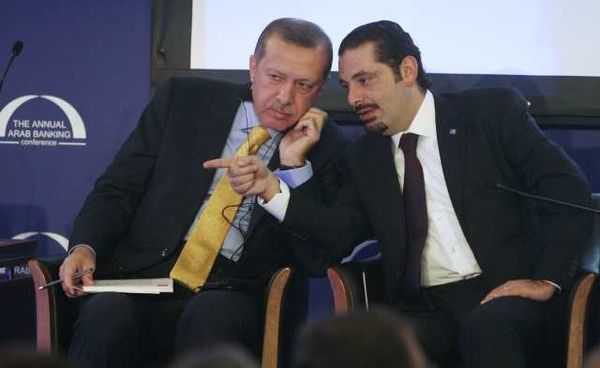
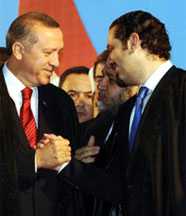
Photos, from top: Lebanon’s Prime Minister Saad Hariri, right, chats with Turkey’s Prime Minister Recep Tayyip Erdogan during the Annual Arab Banking conference in Beirut on Thursday. (Credit: Reuters); Lebanese men of Armenian descent tear up a poster showing the Turkish leader. (Credit: Associated Press)
via LEBANON, TURKEY: Erdogan addresses Israel, shows off Turkish projects | Babylon & Beyond | Los Angeles Times.
Last month the greeting was “Khosh amadid,” Persian for welcome when Iran’s President Mahmoud Ahmadinejad visited Beirut to assert his political influence in the country.
This month, it’s “Merhaba,” Turkish for welcome in honor of the Turkish premier, Recep Tayyip Erdogan, who is scheduled to arrive in Beirut this week in a move that further illustrates how tiny Lebanon is at the whim of foreign powers.
Erdogan’s s visit is likely aimed at attempting to calm the severe political tensions stemming from a United Nations-backed tribunal into the 2005 assassination of former Lebanese premier Rafik Hariri. Turkey will likely use its role as a political and economic regional heavyweight to strengthen ties between the two countries, analysts say.
“It’s extremely important for Turkey to maintain stability in Lebanon,” Mensur Akgun, head of the foreign policy program at the Istanbul-based independent think tank Turkish Economic and Social Studies Foundation, or TESEV, told Babylon & Beyond. “They will do whatever they can do to calm parties.”
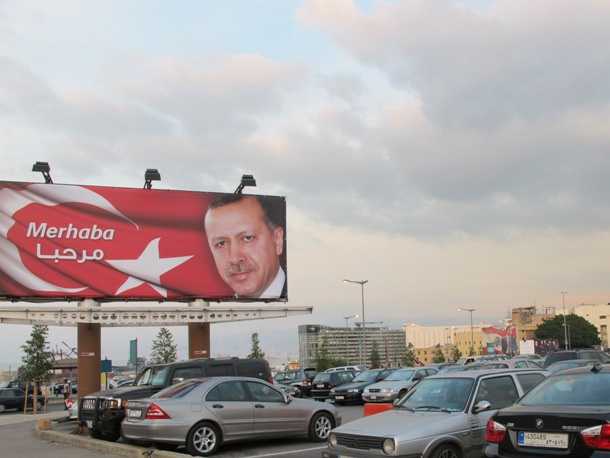
Billboards showing Erdogan with the Turkish flag as backdrop have been mounted in Beirut’s city center, an echo of the scene when Ahmadinejad was welcomed to Lebanon.
The Turkish premier is expected to arrive in Beirut on Wednesday and speak to the press that night, according to the press office of Lebanon’s current Prime Minister Saad Hariri. Erdogan’s visit comes days ahead of Hariri’s scheduled trip to Iran on Saturday.
Turkish leaders might be able to lend a helping hand to troubled Lebanon by mediating with Iran and Syria, amid reports that the U.N.-backed tribunal will likely indict members of Iran- and Syria-backed Lebanese Shiite militant group Hezbollah, an event that’s feared could threaten national security.
“Essentially, Turkey feels it is able to help the Lebanese authorities by establishing political stability in the region by levering on the one hand with Iran and on the other hand with Syria, two countries that have influence on domestic dynamisms in Lebanon,” Sinan Ulgen of the Centre for Economic and Foreign Policy Studies (EDAM) in Istanbul and a former diplomat in the Turkish foreign service told Babylon & Beyond. “The Turkish are pressuring Iran and Syria so that once the verdict is made public, Hezbollah will try not to create instability in the country.”
However, analysts say it’s unlikely that Turkey will move away from its traditional role as mediator and that Erdogan would take an official stand on the tribunal. The court has been marred with controversy, accused of incompetence and dismissed by Hezbollah as an “Israeli project.”
On Tuesday, a report by the Canadian Broadcasting Corp. apparently based on extensive leaks from within the tribunal linked Hezbollah and one of the ex-premier’s top security officials deputies to the assassination, further complicating efforts to resolve the current political stalemate.
Turkey is also throwing weight around in the region across the political and sectarian spectrum, successfully engaging in talks with Shiite Iran and Sunni Egypt, among others.
It’s a much needed skill in politically divided and fragile Lebanon.
“It can really breach the Sunni-Shiite divides in the Middle East. That I think is the value Turkey is bringing to the table,” Ulgen said.
Of course, the famously capitalist Erdogan and Hariri will also try to drum up business for Turkish and Lebanese companies. According to Oussama Safa, head of the Lebanese Center for Policy Studies, his visit will probably focus on strengthening economic and commercial ties between Turkey and Lebanon, boosted earlier this year when Hariri went to Turkey on an official visit to promote closer cooperation between the two countries.
“This is a continuation of Hariri making more approaches,” Safa said. “I don’t see the visit as a political one but for business and culture. It’s very good for Turkey and very good for Lebanon.”
— Alexandra Sandels in Beirut
Photo: A billboard in downtown Beirut shows Turkish Premier Recep Tayyip Erdogan with the Turkish flag as backdrop and says “Welcome” in Turkish and Arabic. Credit: Alexandra Sandels / Los Angeles Times
via LEBANON, TURKEY: Erdogan to visit Beirut to forge peace, make deals | Babylon & Beyond | Los Angeles Times.
Turkish Prime Minister Recep Tayyip Erdogan called on Israel for settlement of peace.
Erdogan visited Turkmens in Kuvasra village in Akkar region of Lebanon together with Lebanese Prime Minister Saad al-Hariri on Wednesday.
Erdogan said, “Israeli government has to see and understand this: if there is peace in this region, Israel wins as much as the region. If there is war and clash in this region, Israeli citizens are harmed as much as the people in the region. Thus, we, one more time, invite Israel to peace, return from its mistakes and apologize both for the interest of Israel and the people in the region.”
We want Israel immediately to stop its provoking activities which endangers the region and the world, added Erdogan.
We want the whole world and public opinion to assume a stance supporting law and justice, said Erdogan adding that Turkey only wanted peace, justice and tranquility in the region.
Regarding Turkish-Lebanese relations, Erdogan said that they would take steps which would strengthen economic and political cooperation. He recalled that visa procedures were lifted mutually between Turkey and Lebanon.
Noting that Turkey would always support Lebanon, Erdogan said that Turkmens in the region would be a friendship bridge between Turkey and Lebanon.
Meanwhile, Hariri said that Lebanon welcomed Turkey’s building a school in the region, and he thanked Erdogan for his efforts.
 Rains put out a major fire in the Jbeil town of Fitri, which came over swathes of woodland and threatened residences. The Lebanese government sought the help of Turkey and Jordan to extinguish the 120 fires that broke out over the weekend.