Category: Iraq

  • Man whose WMD lies led to 100,000 deaths confesses all

    Man whose WMD lies led to 100,000 deaths confesses all

    Defector tells how US officials ‘sexed up’ his fictions to make the case for 2003 invasion

    JONATHAN OWEN
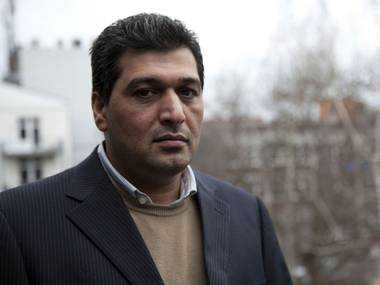
    A man whose lies helped to make the case for invading Iraq – starting a nine-year war costing more than 100,000 lives and hundreds of billions of pounds – will come clean in his first British television interview tomorrow.

    “Curveball”, the Iraqi defector who fabricated claims about Iraq’s weapons of mass destruction, smiles as he confirms how he made the whole thing up. It was a confidence trick that changed the course of history, with Rafid Ahmed Alwan al-Janabi’s lies used to justify the Iraq war.

    He tries to defend his actions: “My main purpose was to topple the tyrant in Iraq because the longer this dictator remains in power, the more the Iraqi people will suffer from this regime’s oppression.”

    The chemical engineer claimed to have overseen the building of a mobile biological laboratory when he sought political asylum in Germany in 1999. His lies were presented as “facts and conclusions based on solid intelligence” by Colin Powell, US Secretary of State, when making the case for war at the UN Security Council in February 2003.

    But Mr Janabi, speaking in a two-part series, Modern Spies, starting tomorrow on BBC2, says none of it was true. When it is put to him “we went to war in Iraq on a lie. And that lie was your lie”, he simply replies: “Yes.”

    US officials “sexed up” Mr Janabi’s drawings of mobile biological weapons labs to make them more presentable, admits Colonel Lawrence Wilkerson, General Powell’s former chief of staff. “I brought the White House team in to do the graphics,” he says, adding how “intelligence was being worked to fit around the policy”.

    As for his former boss: “I don’t see any way on this earth that Secretary Powell doesn’t feel almost a rage about Curveball and the way he was used in regards to that intelligence.”

    Another revelation in the series is the real reason why the FBI swooped on Russian spy Anna Chapman in 2010. Top officials feared the glamorous Russian agent wanted to seduce one of US President Barack Obama’s inner circle. Frank Figliuzzi, the FBI’s head of counterintelligence, reveals how she got “closer and closer to higher and higher ranking leadership… she got close enough to disturb us”.

    The fear that Chapman would compromise a senior US official in a “honey trap” was a key reason for the arrest and deportation of the Russian spy ring of 10 people, of which she was a part, in 2010. “We were becoming very concerned,” he says. “They were getting close enough to a sitting US cabinet member that we thought we could no longer allow this to continue.” Mr Figliuzzi refuses to name the individual who was being targeted.

    Several British spies also feature in the programme, in the first time that serving intelligence officers have been interviewed on television. In contrast to the US intelligence figures, the British spies are cloaked in darkness, their voices dubbed by actors. BBC veteran reporter Peter Taylor, who worked for a year putting the documentary together, describes them as “ordinary people who are committed to what they do” and “a million miles” from the spies depicted in film. He adds: “What surprised me was the extent to which they work within a civil service bureaucracy. Everything has to be signed off… you’ve got to have authorisation signed in triplicate.”

    Would-be agents should abandon any Hollywood fantasies they may have, says Sonya Holt at the CIA recruitment centre. “They think it’s more like the movies, that they are going to be jumping out of cars and that everyone carries a weapon… Yes we’re collecting intelligence but we don’t all drive fast cars. You’re going to be writing reports; you’re in meetings so it’s not always that glamorous image of what you see in the movies.”

    www.independent.co.uk, 01 APRIL 2012
  • Turkey Works to Prevent Sectarian Rift in Iraq

    Turkey Works to Prevent Sectarian Rift in Iraq

    Turkey Works to Prevent Sectarian Rift in Iraq

    Turkey Works to Prevent Sectarian Rift in Iraq

    Publication: Eurasia Daily Monitor Volume: 9 Issue: 12

    January 18, 2012

    By: Saban Kardas

    As Turkey struggles to avert crises involving its neighbors Syria and Iran, Iraq has emerged as yet another issue that needs immediate attention from Turkish diplomacy. Iraqi Prime Minister Nouri al-Maliki’s recent remarks critical of what he considered to be Ankara’s “interference” in Iraqi internal affairs threatens to worsen the already tense situation in the Middle East.

    In an interview broadcast by state television, Maliki sent a stern warning to Ankara asking it to stop its interventions in Iraqi domestic affairs. Maliki maintained that Turkey had acted as though it ruled Iraq, and went on to claim that the current path taken by Ankara might invite disaster and civil war in the region. He warned that if Turkey continued the same rhetoric, it might suffer repercussions from its actions, because it also has different sects and ethnic groups (Anadolu Ajansi, January 13).

    Maliki’s inflammatory rhetoric was triggered by Turkish Prime Minister Recep Tayyip Erdogan’s remarks in the previous week. Both in his conversation with Maliki and in his public addresses, Erdogan urged the Iraqi leadership to take swift measures to reduce tensions in Iraq, which were caused by an arrest warrant being issued for the Vice President Tariq al-Hashimi (Anadolu Ajansi, January 10). Maliki issued an arrest warrant for Hashemi, a leading Sunni politician, shortly before the withdrawal of US forces on the grounds that he was leading a death squad targeting Iraqi politicians. Fearing for his safety, Hashemi escaped to northern Iraq controlled by the Kurdistan regional government. The clampdown on Hashemi and other Sunni ministers triggered a new wave of attacks against the Shiites, raising questions about the sustainability of the fragile coalition government, as well as the future of the country as a unified entity.

    Turkey initially refrained from direct involvement in the unfolding crisis over the arrest warrant against Hashemi and exclusion of Sunnis from key government positions. It drew attention to the risks that the recent rift could escalate into sectarian conflict, with destabilizing effects for the entire region. It also maintained communication with the Kurdistan regional government to forge national consensus. Regionally, Foreign Minister Ahmet Davutoglu also sought to mobilize a joint Turkish-Iranian response to address the Shiite-Sunni disagreements, which lie at the core of the ongoing crises in Syria, Bahrain and Iraq (EDM, January 10).

    However, the recent spree of bombings in Baghdad prompted Erdogan to raise this issue publicly. Raising concerns about the inability of Iraqi political authorities to prevent bloodshed, Erdogan maintained that he has lost his optimism for the future of democracy in this country, as the government laid siege to the houses of coalition partners. Erdogan challenged Maliki to assume his historical responsibility and work to maintain the unity of Iraq, adding that those who instigate chaos with sectarian instincts would go down in history as devils. Echoing speculation that Iran might be behind the recent political crisis in Iraq, Erdogan also warned other countries endeavoring to exert influence in Iraq to act in a prudent and responsible manner (Anadolu Ajansi, January 10).

    While Erdogan was trying to promote common sense on the part of his Iraqi counterparts, he also provided further ammunition to Maliki and his Shiite block that seem determined to take a stand against Turkey to bolster their position in Iraqi domestic politics. Following Maliki’s televised criticism of Ankara, the Turkish envoy in Baghdad was summoned by the Iraqi deputy foreign minister to be reminded of Iraq’s expectation that Turkey must avoid actions which could disturb good neighborly relations (Anadolu Ajansi January 16). In response, the Turkish foreign ministry summoned the Iraqi ambassador in Ankara, who was told that Turkey found unacceptable the allegation that it is interfering in Iraq’s internal affairs. It was only natural for Turkey to pursue the stability of its neighbors, according to Turkish foreign ministry officials (www.ntvmsnbc.com, January 16).

    This development is likely to invite a harsh response from the Turkish side in the days ahead, but it has already pleased Hashemi and his supporters. Reportedly Sunni politicians, who feel threatened by the government crackdown, were approaching Turkish officials to take a more effective role in order to thwart a sectarian conflict. Hashemi also expressed his debt to Turkey, adding that Erdogan had personally worked to support his cause in recent months. Reiterating his concerns about receiving a fair trial in Baghdad, he vowed not to return to the capital before his safety is ensured (www.ntvmnsbc.com, Today’s Zaman, January 16).

    Clearly, this dispute raises many questions about Turkey’s Middle East policy. At one level it reignites the possibility of sectarian conflict in the region. Turkey has purposefully refrained from sectarian considerations in its foreign policy, and has sought to embrace all major groups, a policy which was most clearly observed in Iraq. When a violent civil war destabilized Iraq in the wake of the US-led invasion in 2003, Ankara played a major role in convincing the Sunni groups to withdraw their support from the insurgency and join the political processes in Baghdad. During the government vacuum that ensued after the Iraqi elections of 2010, Turkey again prioritized Iraqi unity and urged the al Iraqiyye list representing Sunni groups to work with the Maliki-led coalition.

    As the risk of sectarian conflict may have increased in the wake of the Arab Spring, Turkey once again wants to spearhead preventive measures to avert such a scenario. In Iraq, while seeking to play a similar role and prevent further polarization and eventual partition of the country along sectarian lines, Turkey arguably runs the risk of being drawn into sectarian divisions, as the Sunni groups are obviously in search of an ally to balance Maliki’s bloc that interestingly is supported by not only Iran, but also the United States.

    Also, this might have repercussions for the Turkish-US relationship. Despite its objections against the invasion of Iraq, Turkey worked closely with the United States, hoping that this would be the best way to prevent the country’s descent into chaos and total breakdown. In the process leading to the withdrawal of US forces, Ankara again coordinated its policy with Washington. However Washington’s support for Maliki, whose reckless show of force and exclusion of Sunni groups from government positions, might also expose new divisions between Ankara and Washington.

    https://jamestown.org/program/turkey-works-to-prevent-sectarian-rift-in-iraq/


  • Iraq Accuses Turkey of Meddling

    Iraq Accuses Turkey of Meddling

    By JOE PARKINSON in Istanbul and SAM DAGHER in Erbil, Iraq

    Iraq summoned Turkey’s ambassador on Monday to protest what it called Ankara’s meddling in Iraqi politics, the latest sign of a rising rift between Sunni Turkey and its Shiite neighbors.

    Iraq’s government was angered by recent warnings from Turkish leaders that Sunni-Shiite tensions in Iraq could engulf the entire Islamic world, as well as by Turkey’s support for a Sunni rival to Iraq’s Shiite prime minister, Nouri al-Maliki.

    “Turkey interferes by backing certain political figures and blocs” in Iraq, Mr. Maliki told The Wall Street Journal last month. “I believe Turkey is unqualified to intervene in the region’s flash points.” In a weekend interview with Arabic language Al-Hurra TV station, Mr. Maliki went further. “Unfortunately, Turkey is playing a role that could lead to a catastrophe or civil war in the region,” he said.

    Iraqi officials were particularly angered by public Turkish comments on the case of Tariq al-Hashemi, Iraq’s Sunni vice president. Mr. Hashemi took refuge in Kurdish-ruled northern Iraq late last year, after the government accused him of leading death squads against Shiites.

    But analysts say the rapid deterioration of relations between Ankara and Baghdad also reflects the wider conflicting interests of Sunni Turkey and Shiite Iran in the wake of the U.S. drawdown from Iraq and of the Arab Spring, now lapping at the borders of both Iraq and Turkey, in Syria.

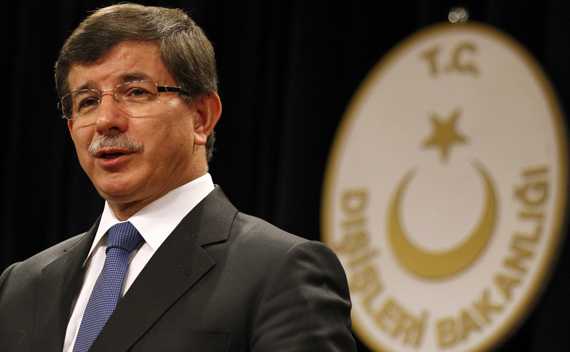
    Turkey’s Foreign Minister Ahmet Davutoglu warned on the eve of a visit to Tehran earlier this month against the risk of a “Cold War” developing between Shiites and Sunnis across the Middle East.

    “Tension is now rising between Turkey and Iran and it will be increasingly difficult to manage as it’s being aggravated by sectarian tensions. These problems are likely to be long-term; I don’t see an easy solution,” said Sinan Ulgen, a visiting scholar at the Carnegie Endowment for International Peace.

    Baghdad’s concerns also have been fueled lately by fears that Syria’s uprising is developing into a Sunni insurgency that Mr. Maliki has said could spread “like a house on fire,” into Iraq. A fresh wave of violence has killed more than 200 Iraqis since the end of the U.S. military mission on Dec. 18.

    Unlike Iraq, which is majority Shiite, Syria is about 75% Sunni, but it is governed mainly by a minority of Alawites, a Shiite sect. Syria’s President Bashar al-Assad’s Tehran-backed regime has expressed deep anger and distrust of Ankara due to its decision to provide haven to mainly Sunni Syrian rebels.

    Turkey says its actions are purely humanitarian, made in the face of Syria’s brutal crackdown on protesters. It also denies any effort to meddle in Iraqi politics.

    Turkish analysts say Ankara is a reluctant hard-power player in the region. for all its neo-Ottoman pretensions, Only a year ago, Mr. Assad was Exhibit A in Turkey’s “zero-problems-with-neighbors” foreign policy. That approach boosted relations and trade with neighboring Muslim regimes, while downgrading ties with former ally Israel. The Arab Spring, however, upended that policy as allies such as former Libyan leader Moammar Gadhafi were pushed aside and Shiite-Sunni tensions rose across the region. In a major change, Turkey agreed last fall to host a North Atlantic Treaty Organization missile-defense system, which was designed by the U.S. to contain Iran.

    Turkish and U.S. diplomats say they now cannot remember a time when cooperation between Ankara and Washington was closer, after a period of significant strain in 2009-2010.

    “When Prime Minister Erdogan came to Washington in 2009, he sounded almost like the ambassador from Iran. Now he sounds quite different…After a period of suspicion, Turkey and the United States have come closer together,” said Stephen Kinzer, a visiting professor of international relations at Boston University.

    Turkish officials insist relations with Tehran remain strong.Turkey buys around 30% of its oil from Iran and is the second-largest consumer of Iranian gas, after Russia. Official data shows that Turkey’s bilateral trade volume with Iraq in 2011 jumped by nearly 50% on the year to $11 billion, with much of the increase coming in the Shiite-dominated areas around Baghdad and in the South.

    In an interview inside Iraqi Kurdistan this month, Mr. Hashemi said that while his political bloc had received advice from Turkey and others, it was no tool for outside powers. “I am not part of the Turkish geopolitical project,” said Mr. Hashemi. He criticized Mr. Maliki’s “conspiratorial” mind and said that his frequent visits to Turkey last year were mostly private.

    Earlier, in October, a key aide to Supreme Leader Ayatollah Ali Khameini told Iran’s Mehr news agency that Turkey should radically rethink its policies on Syria, the NATO missile shield and promoting secularism in the Arab world. Otherwise, Ankara would face trouble from its own people and neighbors, he said.

    Still there is little disguising the building tensions between Ankara and its Shiite neighbors, including Tehran.

    In December, Ankara sought an explanation from Tehran after Hussain Ibrahimi, chief of the Iranian parliament’s national-security committee, told an Iranian newspaper that if Iran were to be attacked, its first retaliatory strike would be against the NATO missile defense radar in eastern Turkey.

    Earlier, in October, a key aide to Supreme Leader Ayatollah Ali Khameini told Iran’s Mehr news agency that Turkey should radically rethink its policies on Syria, the NATO missile shield and promoting secularism in the Arab world. Otherwise, Ankara would face trouble from its own people and neighbors, he said.

    via Iraq Accuses Turkey of Meddling – WSJ.com.

  • Obama: the US can no longer fight the world’s battles

    Obama: the US can no longer fight the world’s battles

    President plans to cut half a million troops and says US can’t afford to wage two wars at once
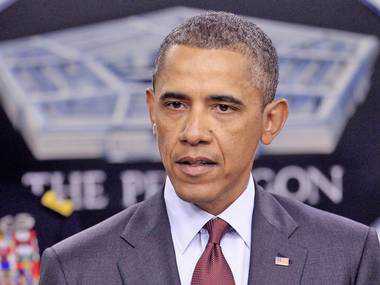
    The mighty American military machine that has for so long secured the country’s status as the world’s only superpower will have to be drastically reduced, Barack Obama warned yesterday as he set out a radical but more modest new set of priorities for the Pentagon over the next decade.

    After the wars in Iraq and Afghanistan that defined the first decade of the 21st century, Mr Obama’s blueprint for the military’s future acknowledged that America will no longer have the resources to conduct two such major operations simultaneously.

    Instead, the US military will lose up to half a million troops and will focus on countering terrorism and meeting the new challenges of an emergent Asia dominated by China. America, the President said, was “turning the page on a decade of war” and now faced “a moment of transition”. The country’s armed forces would in future be leaner but, Mr Obama pointedly warned both friends and foes, sufficient to preserve US military superiority over any rival – “agile, flexible and ready for the full range of contingencies and threats”.

    The wider significance of America’s landmark strategic change was underlined by British Defence Secretary Philip Hammond, who used a visit to Washington to warn that America must not delay the production of US warplanes bound for British aircraft carriers. The US strategy is expected to make a drawdown of some of the 80,000 troops based in Europe.

    “We have to look at the relationship with Americans in a slightly different light,” Mr Hammond told Channel 4 News. “Europeans have to respond to this change in American focus, not with a fit of pique but by pragmatic engagement, recognising that we have to work with Americans to get better value for money.”

    But there is little doubt that Europe will be a much-reduced priority under the new scheme. The blueprint’s status as the president’s own property, after a first three years in office dominated by wars he had inherited from his predecessor, was underlined by his rare personal appearance at the Pentagon flanked by Defence Secretary Leon Panetta and other top uniformed officials.

    Henceforth, Mr Obama underlined, the priorities would be maintaining a robust nuclear deterrent, confronting terrorism and protecting the US homeland, and deterring and defeating any potential adversary. To these ends, the US will also boost its cyberwarfare and missile defence capabilities.

    At the same time, iIf all goes to plan, the centre of gravity of the US defence effort will shift eastwards, away from Europe and the Middle East. The focus will be on Asia and – both he and Mr Panetta made abundantly clear without specifically saying so – in particular on an increasingly assertive China, already an economic superpower and well on the way to becoming a military one as well.

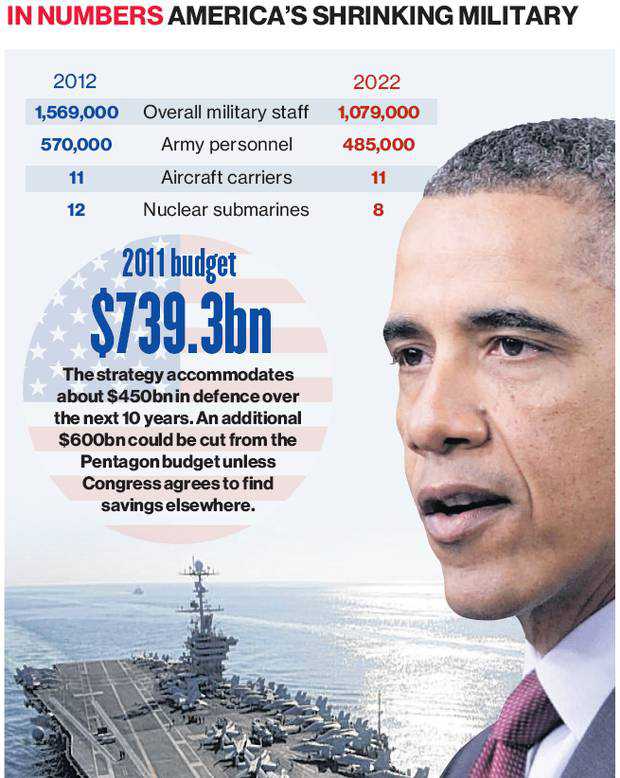
    The specifics of the new proposals, set out in a document entitled “Sustaining US Global Leadership: Priorities for 21st Century Defense”, have yet to be fleshed out. But they are likely to entail a reduction of up to 490,000 in a total military personnel now standing at some 1.6 million worldwide, as well as cuts in costly procurement programmes – some originally designed for a Cold War environment.

    The “Obama Doctrine” reflects three basic realities. First, the long post-9/11 wars are finally drawing to a close. The last US troops have already left Iraq, while American combat forces are due to be out of Afghanistan by the end of 2014 (though a limited number may stay on as trainers and advisers).

    Second, and as the President stressed in a major speech during his recent visit to Australia, America’s national interest is increasingly bound up with Asia, the world’s economic powerhouse, and where many countries are keen for a greater US commitment as a counterweight to China.

    Third, and most important, are the domestic financial facts of life, at a moment when government spending on every front is under pressure. For years the Pentagon has been exempt – but no longer, as efforts multiply to rein in soaring federal budget deficits.

    At $662bn, Pentagon spending for fiscal 2013 will exceed the next 10 largest national defence budgets on the planet combined. Even so, that sum is $27bn less than what President Obama wanted, and $43bn less than the 2012 budget.

    www.independent.co.uk, 06 JANUARY 2012

  • Turkey FM says wanted Iraqi leader should stay in Iraq

    Turkey FM says wanted Iraqi leader should stay in Iraq

    While Iraq’s vice president, for whom an arrest warrant has been issued by his government, takes refuge in Kurdish region, Turkish foreign minister does not rule out granting asylum

    AFP , Saturday 24 Dec 2011

    Turkey’s foreign minister on Saturday urged Iraqi Vice President Tareq al-Hashemi, facing an arrest warrant on terror charges, to remain in Iraq but said Turkey would not turn him away if he requested asylum.

    “What would be appropriate for us is that Mr Hashemi should stay within the Iraqi territory,” said Foreign Minister Ahmet Davutoglu in televised remarks broadcast by the state-run Turkish Radio and Television.

    Davutoglu said Turkey’s doors were open to him but that he would prefer him to stay in Iraq and contribute to a solution to political the problems facing his country.

    Hashemi, a member of Iraq’ Sunni Arab minority who has fled to the autonomous Kurdish region, is the subject of an arrest warrant that has plunged the country into political chaos. Davutoglu said the gravity of the allegation faced by Hashemi could not be minimised.

    “This is a very serious accusation and I think it must be clarified as soon as possible,” he said.

    Asked about Turkey’s response if the Iraqi leader requested asylum from Turkey, which shares a border with Iraq, Davutoglu said: “Our tradition requires us not to say ‘no’ to any statesman who requests asylum from Turkey.”

    A five-member judicial panel has issued a warrant for Hashemi’s arrest on terror charges. Hashemi says that the charges are politically motivated and that he would accept trial before a court in the Iraqi Kurdish region.

    via Turkey FM says wanted Iraqi leader should stay in Iraq – Region – World – Ahram Online.

  • Ankara says Iraqi vice president can come any time to Turkey: report

    Ankara says Iraqi vice president can come any time to Turkey: report

    Ankara says Iraqi vice president can come any time to Turkey: report

    Friday, 23 December 2011

    Baghdad police operations’ issued an arrest warrant against Tariq al-Hashemi, the Iraqi vice president, for his alleged role over the November bombing of parliament. (File Photo)

    Baghdad police operations’ issued an arrest warrant against Tariq al-Hashemi, the Iraqi vice president, for his alleged role over the November bombing of parliament. (File Photo)

    Turkish diplomats said that the Iraqi Vice President Tariq al-Hashemi can come any time to Turkey, a newspaper reported on Thursday.

    The diplomats who wanted to remain anonymous told the Turkey-based newspaper, Today’s Zaman, that “Hashemi, in his capacity as Iraqi vice president, could come to Turkey any time he desires.”

    Officials in Turkey expressed concern over the latest development in Iraq, fearing that the country could descend into chaos as was seein in 2003 after the ouster of Saddam Hussein by the United States.

    Hashemi who has been accused of the November bombing of the Iraqi parliament, and has had an arrest warrant issued against him, is currently in the country’s autonomous region of Kurdistan, and under the protection of the Kurdish leaders.

    Iraqi President, Jalal al-Talabani, who is a Kurd, said that the arrest warrant spoiled Iraqis’ celebration of U.S. troops leaving the country.

    Meanwhile, on Tuesday, Prime Minister Nouri al-Maliki threatened to resign if the parliament did not give a vote of no-confidence against Iraq’s deputy prime minister, Saleh al-Mutlak, and urged the semi-autonomous region of Kurdistan to turn over Hashemi to the government.

    Mutlak, who described the country’s prime minster as a “dictator,” said his secular, Sunni-backed political block is being increasingly marginalized by Maliki, in an interview with Al Arabiya TV.

    On Thursday, a series of coordinated bombings rocked the Iraqi capital, killing at least 67 people and injuring as many as 185 others in the worst violence in Iraq for months and shortly after the U.S. troops’ withdrawal from the conflict-ridden country.

    via Ankara says Iraqi vice president can come any time to Turkey: report.