Category: Middle East & Africa

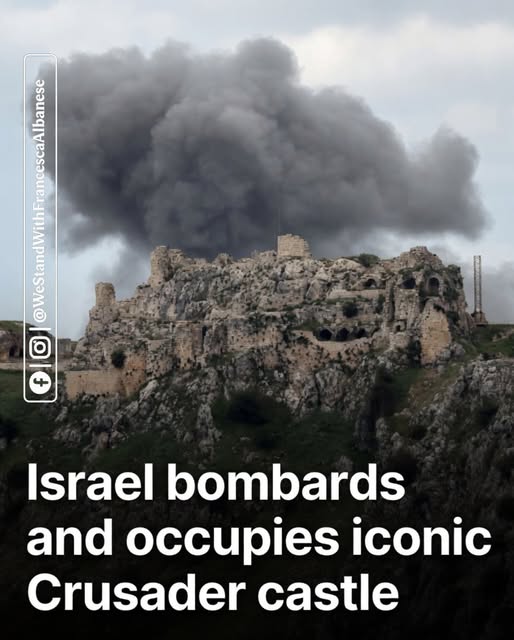
  • Israel bombards and occupies iconic Crusader castle

    Israel bombards and occupies iconic Crusader castle

    In an escalation of its invasion of southern Lebanon, Israel heavily bombarded the historic Beaufort Castle.

    This monument was built around the year 1139 by the Crusaders and is nearly a thousand years old. It is one of the finest examples of medieval military architecture in the Near East and is under special UNESCO protection (The National, 2026UNESCO, 2025).

    Air and artillery strikes caused direct hits and columns of smoke visible over the heritage site. These bombardments worsened previous damage to the medieval monument (Associated Press, 2026).

    The castle was directly struck before Israeli troops occupied it on May 31, 2026, and raised flags over the ruins.

    So far, the Israeli offensive has caused more than three thousand deaths in Lebanon. Israel has systematically killed doctors, paramedics, and journalists, repeating the pattern seen in Gaza. It has also destroyed entire villages through massive bombardments (The Guardian, 2026).

    Beaufort is not only ancient stone, but an emblem of Lebanese identity facing systematic destruction. The invasion violates UNESCO-protected sites.

    This destruction of archaeological heritage in southern Lebanon and in Gaza — a millennia-old city — recalls the actions of ISIS, which deliberately razed historic sites to erase collective memory (Washington Post, 2026).

    References

    The National. (2026, May 😎. Lebanon’s Crusader-era Beaufort Castle is consumed by conflict again.

    UNESCO. (2025). The castles of Mount Amel: Qalaat Al Chakif (Beaufort Castle).

    Associated Press. (2026, May 31). Israeli army captures strategic castle in Lebanon in deepest incursion into the country in 26 years.

    The Guardian. (2026, May 23). Israeli bombardment reduces buildings to craters in southern Lebanon.

    Washington Post. (2026, May 30). Israeli strikes reportedly pound near Crusader-built castle in Lebanon.

  • We Stand With Francesca Albanese

    We Stand With Francesca Albanese

    Former ICC Prosecutor Accuses Mossad of Intimidating Her at Her Home to Protect Israel

    Former Chief Prosecutor of the International Criminal Court (ICC), Fatou Bensouda, has denounced an intense campaign of pressure and intimidation by Israel aimed at forcing her to close the investigation into alleged war crimes and crimes against humanity in Palestine (Middle East Eye, 2026).

    Bensouda, who led the Office of the Prosecutor between 2012 and 2021, opened a preliminary examination in 2015 into violations committed in the West Bank, Gaza, and East Jerusalem, primarily attributed to Israeli forces and also to Palestinian armed groups (Al Jazeera, 2026).

    Shortly after launching that inquiry, two men appeared directly at her home in The Hague and handed her an envelope containing $500, supposedly as a “thank you” gesture. Bensouda interpreted the act as a clear threat: “They came directly to my house. I understood the message they were sending,” she recalled (Middle East Eye, 2026).

    She immediately reported the incident to the Dutch police and ICC security. The investigation revealed that the men’s phone numbers were linked to Israel and that the vehicle in which they arrived had been rented at the airport, confirming the connections to Israel (Middle East Eye, 2026).

    Subsequently, then-Mossad chief Yossi Cohen met with her in Munich and New York to explicitly ask her to abandon the investigation. “What was clear is that he did not want the Palestine investigation to continue,” Bensouda stated (TRT World, 2026).

    The former Gambian prosecutor felt abandoned by the ICC’s member states. “I felt alone. I felt unsupported,” she lamented despite having reported the threats (Al Jazeera, 2026).

    These revelations have reignited the debate over political interference in international justice. Israel categorically denies the allegations.

    References

    Al Jazeera. (2026). Talk to Al Jazeera: Fatou Bensouda on Israeli threats against her and the ICC.

    Middle East Eye. (2026). Former ICC prosecutor says Mossad chief pressured her to stop investigating Israel war crimes.

    TRT World. (2026). Former ICC chief says Mossad pressured her to stop investigating Israel.

  • America lost the war, not officially, never officially

    America lost the war, not officially, never officially

    Washington does not lose wars, Washington achieves strategic objectives.

    Washington successfully degrades enemy capabilities.

    Washington transitions to a ceasefire framework, but Congress has receipts.

    Just revealed something that no Pentagon press briefing would ever say out loud.

    42 American military aircraft shot out of the sky.

    By a country that Washington had already declared defeated.

    Welcome to the story behind the story.

    Before we count what America lost, let us count what America said it would achieve.

    The Trump administration entered Operation Epic Fury with four publicly stated objectives.

    • Destroy Iran’s nuclear program completely.
    • Degraied Iran’s ballistic missile capability.
    • Cut-off Iran’s support for regional proxy groups.
    • Force Iran’s leadership to permanently renounce nuclear weapons.

    Four objectives.

    29 billion dollars.

    Keep those four in your mind.

    We will return to them.

    On February 28th, 2026, the United States and Israel launched Operation Epic Fury.

    Washington was triumphant.

    Supreme Leader Kamine was dead.

    Nuclear sites were hit.

    The state of Hormuz Defense Secretary Pete Heggseth told Congress,”

    We have achieved our strategic objectives.

    Now fast-forward to May the Congressional Research Service.”

    The non-partisan research arm of the United States Congress.

    Quietly published a report.

    No press conference.

    No headlines on American prime time.

    No ticker on CNN. A very uncomfortable document.

    42 United States military aircraft lost or severely damaged.

    In a war that America won.

    Let us now do what Washington refused to do.

    Aircraft by aircraft.

    The F-35A, lightning the second.

    The most expensive weapons program in human history.

    At 1.7 trillion dollars.

    Shot down or severely damaged over Iran on March 19th.

    Cost of one aircraft between 80 and 110 million dollars.

    Iran’s foreign minister, Iraq chi, Iran’s armed forces were the first in the world to shoot down an F-35.

    Washington has not denied it.

    Four F-15E strike-eagles, $100 million each, $400 million total.

    Three destroyed by friendly fire over Kuwait.

    America paid to shoot down its own jets.

    The fourth destroyed in combat over Iran.

    One eight-end thunderbolt the second, $20 million.

    Destroyed inside Iran.

    Seven KC135 strattotankers.

    The aircraft that keep combat jets flying.

    $30 million each, $350 million total.

    Five of them were not airborne.

    They were parked on the tarmac at Prince Sultan Air Base in Saudi Arabia when Iranian missiles found them.

    One E3-century A-wax, $270 million.

    The flying command center.

    The brain of the entire operation.

    Destroyed on the ground in Saudi Arabia by an Iranian missile.

    Two MC130J commandow the second special operations aircraft.

    $100 million each, $200 million total.

    American commandows flew them into Iran on a rescue mission.

    They got stuck in soft sand inside Iranian territory.

    American forces blew up their own aircraft on Iranian soil because they could not fly them out.

    One H-H-60W Jolly Green the second helicopter.

    $40 million, damaged by small arms fire during the same rescue mission.

    24 M-Q-9 Reaper drones between $30 and $56 million each, $720 million total.

    And the M-Q-9 production line was already shut down in 2025.

    America cannot replace them quickly.

    Iran destroyed 24 of a product no longer being manufactured.

    One M-Q-4C Triton surveillance drone.

    $250 million, a quarter billion dollar aircraft.

    Total hardware destroyed in 40 days.

    Approximately $3.5 to $4 billion.

    And that is just the aircraft.

    The Pentagon told Congress the full cost of Operation Epic Fury is now $29 billion.

    That number jumped 4 billion in just two weeks.

    83 cents of every dollar spent.

    $24 billion out of $29 billion.

    Went toward fixing and replacing destroyed military hardware.

    And the $29 billion does not include a single dollar of base repair costs.

    Those assessments are still ongoing.

    Congressional sources say the final bill could reach 200 billion oracles.

    $200 billion for a 40-day war that America won.

    And Iran was not just hitting aircraft.

    Iran hit American military bases across seven countries simultaneously.

    In the first two weeks alone, confirmed base damage reached $800 million.

    The U. S. Navy Fifth Fleet headquarters in Bahrain was hit.

    Repair cost for that one building $200 million.

    In Qatar, Iran struck an early warning radar system valued at $1.1 billion.

    $1 billion.

    In Kuwait, a 50-year-old Iranian F5 jet penetrated the patriot air defense shield and bombed a U. S. compound, a half-century old aircraft.

    Inside a base protected by the most advanced missile defense system in the world.

    And none of this base damage is included in the $29 billion figure.

    It’s still counting.

    Democratic Senator Mark Kelly sat before Congress and used one word to describe America’s weapons inventory after this war.

    His exact words, “I think it is fair to say it is shocking how deep we have gone into these magazines.

    The American people are less safe, whether it is a conflict with China or somewhere else in the world.

    We are talking about years to rebuild.

    America spent $29 billion and weakened itself against every future enemy at the same time.

    Now the scoreboard.

    Destroy Iran’s nuclear program.

    Iran still holds over 450 kilograms of 60 percent enriched uranium.

    Enough for 9 to 11 nuclear weapons.

    Fordale survived.

    Buried under 80 meters of granite.

    Iran’s Parliament voted to end all IAA cooperation after the ceasefire.

    Iran is now less transparent than before the war.

    Netanyahu himself admitted on CBS. There is still nuclear material.

    There are still enrichment sites that have to be dismantled.

    The man who launched the war admitted the war did not finish the job.

    Iran’s ballistic missiles.

    Iranian missiles were still hitting American warships in the straight of Hormuz in May 2026.

    A full month into the ceasefire.

    Cut off Iran’s proxy support.

    Hezbollah operational.

    Health is active.

    My RGC network intact, force Iran to announce nuclear weapons.

    No deal, no signed agreement, no verification framework.

    Trump called Iran’s latest proposal a piece of garbage.

    The nuclear talks are still ongoing.

    The same talks that diplomacy could have produced before a single bomb was dropped.

    Zero out of four objectives achieved.

    Here is what the data tells us.

    The United States launched Operation Epic Fury with the most advanced air force in the world.

    It flew nearly 13,000 soughties.

    It hit over 5,500 targets.

    It killed the Supreme Leader of Iran.

    And it lost 42 aircraft worth $4 billion.

    It spent $29 billion.

    Got its bases hit in seven countries.

    Pleated its missiles for years, achieved zero out of four stated objectives, agreed to a ceasefire with a country it claimed to have defeated.

    And then spent two months hiding the losses from its own Congress, American style.

    The story behind the story is not about what Iran lost.

    The story behind the story is about what Washington could not afford to lose next.

    Because if the war had restarted with Iran’s flight patent data with its proven F-35 kill, with its confirmed drone hunting capability, with American munitions already at shocking levels, the next set of losses would not be 42 aircraft.

    And someone in Washington did the math.

    That is the story behind the story.

    I am your host.

    If you believe the world deserves the full picture, share this video right now.

  • In the Shadow of the Cartel State: The Israeli Mafia, Former Mossad Operatives, and Allegations of a State-Corporate Criminal Alliance in Mexico

    In the Shadow of the Cartel State: The Israeli Mafia, Former Mossad Operatives, and Allegations of a State-Corporate Criminal Alliance in Mexico

    Decades-long drug wars in Mexico have predominantly been explained in academic literature through variables such as inter-cartel competition, deficiencies in state capacity, and drug demand from the United States. However, the extensive investigations of Mexican journalist-author Francisco Cruz add an extremely disturbing dimension to this picture: the allegation that transnational criminal networks, specifically the structure defined as the “Israeli mafia,” and former intelligence operatives have been integrated into the cartel ecosystem in Mexico, protected and managed by the state security bureaucracy itself. Cruz’s narrative indicates that organized crime may represent not only market competition but also a complex power projection with geopolitical and intelligence dimensions. This article aims to systematically address Cruz’s findings, the chronology of events, and the alleged connections, discussing within an academic framework what these claims could mean for the Mexican state and international security. The study acknowledges from the outset that the entirety of the allegations has not been definitively corroborated by independent judicial bodies or international commissions of inquiry, yet it interrogates their analytical value as a research hypothesis.

    Conceptual Framework: The Israeli Mafia and Transnational Crime Networks

    Francisco Cruz particularly emphasizes that the Israeli mafia is not an ordinary criminal organization. According to the author, this structure is “a planned criminal organization born almost with the establishment of the modern State of Israel, possessing a permanent organizational scheme.” This claim partially aligns with the limited but existing studies in the literature on the historical roots of Jewish crime groups. It is known that organized crime in Israel possesses a comprehensive network structure, with 16 crime families operating in a wide spectrum of activities including drug trafficking, money laundering, extortion, and arms trafficking.

    Specifically, with the mass immigration of Soviet Jews to Israel in 1989, Russian organized crime elements began to view Israel as an ideal center for money laundering. Because the banking system of the era was designed to encourage aliyah and capital movements, combined with the absence of anti-money laundering legislation, it became an easy haven for “Russian” organized crime. In 2005, Israeli police estimated that Russian organized crime had laundered between 5 and 10 billion dollars in the fifteen years following the dissolution of the Soviet Union. Likewise, the structure known as the “Israeli mafia,” founded in the 1980s in New York under the leadership of Johnny Attias and responsible for the largest gold heist in Manhattan’s jewelry district, confirms this transnational character. Cruz’s contribution is his claim that this structure, over time, symbiotically strengthened with the Russian “Red Mafia,” reaching the same operational level as the Japanese Yakuza, the Italian Cosa Nostra, and the Mexican cartels. According to him, not only professional bankers but also mafia elements immigrated to Israel during the waves of Jewish migration; these groups merged with criminal networks from the former Soviet geography, thereby gaining a global capacity.

    Entry into Mexico: The 2000s and Initial Detections

    According to Cruz’s chronology, the presence of the Israeli mafia in Mexico dates back to the early 2000s. Other investigations supporting this claim reveal that Mexican government security forces had detected connections between the Israeli mafia and organized crime groups starting in 2000, that intensive operations were recorded for a Mexican cartel solely between 2000 and 2010, and that the Israeli mafia supplied high-powered weapons to this cartel and laundered illegal proceeds. Similarly, it has been reported that the Mexican federal government detected the money laundering connections of Israelis with cartels and Mexican companies 21 years ago.

    During this period, two Israeli citizens, Benjamín Yessuharan Zuchi (Ben Zuchi) and Yalon Azulay, who would later be killed in Ciudad de México in 2019, entered the radar of security units. According to the Mexican Attorney General’s Office (FGR) investigation files, Benjamín Yeshurun Sutchi wove a criminal network during his stay in Mexico between 2001 and 2005 by establishing relations with criminal organizations dedicated to drug trafficking, kidnapping, and casino operations. Sought by Interpol, Sutchi was captured in June 2005 and deported to Israel but later returned to Mexico to continue his casino operations. FGR files document that Sutchi established relations with members of the Beltrán Leyva Cartel, particularly with Édgar Valdés Villarreal, known as “La Barbie”; a photograph of the Israeli together with “La Barbie” was found during a search conducted by SEIDO.

    Genaro García Luna: From Security Chief to Protector of Criminal Networks

    The central figure of the article is undoubtedly former Secretary of Public Security Genaro García Luna. According to the official indictment of the U.S. Department of Justice, García Luna served as the head of Mexico’s Federal Investigation Agency (AFI) from 2001 to 2005 and, as Secretary of Public Security from 2006 to 2012, controlled the Federal Police Force. Arrested in Dallas, Texas in December 2019, he was found guilty by a jury in February 2023 after a four-week trial in Brooklyn federal court of engaging in a continuing criminal enterprise, international cocaine distribution conspiracy, and making false statements. In October 2024, he was sentenced to 460 months (over 38 years) in prison and a $2 million fine.

    Judge Brian M. Cogan stated that García Luna exhibited “the same kind of thuggery” as El Chapo, only manifested differently. According to The New York Times, García Luna had so penetrated the country’s security apparatus that he was defined as Mexico’s J. Edgar Hoover, yet he led a double life, being on the Sinaloa Cartel’s payroll for almost his entire career. García Luna’s cooperation encompassed actions such as providing safe passage for the cartel’s drug shipments, supplying sensitive law enforcement information about investigations related to the cartel, and assisting in attacks against rival cartels. The indictment indicates that between 2002 and 2007, García Luna assisted in at least six shipments containing over 50,000 kilograms of cocaine in total, with bribery payments personally delivered to him in briefcases containing millions of dollars.

    Kidnapping, Extortion, and “Manhunt” Operations

    According to the allegations, the main sphere of activity of the Israeli mafia in Mexico consists of extortion and kidnapping-for-ransom operations targeting wealthy Jewish businessmen. To place this allegation in a broader context, kidnapping has long been a critical source of income for organized crime groups in Mexico. Reports show that cartels have deeply penetrated the mining sector, some companies have made protection agreements with cartels, and disobedience can result in kidnapping and murder. Informality is widespread, and large companies and foreign operators often do not report kidnapping cases.

    Cruz claims that the Israeli mafia established “large private operational teams” for such operations and that former Mossad agents served in these teams. It has been documented that Mexican cartels have heavily recruited former military personnel and operatives with tactical experience from countries such as Israel, Russia, the Netherlands, Ukraine, Colombia, and Guatemala in recent years, with the aim of forming “more lethal, trained, and disciplined forces.” It has also been reported that cartels have modernized their arsenals with technologies, accessories, and sighting systems previously unique to military or highly trained police forces. Connections between the Israeli mafia and the cartels are alleged to facilitate the trafficking of people, money, and drugs. In fact, authorities have documented the money-laundering activities of the Israeli mafia and the participation of members of ETA and the Revolutionary Armed Forces of Colombia (FARC) as well as Los Zetas in training camps.

    The Florence Cassez and Israel Vallarta Case: The Visible Face and Deep Connections

    In Cruz’s analysis, the Florence Cassez and Israel Vallarta case is a “scapegoat” operation covering up this multi-layered network of relationships. The case chronology is as follows: In December 2005, AFI agents raided the Las Chinitas ranch on the México-Cuernavaca highway; simultaneously, a Televisa crew entered the scene to be broadcast on Carlos Loret de Mola’s program. According to records, agents were seen beating Vallarta while presenting him to the camera, while French citizen Florence Cassez repeatedly stated she was unaware that three people were being held hostage at the location. Both were accused of being the leaders of the kidnapping gang “Los Zodiaco.”

    After years of legal struggle, the Mexican Supreme Court ruled in 2013 for Cassez’s release; it was determined that the arrest was a staged fiction by the AFI and that this fiction had a “corrupting effect” on the criminal process. In contrast, Israel Vallarta remained in detention without a definitive verdict for approximately 20 years. Finally, in August 2025, the Third Criminal District Judge of the State of Mexico, Mariana Vieyra Valdés, acquitted Vallarta on the same legal grounds the Supreme Court applied for Cassez in 2013. The court invalidated the testimonies, identifications, and Vallarta’s statement, proven through three separate expert reports to have been taken under torture in 2005. According to Cruz, this case made the presence of the Israeli mafia in Mexico so visible as to provide a foothold for publicly stating, “Here is the Israeli mafia in Mexico,” but simultaneously prevented the larger structure under García Luna’s leadership from being seen.

    The 2019 Murders and the Network Becoming Visible

    All of this alleged structure remained largely in the dark until two murders committed in Ciudad de México in July 2019. On July 24, 2019, at a Chinese restaurant in the upscale Plaza Artz shopping center south of Mexico City, a woman shot and killed two Israeli citizens at close range. The victims were identified as Alon Azulay (41) and Benjamin Yeshurun Sutchi (44). Although the female suspect, initially identified as “Esperanza N.,” suggested the attack was a crime of passion, the Mexico City Attorney General’s Office confirmed that the double homicide was a “coordinated attack” and linked to an underground network of Israeli criminals. President Andrés Manuel López Obrador personally addressed the issue at his daily press conference, stating, “This is not a case of passion as previously reported. This is related to organized crime, and I close the matter here.” Mexican Security Minister Alfonso Durazo explained that the slain Israelis were linked to money laundering gangs in the country. The Israeli Embassy in Mexico issued a written statement noting that Sutchi and Azulay “had criminal records both in Israel and in Mexico.”

    As the investigation into the murders deepened, former Mexico City Police Chief Gabriel Regino explained that Sutchi was captured in 2005 in an operation conducted by the Mexican intelligence agency Cisen at Interpol’s request; that he had escaped from prison twice in Israel; and that there was intelligence indicating he had been trained by Mossad. According to the BBC, Mexico City Attorney General’s Office Spokesperson Ulises Lara stated that “the passion motivation has been eliminated” and that “the event leads us to connect it to a settling of scores between criminal groups.” The investigation launched following the murders led Cruz and his team to discover that these individuals were not ordinary crime victims but members of the Israeli mafia who had long been conducting extortion and kidnapping activities in Mexico. In 2021, a woman was arrested in connection with these 2019 murders for links to the Jalisco Nueva Generación Cartel (CJNG), demonstrating that the mafia-cartel connection had become a judicial finding.

    Mossad Connections: The Most Controversial Link in the Allegation

    The most speculative and hardest-to-verify part of Cruz’s narrative concerns the role of former Mossad agents within these structures. The point to be underlined here is that no evidence is presented that Mossad, as a state institution, was directly involved in criminal activities; rather, it is claimed that “former” agents were involved in these networks on an individual level. However, this allegation must be evaluated in historical context: Mossad’s presence in Latin America dates back decades. The most famous example is the capture of Nazi war criminal Adolf Eichmann by Mossad agents in Buenos Aires in 1960. A more controversial example is the close relationship between former Mossad special operations commander Mike Harari and Panamanian dictator Manuel Noriega. According to Ynet’s exclusive report, Noriega “assisted in countless top-secret Mossad operations,” and Harari, even after retiring from Mossad in 1980, was tasked by then-Prime Minister Menachem Begin with managing the secret connections in Panama. During the U.S. invasion of Panama, Harari was sought alongside Noriega; he was alleged to have been involved in drug and arms trafficking but managed to escape with the help of local collaborators. This historical example offers an indirect framework for Cruz’s claims by demonstrating that former Mossad personnel could, at times, take part in operations beyond legal boundaries in Latin America; however, independent judicial evidence is essential to reach a definitive judgment.

    Operational Symbiosis Model and Theoretical Assessment

    When we expand and analyze Cruz’s claims, the following operational symbiosis model emerges: The Israeli mafia targets the wealthy Jewish community in Mexico using technical expertise provided by former intelligence operatives (surveillance, target profiling, kidnapping, and negotiation); transfers a portion of the proceeds from these activities as bribes to García Luna and his network; and in return gains logistical protection and operational space through strategic partnerships established with the cartels (particularly Beltrán Leyva, Sinaloa, and Jalisco Nueva Generación). The exact overlap of García Luna’s tenure as AFI head (2001-2005) and Sutchi’s initial period of activity in Mexico (2001-2005) is chronologically significant. Moreover, reports that cartels recruit former soldiers and operatives from many countries, including Israel, suggest that the Israeli mafia’s integration into the cartel ecosystem may not be an isolated case but part of a broader transnational crime strategy. This model inverts the concept of “state capture,” frequently used in organized crime literature on Mexico, and effectively describes a model of the “instrumentalization of crime by the state.”

    Conclusion

    When the allegations put forward by Francisco Cruz are combined with the García Luna corruption proven in U.S. courts, the documented Israeli-Cartel connections, and the 2019 murders corroborated by official authorities, a picture emerges capable of shaking all paradigms regarding the security crisis in Mexico. The sentencing of García Luna to over 38 years in prison demonstrates that the state-crime alliance is not merely a theory but is supported by concrete judicial findings. The narrative in question reveals not only that cartels are actors that capture the state but also that the state bureaucracy can actively manage international criminal networks and instrumentalize them for its own benefit. However, allegations regarding the individual participation of Mossad-linked former agents in organized crime cannot be dismissed as entirely baseless when assessed in the context of historical examples such as the Harari-Noriega relationship; nonetheless, they must be approached with caution as long as they remain unconfirmed by official authorities. Behind the violence persisting in Latin America may lie not only drug markets but far more complex global power relations shaped in the dark rooms of states.

    References

    · Beittel, J. S. (2022). Mexico: Organized Crime and Drug Trafficking Organizations. Congressional Research Service.
    · Cruz, F. (various publications). Investigative journalism files and interviews.
    · Serrano, M. (2012). “State-Crime Relations in Mexico.” Journal of Latin American Studies, 44(3), 543-568.
    · Viano, E. C. (Ed.) (2020). Transnational Organized Crime: Yesterday and Today. Routledge.
    · U.S. Department of Justice, Eastern District of New York. (2023, February 21). Ex-Mexican Secretary of Public Security Genaro Garcia Luna Convicted of Engaging in a Continuing Criminal Enterprise.
    · U.S. Department of Justice, Eastern District of New York. (2024, October 16). Ex-Mexican Secretary of Public Security Genaro Garcia Luna Sentenced to Over 38 Years’ Imprisonment.
    · U.S. Department of Justice, Eastern District of New York. (2020, July 30). Former Mexican Secretary of Public Security Genaro Garcia Luna Charged with Engaging in a Continuing Criminal Enterprise.
    · U.S. Department of Justice, Eastern District of New York. (2019, December 10). Former Mexican Secretary of Public Security Arrested for Drug-Trafficking Conspiracy and Making False Statements.
    · The New York Times. (2023, February 21). “Mexico’s Ex-Top Security Official Is Convicted of Cartel Bribery.”
    · The Guardian. (2024, October 16). “Mexican official who led war on drugs jailed for 38 years for accepting bribes.”
    · BBC News Mundo. (2019, July 25). “Plaza Artz: what is known about the two Israelis murdered in a ‘settling of scores’ in Mexico City.”
    · BBC News. (2019, July 26). “Israeli ‘underworld’ figures shot dead in Mexico City ‘hit’.”
    · CNN. (2019, July 26). “Woman shoots two Israelis dead in Chinese restaurant in Mexico City.”
    · Instituto Nacional de Migración (Mexico). (2019, July 25). “Israeli wove criminal network in Mexico.”
    · El Imparcial. (2025, August 2). “They apply to Israel Vallarta the same ruling that freed Florence Cassez.”
    · Infobae. (2025, August 2). “Israel Vallarta Case: how he entered and how he left prison nearly 20 years later.”
    · Los Reporteros MX. (2026, April 30). “Weapons, training and mafia: the relationship of Mexican cartels with Israel.”
    · Ynetnews. (2017, June 1). “Former Panama dictator’s secret ties to Israel.”
    · NCFGT. (2021, September 7). “Israeli mafia.”
    · S-RM Inform. (2026, March 30). “Qtr 1, 2026 | The cost of business: Organised crime in Mexico.”
    · Amos News. (2025, September 27). “Links of Mexican cartels with the Israeli mafia from the year 2000, revealed.”
    · Mexico Daily Post. (2025, September 4). “From Israel to Mexico: Galil rifles end up in the hands of cartels.”

    Sefa Yürükel

    Danish ethnographer and social anthropologist (MA)
    Aarhus University, 1997
    Independent Researcher
    Fields of Research: International Politics, Public International Law, Geopolitics, Sociology, Psychology, Cultural Studies, Systems and Structures

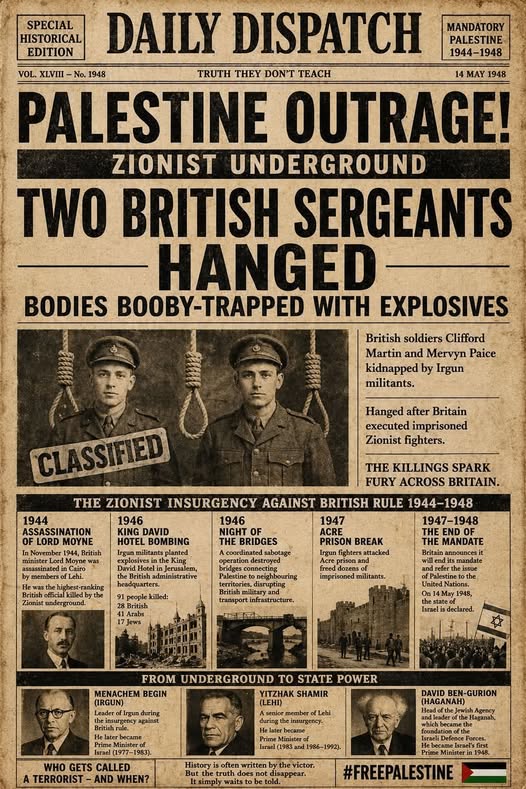
  • The Zionist Underground and the End of British Rule in Palestine

    The Zionist Underground and the End of British Rule in Palestine

    The Zionist Underground and the End of British Rule in Palestine. – Martin Michael

    I went down a historical rabbit hole researching this and honestly, some of it genuinely took a minute to process.

    Before Israel was created in 1948, Britain governed Palestine under what was known as the British Mandate, following the collapse of the Ottoman Empire after World War I.

    In the final years of British rule, several Zionist underground organisations launched an armed insurgency aimed at forcing Britain out of Palestine and paving the way for the creation of a Jewish state.

    The main organisations involved were:

    Irgun

    A nationalist paramilitary group responsible for bombings, assassinations and attacks on British military and administrative targets.

    Lehi (The Stern Gang)

    A smaller but even more radical organisation that carried out assassinations and attacks against British officials and infrastructure.

    Haganah

    The largest Jewish paramilitary organisation in Palestine. Although it often operated differently from Irgun and Lehi, it did at times cooperate in coordinated operations against British targets.

    At the time, British authorities officially referred to some of these groups as terrorist organisations, while supporters viewed them as anti-colonial fighters resisting British rule.

    Historians generally refer to this period as the Jewish insurgency in Mandatory Palestine (1944–1948).

    Some of the major events included:

    1944 — Assassination of Lord Moyne

    Walter GuinnessBritain’s Minister of State in the Middle East, was assassinated in Cairo by members of Lehi.

    He was the highest-ranking British official killed during the insurgency.

    1945 — Escalation of attacks

    Militant groups intensified attacks on:

    • railways

    • bridges

    • police stations

    • government buildings

    • immigration control infrastructure

    Several groups temporarily worked together in a coordinated campaign known as the Jewish Resistance Movement.

    1946 — Night of the Bridges

    A coordinated sabotage operation destroyed bridges linking Palestine with neighbouring territories, severely disrupting British transport and military infrastructure.

    1946 — King David Hotel Bombing

    Irgun militants planted explosives inside the King David Hotel in Jerusalem, which housed the British administrative headquarters.

    The explosion killed 91 people:

    28 British

    41 Arabs

    17 Jews

    It remains one of the deadliest attacks carried out against British rule during the Mandate period.

    1947 — Acre Prison Break

    Irgun fighters attacked Acre prison and freed dozens of imprisoned militants.

    1947 — Execution of British Sergeants

    Two British soldiers, Clifford Martin and Mervyn Paice, were kidnapped and later hanged by Irgun after Britain executed imprisoned militants.

    The killings caused outrage across Britain.

    By 1947–48 the situation had become increasingly unmanageable for Britain.

    Eventually Britain announced it would end the Mandate and hand the issue over to the United Nations.

    On 14 May 1948, the state of Israel was declared.

    What happened next is where the story becomes even more significant.

    Many members of these underground organisations later moved directly into mainstream Israeli politics and state leadership.

    Menachem Begin, leader of Irgun during the insurgency, later became Prime Minister of Israel.

    Yitzhak Shamir, a senior member of Lehi, also went on to become Prime Minister.

    Meanwhile Haganah became the foundation of the Israeli military itself.

    All of this took place in the shadow of World War II and its aftermath, at a time when Britain had been financially and militarily devastated by war.

    By 1944 British ministers were being assassinated.

    By 1946 British headquarters were being bombed.

    By 1947 British soldiers were being kidnapped and executed.

    Yet this history is rarely discussed in Britain today.

    And it raises a question that still follows conflicts across the world now:

    Who gets labelled a terrorist — and who later gets remembered as a freedom fighter or statesman?

    Because history often seems to answer that question differently depending on who eventually wins power.

  • Iran’s Next Move Will SHOCK The World. Israel Has No Answer

    Iran’s Next Move Will SHOCK The World. Israel Has No Answer

    Scott Ritter WARNS Iran’s Next Move Will SHOCK The World Israel Has No Answer

    One hundred and twenty thousand soldiers trapped.

    No fuel, no ammunition, no food.

    In Washington, the most powerful military machine in human history sitting on its hands because there is literally nothing it can do.

    What you’re about to hear is not analysis.

    It is an autopsy.

    And the body on the table is the myth of Israeli military invincibility.

    Let me be clear about who I am and why what I am saying matters.

    I served as a Marine Corps intelligence officer.

    I sat inside the American national security apparatus at levels most people do not reach in a lifetime.

    I reviewed war plans, intelligence assessments, and logistics architectures for conflicts across three decades.

    And I am telling you with the full weight of that experience behind every word, what Iran executed over five days against the IDF supply chain is the most comprehensive, most surgically precise, most strategically complete interdiction campaign I have ever studied.

    Not in briefing documents, not in historical case studies, ever in any conflict at any scale.

    What the mainstream media will not tell you because telling you would require them to dismantle twenty years of carefully constructed narrative about the balance of power in the Middle East is that this was not a military engagement.

    It was a controlled demolition.

    Iran did not fight Israel.

    Iran switched Israel off.

    And the architecture of how they did it, the sequencing, the targeting logic, the operational discipline required to execute five simultaneous phases against redundant systems without a single phase failing, that is what I’m going to walk you through today.

    Because once you understand the mechanics, you will never look at this region or at American power the same way again.

    Start with the foundational reality that almost nobody in Western commentary is willing to state plainly.

    A modern army does not run on courage.

    It does not run on training.

    It does not run on ideology or nationalism or the quality of its officer corps.

    A modern army runs on logistics, fuel, ammunition, food, spare parts, medical consumables, the invisible river of material that flows from port facilities through road and rail networks into forward depots and ultimately into the hands of the soldier in the fighting position.

    Cut that river and the most sophisticated military force on Earth becomes within days a collection of very well-armed, very well-trained and completely immobile human beings sitting in positions they cannot advance from, cannot be reinforced to, and cannot safely extract from.

    That is not theory.

    That is the operational reality that every serious military planner understands at a foundational level.

    The question that Iran answered over five days, the question that should be occupying every defense ministry and every war college in the world right now is this.

    How do you cut that river when the river has been engineered with fifty years of American technical assistance specifically to survive being cut?

    The answer, and this is where the professional sophistication of what Iran accomplished becomes genuinely arresting, is that you do not attack the river at one point.

    You attack every point simultaneously, including the points that exist specifically to compensate for attacks on the other points.

    You eliminate the redundancy by striking every redundant pathway at the same moment so that the system has no surviving mechanism through which to route around the damage.

    When every port is struck, every bridge is destroyed, every forward depot is burning, and every airfield capable of receiving heavy cargo aircraft has cratered runways, there is no logistics system left.

    There is only the clock, the clock that counts down from whatever stockpile remains to the moment when the last round is fired, the last fuel tank runs dry and a hundred and twenty thousand soldiers confront the physical reality of what supply chain collapse actually means for human beings in active combat conditions.

    Uh, Iran did not improvise this.

    Uh, I want to drive that point home because the instinct in Western analysis, and I have watched this pattern play out across three decades of professional observation, is to explain away military success by non-Western actors as luck, as confusion on the other side, as some operational anomaly that preserves the underlying assumption of Western superiority without requiring anyone to revise it.

    That instinct is analytically bankrupt in this case.

    What Iran executed was the product of years of systematic intelligence collection, target development and operational planning.

    Years.

    The precision with which Iranian targeting databases reflected the actual locations of IDF forward logistics depots, facilities whose coordinates represent some of the most closely held operational security in the Israeli military system, is a finding whose intelligence implications extend far beyond the immediate military situation.

    Someone built that database.

    Someone updated it.

    Someone verified it against current operational configurations.

    And that process did not begin last month.

    The campaign opened at two forty in the morning on day one.

    I want you to register that timing because it reflects a specific operational logic.

    Two forty in the morning is the hour of minimum human alertness, minimum institutional responsiveness and minimum ability to execute the kind of rapid damage assessment and emergency response that might in some alternate scenario have allowed Israeli logisticians to begin rerouting supply flows before the interdiction was complete.

    By choosing that moment, Iranian operational planners ensured that the full scope of phase one was complete before Israeli command could transition from shock to organized response.

    Phase one struck Israel’s three functioning port facilities simultaneously.

    Ashdod, the primary military import terminal handling approximately fifty-five percent of IDF equipment and munitions imports by sea, absorbed thirty-four impacts in a strike package that lasted twenty-eight minutes.

    I want you to understand the targeting logic inside that strike package because it reflects a level of operational sophistication that goes well beyond simply putting warheads on port infrastructure.

    The container handling cranes serving the military cargo terminal were struck individually, not the terminal building, not the administrative complex, the cranes.

    Because cranes are what move military cargo from ship to shore, and destroying the cranes means that even if a vessel somehow reaches Ashdod through the subsequent interdiction environment, it cannot offload.

    The fuel offloading pier was destroyed in a sequencing pattern specifically designed to produce complete structural collapse rather than repairable damage.

    The distinction matters enormously.

    Repairable damage buys you days before the facility is functional again.

    Complete structural collapse buys you months, and in the context of an acute supply crisis, months is operationally equivalent to forever.

    The bonded military warehouse complex received penetrating warhead impacts designed to achieve internal detonation of stored munitions, not merely collapsing the external structure, but destroying what was inside it.

    Haifa, the northern port serving as the primary logistics gateway for forces on the northern front, absorbed forty-one strikes with specific targeting focus on its military fuel terminal and the rail connection linking port to forward logistics base network.

    The Red Sea port, representing Israel’s only non-Mediterranean maritime import pathway, was struck by eighteen weapons that destroyed its container handling infrastructure and severed its road and rail connections to the rest of the country.

    By the time the sun came up on day one, ninety percent of Israel’s maritime import capacity was gone.

    Not degraded, not damaged, gone.

    But here is what the cable networks are not explaining to you, and this is where the operational picture becomes something genuinely different from a successful strike campaign.

    The destruction of the ports was not the end of phase one.

    It was the beginning of the sequence.

    Because Iranian planners understood something that their Western counterparts had apparently not fully internalized.

    Destroying the entry point means nothing if the system can route around it.

    And the IDF logistics system had been specifically engineered with American assistance to do exactly that, which is why phase two was already underway before phase one was fully concluded.

    Phase two targeted the overland logistics network.

    Twelve major road bridge crossings on the primary logistics routes between Israel’s central stockpile complex and its northern and southern operational fronts were struck with precision weapons achieving structural collapse at the bridge deck level.

    Not damage, structural collapse.

    The rail lines serving the northern logistics corridor were struck at nine separate points, each chosen to maximize the length of track rendered unusable by a single impact.

    And I want you to understand the targeting philosophy here because it represents a level of analytical sophistication that goes beyond simply knowing where the bridges are.

    Iran’s planners did not attack the vehicles on the road.

    Attacking vehicles is operationally costly, produces only temporary disruption, and triggers workaround behavior that a sophisticated logistics system will execute within hours.

    Instead, they attack the infrastructure the vehicles must use.

    A destroyed bridge cannot be bypassed by a different route when every bridge on every alternate route has also been destroyed.

    The IDF‘s overland logistics capability was not degraded in phase two.

    It was structurally eliminated.

    And the distinction between degradation and elimination is the difference between a logistics system that is operating at reduced efficiency and a logistics system that has ceased to function.

    Stay with me because phase three is where this campaign transitions from impressive to something that should be genuinely alarming to anyone who has spent serious time thinking about how modern military power actually works.

    Because phase three did not target infrastructure that appears on satellite imagery and in publicly available port records.

    Phase three targeted the IDF‘s forward logistics depots, the hardened dispersed operationally secret stockpile facilities maintained in theater to sustain operations for a defined period without resupply.

    These are not places that appear on maps available to the public.

    Their locations are among the most closely held operational security information in the Israeli military system, protected by multiple layers of access restriction and counterintelligence procedure.

    Eleven of Israel’s fourteen identified forward logistics depots were struck.

    Eleven out of fourteen.

    The three that survived did so because they were located within urban areas where the collateral damage calculus constrained the strike package, a constraint that Iranian planners appear to have consciously incorporated into their targeting architecture, which is itself a reflection of operational discipline that many Western analysts would not have predicted.

    The surviving depot inventory after phase three represented supply availability of between three and seven days at current consumption rates, and that clock was already running by the time the assessment was complete.

    You think you’ve heard the worst of it?

    You haven’t.

    Not even close.

    Because everything I have described so far, the ports, the bridges, the rail lines, the forward depots, all of it exists within a planning framework that American and Israeli logisticians had already gamed.

    They had already identified maritime interdiction as a risk.

    They had already built the compensating mechanism into the contingency plan.

    And Iranian operational planners knew they had done so, which is why phase four existed.

    Phase four addressed the emergency resupply pathway that American and Israeli planners had specifically identified as the primary compensating mechanism for maritime and overland interdiction.

    Air logistics, the runways at Ben Gurion International Airport, serving as the primary entry point for air delivered military cargo, were struck at six separate points with penetrating warheads designed to produce subsurface detonations, creating craters resistant to emergency repair.

    Ramon Airport in the south, the secondary air logistics facility, was struck simultaneously.

    The military airfields with runway capacity sufficient to handle heavy cargo aircraft had already been rendered non-operational in the preceding strikes against IDF bases.

    By the end of phase four, Israel had no functional air cargo terminal capable of receiving the heavy lift aircraft that emergency military resupply requires.

    The air bridge that Washington needed to execute emergency resupply did not exist, and that is not a circumstance that arose from poor planning or inadequate preparation on Washington’s part.

    It was a condition that was deliberately engineered by Iranian operational planners who understood exactly what the American compensating response would be and designed the campaign architecture specifically to defeat it before it could be executed.

    That is the level of strategic thinking we are dealing with.

    Not reactive, not opportunistic, anticipatory.

    Iran did not respond to American resupply planning.

    Iran preempted it, and now we arrive at the arithmetic, the cold, unforgiving mathematics of what supply chain collapse actually means for a hundred and twenty thousand human beings in active combat positions.

    Because this is the part of the story that most analysts skip past, either because the numbers are uncomfortable or because the human dimension of military logistics failure is harder to discuss in the clinical language that professional analysis tends to prefer.

    An IDF armored brigade in active operations consumes approximately a hundred and eighty thousand liters of diesel fuel per day across all organic vehicles, tanks, infantry fighting vehicles, artillery tractors, engineering equipment, logistics trucks.

    Israel had approximately eight armored brigades deployed in operational configurations.

    At that consumption rate, the fuel inventory surviving the phase one and phase three strikes, estimated at approximately forty percent of pre-campaign levels, represented between four and six days of operational consumption.

    By day five, fuel availability had fallen below the minimum threshold required to sustain offensive operations.

    Armored vehicles began being immobilized, not by enemy action, not by mechanical failure, not by tactical decision, but by empty fuel tanks.

    I want that to register in its full weight.

    The IDF, the force that the United States and Israel spent fifty years and hundreds of billions of dollars constructing, was being rendered immobile by the simple physical fact of having nothing left to put in its fuel tanks.

    Aviation fuel presents an even more acute constraint.

    IDF air operations at current sortie rates consume approximately two point four million liters of aviation fuel daily.

    The surviving aviation fuel inventory after the port strikes and depot destruction was assessed at approximately eight days of consumption.

    By day five, sortie rates had been reduced by over sixty percent as fuel conservation protocols were implemented.

    The F-35s, Israel’s most capable strike platform, the aircraft around which IDF operational doctrine for deep strike missions is organized, were being flown at a fraction of their operational tempo.

    Their missions rationed against a fuel supply that everyone involved could see was counting down to zero.

    The ammunition mathematics tell a parallel story.

    An Israeli artillery battalion firing at standard sustained rates expends approximately eight hundred rounds per day.

    Multiply that across the artillery systems deployed across five active fronts.

    Add tank main gun ammunition, mortar rounds, anti-tank guided missiles, and the precision guided munitions that modern combined arms combat depends on at every level.

    The daily ammunition consumption figure runs to thousands of tons.

    The surviving forward depot inventory after phase three represented approximately five days of consumption at reduced operational tempo, and that estimate assumed consumption rates lower than what active combat actually demands.

    By day five, multiple artillery units had reported exhaustion of available ammunition stocks.

    Fire missions were being canceled not because the tactical situation did not require fires, but because there were no rounds left to fire.

    And if the fuel picture is alarming and the ammunition picture is alarming, the food situation is the variable that carries the most direct human weight and receives the least serious attention in professional military analysis.

    Military ration supply for a hundred and twenty thousand personnel requires approximately three hundred and sixty tons of food daily.

    IDF doctrine calls for forward units to carry three days of organic ration supply.

    By day four, units in the most forward positions were consuming emergency ration reserves intended for genuine last resort situations.

    By day five, operational assessments across multiple sectors included language that no military commander wants to read and no soldier wants to hear described about themselves.

    Personnel combat effectiveness degraded by nutritional insufficiency.

    Let me translate that out of the bureaucratic register and say what it actually means.

    Soldiers were hungry.

    Soldiers who are hungry make decisions differently than soldiers who are fed.

    They assess risk differently.

    They sustain effort differently.

    They maintain cohesion differently.

    And an army whose soldiers are making different decisions under the pressure of physical deprivation is not the army that its commanders planned for, trained for, or built their operational concepts around.

    Keep watching because the next part of this story is where the American dimension enters and where the gap between what Washington promised and what Washington could actually deliver becomes something that every serious student of military power needs to confront directly.