Category: UK

  • Poor Richard’s Report

    Poor Richard’s Report

    Poor Richard’s Report
    Over 300,000 readers
    My Mission: God has uniquely designed me to seek, write, and speak the truth as I see it. Preservation of one’s wealth while continuing to provide needed income is my primary goal for these unsettled times. I have been given the desire to study and observe global money progressions and trends for the last 50 years. I evaluate possible future trends in order to provide positive concepts for you to form your own conclusions. The main purpose of this letter is to warn you of possible financial sinkholes.
    Good Bye Stocks – Hello Bonds

    We are leaving the golden era of free enterprise due to unmitigated greed and chicanery. We can easily adjust if we accept the true meaning of what awaits us. If we fight to retain our old dreams and fantasies we will see ourselves being spoon fed by fat socialist bureaucrats for the “common good”.
    In this letter I will present some facts for your perusal and then you can make up your own mind in regards to your financial decisions. Those willing to change their offensive strategy can become winners in life’s never ending battles.
    The result of these recent price disturbances (all the bubbles bursting) is the falling value of the property that has been borrowed against. The value of the property’s income also falls. We have come from extreme over indebtedness and now find ourselves in a hole – we should stop digging.
    This is a hard lesson that our grandparents learned in the 1930’s, but sadly has been forgotten as satanic greed took over our souls. We now find ourselves caught between a recession and a depression. I call it a MESSYSESSION.
    All the corporations whose bubbles have burst must work down their inventories; since many are in the financial sector this will take time. Individuals must use their earnings to pay down debts to save their homes instead of spending money on frivolous purchases. The Rule of 72 has the deck stacked against them, unless the Usury Law is resumed. The lack of the Usury Law is quicksand for our economic recovery.
    The working down of inventories alone can be deflationary, however, the Federal Reserve has been pumping money into our supply pipeline at super speed. When an entity goes bankrupt, those debts do not go back into circulation, they go to money heaven. This is why the Fed has to keep the supply pool full and why this action should keep us out of a depression.
    Having to pay down all this debt slows down our economy and hurts our suppliers worldwide. This is why we have a world wide Messysession.
    Corporations that have borrowed from the Government will have a hard time maintaining their common stock dividends because their first priority is bond interest. Their second priority is preferred dividends. What is left over will then be distributed to common stock holders or used for debt reduction. Debt reduction means job security.
    Sooner or later the US Government will have to go on a massive borrowing campaign. This could weaken the dollar and send interest rates soaring along with the price of Gold – for a while.
    Some recessions are “V” shaped, which means stocks fall down hard and come back up quickly. Stocks tumble, but recover because there are people looking across the valley. If the recovery is like an elongated “U” or “L” one needs binoculars to see across the valley to a recovery. This could cause price to earnings ratios to shrivel, since analyst’s earnings estimates will be suspect at best. The economy can take a year or two to recover based upon how responsible Congress is. It will be years before our economy fully recovers from all the bubble bursting. What we need is a cheap new energy invention.
    The only period, since 1872, where stocks substantially outperformed bonds on a prolonged basis was the 1950s to 1960s. This was a golden era for stocks and it has taken many abuses to wind down.
    These are some of the many issues that President Obama faces on the home front. Now we shall look at some of his international problems.
    Europe is changing. It used to be that France and Germany were the major players, with Great Britain looking on. The United States has encouraged the expansion of the European Community to diminish the power of the two largest countries. Poland is emerging as an economic power and if Turkey is admitted, as they should be, they will bring new found political clout for the first time since the demise of the Ottoman Empire 90 years ago. Their inclusion could bring stabilization to the chaotic Middle East situation. Turkey has freedom of religion, a vigorous economy (17th largest), and a solid government. Their influence is growing. They also have a strategic location to insure peace long term.
    Then, there is Russia, who can throw all kinds of money around, but when it comes to signing on the dotted line – they cannot be trusted. Turning off gas supplies in mid-winter and canceling major contracts with world-renowned companies are actions that are hard to forget. Obama has pledged to focus US military power on the war in Afghanistan. The bulk of supplies must come from the north. Russia does not want a ballistic missile defense system in central Europe. It wants a halt to NATO expansion and reduced American influence in the Caucus and central Asia. They also want a broad renegotiation on non-trivial treaties that are terrible for Russia in 2009. (Anyone want to be President?)
    We must come up with a way to renew confidence for the consumer. First and foremost is the renewal of our Usury laws that were dropped because disintermediation was wrecking the banking system in the 1970s. Creating lasting jobs will not happen by just building roads. These programs must be done so that they promote or improve future growth. It is difficult to do this on a national level because there are too many fingers in the pie. Programs done on a state level are easier to control. It is more realistic to meet regional needs.
    Lowering corporate taxes when a corporation moves into intercity areas would mean better roads, and businesses to support them. Raising taxes invites tax avoidance schemes that only benefit the issuer. It also removes money from the private sector. Today, pricing power has evaporated.
    There must be global reorganization of the securities laws, most importantly the Uptick rule. Countries that do not participate should be banned from trading within the member countries. Today hedge funds and institutions have spent millions of dollars on sophisticated trading programs. This makes for an uneven playing field and has driven the small investor to the sidelines, as witnessed by declining volume on the exchanges. The large institutional investor becomes the ultimate bag-holder at the bottom of markets when they have no one to sell to.
    If a country’s Gross Domestic Product (GDP) is declining that means the average on corporate earnings will be declining also. This means fewer companies will be showing an increase in earnings and therefore there will be fewer securities that have an investment grade value. Since there are already too many mutual funds and they all cannot buy the same stocks, that game is over. I would sell your mutual funds while you can if you are over 55 years old. If they get too many orders for liquidation they have the option of delivering stock of the same value to you. That is an easy way to get rid of their losers. If you are under 55 and own a balanced fund where the income can be reinvested on a periodic basis you are in the catbird seat. Lower prices will mean more shares and 10 to 15 years from now when the market recovers you could be a wealthy person. Other low income on non paying funds should be sold. It could be 20 to 25 years just to breakeven and that is only if it is a survivor.
    First quarter earnings are going to be a disaster. I suspect this is when many will throw in the towel and give up.
    Gold should be considered a hedge – possible short term.
    Here are some moneymaking ideas. A successful portfolio can be 20% equities 50% fixed income and 30% cash.
    By equities I mean income-producing securities yielding over 5%. There are a few out there that are “stupid” cheap versus dirt-cheap. Then there are preferred stocks, many of which are 85% tax-free. Many are selling below their call price. This means if a company wants to improve its balance sheet, they can do that by calling your preferred from you by paying the call price. If they fail to pay a preferred dividend it becomes cumulative. To resume payments they must make up the back dividends first. One that falls into this category is: AMERCO Pfd A (NYSE) 20 (2-6-09) pays $2.125 which yields 9.41%. gives you a tax free yield of 8%. If they call the stock at $25 you will have a $5 gain which amounts to a 25% gain. You won’t be able to have this return with common stocks over the next several years.
    Tax free bonds were good when income tax rates were 55%-92%. The low tax rates today are beaten by preferred stock’s rates, such as the one I mentioned above. You have a ready market and real value. What you see is what you get. There was an issue on Long Island that defaulted in the depression. A default like that today would wreck havoc in the entire sector. For safety reasons, please avoid tax-free bonds.
    Since the US has to borrow around a trillion dollars or more, Government bonds could be an instant loss. For now, I would avoid these also. That leaves us with corporate bonds. Many corporate bonds have a better balance sheet than the United States. Buying bonds in the five year range is the safest place to be. As the bond gets closer to maturity the price fluctuations are at a minimum and easily salable. You are better off buying an individual bond than a fund. The fund will charge a yearly management fee as well as anything else they can get away with. Also, some funds simply dump bonds into a portfolio and walk away. There was a case where a fund dumped their holdings of an issue right at the very bottom, only to have the bonds called a few months later. Please remember that corporate bond holders have first lien on a corporation’s asset.
    I suspect that in a few months you will see a stampede out of many mutual funds and a proliferation of all types of bond funds trying to cash in on the new trend. Keep it simple- buy your own.
    I know I have thrown many ideas your way in this letter and I apologize, but I feel the times warrant such thinking. I will be available, free of charge, to anyone who would want to discuss any of these ideas at the addresses below.
    CHEERIO!!!!
    Richard C De Graff 2/10/2009
    256 Ashford Road
    RER Eastford Ct 06242
    860-522-7171 Main Office
    800-821-6665 Watts
    860-315-7413 Home/Office
    [email protected]

    This report has been prepared from original sources and data which we believe reliable but we make no representation to its accuracy or completeness. Coburn & Meredith Inc. its subsidiaries and or officers may from time to time acquire, hold, sell a position discussed in this publications, and we may act as principal for our own account or as agent for both the buyer and seller.

  • Middle East parties must be brought together

    Middle East parties must be brought together

    Gordon Brown has insisted that all parties to the Middle East dispute over Palestine must be brought together to thrash out a lasting peace settlement despite the recent hostilities in Gaza.

    Speaking at a press conference with Palestinian President Mahmoud Abbas in Downing Street on Thursday, the PM said that peace could be achieved in the Middle East based on a secure Israel and a viable Palestinian state. Progress on the issue remains a top priority for the UK and international partners will be urged to work together to come to an agreement, he said.


    www.number10.gov.uk

  • Temper tantrums

    Temper tantrums

    Temper tantrums

    Feb 5th 2009 | ANKARA
    From The Economist print edition

    A dramatic Davos walkout raises new questions about Recep Tayyip Erdogan

    WAS it premeditated? Or did Turkey’s prime minister, Recep Tayyip Erdogan, lose control? Mr Erdogan’s walkout from a debate with Israel’s president, Shimon Peres, in Davos has made him the most talked about Turkish leader since Kemal Ataturk. His audience of financiers and policy wonks was stunned. But Muslims worldwide cheered as Mr Erdogan scolded Mr Peres over Israel’s war in Gaza. “When it comes to killing, you know very well how to kill. I know well how you hit and kill children on beaches,” thundered a crimson-faced Mr Erdogan.

    The incident has led to new debate over Turkey’s strategic alliance with Israel, whether an increasingly erratic Mr Erdogan is fit to lead Turkey at all and, if so, in what direction: east or west? There is no question of Turkey walking away from NATO or the European Union, or scrapping military ties with Israel and America. Mr Erdogan’s critics say his outburst was a ploy to please voters. If so, it worked: his approval ratings have shot up. Polls suggest that 80% of Turks support Mr Erdogan’s actions. His mildly Islamist Justice and Development party will reap dividends in municipal elections on March 29th.

    Mr Erdogan’s defiance has also helped to assuage his people’s long-running feelings of humiliation and inferiority, which date back as far as the Ottoman defeat in the first world war. Many insist that Mr Erdogan’s reaction was spontaneous and utterly sincere. Turkey has assumed “moral leadership” based on Western values, opined Cengiz Candar, a liberal commentator. Mindful of the public mood, Turkey’s secular opposition leader, Deniz Baykal, grudgingly declared that his rival had done the right thing.

    Not everybody agrees, however. Mr Erdogan’s behaviour makes it less likely that Turkey can successfully mediate between Israel and Syria. His call to Barack Obama to “redefine” what terrorist means has been seen as an appeal to remove the label from Hamas. Although European and American reaction has been muted, in private officials are unhappy. “What [the Davos spat] does leave in Europe is the feeling that Mr Erdogan is unpredictable,” says a European diplomat. Mr Obama is highly unlikely now to pay Turkey an early visit.

    Mr Erdogan’s temper tantrums are not new. But they used to be reserved for his critics at home. The Davos affair, says another foreign diplomat, is further evidence of “Mr Erdogan’s conviction that the West needs Turkey more than Turkey needs it.” It is of a piece with Mr Erdogan’s threat to back out of the much-touted Nabucco pipeline to carry gas from the Caspian Sea to Europe via Turkey. In Brussels recently Mr Erdogan said that, if there were no progress on the energy chapter of Turkey’s EU accession talks then “we would of course review our position”. Meanwhile, Turkey sided with Saudi Arabia and the Vatican in opposing a UN statement suggested by the EU to call for the global decriminalisation of homosexuality.

    Mr Erdogan’s supporters argue that EU foot-dragging on Turkey’s membership bid explains why Turkey is now seeking new friends in the Middle East and beyond. Its growing regional clout is another reason why the EU should embrace Turkey. But the reverse is also true. It is because it is the sole Muslim country that is at once secular, democratic and allied with the West that Turkey commands such respect in the rest of the world. Growing numbers of Arab investors have flocked to Turkey, “because we see it as part of Europe, not the Middle East,” says an Arab banker in Istanbul.

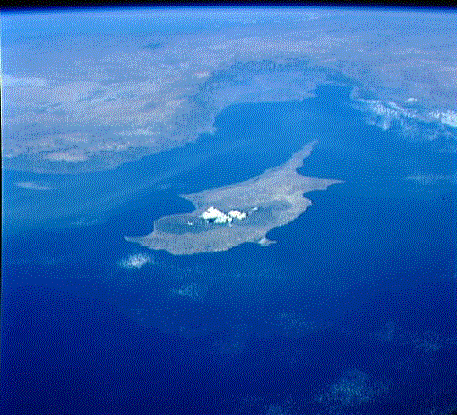
    To retain its allure, Turkey will need to swallow its pride and make further concessions on Cyprus. The EU may suspend membership talks altogether unless Turkey meets a December 2009 deadline to open its ports to Greek-Cypriots. The hope is that Egemen Bagis, who was chosen as Turkey’s official EU negotiator in January, will remind Mr Erdogan that, at least in these talks, it is Turkey that is the supplicant not the other way round.

    Source:  Economist, Feb 5th 2009

  • MPs join Gaza protest against BBC

    MPs join Gaza protest against BBC

    By Mark Hookham
    Political Editor

    Fabian Hamilton, MP

    THREE Leeds MPs have added their voices to the mounting criticism of the BBC for its refusal to televise an appeal for victims of the humanitarian disaster in Gaza.

    John Battle (Leeds West, Lab), Fabian Hamilton (Leeds North East, Lab) and Greg Mulholland (Leeds North West, Lib Dem) have joined more than 100 other MPs in signing a parliamentary motion urging the corporation to reverse its decision.

    The Disasters Emergency Committee’s two-minute Gaza Crisis Appeal was screened on Monday by ITV, Channel 4 and Five.

    However, BBC bosses have insisted that airing the film would threaten its impartiality and that the corporation should not give the impression it was “backing one side” over the other.

    Protests

    The decision has sparked more than 15,500 complaints and protests at BBC Broadcasting House.

    Mr Battle, a former junior minister, has also raised the issue with ministers at a Commons international development select committee.

    Relatives of his sister’s husband live in Gaza and have given him first hand reports of the intense suffering caused by the bombing.

    Fabian Hamilton, a member of Labour Friends of Israel, said: “To a child who has lost his parents and whose house is a pile of rubble it doesn’t matter whether it was Israelis or an earthquake. That child needs aid and our help. We have a duty to relieve that suffering.”

    Greg Mulholland said he thought the BBC’s reasoning was “utterly flawed.”

    A RALLY is to be staged outside the BBC’s regional HQ in Leeds to protest at the corporation’s refusal to broadcast a charity appeal for funds to help the people of Gaza.

    The rally takes place this evening from 5pm to 7pm outside BBC Broadcasting Centre in St Peter’s Square, near Leeds bus station.

    The BBC has refused to broadcast the appeal by the Disasters Emergency Committee which includes charities such as Christian Aid and Oxfam.

    It says to do so might lead to accusations of “bias.”

    Source: Yorkshire Evening Post, 28 January 2009

  • Archbishop joins criticism of BBC refusal to screen Gaza appeal

    Archbishop joins criticism of BBC refusal to screen Gaza appeal

    Corporation receives 11,000 complaints and 50 MPs plan to back motion calling on BBC to change its mind over aid film

    Protesters demonstrate outside the BBC's Broadcasting House. Photograph: Andy Rain/EPA

    The Archbishop of Canterbury today added to criticism of the BBC over its refusal to broadcast a charity appeal for aid to Gaza.

    He spoke as it emerged the BBC had received some 11,000 complaints and more than 50 MPs planned to back a parliamentary motion urging the corporation to reverse its decision not to broadcast tomorrow’s appeal by the Disasters Emergency Committee (DEC).


    The early day motion to be tabled tomorrow by Labour’s Richard Burden has received the support of 51 MPs from across the Commons; ministers and some senior BBC staff have also called for the BBC to change its mind. The corporation today admitted it had received “approximately” 1,000 telephone complaints about the decision and a further 10,000 by email.


    Meanwhile, adding his voice to the calls for a U-turn while speaking after a church service in Cambridge, the Right Rev Rowan Williams said: “My feeling is that the BBC should broadcast an appeal.”


    But despite the increasing pressure, a BBC spokesman today said the situation remained unchanged.


    Mark Thompson, the BBC director general, has been left isolated as ITV and Channel 4 agreed to air the plea for aid.


    The BBC has decided that broadcasting the appeal might be seen as evidence of bias on a highly sensitive political issue.


    The culture secretary, Andy Burnham, said it was right that broadcasters made their own decisions, adding that the BBC faced a difficult choice because of the way it is funded.

    The communities secretary, Hazel Blears, said she hoped the BBC would “urgently review its decision”, and the Scottish first minister, Alex Salmond, said the corporation had made the “wrong decision”.

    Yesterday, the Archbishop of York, the John Sentamu, accused the broadcaster of “taking sides” and said: “This is not a row about impartiality, but rather about humanity.


    “This situation is akin to that of British military hospitals who treat prisoners of war as a result of their duty under the Geneva convention,” he added.

    “They do so because they identify need rather than cause. This is not an appeal by Hamas asking for arms, but by the Disasters Emergency Committee asking for relief.

    “By declining their request, the BBC has already taken sides and forsaken impartiality.”

    Thompson received backing from the BBC Trust’s chairman, Sir Michael Lyons. He said he was “concerned” about the tone of some politicians’ comments on the issue, which he said came close to “undue interference” in the BBC’s editorial independence.

    The BBC’s unrepentant stance has stirred up rebellion in the ranks of it own reporters and editors. One senior BBC news presenter told the Observer: “I’ve been talking to colleagues, and everyone here is absolutely seething about this.

    “The notion that the decision to ban the appeal will seem impartial to the public at large is quite absurd.

    “Most of us feel that the BBC’s defence of its position is pathetic, and there’s a feeling of real anger, made worse by the fact that, contractually, we are unable to speak out.”

    Jon Snow, the journalist who presents Channel 4 news, said the BBC should have been prepared to accept the judgment of the aid experts of the DEC.

    “It is a ludicrous decision,” he said. “That is what public service broadcasting is for. I think it was a decision founded on complete ignorance and I am absolutely amazed they have stuck to it.”

    Snow said he suspected a BBC bureaucrat had “panicked” and urged Thompson to put the situation right.

    Martin Bell, the former BBC foreign correspondent, said the corporation should admit it had made a mistake and claimed “a culture of timidity had crept” in.

    “I am completely appalled,” he said. “It is a grave humanitarian crisis and the people who are suffering are children. They have been caught out on this question of balance.”

    But Greg Dyke, Thompson’s predecessor as director general, said the issue had put the BBC in a “no win situation”.

    “Outside of Iraq, the single biggest issue that caused complaints was the coverage of Israel,” he added. “I can understand why the BBC has taken this decision, because on a subject as sensitive as the Middle East it is absolutely essential that the audience cannot see any evidence at all of a bias.”

    The BBC also faces demands for an explanation from within the ­Commons international development select committee.

    Andrew Mitchell, the shadow international development secretary, said: “We believe that they should allow the broadcast to proceed so that the British public, who have proved themselves so generous during recent emergencies in the Congo and Burma, can make their own judgment on the validity of the appeal.”

    The satellite broadcaster Sky said it was “considering” broadcasting the appeal.

    A BBC spokesman said: “We do accept that people are strongly guided in their view on this by the humanitarian emergency.

    “We are highlighting the situation in Gaza in every news bulletin, and that is one of the reasons the issue is so high on the agenda.”

    Guardian

  • Miliband regrets ‘war on terror’

    Miliband regrets ‘war on terror’

    The idea of a “war on terror” is a “mistake”, putting too much emphasis on military force, Foreign Secretary David Miliband has said.

    Mr Miliband seeks international co-operation to combat terrorism

    Writing in the Guardian, Mr Miliband said the idea had unified disparate “terrorist groups” against the West.

    He said the right response to the threat was to champion law and human rights – not subordinate it.

    Mr Miliband repeated the views in a speech in Mumbai, India, the scene of attacks by gunmen last year.

    Mr Miliband’s warning comes five days before the end of US President George Bush’s administration, which has led the so-called “war on terror”.

    The foreign secretary wrote that since 9/11 the phrase “war on terror” had “defined the terrain” when it came to tackling terrorism and that although it had merit, “ultimately, the notion is misleading and mistaken”.

    The phrase was first used by President Bush in an address to a joint session of Congress on 20 September 2001, in the aftermath of the attacks on New York and Washington.

    Mr Miliband wrote that the phrase was all-encompassing and “gave the impression of a unified, transnational enemy, embodied in the figure of Osama Bin Laden and al-Qaeda” when the situation was far more complex.

    Calling for groups to be treated as separate entities with differing motivations, he wrote that it was not a “simple binary struggle between moderates and extremists, or good and evil” and treating them as such was a mistake.

    “Historians will judge whether [the notion] has done more harm than good”, he said.

    The phrase, informally dropped from use by the UK government several years ago, “implied a belief that the correct response to the terrorist threat was primarily a military one – to track down and kill a hardcore of extremists”, he wrote.

    But the stance he now promoted was international “co-operation”.

    Highlighting US President-elect Barack Obama’s commitment to close the Guantanamo Bay detention centre, Mr Miliband said it was time to ensure human rights and civil liberties were upheld.

    He suggested that the different organisations took advantage of the belief that they had one common enemy and a key way to tackle them was to stop this.

    “Terrorism is a deadly tactic, not an institution or an ideology.”

    Edward Davey, foreign affairs spokesman for the Lib Dems, said: “If the British foreign secretary had said this to President Bush many months, if not years ago, then it would have deserved some credit.

    “Mimicking President-elect Obama’s lines days before his inauguration does not show leadership.”

    The Scottish National Party leader at Westminster, Angus Robertson, accused Mr Miliband of hypocrisy: “This declaration by David Miliband and the Labour Party is rank hypocrisy. His government acted as a poodle to the Bush doctrine in Iraq and elsewhere.

    “People will not be misled by this wishful re-writing of history.”

    Mr Miliband repeated his views on the “war on terror” in a speech at the Taj Mahal Palace hotel, in Mumbai, India. The hotel was among several sites attacked by gunmen in the city last November.

    He is in the country in an attempt to defuse tensions between India and Pakistan over the attacks which killed at least 173 people.

    Mr Miliband urged Pakistan’s government to take “urgent and effective action to break up terror networks on its soil” and called for a resolution over the disputed region of Kashmir.

    BBC