Category: Non-EU Countries

  • Two men held over MI6 and Downing Street parcel bombs

    Two men held over MI6 and Downing Street parcel bombs

    Suspects arrested in north Wales over packages allegedly addressed to MI6 offices and Downing Street

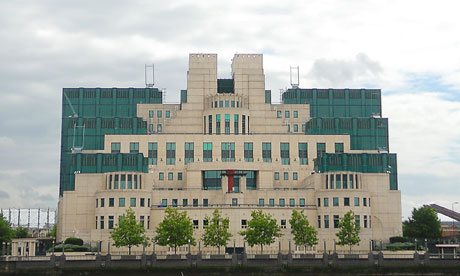
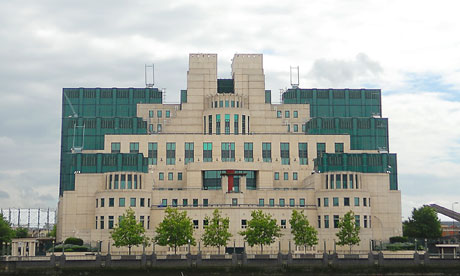
    MI6 headquarters

    Two men are being held by police today after two parcel bombs reportedly addressed to 10 Downing Street and MI6 were intercepted last week.

    The suspects, aged 52 and 21, were arrested on suspicion of explosive offences at separate addresses in Caernafon, north Wales, on Friday by Metropolitan police officers and local police.

    The Met said one package was found at the postal handling centre for MI6 near to its headquarters on the Albert Embankment, in London. It would not confirm or deny that the other, held at a south London sorting office, was addressed to Downing Street.

    Police were called at 12.40pm on Wednesday after a suspicious package was found at the MI6 office. The second parcel was discovered at 4.30am on Thursday.

    A police spokesman said: “The Metropolitan police service is investigating two suspect packages addressed to premises in central London. Both packages have been recovered by police.”

    The last known attack on MI6 HQ was in 2000 when it suffered superficial damage in a rocket attack by dissident Irish republicans.

    The Guardian

  • David Cameron backs Turkey’s EU bid

    David Cameron backs Turkey’s EU bid

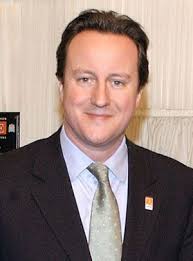
    Prime Minister David Cameron has said he will fight for Turkey to become a member of the European Union as he addressed business leaders in the country’s capital Ankara.

    The PM said Turkey’s economic rise was an opportunity for other EU states, not a threat, and also highlighted the nation’s contribution to the NATO effort in Afghanistan.

    Mr Cameron said he wanted to establish a new partnership between Britain and Turkey because it was “vital” for the UK economy, security and politics.

    The PM said:

    “When I think about what Turkey has done to defend Europe as a NATO ally, and what Turkey is doing today in Afghanistan alongside our European allies, it makes me angry that your progress towards EU Membership can be frustrated in the way that it has been. My view is clear. I believe it’s just wrong to say that Turkey can guard the camp but not be allowed to sit in the tent.

    “So I will remain your strongest possible advocate for EU membership and for greater influence at the top table of European diplomacy. This is something I feel very strongly, very passionately about. Together, I want us to pave the road from Ankara to Brussels.”

    Mr Cameron added that Turkey could be a “unifier” because of its links to both East and West and called on the country’s government to “push forward aggressively” with the EU reforms it is already making to help its bid for membership.

    Later, the PM met Prime Minister Recep Tayyip Erdogan for talks and signed a new Strategic Partnership document setting out how the two Governments will intensify relations in a range of areas, including trade, defence, and culture.

    • Listen to the joint press conference

    Earlier, Mr Cameron laid a wreath at the mausoleum of Mustafa Kemal Ataturk, the founder of modern secular Turkey.

    The visit to Turkey is only Mr Cameron’s fifth bilateral overseas visit since becoming Prime Minister, following trips to France, Germany, Afghanistan and last week’s visit to the US.

    Listen to the speech

    Speeches and transcripts: PM’s speech in Turkey

    Speeches and transcripts: Press conference with Turkish PM

    The Prime Ministers Office

    Number 10

  • NHS accused of racism

    NHS accused of racism

    The NHS has been accused of racism after figures showed applicants from ethnic minorities find it harder to get a job, are more likely to be bullied if they do and have more grievances taken out against them.

    Figures from the South East Coast NHS, one of ten regions in England, found that although black and minority ethnic groups made up almost a third of applicants for jobs they only represented 16 per cent of appointees.

    Rob Berkeley, deputy director of the Runnymede Trust, a racial equality think tank, told the Health Service Journal: “The patterns are broad enough to suggest it’s about institutional racism. The NHS has been slower to address it.”

    The data show three per cent of the 193 executive directors were black and ethnic minority in origin along with only 2.5 per cent of non-executive directors.

    Candy Morris, chief executive of NHS South East Coast, said: “We recognise that we need to do more to address the needs of black and minority ethnic patients and members of the public as well as provide greater leadership opportunities for black and minority ethnic staff members.”

    A spokesman for the Department of Health said The Race Equality Service Review had shown there were still areas of concern.

    The Telegraph

  • Cameron Throws Down Gauntlet To France, Germany With Backing For Turkey EU Bid

    Cameron Throws Down Gauntlet To France, Germany With Backing For Turkey EU Bid

    British Prime Minister David Cameron (left) with Turkish Prime Minister Tayyip Erdogan in Ankara on July 26British Prime Minister David Cameron (left) with Turkish Prime Minister Tayyip Erdogan in Ankara on July 26

    July 27, 2010
    By Robert Tait
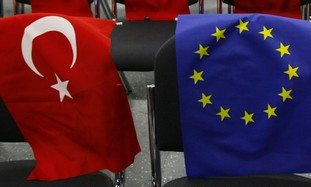
    British Prime Minister David Cameron appears to have set himself on a collision course with France and Germany by expressing “anger” at moves blocking Turkey’s entry into the European Union and pledging to help “pave the road from Ankara to Brussels.”

    Speaking in the Turkish capital, Ankara, Cameron said he “passionately” supported Turkey’s EU membership and said opponents were guilty of double standards because they were happy to accept its contributions to Europe’s defense as a member of NATO.

    “When I think about what Turkey has done to defend Europe as a NATO ally and what Turkey is doing now in Afghanistan alongside European allies, it makes me angry that your progress towards EU membership can be frustrated in the way it has been,” he told a meeting of the Turkish chambers of commerce. “I believe it’s just wrong to say Turkey can guard the camp but not be allowed to sit inside the tent.”

    Cameron called Turkey” a great NATO ally” that “shares our determination to fight terrorism in all its forms, whether from Al-Qaeda or from the PKK [Kurdistan Workers Party].”

    While Cameron’s remarks — on his first official visit to Turkey — echoed the support of Britain’s previous Labour government for Turkish EU membership, they were striking in their vehemence. They also represented a direct challenge to France and Germany, both of which oppose the majority Muslim country’s entry even though it formally opened membership negotiations in 2005. Since then, the pace of Turkey’s application has floundered, with just 13 of 35 chapters of European law required for membership opened.

    Doing De Gaulle Proud

    French President Nicolas Sarkozy and German Chancellor Angela Merkel have tried to assuage Turkish aspirations by offering it “privileged partnership” status — a designation Turkey rejects.

    Germany’s opposition was reiterated on July 27 by Foreign Minister Guido Westerwelle, who was also visiting Turkey but said it was not “ready to join” the EU.

    “If the question had to be decided today, Turkey would not be ready for membership and the EU would not be ready to absorb it,” Westerwelle told the German newspaper “Bild.” “But we have a big interest in Turkey turning in Europe’s direction. I want a Turkey that is on Europe’s side. Not just for economic reasons. The country can also provide very constructive help in resolving many conflicts.”

    Sarkozy has justified his opposition to Turkish membership by citing cultural differences and saying it would pose a threat to the bloc’s political cohesion.

    But Cameron brazenly ruffled French feathers by comparing Paris’s position to President Charles de Gaulle’s hostility to British membership in the 1960s.

    “Do you know who said, ‘Here is a country which is not European. Its history, its geography, its economy, its agriculture and the character of its people — admirable people though they are — all point in a different direction. This is a country which cannot, despite what it claims and perhaps even believes, be a full member’?” Cameron asked. “It might sound like some Europeans describing Turkey, but it was actually General de Gaulle describing the UK before vetoing our EU accession. We know what it’s like to be shut out of the club. But we also know that these things can change.”

    Useful Friend

    He also attacked opponents of Turkish entry on the grounds of its Muslim population as being guilty of seeing “the history of the world through the prism of a clash of civilizations.” He added: “They think Turkey has to choose between East and West and that choosing both is not an option.”

    Turkey’s growing economic power meant that the Europe could not turn its back on it, Cameron suggested.

    “Which European country grew at 11 percent at the start of this year? Which European country will be the second-fastest-growing economy in the world by 2017? Which country in Europe has more young people than any of the 27 countries of the European Union? Which country in Europe is our No. 1 manufacturer of televisions and second only to China in the world in construction and in contracting?

    “Tabii ki Turkiye,” he said, Turkish for “Turkey, of course.”

    He also said Turkey was vital to resolving the dispute over Iran’s nuclear program, which Tehran claims is for peaceful purposes but which the West suspects is for bomb-making.

    “Which European country could have the greatest chance of persuading Iran to change course on its nuclear policy?” Cameron asked. “Of course, it’s Turkey. It’s Turkey that can help us stop Iran from getting the bomb.”

    Turkey, along with Brazil, reached an agreement with Iran in May to export 1,200 kilograms of low-enriched uranium in exchange for nuclear fuel for a medical reactor in Tehran. The agreement failed to prevent a fourth round of UN sanctions against Iran, together with further EU and U.S. embargoes. But Cameron said he hoped the deal could help “see Iran move in the right direction.”

    Not So Simple

    Cameron also urged Turkey to repair its tattered relations with Israel after the recent confrontation over a commando raid on an aid flotilla bound for Gaza, resulting in the deaths of nine Turkish citizens.

    “No other country has the same potential to build understanding between Israel and the Arab world,” Cameron said, acknowledging Turkey’s potential to act as a bridge between East and West. “I urge Turkey — and Israel — not to give up on that friendship.” But he also appeared to side with Turkish sentiments over Gaza, saying: The situation in Gaza has to change. Humanitarian goods and people must flow in both directions. Gaza cannot and must not be allowed to remain a prison camp.”

    His comments appeared to reflect the belief of many Western policymakers that Turkey’s recent hostility toward Israel may have been partly fueled by its feelings of rejection by the EU and a resulting need to foster alternative alliances in the east, including with Iran.

    U.S. President Barack Obama and Defense Secretary Robert Gates have both suggested in recent remarks that the EU has driven Turkey away from the West. .”If they do not feel part of the European family, then obviously they’re going to look elsewhere for alliances and affiliations,” Obama told the Italian newspaper, “Corriere Della Sera,” this month.

    However, Turkey’s EU critics complain that an internal domestic reform process needed for membership has slowed. They also cite Turkey’s failure to open its ports to goods from Cyprus, an EU member that Ankara refuses to recognize because of its division into Greek and Turkish sectors.

    https://www.rferl.org/a/Cameron_Throws_Down_Gauntlet_To_France_And_Germany_With_Backing_For_Turkish_EU_Bid/2111086.html
  • Pink Floyd duo outshine Kate Moss at Palestine charity gig

    Pink Floyd duo outshine Kate Moss at Palestine charity gig

    It is not often that Kate Moss finds herself upstaged. But the supermodel’s enthusiastic turn on the tambourine was overshadowed by a rare reunion of Pink Floyd legendsDavid Gilmour and Roger Waters.

    They took to the stage at the Hoping For Palestine charity gala, where guests bid at an auction throughout the night to raise money for Palestinian refugee children.

    Held at Jemima Khan‘s country house Kiddington Hall at the weekend, the Pink Floyd duo performed To Know Him Is To Love Him, Wish You Were Here and Comfortably Numb. Financier Arpad Busson then bid £50,000 for them to play Another Brick In The Wall.

    The evening began when Nick Cave and Jamie Hince sang Stagger Lee, with Moss and Cave’s wife Susie Bick on tambourines.

    The evening was orchestrated by the Hoping Foundation’s trustees Bella Freud, Karma Nabulsi, James Fox and Sudhir Hazareesingh and raised £400,000. Guests included Guy Ritchie and new girlfriend Jacqui Ainsley, Fearne Cotton, Dougray Scott, Harry Potterdirector Alfonso Cuarón and Sheherazade Goldsmith.

    This Is London

  • UK envoy’s praise for Lebanon cleric draws Israel anger

    UK envoy’s praise for Lebanon cleric draws Israel anger

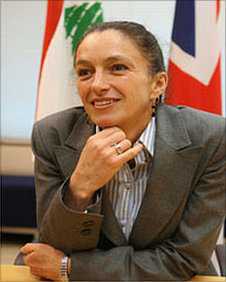
    Frances Guy has extensive experience in the Middle East

    Israel has criticised Britain’s ambassador to Lebanon for eulogising a recently deceased Lebanese cleric said to have inspired Hezbollah.

    Frances Guy wrote on her personal blog that Grand Ayatollah Mohammed Hussein Fadlallah was a “decent man” who rated among the people she most admired.

    An Israeli spokesman said Ayatollah Fadlallah was “unworthy of praise”.

    The UK foreign office says it has taken down the blog after “mature consideration”.

    It said the comments reflected Ms Guy’s personal opinion, not official UK policy.

    Ayatollah Fadlallah, Lebanon’s top Shia Muslim cleric, died on Sunday at the age of 74. Thousands of people attended his funeral in Beirut and tributes poured in from all over the Arab and Islamic worlds.

    Two days ago, CNN sacked a veteran Middle East editor who wrote on Twitter that she “respected” the late cleric, saying that her credibility had been compromised.

    Controversial figure

    Ayatollah Fadlallah was customarily described as the spiritual leader of the militant movement Hezbollah when it was formed in 1982 – a claim both he and the group denied.

    Ms Guy, who has been ambassador since 2006, wrote on her blog that Ayatollah Fadlallah was the politician in Lebanon she most enjoyed meeting.

    “The world needs more men like him willing to reach out across faiths, acknowledging the reality of the modern world and daring to confront old constraints,” she wrote.

    Israel’s foreign ministry denounced the comments.

    “We believe that the spiritual leader of [Hezbollah] is unworthy of any praise or eulogising,” a spokesman told the Israeli newspaper, Yediot Ahronot.

    “If Hezbollah was firing missiles at London and Glasgow, would this leader still be called ‘decent’?” he added.

    Ayatollah Fadlallah was a controversial figure.

    He was revered as one of Shia Islam’s highest religious authorities and won support from many Muslims for his anti-American stance and his support for the Islamic revolution in Iran.

    He advocated suicide attacks as a means of fighting Israel, and has been linked to the 1983 suicide bombings that killed more 300 American troops at the US marine barracks in Beirut.

    But he condemned the 9/11 terror attacks and had relatively progressive views on the role of women in society.

    ‘Personal view’

    Hezbollah’s military wing is proscribed in the UK as a terrorist organisation.

    But Ms Guy, who has met with Hezbollah officials on several occasions, wrote that Ayatollah Fadlallah’s passing left Lebanon “a lesser place”.

    “When you visited him you could be sure of a real debate, a respectful argument and you knew you would leave his presence feeling a better person,” she wrote.

    “That for me is the real effect of a true man of religion; leaving an impact on everyone he meets, no matter what their faith.”

    The British foreign office said it had removed the blog post as it did not fully reflect the British government’s policy.

    “The ambassador expressed a personal view on Sheik Sayyed Fadlallah, describing the man as she knew him,” a spokesman told the BBC.

    “While we welcomed his progressive views on women’s rights and interfaith dialogue, we also had profound disagreements – especially over his statements advocating attacks on Israel,” he added.

    https://www.bbc.co.uk/news/10572025, 9 July 2010