Thousands of kilometers away from their homeland, Turks living in the Netherlands are still taking a keen interest in the Turkish economy, lauding the visible improvements observed over the past decade in particular.
The journey of Turks moving to foreign countries started in the 1960s when the population of Western Europe was not able to meet its fast-growing need for labor. The first Turkish “gastarbeiters” (guest workers) arrived in Germany in 1961, followed by the Netherlands, Austria and Belgium in 1964. Since then, the population of Turks in the European Union has edged 4 million people. Following Germany — where the Turkish population is the highest — the importance of the Turkish community in the Netherlands has also increased over time.
The opinions of this group of allochtoon (immigrant in Dutch) about the Turkish economy is important since they only visit Turkey once a year or even less and therefore have the opportunity to observe whether the country is changing positively or negatively over time. When looking at the Turkish economy over the last seven years, it is evident that many have noticed some major successes. The country reported an annual growth figure of 8.9 percent in the past year while its exports reached $114 billion, and national income per capita passed $10,000. These are just a few of the evident improvements. However, there are still objections that this economic progress is not being reflected equally across the community, and some say it has just made the rich even richer.
In remarks to Sunday’s Zaman, Fatih Kulaksızoğlu, an economist at a Dutch pension company, said Turkey is seen as attractive for foreigners with its noteworthy growth figures in a period where European economies such as Greece, Portugal and Spain are facing financial troubles. “Turkey managed to come out of the global financial crisis stronger, together with major emerging countries like China and India. I view the economy like a race and Turkey is now much closer to the finish line,” he says.
Tahir İpekçi, a cab driver in Amsterdam who visits Turkey once a year, has similar views and especially notes that Turkey has managed to achieve price stability in the country. “I remember when the prices of services, products and foods in Turkey showed a big difference from year to year. We would have a hard time getting used to the price fluctuations. But now this has changed a lot in line with its [economic] development. I can definitely say that there is price stability in the country now,” he adds.
Commenting on the claims of some groups in Turkey who argue that this economic growth has not been reflected in the lives of ordinary people, İpekçi said he certainly believes the welfare of every single Turk has improved. “For instance, in my hometown of Büyüköz in Yozgat’s Boğazlıyan district, people were demanding drinking fountains and roads to the city center from the mayor. But now, they are asking for community centers where they can gather and participate in personal development activities. How can a poor public ask for these kinds of things from the municipality?” he notes. “Almost all of the villagers now buy their bread, cheese or other foods from the market instead of making their own and they have Internet connections at home. Are these not signs of development over time?” he asks.
On the other hand, Kulaksızoğlu thinks that it will take some time for the rise in welfare to be reflected at the individual level. He says it is normal to witness unfair income distribution in emerging economies such as Turkey, adding that this will disappear when the country matures. “When a country grows, capital is the winner in the first phase. The labor force will come next,” he adds. “The problem with Turkey is some groups have benefited more from the economic growth than others. This is basically where the debates starts — whether wealth has increased for every single person.”
Things yet to be improved
“Despite improvements in many fields, Turkey still has some issues that could lead the country into trouble in the near future,” Kulaksızoğlu said. He noted that economic fragility, such as a plunge in the value of the Turkish lira and a rising current account deficit, even a small change at a time when there is a negative development in international markets, could cause headaches for economic administrators if they cannot control it. “In terms of the sustainability of attracting foreign capital into the country, it is essential to control foreign exchange stability and the current account deficit,” he noted.
Another point Kulaksızoğlu highlighted was the prevalence of the unregistered economy in Turkey. He says it is not always wise to increase the tax rate in order to collect more taxes. “By decreasing tax rates, the number of employees with social security could increase as employers would need to pay fewer taxes for the pension, insurance, etc., for their employees. … Besides, increasing income tax does not mean that taxation income will effectively rise. This could deter people from paying taxes,” he says.
via zaman
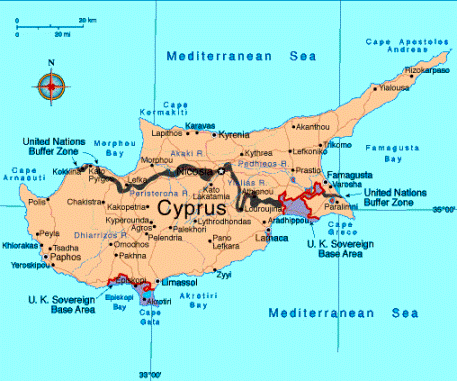
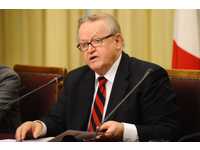 (ANSAmed) – BRUSSELS – An appeal was launched today in Brussels by the ‘wise men’ of the Independent Commission on Turkey to restart negotiations on EU membership with Ankara, which have been caught in a vicious circle for four years. The wise men – former Finnish President and Nobel prizewinner for Peace Martti Ahtisaari; fomer EU Commissioner Emma Bonino, Italy, and Hans van den Broek, Holland; former French Premier Michel Rocard; former Spanish Foreign Minister Marcelino Oreja; Austria’s former Secretary General for Foreign Affairs Albert Roahn – presented their report ‘Turkey in Europe, breaking the vicious circle’, taking the opportunity to make observations on the recent turbulent years in relations between Ankara and the EU. It all started with a ‘paradox’, said Rohan: ”Since negotiations started in 2005, the virtuous circle has turned into a vicious circle”. There are several reasons for this change of tack: the thorny issue of Cyprus, with the failed 2004 referendum over the reunification of the island following the ‘no’ vote by the Greek-Cypriots, the slowing-down of reforms by Ankara, and also ”the opposition to Turkey’s entry on the part of several European leaders and public opinion in many countries”. The positions of the leaders, said Rohan, ”are in stark contradiction to the unanimous decision to open adhesion negotiations taken by heads of State and government in December 2004. This attitude has given Turkey the impression of not being wanted, of being treated differently from other candidates. But this approach is contrary to European interests: Turkey is a strategic country for energy routes, its presence in the Caucasus, its economic strength in Central Asia, and its negotiating weight in the Middle East”. The result is that now more than half of the 35 chapters of negotiations for adhesion are blocked, either because of Cyprus’ veto, as a response to the lack of full application of the Ankara Protocol on the part of Turkey, which regulates customs relations with the 27 countries, or because of the block placed informally by other chapters. France has blocked five chapters, preferring to focus on partnership rather than integration. Austria, Germany and Holland also have political positions or public opinion overwhelmingly against Turkey’s inclusion in the EU. As for Italy, Bonino said that ”lately, for the first time, opposing positions have been taken very very firmly by the Northern League”. For this reason the former EU commissioner has called on Berlusconi to ”mediate” inside the Government so as to define a clear position ahead on the EU summit on December 9-10, during which the next steps for the adhesion talks will be defined. Emma Bonino said that the question ”of identity is an alibi for not saying anything, for not saying that they are Muslims, there are 80 million of them. I always feel like saying, what is the European identity? For me, Europe is a State of rights, division of power, democracy, open society; I do not believe that Europe is a religious project or a geographic project”. In this negative context, there are only a few signs of a change in tendency, for example the resumption of Turkish-Armenian dialogue. But the ‘wise men’ insist that ”an effort is needed, we need good news from Turkey, on its reform plans, and a greater sense of responsibility on the part of the authorities and the European media”. ‘‘Not just the credibility of Europe towards Turkey, but the international role of the EU are at stake”, concluded Ahtisaari. (ANSAmed).