Category: Hungary

  • Direct Budapest-Istanbul rail service to be reestablished in 2012

    Direct Budapest-Istanbul rail service to be reestablished in 2012

    MTI – Econews

    Thursday 10:25, May 19th, 2011

    The Turkish and Hungarian state railways have agreed to reestablish direct rail service between Budapest and Istanbul in 2012, Hungarian state railways MAV told MTI.

    Trains should begin running directly between Hungary and Turkey during the summer of next year, MAV said.

    MAV expects significant interest from western Europe and North America for the direct service first inaugurated in 1889 and subsequently discontinued.

    via Direct Budapest-Istanbul rail service to be reestablished in 2012 | The Budapest Business Journal on the web | bbj.hu.

  • While you were watching Egypt, Balkans are like a bomb ready to explode

    While you were watching Egypt, Balkans are like a bomb ready to explode

    SHARP-EYED observers have noted that some of the protestors that brought down Egypt’s president used the clenched-fist logo of  Otpor, the well-organised, foreign-financed civic resistance movement that helped topple Slobodan Milosevic in 2000. Parts of the Serbian press, notes Florian Bieber, an academic who works on Balkan affairs, have claimed that former Otpor activists helped train some of the opposition groups.

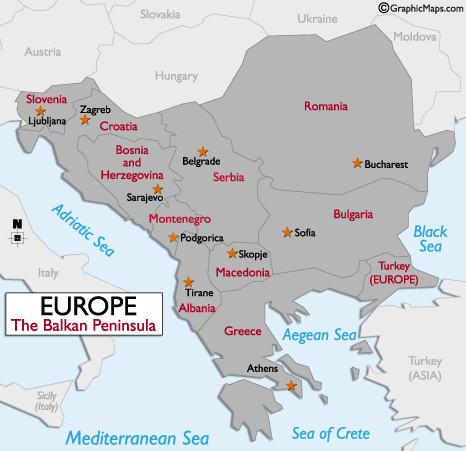
    With the world’s attention on the Arab world, the political instability gripping much of the western Balkans has largely been ignored. Yet so serious is the unrest here—including mass demonstrations in BelgradeTirana and Skopje—that one diplomat told me his country’s foreign ministry had asked him if he thought that Egypt-style revolution might sweep northwards into the Balkans. (His answer was an emphatic “no”.) Here is a round-up of recent developments:

    Kosovo held an election on December 12th, but still has no government. Following allegations of “industrial-scale” fraud, re-runs had to be held. Until an apparent breakthrough yesterday, the country’s politicians had been unable to secure the basic outlines of a deal which would permit the formation of a government. Now, however, a faction within the Democratic Party of Kosovo of Hashim Thaci, the acting prime minister, has been forced to drop its insistence that its man, Jakup Krasniqi, the acting president, be given the job formally.

    Behgjet Pacolli, a tycoon, now looks set to become president. In exchange his party, the New Kosovo Alliance, will enter into coalition with Mr Thaci. Mr Pacolli is married to a Russian, which, given Moscow’s refusal to recognise Kosovo’s independence, leaves some Kosovars appalled.

    Two years after independence, Mr Thaci has never been so weak politically. He has been weakened by a row with Fatmir Limaj, the outgoing minister of transport, who enjoys much support in the party. Internationally, his standing has been shredded by a recent Council of Europe report making all sorts of lurid allegations against him. EULEX, the EU’s police mission in Kosovo, is now investigating. Partly as a consequence Kosovo’s European integration process has failed to get off the ground. Five of the EU’s 27 members do not recognise Kosovo.

    The situation in Macedonia is little better. Nikola Gruevski, the prime minister, has set off for Washington seeking support for his attempts to speed EU and NATO integration, but he may get his ear chewed off when he arrives. Solving the almost 20-year-old name dispute with Greece appears less of a priority in Skopje than ever. Construction of a giant  plinth that will support a statue of Alexander the Great is proceeding briskly, guaranteeing fresh outrage in Greece.

    The Social Democratic opposition has pulled out of parliament, and Macedonia is gripped by the saga of A1 Television, whose bank accounts have been frozen for a second time by the courts. Mr Gruevski’s opponents say that the government is trying to muzzle the last bastion of free speech in the country. Nonsense, claim government supporters. The courts are simply clamping down on tax evasion. In fact, the two arguments do not contradict each other. The smart money is on an early election in June.

    Meanwhile a small group of Albanians and Macedonians fought a pitched battle in Skopje castle on February 13th, where the government has begun building what it says is a museum, in the shape of a church. The problem is that the castle is in an Albanian, and hence Muslim, part of town. When the Albanians protested, saying that the structure was being built over an ancient Illyrian site,  Pasko Kuzman, the chief archaeologist, said construction would stop. But builders went in at night to continue their work, which led the Albanians to try and dismantle the structure. And so on, and so on.

    Over in Albania the prime minister, Sali Berisha, has accused the opposition of staging a coup, following a demonstration on January 21st that went horribly wrong when Republican Guards allegedly fired on opposition supporters, killing four. The demonstration sprang from charges by the opposition, led by Edi Rama, the Socialist mayor of Tirana, that Mr Berisha was returned to power in June 2009 by fraudulent elections. Unlike Macedonia, Albania is a member of NATO, but its EU integration path has effectively stalled.*

    The Serbian government has been holed and is taking on water—but has not sunk yet. Mladjan Dinkic, head of the G17 Plus party and Serbia’s deputy prime minister, had been openly criticising his governmental colleagues from President Boris Tadic’s Democratic Party. On February 14th Mirko Cvetkovic, the prime minister, moved to sack him. Mr Dinkic resigned today but stopped short of pulling his party out of the government.

    How long the Serbian government can limp on like this is anyone’s guess. Tomislav Nikolic, leader of the opposition Serbian Progressive Party, has said that unless new elections are called before April 5th he will lead more protests in Belgrade. Watch this space.

    Last but not least, Bosnia and Hercegovina. Elections there were held on October 3rd, but there is still no government at state level. No surprise there. Progress on anything, let alone EU integration, has been stalled in Bosnia since 2006 in the wake of the failure of the so-called “April Package” of constitutional reforms. Al Jazeera recently announced plans for a Balkans channel, based in Sarajevo and broadcasting in what it delicately calls “the regional language”. Given the station’s role as the cheerleader of revolt in Tunisia and Egypt, one can understand diplomats’ concerns.

    Global Agenda

  • Standoff at Tahrir Sq.

    Standoff at Tahrir Sq.

    by Kutluk Ozguven

    29 January 2011

    The rules of the game have been simple: Police trumps protesters. Masses trump police. Army trumps masses. If the army stands back, you have a revolution (Iran 1979, Romania 1989, Tunisia 2011), if not, then bloodshed (Hungary 1956, China 1989, Algeria 1992). I don’t recall any popular uprising successful over a fully functioning armed force determined to go all the way. That is why armed forces are always considered as backbones of corrupt dictatorships.

    This weekend we shall see if the Egyptian armed forces, which the latest Wikileaks leak as US believes it to be unhappy, at least in the mid-ranking officers, but probably higher, will open fire to stop the masses or the masses will blink, or it will give way to the people. Egyptian army is a conscript army and there is no part of the Egyptian society that may be counted on apart from the westernised elites, whose children do not operate tanks during military service. The news is that the Egyptian army are already mobilised into urban areas and taken control of strategic points.

    Egyptians I came to know during a series of visits for international projects were a very kind people, members of a polite and civilised nation, well known among the other Arabs with their humour and taking things lightly. This nation of gentle farmers has been easy to manage by foreign soldiers (the Hyksos, Ptolemeans, the Mamluke, Ali Pasha troops) or domestic warlords, perhaps exact opposite of Chechens or Afghans. They are patient, soft-spoken, happy in the face of any event, and cultured. In short, any megalomaniac tyrant’s dream population.

    They have gone through a westernisation process predating Turkey, and a secularisation process of 50 years under socialist dictatorship. Save occasional and sensational terror incidents, there is no history of popular uprising or even any active political formation, except for the elitist Muslim Brotherhood, structured in 30s as a Muslim answer to Freemasonry, who wouldn’t even entertain the idea of going on the streets with sweaty youngsters. Americans and Israelis are all over the country, to the degree that five star Cairo hotels put on Hebrew-language TV channels for their guests from their northeastern neighbours. It has highest number of Internet access in the region with 20 million users and more advanced in some software technologies than, say, Turkey.

    Therefore, one wouldn’t expect a popular uprising overthrowing one of the most entrenched dictators of the world. Most well-informed experts, political commentators or social analysts certainly did not expect that the events would have gone out of control to this degree where it is becoming more and more unlikely that Mubarak will survive. When he unplugged the Internet less than a day ago, I recalled another ridiculous caricature, Alan Rickman’s Sheriff of Nottingham cancelling Christmas. He could have blocked social networks and slowed down the e-mail, but that would be too sophisticated to epitomise this wily little people who see it their birth right to enslave tens of millions of human beings. Which explains the situation better than any verbose expertise: it is the tyranny of stupid, primitive, incompetent minds over masses much more sophisticated and much deeper than them.

    When one sees all these Middle Eastern or Central Asian rulers and their small social segments whom they depend upon to man their security forces or financial institutions, one cannot help but be only deaf to any economic analysis. Despotism is always a disaster for economy because meritocracy is not allowed and accountability does not exist. The small clique of rulers milks the real productive people and eventually kills their productivity long before they would expire naturally. This leaves society weak and inefficient. If we add to the two factors the global financial system, which get the lion’s share of the bounty and only leaving crumbs to the visible rulers, it is obvious that the dictatorship is not a long term stable solution. Either the nation is annihilated from within or without, or it throws its rider. The last military period in Turkey, 1997-2002, is a good accelerated example to despotic cronyism, when the rampant economy of 1997 was brought to bankruptcy in four winters. Imagine that being practiced 30 years or 50 years.

    It is true that the 2011 Domino events stem from people wanting to get rid of the despotic cronyism, with them seeing that it is no more to mind one’s own business anymore as there is no business being left. And this is why analysts keep calling them secular uprisings, emphasizing the difference between Iran, Algeria, Hama or others. But this distinction comes out of their own mental compartmentalisation rather than the field. There is no separation between three elements that are in force here: people’s dignity, economic development and return to Islam. In the middle-east, or any once-have-been Islamic nation, the three are inseparable.

    Economic development is impossible without a level playing field and risk taking, bold, free, entrepreneurial players and accountable refereeing. That is impossible without popular social consent and social contract without privileged classes, aristocracies and caste systems. Perhaps in Hindu society, or in Confucian society. But not where Islam had been the source of social order with its egalitarian principles, holistic justice concept and personal freedoms. Once the verses of the Quran are practiced at some point by any society, it can never have another long-term working social system. That is why in any free election in the Middle East at any given time, Muslim-leaning parties have always won without exceptions. Therefore however secular the protests might have been, if there will be political freedom, reversal of de-Islamisation will be part of it.

    This is why many in the Middle East look towards the Turkish experiment. Without oil and natural sources, and to confess, with little ingenuity, by simply doing things as they should be done, Turkey turned from the military-dominated status to a richer, functional democracy managed by Muslims.

    The Tunisians, Jordanians, Algerians, Yemenis and Egyptians want this, no more. The talk of Turkey without oil is doing well with a free society, with secularised and religious people coexisting under a religious president, with none of the pretentious extravaganza is the greatest fairy tale to Arab ears. A fantastic dream which had been once ruled out as absurd. They just want the same. But when they get it, as they will, another fairy tale that was once ruled as absurd, will inevitably roll on: the cooperation and eventual unity of these independent states.

    If the troops on the Tahrir Square open fire, the process will only be delayed. But not stopped.
  • European countries provide most of PKK’s weapons

    European countries provide most of PKK’s weapons

    Intelligence sources indicate that the biggest arms suppliers of the terrorist Kurdistan Workers’ Party (PKK) are allies of Turkey that are also members of NATO. Recently drafted General Staff reports say that many mines planted by the PKK were obtained from Italy and Spain.

    Turkey is ready to start a new round of diplomatic initiatives to stop countries that supply the PKK with arms. Turkey has undertaken similar initiatives in previous years.

    Over the past few months, the PKK has relied on arms from Mediterranean countries, intelligence reports indicate. The roadside bomb that exploded in Halkalı on Tuesday was of Portuguese origin, intelligence sources said, adding this country to the list of countries that supply arms to the terrorist organization. That attack was carried out by the PKK’s urban offshoot, the Kurdistan Freedom Falcons (TAK).

    The most crucial question is how the PKK is able to bring these arms supplies it obtains from Mediterranean countries to northern Iraq. US journalist Seymour Hersh claimed in 2007 that this was done via Israel.

    The General Staff has seized PKK arms and ammunition originating from 31 different countries. However, NATO-member countries have been the biggest suppliers. Most of the arms and ammunition seized are of Russian, Italian, Spanish, German and Chinese origin.

    In 2007 Turkey questioned the countries where the arms used by the PKK — particularly the heavy artillery the terrorist group uses — are mostly manufactured on how the PKK could have obtained these weapons. These diplomatic attempts must have produced some sort of a result, as all PKK weaponry seized in the past three years have had their serial numbers erased. The military has noticed that the PKK now generally erases serial numbers, especially on explosives. However, most of the time the origins of the ammunition can still be traced. Turkey is concentrating on finding the sources of not the lighter arms but of heavy artillery such as heavy machine guns, rocket launchers, mines and hand grenades.

    According to data from the General Staff, the Kalashnikovs used by PKK terrorists are from Russia and China. The rocket launchers, mines, hand grenades and heavy machine guns so far seized from the organization appear to have been manufactured in Italy, Germany, England, Spain, Portugal, Czech Republic and Hungary.

    The organization uses a third country to bring the weapons to northern Iraq and then into Turkey. What disturbs Turkey most is that the mines that have killed more than 100 Turks recently were all obtained from Italy.

    Another issue is that the PKK, which had been rather sloppy in using remote-controlled mines until 2008, has become more of an expert at such attacks. Terrorism experts say the PKK has been given special training, with many suspecting Mossad agents. In 2009, Interior Minister Beşir Atalay claimed that some Mossad agents had gone to northern Iraq and given training on remote-controlled explosives.

    According to documents from the General Staff, 72 percent of the Kalashnikovs used by the PKK are from Russia, 15 percent from China and the rest from Hungary and Bulgaria.

    In 2007, it was reported that more than 170,000 weapons donated by the US to the Iraqi army had ended up in the PKK’s hands. The US Defense Department started an investigation after Turkey’s discovery of this fact.

    Turkey is making a point to not publicly announce how it suspects these weapons are being brought into northern Iraq. Pulitzer-winning journalist Hersh, in an interview with the Takvim daily earlier this month, said Israel helped the PKK base in the Kandil Mountains bring in arms and supplies on helicopters.

    He said that Israel gives extensive support to the PKK and the related Iranian organization Party for a Free Life in Kurdistan (PJAK), especially in terms of arms supplies. He also said that Mossad operatives are active in the area, noting that Jewish Kurds who left northern Iraq 50 years ago returned to the region after the 2003 US occupation. He argued that most of these people are cooperating with the PKK and the purpose of these developments will become clear to all in the near future.

    Although this interview has attracted the attention of Turkish security units, there is a visible effort to avoid making any official statements at this point. Turkey recently made a decision to start diplomatically lobbying countries that supply arms to the PKK. If these countries fail to cut the support they provide for the PKK, then they will be warned openly in the international arena.

    24 June 2010, Thursday
    ERCAN YAVUZ ANKARA

    www.todayszaman.com, Jun 26, 2010