Islam in Greece: Country outlook |
Ioannis Michaletos |
| 05 Aug 2011 | |
|
Points of interest
Greece is an EU, NATO and Eurozone country which has traditionally strong links with the Islamic world due to the geographical proximity with the Middle East and North Africa and the Ottoman rule that lasted four centuries, along with numerous historical encounters with Islam since the Middle Ages.
Presently, the country hosts a Muslim minority which is a reminiscent of the Ottoman Empire, but also an expanding Islamic population from the Arab countries and Pakistan that enter Greece in significant numbers as illegal immigrants.Moreover, large corporations in the country, such as banking institutions, tourist companies and real estate ones are in control of Islamic funds, whereas countries such as Egypt, Saudi Arabia, Iran, Turkey and Libya, can be considered as significant trade partners of Greece.
In Athens Greece, the Iranian Saderat bank is hosted(1), which is a U.S black-listed institution due to alleged links with Hezbollah (2). Iran covers 25% of Greece’s oil needs per annum and some 15% of its natural gas needs. Furthermore, there are indications that Hezbollah groups are operating in a logistic support basis in Athens by gathering funds through tobacco contraband over the past years (3).
In a broad sense, Greece due to a mixture of its geographical placement, history and business links, is considered as a gate-away for the Islamic element towards the EU and the Balkans and over the past 10 years it has become one of the main transit territories for Islamic-originating illegal immigration to Europe.
Until now Greece does not seem to have a particular issue of Islamic fundamentalism. Nevertheless as aptly described in a U.S State Department report on terrorism, “Greece is increasingly an EU entry point for illegal immigrants coming from the Middle East and South Asia and there was concern that it could be used as a transit route for terrorists travelling to Europe and the United States. The number of illegal immigrants entering Greece, especially through the Aegean Sea, increased dramatically in 2008 and 2009, with more than 100,000 illegal immigrants, nearly half of whom originated from North Africa, the Middle East, and South Asia, arrested each year” (4).
Islamist activity in Greece
Presently in Greece, there seems to be an activity within radical Islamic elements, as well as, gradual projection of Islamic political entities through the use of Greek nationals.
A revelation by the infamous Wiki Leaks US Dept of State telegrams, showed that, the ex-Ambassador of US in Athens, Mr. Daniel Speckhard, has noted the danger of the nexus between Greek domestic terrorist groups and Islamic groups, including those from Iran, as he was informed by the then Greek Minister of public Order, Mr. Chrysohoidis (5).
Furthermore, in a special report by the French daily “Le Figaro”, on the 21st of December 2010, the case of the route of Islamic terrorists from Lebanon to Europe was noted with significant details (6) .
The article titled “Liban-une filiere djihadiste vers l’Europe”, clearly illustrated the perils involved for Greece as well. More specifically, the Lebanese Army Cornell Mahmoud Issa noted to the French journalists that since November 2010, some 20 extremists managed to escape from a camp where they were kept in Lebanon and found their way to the EU.
He stated that already the authorities were notified in an international level, although he admitted that this is a difficult task. From their part, the French security authorities believe that this is the case of a new Jihad mission heading towards European metropolises.
In classified documents that were in possession of radical groups in Lebanon, it was noted, that the individuals named: Karoum Imad Youssef, Ahmad Kayed and Sidawa, managed to leave the camp previously and through Syria and Turkey ventured up to Greece and Bulgaria with the assistance of illegal immigrant transport networks managed by Turks.
Moreover they managed to acquire fake ID’s and they were finally caught by a common operation of the Bulgarian and Greek authorities. That case according to many reliable sources was closely monitored by the British and French intelligence, due to the fact that these two countries was the ultimate destination of the Lebanese group. Mahmoud Issa, stated that more cases are to be found that evade the authorities so far. In the article Greece is mentioned as a traverse region from where potential terrorists travel on their way to other EU countries.
French intelligence sources dating back to the pre-9/11 period claimed that organized networks of radical Arab groups that have operated in Greece in the past have been used by al-Qaeda affiliates and other fundamentalist networks (7).
According to a pre-9/11 French intelligence report, American interests in Greece and Cyprus were considered by Osama bin Laden’s network as targets. Citing a DGSE document, the newspaper “To Vima”, reported that members of the bin Laden network in cooperation with Taliban officials and other armed groups were planning to hijack airplanes between March and September 2000, yet it was never carried out due to various logistical and operational disagreements (8).
In another notable case, in September 2005, the Moroccan Anwar Mazrar was arrested on the Greek-Turkey border while attempting to travel to Greece on the Istanbul-Thessalonica bus service . Mazrar had been accused of being a leading member of terrorist groups in Morocco and also of having ties with al-Qaeda (10).
European intelligence agencies have also reported that around 20 Arab fundamentalists have been arrested in Britain, Italy, Portugal, France and the Netherlands for having in their possession forged Greek passports (11).
Various intelligence sources conclude that the Greek immigration policy has deterred many radical Islamist networks from establishing permanent ties in the country. A security brief issued during the 2004 Olympic Games noted, “The legal environment was for many years an obstacle for the growth and development of organized networks that could operate overtly or covertly using religious and cultural organizations and NGOs as legitimate fronts.” This policy, however, unintentionally leads many groups to go underground.
The Greek secret service has mapped a transnational network of radicals that has been developing in Greece over the years. Field informants indicate that this semi-legal web spreads across five different communities, including:
• Mosques and local Muslim communities
• Humanitarian organizations and NGOs
• Islamic cultural centres in Europe
• Foreign political, economic and religious elites
• International Islamist terrorist organizations
The key members of this network (referred to as “The Union of Mosques” or “The Union of Imams”) have military training and combat experience and are well connected with terrorist groups, foreign governments and the Muslim Diaspora in Europe (mainly in Britain, Italy and France). They use criminal activities to finance and facilitate their ideological objectives. The most noticeable illegal activities they conduct are passport forging, arms trafficking, people smuggling and drug trafficking. Finally, according to the same sources, the network has developed an internal structure to support fundraising, recruitment and counter intelligence activities (12).
Greece’s rather recent encounter with domestic radical activities is getting stronger, as the data show regarding the spread of Islamic-driven NGO’s and charity groups.
Al Jabbar, is a Islamic charity NGO active in Greece over the past five years. According to information of high value, the organization possesses funds in excess of 400,000 Euros and it is actively launching campaign for the raise of another 150,000 Euros in the near term. Furthermore, it has spent 550,000 Euros, in 2008 in order to buy a buiding in the Aeschilus Street, number 37 in the centre of Athens. In the nearby streets, over the past 24 months, there has been a notable increase of houses being bought by Pakistani nationals who pay in cash, although they tend not to reside there or open up businesses. Further, an undisclosed amount of capital, which is estimated at over 2 million Euros was invested between 2007-2009 for the construction of a “Islamic cultural centre” in the district of Moschato in Athens, by Al Jabbar, although details are in flux regarding the actual involvement. A Saudi financier was also involved into assisting this project. The organization claims unofficially to have as much as 45,000 members, although reliable information point out that the actual membership is a few hundred people. The vast majority of its members is illegally residing in Greece and is of Pakistani descent, although the top members come from the Arab countries. There are no data, if there has been a thorough vetting process by the authorities regarding the transfer of these funds or if they derive from legal and taxed charity work. By taking into account the present state of affairs in the Islamic communities in Athens, there are strong indications that the capital was transferred from Arab countries. The Al Jabbar NGO is highly secretive; its members take measures as not to appear in public or have any kind of pubic contact with governmental authorities or the media (13).
Lastly, a case of interest was the arrest in 2009 of the Iraqi citizen named Abu Sanjad. In this case he was arrested in Athens in July 2009, and he was subsequently sent to Irbil-Iraq, when his identity as a wanted terrorist by the Iraqi government was established. He entered the country, as an illegal immigrant (14).
Islamism and Society
Estimates of the recognized Muslim minority, which is mostly located in Thrace, range from 98,000 to 140,000 (between 0.9% and 1.2%), while the immigrant Muslim community numbers between 200,000 and 300,000. Albanian immigrants to Greece are usually associated with the Muslim faith, although most are secular in orientation (15).
Greece’s Muslim minority is to be found in Western Thrace, the province neighbouring with Bulgaria and Turkey. The first Muslim coming from Anatolia, settled there in 1363 along with the Ottoman Turks in the first European conquest endeavour.
In 1923 Greece and Turkey agreed to a mass exchange of populations and consequently Greeks resettled from Minor Asia to mainland Greece and vice versa (16). The Muslim minority in Thrace along with the Greek-Orthodox in Istanbul remained as a counterweight to its other and as a symbolic remembrance of the oldest Muslim settlement in Europe and the historical Byzantine – Christian presence in the East respectively.
The course of events though revealed a systematic extinction of the Greek-Orthodox Christians in Istanbul that number some 5,000 people down from 200,000 in the 1920’s (17). In Western Thrace around 110,000 Muslims reside -45% Turks, 40% Pomaks, 15% Roma-, and constitute about 1% of the total population in Greece and a Quarter of the Western Thracian populous. The strategic importance of the region has often attracted Turkish attention that the Greek government is accusing of sporadically trying to inflame nationalistic or religious divisions between the Muslim citizens and the Christian ones (18).
A major aspect into examining the present state of affairs in Greece regarding the Islamic element in the country is the influx of illegal immigration, which comes almost exclusively through Turkey.
Tens of thousands of illegal immigrants from the Middle East see Greece as their destination or point of entry into the EU. Only in 2010, their number was 128,000, the highest in all EU member states (19).
Moreover, Turkey does not maintain visa regime with Iran (20) and other Middle Eastern countries, thus promoting in effect the movement of Afghans and Pakistanis, as well as, Iranians into Europe.
The immigrants from the African countries (Somalia,Nigeria) travel to Smyrna, Istanbul and Mersina through vessels crossing the Mediterranean Sea, whilst Arabs come mostly through the Syrian-Turkish borders. The Asians (Pakistani, Bangladeshi, Kurds, and Afghani) pass through the Iranian-Turkish borders and it has to be noted that both countries do not have a visa regime, although Teheran is accused by the world community as a sponsor of terrorism. Therefore the flow of people from Iran to Turkey is in fact unconstrained and there has not been pressure to Ankara to alter this state of affairs with its neighbour.
Istanbul in particular is the undisputable centre where masses of illegal immigrants concentrate before they are transported to the West. In the Vefa neighborhood right beside the Süleymaniye Mosque, the Iraqi-Kurdish immigrants gather.
In the Laleli area the most immigrants come from the Caucasus. In the Aksaray and the Beyazit Meydani regions there are people from all corners of earth pilled in cheap hotels and in the Tarlabasi, African immigrants. In a city of almost 17 million people, it is roughly estimated that between 250,000 & 500,000 of those are illegally residing and waiting mainly to find a way reallocating towards Europe through Greece (21).
The first official mosque—officially named as: the Greek-Arabic educational and cultural centre—began operating in Athens in June 2007 following fierce opposition by political parties and the general public. The Saudi-sponsored mosque can accommodate more than 1,000 religious followers. The new mosque—which officially operates as a licensed cultural centre and school for Arabic language—was financed by the Saudi businessman El Faouza. The Egyptian imam, Omar Abde Kafi, was invited to be present at the opening of the mosque (22).
The Muslim Association of Greece (MAG) was founded in 2003 (23) . The MAG claims to represent all Muslims living in Greece. President of the MAG is Naim El-Ghandour an Egyptian born Muslim who lives in Greece since the early 1970s and has acquired Greek citizenship (24). His wife Anna Stamou a Greek convert to Islam is a member of the board of advisors of the MAG (25). She was also administrator of the islamfriends.gr website. Currently (March 2011), she is responsible for the MAG’s public relations and she also works for the greeksrethink.com website (in Greek language) which appeals to Greek converts to Islam all over the world.
Another important member of the board of advisors of the MAG is Iman Sotiria Kouvali a Greek-Canadian convert to Islam (26). She was founder of the greeksrethink.com website and she is adviser for strategic planning for the MAG. MAG’s official ‘educational’ website is ora-islam.gr. This website was created in early 2010 and seeks to spread knowledge about Islam in Greek language.
The website islam.gr has as an administrator who is Shadi Ayoubi, a Lebanese journalist and correspondent of the Al Jazeera media empire in Athens (27).
The Greek-Arabic Cultural Centre is situated in Athens (Moshato area). The Greek-Arabic Cultural Centre, better known as the Islamic Cultural Centre of Athens, was founded in 2001 in the Athens area of Ambelokipi and was relocated in 2007 in Moshato, an area close to Piraeus port. In December 2006 a Saudi businessman named Al-Fauzan bought an old textile factory building at the price of 2.5 million euros, in order to host the Greek-Arabic Cultural Centre. The building of 1,800 m2 also provides a place where Muslims can pray and serves as an informal mosque (28). The new building has a capacity to host 3,000 believers. The Greek-Arabic Cultural Centre is a member organization of the Federation of Islamic Organizations in Europe (FIOE) (29).
The main Dawah activity in Athens is coordinated by the Association named “El-Rahman” which runs the islamforgreeks.org website (30). The association allegedly numbers 1,500 members (Real numbers of active members much less), mainly Greek converts to Islam. The founder and President of the association is Mohi Eldin Ahmed Ali. However, the brain of the association is his son Ahmed Eldin who serves as vice-president. Ahmed Eldin studied Islamic Theology in Cairo-Egypt as well as public relations and journalism in a private college.
In early February 2011 two Greek converts to Islam (Abu Jassir and Hamza) who are following the Salafi-Wahhabi strand of Islam joined Ahmed Eldin in the islamforgreeks.org website. Abu Jassir and Hamza, (before joining Ahmed Eldin), in partnership with Abu Alia another Greek convert to Islam were propagating the Wahhabi strand of Islam via the YouTube (31). Moreover, Abu Alia according to a report from Radio Free Europe was also actively propagating Wahhabi Islam in the Balkans. An international Wahhabi organization named “Poziv u Raj” (Invitation to Heaven) has launched a campaign in Bosnia-Herzegovina (March 2010) calling on non-Muslims to convert to Islam (32).
In overall, Greece and especially Athens, already hosts a number of Islamic organizations, which can be classified as NGO’s and immigrant-support groups. They tend to keep a low profile and most of them do not retain a website or make their details publicly available (33).
Islamism and the State
Due to the fact that the majority of the Islamic population in Greece and especially the radicalized part of them are mainly interested into establishing themselves on a permanent basis in Western and Northern Europe, the situation is deemed as controllable by the local authorities, something that cannot be guaranteed in the long-term
Since late 2008, there have been three major cases that show the tendency of creating a rising network of a quasi-radical Islamic element in the Greek society. The first was in the December 2008 riots (34) , were a large number of the people arrested were Pakistanis and Afghanis, some of them claiming to the authorities that were paid in order to participate in the violent demonstrations (35).
The second development was the May 2009 so-called “Koran demonstrations” (36), when a multicultural group of various Islamic communities in Athens took to the street allegedly claiming that the Police desecrated the Koran during a routine search in the pockets of a Syria street contraband vendor (37).
Bus stops, 5 shops, one bank and 57 cars, where smashed in and the city centre’s main squares and streets were turned into battle zones for hours. 46 immigrants were arrested, 7 immigrants and 7 police officers were wounded during the clashes (38).
It was later revealed that this particular individual was lying to the authorities and the press and was involved in various illegal actions including armed robberies (39).
A third phase was the mass prayer of thousands of Muslims in the centre of Athens in October 2010, without attaining the necessary state permission for that (40). Amongst the organizers they were individuals associated with the Muslim Brotherhood and an Imam was brought by Egypt to commemorate the ending of the Ramadan.
Small-scale riots started the next few days when they were again false allegations for Koran desecration by the Greek police in the centre of the city (41). It was again proved to be false, but it is more than obvious that a “street mechanism” is being established in the country that facilitates the mobilization of a few hundred “angry Muslims”, and the spread of these kind of news to the media through the use of Greek intermediates along with the umbrella of NGO’s that operate by spending considerable amounts of capital (42).
In 2005, the “Pakistani abduction case,” took place, in which 28 Pakistani immigrants were allegedly kidnapped by intelligence agents in Athens (43). That case was connected to the cooperation between the Greek and UK authorities following the July 2005 bombings in London, but was also the first notable case of accusation of the Greek state by Islamic organizations that Greece is actively turning against the Islamic element and takes harsh measures in the “war against terror”. The Greek weekly newspaper, “Proto Thema” also disclosed the names of 15 alleged Greek agents and an MI6 spy chief allegedly involved with kidnapping and torturing the Pakistanis eight days after the London bombings of July 7, 2005 (44). There was widespread support by leftist groups mostly that demanded through a series of legal actions and demonstrations the punishment of the Greek and UK security members involved.
In another case, which was the devastating wildfires in Greece in the summer of 2007 (45), a report, citing US intelligence channels, claimed that an Arabic-language jihad website has urged Muslims in Europe, America and Australia to use arson as a tool of terror. The website apparently cited imprisoned Al Qaeda “theorist” Abu Musab Al-Suri as the ideological progenitor of this plan. While Greece is not specified among the countries to be attacked, and while it is not a contributor of troops to the US-led coalition in Iraq, it has been vital to the war effort by allowing the Americans access to its island bases, transport and other logistical services (46) .
Further evidence attests to a possible connection between Islamists and the forest fires in Greece. A type of improvised explosive device used in setting off the fires was ignited with a mobile phone (47). By calling the phone’s number, the device exploded, sparking a blaze that soon grew out of control. The advantage for the perpetrators is that this result can be achieved from a safe distance- even from abroad. Significantly, it is similar to one of the methods used in the Madrid bombing in March 2003 and frequently used in IED’s in Iraq and Afghanistan.
Further, a ranking Greek intelligence officer that spoke on the condition of anonymity stated that during the height of the summer fires a Saudi national equipped with such a device was arrested by Greek border police in the north of Greece, in the company of several Kosovo Albanians. It is no secret that the latter consider Greeks to be an enemy, in light of the latter’s historic support for the Serbian point of view regarding the Kosovo issue. Nevertheless, there is evidence, some of it gathered in an August 2007 Jamestown Foundation report, of Greece being used as a transit zone and even potential target for al Qaeda and related groups (48).
The Greek state authorities have numerously in the recent past, been called upon, to investigate potential Islamic terrorist activity in the country. A warning from Serb intelligence about the mobilization of an extremist Islamic organization in Greece has put the Greek authorities on high alert in 2007. The Serb intelligence briefed a Serb parliamentary Committee that a group of extremists Islamists who are part of the Islamist organization Salaf have become active near Serbia’s southern border.
“There is no organized Salaf camp in Greece,” claimed an EYP [Greek National Intelligence Service] official responsible for preventing the mobilization of Islamic organizations domestically. Greece, he revealed, “has been used as a crossing for terrorists headed either for the West for the former Eastern Bloc. We also have information that Greece has been used to support Islamic terrorist networks” (49).
In 2005, immediately after the capture of Anwar Mazrar, who was linked to Al-Qaeda, Europol asked Greece to intensify its investigations into the potential activities of Muslim extremists. As a result, dozens of them, the majority from Pakistan and North African countries, were placed under continuous surveillance. Sources report the authorities are focusing on two North African imams suspected of membership in extremist Islamist organizations in Algeria. Furthermore, US, British, Italian and French intelligence have informed the Greek authorities that members of extremist Islamic terrorist organizations have used Greece as a “support country” (50).
Towards the end of 2010, various press reports, claimed that radical Islamic action was increasing in the centre of Athens and the issue became widely publicised after it was brought to the Parliament via the LAOS political party that demanded state explanations upon the issue and the proper notification of the security forces (51).
About 290 mosques operate in Western Thrace and on the islands of Rhodes and Kos. The only Muslim cemeteries are in Western Thrace. Although they formally have the right to use municipal cemeteries, this practice is reportedly discouraged, and few have done so. A Muslim cemetery is being developed currently in the outskirts of down town Athens. The Greek Orthodox Church has also donated 300,000 square feet (28,000 m2), worth an estimated $20 million, in west Athens for the purpose of a Muslim cemetery (52). The Greek state pledged it will provide 15 million Euros for the construction of the Mosque.
Generally, Muslims in Greece must pursue burials either in Thrace or other countries. The Treaty of Lausanne also provides powers over some aspects of civil law to muftis in Thrace. These provisions have been respected by the Greek government (53).
Moreover, there are various evidence that around 120 non-classified or known officially to the authorities, Mosques operate in Athens (54). According to sources of the Greek daily “Kathimerini” newspaper, the number of unofficial mosques operating in Greece are 75 unofficial mosques (compared to 68 in June 2009), 23 of which have been founded by Pakistani and 15 by Bangladeshi immigrants. According to the same newspaper there are indications that the number of Muslim extremists reaching Greece through illegal immigration is also increasing (55).
The Greek state, with the Law 3512 of 2006, agreed for the construction of an “Official Mosque” near the city centre. According to the legislation, the Mosque will be classified as an entity administered by a seven-member board that will be composed by state, municipal officials and representatives of the Muslim communities, residing legally in the country. The Mosque has not yet to be constructed due to a variety of bureaucratic, political and social reasons (56).
Notes:
1) in.bsi.ir/Greece/default.bsi
2)http://news.bbc.co.uk/2/hi/business/5329326.stm
3)”Transnational Threats”, Edited by Kimberley L. Thachuk, Page 92, Praeger Security International, London, 2007
4)http://www.state.gov/s/ct/rls/crt/2009/140885.htm
5)http://www.tovima.gr/politics/article/?aid=377454 (To Vima daily newspaper : Wikileaks revelations for Greek security”, 11th of January 2011)
6)http://www.lefigaro.fr/international/2010/12/21/01003-20101221ARTFIG00563-liban-une-filiere-djihadiste-vers-l-europe.php
7)Greek weekly newspaper “To Vima, April 22, 2007
8)http://www.jamestown.org/single/?no_cache=1&tx_ttnews%5Btt_news%5D=4347
9)http://www.iss.org.za/pgcontent.php?UID=19716
10)Greek daily newspaper, “Ta Nea”, May 15, 2007
11)Ibid.
12)Jamestown Foundation, Islamist Terrorism in Europe: Could Greece Be Next? 4 October 2010, by Panos Kostakos, Terrorism Monitor Volume: 8 Issue: 37, available at:
13)”Terrorism & Organized Crime Database” service, by the faculty of Security Studies of the University of Belgrade and the George C. Marshall Center for Security Studies, accessed at 19th of March 2011
14)http://news.kathimerini.gr/4dcgi/_w_articles_politics_100056_20/03/2011_436444 (Kathimerini daily newspaper : “Illegal immigration & terrorism; revelations of the Greek Wikileaks”, 20th of March 2011)
15)http://www.state.gov/g/drl/rls/irf/2006/71383.htm
16)http://www.hri.org/docs/straits/exchange.html
17)http://www.answers.com/topic/greeks-in-turkey
18)http://www.unhcr.org/refworld/country,,,CHRON,GRC,,469f3890c,0.html
19)http://www.novinite.com/view_news.php?id=126456
20)http://www.nytimes.com/2010/06/13/world/middleeast/13turkey.html?_r=1
21)
22)Greek daily newspaper, “Eleftherotypia”, May 15, 2007
23)http://www.equalsociety.com/
24)http://www.setimes.com/cocoon/setimes/xhtml/en_GB/features/setimes/articles/2011/01/03/reportage-01
25)http://www.greeksrethink.com/tag/anna-stamou/
26)http://www.greeksrethink.com/tag/iman-sotiria-kouvalis/
27)http://news.kathimerini.gr/4dcgi/_w_articles_ell_100062_13/09/2008_284648 (Kathimerini daily newspaper :The unknown Islam in a webpage in Greek”, 13th of September 2008)
28)http://archive.enet.gr/online/online_text/c=112,dt=22.06.2007,id=45124756 (Elefherotypia daily newspaper: “Saudi Arabian funds finance Mosque in Athens”, 22nd of June 2007)
29)http://www.euro-muslim.com/En_u_Foundation_Details.aspx?News_ID=211
30)http://islamforgreeks.org/
31)http://www.youtube.com/watch?v=EPtJ10QYPXg&feature=related
32)http://www.rferl.org/content/Wahhabi_Group_Launches_Conversion_Campaign_In_Bosnia/2001137.html
33)http://www.islamicfinder.org/worldIslamicCountry.php?more=more&startPoint=0&endPoint=50&country=greece&lang=
34)http://en.wikipedia.org/wiki/2008_Greek_riots
35)Interview by Ioannis Michaletos to Polish Times on the Greek riots, English version:
36)http://www.enet.gr/?i=news.el.ellada&id=47040 (Elftherotypia daily newspaper : “Clashes with Muslim immigrants”, 23rd of May 2009)
37)http://www.setimes.com/cocoon/setimes/xhtml/en_GB/features/setimes/newsbriefs/2009/05/31/nb-06
38)http://www.enet.gr/?i=news.el.ellada&id=47040
39)http://www.analyst-network.com/article.php?art_id=3722
40)http://archive.ekathimerini.com/4dcgi/_w_articles_politics_100006_17/11/2010_121222
41)http://www.enet.gr/?i=news.el.ellada&id=225466 (Eleftherotypia daily newspaper : “Muslims clash with riot Police because of the Koran, 19th of November 2010)
42)Ibid.
43)http://news.bbc.co.uk/2/hi/europe/4763777.stm
44)http://www.worldsecuritynetwork.com/showArticle3.cfm?article_id=15586
45)http://www.guardian.co.uk/world/2007/aug/28/helenasmith.international
46)http://www.worldsecuritynetwork.com/showArticle3.cfm?article_id=15586
47)http://wn.com/Forest_Fires__Suspected_arson__Athens,_Greece
48)http://www.worldsecuritynetwork.com/showArticle3.cfm?article_id=15586
49)Greek daily newspaper “Ta Nea” on 30 November 2007:”Greece Servers As Transit Country for Islamists”
50)Ibid
51)http://www.epikaira.gr/epikairo.php?id=2682&category_id=0 (Epikaira weekly political magazine: “Preparations for urban Islamic uprising”, 24th of November 2010)
52)http://www.islamicpopulation.com/Europe/Greece/Islam%20in%20Greece.html
53)http://www.euro-islam.info/country-profiles/greece/
54)http://www.inews.gr/116/i-lista-me-ta-paranoma-tzamia-stin-athina.html, “The list with the illegal mosques in Athens”
55)http://news.kathimerini.gr/4dcgi/_w_articles_ell_1_24/04/2010_398765 (Kathimerini daily newspaper : “The process for the construction of the Mosque in Athens is accelerating”, 24th of April 2010)
56)http://www.npr.org/2011/01/21/133121680/Greeks-Divided-On-Mosque-Construction
|
|
Category: Greece
-
Islam in Greece: Country outlook
-
Greece builds a trench to keep out illegal migrants from Turkey
Greece has begun work on a trench along its border with Turkey. The trench, originally intended to relieve flood pressure on the river Evros, is also intended to keep out thousand of illegal migrants from Turkey.
Greek authorities are taking matters in their own hands Greece has taken matters into its own hand in its attempt to stem the flow of illegal immigrants arriving from Turkey: it has started building a 120-kilometer moat along the Evros River near the Turkish border. The water-filled trench, one of the Greece largest projects along the river, will be 30 meters wide and seven meters deep, according to the Greek newspapers Ta Nea and Ta Vima. The first 14.5 kilometer section has just been completed near the town of Orestiada in northern Greece.
“It’s a military operation, officials have kept it secret for the last few months,” said Deutsche Welle correspondent, Christine Pirovolakis, explaining why so little had been heard so far about the trench.
Greek authorities say more than half a million illegal migrants entered Greece in the past four years. Around 128,000 did so last year alone.
Greece struggles to meet EU migration rules
Greece is obliged under European Union rules to prevent migrants without documents from moving on to other parts of the bloc. But Athens says that due to its economic difficulties, it can barely cope.
EU Commissioner for Home Affairs Cecilia Malmström visited the town of Orestiada in October last year. She agreed at the time that “Greece needed help urgently in creating an efficient asylum system” and that the “humanitarian situation in refugee camps was disastrous.”
Greece, together with the European Union border agency Frontex, has since increased its sea and land border patrols, fearing the escalating crisis in North Africa and the Middle East could trigger a wave of illegal immigrants.
Cecilia Malmström in front of an EU flag with stars.Bildunterschrift: Großansicht des Bildes mit der Bildunterschrift: Brussels is trying to coordinate migrant flow in the EU.“The border in northeastern Greece is so vast, it’s impossible to properly patrol, even with the number of EU Frontex border guards, Greek police and Greek military that are currently up there at the moment,” said Pirovolakis. “You have illegal immigrants coming over the border every five minutes.”
In January this year the European Union finalized a deal with Greece allowing it to send irregular immigrants back to Turkey. Under the agreement, Turkey is required to take back both its own citizens who enter the EU illegally and citizens of other non-EU states who do the same.
“Athens is basically depending on Turkey to do this, Turkey hasn’t come through all these months, and so Greece is taking the matter into its own hands now,” said Christine Pirovolakis.
Author: Wilhelmina Lyffyt
Editor: Michael Lawton
via Greece builds a trench to keep out illegal migrants from Turkey | Europe | Deutsche Welle | 04.08.2011.
-
Operation Sunshine in Cyprus

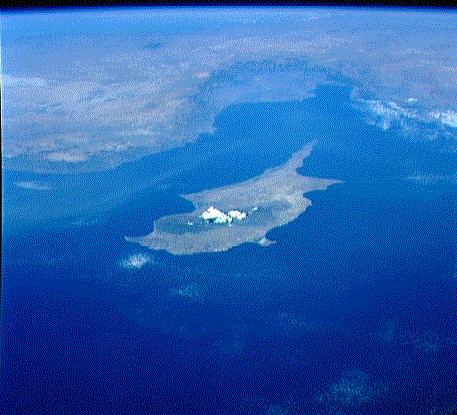
Does anyone know what Operation Sunshine is, or was? It is, or was, an MI6 operation in Cyprus back in 1959. The details are revealed in the enlightening research of Stephen Dorril under the title “MI6-Inside the Covert World of Her Majesty’s Secret Intelligence Service.”
The summary is as follows: Cyprus was drawn into ethnic conflict in the late 1950s. Armed, right-wing Greek bands were carrying out attacks against British rule on the island and against Turkish civilians – something that would be named as an attempt at ethnic cleansing in today’s world. In response, Turkey secretly helped an embryonic resistance among Turkish Cypriots, organizing and arming them.
The Brits decided to take effective steps. MI6 started to tap some VIP telephones, relying on the cutting-edge technology of the day in order to prevent further killings and provide a basis for a settlement between Greek and Turkish Cypriots. The names included the Greek leader, Archbishop Marakios III. While eavesdropping on Makarios’ lines in order to obtain some political and military information, they recorded some other stuff by mistake – “Rather unusual homosexual proclivities,” as described by the book.
That was in 1958 and when Makarios resisted signing an agreement with Turkish Cypriots under the guarantee of Britain, Turkey and Greece in 1959 in Zurich, he had a visitor in his hotel room with some information to share. Makarios changed his mind overnight, came down to the hotel lobby where his Turkish counterpart Fazıl Küçük was waiting and signed the first treaty on Cyprus which lead the establishment of the Republic of Cyprus in 1960.
That was Operation Sunshine. That is a part of the background story about how the Republic of Cyprus with Makarios as the president and Küçük as the deputy president was established.
That British-made fragile structure began to fall apart a few years later, ultimately leading to theTurkish military intervention which divided Cyprus into two in 1974.
Being happy with the status quo, Ankara did almost nothing other than support the declaration of the Turkish Republic of Northern Cyprus, of which only Turkey recognizes.
Turgut Özal was the first Turkish leader who talked about a “bi-zonal, bi-communal, federal system” in the 1980s. In the mid-1990s, Turkey silently distanced itself from that formula, which was not adopted by the Greeks anyway.
Under the Justice and Development Party, or AK Parti, Prime Minister Tayyip Erdoğan adopted a U.N.-backed reunification strategy, which was rejected by the Greek Cypriots in 2004. The European Union’s subsequent admittance of the Republic of Cyprus (officially representing the separated Turks in the north as well), made Erdoğan upset, like many of the Turks.
Now Erdoğan is going back to Özal’s federal model and is threatening whomever by starting to support two separate states on the island, risking Turkey’s relations with the EU.
That brings us to the threshold of a series of very interesting events in the coming months in the eastern Mediterranean.
Hürriyet Daily News
-
Baklava Bailout: How Turkey Helped Greece’s Sweet Tooth
By JOE PARKINSON And AYLA ALBAYRAK
ISTANBUL—Europe’s multibillion-euro bailout of Greece has been making headlines on a daily basis. Less noticed was a Turkish bailout last week of an Athens institution: sweet seller Baklavas Epe.
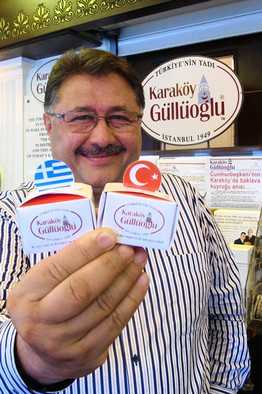
Joe Parkinson/The Wall Street Journal Nadir Gullu, with baklava boxes decorated with Greek and Turkish flags. Greeks and Turks have bickered for centuries over which nation makes the better baklava, a sticky-sweet dessert of layered pastry devoured in huge quantities across the eastern Mediterranean and the Middle East. But for the past 10 years, Turkey’s best-known producer, businessman Nadir Gullu, has been supplying Greece’s closely held Baklavas Epe, which operated five stores in Athens. He provided about two tons of baklava and other Turkish sweets per month.
Old rivalries aside, Athenians lapped them up—until, that is, they ran out of cash.
Baklavas Epe’s most profitable shop is on Athens’s landmark Syntagma Square. Before the crisis, tourists and locals queued up in droves to buy the pastries. But as the government embarked on a severe austerity program to reduce its debt burden and qualify for international support, demand sank.
Baklavas Epe closed three of its five stores in Athens as sales dropped. Meanwhile, it ratcheted up close to €160,000 (about $226,000) in debt for deliveries of sweets from across the Aegean Sea, according to the company. Plunging revenue made it impossible for Baklavas Epe to finance baklava purchases from Istanbul.
“Baklava has become a luxury. Think about it: Three kilos of minced beef costs the same as one kilo of baklava,” said a company spokesman. (A kilogram is about 2.2 pounds.)
In Turkish newspapers, Mr. Gullu, the owner of Karakoy Gulluoglu, a well-known baklava shop near the shores of the Bosporus in Istanbul, said the Greeks should pay their debts within a year and the business relationship was in jeopardy.
With elevated wage costs and sporadic vandalism amid protests over austerity measures adding to its woes, Baklavas Epe said it needed more time. Besides, it said, Mr. Gullu in public comments had exaggerated the amount of the debt. In short, it didn’t look good for business and friendship in the Greek-Turkish baklava trade.
[BAKLAVA]
But after the partners met last week to discuss a possible resolution, they reported a deal that would preserve and even expand their business ties. Under terms of the deal, Karakoy Gulluoglu will continue to supply Baklavas Epe and extend its loan financing for three more years. The firms will also embark on a new joint-venture coffee shop in Athens, which is scheduled to open in September.
The thinking is that if Athenians can’t afford to buy a kilo of baklava to take home anymore, maybe they can afford a few pieces to have with a coffee, the Baklavas Epe spokesman said.
Mr. Gullu says his own business, which has expanded dramatically in recent years to sell baklava and Turkish sweets in 85 countries, including the U.S., is in a position to extend the loans. “I told them, ‘it’s OK, keep paying slowly,’ ” Mr. Gullu said in an interview. “We are doing this for our friendship and for Turkish moral pride.”
The Baklavas Epe spokesman said both companies remained positive about their relationship and about the potential for the Greek economy to bounce back. “I don’t believe that Greece will stay like this because Greeks love life,” he said.
Mr. Gullu’s decision to extend his partner’s credit line is indicative of an improvement in relations between Greece and Turkey, particularly in the business community, since a pair of earthquakes drew them together in 1999. Turkish-Greek trade increased steadily until it reached around $3.6 billion in 2008, falling back to $3 billion last year amid the global economic slowdown, according to figures from the Turkish statistics agency Turkstat.
Mr. Gullu says Turks are no strangers to the pains of austerity, having negotiated their most recent International Monetary Fund bailout package in 2002 after a banking crisis the year before roiled the economy. Turkish businesses could use cash flow from their country’s booming economy to invest in Greece if it makes business sense, he added.
“We’ve suffered economic crises here in Turkey before so we understand the problems Greeks are going through….We will find a solution to this sticky situation,” he said.
via Baklava Bailout: How Turkey Helped Greece’s Sweet Tooth – WSJ.com.
-
Greece most complex debt crisis for years: IIF chief
By Alexandra Hudson and Asli Kandemir
ISTANBUL | Tue Jun 28, 2011 8:20am EDT
ISTANBUL (Reuters) – Greece is embroiled in the most complex sovereign debt problem for years as there are so many parties involved and no unified European view, the head of the Institute of International Finance (IIF) said on Tuesday.
“This is the most complex sovereign debt crisis I have ever been connected with, because there are so many players, no unified European view, and the weaknesses of the Greek economy are extraordinarily serious,” said Charles Dallara, who has been managing director of the IIF bank lobby group for 18 years and was involved in other sovereign crises.
“The private financial community has to play a part,” Dallara said, but added: “It will be exceptionally difficult to align the political, economic and financial stars.”
Dallara said radical proposals by France to roll over some Greek debt for 30 years had stimulated debate and some of the proposals were likely to be in the final solution.
But he said more European cohesion is needed. “At some points European leaders will have to see themselves as European leaders and not as French, or German or Greek.”
Speaking in Istanbul at an event hosted by Turkey’s Garanti Bank, he said if Greece’s government approves an austerity plan and Europe commits to a further bailout then the International Monetary Fund and others are likely to allow Greece a period of time to sustain its efforts.
Dallara, a former banker who has also held senior roles in the U.S. Treasury, is playing an informal role in the talks to thrash out a solution.
It is familiar ground for the IIF, which represents over 400 firms and was created in 1983 in response to the international debt crisis and aims to help stabilize the industry, including managing sovereign risk.
(Reporting by Alexandra Hudson and Asli Kandemir; Editing by Dan Lalor and David Holmes)
via Greece most complex debt crisis for years: IIF chief | Reuters.
-
Foreign ministry urges Greek citizens not to participate in Gaza flotilla
Source: ANA
The Greek Foreign ministry urged Greek citizens not to participate in the new flotilla for the port of Gaza, as well as the ships and seafaring means of the Greek shipping register.
Turkish protestors accompany by boats the Mavi Marmara passenger ship during its return ceremony in Istanbul after Israel’s deadly raid on an aid flotilla bound for Gaza Strip on 31 May, in Istanbul, Turkey on 26 December 2010. Israeli commandos on 31 May 2010 stormed six ships carrying hundreds of pro-Palestinian activists on an aid mission to the blockaded Gaza Strip, killing at least 10 people and wounding dozens after encountering unexpected resistance as the forces boarded the vessels.
The Greek Foreign ministry urged Greek citizens not to participate in the new flotilla for the port of Gaza, as well as the ships and seafaring means of the Greek shipping register.
A relevant announcement by the Foreign ministry on Wednesday calls for the appeal by the UN secretary general, the declared intention of the Israeli government not to allow the approach of vessels to the coast of Gaza, to be taken into consideration, as well as the direct dangers for human life and security entailed by participation in this undertaking, particularly in light of last year’s events.
It is also pointed out that “the defining and exercising of the country’s foreign policy is the responsibility of the government, with the criterion of the promotion of the interests of Greece” and “in this crucial conjuncture all must show the corresponding responsibility or fully assume the responsibility for their actions.”
Moreover, it stresses that “the planned operation does not tackle the essence of the humanitarian problem in Gaza”, adding that Greece and Cyprus have made specific proposals in the past in the direction of handling the humanitarian needs of the inhabitants of Gaza.
“Greece actively supports the resumption of the peace talks which constitutes the only path for an overall and viable solution of the Palestinian issue,” the announcement concluded. (ANA)
via Foreign ministry urges Greek citizens not to participate in Gaza flotilla :: EMG :: SEE news.