Skip to content

Turkish Forum

  • World
  • Turkey
  • Culture/Art
    • YouTube
    • Twitter
    • Facebook
    • RSS Feed
  • EN
    • TR
    • DE
    • RU
Log in

Category: Southern Caucasus

  • While You Hear a Voice of Justice

    While You Hear a Voice of Justice

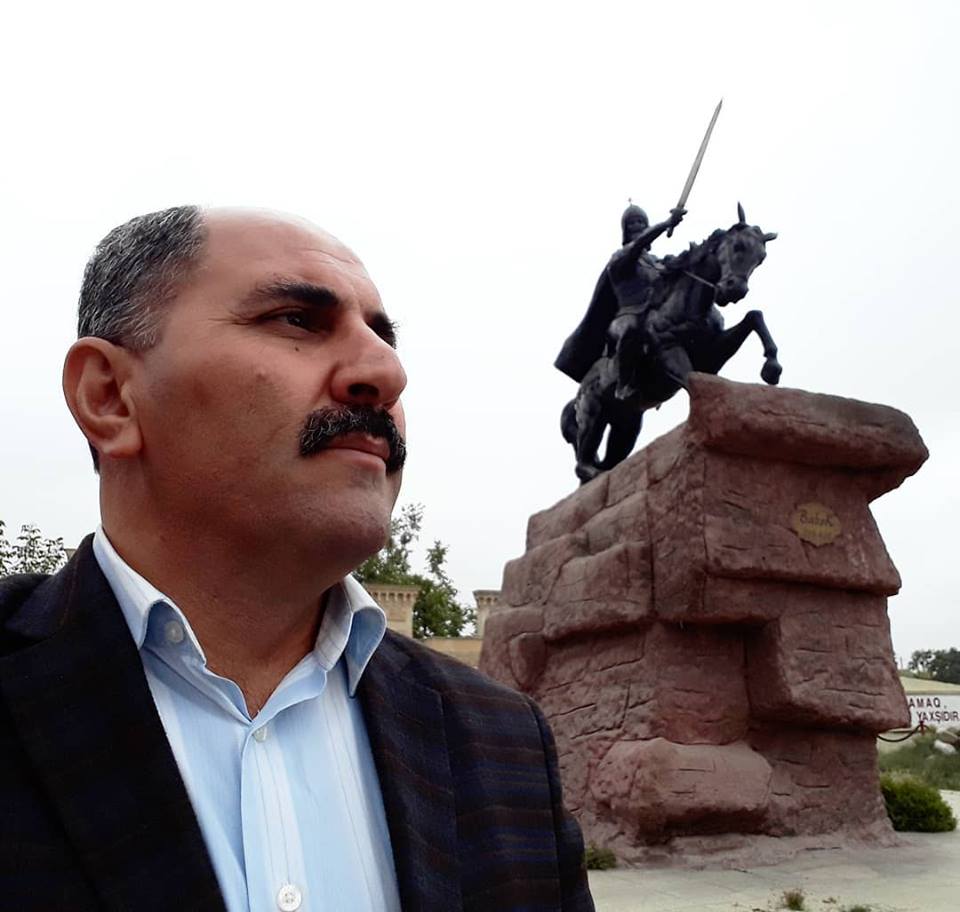
    Azer HASRET

    By Azer HASRET, [email protected]

    Recently, on the day of 26th February, 2019 US Congress` Helsinki Commission Chairman Rep. Alcee L. Hastings (FL-20) raised an issue of Khojaly Massacre, perpetrated by Armenian occupant army regiments together with Russian Army`s 366th motorized unit 27 years ago. As the recent history witnesses, during this occupation and massacre operation 613 men, women, children and other innocent people of Azerbaijani nationality were brutally killed by occupant army units.

    27 years has passed since Khojaly Massacre and the people of Azerbaijan always ask international community for justice and help to bring to the responsibility desk those who ordered and who implemented this act of genocide. But unfortunately many organizations and forceful actors – world leaders were not even fair towards this act of genocide.

    As Azerbaijan is new democracy and looking towards new practices and challenges through the leading democracies, the people of country always are attentive to the world leader country – the United States. Even this country usually is behind democratization and bringing new values throughout the world, sometimes some voices from Washington are not fairly approaching events like Khojaly Massacre of 26th February 1992. That’s why while Hon. Alcee L. Hastings acted with statement in the House of Representatives calling “to recognize the 27th anniversary of the Khojaly Massacre” we, the people of Azerbaijan were happy to hear this. That was fair approach and an act of justice initiative.

    Rising the issue, Mr. Hastings once more approved his country`s role as a major actor on the globe to bring peace and justice to humanity. We always wish to see the US like this. We believe in the mighty of the United States and we believe that this country having all opportunities can be fair mediator to solve any kind of conflicts even thousands of miles away.

    While Mr. Hastings acted with the statement towards Khojaly Massacre, our belief that the perpetrators will be brought to justice were renowned again. Indeed, we want and wish to rely on US`s justice and fair approach.

    We, the people of Azerbaijan and likewise countries are always alongside with those forces which are powerful and fair. And which really is in line with international rules to defend those who face injustice. In this regard Mr. Hastings` act in the House is a sign of will, which can rehabilitate belief of people of Azerbaijan. Because we were losing our belief as the US actors sometimes were ignorant towards Azerbaijani peoples` pains.

    Using this opportunity we would like to express our gratitude to Mr. Hastings and call to other US Congress members to act likewise in order to help with justice to prevail. The US were and remain Azerbaijan`s ally on the globe. And Azerbaijan is the country which is trusty to its principles in combating any kind of unfair approach towards humanity. In this struggle Azerbaijan was and remain as a main ally of the United States in the region of South Caucasus and alongside geography.

    In order to solve the problem of occupation of lands by neighboring Armenia Azerbaijani people look towards US`s fair approach to act more quickly and more effective. As some 1 million people of Azerbaijan are still suffering the pains of war and occupation by Armenia we look towards fair voices throughout the world. Mr. Hastings is one of the rising fair voices in this regard which surely will rehabilitate belief on the US.

    Yes, Azerbaijan was very quick to respond to the US calls “in the days after September 11, 2001” to overcome the world terrorism. And Azerbaijan remains as a trusty ally in this regard. But waiting the same approach from the US side in combating occupation and inhuman approach by the aggressive neighbor – Armenia as well. In this regard Mr. Hastings voice in the US Congress was due for the hope of Azerbaijani people. And people of Azerbaijan have the right to wait more and effective efforts from the US to end with injustice in our region and bring a piece to the region of South Caucasus.

    P.S. While compiling very this piece of mine I just saw an initiative by the Rep. Frank Pallone, Jr. on “Expressing the sense of the House of Representatives supporting visits and communication between the United States and the Republic of Artsakh at all levels of civil society and government”. One can be shocked while seeing this, as the US does not recognize any country under the name of “Artsakh” (Nagorno Karabakh). But political actors like Pallone always were obstacle while the US tries to act in a fair manner. Anyway we believe on US fair approach as there are politicians like Mr. Hastings who really want to contribute to peace building in our region.

    @azerhasret
    March 11, 2019
  • Azerbaijan Enlists Infamous Congressman  Hastings in its Anti-Armenian Propaganda

    Azerbaijan Enlists Infamous Congressman Hastings in its Anti-Armenian Propaganda

    Cong. Alcee L. Hastings (Democrat of Florida) is the latest transmitter of Azeri propaganda. He issued a statement on February 25, 2019, which he entered in the Congressional Record, accusing Armenians of killing 613 Azeri men, women, and children on Feb. 26, 1992, in the Khojaly village of Azerbaijan during the height of the Artsakh (Karabagh) war. Human Rights Watch placed the number of Azeri dead at 161. Nevertheless, even the single loss of life is regrettable be it Azeri or Armenian. Cong. Hastings, a member of Azerbaijan Congressional Caucus, called the alleged killings “the Khojaly Massacre.”

    These killings are controversial with Armenians and Azeris blaming each other for the deaths. In recent years, the government of Azerbaijan has made these killings a cause celebre, organizing observances in various countries and accusing Armenians not only of committing a massacre, but a genocide! These propaganda observances are funded by what is known as “caviar diplomacy,” meaning that Azerbaijan bribes government officials around the world to block decisions critical of Azerbaijan or adopt resolutions in its favor.

    It is ironic that while Azerbaijan describes the alleged killing of 613 Azeris a genocide, it shamelessly denies the actual genocide of 1.5 million Armenians from 1915 to 1923.

    On March 3, 1997, the Armenian Foreign Ministry circulated a statement to members of the United Nations General Assembly and Security Council, rejecting the statement issued by Azerbaijan on February 22, 1997 on “the Khojalu event.” Armenia quoted the words of the then President of Azerbaijan Ayaz Mutalibov who had stated that the Azerbaijani National Front “actively obstructed and actually prevented the exodus of the local [Azeri] population through the mountain passages specifically left open by Karabakh Armenians to facilitate the flight of the civilian population.” Mutalibov had made that statement in the days following “the Khojalu event” in an interview with Czech journalist Dana Mazalova published in the April 2, 1992 issue of the Russian newspaper Nizavisimaya Gazeta.

    By organizing such propaganda observances, Azerbaijan’s officials have found a convenient way of countering the mass murder of Armenians in the Azeri towns of Sumgait (Feb. 28, 1988), Gyanja (November 1988), and Baku (January 1990) as well as the Armenian genocide by Ottoman Turkey.

    Azerbaijan could not have found a more infamous member of U.S. Congress to carry out its propaganda war against Armenia. Prior to becoming a member of Congress, Hastings served as a United States District or Federal Judge from 1979 to 1989, at which time he was impeached and removed from office!

    According to Wikipedia, “In 1981, [Judge] Hastings was charged with accepting a $150,000 bribe in exchange for a lenient sentence and a return of seized assets for 21 counts of racketeering by Frank and Thomas Romano, and of perjury in his testimony about the case. In 1983, he was acquitted by a jury after his alleged co-conspirator, William Borders, refused to testify in court, resulting in a jail sentence for Borders.”

    “In 1988, the Democratic-controlled United States House of Representatives took up the case, and Hastings was impeached for bribery and perjury by a vote of 413–3. He was then convicted on October 20, 1989, by the United States Senate, becoming the sixth federal judge in the history of the United States to be removed from office by the Senate. The Senate, in two hours of roll calls, voted on 11 of the 17 articles of impeachment. It convicted Hastings of eight of the 11 articles. The vote on the first article was 69 for and 26 opposed….”

    Cong. Hastings was disgraced for the second time when a staff member of the Helsinki Commission for which he was the Chairman, accused him of inappropriate sexual behavior! The Roll Call newspaper reported on December 8, 2017 that the U.S. Treasury Department secretly paid the staffer $220,000 to settle an alleged sexual harassment case against Cong. Hastings.

    Winsome Packer, the staff member of the congressional commission, stated in a written document that Cong. Hastings touched her, made unwanted sexual advances, and threatened her job. In her lawsuit, Packer stated “that Hastings repeatedly asked to stay at her apartment or to visit her hotel room. Packer also said he frequently hugged her, and once asked her what kind of underwear she was wearing,” according to Roll Call. Cong. Hastings denied the accusation.

    Finally, it appears that Cong. Hastings has maintained extensive contacts with the BGR Group, a major U.S. firm that is paid $50,000 a month to lobby for Azerbaijan in Washington.

    Under the federal FARA (Foreign Agents Registration Act) laws, every lobbying firm has to register with the U.S. Justice Department, disclosing the contract signed with the foreign entity. More importantly, the lobbying firm’s employees are required to report to the Justice Department every contact they make with outsiders on behalf of their clients, whether by email, phone call, or personal meeting.

    For example, during the six-month period of December 1, 2017 to May 30, 2018, BGR reported contacting congressional offices hundreds of times. Each time the subject matter was listed as “U.S.-Azerbaijan Relations.” Cleverly, BGR had hidden the name of the Congressman or Senator, mentioning only his or her staff member’s name.

    Armenian National Committee of America (ANCA) conducted a lengthy investigation to identify the names of the Congress members for whom these staff members worked. The ANCA investigation disclosed that on Nov. 17, 2017, Feb. 27, March 5, March 12, April 30, May 22, May 23, and May 30, 2018 BGR lobbyists emailed Tom Carnes, a staff member of Cong. Hastings. BGR also had a meeting with Tom Carnes on May 30, 2018. In addition, on May 22, 2018, lobbyists from BGR e-mailed Susannah Jackson of Cong. Hastings office. In addition, on Nov. 2, 2017, Rob Mangas, Tim Hutchinson, K. Laurie McKay, Killoran Long, and Albert Wynn on behalf of a lobbying firm for Turkey, Greenberg Traurig, had discussions with Lale Morrison from the office of Cong. Hastings regarding U.S.-Turkish relations. Finally, on Oct. 27, 2017, Lydia Borland on behalf of another lobbying firm for Turkey, LB International Solutions, LLC, met with Lale Morrison from the office of Cong. Hastings regarding U.S.-Turkey relations.

    No wonder that Cong. Hastings was given the low grade of D and D plus in recent years by the ANCA for not supporting various Armenian issues in Congress.

    Azerbaijan has tried to cover up its crimes against Armenians and human rights violations of its deprived citizens by bribing foreign officials around the world and blaming others for its own wrongdoing!

    March 5, 2019
  • Azerbaijan’s Destruction of Armenian Monuments Exceeds ISIS Crimes

    Azerbaijan’s Destruction of Armenian Monuments Exceeds ISIS Crimes

    “A groundbreaking forensic report tracks Azerbaijan’s destruction of 89 medieval churches, 5,480 intricate cross-stones, and 22,700 tombstones,” is the subtitle of an incredible article by Simon Maghakyan and Sarah Pickman, published in the Hyperallergic Newsletter last week. The article is titled: “A Regime Conceals its Erasure of Indigenous Armenian Culture.”
    In April 2011, when the US Ambassador to Azerbaijan wanted to visit Nakhichevan, an Armenian territory classified by the Soviets as an “autonomous republic” of Azerbaijan, to verify the destruction of thousands of historical medieval Armenian khachkars (cross-stones), he was blocked by Azeri officials who told him that reports of their destruction was fake news.
    Under Azeri oppression, the longstanding Armenian community of Nakhichevan had dwindled to zero! Not content with ethnic-cleansing, the Azeris proceeded to eliminate all traces of Armenian monuments, claiming that no Armenians had ever lived in Nakhichevan.
    “In December 2005, an Iranian border patrol alerted the Prelate of Northern Iran’s Armenian Church that the vast Djulfa cemetery, visible across the border in Azerbaijan, was under military attack. Bishop Nshan Topouzian and his driver rushed to videotape over 100 Azerbaijani soldiers, armed with sledgehammers, dump trucks and cranes destroying the cemetery’s remaining 2,000 khachkars; over 1,000 had already been purged in 1998 and 2002,” reported Maghakyan and Pickman.
    The flattened land, where the khachkars stood for centuries, is now a military rifle range. The “demolition was the ‘grand finale’ of Azerbaijan’s eradication of Nakhichevan’s Armenian past,” wrote the two authors.
    Maghakyan and Pickman reported that “the American Association for the Advancement of Science (AAAS) employed remote sensing technologies in its pioneer investigation into cultural destruction. Their 2010 geospatial study concluded that ‘satellite evidence is consistent with reports by observers on the ground who have reported the destruction of Armenian artifacts in the Djulfa cemetery.’”
    “Absolutely false and slanderous information … [fabricated by] the Armenian lobby,” proclaimed Azerbaijan’s President Ilham Aliyev, who makes frequent threats against Armenia and distorts its history.
    The authors also quote from public decree No.5-03/S on December 6, 2005, by Nakhichevan’s “local autocrat” Vasif Talibov, a relative of Pres. Aliyev, “ordering a detailed inventory of Nakhichevan’s monuments. Three years later, the investigation was summed up in the bilingual English and Azerbaijani ‘Encyclopedia of Nakhchivan Monuments,’ co-edited by Talibov himself. Missing from the 522-page ‘Encyclopedia’ are the 89 medieval churches, 5,840 intricate khachkars, and 22,000 tombstones that [Armenian researcher Argam] Ayvazyan had meticulously documented. There is not so much as a footnote on the now-defunct Christian Armenian communities in the area — Apostolic and Catholic alike. Nevertheless, the official Azerbaijani publication’s foreword explicitly reveals ‘Armenians’ as the reason for No. 5-03/S: ‘Thereafter the decision issued on 6 December 2005 … a passport was issued for each monument … Armenians demonstrating hostility against us not only have an injustice [sic] land claim from Nakhchivan, but also our historical monuments by giving biassed [sic] information to the international community. The held investigations once again prove that the land of Nakhchivan belonged to the Azerbaijan turks [sic]….’”
    Any Azerbaijani who dares to speak out in defense of Armenians is also attacked as an enemy of Azerbaijan. A courageous Azerbaijani writer, Akram Aylisli, paid a hefty price for telling the truth about the destruction of Armenian monuments in his hometown of Agulis (known today as Aylis). The well-known novelist was furious that the Azeri government was destroying Armenian churches. In his novel, “Stone Dreams,” the protagonist, an intellectual from Agulis, refers to memories of the town’s eight of the 12 medieval churches that had survived until the 1990’s, and protects a victim of anti-Armenian pogroms in Azerbaijan’s capital Baku. Pres. Aliyev revoked Aylisli’s pension and title of “People’s Writer.” His writings were removed from school curricula, his books were publicly burned, and his family members were fired from their jobs. He has been under de facto house arrest since the release of his novel. Aylisli protested the destruction of the Armenian churches in Agulis and resigned from his position as Member of Azerbaijan’s Parliament. He fearlessly sent a telegram to Pres. Heydar Aliyev in 1997, calling the destruction of the Armenian churches in Aylis an “act of vandalism being perpetrated through the involvement of armed forces and employment of anti-tank mines.”
    The two authors spoke with Russian journalist Shura Burtin who after interviewing Aylisli in 2013 traveled to Nakhichevan and reported that he didn’t see “a trace of the area’s glorious past.” Burtin concluded: “Not even ISIS could commit such an epic crime against humanity.”
    The authors reported that Aylisli’s 2018 non-fiction essay in Farewell, claimed “that a mosque built five years ago on the site of one of the destroyed churches has been boycotted by locals because ‘everyone in Aylis knows that prayers offered in a mosque built in the place of a church don’t reach the ears of Allah.’”
    Argam Ayvazyan, a native of Nakhichevan who spent decades photographing the local Armenian monuments before their destruction, was quoted by Maghakyan and Pickman as decrying the world’s silence: “Oil-rich Azerbaijan’s annihilation of Nakhichevan’s Armenian past make it worse than ISIS, yet UNESCO and most Westerners have looked away.” ISIS-demolished sites like Palmyra can be renovated, Ayvazyan argued, but “all that remain of Nakhichevan’s Armenian churches and cross-stones that survived earthquakes, caliphs, Tamerlane, and Stalin are my photographs.”


    February 26, 2019
  • Baku. Remembering 20 January 1990

    Baku. Remembering 20 January 1990

    By Azer HASRET, [email protected]

    Those days I was a student. Azerbaijan still was a part of the Soviet Union. Thus, was not independent like today. There were no freedoms under hegemony of Russians in my beloved country. We were under exploitation.

    More than 250 thousands Azerbaijanis living in Armenia were forced to deportation in 1988. And they faced beating, harassment, insults and even killing by Armenians in order to be eliminated. That`s why people of Azerbaijan were on raise.

    And me, just coming back from the army service and as a student had joined newly formed Azerbaijan Popular Front in order to lead national struggle for the independence of Azerbaijan. Those days I was as an individual of my nation among those hundreds of thousands filling the squares.

    But the Soviets were not keeping silence as well. They used Armenian citizens to open a way to any kind of provocation in Azerbaijan. Just to show that Azerbaijanis are killing Armenians and likewise. But in reality no one was killing Armenians. Those individual killings, which arose sometimes were masterminded by the agents of Moscow`s KGB and their servicemen Armenians. So the people were provoked to cause clashes between two nations.

    In such a situation everyone was understanding that the Soviet soldiers are looking for excuse to occupy Baku. That was a case of moment for soldiers to step out their positions and to butter the people.

    We were on watch around with my student comrades those days. Just starting from 17 January 1990 in the centre of Baku, around “Salyan barracks” – the military base – we patrolled through the nights, early morning returned to student hostel, and for the night came back to patrol surrounding.

    The nights linking 17 January to 18 and 18 January to 19 passed in a quite environment. We were able to see bearded soldiers inside the military base. There were claims that they are Armenians. Anyway we urged everyone not to provoke soldiers.

    We started patrolling on the night of 19 January as usual. Somewhere around 11 p.m. I decided with my friend Nazim to go back to hostel and get a cup of tea. We came to the hostel. I started to prepare a tea. While waiting to drink a tea and listening to music we heard the first fire shout from a distance. Just looked at watches. It was 12 p.m. Yes, the attack on the city was started on the night of 19 January linking to 20 January.

    We just left our teacups on the table and rushed out in the direction of “Salyan barracks”. Everyone was running in a horror to escape from tanks and automatic rifles. Even there was nothing to do with panzers and tanks. While approaching the running away people I shouted: “Where are you running?! Just turn back immediately!” People stopped for a moment, turned opposite and immediately started to run after me. I thought that fires are made just with false bullets to scare people. But while a car was shout and stopped just in front of me next to the barracks and a young man got off it, laid down on the ground being wounded I realized that we are in the center of real war. I stopped for a moment, understood that there is no meaning to go forward. The young man put the efforts and managed to get up and reached us. We started to step back slowly. Now dozens of panzers were approaching the people shouting right and left. I laid down to the ground to save myself. As the forerunners of panzers passed a while I stood up and tried to get away. There was no one around. Everyone had run into yards and tried to escape.

    With my friend Nazim we walked in the city quarters up to that morning. We did not came back to the hostel. Because the people were not sleeping and everyone was wondering through balconies. Even those sleeping were on raise, the city was in excitement. We just walked around and were calling on the people to keep silence and not to be showed through balconies and windows. Because the mad bullets were throwing everywhere and everyone could become an occasional target.

    We opened the morning in this mood. While we did not know the balance, we learned that there are many killed and maybe 5 times more wounded. Yes, the city was occupied. The Soviet-Russian tanks and soldiers caused these atrocities to the unarmed people who even did not have a knife at the hand. There were cars pressed under tanks, the streets were filled with the pools of blood, the hospitals were full of wounded.

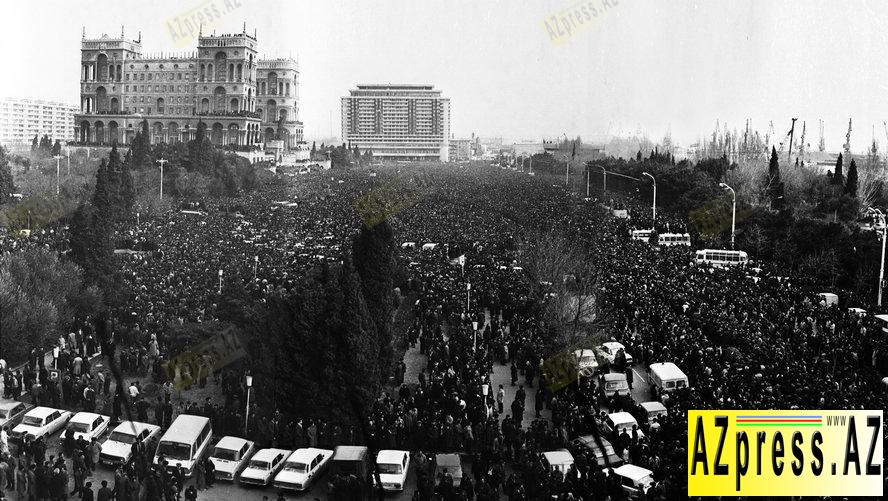
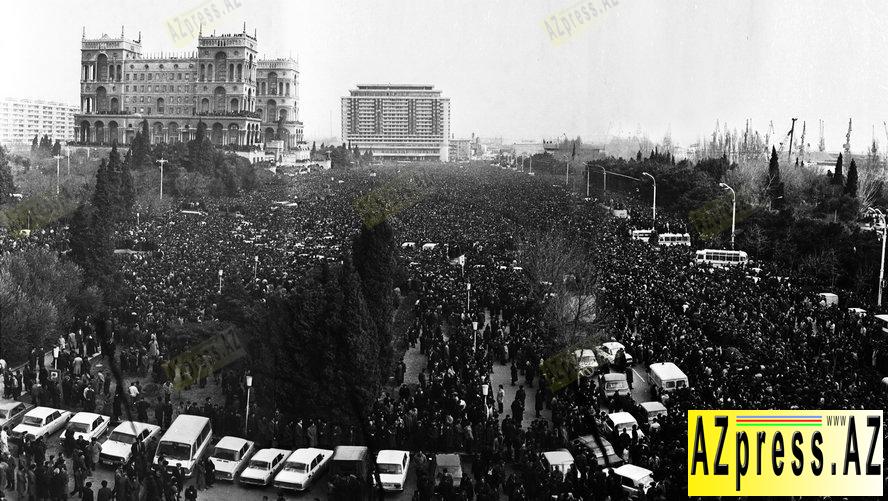
    Funeral of Martyrs on January 22, 1990. Baku. Estimated 1 million people attended. Photo: Rasim Sadikhov

    There was no wounded or killed among my friends. But there were a lot of elderly people, children and women among killed. And not only Turks were among killed, but Jews, Russians and representatives of other nations. We learned the figure afterwards: 147 people killed, more than 700 people wounded. Many cars, buses, ambulances were hit, the people inside were killed. Tanks were driven on some cars. On 20 January 1990 Baku was like a battlefield. But there was only one side of the war: Russians alongside with Armenians were fighting against the people of Azerbaijan…

    Now it is 20 January 2019. Total 29 years have passed from that night. Me and other eyewitnesses have not forgotten those atrocities implemented by Russians together with Armenians. Because we can`t forget…

    After so many years my Azerbaijan is independent, free and strong country. We have to solve yet a conflict with Armenia. One day we will manage with this conflict as well as we managed to get free of Russian-Soviet exploitation.

    January 22, 2019
  • Sen. Menendez Delays Senate Confirmation Of US Ambassador to Azerbaijan

    Sen. Menendez Delays Senate Confirmation Of US Ambassador to Azerbaijan

    By Harut Sassounian
    Publisher, The California Courier
    www.TheCaliforniaCourier.com
     
    Pres. Donald Trump nominated on Sept. 4, 2018 career Foreign Service Officer Earle Litzenberger to serve as US Ambassador to Azerbaijan replacing Amb. Robert Cekuta who left Baku nine months ago.
     
    A month before the Senate Foreign Relations Committee’s October 4, 2018 hearing on Litzenberger’s confirmation, the Armenian National Committee of America (ANCA) issued a press release urging the Armenian American community, friends of Armenia, and human rights activists to call on their Senators to scrutinize Litzenberger’s nomination.
     
    Aram Hamparian, Executive Director of ANCA, explained that “there’s never been a more urgent need for clarity regarding the nature and scope of American relations with the Aliyev regime. This confirmation process provides a much-needed opportunity for substantive Congressional oversight of an increasingly troubled U.S.-Azerbaijan bilateral relationship, characterized by escalating aggression against Armenians, a worsening crackdown on dissent, and a well-funded campaign to manipulate the American political process.”
     
    Litzenberger has served as Senior Fellow at the German Marshall Fund; Deputy Chief of Mission to the United States Mission to NATO; NATO Deputy Senior Civilian Representative to Afghanistan; Deputy Chief of Mission at the United States Embassy in Belgrade, Serbia; and Deputy Chief of Mission at the United States Embassy in Bishkek, Kyrgyzstan. Litzenberger earned a B.A. from Middlebury College and M.S. from the United States Army War College. He speaks French, Russian, Serbian, and Bulgarian.
     
    During the October 4, 2018 Senate Foreign Relations Committee hearing, Litzenberger came under intense scrutiny. The ANCA reported that Sen. Bob Menendez (D-NJ) referred to Azeri President Ilham Aliyev’s “bellicose rhetoric and sporadic outbursts of violence,” when pressing Litzenberger about Azerbaijan’s violent strategies. Litzenberger responded that he would urge the Azerbaijani government to step back from behaviors that would disrupt the line of contact in the Artsakh conflict. He also stated that the U.S. is working along three lines — the non-use of force, respect for territorial integrity, and the right to self-determination.
     
    In addition, Litzenberger referred to the Organization for Security and Cooperation in Europe (OSCE) Minsk Group, which condemns “any violence and any threat of the use of violence along the line of contact” without specifically citing Azerbaijan’s attacks.
     
    During the hearing, Sen. Menendez inquired whether providing weapons to Azerbaijan should be curtailed based on its human rights violations. Litzenberger responded that the State Department will be careful to ensure its decisions do not undermine efforts to reach a peaceful settlement of the Artsakh conflict. He also mentioned an increased focus on Azerbaijani training in human rights.
     
    Following the hearing, both Sen. Menendez and Sen. Ed Markey (D-MA) submitted written questions to Litzenberger. At the request of Sen. Menendez, the Senate Foreign Relations Committee postponed consideration of Litzenberger’s nomination to an unspecified date. Both Senators may have additional written questions to the nominee as a result of their concerns at National Security Advisor John Bolton’s offer to sell weapons to Armenia and Azerbaijan during his late October trip to the Caucasus.
     
    Litzenberger was the only one of 19 ambassadorial nominations to be postponed, very likely until next year, when the Committee will hold its next business meeting.
     
    ANCA’s Hamparian welcomed Litzenberger’s delay giving the Senators the “opportunity for more careful Congressional oversight of our country’s increasingly challenging bilateral ties with Azerbaijan’s aggressive and abusive Aliyev regime, particularly in light of National Security Advisor John Bolton’s controversial suggestion that the U.S. start selling arms to Baku.”
     
    Hamparian went on to assert: “We join with our Senate friends in seeking greater clarity on this point, and, more generally, regarding the Administration’s policy on Aliyev’s worsening pattern of aggression against Artsakh and Armenia, incitement of hatred against all Armenians, unapologetic blacklisting of U.S. legislators, obstruction of the Royce-Engel peace proposals, threats to shoot down civilian aircraft, the destruction of the Djulfa cemetery and other Christian heritage sites, and – of course – his severe crackdown against domestic dissidents and ethnic-religious minorities.”
     
    Azerbaijan’s Turan news Agency reported the news about the delay of the confirmation of the US Ambassador to Baku. Surprisingly, Turan speculated that Pres. Trump may make a recess appointment taking advantage of the absence of Senate sessions in December, which would mean that the President could appoint Litzenberger as Ambassador to Azerbaijan without Senate confirmation.
     
    Readers may recall that Pres. Obama made such a recess appointment in the case of Matt Bryza dispatching him as Ambassador to Azerbaijan, after Sen. Menendez twice blocked his confirmation. Bryza could only serve in Baku for 12 months before being forced to return to Washington, after the Senate Foreign Relations Committee refused to confirm his nomination.
     
    In the case of Matt Bryza, the Armenian-American community had a good reason to object to his nominations as he had a serious bias against Armenia and favored Azerbaijan and Turkey. However, Litzenberger does not seem to have such biases and there is nothing personal against him. Delaying his nomination is simply a means to ensure that he would defend human rights in Azerbaijan and would urge the Aliyev regime to be less bellicose in the Artsakh conflict. Litzenberger’s delay would also send a message to John Bolton that the Senate does not welcome his offer to sell weapons to Azerbaijan.
     
    The delay of the Ambassador’s Senate confirmation would serve the additional aim of upsetting the Aliyev regime by prolonging the lengthy absence of a US Ambassador to Baku, causing an irritation in Azerbaijan-United States relations.
    December 4, 2018
  • How Azerbaijan Distorts UN Security Council Resolutions

    How Azerbaijan Distorts UN Security Council Resolutions

    (Part 2)

    Last week, I described Azerbaijan’s distortions of two of the four UN Security Council Resolutions adopted in 1993. I will now present the remaining two Resolutions:

    Excerpts from UN Security Council Resolution 874, adopted October 14, 1993:

    “Calls upon the parties concerned to make effective and permanent the cease-fire established as a result of the direct contacts undertaken with the assistance of the Government of the Russian Federation in support of the CSCE Minsk Group.”

    “Expresses the conviction that all other pending questions arising from the conflict… should be settled expeditiously through peaceful negotiations in the context of the CSCE Minsk process.”

    “Calls for the immediate implementation of the reciprocal and urgent steps provided for in the CSCE Minsk Group’s “Adjusted timetable”, including the withdrawal of forces from recently occupied territories and the removal of all obstacles to communications and transportation.”

    “Calls on all parties to refrain from all violations of international humanitarian law and renews its call in resolutions 822 (1993) and 853 (1993) for unimpeded access for international humanitarian relief efforts in all areas affected by the conflict.”

    “Urges all States in the region to refrain from any hostile acts and from any interference or intervention which would lead to the widening of the conflict and undermine peace and security in the region.”

    Azerbaijan has violated every one of the above clauses. In addition to the frequent violations of the mandated cease-fire, the Azerbaijani forces attacked Artsakh in April 2016, causing major damage to border towns and killing civilians. By cutting off the ears of elderly Armenian villagers and decapitating several Armenian soldiers, Azerbaijan’s armed forces committed a barbaric act and a war crime!

    Excerpt from UN Security Council Resolution 884, adopted November 12, 1993:

    “Calls upon the Government of Armenia to use its influence to achieve compliance by the Armenians of the Nagorny Karabakh region of the Azerbaijani Republic with Resolutions 822 (1993), 853 (1993) and 874 (1993), and to ensure that the forces involved are not provided with the means to extend their military campaign further.”

    Armenian officials usually neither respond to the Azeri accusations regarding the UN Security Council Resolutions nor try to set the record straight. The only exception was Pres. Serzh Sargsyan’s comprehensive speech at the U.N. General Assembly on Sept. 24, 2014.

    Pres. Sargsyan stated: “While discussing the Nagorno Karabakh conflict settlement I cannot but address the four UN Security Council Resolutions, which were adopted during the war, that every so often are being exploited by the Azerbaijani authorities in order to justify their obstructive policy.”

    “It is about those four Resolutions that demanded unconditionally as a matter of priority cessation of all military hostilities. Azerbaijan failed to comply. Azerbaijan’s own noncompliance with the fundamental demands of these Resolutions made impossible their full implementation. The Resolutions contained calls upon the parties to cease bombardments and air strikes targeting the peaceful civilian population, to refrain from violating the principles of the international humanitarian law but instead Azerbaijan continued its indiscriminate bombardments of the civilian population. Azerbaijan did not spare children, women and old persons thus gravely violating all legal and moral norms of the international humanitarian law.”

    “Now Azerbaijan cynically refers to these Resolutions — refers selectively, pulling them out of context as a prerequisite for the settlement of the problem. The adequate interpretation of the UN Security Council Resolutions is not possible without correct understanding of the hierarchy of the demands set therein.”

    “The Resolutions inter alia request the restoration of economic, transport and energy links in the region (UN SC Resolution 853) and removal of all obstacles to communications and transportation (UN SC Resolution 874). It is no secret that Azerbaijan and Turkey imposed blockade on Nagorno Karabakh and the Republic of Armenia from the outset of the conflict. The Azerbaijani President in his statements even takes pride in this fact promising his own public that direction would remain the priority of Azerbaijan’s foreign policy.”

    “The above mentioned UN Security Council Resolutions called upon Azerbaijan to establish direct contacts with Nagorno Karabakh. Azerbaijan refused to establish any direct contacts with Nagorno Karabakh, which was a legally equal party to the Cease-fire Agreement concluded in 1994 as well as a number of other international Agreements; moreover, Azerbaijan preaches hatred towards people it claims it wants to see as a part of their State.”

    “None of the UN Security Council Resolutions identifies Armenia as a conflicting party. Our country is called upon only ‘to continue to exert its influence’ over the Nagorno Karabakh Armenians (UNSC Resolutions 853, 884) in order to cease the conflict. Armenia has fully complied, and due to its efforts a Cease-fire Agreement was concluded in 1994. All UN Security Council Resolutions recognize Nagorno Karabakh as a party to the conflict.”

    “Azerbaijani authorities have failed to implement the fundamental demands of the Security Council Resolutions, including abiding and sticking by the humanitarian norms.”

    “Incidentally, Azerbaijan has been gravely violating this demand every now and then. Azerbaijan’s cruel and inhumane treatment of the Armenian civilian prisoners of war regularly results in their deaths. Although, I think, one shall not be surprised about it because it is the same State that suppresses and exercises the most inhumane treatment of its own people. A clear proof of it was the decision of the UN Subcommittee on Prevention of Torture to suspend its visit to Azerbaijan due to obstructions it encountered in the conduct of official Baku.”

    “The Co-Chairmanship of the OSCE Minsk Group is the only specialized structure that has been dealing with the Nagorno Karabakh issue according to the mandate granted by the international community. While Azerbaijan is very well aware that it could not possibly deceive or misinform the Minsk Group, which is very-well immersed in the essence of the problem, it attempts to transpose the conflict settlement to other platforms trying to depict it as a territorial dispute or exploiting the factor of religious solidarity. That is ironic, since Armenia traditionally enjoys very warm relations with the Islamic nations both in the Arabic world or, for instance, with our immediate neighbor Iran.”

    I would like to summarize my key points regarding Azerbaijan’s distortions of the four UN Security Resolutions:

    1)    The UN Security Council Resolutions were adopted in 1993 during the height of the war between Artsakh/Armenia and Azerbaijan. These Resolutions reflect the conditions on the ground at the time. Since then, the situation has dramatically changed.
    2)    Despite the cease-fire that was signed in 1994 between Armenia, Artsakh and Azerbaijan, the latter keeps violating both the ceasefire and the UN Security Council Resolutions by its frequent attacks on both Artsakh and Armenia.
    3)    Azerbaijan opposes Artsakh’s participation in the negotiations, thus violating the UN Security Council Resolutions.
    4)    The Minsk Group co-chairs, composed of the United States, France, and Russia, are the official mediators of the Artsakh conflict, not the UN Security Council and not the UN General Assembly.
    5)    In fact, when Azerbaijan brought the Artsakh issue to the UN General Assembly in 2008, all three Minsk Group co-chairs voted against it. Azerbaijan’s proposal was adopted by a small number of States. The overwhelming majority abstained.
    6)    By blockading Artsakh, Azerbaijan is violating the four UN Security Council Resolutions.
    7)    Importantly, Armenia is mentioned in the UN Security Council Resolutions, not as a party to the conflict, but only as an intermediary to persuade Artsakh Armenians to comply with these Resolutions. Azerbaijan’s President Heydar Aliyev acknowledged this fact during his speech to the Parliament on February 23, 2001: “Four resolutions have been adopted in the United Nations Security Council…. It is written in these four resolutions that the occupational army should leave occupied lands of Azerbaijan. But there is not a word “Armenia”, that is, there are no words “the Armenian armed forces”. But in one of resolutions it is written to demand from Armenia to exert influence on Mountainous Garabagh (Nagorno-Karabakh). In reality, it is an Armenian-Azerbaijan war. In reality, Armenia has made aggression against Azerbaijan. However, nobody recognizes Armenia as an aggressor in a document of any international organization….”

    Azeris who continue to distort the four UN Security Council Resolutions should follow former President Heydar Aliyev’s statement and refrain from accusing Armenia of violating these Resolutions when in fact Azerbaijan is the one not complying with them.

    March 27, 2018
←Previous Page
1 … 5 6 7 8 9 … 195
Next Page→
Turkish Forum

Turkish Forum

Informed Cultures Cooperate

  • About
  • Authors
  • Legal
  • Contact

© 1993-2024 Turkish Forum. All Rights Reserved.

Designed and technology provided by Hosting4us