Category: Georgia

  • Georgia marks its Independence Day

    Georgia marks its Independence Day

    Letter to Staten Island Advance Newspaper  Editor 


    The United States and the Republic of Türkiye Must Stand Firm in Support of Georgia’s Democratic Future

    As Georgia marks its Independence Day on May 26th, the occasion calls for reflection—not just for Georgians, but for allies like the United States and the Republic of Türkiye. Both nations have long-standing ties with Georgia, and both now face a defining choice: to reaffirm their support for a young democracy or risk undermining decades of democratic progress and regional stability.

    In July 2024, U.S. Secretary of State Antony Blinken announced the suspension of more than $95 million in assistance to the Georgian government, following a bilateral review initiated in May. While some aid to civil society remains, this sharp shift in policy could destabilize one of the few democracies in the Caucasus and create a vacuum for greater Russian influence in a geopolitically sensitive region.

    Georgia has reaffirmed its commitment to Euro-Atlantic integration a message reiterated by its diplomats at a recent reception I attended in New York. For over 30 years, U.S. support has helped build Georgia’s civil and defense infrastructure, trained educators and doctors, and strengthened its coast guard and armed forces. These investments have fortified both national resilience and regional security.

    Turning away from Georgia now would be short-sighted. It sends the wrong message to Georgians and the international community one of retreat at a moment that demands resolve. A country that has sought closer ties with the transatlantic world should not be left vulnerable.

    The United States must urgently reconsider its approach. Continued support for Georgia is not a favor it is a strategic imperative. It serves our democratic values and our long-term interests in a secure, Western-oriented Black Sea region. Principled engagement and constructive dialogue—not disengagement—should define U.S.-Georgia relations going forward.

    Likewise, the Republic of Türkiye must act decisively. As a NATO ally, a regional super power, and a country deeply linked to Georgia through history, culture, and trade, Türkiye has much at stake. Georgia is a key transit hub for energy and commerce—home to the Baku–Tbilisi–Ceyhan pipeline and Southern Gas Corridor, both vital to Europe’s energy diversification and Türkiye’s role as an energy bridge. The cities in Turkiye like Artvin, Rize, and Trabzon are directly connected to this strategic geography.

    Yet Türkiye’s recent posture has appeared cautious. This is not the time for hesitation. A stable, democratic Georgia strengthens Türkiye’s regional leadership and helps counter malign influence from the north.As Georgia continues its path toward democratic consolidation, both Washington and Ankara must act with strategic clarity. Independence Day should serve not merely as a ceremony, but as a catalyst for renewed support. Reinstating U.S. assistance and deepening  Türkiye’s engagement would reaffirm shared values and commitments.

    Let May 26th remind us not of uncertainty, but of enduring solidarity with a nation that has stood beside us. Georgia’s success is not just its own it is a victory for democracy itself.

    Ibrahim Kurtulus 
    Dongan Hills
  • Georgia leader breaks shoulder during Turkey state visit

    Georgia leader breaks shoulder during Turkey state visit

    163241_mainimg

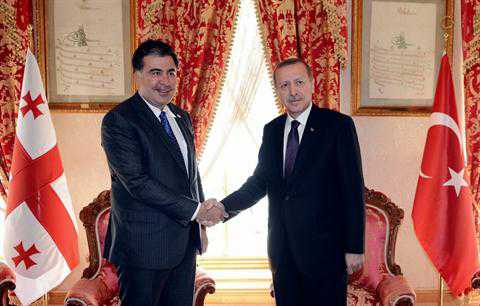
    In this photo released by the Turkish Prime Minister’s Press Office, Turkish Prime Minister Recep Tayyip Erdogan, right, and Georgian President Mikhail Saakashvili shake hands before a meeting in Istanbul, Turkey, Saturday, April 6 , 2013. (AP Photo/Kayhan Ozer, Turkish Prime Minister’s Press Office)

    TBILISI: Georgian President Mikheil Saakashvili has suffered multiple shoulder fractures after a bicycle accident while on a state visit in Turkey, his office said on Monday.

    “The president has suffered an injury during his daily bicycle workout and was diagnosed with a triple fracture of the shoulder,” his office wrote in a post published on the Georgian leader’s Facebook page.

    According to the statement, which did not give details of Sunday’s accident, Saakashvili has undergone surgery for his injuries at an Istanbul hospital.

    It was not immediately clear if he had been released from hospital.

    Due to the accident, the president’s schedule for Monday — a dinner meeting with his Turkish counterpart Abdullah Gul — was pushed back to Tuesday, after which he is due to leave Turkey.

    On Saturday, Saakashvili met with Turkey’s Prime Minister Recep Tayyip Erdogan.

    Georgia’s key regional ally Turkey supports the ex-Soviet republic’s bid to join the North Atlantic Treaty Organisation (NATO) — an ambition strongly opposed by its former imperial master Russia.

    The neighbouring Black Sea countries also share economic interests in promoting the transit of Caspian gas to Europe via a pipeline bypassing Russia.

    Saakashvili is due to step down from his post in October when his second and final presidential term expires.

    via Georgia leader breaks shoulder during Turkey state visit | News , Middle East | THE DAILY STAR.

  • Saakashvili visits Turkey

    Saakashvili visits Turkey

    TBILISI, DFWatch–Georgia’s president Mikheil Saakashvili is on an official visit to Turkey, and has already held meetings with the Turkish prime minister and ethnic Georgians living in the northern industrial city Bursa.

    President Mikheil Saakashvili met with Georgians in the Turkish city Bursa. (President’s photo.)
    President Mikheil Saakashvili met with Georgians in the Turkish city Bursa. (President’s photo.)

    After meeting with the prime minister, Saakashvili said they discussed the issue of Rabati Castle, along with other important topics.

    “First of all we spoke about the issue of NATO integration, and Turkey promised to help us in this direction,” he said on a joint press-conference held after the meeting, “Our main guide to the NATO integration is Turkey.”

    The two also discussed the economy.

    Commenting on the reconstruction of Rabati caste, a hot topic during the last week, he said that the Turkish prime minister assured him that there weren’t any categorical demands about the castle.

    “The prime minister agreed with me that the dome should remain gold. All the other issues should be discussed in detail together with specialists not to harm the interests of any party,” Saakashvili said.

    He said he had agreed with the Turkish prime minister that Georgian specialists will be allowed onto Turkish land to study the Georgian heritage there, which is important, he said, because this cultural heritage needs to be saved.

    “Let them leave Rabati dome alone. We need to conduct a respectful policy in regards to foreign affairs,” he added.

    During the visit the president met with ethnic Georgians living in Bursa. The locals there told him about a desire to have close relations with their historic homeland. The president promised to grant citizenship to everyone who retained Georgian language and culture.

    via Saakashvili visits Turkey | Democracy & Freedom Watch.

  • Turkey confirms Rabati castle agreement

    Turkey confirms Rabati castle agreement

    Turkey’s ambassador to Georgia confirms that experts from Turkey have visited Rabati castle and requested certain ‘changes and improvements’ for the complex.

    rabati-castle

    Two days ago, a spokesperson for President Mikheil Saakashvili presented a draft of an agreement the government has prepared with Turkey, which included making changes to the rehabilitated Rabati castle complex in southern Georgia.

    The president and his party are strongly opposed to the plans and argue that the changes would destroy the castle.

    Turkish ambassador Levent Murat Burhan on Thursday told journalists that there is no final decision yet, but experts expect there to be made corrections and changes at the complex.

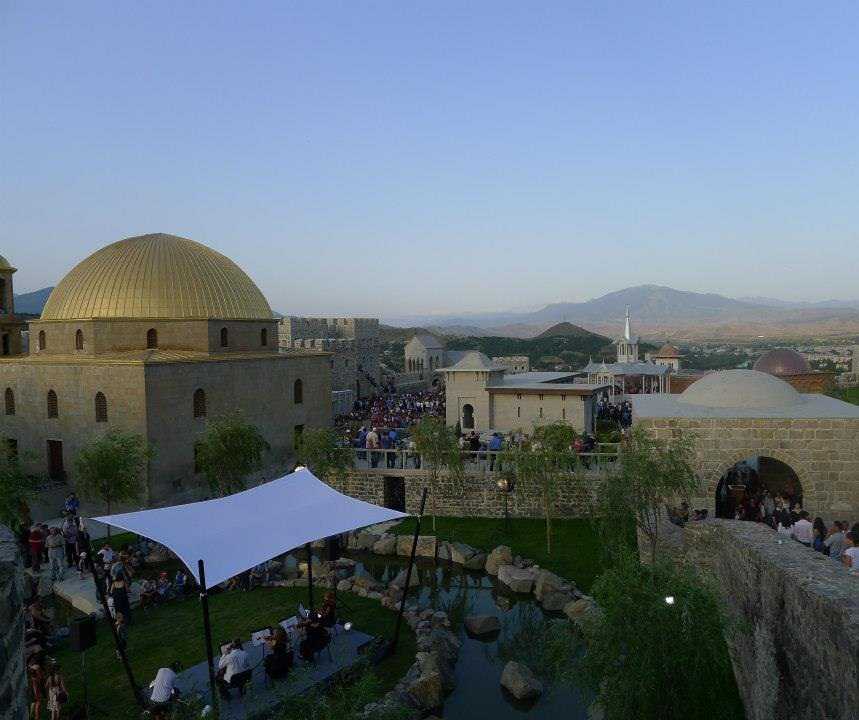
    Rabati castle dates back to the 13th century and lies in the town of Akhaltsikhe. It contains a synagogue, a mosque, a church and a minaret, and was refurbished in 2011-2012 by Saakashvili’s government.

    Now, the Culture Ministry will organize a round table discussion about the reconstruction of Rabati, and has invited experts, employees of the complex, and representatives of civil society. The ministry also has invited Vano Merabsivhili, one of the National Movement leaders, who managed the last round of rehabilitation work at Rabati.

    Yesterday, he responded to this issue saying that ‘the government started fighting against Rabati complex.’

    “Everyone can come and present their own arguments and counter-arguments,” Culture Minister Guram Odisharia said after Thursday’s government session.

    The minister said that a group from the ministry has arrived in Akhaltsikhe in order to study the situation and inform society. Meanwhile, discussion may continue during the round table.

    The new government thinks there were made mistakes during the last reconstruction of Rabati, and Turkey has requested to improve them. The government therefore prepared the text of an agreement, which Manana Manjgaladze, Saakashvili’s spokesperson, presented yesterday.

    The text of the agreement foresees ‘restoring the Akhaltsikhe bath complex from the 18th century; to change the color of the dome, to bring back the older lattices, to check the drainage system around the buildings and if needed, to improve the facing material.’

    via Turkey confirms Rabati castle agreement | Democracy & Freedom Watch.

  • Georgia, Azerbaijan, Turkey Sign Cooperation Plan

    Georgia, Azerbaijan, Turkey Sign Cooperation Plan

    The foreign ministers of Georgia, Azerbaijan, and Turkey have signed a wide-ranging plan to expand cooperation between their departments.

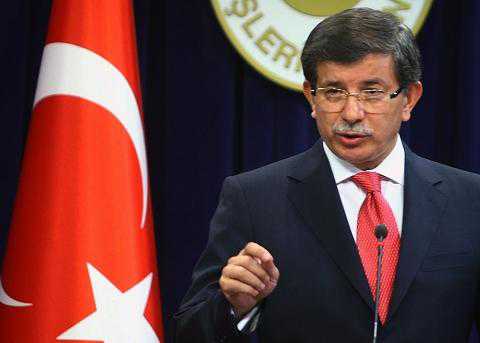
    Georgia’s Maia Panjikidze, Azerbaijan’s Elmar Mammadyarov, and Turkey’s Ahmet Davutoglu held talks in the Georgian port city of Batumi on March 28.

    At a joint press conference after the meeting, Panjikidze said the two-year cooperation plan would strengthen relations between the three countries.

    Mammadyarov said their cooperation was “an example for the whole region.” Davutoglu said the trilateral meeting was a “unique cooperation platform.”

    The first such trilateral foreign-ministerial meeting was held in Trabzon, Turkey, in June 2012.

    The next one is expected to be held in Azerbaijan later this year.

    Based on reporting by ITAR-TASS and Apsny.ge

    via Georgia, Azerbaijan, Turkey Sign Cooperation Plan.

  • Ballet “1001 nights” by Azerbaijani composer performed in Turkey

    Ballet “1001 nights” by Azerbaijani composer performed in Turkey

    Turkey_flag_1

    “1001 Arabian nights” ballet by prominent Azerbaijani composer Fikrat Amirov was perfomed in Samsun State Opera and Ballet under the 3rd Eskishehir National Opera and Ballet days organized by the Turkish Ministry of Culture and Tourism.

    Prepared by Georgian choreographer Nugzar Magalashvili, the ballet was performed by Turkish and Georgian ballet dancers.

    via Ballet “1001 nights” by Azerbaijani composer performed in Turkey – AzerNews.