Note:This article was sent to The Washington Post. But unfortunately, they ignored it…
We used to read the Western media. As citizens of a new democracy like Azerbaijan, we strive to learn from the West many valuable principles, including media neutrality and accuracy. Because we were part of the totalitarian Russia – Soviet Union, where any freedom was prohibited, including media freedom, that’s why while gaining independence from the Russian Empire (USSR) in 1991, we needed to learn those values from experienced Western democracies.
I remember, in those days, we believed that the Western media couldn’t distort the facts. We were more than sure that the Western media was neutral and accurate. But after getting deeper into the issue, we saw that the Western media is lying, distorting, and making propaganda…
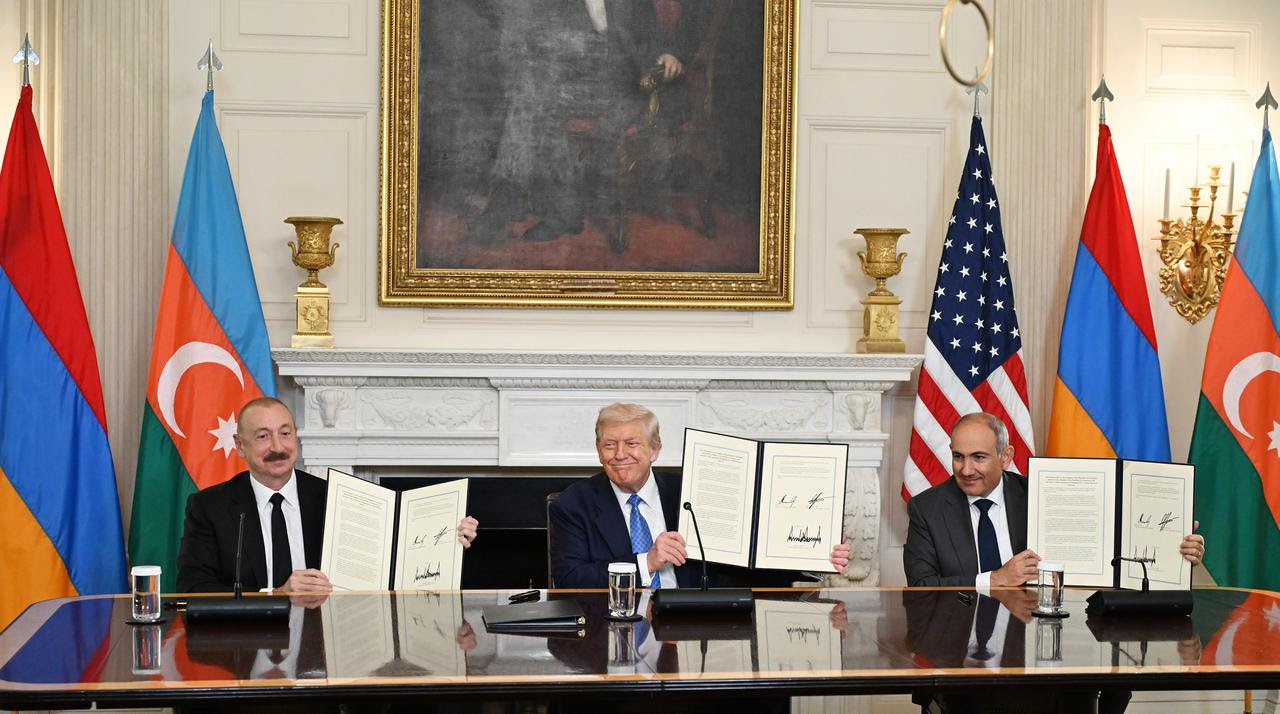
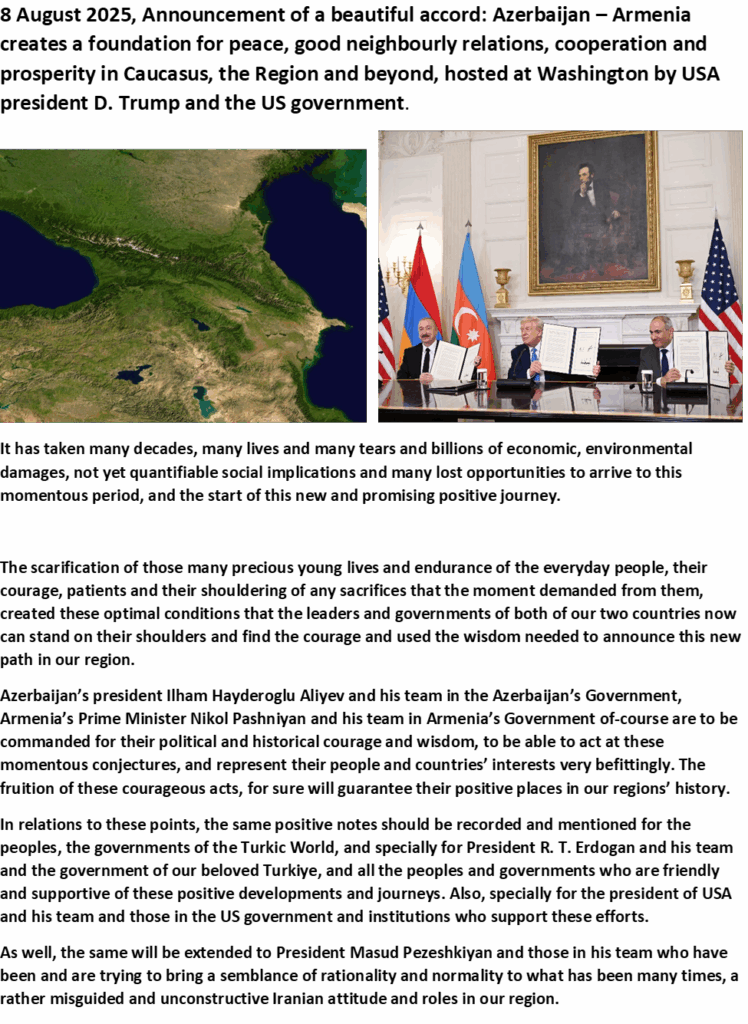
As is seen, the author is trying to compare today’s Gaza situation with the Karabakh of Azerbaijan, which ended about 5 years ago. And the conflicting parties – Armenia, which occupied Azerbaijani lands and kept them under control for about 30 years; Azerbaijan, which liberated its lands, are happy with the outcomes. So, on August 8, 2025, parties, represented by President Ilham Aliyev and Prime Minister Nikol Pashinyan, signed a deal in Washington, witnessed by the US President Donald Trump. This means that the conflict is over, both sides are ready for mutual understanding, and from now on, there is no conflict between them.
But the author is distorting the facts from the start. He has added the photo of Aghdam city of Azerbaijan, destroyed totally, claiming that Azerbaijan had implemented ethnic cleansing against Armenians. One who is not familiar with the situation, seeing the photo, can think that the city belongs to Armenians and it is destroyed by Azerbaijan to force Armenians off. But the reality is very different. The city of Aghdam was occupied by Armenia in 1993, and its inhabitants – all Azerbaijanis were forced off.
While Armenia had occupied about 77 percent of Aghdam, the district’s inhabitants of about 130 thousand had to flee the region. Some 6 thousand Azerbaijanis were killed by Armenians as well.
…The author is claiming that 150 thousand Armenians were ethnically cleansed in 2023. We’re surprised! Because Armenian propaganda continuously claimed that 120 thousand Armenians were living in Karabakh. So, the question is: where did the author get the number of 150 thousand?
For those who are not familiar with the situation in the field, I’d like to clarify the facts.
There were about 50 thousand Armenians living in Karabakh. But the government of Armenia, alongside the separatists and terrorists, claimed that 120 thousand Armenians live there. While in September 2023 Armenians voluntarily left Karabakh, Armenia could record a move of about 100 thousand of them! And 25 thousand of those Armenians were repatriates from Russia, having Russian citizenship. They were brought to Karabakh by Russian peacekeepers to create artificial supremacy of the Armenian population of the region. Another 17 thousand were Armenia’s Army personnel to fight against Azerbaijan. They moved to Karabakh with the help of Russian peacekeepers. So, Azerbaijan, to achieve peace, let them leave and did not stop even those illegal military personnel. Among those who left Karabakh were Armenians from Syria, Lebanon, and other countries as well. All of them were happy to leave the Azerbaijani lands in peace and security.
Then, during those days, Azerbaijan suggested to all Armenians of Karabakh, who had the proof that they were born and lived in Azerbaijan before the conflict, to stay and get Azerbaijani citizenship, live in peace as other people of the country. But only several Armenians decided to stay…
So, while compiling a column, The Washington Post writer had to look into facts, respect his readers, and give accurate information. But unfortunately, he failed to act in a way that is in line with media ethics.
BTW, the writer is quoting Aram Hamparian, executive director of the Armenian National Committee of America, who is one-sidedly distorting the facts as well. As an experienced journalist, I know that while quoting one side, you must quote the opposite side as well. This is a requirement of media ethics. I believe that any journalist working in an esteemed media outlet like The Washington Post must know this rule. Even if he/she does not know this rule, the editors of the media must correct him or deny the publication. As we see, The Washington Post has closed its eyes to this distortion. Thus, the media outlet itself shares the responsibility for the distortion and disrespect to its readers.
While ending my compilation, I’d call on The Washington Post to publish my thoughts and show that they really serve the interests of the readers and remain neutral, accurate. My writing can be considered an open letter to those who misuse the media for ugly propaganda as well.
P.S. While Armenia started to occupy Azerbaijani lands, including Karabakh, in the early 1990s, there were about 750 thousand Azerbaijanis and 120 thousand Armenians living there. But Armenia ethnically cleansed those 750 thousand Azerbaijanis, and journalists like Ishaan Tharoor prefer to keep silent about this…
Peace under normal circumstances have no losers, but if it is utilized wisely will benefit all involved and beyond. Now that the crucial step has been taken, both Azerbaijan and Armenia and all the relevant partners should use this momentum and lay the needed foundations for a lasting peace, cooperation and prosperity in the Caucasus and our region. Sitting on the signed memorandum(s) and accords or becoming complacent, can undermine and squander the created good conditions and opportunities for constructive actions. This in turn, can encourage the opponents and the ill-wishers to move in again and infest the region again for many more decades.
Now is the time to act with due speed and determination.
We in Azerbaijan see and know what does mean Armenian fake propaganda because we face it at the everyday level and usually try to answer in a related manner. But the Armenian propaganda machine uses even any tiny shell to spread lies and fake information about Azerbaijan, Türkiye, and other Turkic countries…
Now I’m providing an example of the fake propaganda action by Armenians once more.
On August 1, 2024, there was a regular State Department Press Briefing at the White House. Vedant Patel, Principal Deputy Spokesperson made a brief introduction and afterwards answered the questions of journalists.
Let’s see a question by a journalist (maybe Armenian, we don’t know):
Question: “There are Armenian POWs in the jails of Azerbaijan for four years by now, and there are Armenian local politicians from Nagorno-Karabakh again in the prisons of Azerbaijan for nearly one year after Azerbaijan launched another unprovoked attack last fall. According to Freedom House, after Karabakh territory came under Azerbaijani control, Karabakh is the most unfree territory in the world. It’s worse than North Korea. It’s worse than Venezuela, Syria, Afghanistan, you name it”.
This is the first part of the question. The person addressing the question claims that “there are Armenian POWs in the jails of Azerbaijan”.
Are there any?
Not of course! Because all POWs captured during the 44-day war of 2020 were returned to Armenia! Thus, Azerbaijan does not have any single Armenian POW at its disposal…
But why does Armenian propaganda claim that Azerbaijan has the Armenian POWs?
This is purely for propaganda purposes! Armenians know that they need to bring this issue to the attention of the world in a way where people can think that Azerbaijan is so inhumane and keeps POWs. Of course, many million people around the world do not know the realities in the region. Even most of them don’t know where Armenia is, who Armenians are, and so on. But propaganda works anyway…
Then this very “journalist” quotes the Freedom House claiming that “Karabakh is the most unfree territory in the world. It’s worse than North Korea. It’s worse than Venezuela, Syria, Afghanistan”.
Are we surprised?
No!
Because this very Freedom House is a propaganda tool as well to suppress new emerging democracies. This organization has been known for its pro-Armenian stance for dozens of years! It was and is supporting Armenian separatism while being silent about more than 250 thousand Azerbaijanis forcefully expelled from Armenia and those 750 thousand IDPs forced off from Karabakh by Armenian occupants!
Just for a reminder, starting from 1988 Armenia expelled all Azerbaijanis from its territory. Hundreds of Azerbaijanis were killed, and their homes were looted by Armenians. This move served as the start of the Armenia-Azerbaijan conflict back in those years. Then Armenia occupied 20 percent of Azerbaijani lands early in the 1990s and forced out 750 thousand inhabitants! Azerbaijan managed to free its lands from Armenia’s occupation only after 30 years and during this movement, Armenian inhabitants (approximately 70 thousand people) voluntarily left Karabakh while Azerbaijan repeatedly asked them to stay…
So why the Freedom House is claiming that Karabakh is the most unfree territory? Those 750 thousand Azerbaijanis need to return to Karabakh but can’t because Armenians have wiped off any single home in that territory. That’s why very few people live there and there can’t be any evolution regarding freedoms in that area. The lands freed from Armenian occupation are covered with landmines and even it’s dangerous to walk around.
Let’s see why and how the Freedom House decided that “Karabakh is worse than North Korea”.
Maybe because the Freedom House’s Vice President for Policy and Advocacy is Annie Wilcox Boyajian, whose husband is an Armenian for example?..
This was the first part of the question of blackmailing Azerbaijan. But a “journalist” continues further with his attempt to blackmail Azerbaijan. Let’s see the second part of the question.
Question: “So the question is whether you follow this situation with the collapse of liberties and civil society in Nagorno-Karabakh, if you have any comments on this, and is there anything that this administration can do to help the detained Armenians in – that are jailed in Azerbaijan, whether to – you can help them to release – to be released or assist in any other form? Thank you”.
“Liberties and civil society in Nagorno-Karabakh”? Isn’t this a bit strange? Who can speak about the liberties and civil society in any territory that was under the occupation of a foreign country? In our case, we speak about the Azerbaijani Karabakh region which was under Armenia’s occupation for about 30 years and thus there couldn’t be any sign of liberties and civil society. But this Armenian propaganda mouthpiece claims that “liberties and civil society collapsed” in Karabakh…
What is good, Vedant Patel’s answer was quite accurate, and the terms used were selected very carefully. Let’s see.
MR PATEL: “So, on the context of the broader situation in the South Caucasus, this is something that the Secretary and the department continue to be deeply engaged on. I don’t have any updates for you as it relates to that process. And look, when it comes to detainees, we have been clear and consistent that any country needs to treat all detainees humanely, with dignity, and in accordance with international law, and needs to respect detainees’ human rights, and that continues to be true in this case as well”.
No single word about the so-called POWs! And no mention of Azerbaijan!
The State Department and the US Administration know quite well what is what in the South Caucasus!
And now let’s be clear with those detainees to whom Vedant Patel is paying attention. Yes, Azerbaijan has Armenian detainees. But they are not the citizens of Armenia (except one) and none of them was captured during the war actions. All of them are tried for being a part of an organized crime against civilians which caused the killing of hundreds of people. At the same time, they are citizens of Azerbaijan of Armenian origin, and they need to answer for those killings before the court. This is very simple and understandable, and the US Administration and other major international actors have quite enough information about this…
Now let’s pay attention to the report by Armenian media which claims that Vedant Patel spoke about “Armenian POWs”.
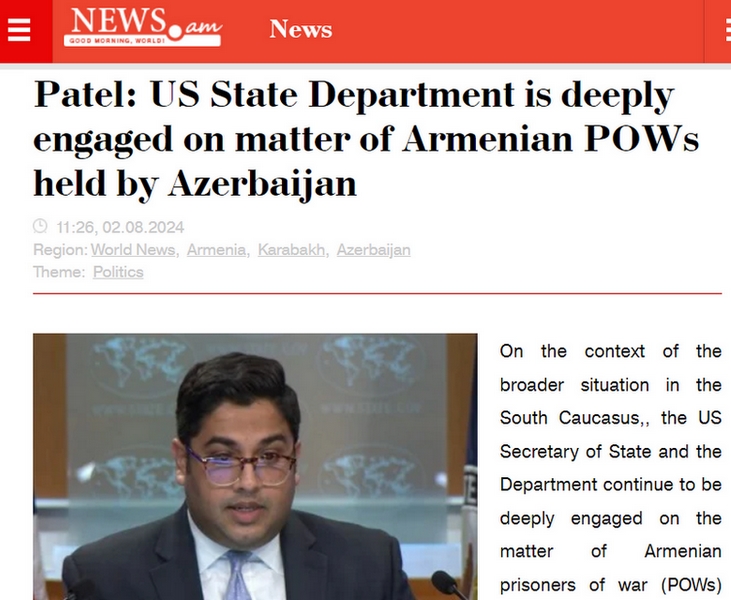
The headline at the News.am reads: “Patel: US State Department is deeply engaged on matter of Armenian POWs held by Azerbaijan”.
Further, the news reads: “On the context of the broader situation in the South Caucasus, the US Secretary of State and the Department continue to be deeply engaged on the matter of Armenian prisoners of war (POWs) being held in Azerbaijan. Vedant Patel, Principal Deputy Spokesperson of the US Department of State, noted about this at Thursday’s Department press briefing”.
Did Vedant Patel use the wording like “Armenian prisoners of war (POWs) being held in Azerbaijan”?
Not of course!
We have quoted Vedant Patel’s answer to this question in full and as we mentioned above, he was quite accurate in using the terms. But the Armenian fake propaganda machine claims, that Vedant Patel spoke about “Armenian POWs”…
So, this is a way how Armenian propaganda works. Most people who read Armenian-style “news” usually don’t investigate the origins. It is usual and understandable for all people around the world. Because those not engaged in politics and news-making are not professionals and they used to believe the media. And Armenians use this opportunity for their ugly propaganda…
Originally Answered: Which country do you prefer, Turkey or Azerbaijan, as a an Armenian?
I find it amusing that this question is meant for Armenians and yet Turks and Azerbaijanis are answering it.
There is no choice really. Hundreds of Armenians travel in and out of Turkey every day (including from Armenia). Nearly no Armenians travel in and out of Azerbaijan. This “voting with feet” should answer the question.
The Republic of Turkey does not discriminate against Armenians entering and traveling the country. The Republic of Azerbaijan nearly universally denies all Armenians of the world entry. As a result, many Armenians (myself included) travel to Turkey and have fond associations and experiences there, where as such a thing is not possible with Azerbaijan.
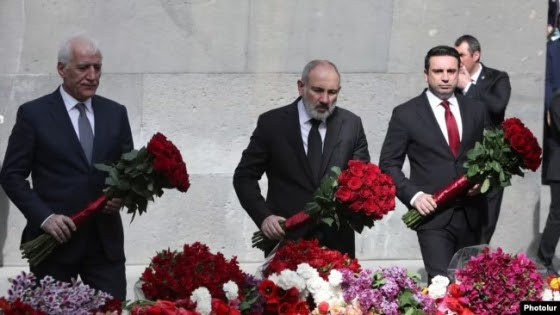
On 24th April each year Yerevan issues its standard message commemorating the “Armenian Genocide” of 1915. This is usually a matter of routine. But not this year. The statement issued by Prime Minister Nikol Pashinyan has led to him being called a “denialist” by the Armenian diaspora and the Genocide industry in the US and elsewhere in the West.
Here are the relevant parts of Pashinyan’s statement that have attracted the ire of those with a stake in the Genocide accusation:
“Dear people, dear citizens of the Republic of Armenia,
Today we commemorate the memory of 1.5 million victims of the Armenian Genocide, the Meds Yeghern, who were put to the sword in the Ottoman Empire since 1915 for being Armenians.
This large-scale tragedy took place during the years of the World War I, and the Armenian people, who had no statehood at the time, having lost their statehood centuries ago, had essentially forgotten the tradition of statehood, and became victims of geopolitical intrigues and false promises, lacking first of all a political mind capable of making the world and its rules understandable.
Meds Yeghern became a nationwide tragedy and grief for us, and without exaggeration, is now a predetermining factor for our socio-psychology. Even today, we perceive the world, our environment, ourselves under the dominant influence of the mental trauma of the Meds Yeghern, and we have not been able to overcome that trauma.
This means that… we often relate and compete with other countries and the international community in a state of mental trauma, and for this reason, sometimes we cannot correctly distinguish the realities and factors, historical processes and projected horizons confronting us.
Maybe this is also the reason why we receive new shocks, and relive the trauma of the Armenian Genocide as both a legacy and as a tradition… When talking about the Armenian Genocide, the Meds Yeghern, we always talk to the outside world, but our internal conversation never takes place on this event.
What should we do and what should we not do in order to overcome the trauma of genocide and exclude it as a threat? These are questions that should be the key subject of discussion in our political and philosophical thinking, but this kind of point of view of dealing with the fact of the Meds Yeghern is not common among us.
This is an imperative, an urgent imperative, and we must evaluate the relations between the Meds Yeghern and the First Republic of Armenia, we must relate the perception of the Meds Yeghern with the vital interests of the Republic of Armenia, our national statehood…
We must now stop the searches for a “national homeland” because we have already found that homeland, our Promised Land, where milk and honey flow. For us, the commemoration of the martyrs of the Meds Yeghern should not symbolize the “lost homeland”, but the found and real homeland, in the person of the Republic of Armenia, whose state… policies can prevent a repetition.
Never again! We should not say this to others, but to ourselves. And this is not an accusation against us at all, but a point of view where we, and only we, are responsible for the directing of our destiny and we are obliged to have enough mind, will, and depth of knowledge to carry through that responsibility in the domain of our sovereign decisions and perceptions.
May the martyrs of Meds Yeghern and all our other martyrs be consoled in their permanent sleep by the Republic of Armenia.
And long live the Republic of Armenia.”
It has been noticed that in his statement of April 24th, 2024, the Armenian Prime Minister chose to continually refer to the event the diaspora has been promoting for the last 50 years as “the Armenian Genocide” as Meds Yeghern or “the Great Crime”. He used the Genocide term extremely sparingly, almost in derogatory fashion against its diasporan promoters. Meds Yeghern is the term that Armenians used until the 1940’s to describe the events of 1915 before the term Genocide was coined by Raphael Lemkin and applied by the Armenian diaspora in its campaign for reparations against the Turkish state since the 1970s. Since then, there has been an insistence that the proper and legal term that should be used is “Genocide” or Tseghasbanoutyoun, in Armenian.
What Pashinyan seems to be suggesting is that Armenia should stop its myth-making and deal with the realities of situations as they present themselves. In other words it should stop treating propaganda as fact because propaganda is a poor basis for policy and Armenia’s recent disasters are very much connected with this tendency. In line with this he has suggested, in line with Azerbaijan President Aliyev’s demand, that Armenia adopt a new constitution deleting the references to “Artsakh” and “the Armenian Genocide”.
One of Pashinyan’s top lieutenants’ has also made the suggestion of making a list of all “1.5 million victims of the Armenian Genocide”. This has been seen by the Armenian diaspora as an indirect way of questioning the veracity of the “Armenian Genocide” and part of a policy of appeasment toward Azerbaijan and Turkiye.
The Lemkin Institute, horrified that its raison d’etre has been questioned by the Armenian Prime Minister, no less, issued a very lengthy and detailed statement saying:
“While we do not generally involve ourselves in domestic affairs of states unless there is an internal threat of genocide, we must address concerns stemming from recent statements made by Armenian Prime Minister Nikol Pashinyan that appear to diverge from fundamental principles of genocide prevention, genocide recognition, and transitional justice, and that directly relate to issues of Armenian national security.”
The Lemkin Institute statement then seeks to refute Pashinyan’s own statement published on April 24th:
“Perhaps most striking about Pashinyan’s statement on the genocide was the absence of any mention of aggressors. In paragraph three, for example, Pashinyan — discussing the period in the Ottoman Empire leading up to the 1915 genocide — cryptically asserted that “…the Armenian people, who had no statehood, had lost their statehood centuries ago, and essentially had forgotten the tradition of statehood, became victims of geopolitical intrigues and false promises, lacking first of all a political mind capable of making the world and its rules understandable.” This statement seems to assert that Armenians mysteriously experienced genocide due to their own witlessness. By asserting that Armenians were solely “victims of geopolitical intrigues and false promises,” Pashinyan further disregards the long-term and multi-layered historical oppression of Armenians in the Ottoman Empire as well as the deep and visceral contempt for Armenians among members of the Committee of Union and Progress, the ruling party during the genocide. In other words, Pashinyan’s statement fails to recognize the role played by the ethnic, religious, and cultural animosity for Armenians in the Turkic supremacist campaign of extermination that targeted Armenians during World War I.
Furthermore, instead of attributing blame for the genocide to the leaders of the Ottoman Empire during World War I, Pashinyan redirects attention towards Armenians, and specifically their apparent incapacity to understand politics at the time. He appears to be referencing the actions of the Russian Empire and Western powers during that era, who promised to protect Armenians but did not follow through, which aggravated the Ottoman leaders’ sense of external threat to the empire and drew negative attention to the Armenians as ‘foreign agents’. However, he does not state this outright; instead he seems to believe that Armenians brought the genocide upon themselves by misunderstanding the political terrain. Pashinyan’s talking points in this passage seem ironic, given that he has himself embraced Western offers to save Armenia from its hostile neighbors. Yet, his talking points also echo the official position of Türkiye regarding the Armenian Genocide which justified it by contracting “against an onslaught of external invaders and internal nationalist independence movements”. By parroting the Turkish narrative of the events of 1915-1923, the Armenian Prime Minister risks absolving Türkiye of its responsibility for the Armenian Genocide, downplaying all previous acknowledgment efforts. Further, it may substantially hamper the continuing work on international recognition of the Armenian Genocide and Turkish accountability – something that the worldwide Armenian diaspora, as well as genocide scholars and activists, have been fighting for.
Pashinyan’s argument that “Armenian people, who had no statehood, had lost their statehood centuries ago, and essentially had forgotten the tradition of statehood” inexplicably plays into the denialist agenda of Türkiye and Azerbaijan by obliquely mischaracterizing Armenian efforts to gain equal rights and human security in the Ottoman empire with foolish attempts to exercise a quest for independent statehood for which they had no capacity. The vast majority of Armenians under Ottoman rule were not seeking secession, but rather security and justice. Pashinyan’s words directly echo the official Turkish view of the Armenian people as rebellious “traitors” who collaborated with hostile European powers to bring about the dissolution of the Ottoman Empire, and who therefore betrayed the country. In fact, in this passage, Pashinyan seems to be making the case that Armenians can only avoid future genocides by capitulating to present-day Türkiye’s expansionist designs.”
It must be admitted that the Armenian Prime Minister has a better understanding of Armenian history than the propagandists in the Genocide industry.
Just after the Great War of August 1914 began in Europe a delegation of Young Turks attended the 8th Dashnak Congress held at Erzurum, in Ottoman eastern Anatolia. There they made an offer to the Armenians to secure their loyalty in the event of the War coming to the Ottoman territories – so as to preserve stability in the territories in which the Armenians lived.
That the Ottomans should have hosted the Dashnak Congress as the Great War was beginning reveals something about the good intentions of the Committee of Union and Progress (New/Young Turks). For most of the previous decade the Dashnaks had sat in the Ottoman parliament, Armenians had been Ottoman ministers and there had been genuine attempts at reform, which were to be supervised by International inspectors, in the eastern vilayets where the Armenians mostly lived.
At this Congress the Ottomans offered the Dashnaks the thing they had been struggling for over the previous 30 years – autonomy.
The Ottoman Government sent a delegation of 28 CUP members, representing all the ethnic groups of the Empire, including important individuals like Behaeddin Shakir and Naji Bey, to make an offer to the Armenians – who were observed to be moving toward supporting a Russian assault on the Empire.
There is a detailed account of the offer made to the Dashnaks at their Congress in Erzurum in a book written by Morgan Philips Price, a pro-Armenian British Liberal, who later became a Labour M.P. He acted for C.P. Scott as The Manchester Guardian’s Caucasus correspondent during the Great War:
“At the outbreak of the European war the Committee of Union and Progress became all-powerful, and all reform schemes and reconciliation plans fell to the ground. The Armenian party, “Dashnaktsution”, happened to be holding a conference at Erzerum when the war began. Turkey had not yet entered; but at the beginning of August Hilmi Bey, Behadin Shekir Bey, and Nedji Bey were delegated by the Committee to make certain proposals to the Armenians in the event of war with Russia. These delegates arrived at Erzerum at the end of the month, and their first proposal was that the Armenians should observe complete neutrality, the population of Armenia and the Trans-Caucasus doing its military duty, to whatever Empire it owed allegiance.
This the Armenians accepted, and all seemed to point to an agreement. But a few days later the Turks suddenly made another proposal. Turkey, they said, could never be secure until there was a chain of buffer States between her and her arch-enemy, Russia, and they claimed that, if war broke out, the Armenians should assist them in carrying out their plan. They then produced a map of the Middle East in which the following political divisions were made. Russia was to be pushed back to the Cossack steppes beyond the main range of the Caucasus. Tiflis and the Black Sea coast, with Batum and Kutais, were marked as belonging to an autonomous province of Georgia. The central part of the Trans-Caucasus, with Kars, Alexandropol and Erivan, were to be joined to the vilayets of Van, Bitlis, and East Erzerum, as an autonomous Armenia. Eastern Trans-Caucasia, including Baku, Elizabetopol and Dagestan were to become an autonomous province of Shiite Tartars. The Armenians, feeling the impossibility of the Ottoman Empire ever being able to realize such a grandiose scheme… refused to have anything to do with the proposal. So the Young Turk delegates, unable to make any impression in Erzerum, proceeded to Van, where they met with no greater success.
According to statements made to me during 1915 by prominent Van Armenians, it is clear that the action of the Tiflis Dashnakists, about which the Committee of Union and Progress had doubtless been informed by the end of August, was the principal cause of these Turkish demands. Early in August 1914 the Tiflis Armenians seem to have decided that a Russo-Turkish war was inevitable, and thereupon the Dashnakist leaders there at once offered 25,000 volunteers to assist the Russians in conquering the Armenian vilayets.
This offer was made before the outbreak of the war with Turkey, and in the interval the volunteers were busy training and forming at the various centres in the Caucasus. At the end of October, when Turkey came into the war, preparations had been so far advanced that Andranik, the famous revolutionary leader from Turkey, at the head of the first volunteer battalion, took part with the Russians in the advance through North-west Persia, capturing Serai early in November. Meanwhile five more battalions had been formed and were ready to leave for the front, as soon as they could get rifles and equipment. Fifty per cent, of these volunteers were Armenians who had left Turkey, Bulgaria and Roumania since the outbreak of the European war, and had come to the Caucasus to offer their services.
There can be little doubt that this volunteer movement, started under the auspices of the Caucasus Armenians, was the cause of the Young Turk demands on the Armenians of Erzerum, Van and Bitlis for a similar volunteer movement against Russia, and of the subsequent persecution when this demand was refused. Prominent Armenians, whom I met in Van, told me how the attitude of Djevdet Pasha towards them and their people became much more unfriendly as soon as the news arrived that Armenian volunteers were on the front fighting against the Turks. He at once demanded the return of a number of Armenian deserters, whose absence had hitherto been winked at. He accused them of going over to the volunteers with the Russians, and commenced the policy of forcing the Armenians into special labour battalions, where they had very hard work and bad food. Thus the Van Armenians were at the mercy of the Turks, who avenged on them all the rash acts of their kinsmen in the Caucasus.
That their conduct was keenly resented by the Turkish Armenian refugees in the Caucasus, was made clear by some articles in the Van Tosp, the organ of the Van Armenians in Tin as early in 1916. In its issue for January 9th, 1916, Professor Minassian took the Dashnaktsution party to task for having entered into negotiations with the Russian authorities without consulting its kindred societies in Turkish Armenia. It had spread, he said, baseless rumours of a Russian promise of autonomy for Armenia, and then had proceeded to organize volunteer battalions, regardless of the effect that this would have on their kinsmen in Turkey, whose position under the nose of the Turks was very precarious and required tactful handling. He denied that there was any serious negotiation with the Russian Government about Armenian autonomy, and said that the Dashnaktsution leaders of the Caucasus were pretending to represent responsible opinion, whereas they really only represented a group. The Orizon, the organ of the Dashnaktsution in Tiflis, defended itself by saying that the massacre would have happened in any case, and that Prince Vorontsoff Dashkoff had not only verbally promised Armenian autonomy in return for the service of the volunteers, but had actually signed a document to this effect. Whether this document ever existed is however exceedingly doubtful.” (War and Revolution in Asiatic Russia, pp.243-6)
The Armenians turned the Ottoman offer down and instead joined the Tsarist invasion and mounted an insurrection against the Ottoman state. That proved to be a fateful effor with the most tragic of results.
The CUP mission offered the Armenians autonomy in 2 and a half vilayets of East Erzurum, Van and Bitlis plus “Russian Armenia” in return for service in the Ottoman army in the event of war and support from their brethren in Russian territory, who would then, in the event of victory, be part of the larger autonomous region. The offer would be guaranteed by the German Government. The CUP delegation proposed that the Dashnaks aid the Ottoman State by mounting attacks on any Russian invasion behind the lines in Transcaucasia, where an autonomous Armenian state could be founded.
In the 2 and a half vilayets of Turkish Armenia this would have placed around 1 million Muslims under the authority of an autonomous Armenia containing only around 400,000 Armenians. So it was undoubtedly a generous concession on the Ottoman side (see Justin McCarthy, Turks and Armenians: Nationalism and Conflict in the Ottoman Empire, p.10) According to the 1897 Tsarist figures the Armenian population of the autonomous area would have been increased by another 1 million from the Kars, Erivan and Alexandropol Russian guberniyas (although this area would have also contained a sizeable amount of Muslims. By 1917 the Russians counted 1.4 million Christians in Russian Armenia and 670,000 Moslems).
So, an Armenian autonomous region, with “Russian Armenia” included, under Ottoman sovereignty would have perhaps been made viable by a small majority of Armenians – something that all the Armenian territorial claims were incapable of delivering without the extensive ethnic cleansing of Muslims.
This was the concrete realisation, to all intents and purposes, of the deal the Dashnaks had concluded with the Young Turks in 1907. It was more realistic and realisable than the choice the Dashnaks subsequently took in throwing in their lot with Russian expansionism and British Imperialism.
It could be said that the Dashnaks backed the wrong horse, believing it to be the more powerful one, more likely to win. They were taken in by the promises and propaganda of the Triple Entente – Britain, France and Russia – and paid an awful price for it.
Prime Minister Pashinyan, therefore, has a point. Armenians should grasp this historic opportunity to forget altogether about the myths around “Greater Armenia” and instead concentrate all efforts in improving the lives of Armenians living in the actual Armenia. The ideology of “Greater Armenia” and the “Armenian Genocide” combined, at the collapse of the USSR, to impel Armenia to seize a large portion of Azerbaijan where there was a sizeable Armenian population and which Armenian history had taught was a part of “historic Armenia”. In the course of this conquest there were fearsome massacres of Azerbaijani civilians and over 750,000 were driven from their homes to become internally displaced persons in other parts of Azerbaijan. And the US diaspora volunteeers, led by Monte Melkonian, conducted the notorious Khojaly massacre.
The seizure of Karabakh and the surrounding regions and ethnic cleansing of its population was justified not only on irredentist grounds but with reference to the events of 1915. Azerbaijani Turks could not be allowed to live in Karabakh because these “Turks” were, after all the same Turks as 1915!
The “Armenian Genocide” narrative also chained Armenia to its Russian “protector” after the breakup of the Soviet Union. Armenia was in need of a “protector” after what it did in Karabakh in the early 1990s and Moscow was indeed happy to oblige. This had a consequent retarding effect on Armenia’s post-Soviet national independence and development when the route to the West went through Turkiye. Pashinyan is very aware of this.
One of the first acts of the current US President upon coming to power was to recognise the “Armenian Genocide.” And now that same “caller out” of genocides is the essential facilitator of the clearest case of attempted genocide seen in modern times.
Perhaps that is concentrating the mind of the Armenian Prime Minister and making him into something of a statesman.
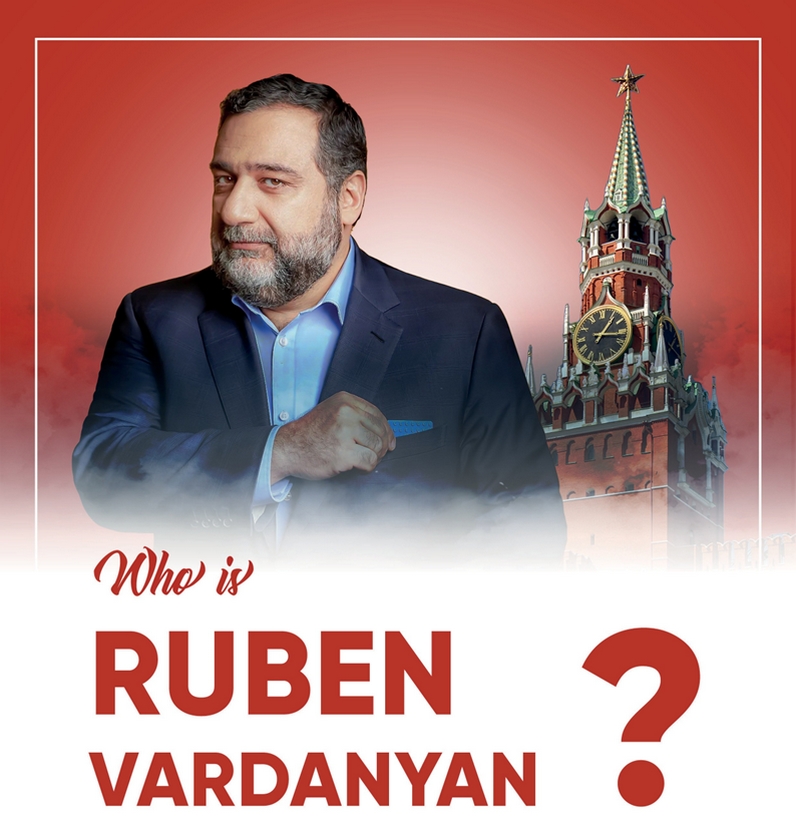
I believe that this information will be of interest to our esteemed readers. That’s why I’m reprinting it. The information below is not my investigation. It was published by one of the X users and as I see seems very trustworthy. I do deal with the issues in our region, especially with the problem of conflict between Armenia and Azerbaijan. I know quite well the roots of the Karabakh conflict as well. And I’m aware of Ruben Vardanyan’s illegal activities in the territory of Azerbaijan.
For those who need a bit more information, Ruben Vardanyan alongside other criminal separatist elements of Karabakh was stopped and brought to Baku to be investigated. He is among those who fueled ethnic hatred between Armenians and Azerbaijanis. He was arrested after a 1-day local anti-terror operation led by the Azerbaijani military on September 19-20, 2023. Before that, he and others were called to lay down arms and cease. But they continuously ignored peaceful calls. Then Azerbaijan had to launch an anti-terror operation, which resulted in success.
Now let’s see who this friend of Russian President Vladimir Putin and a perpetrator of crimes even in Ukraine Ruben Vardanyan is.
Backed by Kremlin Ruben Vardanyan was very sure that he will not be punished…
GENERAL INFORMATION
Ruben Vardanyan, born in Yerevan on 25 May 1968, is a Russian oligarch of Armenian descent, a billionaire, and former minister of the state of the so-called “Nagorno-Karabakh Republic”, an entity not recognized anywhere in the world.
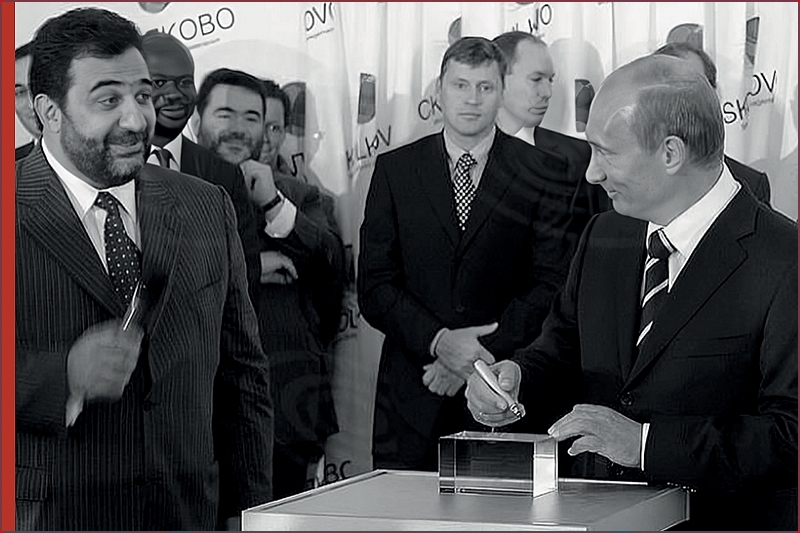
Vardanyan was the initiator, one of the founders, and the first president of the Moscow School of Management in Skolkovo. President Vladimir Putin attended the groundbreaking ceremony for the campus in 2006.
According to the Washington Times, Vardanyan is a friend of Vladimir Putin.
Ruben Vardanyan with the Russian President Vladimir Putin
Vardanyan was once the head and main partner of Troika Dialog, an investment company that created an extensive network of offshore companies involved in money laundering from Russia. Since 2011, Forbes has included him in its ranking of Russia’s richest people.
In September 2021, Ruben Vardanyan renounced his Russian citizenship but continued to actively participate in Russian business, where his partner is the head of ROSTEC, Sergei Chemezov. Together they hold positions on the Board of Directors of KAMAZ OJSC and receive significant payments for their work. In addition, Vardanyan owns a stake in the car manufacturer KAMAZ through a consortium of investors in which ROSTEC also participates.
In 2018, Vardanyan’s foundation and a subsidiary of ROSTEC invested in facial recognition technology by buying shares in the company. In addition, Vardanyan was a former co-owner of Avtovaz, but sold his stake for $180 million in 2013, remaining in partnership with ROSTEC.
SKOLKOVO PROJECT
Back in 2009, well-known Russian opposition actor Alexei Navalny (now dead) investigated Skolkovo’s financing scheme and noted in his blog that, despite Vardanyan’s statement about the charitable nature of Skolkovo, the school’s project was estimated at $500 million, with half of that amount coming from the founders’ donations and the remaining $250 million coming as a loan from Sberbank.
“The loan was granted under unclear conditions and with unclear guarantees. Both the Skolkovo school and Sberbank categorically refuse to disclose the terms of the loan,” Navalny said.
“The construction of the Skolkovo school was financed from the funds of the state-owned Sberbank, and no one was going to pay back the money, but Vardanyan and the rest of the gang of tycoons told the naive public and journalists that this was a very “cute” commercial project”, Navalny added.
ORGANIZED CRIME AND CORRUPTION REPORTING PROJECT (OCCRP) ABOUT TROIKA DIALOG
For more than two decades, Ruben Vardanyan was the face of Western-style investment banking as the founder of Troika Dialog during the birth of Russian capitalism, with successes that earned him billionaire status and ties to the Kremlin.
The system dubbed the Troika Laundromat by the Organized Crime and Corruption Reporting Project, involved at least 75 offshore companies and exported about $4.8 billion between 2006 and 2013, often through fictional deals, with the help of a now-defunct Lithuanian bank, according to the OCCRP’s investigative journalists.
Sergey Roldugin, a cellist and friend of Vladimir Putin, was among the ultimate recipients of the funds.
While Vardanyan wasn’t personally accused of wrongdoing, he was president, chief executive officer, and chairman of Troika during this period, as well as its main partner. According to the OCCRP, he used the bank to pay millions of dollars in personal expenses.
In March of 2019, the European Parliament members wrote a letter to the European Commission President Jean-Claude Juncker, in which they stated the need to introduce sanctions against the ex-owner of Troika Dialog Ruben Vardanyan and others linked to Troika Dialog’s “offshore eco-system”. The letter was signed by 22 MEPs representing Lithuania, Poland, Sweden, Germany, Great Britain, and other countries.
VARDANYAN’S INVOLVEMENT IN AGGRESSION AGAINST UKRAINE
Known for his active pro-Russian stance, Ruben Vardanyan was included in the Ukrainian “Peacekeeper” sanctions database for his assistance to the Russian invaders and his involvement in crimes committed by the Russian authorities against Ukraine and its citizens. He is also accused of denying and publicly justifying Russian aggression and financing military actions in the post-Soviet space. The list designates him as a person subject to “immediate arrest and transfer to the law enforcement authorities of Ukraine and NATO countries”.
Bob Blackman, a Conservative member of the British parliament, said Vardanyan was an accomplice to aggression against Ukraine. “We have to understand that this is someone who has been sanctioned as part of Russia’s involvement in Ukraine, and it is believed that Russia is trying to strengthen its capabilities in terms of its war effort. His companies have been well used and well involved in the whole process of expanding the military presence in Ukraine and Nagorno-Karabakh”, the British MP said.
Vardanyan also has links with Tehran, which is helping Moscow in its regular attacks on Ukraine. His ties to Iran can be traced through Russia’s Gorchakov Foundation, which organizes events in various countries, including Armenia, with government-approved speakers from Tehran.
In September 2022, Vardanyan renounced his Russian citizenship to avoid Western sanctions, but Ukraine included him on its sanctions list for providing logistical support to the Russian occupation army.
IN THE TERRITORY OF AZERBAIJAN
After renouncing his Russian citizenship to avoid Western sanctions, Vardanyan came to “power” in Karabakh and illegally seized copper, molybdenum, and gold deposits in the region, which belongs to Azerbaijan. The resources, guarded by the Russian peacekeepers, were plundered in violation of environmental regulations. The Azerbaijani authorities demanded that experts be given access to the deposits, but this was repeatedly blocked.
According to Canada’s Geopolitical Monitor, the Kremlin appointed Vardanyan to the post of “Minister of State of the Republic of Nagorno-Karabakh” in order to thwart the European Union’s potential success in reaching a peace agreement.
Bulgarian National Radio noted that Vardanyan was engaged in active propaganda that did not contribute to the resolution of the conflict between Baku and Yerevan.
There are reasonable grounds to suspect that Vardanyan has committed offenses under Articles 214-1 (Financing terrorism), 279.3 (Participation in the creation and activities of paramilitary groups or groups not provided for by law), and 318.1 (Illegal crossing of the state border of Azerbaijan) of the Criminal Code of Azerbaijan.