(Reuters) – Former premier Tony Blair has postponed a party at the Tate Modern art gallery celebrating the launch of his autobiography because of threats from protesters, his office said on Wednesday.
Anti-war demonstrators had planned to disrupt the reception on Wednesday evening and a group of celebrated artists including Tracey Emin and Vivienne Westwood had called on the gallery to cancel the “disgraceful” event.
Blair has also been forced to cancel a signing session for “A Journey” at a bookstore in central London.
“It has been postponed for the same reason as the book signing,” a spokesman for Blair said.
“We don’t want to put our guests through the unpleasant consequences of the actions of demonstrators.”
At the weekend, protestors hurled eggs and shoes at the former prime minister during a promotional event in Dublin.
Blair, prime minister for Labour between 1997 and 2007, led Britain into wars in Iraq and Afghanistan. In particular, the occupation of Iraq by Western coalition forces was widely opposed and contributed to a dive in Blair’s popularity.
Emin, Westwood and musician Brian Eno, were among figures from the arts world who wrote a letter to the Guardian newspaper on Wednesday to voice their concern about the Tate Modern event.
“It is disgraceful that the Tate is being used for this purpose,” they said.
(Reporting by Matt Falloon; Editing by Steve Addison)
Caught up in a smoldering feud between its President and Prime Minister, Russia is not making the most of the historic opportunity to deploy in the Middle East. Russian elites were unable to draw up a strategy for that region when they had the chance and, now, they are no longer capable of it. In Thierry Meyssan’s view, Moscow is paralyzed, having failed both to take full advantage of the botched US “remodeling” of the Middle East and to fulfill the hopes raised by Vladimir Putin.
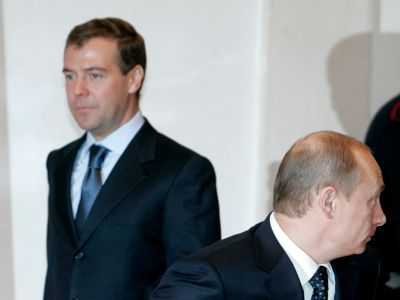
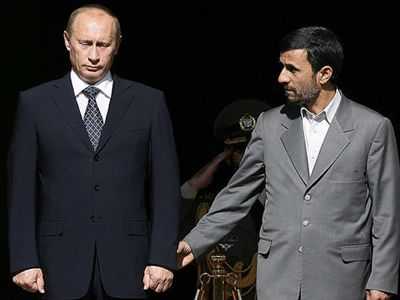
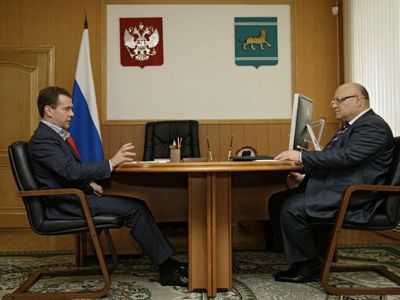
President Medvedev and Prime Minister Putin. The understanding between the “30-year” friends has abruptly turned into an open war. Under these conditions, how could Moscow nurture any major ambition in the Middle East?
The Israeli defeat in the Summer of 2006 against the Lebanese resistance spelled the end of US supremacy in the Middle East. In only four years, the military, economic and diplomatic situation in that region underwent a complete change.
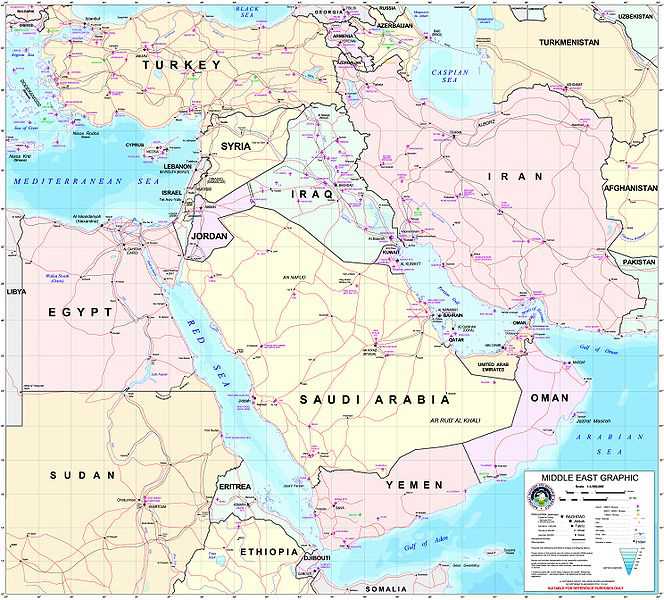
At present, the Turkey-Syria-Iran triangle has emerged as the leading pole while Russia and China expand their influence as that of the United States is fading. However, Moscow is reluctant to seize the opportunities it has at hand. First of all, its priority is not the Middle East; secondly because no project related to this region has the consensus of the Russian elites, finally because Middle East conflicts have sensitive implications for Russia’s own domestic problems. Let’s take stock of the situation.
2001-2006 and the myth of the remodeling of the “Great Middle East”
The Bush administration was able to rally the oil lobby, the military industrial complex and the Zionist movement around a huge project: securing control of the oil fields running from the Caspian Sea to the Horn of Africa by redesigning the political map based on small ethnic states.The zone, demarcated not according to its population but to the riches under its soil, was first called “Crescent Crisis” by University professor Bernard Lewis and later “Greater Middle East” by George W. Bush.
Washington did not skimp on its Middle East “remodeling” project. Huge sums of money were invested in buying local elites so that their personal interests would come before national interests in the context of a globalized economy. Most important was the deployment of a strong military force to Afghanistan and Iraq to hem in Iran, the main actor in the region that stands up to the empire. Maps of the new region were drawn up and circulated by the Chiefs of Staff. All countries in the region, including Washington’s allies, would be broken up into various emirates incapable of defending themselves, while vanquished Iraq would be divided into three federate states (a Kurdish, a Sunni and a Shiite).
When it seemed that nothing could prevent that domination process from going ahead, the Pentagon handed Israel the task of destroying all secondary fronts before attacking Iran. The aim was to wipe out the Lebanese Hezbollah and to overthrow the Syrian government. However, after submitting one third of the Lebanese territory to a bombing campaign the likes of which hadn’t seen since the Vietnam War, Israel was forced to retreat without having attained any of its goals. That defeat marked a strategic shift in the balance of forces.
Over the next months, US generals rebelled against the White House. They had lost control of the situation in Iraq and anticipated with apprehension the difficulties of a war against a well-armed and organized state—Iran—potentially setting the entire region ablaze. The generals, gathered around Admiral William Fallon and senior general Brent Scowcroft, forged an alliance with several realistic politicians who opposed the danger inherent in the excessive military deployment.
They used the Baker-Hamilton Commission to influence American voters until obtaining the dismissal of Defense Secretary Donald Rumsfeld and his replacement with one of their allies: Robert Gates. Subsequently, these same individuals hoisted Obama to the White House, on condition that Robert Gates would remain the Pentagon.
In fact, the US General Staff has lacked an alternative strategy ever since the “remodeling” failed. Its only concern is to stabilize its positions. US soldiers withdrew from large Iraqi cities and retreated to their bases. They left the management of Iraq’s Kurdish areas in the hands of the Israelis while the Arab zones were left to the Iranians. The US State Department has stopped handing out sumptuous gifts to regional leaders and has become increasingly avaricious in these times of economic crisis. Yesterday’s beholden are looking for new masters to feed them.
Tel Aviv is the only one to still believe that the US withdrawal is but an eclipse and that the “remodelling” will resume once the economic crisis is over.
Formation of the Turkey-Syria-Iran Triangle
Washington thought that the dismantlement of Iraq would be contagious. The Sunni-Shiite civil war (the Fitna, in Arabic) was supposed to pit Iran against Saudi Arabia and split the whole Arab-Muslim world. The virtual independence of Iraqi Kurdistan was expected to cause a Kurdish secession in Turkey, Syria and Iran.
But the opposite happened. The easing of US pressure on Iraq sealed the alliance among the enemy brothers of Turkey, Syria and Iran. All three realized that in order to survive they had to unite and that once united they could exert regional leadership. In fact, Turkey, Syria and Iran, together, cover all crucial aspects of the regional political spectrum. As the heir to the Ottoman empire, Turkey incarnates political Sunni Islam. As the only remaining Baathist state after the destruction of Iraq, Syria embodies secularism. And, finally, since the Khomeiny Revolution, Iran represents political Shi’ism.
In just a few months, Ankara, Damascus and Teheran opened their common borders, lowered customs tariffs and paved the way for a common market. This opening provided them with a breath of fresh air and a sudden economic growth which, despite the memories of prior disputes, has also garnered genuine grassroots support.
However, each of these three states has its own Achilles’ heel which the United States and Israel, as well as some of their neighbors, will attempt to exploit.
For years, Tel Aviv and Washington have accused Iran of violating its obligations as signatory of the [nuclear] Non-Proliferation Treaty and of developing a secret military nuclear program. In the times of Shah Reza Pahlevi, both capitals – plus Paris – had set up a large program designed to provide Iran with the atomic bomb. In view of its history, it was generally accepted that Iran had no expansionit ambitions and that the great powers could safely provide it with such technology. A propaganda campaign based on deliberately fabricated information was later organized, painting current Iranian leaders as fanatic and capable of using the atomic bomb – if they had it – in an irrational manner, therefore posing a great threat to world peace.
Nevertheless, Iranian leaders affirm they have renounced to building, storing or using the atomic bomb, precisely due to ideological reasons. And their assertion to totally reliable. Let us simply recall what happened during the war led by the Iraq of Sadam Husein against the Iran of Imam Khomeiny.
When Baghdad unleashed a stream of missiles against Iranian cities, Teheran retaliated in the same way. But they were unguided missiles that were launched in any given direction and fell indicriminately. Imam Khomeiny intervened to denounce the use of such weapons by his own armed forces. Khomeiny stressed that good Muslims should refrain from shooting at the military if it entailed the risk of killing a large number of civilians. Khomeiny then prohibited the use of missiles against cities, which had an impact on the balance of forces, prolonged the war and brought new suffering to the Iranian people. At present, the successor of Khomeiny, Ali Khamenei, Supreme Leader of the Revolution, defends the same ethics in respect of nuclear weapons and it is unthinkable that any faction of the Iranian state would dare to violate the authority of the Supreme Leader and secretly build the atomic bomb.
The fact is that after the Iraqi offensive, Iran anticipated the eventual depletion of its hydrocarbon reserves and wanted to have a civil nuclear industry to guarantee its own long-term development and that of the rest of Third World nations. To this end, the Revolutionary Guards set up a special team of officials dedicated to scientific and technical research, which was organized in secret cities, according to the soviet model. These researchers are also working on other programs, such as those linked to conventional weapons. Iran has opened all its nuclear facilities for inspections by the International Atomic Energy Agency (IAEA), but it refuses to give them access to research facilities dedicated to conventional weapons. We therefore find ourselves in a déjà vu situation : IAEA inspectors assure there is nothing to accuse Iran of, while the CIA and the Mossad insist—without any evidence—that Iran hides its illegal activities within its vast scientific research sector.This situation is reminiscent of the intoxication campaign previously carried out by the Bush administration, accusing the UN inspectors of not doing their job properly and of overlooking the WMD programs supposedly developed by Sadam Husein.
No country in the world has been the object of so many IAEA inspections and it is not serious to keep accusing Iran, but it hasn’t made a dent in the bad faith displayed by Washington and Tel Aviv. The fallacy about the alleged threat is crucial for the military industrial complex, which has for years implemented the Israeli program known as “antimissile shield” with US taxperyers’ money. Without the Iranian threat, there is no budget!
Teheran has undertaken two operations to get out of the trap which was set against it. First, it organized an international conference for a nuclear-free world, during which Iran finally expounded its position to its principal partners (on April 17). Iran also accepted the mediation by Brazil, a country whose president Lula da Silva aspires to become the Secretary General of the United Nations. President Lula had asked his US counterpart Barack Obama what kind of measures would be likely to reestablish confidence. Obama replied in writing that the compromise concluded in November 2009, but never ratified, would suffice. President Lula travelled to Moscow to make sure Russian President Dimitri Medvedev had the same opinion. President Medvedev publicly confirmed his view that the November 2009 compromise would be enough to solve the crisis. The next day, May 18, President Lula co-signed with Iran’s Mahmoud Ahmadinejad a document that, from all perspectives, met the demands made by the United States and Russia. But the White House and the Kremlin did an about-face, going back on their position, and denounced the guarantees offered by the new document as insufficient.
However, there is no significant difference between the document negotiated in November 2009 and the one ratified [by Iran, Brazil and Turkey] in May 2010.
Turkey inherited from its past a large number of problems with its minorities and neighbors; the United States has been fueling these problems for decades to keep Turkey under its thumb. Professor Ahmet Davutoglu, a theorist of neo-ottomanism and new Turkish foreign minister, has drawn up a foreign policy aimed, in the first place, at freeing Turkey from the endless conflicts bogging it down, as well as at multiplying its alliances with various intergovernmental institutions.
The dispute with Syria was the first to be solved. Damascus stopped using the Kurds and abandoned its claim over the Hatay province. In return, Ankara yielded on the division of river waters and helped Damascus to come out of its diplomatic isolation; it even organized direct negotiations with Tel Aviv, which occupies the Syrian Golan. Syrian President Bachar el-Assad was received in Turkey (in 2004) and the Turkish President Abdullah Gull was welcomed in Syria (in 2009). A Strategic Cooperation Council was set up by the two countries.
As for Iraq, Ankara had opposed an invasion of this country by the Anglo-Americans (in 2003). It banned the United States from using the NATO bases on Turkish territory to attack Bagdad, thus upsetting Washington and delaying the start of the war. When the Anglo-Americans formally transferred power to the Iraqis, Ankara favored the electoral process and encouraged the Turkmen minority to take part in the vote. Later, Turkey relaxed border controls and boosted bilateral trade. There is only one aspect marring this panorama: relations between Ankara and the Bagdad national government are excellent, but they are chaotic with the Kurdish regional government of Erbil. The Turkish army even took the liberty of persecuting the PKK separatists inside Iraqi territory—needless to say, with the support of the Pentagon and under its control. Be that as it may, an accord was signed to guarantee the export of Iraqi oil through the Turkish harbor of Ceyhan.
Ankara took a series of initiatives to put an end to the secular conflict with the Armenians. Resorting to “football diplomacy”, Ankara acknowledged the 1915 massacre (but refused the term ‘genocide’), and managed to establish diplomatic relations with Erevan, while it seeks a solution to the High Karabaj conflict. Nevertheless, Armenia suspended the ratification of the Zurich bi-party accord.
Turkey’s liability in relation to Greece and Cyprus is also very significant. The division of the Aegean Sea has not yet been clarified and the Turkish army is still occupying Northern Cyprus. Ankara has proposed different measures to reestablish confidence, particularly the mutual reopening of harbors and airports. But relations are far from being normalized and, for the time being, Ankara does not appear willing to abandon the self-proclaimed Turkish Republic of Northern Cyprus.
Washington has accused Syria of continuing its war against Israel through various intermediaries: Iran’s secret services, the Lebanese Hezbollah and the Palestinian Hamas. The United States thus falsely blamed Syrian President Bachar el Assad of having ordered the assassination of former Lebanese Prime Minister Rafik Hariri, and had a Special Penal Court set up to judge the Syrian President.
With astonishing ability, Bachar el-Assad, who had been depicted as a conceited and totally incompetent “daddy’s boy”, managed to wiggle out of that corner without making concessions or firing a single shot. The testimonies of his accusers wilted one after the other, and Saad Hariri, the son of the late Hariri, stopped demanding his arrest and even paid him a friendly visit in Damascus. Nobody wants to finance the Special Court any more and it is possible that the UN might decide to dismantle it even before it convenes, unless it will be used as a forum to accuse Hezbollah.
Finally, in response to US Secretary of State Hillary Clinton’s injunctions to break relations with Iran and with Hezbollah, Bachar el-Assad organized a surprise Summit meeting with Iranian President Mahmoud Ahmadinejad and with the top Hezbollah leader Hassan Nasrallah
What about Russia?
The consolidation of the Turkey-Syria-Iran triangle is a consequence of US and Israeli military power decline. The vacuum created is being filled by others.
China has become Iran’s first commercial partner and draws on the expertise of the Revolutionary Guards to overcome the hurdles set up by the CIA in Africa. It also gives military back-up, as discreet as it is effective, to Hezbollah (which it probably equipped with land-to-air missiles and guiding systems to counter interference) and to Hamas (which opened a representation office in Pekin). However, China is advancing very slowly and cautiously on the Middle East stage where it has no intention of playing a decisive role.
All expectations point in Moscow’s direction, which has been absent from the region since the fall of the Soviet Union. Russia wants to recover its former position of world power, but is reluctant to make a move before having solved the problems it currently faces in the former Warsaw Pact zone. The main drawback is that the Russian elites have no alternative policy to replace the US “remodeling” project and are stuck on precisely the same problem as the United Sates: in view of the shift in the regional power correlation, it is no longer possible to implement a balanced policy between Israel and the Arab countries. Any involvement in the region implies, sooner or later, a rupture with the Zionist regime.
Moscow’s clock stopped in 1991, at the moment when the Madrid Conference took place. Moscow has not yet registered the failure of the Oslo (signed in 1993) and the Wabi Araba (1994) accords in terms of implementing the so-called “Two-State Solution”, which is no longer viable. The only peaceful option is the one implemented by South Africa: the abandonment of Apartheid and the recognition of a single nationality for all citizens, Jews and non-Jews alike; and the reinstatement of a real democracy based on the principle of “one man, one vote.” That is already the official position adopted by Syria and Iran, which will soon be embraced also by Turkey.
The great diplomatic conference on the Middle East that the Kremlin wanted to organize in Moscow in 2009, and which was both announced at the Annapolis Summit and confirmed by several UN resolutions, never took place. Russia passed up its opportunity to act.
Those Russian elites which still enjoy great prestige in the Middle East, no longer frequent the region; they fantasize about it more than they understand it. In the 1990s, they were enthusiastic over the romantic theories of anthropologist Lev Gumilev and were in tune with Turkey, the only nation which, similar to Russia, is both European and Asian. Then, they fell for the geo-political charisma of Alexander Dugin, who detested western materialism, thought that Turkey was contaminated by western values, and was mesmerized by the asceticism of the Iranian Revolution.
However, that momentum evaporated in Chechnya before it began to materialize. Russia was brutally confronted with a form of religious extremism that received undercover support from the United States and was fueled by the Turkish and Saudi secret services. As a consequence, any alliance with a Muslim state seemed risky and dangerous. And when peace was reestablished in Grozny, Russia was unable, or did not want, to play on its colonial heritage. According to the President of the Islamic Committee of Russia, Gaidar Zhemal, Russia cannot aspire to become an euro-Asian nation and at the same time pretend that nothing happened nor can it continue to view itself as an orthodox state which is protecting its turbulent Muslim brothers. Russia had—and still has—to define itself by considering orthodox and Muslims as equals.
Rather than leaving for tomorrow the solution to the problems concerning minorities, and postponing for the day after tomorrow its involvement in the Middle East, Russia could consider interacting with Muslim partners abroad, as reliable third-party players, with a view to establishing an internal dialogue. The Syria of Bachar el-Assad constitutes a model of a post-socialist state on its way to democratization that has been able to preserve its lay institutions, has allowed the flourishing of major religions and their various ramifications, including hardcore Wahhabism, while also managing to preserve social peace.
The economic attraction
For the time being, the Russian elites are ignoring the warning issued by former Chief of Staff of the Russian armed forces, General Leonid Ivashov, about the need to establish alliances in Asia and in the Middle East, in the face of US imperialism. As noted by political analyst Gleb Pavlovski, they prefer to think that geo-political antagonism will dissipate thanks to economic globalization. They also regard the Middle East primarily as a market.
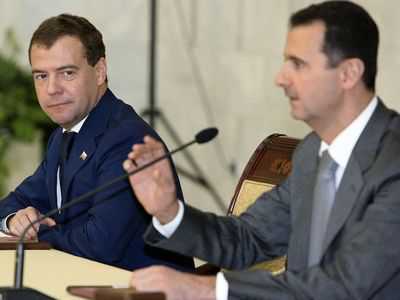
President Dimitri Medvedev has recently concluded a tour that took him to Damascus and Ankara. He lifted visa requirements and opened the doors of the burgeoning common market (Turkey, Syria, Iran + Lebanon) for Russian companies. He also favored the sale of a large arsenal to all these countries. In particular, he negotiated the ten-year construction of nuclear power plants. Finally, he took advantage of Turkey’s strategic evolution to obtain support for the transit of Russia’s hydrocarbons. A Russian land oil pipeline would connect the Black Sea to the Mediterranean Sea and Ankara might be attracted to the transnational South Stream gas pipeline project.
The limits of Russia’s involvement
Outside of the economic sphere, it is hard for Moscow to consolidate its position. Former Soviet naval bases in Syria have been reactivated and opened to the Russian fleet in the Mediterranean, all the more since naval deployment in the Black Sea is expected to be reduced. It is all happening as if Moscow were trying to gain time and postpone the Israeli issue.
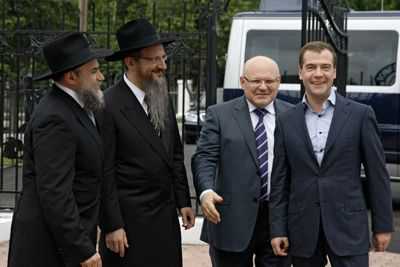
The fact is that any condemnation [by Russia] of Jewish colonialism may revive internal problems. In the first place because, to express it in a caricatural and unflattering manner, Israeli apartheid is reminiscent of Russia’s treatment of the Chechnyans; and also because Russia is acting under the burden of a historical complex: that of anti-Semitism. Vladimir Putin has tried on several occasions to turn the page through symbolic gestures such as appointing a rabbi to the army, but Russia keeps feeling uncomfortable with this issue.
However, Russia ought to stop playing the waiting game; the dice have been tossed and Russia must face the consequences once and for all. Israel played a crucial role in arming and training the Georgian troops that attacked and killed Russian citizens in Southern Ossetia. In response, Georgia’s Defense Minister Davit Kezerashvili, a double Israeli-Georgian national, rented two military air bases to the Israeli Tsahal enabling it to attack Iran from a closer distance.Moscow stood stoically by without lifting a finger against Israel.
The Middle East looked upon this lack of reaction with surprise. It is true that Tel Aviv has numerous relations with the Russian elites, networking with them by offering to some of the most influential people material privileges in Israel. But, Moscow has comparatively many more contacts in Israel, considering the presence of some one million Soviets immigrants. Conceivably, Moscow could bring to the fore some personality capable of playing in occupied Palestine the role played by Frederik de Klerk in South Africa: to abolish Apartheid and establish democracy in the heart of one single state. With this scenario in mind, Dimitri Medvedev anticipates a possible exodus of Israeli Jews who would not tolerate the new situation. Therefore, he blocked the formerly announced merger between the Krai of Jabarovsk with the autonomous Jewish Oblast of Birobidyan. The Russian president, who comes from a Jewish family and converted to the Russian Orthodox religion, plans to reactivate that administrative entity founded by Stalin in 1934 as an alternative to the creation of the State of Israel. What used to be a Jewish republic within the former Soviet Union could become the future home to refugees, who would certainly be welcomed since Russia is experiencing a plummeting demographic decline.
Ultimately, it is Russia’s procrastinations with respect to Iran’s nuclear program that surprise the most. It is a fact that Iranian businessmen have constantly questioned the bills submitted for the construction of the Bushehr nuclear plant. It is also true that the Persians have become sensitive after years of Anglo-American interference. But the Kremlim hasn’t stopped blowing hot and cold. President Medvedev speaks with the West and pledges Russia’s support in favor of the UN sanctions voted by the Security Council. Meanwhile, Putin assures the Iranians that Russia will not leave them unshielded if they accept to play the game of transparency. On the ground, officials are wondering whether the two leaders have split their roles according to the interlocutors in order to jack up the bids. Or, whether Russia has been paralysed by a conflict brewing at the apex of power? In reality, this is what appears to be happening: the Medvedev-Putin duo has gradually deteriorated and their relationship has abruptly turned into a fratricidal war.
Russian diplomacy had led the Non-Aligned countries to believe that a fourth resolution adopted by the UN Security Council condemning Iran would be preferable to the adoption of unilateral measures by the United States or the European Union. It was wrong since Washington and Brussels would automatically use the UN resolution to justify their own unilateral and additional sanctions.
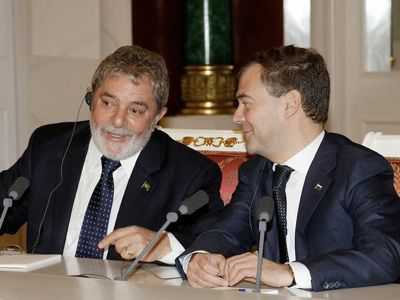
During a joint press Conference, held on May 14, with his Brazilian counterpart, President Medvedev indicated that he had reached a common position with President Obama during a phone conversation: If Iran accepted the proposal made [in November 2009] to enrich uranium abroad, there would be no reason to adopt sanctions at the Security Council. But when Iran unexpectedly signed the Teheran Protocol with Brazil and Turkey, Washington withdrew and Moscow hurriedly followed suit, breaching its commitment.
It is a fact that Russia’s permanent representative at the Security Council, Vitaly Churkin, drained resolution 1929 of much of its substance by preventing a total energy embargo … but he nevertheless voted in favor. Short of being effective, the resolution is altogether an outrage for Iran, for Brazil, for Turkey as well as for all the Non-Aligned states that support Teheran’s position. The resolution is all the more shocking since it violates the terms of the Non-Proliferation Treaty which guarantee to all signatory countries the right to enrich uranium. Resolution 1929 of the UN Security Council denies Iran that right. Up to now Russia seemed to be the defender of international law. But it is not any longer. The Non-Aligned countries in general, and Iran in particular, have interpreted the Russian vote as the will on the part of a great power to prevent emerging powers from attaining the energy independence they need for their economic development. And it will be difficult to make them forget this Russian faux pas.
* Thierry Meyssan
French political analyst, founder and chairman of the Voltaire Network and the Axis for Peace conference. He publishes columns dealing with international relations in daily newspapers and weekly magazines in Arabic, Spanish and Russian. Last books published in English :9/11 the Big Lie and Pentagate
https://www.voltairenet.org/article166818.html, 24 August 2010
Sometimes Turkey really is a bridge between west and east
Turkish foreign policy
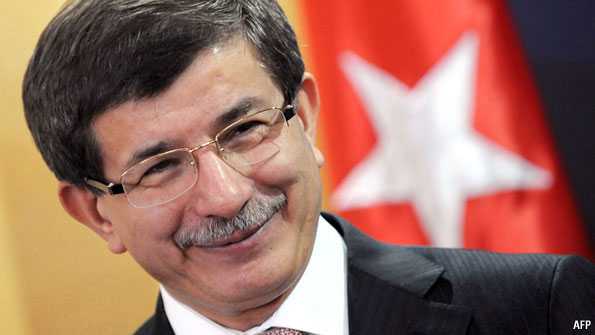
How can Mr Davutoglu help you?
IN JUNE 2006, days after a young Israeli private was captured by Hamas, Israel’s ambassador to Turkey paid a midnight visit to Recep Tayyip Erdogan, the prime minister. Gilad Shalit was feared to be gravely ill, perhaps even dead. Could Turkey help? Phone calls were made and favours called in. Mr Shalit turned out to be alive, and his captors promised the Turks they would treat him respectfully.
Turkey’s relations with Israel, once an ally, have worsened of late, and hit a fresh low in May, when Israeli commandos raided a Turkish ship carrying humanitarian supplies to Gaza, killing nine Turkish citizens. Yet Turkey continues to lobby Hamas for Mr Shalit’s release.
Turkey’s falling out with Israel has sparked a flurry of anguished commentary in the West about its supposed eastward drift under the mildly Islamist Justice and Development party, which has governed the country since 2002. Concern over its cosy relations with Iran, despite that country’s refusal to suspend suspect nuclear work, has run particularly high. Yet nobody complained in April 2007 when Turkey brokered the release of 15 British Royal Navy sailors who had been seized by Iran.Similarly, France was delighted in mid-May when a personal intervention by Turkey’s foreign minister, Ahmet Davutoglu, secured the release of Clotilde Reiss, a French teacher being held in Iran on spying charges.
Turkey is the first stop for thousands of political refugees from Iran, Iraq, Afghanistan and Central Asia. These include Mohammed Mostafei, an Iranian lawyer who took up the case of Sakineh Ashtiani, a woman facing death by stoning in Iran for alleged adultery. Mr Mostafei fled to Turkey earlier this month after receiving death threats (he has since gone to Norway). Now Turkey has discreetly taken up his client’s case (although Iran has turned down a Brazilian offer of asylum for Ms Ashtiani). It is also pressing Iran for the release of three American hikers who were arrested, on suspicion of “spying”, near the Iraq border a year ago and who have been rotting in Tehran’s notorious Evin prison ever since.
Turkey’s mediating skills have even aroused excitement in Africa. Mr Davutoglu recently revealed that Botswana had sought his help in fixing a territorial dispute with Namibia. Flattered though he was, however, Mr Davutoglu confessed that, for once, he was stumped.
http://www.economist.com/node/16847136?story_id=16847136&fsrc=rss, Aug 19th 2010
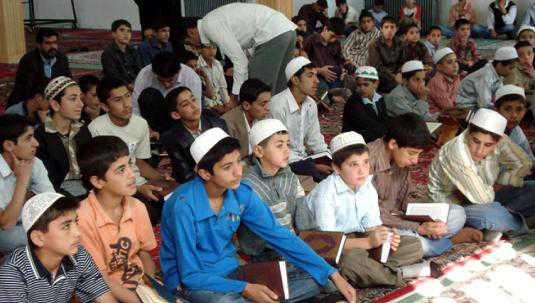
Kurdish Children are taught Quran in a Sunni Mosque in Urmia, a Kurdish city of Iran.———- Photo by Rudaw
By AZAD KURDI
ERBIL, Iraqi Kurdistan: Not long ago, three 19-year old boys left Iran’s Kurdish region to Afghanistan to join al-Qaeda. In the mid of last month, it was reported that they had been killed by the American and coalition forces.
The dead fighters were Kurds from the city of Saqiz where majority of the people are Sunni Kurds, poverty and unemployment on the rise.
Here in this city and other Kurdish towns of Iran, residents point to an increasing number of extremist Salafi groups spreading Jihadist ideologies and swaying beliefs of dozens of adults.
Many Kurds warned that the region was increasingly becoming a place to recruit fighters for al-Qaeda.
Iran’s Kurds are subjected to a doubled-discrimination. Firstly they are discriminated for being Kurds not Persians and second they for being Sunnis not Shiites.
Right after the disappearance of their sons, the parents of the three dead fighters started to file lawsuits against a number of Mullahs preaching extremism and anti-Western ideas.
Rudaw found out that none of the Mullahs had been arrested by the Shiite-led government.
Kurdish youths fighting against American and Western forces in Afghanistan and Iraq is not a new thing. Last year, Suleiman Ahmadi, Iranian Kurds, was found killed in Afghanistan.
Experts see the rise of unemployment, using drugs, poverty in the region as main reasons why the adults join al-Qaeda.
“All of these play roles in strengthening the groups,” said Khalid Tawakwli, Iranian Kurdish sociologist.
Before 2003, in the Iraqi Kurdish mountains of Hawraman bordering Iran, there was a Kurdish offshoot of al-Qaeda under the name of “Ansar al-Islam.”
Their bases were bombed by the American missiles at the outbreak of the Iraq war, many members killed and the rest fled to Iran, south and center of Iraq and abroad.
The leader of the group, Mullah Krekar, is now based in Norway. It is not clear whether any of the former Ansar al-Islam members is working in the current Iranian-based groups.
But a senior member of a pro-Kurdish Iranian opposition party, Aram Mudaris, was convinced that many of the senior members of the Iranian extremist groups had been ex-members of Ansar al-Islam fled to Iran after the US-bombardment.
“Those groups are logistically and financially supported by the Iranian regime” said Mudaris, senior leader of Komala party.
He said that the groups have mainly relied on using mosques to practice their political work and convene with their members since the 2003 US-led invasion.
Some other experts say that Iran’s toleration of these groups is to kill two birds with one stone.
The first goal is domestic, that is, undermining Kurdish nationalism. The second one is to use the groups to weaken U.S. counter insurgency strategy in Afghanistan and Iraq.
From Left: United States Air Force; Robert Young Pelton; Mike Wintroath/Associated Press; Adam Berry/Bloomberg News
From left: Michael D. Furlong, the official who was said to have hired private contractors to track militants in Afghanistan and Pakistan; Robert Young Pelton, a contractor; Duane Clarridge, a former C.I.A. official; and Eason Jordan, a former television news executive.
By DEXTER FILKINS and MARK MAZZETTI
Published: March 14, 2010
KABUL, Afghanistan — Under the cover of a benign government information-gathering program, a Defense Department official set up a network of private contractors in Afghanistan and Pakistan to help track and kill suspected militants, according to military officials and businessmen in Afghanistan and the United States. The official, Michael D. Furlong, hired contractors from private security companies that employed former C.I.A. and Special Forces operatives. The contractors, in turn, gathered intelligence on the whereabouts of suspected militants and the location of insurgent camps, and the information was then sent to military units and intelligence officials for possible lethal action in Afghanistan and Pakistan, the officials said.
While it has been widely reported that the C.I.A. and the military are attacking operatives of Al Qaeda and others through unmanned, remote-controlled drone strikes, some American officials say they became troubled that Mr. Furlong seemed to be running an off-the-books spy operation. The officials say they are not sure who condoned and supervised his work.
It is generally considered illegal for the military to hire contractors to act as covert spies. Officials said Mr. Furlong’s secret network might have been improperly financed by diverting money from a program designed to merely gather information about the region.
Moreover, in Pakistan, where Qaeda and Taliban leaders are believed to be hiding, the secret use of private contractors may be seen as an attempt to get around the Pakistani government’s prohibition of American military personnel’s operating in the country.
Officials say Mr. Furlong’s operation seems to have been shut down, and he is now is the subject of a criminal investigation by the Defense Department for a number of possible offenses, including contract fraud.
Even in a region of the world known for intrigue, Mr. Furlong’s story stands out. At times, his operation featured a mysterious American company run by retired Special Operations officers and an iconic C.I.A. figure who had a role in some of the agency’s most famous episodes, including the Iran-Contra affair.
The allegations that he ran this network come as the American intelligence community confronts other instances in which private contractors may have been improperly used on delicate and questionable operations, including secret raids in Iraq and an assassinations program that was halted before it got off the ground.
“While no legitimate intelligence operations got screwed up, it’s generally a bad idea to have freelancers running around a war zone pretending to be James Bond,” one American government official said. But it is still murky whether Mr. Furlong had approval from top commanders or whether he might have been running a rogue operation.
This account of his activities is based on interviews with American military and intelligence officials and businessmen in the region. They insisted on anonymity in discussing a delicate case that is under investigation.
Col. Kathleen Cook, a spokeswoman for United States Strategic Command, which oversees Mr. Furlong’s work, declined to make him available for an interview. Military officials said Mr. Furlong, a retired Air Force officer, is now a senior civilian employee in the military, a full-time Defense Department employee based at Lackland Air Force Base in San Antonio.
Network of Informants
Mr. Furlong has extensive experience in “psychological operations” — the military term for the use of information in warfare — and he plied his trade in a number of places, including Iraq and the Balkans. It is unclear exactly when Mr. Furlong’s operations began. But officials said they seemed to accelerate in the summer of 2009, and by the time they ended, he and his colleagues had established a network of informants in Afghanistan and Pakistan whose job it was to help locate people believed to be insurgents.
Government officials said they believed that Mr. Furlong might have channeled money away from a program intended to provide American commanders with information about Afghanistan’s social and tribal landscape, and toward secret efforts to hunt militants on both sides of the country’s porous border with Pakistan.
Some officials said it was unclear whether these operations actually resulted in the deaths of militants, though others involved in the operation said that they did.
Military officials said that Mr. Furlong would often boast about his network of informants in Afghanistan and Pakistan to senior military officers, and in one instance said a group of suspected militants carrying rockets by mule over the border had been singled out and killed as a result of his efforts.
In addition, at least one government contractor who worked with Mr. Furlong in Afghanistan last year maintains that he saw evidence that the information was used for attacking militants.
The contractor, Robert Young Pelton, an author who writes extensively about war zones, said that the government hired him to gather information about Afghanistan and that Mr. Furlong improperly used his work. “We were providing information so they could better understand the situation in Afghanistan, and it was being used to kill people,” Mr. Pelton said.
He said that he and Eason Jordan, a former television news executive, had been hired by the military to run a public Web site to help the government gain a better understanding of a region that bedeviled them. Recently, the top military intelligence official in Afghanistan publicly said that intelligence collection was skewed too heavily toward hunting terrorists, at the expense of gaining a deeper understanding of the country.
Instead, Mr. Pelton said, millions of dollars that were supposed to go to the Web site were redirected by Mr. Furlong toward intelligence gathering for the purpose of attacking militants.
In one example, Mr. Pelton said he had been told by Afghan colleagues that video images that he posted on the Web site had been used for an American strike in the South Waziristan region of Pakistan.
Among the contractors Mr. Furlong appears to have used to conduct intelligence gathering was International Media Ventures, a private “strategic communication” firm run by several former Special Operations officers. Another was American International Security Corporation, a Boston-based company run by Mike Taylor, a former Green Beret. In a phone interview, Mr. Taylor said that at one point he had employed Duane Clarridge, known as Dewey, a former top C.I.A. official who has been linked to a generation of C.I.A. adventures, including the Iran-Contra scandal.
In an interview, Mr. Clarridge denied that he had worked with Mr. Furlong in any operation in Afghanistan or Pakistan. “I don’t know anything about that,” he said.
Mr. Taylor, who is chief executive of A.I.S.C., said his company gathered information on both sides of the border to give military officials information about possible threats to American forces. He said his company was not specifically hired to provide information to kill insurgents.
Some American officials contend that Mr. Furlong’s efforts amounted to little. Nevertheless, they provoked the ire of the C.I.A.
Last fall, the spy agency’s station chief in Kabul, Afghanistan’s capital, wrote a memorandum to the Defense Department’s top intelligence official detailing what officials said were serious offenses by Mr. Furlong. The officials would not specify the offenses, but the officer’s cable helped set off the Pentagon investigation.
Afghan Intelligence
In mid-2008, the military put Mr. Furlong in charge of a program to use private companies to gather information about the political and tribal culture of Afghanistan. Some of the approximately $22 million in government money allotted to this effort went to International Media Ventures, with offices in St. Petersburg, Fla., San Antonio and elsewhere. On its Web site, the company describes itself as a public relations company, “an industry leader in creating potent messaging content and interactive communications.”
The Web site also shows that several of its senior executives are former members of the military’s Special Operations forces, including former commandos from Delta Force, which has been used extensively since the Sept. 11 attacks to track and kill suspected terrorists.
Until recently, one of the members of International Media’s board of directors was Gen. Dell L. Dailey, former head of Joint Special Operations Command, which oversees the military’s covert units.
In an e-mail message, General Dailey said that he had resigned his post on the company’s board, but he did not say when. He did not give details about the company’s work with the American military, and other company executives declined to comment.
In an interview, Rear Adm. Gregory Smith, the top military spokesman in Afghanistan, said that the United States military was currently employing nine International Media Ventures civilian employees on routine jobs in guard work and information processing and analysis. Whatever else other International Media employees might be doing in Afghanistan, he said, he did not know and had no responsibility for their actions.
By Mr. Pelton’s account, Mr. Furlong, in conversations with him and his colleagues, referred to his stable of contractors as “my Jason Bournes,” a reference to the fictional American assassin created by the novelist Robert Ludlum and played in movies by Matt Damon.
Military officials said that Mr. Furlong would occasionally brag to his superiors about having Mr. Clarridge’s services at his disposal. Last summer, Mr. Furlong told colleagues that he was working with Mr. Clarridge to secure the release of Pfc. Bowe Bergdahl, a kidnapped soldier who American officials believe is being held by militants in Pakistan.
From December 2008 to mid-June 2009, both Mr. Taylor and Mr. Clarridge were hired to assist The New York Times in the case of David Rohde, the Times reporter who was kidnapped by militants in Afghanistan and held for seven months in Pakistan’s tribal areas. The reporter ultimately escaped on his own.
The idea for the government information program was thought up sometime in 2008 by Mr. Jordan, a former CNN news chief, and his partner Mr. Pelton, whose books include “The World’s Most Dangerous Places” and “Licensed to Kill: Hired Guns in the War on Terror.”
Top General Approached
They approached Gen. David D. McKiernan, soon to become the top American commander in Afghanistan. Their proposal was to set up a reporting and research network in Afghanistan and Pakistan for the American military and private clients who were trying to understand a complex region that had become vital to Western interests. They already had a similar operation in Iraq — called “Iraq Slogger,” which employed local Iraqis to report and write news stories for their Web site. Mr. Jordan proposed setting up a similar Web site in Afghanistan and Pakistan — except that the operation would be largely financed by the American military. The name of the Web site was Afpax.
Mr. Jordan said that he had gone to the United States military because the business in Iraq was not profitable relying solely on private clients. He described his proposal as essentially a news gathering operation, involving only unclassified materials gathered openly by his employees. “It was all open-source,” he said.
When Mr. Jordan made the pitch to General McKiernan, Mr. Furlong was also present, according to Mr. Jordan. General McKiernan endorsed the proposal, and Mr. Furlong said that he could find financing for Afpax, both Mr. Jordan and Mr. Pelton said. “On that day, they told us to get to work,” Mr. Pelton said.
But Mr. Jordan said that the help from Mr. Furlong ended up being extremely limited. He said he was paid twice — once to help the company with start-up costs and another time for a report his group had written. Mr. Jordan declined to talk about exact figures, but said the amount of money was a “small fraction” of what he had proposed — and what it took to run his news gathering operation.
Whenever he asked for financing, Mr. Jordan said, Mr. Furlong told him that the money was being used for other things, and that the appetite for Mr. Jordan’s services was diminishing.
“He told us that there was less and less money for what we were doing, and less of an appreciation for what we were doing,” he said.
Admiral Smith, the military’s director for strategic communications in Afghanistan, said that when he arrived in Kabul a year later, in June 2009, he opposed financing Afpax. He said that he did not need what Mr. Pelton and Mr. Jordan were offering and that the service seemed uncomfortably close to crossing into intelligence gathering — which could have meant making targets of individuals.
“I took the air out of the balloon,” he said.
Admiral Smith said that the C.I.A. was against the proposal for the same reasons. Mr. Furlong persisted in pushing the project, he said.
“I finally had to tell him, ‘Read my lips,’ we’re not interested,’ ” Admiral Smith said.
What happened next is unclear.
Admiral Smith said that when he turned down the Afpax proposal, Mr. Furlong wanted to spend the leftover money elsewhere. That is when Mr. Furlong agreed to provide some of International Media Ventures’ employees to Admiral Smith’s strategic communications office.
But that still left roughly $15 million unaccounted for, he said.
“I have no idea where the rest of the money is going,” Admiral Smith said.
Dexter Filkins reported from Kabul, and Mark Mazzetti from Washington.
Armenia — Defense Minister Seyran Ohanian addresses students and professors at Yerevan State University on January 25, 2010.
03.02.2010
Defense Minister Seyran Ohanian will fly to Istanbul on Thursday to attend an international conference on the future of the ongoing NATO-led mission in Afghanistan which Armenia is about to join.
Defense ministers of NATO member states are scheduled to start the two-day gathering on Thursday evening with a working dinner centered on reforms of the alliance. They will be joined on Friday by their counterparts from partner countries participating in the NATO-led International Security Assistance Force (ISAF) which has been fighting the Taliban insurgency in Afghanistan along with American troops.
The meeting will discuss the planned dispatch of around 40,000 extra troops to Afghanistan as part of the ISAF’s new counter-insurgency strategy. They include a 40-strong Armenian army unit that will serve under German command and be mainly tasked with protecting a military airport in the northern Afghan city of Kunduz.
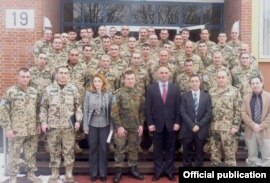
Armenia — Armen Martirosian (C), the Armenian ambassador to Germany, poses for a photo with Armenian troops due to be deployed in Afghanistan, January 28 2010.
The Armenian parliament approved the deployment in early December after months of negotiations between Armenian and NATO officials. The Armenian contingent left for Germany last month to undergo additional training at a German military base located in the southwestern Baden-Wurttemberg region. It is due to flown to Kunduz later this month.
Armenia’s ambassador to Germany, Armen Martirosian, visited the Afghanistan-bound troops on January 28. “The commanders of the [German] military base highly assessed the degree of the servicemen’s preparedness,” the Armenian Foreign Ministry said in a statement.
According to the Armenian Defense Ministry, Ohanian will hold bilateral meetings with some of his Western counterparts on the sidelines of the Istanbul forum. A ministry statement said he will also visit the Istanbul Patriarchate of the Armenian Apostolic Church which leads Turkey’s small Armenian community.
Ohanian will apparently become the first serving Armenian defense minister to set foot in Turkey.

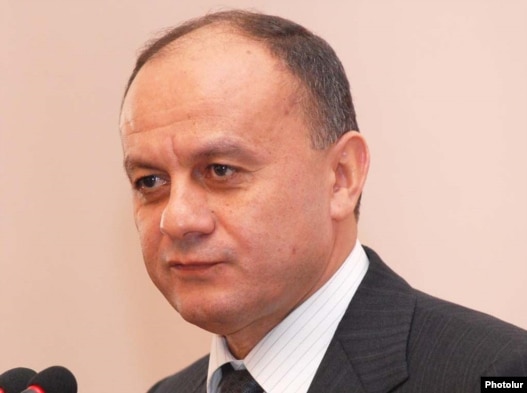
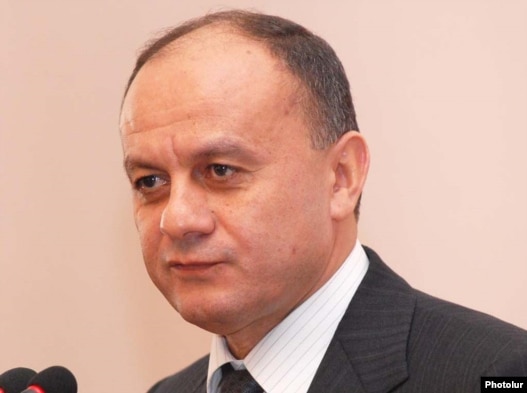 Armenia — Defense Minister Seyran Ohanian addresses students and professors at Yerevan State University on January 25, 2010.