Category: Asia and Pacific

  • Aidat ve Bağış Ödeme Yöntemleri

    Aidat ve Bağış Ödeme Yöntemleri

    PAYPAL SİSTEMİNİ KULLANARAK  ÜCRETSIZ OLARAK BANKANIZDAN TURKISH FORUMA TRANSFER YAPABİLİRSİNİZ VEYA KREDİ KARTINIZI AYNI GAYE İLE KULLANABİLİRSİNİZ.

    1. Türkiye de banka transferi :Hesap sahibi: Turkish Forum Inc.
      TC ZIRAAT BANKASI Istanbul/Taksim Subesi (Sube No:843)
      Hesap sahibi: Turkish Forum Inc.
      SWIFT# TC2BTR2A

      USD Hesap
      No
      : 5761628-5001
      IBAN = TR09 0001 0008 4305 7616 2850 01
      ********
      TL Hesap No: 5761628-5002
      IBAN = TR79 0001 0008 4305 7616 2850 02
      ********
      EURO Hesap No: 5761628-5003

      IBAN = TR52 0001 0008 4305 7616 2850 03

      ***

    2. Çek ile : TurkishForum , PO Box: 1104 Marblehead, MA 01945 USA
    3. PayPal ve Kredi Kartı  ile : Dünyanın pek çok ülkesinde banka hesabınızdan veya kredi kartınızdan aşağıdaki tuşa basarak güvenli ödeme yapabilirsiniz.

    KURUCU ÜYE STATÜSÜNÜ VE CERTİFİKASINI KAZANMAK İÇİN BAĞIŞ YAPACAGINIZ ÖZEL  MİKTARINIZI LÜTFEN GİRİNİZ. Kitap satın alışlarınız içinde bu kısmı kullanabilirsiniz. KURUCU ÜYE STATÜSÜNÜ KAZANMAK 30  ARALIK 2010 TARİHİNDE KADAR YÖNETİM KURULUMUZCA UZATILMIŞDIR. KURUCU ÜYE STATUSU 2010 YENİDEN DOĞUŞ SENESİ İÇİN ÖZELDİR VE BU SENDEN SONRA BİR DAHA GÜNDEME GELMİYECEKDİR.

    1. ÜYE AİDATLARI VEYA ÖZEL BAĞIŞLARINIZ  İÇİN AŞAĞIDAKİ LİNKLERİDE KULLANABİLİRSİNİZ  (KURUCU ÜYE STATÜSÜ DAHİLDİR)
    Kredi Kartı (Paypal) Regular Donor – 75 USD(2010 Üye Aidatı)
    Seçme ve Seçilme Hakkı


    Çırağan Club Sponsor – 250 USD
    Seçme ve Seçilme Hakkına ek olarak
    Sponsor üye sertifikası
    Turkish Forum tarafından satışı yapılan kitap gibi ürünlerde %10 indirim

    Dolmabahçe Club Sponsor – 500 USD
    Seçme ve Seçilme Hakkına ek olarak
    Sponsor üye sertifikası
    Turkish Forum tarafından satışı yapılan kitap gibi ürünlerde %20 indirim

    Topkapı Club Sponsor – 1.000 USD
    Seçme ve Seçilme Hakkına ek olarak
    Sponsor üye sertifikası
    Turkish Forum tarafından satışı yapılan kitap gibi ürünlerde %20 indirim
    Ve Danışma Kurulu üyeliği

    Corporate Donor – 2.500 USD
    Topkapı Club avantajlarına ek olarak, kurumsal üye statüsünde sponsorlar arasında yer almak

    LifeTime Donor – 5.000 USD
    Yaşam Boyu üye sertifikası

    Bağışlarınızı ABD ve Türkiye içinde vergi matrahınızdan düşmek mümkündür. Kuruluşumuzun Türkiye  vergi numarasi 8710506391’dir. ABD’de ise 501-3-C numara ile vergiden muaf kar amacı gütmeyen kuruluşuz.

    HEP BERABER, DAHA NİCE ORTAK BAŞARILARA İMZA ATMAK DİLEĞİ VE ÜMİDİYLE�

    DR. KAYAALP BÜYÜKATAMAN , BAŞKAN
    TURKISH FORUM – DÜNYA TÜRKLERİ BİRLİGİ

    © 1993-2010 TurkishForum

  • U.S. Pressure ‘Essential’ For Turkish-Armenian Normalization

    U.S. Pressure ‘Essential’ For Turkish-Armenian Normalization

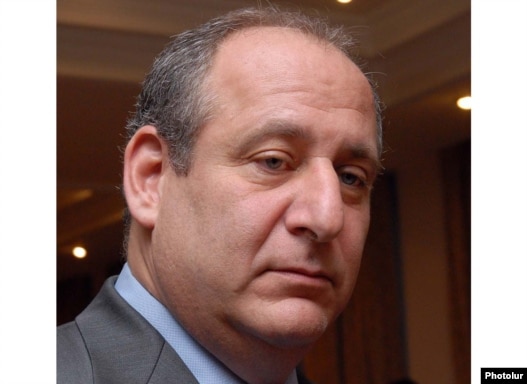
    Armenia — David Phillips, a U.S. scholar who chaired the former Turkish-Armenian Reconciliation Commission, presents the Armenian translation of his book in Yerevan, February 4, 2010.

    04.02.2010
    Emil Danielyan

    Stronger U.S. pressure on Turkey is essential for salvaging its fence-mending agreements with Armenia and the administration of President Barack Obama understands that, according to a renowned U.S. scholar who was actively involved in Turkish-Armenian reconciliation initiatives.

    In an interview with RFE/RL on Thursday, David Phillips also criticized Ankara’s linkage between the implementation of those agreements and a Nagorno-Karabakh settlement. He dismissed Turkish claims that a recent ruling by the Armenian Constitutional Court ran counter to key provisions of the Turkish-Armenian “protocols” signed in October.

    Phillips, who coordinated the work of the U.S.-sponsored Turkish-Armenian Reconciliation Commission (TARC) in 2001-2004, further said that Armenia should not rush to walk away from the deal. But he stressed that its ratification by the Turkish parliament can not be “an open-ended process.”

    “If these protocols fall apart and there is a diplomatic train wreck, it will have a serious adverse effect on U.S.-Turkish relations,” he said. “And this comes at a time when the U.S. is seeking Turkey’s cooperation on Iran, when Turkey is playing an increasingly important role in Afghanistan and during the wrap-up to redeployment from Iraq.

    “The Obama administration knows full well that these protocols should go forward because it is in the interests of Turkey and Armenia. It is also in America’s interests to keep the process moving forward so that U.S.-Turkish cooperation is in effect.”

    Analysts believe Washington will step up pressure on Ankara ahead of the April 24 annual commemoration of more than one million Armenians massacred in the Ottoman Empire in 1915-1918. Obama avoided describing the massacres as genocide in an April 2009 statement, implicitly citing the need not to undermine the ongoing Turkish-Armenian rapprochement.

    U.S. Deputy Secretary of State James Steinberg discussed the issue with President Serzh Sarkisian and Foreign Minisiter Edward Nalbandian during a one-day visit to Yerevan on Thursday.

    Phillips, who currently runs a conflict resolution program at the American University in Washington, declined to speculate on just how strong that pressure will be. “But I do believe that unless the Obama administration presses the Turks at the highest level, the likelihood of the protocols being ratified in Ankara will decrease,” he said.

    Phillips described Steinberg’s visit as a “a clear indication that the Obama administration understands the importance of this matter and the need to raise the profile of its involvement.” “And its efforts to use its leverage should intensify in the near future,” he said. “The U.S. needs to be actively engaged in this process if it is going to work.”

    U.S. officials have already made clear that they disagree with Ankara’s highly negative reaction to the Armenian court ruling. While upholding the legality of the protocols, the Constitutional Court ruled last month that they can not stop Yerevan seeking a broader international recognition of the Armenian genocide.

    Turkish leaders claim that the court thereby prejudged the findings of a Turkish-Armenian “subcommission” of history experts which the two governments have agreed to set up. The Armenian side insists, however, that the panel would not be tasked with determining whether the mass killings and deportations of Ottoman Armenians constituted genocide. It says the Turks are deliberately exploiting the ruling to justify their reluctance to ratify the protocols.

    “There is nothing in the [relevant protocol] annex that says that the subcommission is going to be considering the veracity of the Armenian genocide,” agreed Phillips. “If those questions are being raised, they are being raised as a way of deflecting the focus of discussions and creating conditions whereby Armenia is blamed for any breakdown of the process.”

    “If the Turks ever thought that signing the protocols would bring an end to international recognition efforts, they were wrong,” he said. “They should have known that from the beginning and I’m quite sure that they do know that.”

    Commenting on Turkish leaders’ repeated statements making protocol ratification conditional on the signing of a Karabakh agreement acceptable to Azerbaijan, Phillips said, “The protocols are very clear. There is no mention in the protocols themselves or in any of the annexes about Nagorno-Karabakh.”

    President Serzh Sarkisian has publicly threatened to annul the agreements unless Ankara drops the Karabakh linkage “within a reasonable time frame.” Some of his aides have spoken of late March as an unofficial deadline for their unconditional implementation.

    In Phillips’s view, walking away from the deal at this juncture would be a “mistake.” But he acknowledged that the Armenian government can not wait for Turkish ratification for much longer.

    “I know that for domestic political reasons, this can’t be an open-ended process, and April 24, as the anniversary of the Armenian genocide, has been put forward as a deadline,” he said. “Whether or not April 24 is a deadline is something for the Armenian government to decide. But there clearly needs to be an end point.”

    In the meantime, suggested Phillips, Sarkisian should formally submit the protocols to Armenia’s parliament “without necessarily calling for a vote.” “Then the onus of responsibility for a potential diplomatic breakdown would rest with Ankara,” he reasoned.

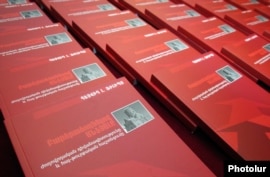
    Armenia — Armenian-language copies of Unsilencing the Past, a book on the Turkish-Armenian Reconciliation Commission written by U.S. scholar David Phillips.

    Phillips spoke to RFE/RL in Yerevan where he arrived earlier on Thursday to present the newly published Armenian translation of his 2005 book, “Unsilencing the Past,” that gives a detailed account of TARC’s largely confidential activities. The panel of Turkish and Armenian retired diplomats and prominent public figures was set up in 2001 at the U.S. State Department’s initiative and with the tacit approval of the authorities in Ankara and Yerevan.

    TARC repeatedly called for the unconditional establishment of diplomatic relations between the two states and opening of their border before being disbanded in 2004. It is also famous for commissioning a study on the events of 1915 from the New York-based International Center for Transitional Justice (ICTJ). In a report released in February 2003, ICTJ concluded that the Armenian massacres “include all of the elements of the crime of genocide” as defined by a 1948 United Nations convention.

    But the report also said, to the dismay of nationalist groups in Armenia and its worldwide Diaspora, that the Armenians can not use the convention for demanding material or other compensation from Turkey. Former U.S. President George W. Bush repeatedly cited the ICTJ study in his April 24 statements.

    Phillips hailed the study as a potential blueprint for Turkish-Armenian reconciliation. “The full benefit of that finding has yet to be fully understood and materialized,” he said.

    Phillips also credited TARC with laying the groundwork for the unprecedented thaw in Turkish-Armenian relations that began shortly after Sarkisian took office in April 2008. “The rapprochement that’s underway today would never have occurred in this time frame if TARC hadn’t existed,” he said. “All of TARC’s recommendations are now being put into effect.”

    https://www.azatutyun.am/a/1949005.html
  • U.S. House Panel Schedules Vote On Armenian “Genocide” Bill

    U.S. House Panel Schedules Vote On Armenian “Genocide” Bill

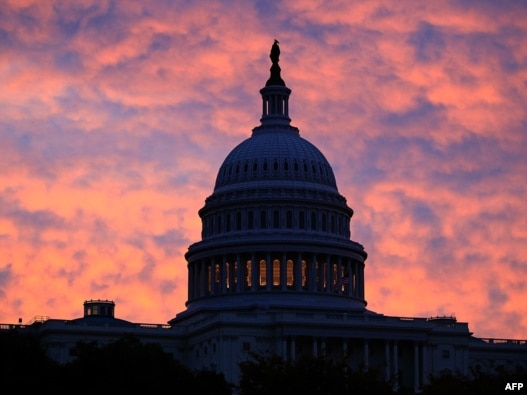
    U.S. — The early morning sun rises behind the US Capitol Building in Washington, DC, 22Oct2009

    05.02.2010
    Emil Danielyan

    A key committee of the U.S. House of Representatives will vote early next month on a resolution urging President Barack Obama to describe the 1915 mass killings and deportations of Armenians in the Ottoman Empire as genocide, Armenian-American leaders said on Friday.

    The Armenian National Committee of America (ANCA), said Howard Berman, chairman of the House Foreign Affairs Committee, has scheduled the vote for March 4. The ANCA chairman, Ken Hachikian, thanked the California Democrat for taking what he called a “bold step.”

    Officials from the Armenian Assembly of America, the other major Armenian lobby group in Washington, confirmed the information. The Assembly was due to officially announce it later in the day.

    “We look forward to working with the Chairman and all our friends on the Committee from both parties to facilitate passage of this critical piece of human rights legislation by both this panel and the full House of Representatives,” Hachikian said in a statement. “Our grassroots activists are mobilized to help achieve the success of this effort.”

    The draft resolution introduced by pro-Armenian legislators a year ago urges Obama to “accurately characterize the systematic and deliberate annihilation of 1,500,000 Armenians as genocide.” Its progress in the House of Representatives stalled in 2009 amid an intensifying dialogue between Armenia and Turkey that culminated in the signing last October of two “protocols” on normalizing relations between the two nations.

    The reported scheduling of the House committee vote will add a new twist to Washington’s efforts to secure the protocols’ ratification by the Armenian and Turkish parliaments. Some observers expect the Obama administration to use the prospect of genocide recognition in its efforts to eliminate ratification conditions set by the Turkish government.

    Ankara has gone to great lengths in the past to prevent similar genocide resolutions from reaching the House floor. The House Foreign Affairs Committee approved such legislation in 2000, 2002 and 2007.

    The upcoming committee vote could further complicate Turkey’s efforts to win U.S. support over a recent Armenian Constitutional Court ruling which the Turks say was at odds with the letter and spirit of the protocols. A top Turkish diplomat will reportedly visit Washington for that purpose in the coming days.

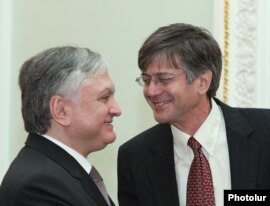
    Armenia — Foreign Minister Edward Nalbandian (L) talks to visiting U.S. Deputy Secretary of State James Steinberg on February 4 2010.

    Senior U.S. State Department officials have already dismissed, however, the Turkish protests against the court’s conclusion that the protocols can not stop Yerevan from seeking broader international recognition of the Armenian genocide. According to official Armenian sources, Deputy Secretary of State James Steinberg reaffirmed that position during a visit to Yerevan on Thursday.

    Steinberg on Friday described his talks with President Serzh Sarkisian as “extremely productive and substantive.” He also urged Ankara and Yerevan to move forward on protocol ratification, the AFP news agency reported.

    “I very much hope that both Armenia and Turkey will move forward. I don’t think delay is in anybody’s interest,” Steinberg told journalists in Tbilisi.

    “There’s a very strong commitment on behalf of the United States to work with Armenia and Turkey to see the ratification of the protocols,” he said.

    Armenian-American leaders say the near-term passage of the genocide bill, vehemently opposed by the Turkish government, hinges, in large measure, on whether Turkey’s parliament will endorse the protocols. As one of them told RFE/RL recently, “If Turkey does not ratify the protocols or open the border [with Armenia] on time, the resolution will be relatively easy to pass.”

    https://www.azatutyun.am/a/1950012.html
  • International Conference and Student Workshop on the Armenian Diaspora

    International Conference and Student Workshop on the Armenian Diaspora

    BOSTON—Boston University will host an international conference and a student workshop on the Armenian Diaspora during the weekend of February 12. The three-day event is organized by the Charles K. and Elisabeth M. Kenosian Chair in Modern Armenian History and Literature, Boston University.

    Armenian Diasporan communities emerged over centuries as a result of voluntary migration and forced displacement in times of military conflicts, the Genocide during World War I, and economic and political crises. Featuring ten panels, the conference and the workshop will bring together more than forty scholars to present their views and new research on the Armenian Diaspora. They will explore a wide range of topics, including the formation of Armenian Diaspora communities and identities in different parts of the world, the role of the Armenian communities in host societies, and the development of diasporic cultures in various contexts (e.g., nationalism, transnationalism, feminism).

    Friday Program:

    The student workshop will take place on Friday, February 12, from 10 a.m. to 6 p.m. at The Castle, 225 Bay State Road, Boston University.

    The workshop is sponsored by the Charles K. and Elisabeth M. Kenosian Chair in Modern Armenian History and Literature, and the International Institute for Diaspora Studies (A Division of the Zoryan Institute).

    Session 1: Diasporic Identities and Community-building
    Friday, 10 a.m. – 12:15 p.m.
    Chair & discussant: Simon Payaslian (Boston University)

    Presenters:

    Cynthia Oliphant (California State University, Fresno)
    “The Effect of Organizational Structure on the Diaspora Experience”

    Anna Harutyunyan (Freie Universität Berlin, Institute Of Ethnology)
    “Challenging the Theory of Diaspora from the Field”

    Hakem Rustom (London School Of Economics)
    “The ‘Others’ of the Diaspora: Armenian Migration from Anatolia to France”

    Session 2: Diaspora and Cultural Development
    Chair: Bedross Der Matossian (MIT)
    Discussant: Kevork Bardakjian (University Of Michigan, Ann Arbor)
    Friday, 1:30 p.m. – 3:30 p.m.

    Presenters:

    Lilit Keshishyan (UCLA)
    “Wandering as Rule: The Diasporic Subject in Vahe Berberian’s Namakner Zaataren”

    Marie-Blanche Fourcade (Université De Montréal)
    “Heritage Challenges in Diaspora: How to Preserve, to Share and to Pass Down? The Case Study of the Quebec Armenian Community”

    Stephanie Stockdale (Thunderbird School Of Global Management)
    “Cultural & Social Factors of the Armenian and Jewish Diasporas of Argentina: A Comparative Study”

    Session 3: Transnationalism, Nationalism, and Conflict
    Friday, 4 p.m. – 6 p.m.
    Chair: Richard G. Hovannisian (UCLA)
    Discussant: Asbed Kotchikian (Bentley University)

    Presenters:

    Stepan Stepanyan (Fletcher School Of Law And Diplomacy, Tufts University)
    “The Armenian Community of Georgia as a Factor of Security in the South Caucasus Region”

    Anush Bezhanyan (University Of South Carolina)
    “Iraqi Armenians after the Toppling of Saddam Hussein: Emigration or Repatriation”

    Katherine Casey (University Of Chicago)
    “Agree to Disagree: The Incompatible Nationalisms of Armenia and Its Diaspora”

    Lorand Poosz (Bolyai University)
    “Data Concerning the Transylvanian Armenian Community’s Response to the Armenian Genocide”

    Saturday-Sunday Program

    The conference will take place on Saturday, February 13, from 9 a.m. to 6:30 p.m., and on Sunday, February 14, from 9:30 a.m. to 6 p.m. On both days the conference will be held at the School of Management, Auditorium-Room 105, 595 Commonwealth Avenue, Boston University.

    The conference is sponsored by the Charles K. and Elisabeth M. Kenosian Chair in Modern Armenian History and Literature, the International Institute for Diaspora Studies (A Division of the Zoryan Institute), and the National Association for Armenian Studies and Research, Belmont, Mass.


    Saturday Program

    Session 4: Diasporic Identity, Human Rights, and Genocide
    Saturday, 9 a.m. – 10:30 a.m.
    Chair: Simon Payaslian (Boston University)
    Discussant: George Shirinian (Zoryan Institute)

    Presenters:

    Nanor Kebranian (Kenderian) (Columbia University)
    “Can the Armenian Diaspora Speak? Diasporic Identity in the Shadow of Human Rights”

    Joyce Apsel (New York University)
    “Teaching the Armenian Genocide in North America: New Resources, Programs, and Integration within Genocide Studies”

    Rubina Peroomian (UCLA)
    “The Third-Generation Armenian-American Writers Echo the Quest for Self-Identity with the Genocide at Its Core”


    Session 5: Narrativization of Diasporic Belongingness and Revival
    Saturday, 10:30 a.m. – noon
    Discussant: Khachig Tölölyan (Wesleyan University)
    Chair: Marc Mamigonian (NAASR)

    Presenters:

    Susan Pattie (University College London)
    “Constructing Narratives of Belonging among Armenians in the Diaspora”

    Sebouh Aslanian (Cornell University)
    “Networks of Circulation, Patronage, and ‘National Revival’: The Armenian Translation of Charles Rollin’s History of Rome”

    Sona Haroutyunian (Ca’ Foscari University Of Venice)
    “Vittoria Aganoor’s Alter Ego”

    Session 6: Armenian Repatriations 1946-1949: Contexts, Experiences, Aftermaths
    Saturday, 1:30 p.m. – 3:45 p.m.
    Chair & Discussant: Susan Pattie (University College London)

    Presenters:

    Sevan Yousefian (UCLA)
    “Picnics for Repatriates”

    Astrig Atamian (Inalco, Paris)
    “Armenia, here we come! The French Armenian Communists during the Repatriations”

    Kari Neely (Middle Tennessee State University)
    “Kevork Ajemian’s Use of Middle Eastern Armenian Repatriation in ‘A Perpetual Path’ ”

    Session 7: Desnelle Collective
    Saturday, 4 p.m. – 6:30 p.m.   
    Chair: Hrayr Anmahouni/Eulmessekian (La Crescenta, Calif.)
    Discussant: David Kazanjian (University Of Pennsylvania)

    Presenters:

    Helin Anahit (Middlesex University, London)
    “Diaspora Landscapes as a Thought Model”

    Emily Artinian
    (Chelsea College Of Art & Design, London)
    “From Ararat to Anywhere?”

    Christopher Atamian
    (New York)
    “Thinking the Past: Restorative and Reflective Nostalgia in Frounze Dovlatian’s ‘Garod’”

    Charles Garoian
    (Penn State School Of Visual Arts)
    “Scattered Flesh / Tservadz Mort”

    Neery Melkonian (New York)
    “A Feminism that is Often Accented, Sometimes Whispers, Even Stutters: Modern and Contemporary Armenian Women Artists in Transnational Contexts”

    Abelina Galustian (University Of California, Santa Barbara)
    “The Substance of Orientalism in Visual Representation”

    Sunday Program

    Session 8: Culture & Economy in Diasporan Communities
    Sunday, 9:30 a.m. – noon
    Chair: George Shirinian (Zoryan Institute)
    Discussant: Marc Mamigonian (NAASR)

    Presenters:

    Aida Boudjikanian (Montreal)
    “The Armenian Jewelers’ Niche of Montreal: Between a Local Trait and an Armenian Diasporic Tradition”

    Gregory Aftandilian (Washington)
    “Re-cementing Kinship Ties: Armenian-American Soldiers and the French Armenian Community during World War II”

    Philippe Videlier (Centre National De La Recherche Scientifique, Lyons)
    “Armenians and Turks in France Confronting the Genocide”

    Matthias Fritz (State Linguistic V. Brusov University, Yerevan)
    “The Evolution of the Armenian Diaspora in Germany during the Past Two Decades”

    Session 9: Transdisciplinarity of Diaspora Studies
    Sunday, 1 p.m. – 3:30 p.m.
    Chair: Richard G. Hovannisian (UCLA)
    Discussant: Khachig Tölölyan (Wesleyan University)

    Presenters:

    Daniel Douglas And Anny Bakalian (CUNY)
    “Armenians in the United States: A Quantitative Analysis Using the American Community Survey”

    Carel Bertram (San Francisco State University)
    “Diasporic Armenians as Pilgrims to Their Family Towns and Villages”

    Joan Bamberger (Anthropologist, Watertown, Mass.)
    “Re-Generation of Armenian Arts in Watertown, Massachusetts”

    Nikol Margaryan (Yerevan State University)
    “Anthroponyms in the Context of Ethnic Identity”


    Session 10: Diasporan Ethnonationalism and Transnationalism
    Sunday, 3:45 p.m. – 6 p.m.
    Chair: Asbed Kotchikian (Bentley University)
    Discussant: Bedross Der Matossian (MIT)

    Presenters:

    Ara Sanjian (University Of Michigan-Dearborn)
    “Limits of Conflict and Consensus among Lebanese-Armenian Political Factions in the Early 21st Century”

    Vartan Matiossian (Hovnanian School, New Jersey)
    “Domino Effect: U.S. Immigration Policies and the Formation of the Armenian Communities in Latin America”

    Ohannes Geukjian (American University Of Beirut)
    “Armenia-Diaspora Intransigence in Light of Armenian-Turkish Relations and the Resolution of the Nagorno-Karabakh Conflict, 1991-Present”

    Both the workshop and the conference are open to the public, and admission is free.

    Founded in 1839, Boston University is an internationally recognized institution of higher education and research. With more than 30,000 students, it is the fourth largest independent university in the United States. BU consists of 17 colleges and schools along with a number of multi-disciplinary centers and institutes that are central to the school’s research and teaching mission.
  • Armenian Defense Chief To Attend Afghanistan Forum In Turkey

    Armenian Defense Chief To Attend Afghanistan Forum In Turkey

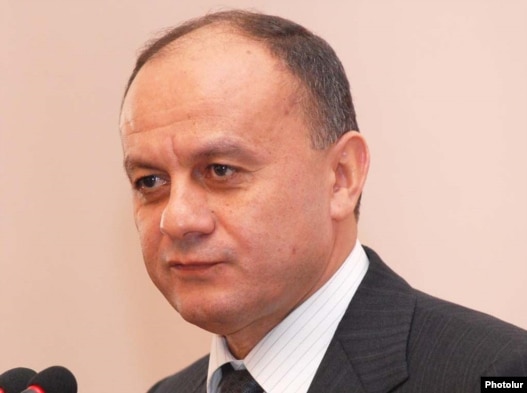
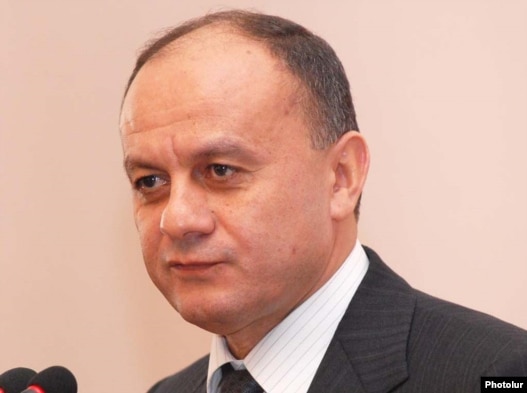
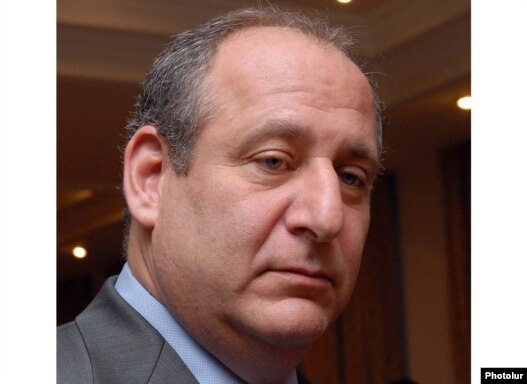
    Armenia — Defense Minister Seyran Ohanian addresses students and professors at Yerevan State University on January 25, 2010.
    03.02.2010

    Defense Minister Seyran Ohanian will fly to Istanbul on Thursday to attend an international conference on the future of the ongoing NATO-led mission in Afghanistan which Armenia is about to join.

    Defense ministers of NATO member states are scheduled to start the two-day gathering on Thursday evening with a working dinner centered on reforms of the alliance. They will be joined on Friday by their counterparts from partner countries participating in the NATO-led International Security Assistance Force (ISAF) which has been fighting the Taliban insurgency in Afghanistan along with American troops.

    The meeting will discuss the planned dispatch of around 40,000 extra troops to Afghanistan as part of the ISAF’s new counter-insurgency strategy. They include a 40-strong Armenian army unit that will serve under German command and be mainly tasked with protecting a military airport in the northern Afghan city of Kunduz.

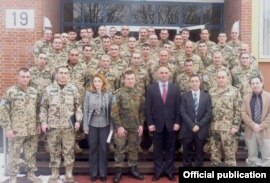
    Armenia — Armen Martirosian (C), the Armenian ambassador to Germany, poses for a photo with Armenian troops due to be deployed in Afghanistan, January 28 2010.

    The Armenian parliament approved the deployment in early December after months of negotiations between Armenian and NATO officials. The Armenian contingent left for Germany last month to undergo additional training at a German military base located in the southwestern Baden-Wurttemberg region. It is due to flown to Kunduz later this month.

    Armenia’s ambassador to Germany, Armen Martirosian, visited the Afghanistan-bound troops on January 28. “The commanders of the [German] military base highly assessed the degree of the servicemen’s preparedness,” the Armenian Foreign Ministry said in a statement.

    According to the Armenian Defense Ministry, Ohanian will hold bilateral meetings with some of his Western counterparts on the sidelines of the Istanbul forum. A ministry statement said he will also visit the Istanbul Patriarchate of the Armenian Apostolic Church which leads Turkey’s small Armenian community.

    Ohanian will apparently become the first serving Armenian defense minister to set foot in Turkey.

    https://www.azatutyun.am/a/1947885.html
  • U.S. Intelligence Chief Warns Of Karabakh War

    U.S. Intelligence Chief Warns Of Karabakh War

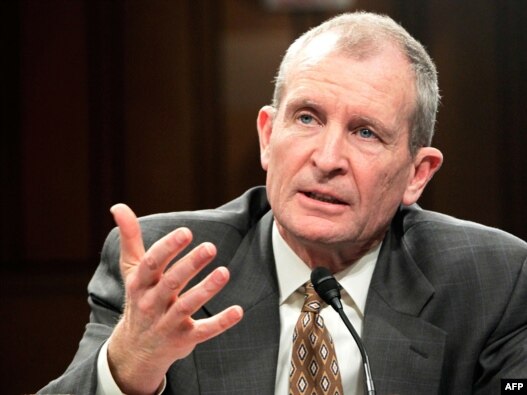
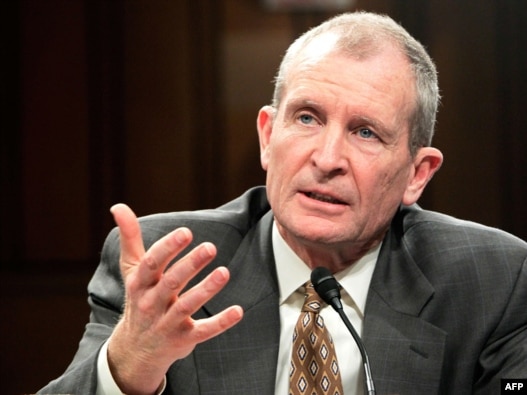
    U.S. — U.S. National Intelligence Director Dennis Blair testifies during a hearing before the Senate (Select) Intelligence Committee February 2, 2010 on Capitol Hill in Washington, DC.

    03.02.2010

    The likelihood of another Armenian-Azerbaijani war for Nagorno-Karabakh has increased as a result of the U.S.-backed rapprochement between Armenia and Turkey, according to America’s top intelligence official.

    “Although there has been progress in the past year toward Turkey-Armenia rapprochement, this has affected the delicate relationship between Armenia and Azerbaijan, and increases the risk of a renewed conflict over Nagorno-Karabakh,” Director of National Intelligence Dennis Blair warned late Tuesday in written testimony to a U.S. Senate committee.

    Blair also warned of broader security and stability threats persisting in the South Caucasus. “The unresolved conflicts of the Caucasus provide the most likely flashpoints in the Eurasia region,” he said. “Moscow’s expanded military presence in and political-economic ties to Georgia’s separatist regions of South Ossetia and sporadic low-level violence increase the risk of miscalculation or overreaction leading to renewed fighting.”

    The United States has strongly supported and at times mediated in the Turkish-Armenian rapprochement that began nearly two years ago and led to the signing last October of two “protocols” envisaging the normalization of relations between the two historical foes.

    Azerbaijan has condemned the agreements, saying that an open border with Turkey would only discourage Armenia from seeking a compromise solution to the dispute. Azerbaijani leaders have also continued to threaten to win back Karabakh and surrounding Armenian-occupied territories by force.

    The authorities in Armenia and Karabakh have dismissed the war threats. International mediators have also disapproved of them, repeatedly urging the conflicting parties to refrain from bellicose rhetoric.

    U.S. diplomats have seemed confident, at least until recently, that chances for renewed large-scale fighting in Karabakh are slim. Speaking to RFE/RL in October 2008, then U.S. Assistant Secretary of State Daniel Fried said the danger of another war “has somewhat receded because the [August 2008] war in Georgia reminded everyone in this region how terrible war is.” “War is no joke,” Fried said. “It’s a bad option.”

    https://www.azatutyun.am/a/1947893.html