Category: Asia and Pacific

  • Khojaly genocide commemorated at University of California

    Khojaly genocide commemorated at University of California


    [ 22 Feb 2010 15:40 ]

    Baku – APA. California-based Azerbaijan-American Council, Association of Turkic-speaking students at Berkeley and Association of Turkish-American Assembly organized a ceremony for commemoration of Khojaly genocide on February 19 at the University of California, Berkeley. Azerbaijan-American Council told APA members of the Azerbaijani community, Azerbaijani students educated in California, officials of the Consulate General of Azerbaijan in Los Angeles and Berkeley students attended the ceremony. Professor Thomas Goltz of Montana University, Professor Thomas Ambrosio of North Dakota State University, Parvin Akhanci of University of California, Davis, Azerbaijan Consulate General official Elshan Baloglanov, ATAA representative Ergun Kirikovali and AAC Director Executive Javid Huseynov addressed the ceremony.

    Odious Armenian terrorist, Armenian national hero Monte Melkonian, who was killed by the Azerbaijani soldiers in Nagorno Karabakh region of Azerbaijan in June, 1993, graduated from the University of California, Berkeley.

  • Washington DC – Khojali Massacre DEMONSTRATION

    Washington DC – Khojali Massacre DEMONSTRATION

    COMMUNITY DEMONSTRATION

    To Commemorate the Anniversary of Khojali Massacre

    And Protest Armenia’s Occupation of Western Azerbaijan

    Friday, February 26, 2009 Time and Location 11:30 AM  – 12:00 PM:

    Assembling at Dupont Circle

    (intersection of Massachusetts , Connecticut , and New Hampshire avenues).

    Closest metro station: Dupont Circle , red line. 1

    2:00 PM -1:30 PM:

    Walking through Massachusetts Avenue to the Embassy of Armenia

    located at 2225 R Street NW (intersection of Massachusetts Avenue and R Street ,

    near Sheridan Circle ) and holding demonstration.

    1:30 PM:

    Disbanding. This event, organized by local community members,

    has been coordinated with Washington DC Metropolitan Police and Secret Service.

    Sound equipment and signs will be provided, but participants are free to bring their own signs, posters, and flags. 

    Due to heavy traffic in and around DC area and difficulties with finding parking space,

    participants are encouraged to use public transportation,

    especially Metro, to ensure timely arrival.

    For additional information, contact Bedir Memmedli,  703-400-2523  703-400-2523 or [email protected]

    DEMAND JUSITCE FOR KHOJALI VICTIMS!

    SAY NO TO ARMENIAN MILITARY PRESENCE IN WESTERN AZERBAIJAN !

    SHOW YOUR SUPPORT FOR AZERBAIJAN’ S TERRITORIAL INTEGRITY

  • Three Azerbaijani Soldiers Killed Near Karabakh

    Three Azerbaijani Soldiers Killed Near Karabakh

    February 18, 2010
    BAKU — Three Azerbaijani soldiers were killed today after exchanging fire with Armenian armed forces near the disputed Nagorno-Karabakh region, RFE/RL’s Azerbaijani Service reports.

    Azerbaijan’s Defense Ministry confirmed the deaths and said another soldier was wounded as a result of the shooting, which is a violation of a ceasefire agreement between the two forces.

    The ministry did not say exactly where the fighting between Azerbaijani and Armenian forces took place. A ministry spokesman said the Armenian side also suffered casualties.

    News agencies reported earlier today that Armenian forces shelled Azerbaijani positions in the Agdam, Terter, and Goranboy districts. Najmeddin Sadikhov, the chief of Staff of Azerbaijan’s Armed Forces, told the ANS TV station that Azerbaijan’s army responded to the shelling.

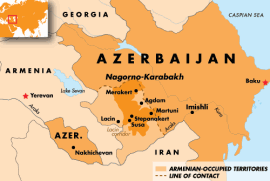
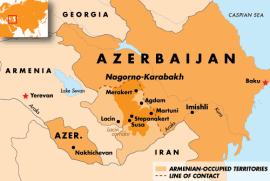
    Armenia and Azerbaijan fought a six-year war over Nagorno-Karabakh that ended in 1994 with Armenian forces in control of the disputed territory and seven other Azerbaijani districts.

    https://www.rferl.org/a/Three_Azerbaijani_Soldiers_Killed_Near_NagornoKarabakh/1962175.html
  • Organizations to commemorate Khojaly genocide

    Organizations to commemorate Khojaly genocide

    [ 18 Feb 2010 18:41 ]

    Baku – APA. State Committee for Diaspora confirmed the plan of events on Azerbaijani Diaspora organizations’ commemorating the 18th anniversary of Khojaly genocide abroad, the committee’s press service told APA. Protest actions, conferences, commemorative events, exhibitions will be held this year, too.
    German Azerbaijanis Coordination Center with the support of Azerbaijani embassy in Germany will demonstrate the paintings included into the exhibition of the Heydar Aliyev Foundation “Khojaly in the eyes of children” in Berlin from February 18 till February 28.

    Rally on the 18th anniversary of the genocide will be held in Breitscheidplatz, Berlin, on February 26. The event will be held on the initiative of German Azerbaijanis Coordination Center, Azerbaijani House, German Azerbaijan Solidarity Society with the participation of Ireli Public Union and Justice for Khojaly movement.
    The 18th anniversary will also be commemorated in France. On February 21, Strasbourg Azerbaijan House will broadcast a special radio program on Khojaly tragedy. The Azerbaijanis living in Strasbourg will also organize “MAIL” action on February 24-25.
    Over 6000 mails on Khojaly tragedy in French, English and Turkish will be sent as a result of the cooperation of Azerbaijani House with French organizations. They will be mainly sent to the Council of Europe, European Union, other international organizations, senate and state bodies of France, Belgium, Switzerland, Canada, Sweden, US, Israel and Sutralia. Rally on the 18th anniversary of Khojaly genocide will be held in Kleber square, Strasbourg on February 27.

    Forum of Azerbaijani Students in Europe (FASE) is planning to hold meetings and other protest actions in several cities of France on 18th anniversary of Khojaly genocide. The officials will be also invited to the events. Union of Azerbaijanis of France and French-Azerbaijani Youth Association and Toulouse-based Azerbaijani Student Association and Public Union of Azerbaijan “Irali” (Forward) will organize a march of protest in the center of Paris.

    UK-based European Azerbaijani Society will collect signatures within the campaign Justice for Khojaly on February 24. Our compatriots will join a meeting to take place at the UK parliament between the Azerbaijani embassy and lords on February 26. American writer-journalist, researcher of Caucasian conflicts over the past 20 years, author of Azerbaijani Diary Thomas Goltz will address the meeting.

    Representatives of Azerbaijani Diaspora will hold a protest action outside of the UK parliament on February 26.

    The genocide victims will be commemorated in the different events in the United States. Truth about the Khojaly tragedy will be delivered to the world community at the events organized by the American-Azerbaijan Council, Azerbaijan New York Association, Houston-Baku Twin Cities Association.

    Turkey-based Azerbaijani organizations are also planning to hold commemoration events on 18th anniversary of the genocide.

    Students and professors of the Northern Cyprus Eastern Mediterranean University will attend the commemoration event organized by the Economic, Cultural Cooperation Center of the University.

    Commemoration events will be organized in the Netherlands, Belgium, Sweden, Switzerland, Denmark, Czech Republic, Latvia, Lithuania, Moldova, Estonia, Hungary, Romania, UAE, Egypt, Thailand, New Zealand, Georgia, Uzbekistan, Kazakhstan, Kyrgyzstan, Russia, Ukraine and Belarus.

  • Australian Tatars Mark 60th Anniversary Of First Immigrants

    Australian Tatars Mark 60th Anniversary Of First Immigrants

    Tatar children dance at a celebration of the 60th anniversary of Tatar immigration to Australia in Adelaide.
    February 13, 2010
    ADELAIDE, Australia — Ethnic Tatars living in Australia marked the 60th anniversary of their immigration to Australia this week with a series of events, RFE/RL’s Tatar-Bashkir Service reports.

    The majority of the estimated 500 Tatar-Australians are concentrated in Adelaide, South Australia, where they came to settle after World War II.

    Special events were held by Tatar organizations in Adelaide to mark the anniversary. Michael Atkinson, South Australia’s minister for multicultural
    affairs, attended events along with other local officials.

    Tatars also have a cultural center in Adelaide where children can study the Tatar language and culture.

    https://www.rferl.org/a/Australian_Tatars_Mark_60th_Anniversary_Of_First_Immigrants/1957128.html
  • Armenia Showcases Iran Ties, as Talks With Azerbaijan and Turkey Falter

    Armenia Showcases Iran Ties, as Talks With Azerbaijan and Turkey Falter

    Publication: Eurasia Daily Monitor Volume: 7 Issue: 29

    February 11, 2010

    By: Emil Danielyan

    Armenia is showcasing its close relationship with Iran at a delicate time in its negotiations with two other, less friendly neighbors: Azerbaijan and Turkey. With the normalization of Turkish-Armenian relations and the resolution of the Karabakh conflict looking increasingly problematic, authorities in Yerevan seem to be hedging their bets by pursuing more multi-million dollar commercial projects with Tehran.

    Armenian leaders have also made a point of underlining Iran’s broader geopolitical significance for their landlocked country and what they have long described as Tehran’s “balanced” position on the Karabakh dispute. Their Iranian counterparts have readily reciprocated that praise in the latest flurry of diplomatic activity between the two governments. “The foundation of the two countries’ relations is being fundamentally strengthened and cooperation in such major fields as energy, transportation, and communications would project a new image of our bilateral ties,” Iranian Foreign Minister Manouchehr Mottaki said at the end of a two-day visit to Yerevan on January 27 (IRNA, January 28).

    “You know well what importance we attach to relations with the Islamic Republic of Iran, and that we perceive you as a reliable partner and a country with a pivotal significance in the region,” Armenian President Serzh Sargsyan told Mottaki during their talks adding, “Therefore, the development and deepening of bilateral relations stems from our interests” (Statement by the Armenian presidential press service, January 27).

    The main official purpose of Mottaki’s trip was to co-chair with the Armenian Energy Minister Armen Movsisian a regular session of an Armenian-Iranian inter-governmental commission on economic cooperation. The meeting focused on plans for building a railway connecting the two countries, a pipeline to deliver Iranian oil products to Armenia, and a major hydro-electric station on the Arax River marking the Armenian-Iranian border. Mottaki and Movsisian said they have made further progress on these projects, requiring billions of dollars in funding, but announced no dates for their implementation. The Iranian minister said only that the commission is “aiming to achieve quick results” (Kapital, January 27).

    With an estimated cost of $2 billion, the railway project is particularly ambitious. Just how the two sides, and Armenia in particular, plan to finance it remains unclear. The Iranian government reportedly expressed its readiness during Sargsyan’s April 2009 visit to Tehran to provide a $400 million loan to Yerevan for that purpose. The Armenian side, which would foot the bulk of the bill due to the virtual absence of any rail infrastructure in its southeastern Syunik region bordering Iran, is expected to seek the remainder of the funding from multilateral lending institutions. One of them, the Manila-based Asian Development Bank, has already agreed to finance a $1 million feasibility study on the project to be conducted soon.

    Armenian-Iranian economic cooperation has, until now, centered on energy, resulting in the construction of a natural gas pipeline inaugurated by the two governments in December 2008. In May 2009, Armenia began importing modest amounts of Iranian gas (approximately 1 million cubic meters per day) and paying for it with electricity supplies to the Islamic Republic. The volume of those deliveries is due to rise sharply after the planned construction of a third high-voltage transmission line linking the Armenian and Iranian power grids. Movsisian said in November 2009 that the work on that line will start in 2010 and take about 18 months (www.armenialiberty.org, November 12). The ongoing reconstruction of Armenia’s two largest thermal-power plants, the main recipients of Iranian gas, should be completed by that time.

    Mottaki arrived in Yerevan less than a week after the former Armenian President Robert Kocharian’s surprise visit to Tehran, which sparked intense media speculation in Armenia. Kocharian held talks there with the Iranian President Mahmoud Ahmadinejad and Mottaki. The official Iranian IRNA news agency cited Ahmadinejad on January 21 as calling the Armenian-Iranian relationship “very friendly” and saying that the two neighboring nations are “determined to implement joint projects and play an active role in regional developments.” Both the Armenian government and Kocharian’s office insisted afterwards that the former president, who has kept a low profile since handing over power to Sargsyan in April 2008, visited Iran in a private capacity, even though he was invited by the Iranian government. Speaking at a news conference in Yerevan, Mottaki described Kocharian’s talks in Tehran as a conversation between old “friends” who share “good memories of the past” and have plans for the future (www.armenialiberty.org, January 27).

    Some Armenian media commentators construed Kocharian’s first major political engagement since his resignation as a sign of his impending bid to return to power. Others said, however, that Sargsyan himself sent his predecessor and longtime ally to the Iranian capital to warn the West against pressuring Armenia to make additional concessions to Azerbaijan and Turkey. The main opposition Armenian National Congress (HAK), Kocharian’s most bitter detractor, subscribed to the latter theory. In a January 26 interview with Radio Free Europe’s Armenian service, one of the HAK leaders, Levon Zurabian, speculated that a high-profile visit to Tehran by Sargsyan or another serving Armenian leader would have made Yerevan’s diplomatic gambit too galling for the United States and other foreign powers involved in the Karabakh peace process.

    According to the pro-government newspaper Hayots Ashkhar, Kocharian’s trip was meant to send a different message to the West. The paper said on January 26 that it reflected Yerevan’s frustration with the Western powers’ failure to convince Ankara to stop linking the normalization of Turkish-Armenian relations with a Karabakh settlement acceptable to Azerbaijan. The Armenian leadership, it said, “cannot sit and wait for the West to exert serious pressure on Turkey.”

    In what might be a related development, Iran’s Defense Minister Ahmad Vahidi has invited his Armenian counterpart, Seyran Ohanian, to visit the Islamic Republic in the coming months. Ohanian received the invitation at a February 3 meeting with the Iranian Ambassador to Armenia, Seyed Ali Saghaeyan. A statement by the Armenian defense ministry said they had discussed “regional problems of mutual interest and issues related to the resolution of conflicts.”

    https://jamestown.org/program/armenia-showcases-iran-ties-as-talks-with-azerbaijan-and-turkey-falter/