Category: East Asia & Pacific

  • Turkey becomes partner of China, Russia-led security bloc

    Turkey becomes partner of China, Russia-led security bloc

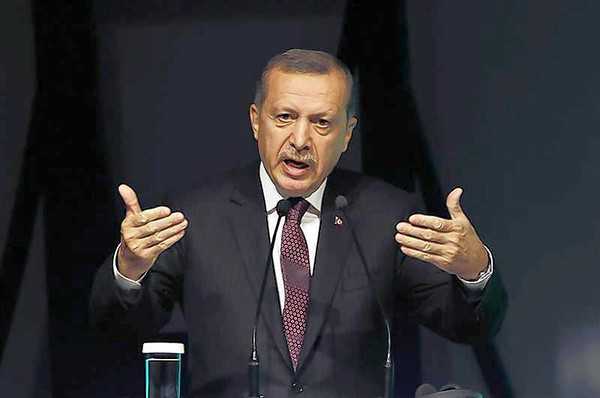
    Turkey's PM Tayyip Erdogan makes a speech during the Global Alcohol Policy Symposium in Istanbul

    Turkey’s PM Tayyip Erdogan makes a speech during the Global Alcohol Policy Symposium in Istanbul (MURAD SEZER, REUTERS / April 26, 2013)

    ALMATY (Reuters) – NATO member Turkey signed up on Friday to became a “dialogue partner” of a security bloc dominated by China and Russia, and declared that its destiny is in Asia.

    “This is really a historic day for us,” Turkish Foreign Minister Ahmet Davutoglu said in Kazakhstan’s commercial capital Almaty after signing a memorandum of understanding with Shanghai Cooperation Organisation Secretary General Dmitry Mezentsev.

    “Now, with this choice, Turkey is declaring that our destiny is the same as the destiny of the Shanghai Cooperation Organisation (SCO) countries.”

    China, Russia and four Central Asian nations – Kazakhstan, Kyrgyzstan, Tajikistan and Uzbekistan – formed the SCO in 2001 as a regional security bloc to fight threats posed by radical Islam and drug trafficking from neighboring Afghanistan.

  • Overcoming Conflict: How The Battle Of Gallipoli Sparked A New Friendship

    Overcoming Conflict: How The Battle Of Gallipoli Sparked A New Friendship

    Overcoming Conflict:
    How The Battle Of Gallipoli Sparked A New Friendship

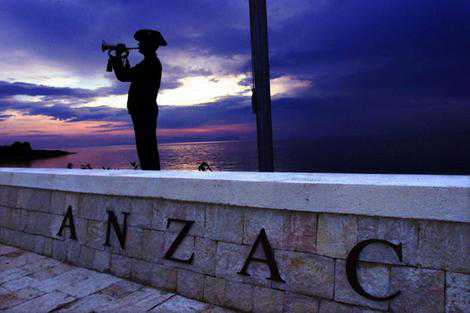
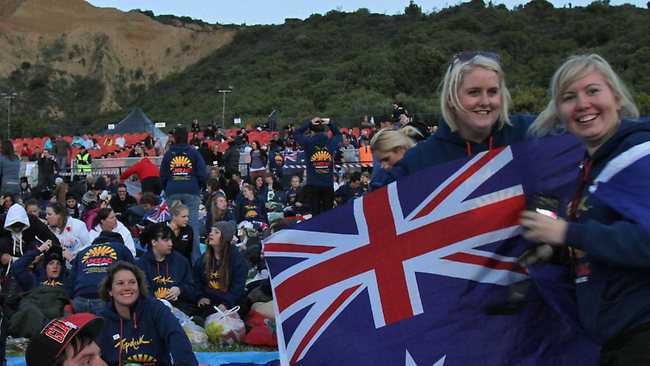
    The following op-ed by Sevin Elekdag, TCA Research Fellow and Onur Isci, Lecturer at the Department of History at Georgetown University was published in the Eurasia Review on   April 25.Every year on April 25, Turks join with Australian and New Zealand friends to commemorate ANZAC Day. On this day 98 years ago, with the Allies at their side, the newly formed Australian and New Zealand Army Corps (ANZACS) landed on the Gallipoli peninsula to invade the Ottoman Empire’s capitol, modern-day Istanbul, and take control of a precious WWI supply route to Russia. As support for the war waned, the British came to Australia with a propaganda machine aimed at encouraging young Australian men to sign-up to fight in this war on a foreign land half a world away. Over the next nine months, the Turks fought a bloody battle against the ANZACs, and while the Ottoman army ultimately prevailed, both sides suffered great hardships and heavy casualties.

    For the ANZACS, this little known WWI event is recognized as their first ever major offensive and has become a defining moment in shaping the national identities of the Australian and New Zealand people. For Turks, it gave inspiration and a leader (Mustafa Kemal) to the Turkish National Resistance Movement that eventually freed Anatolia from foreign invaders.

    In 1934, when memories of the battle were still fresh, Mustafa Kemal Atatürk, commander at Gallipoli and founder of modern Turkey, stated:

    “Those heroes that shed their blood and lost their lives…You are now lying in the soil of a friendly country. Therefore rest in peace. There is no difference between the Johnnies and the Mehmets to us where they lie side by side now here in this country of ours…you, the mothers, who sent their sons from faraway countries wipe away your tears; your sons are now lying in our bosom and are in peace. After having lost their lives on this land. They have become our sons as well.”

    These words mark the beginning of years of cultural exchange and efforts to establish official diplomatic relations between these nations. At the time, it may have seemed impossible to bridge the obvious differences in how the event was, and is, perceived in each country. But with perseverance, what ultimately emerged from the wreckage was a new friendship between Turkey, Australia and New Zealand. Out of respect and understanding, these nations now come together to reflect on the tragic realities of war.

    So it is that Gallipoli has become a national symbol of reconciliation. How inspiring to see Turks, Australians and New Zealanders set aside animosity and empathize with the experiences and suffering of the other. Coming together over this shared experience has allowed nations once at war to build friendship and solidarity from its ashes.

    Following last year’s anniversary, Turkish Prime Minister Recep Tayyip Erdogan and his Australian counterpart, Julia Gillard, met in Ankara, Turkey to plan a special remembrance of the centenary of the Gallipoli campaign. The two leaders announced that 2015 would be proclaimed the Year of Turkey in Australia and the Year of Australia in Turkey.

    Every day, news from the Middle East is dire. As governments change and conflicts rage on, one worries about the next generation of leaders for Palestine, Syria, Israel, Iraq and Afghanistan. Are they being given examples showing that after the hostilities, there is the possibility for finding common ground? That dialogue and reconciliation are important steps towards a more prosperous and stable future for their children, and every generation thereafter? Is history passed down in a way that considers the perspectives of other cultures?

    As war and threats of conflict swirl across the continents, it is never too soon to use the lessons of Gallipoli to teach our children not just to honor bravery and sacrifice, but also to recognize that it takes equal measures of great strength and empathy to set aside the tragedies of war.

  • Turkey: Following the Anzacs

    Turkey: Following the Anzacs

    Turkey puts $60 million into multimedia encounter, writes Russell Maclennan-Jones

    Turkish World War I memorial at Canakkale near Gallipoli, Turkey. Photo / Supplied

    People on this side of the world have a clear picture of Gallipoli: mateship, valour, sacrifice in a small campaign that we lost on the way to winning World War I. It’s far more complicated for Turkish people. They won the campaign at the cost of many lives and saved their country, but went on to lose the war.

    They lost an empire, too, but from its ashes rose modern Turkey, a prosperous, fairly stable country linking Europe to the Middle East.

    A new centre near the battlefields of a century ago makes it easier for visitors to get a Turkish perspective. Allied victory there, and greatly increased support for Russia through the Bosphorus, could have ended the war swiftly and even altered the Russian revolution.

    The Turks have spent nearly $60 million on the Canakkale Epic Promotion Centre and epic is the right word. It’s history as entertainment and a vivid celebration of the men who defeated the invading Anzacs, British and other Allies, in 1915.

    Conceived as a multimedia extravaganza, with actors bringing many scenes to life in film segments, the building has an ambitious flowing scheme to cope with big crowds moving from one multimedia experience to another.

    No media trick is forgone, from the 3D thrill of being shelled by a battleship to hand-to-hand battles in the trenches on the peninsula. It gets pretty confusing and is very noisy. Headphones provide an English translation, which can be a bit hard to follow.

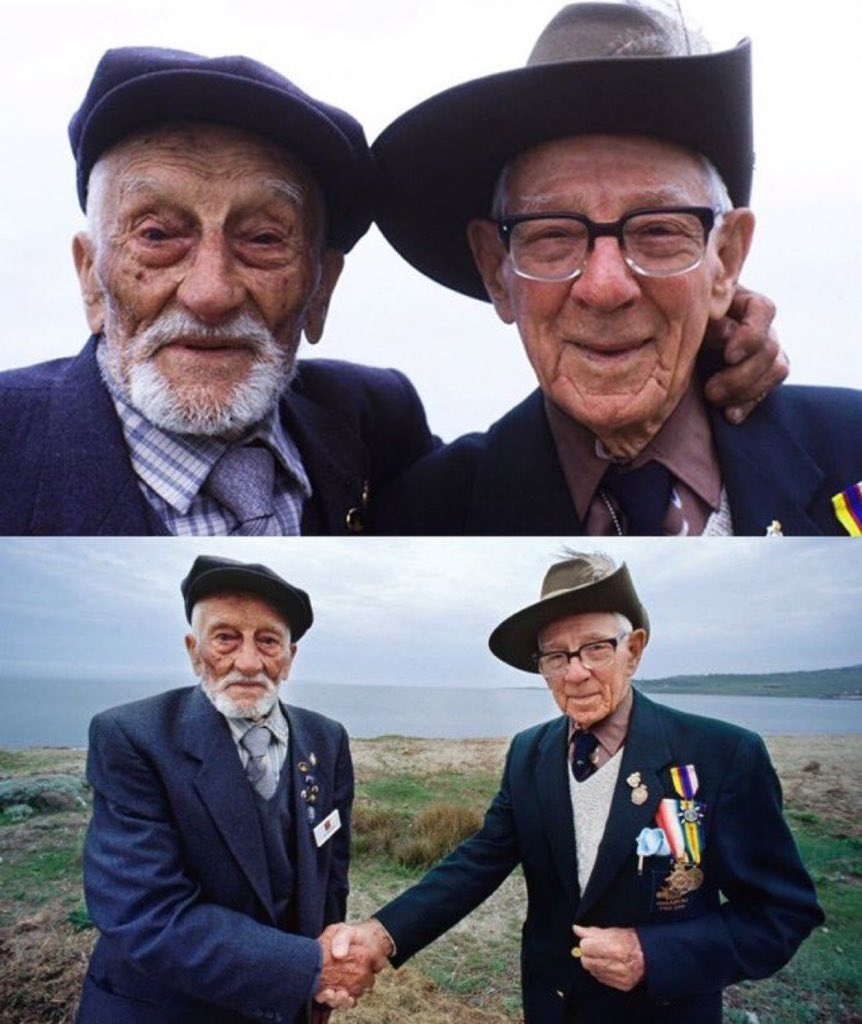
    anzacs and ottoman turks
    The Ottoman veteran Adil Şahin and the Australian veteran Len Hall met as friends in Gallipoli in 1990, 75 years after they fought as enemies in the same place.

    Generations of Kiwis mark the battle’s start on April 25, Anzac Day, but the Turks celebrate March 18, when they routed Allied navies, a defeat that led to the invasion attempt, and this naval battle takes up a lot of the experience.

    Guides lead the 30 or so people in each group from room to room. At one point you’re on the heaving deck of a battleship, at another you feel as though you are in the middle of the fighting.

    Some of the acting is unconvincing (British Navy types discussing tactics, all in Turkish, of course), but the ordinary soldiers bring some of the scenes to life. Facts, figures and statistics are sparing. It’s more a matter of the feeling that the homeland was under threat and brave soldiers stood up when it mattered.

    Allied soldiers are shown being shot down on the beach, and the ruse of guns left to fire themselves as the Anzacs withdrew is depicted in detail. But between those two events little is shown of the Allied effort or of how the soldiers scraped an existence on the unfriendly hills.

    After the high-tech experience I hope schoolchildren are taken up the hill to where their forefathers fought ferocious battles. The graves there show how many people died in what was a fruitless campaign.

    Because the centre is new, tour groups may not have incorporated visits yet. The best way to get there is to take a taxi from Eceabat. Buses are infrequent. If you can spend two or three days in Eceabat or Canakkale do visit the centre and take a guided tour of the battlefields. To avoid crowds go at dawn or sunset and ask a taxi driver to show you the landing places and cemeteries.

    CHECKLIST

    Getting there: Emirates flies daily from Auckland to Dubai with a connection there to its flight to Istanbul. fares are currently available from $2,497 return.

    By Russell Maclennan-Jones

    Watch: Anzac Day weather forecast

    VIDEO Anzac Day weather forecast (2:56)

    1. Turkey: Why would you walk 500k’s?
    2. Russell Baillie: Commanding but not compelling
    3. Turkey: Rising from margins to centre stage
    4. Veterans revisit ‘end of beginning’

    Related Tags

    1. Anzac Day
    2. Europe
    3. International Travel
    4. Turkey
  • Anzac Day terror warning for Australians travelling to Turkey

    Anzac Day terror warning for Australians travelling to Turkey

    AUSTRALIANS attending Gallipoli’s Anzac Day dawn service are being warned of the possibility of a terrorist attack in the country.

    Visitors making the April 25 pilgrimage are being told to “exercise a high degree of caution in Turkey because of the high threat of terrorist attack”.

    The warnings, contained in the Department of Foreign Affairs’ Smartraveller bulletin for Turkeyand Anzac travellers, ask people to be aware terrorists are constantly active in the country.

    The latest attack was in February when a suicide bomber targeted the US Embassy in Ankara, killing himself and a security guard and injuring others.

    Australians are being warned of the possibility of terror attacks in Turkey as Anzac Day approaches. File image. Source: AFP
    Australians are being warned of the possibility of terror attacks in Turkey as Anzac Day approaches. File image. Source: AFP

    The Turkish Government has warned the group claiming responsibility is planning further attacks.

    There have been nine notable events since 2010, and Australian Amanda Rigg, 22, was killed when a suicide bomber hit an Istanbul police station in 2001.

    “Terrorist attacks can occur anywhere at any time in Turkey,” the travel advice says.

    “In recent years, terrorist attacks have occurred in tourist areas and locations frequented by foreigners.

    “Foreigners have been killed and injured.”

    Terrorism expert Professor Clive Williams, from the Australian National University, said Australian tourists were not usually targets but the advice was sensible.

    Travellers risked being caught in “the wrong place”, as Ms Rigg had been, he said.

    “She was not targeted, she just happened to be where a bomb went off,” Professor Williams said.

    “In Turkey, the main target is the government and then second is the United States and then third is the UK.

    “You just need to be careful where you go and what you do in Turkey.”

    Travellers should avoid government offices, embassies and consulates, be wary in busy areas like transport hubs and exercise particular care around significant local dates, like May Day on May 1.

    Those considering travelling to areas bordering with Syria, Iraq and Iran are told to reconsider their need to travel.

  • Turkey shares its music with Indonesia

    Turkey shares its music with Indonesia

    Melody: A Turkish performer plays for a crowd in Jakarta on Thursday. JP/P.J. Leo

    Music is a universal language. People can enjoy melodies no matter where they come from.

    This fact inspired Turkish Ambassador Zekeriya Akcam to invite two Turkish groups to perform in Jakarta.

    The groups were Allegra and Gul Isigi. Allegra represents modern Turkish music, Gul Isigi the traditional.

    “These musicians are the best of the best in my country. We will be entertained by high quality Turkish music in Jakarta,” the ambassador told The Jakarta Post at the concert at Usmar Ismail Hall in Kuningan, Jakarta, on Thursday night.

    The performance began with Allegra singing Indonesia’s national anthem, “Indonesia Raya”, and Turkey’s national anthem, “Independence Hymn”. The music featured piano, violin, flute and violoncello.

    The beautiful voice of Allegra’s soloist Mehlika Karadeniz mixed with the perfect sound of the musical instruments to create harmonics enjoyed by the audience of comprising ambassadors, businessmen, foreigners and Indonesian artists.

    Gul Isigi took the stage after Allegra, performing traditional Turkish music with a zither, frame drum, reed flute and oud (a pear-shape stringed instrument).

    They played 15 maqams (a style of singing with music), representing Makam Segah, Ussak, Muhayyer Kurdi and Nihavend.

    There have actually been 500 maqams composed in Turkey. Today as many as 50 maqams are still used, creating the forms and tastes of Turkish music.

    Turkish classical music is complicated for music loving beginners. The music uses both micro and macro tones and each maqam has its own style and scale.

    Gul Isigi performed the Ilahi, which is a hymn to show love for Allah and the Prophet Muhammad. The Ilahi had been arranged in several maqams. There is no difference between Ilahi, songs and musical instruments in terms of maqam. The difference is only the style and staging.

    During the performance, Gul Isigi presented the history of Turkish music from the 18th century to today.

    The next performance was a solo folk music performance with a baglama. The Baglama is a stringed musical instrument. Like an oud, a baglama has a deep round back but a much longer neck.

    Allegra then performed 12 folk songs from Turkey. Just like Indonesia, Turkey has many folk songs that are still popular today.

    One of the folk songs was “Magusa Port” from the Cyprus area. The song tells of a man named Arap Ali who worked at the Limasal Port. In 1943, Arap Ali went to the Magusa Port to load his goods. He visited a bar there and was involved in a fight with a British soldier. He was killed and the song was composed.

    The performances of these two groups of musicians created different points of view in terms of Turkish music.

    “The zither makes the Turkish music different and I like the sound of that instrument, it is so unique,” Diah, an audience member, said.

    “The instruments and framed drum create a different kind of music. It seems like Arabic music but it is not,” another audience member said. “The performance is beautiful and makes me so relaxed.”

    Allegra was founded as the Allegra String Quartet in 2005. The group is comprised of seven women, and was established to perform the musical heritage of Turkey and to consider the universality of music.

    Gul Isigi perform Turkish classical and Sufi compositions of the finest quality. The members of the group are from the academic world, and teach and research the history of Turkish music.

    Turkish Ambassador Zekeriya Akcam said this was the first performance of Turkish musicians in Indonesia. He plans to invite more musicians to perform in the country in order to introduce Turkey to Indonesia.

    “We plan to hold a concert in May or June. I would like to discover what kind of music they like and then we can perform maybe in Surabaya, Jakarta or Bandung,” he said.

    “The performance today is a test case to see whether people in Indonesia like Turkish music,” the ambassador added.

    In the future, it will be possible to invite Indonesian musicians to Turkey to perform.

    “Actually we share many similarities. Turkey also has a kind of music similar to dangdut in Indonesia,” Akcam said with a big smile.

    He added that the money earned from the recent show will be donated to the Rehabilitation of Disabled Children Foundation (YPAC).

    Purti Muki, the chairwoman of YPAC, confirmed the donation.  She said she was pleased with the generosity of the Turkish Embassy, as YPAC needed funds.

    via Turkey shares its music with Indonesia | The Jakarta Post.
  • Turkey denies French-Japanese JV win nuke bid

    Turkey denies French-Japanese JV win nuke bid

    Turkey declined reports on Thursday that a French-Japanese consortium has won a tender to build the country’s second nuclear power plant, asserting it was “too early to comment.”

    Japan’s Nikkei business daily reported on Thursday that the Japanese Mitsubishi Heavy Industries Ltd. and France’s Areva SA have won an order to build Turkey’s second nuclear power plant, a project expected to cost around $22 billion. Representatives from Areva and Mitsubishi Heavy were unavailable immediately to comment, but Turkish Energy Minister Taner Yildiz rushed in on Thursday to deny that such a deal existed.

    “It is too early to make such comments. … We cannot yet say the race for [who will build] our second nuclear power plant is over,” Yildiz told a private news channel on Thursday.

    Turkey has been in negotiations with South Korea, China, Japan and Canada for the construction of a second nuclear power plant in the Black Sea province of Sinop. An agreement was reached with Russia in 2010 to build the first plant in Mersin’s Akkuyu district.

    Reiterating the Turkish government’s reluctance to offer a state guarantee for the nuclear project’s financing, Yildiz said South Korea was eliminated due to this condition, while more focused talks continued with Japan and China. “I think we are now closer to finalizing the talks with these two countries than ever,” said the energy minister.

    This is not the first time Turkey has insisted on “risk sharing” in the months-long Sinop nuclear bid. Observers argued Yildiz’s statements were meant to further heat up competition between the bidders so that they would agree to relatively more favorable terms.

    Ongoing rapprochement between Ankara and Paris as the latter decided to lift its block on Turkey’s EU accession negotiations along with improving ties with Japan remains a key factor in the alleged nuclear deal.

    Nikkei on Thursday said Turkey’s Ministry of Energy and Natural Resources had informed Japanese government and corporate officials of the decision to award them a deal to build four pressurized water nuclear reactors with a combined capacity of about 4.5 gigawatts in Sinop, a province on the Black Sea coast.

    The paper added that the Turkish government had approached Japan about a summit meeting between Japanese Prime Minister Shinzo Abe and his Turkish counterpart, Recep Tayyip Erdogan, in early May, after which it is likely to officially grant preferred negotiating rights to the Mitsubishi-Areva consortium. It added construction is set to start in 2017, with the first reactor slated to come online by 2023, and France’s GDF Suez SA will operate the plant.

    Energy-poor Turkey aims to have three nuclear power plants, all of them operational by 2023, its centennial. It is anticipated to overtake Britain as Europe’s third-biggest electricity consumer within a decade.

    Meanwhile, Yildiz on Thursday asserted the government will stick with plans to increase oil trade with Iraq’s north while a possible natural gas pipeline from Israel to flow through Turkey into world markets was “on the table.” “All countries in this region are aware Turkey is the key, most feasible corridor for similar energy transfer projects.”

    via Turkey denies French-Japanese JV win nuke bid.