Category: China

  • China holds exhibition to ease Turkish concerns over treatment of ethnic Uygurs

    China holds exhibition to ease Turkish concerns over treatment of ethnic Uygurs

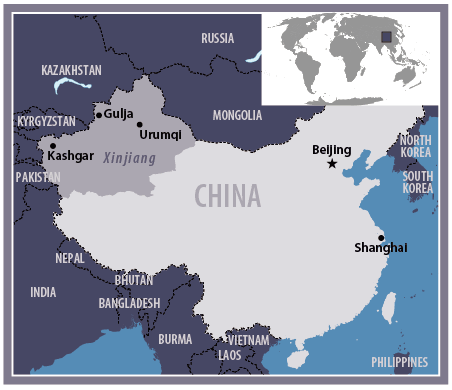
    Chinese Muslims, all 23 million of them, say it can be hard practicing their faith in China. Particularly for ethnic Uyguys, there is long-running discrimination that many Uygurs say endangers their cultural existence.
    China’s government is hoping to soothe Turks’ concerns about the ill treatment of that country’s 23 million Muslims — which include a fairly substantial population of Turkic Uygurs.

    The Chinese have funded an exhibition in Istanbul that amplifies the positives with Chinese Muslims’ relationship with the central government. Muslims in China make up less than 2 percent of the population.

    Zhang Jian from the Chinese state religious body, says the Istanbul exhibition is meant to inform international audiences about the richness of Islamic culture in China.

    “To know more about how Chinese Muslims live their lives in China and how they live their religious life,” Jian said.

    See more photos from the Chinese exhibit, visit TheWorld.org.

    There’s a lot of rumors he says, that the Chinese government prevents Muslim men from wearing beards for example, or that it stops women from covering their heads.

    It’s not true, he says. Muslims live freely in China and the exhibits are proof of this reality.

    “The reasons we hold such kind of activities, is to know what really happens in China,” he said.

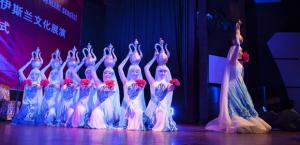
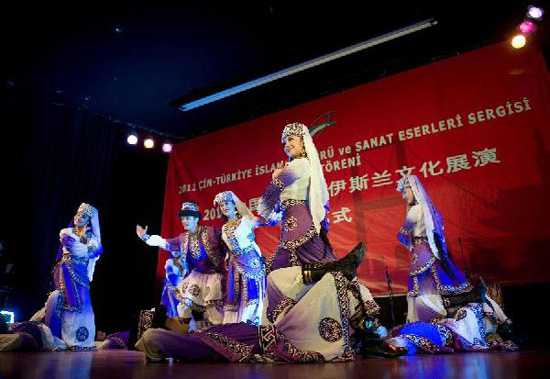
    The exhibition features traditional songs and dances by two Muslim performing groups. The Uygur dancers are dressed in intensely colorful costumes as they perform tightly choreographed songs and dances. But unlike the music, and the rosy picture painted by the government official, life for Uygurs in China isn’t especially joyful.

    “I don’t want to speak Chinese,” said a Uygur émigré at the performance. She didn’t want to reveal her name, fearing reprisals against her family in Xinjiang.

    She says the Chinese government is trying to wipe out the Uygur language.

    “I’m afraid for the future. I fear for the Uygur language that everyone will forget it. Everywhere it’s only Chinese,” she said.

    The woman says the Chinese government is trying to assimilate Uygurs by force, eliminating Uygur-language education and giving economic opportunities only to the majority ethnic Han Chinese.

    Human Rights Watch concurs. A recent report said, “under the guise of counterterrorism and anti-separatism efforts, the government maintains a pervasive system of ethnic discrimination against Uyghurs and other ethnic minorities.”

    Perhaps more than anywhere else in the world, in Turkey, the people and government are sensitive to Uygur pleas. Hugh Pope, a Turkey analyst and author of “Sons of the Conquerors: The Rise of the Turkic World,” said Turkish school children are taught that China’s Uyguys are their brothers.

    “Eight million people who are under Chinese sovereignty in Xinjiang, or as it used to be known East Turkestan, because it’s the eastern bit of where Turks still live in Central Asia,” he said, “(are) still in the Turkish consciousness as being a Turkic people, blood brothers according to the state ideology of the Turkish Republic.”

    China hopes that cultural exchanges like this one will help ease Turks’ reservations about Muslims in China. But Pope says public relations are probably not even needed. China’s economic power will always move Turkey more than the human rights of their Uygur brothers.

    “Most people are interested in buying Chinese products, Turkish companies are building things in Chinese cities just like everyone else in the world,” Pope said. “We are seeing the beginning of a military relationship. Turkish leaders do go and visit Xinjian and wear Uygur dress. And China is happy with that because it shows that everything is all right.”

    Turkey is a rising regional power but it’s still a medium-sized, developing country. Its not in Turkey’s interest to have trouble with China, Pope said.

    What’s more, most of the Uygurs’ ancient cities have already been razed, to make way for new cities likely to be dominated by majority ethnic Han Chinese.

    via China holds exhibition to ease Turkish concerns over treatment of ethnic Uygurs | PRI.ORG.
  • Chinese Islamic cultural pageant kicks off in Turkey

    Chinese Islamic cultural pageant kicks off in Turkey

    Chinese dancers perform a Muslim dance during the opening ceremony of “2012 China-Turkey Islamic Cultural Exhibition and Performances” in Istanbul, Turkey, on Aug. 31, 2012. (Xinhua/Ma Yan)

    ISTANBUL, Aug. 31 (Xinhua) — Over 500 Chinese and Turkish government officials and Muslim representatives on Friday attended here the opening ceremony of the Chinese Islamic cultural pageant, which will last eight days.

    The event, part of the celebrations to mark the China-Turkey Cultural Year, is held to introduce China’s Islamic history and unique Muslim culture to Turkey.

    Wang Zuoan, Director of Chinese State Administration of Religious Affairs, said at the opening ceremony that the exposition, the first of its kind between the two countries, will help deepen mutual understanding and enhance the cooperation between Chinese and Turkish Muslims.

    Nowadays, Wang said, Islam is getting more and more popular in China as Muslims’ religion belief and custom are fully respected. The Islam also plays an active role in promoting economy and culture, he said.

    For his part, Turkish Deputy Prime Minister Bekir Bozdag said that it is a very important opportunity for the two countries to enhance cooperation and introduce Chinese Muslims’ life, culture and belief to the Turkish people.

    “The relations between Turkey and China showed many positive developments throughout history,” he said.

    “On one hand, we wish to convey the Islamic civilization in China to our public and, on the other hand, we wish to jointly work for the religious education and religious affairs of Muslims in China. When you look at the bilateral relations from a cultural perspective, you can see that there is high hope to develop our relations,” Bozdag said, adding that Turkey will carry out a series of Islamic cultural programs in China next year to enhance its relations with China.

    During the exposition, Chinese Muslims will exhibit Chinese Islamic culture, Quran chanting, a symposium on China-Turkey Islamic exchanges, as well as Islamic singing and dancing shows.

    via Chinese Islamic cultural pageant kicks off in Turkey – People’s Daily Online.

  • Chinese Muslims to shine in Turkey expo

    Chinese Muslims to shine in Turkey expo

    Chinese Muslims will bring their unique culture to Turkey in an Islamic cultural pageant to be held in Istanbul, Turkey’s largest city, on August 31, according to the Islamic Association of China (IAC).

    The China-Turkey Islamic Cultural Expo and Performances 2012, jointly organized by China’s State Administration for Religious Affairs and Turkey’s Presidency of Religious Affairs to mark the China-Turkey Cultural Year, will include an exhibition of Chinese Islamic culture, Quran chanting, a symposium on China-Turkey Islamic exchanges, and Islamic singing and dancing shows, according to Zhang Guanglin, deputy secretary-general of IAC.

    According to Zhang, the highlight of the show will be Chinese variants of Islamic culture, including a combination of Chinese calligraphy with Arabic and Uyghur handwriting, ancient Chinese Muslims’ articles of religious and daily use which date back to the 14th century, artistic shows presented by Chinese Muslims, and most importantly Chinese transcripts of the Quran.

    This will be the first time that foreign countries will host Chinese ancient transcripts of the Quran, some of which are valuable cultural relics with a history of around 300 years. The event will also showcase Quran copies made by modern Chinese Muslims, including a 208-meter-long paper-cut Quran, and copies engraved in jade and printed on silk.

    Quran transcripts have played an important role in China’s Islamic history, according to Zhang. Quran transcripts in Chinese language allowed Islamic preaching to reach the masses in China 300 years ago and facilitated the development of the then repressed religion. Today, China encourages the development of Islamism. Zhang said China has translated and published the Quran in languages including Chinese, Uyghur, Kazak and Kirgiz, and such translations will also be showcased in Istanbul.

    “Our Quran transcripts will give the world a glimpse of China’s Islamic history and Chinese Muslims’ devotion to Quran teachings,” said Zhang.

    During the symposium on China-Turkey Islamic exchanges, Chinese speakers will introduce Islamic history in China, the reality of Islamism in China today, the unique culture of Chinese Muslims, as well as the life of modern Chinese Muslims.

    “We will show the world the unique and splendid culture of Chinese Muslims,” said Zhang, adding that the event is also a move to boost religious exchanges between China and Turkey.

    “It will be a good opportunity to display the splendid Islamic cultures of the two countries, promote the Islamic spirits of peace, tolerance, moderation and cooperation, enhance friendly relations between the two countries, and promote the diversity of human culture,” according to the IAC deputy secretary-general.

    Zhang also mentioned that discussion is under way between China and Turkey covering cooperation in areas such as Quran printing and student exchange programs, as part of efforts to implement the Memorandum of Understanding signed by the two countries in 2011.

    China has 23 million Muslims, living mainly in its northwestern Xinjiang Uyghur Autonomous Region, Gansu Province, Ningxia Hui Autonomous Region, and Qinghai Province.

    via Chinese Muslims to shine in Turkey expo – Globaltimes.cn.

  • Burger King Plans Large Expansion in China

    Burger King Plans Large Expansion in China

    By Charlene Cooper

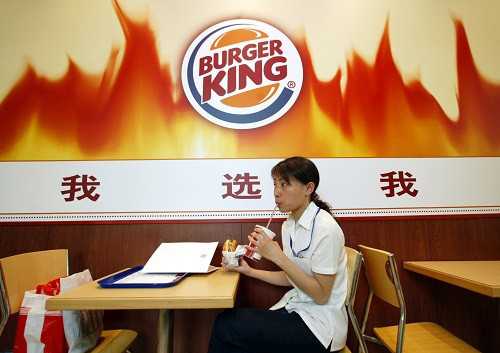
    A Chinese customer eats a burger at a Burger King.

    A Chinese customer eats a burger at a Burger King. (Photo: Reuters)

    Burger King, One of the largest hamburger chains in the world, plans on expanding in China. With only 63 current restaurants in China, the company will be opening 1,000 locations in the country within five to seven years. This is the biggest development deal that Burger King has ever made.

    Competitor McDonald’s Corp. currently has over 1,400 restaurant locations in China.

    The company explained to Bloomberg BusinessWeek, that the expansion is a collaboration between the Kurdoglu family, which is responsible for Burger King restaurants in Turkey, and Cartesian Capital Group, a private equity firm.

    Burger King has over 12,500 restaurants around the world. The company’s biggest international franchise is run by the Kurdoglu family.

    Burger King revealed plans to additionally expand in Russia earlier this month. In 2011, the company also expanded its restaurants in Brazil.

    Last year, 80 percent of Burger King’s expansion had occurred in the Middle East, Africa, and Europe.

    With its past market share declining nationally, the company agreed to be taken by 3G Capital, a New York based investment firm, in 2010.

    Rather than expanding in the United States, Burger King locations have seen more of a face lift to current restaurants. This past April, the company expanded its menu, including popular options such as snack wraps and fruit smoothies.

    Competing companies such as McDonald’s Corp and Yum Brands Inc. which owns Taco Bell, KFC, and Pizza Hut, have also been looking into international expansion. McDonald’s has decided to open 900 new fast food locations in 2012, in Asia, Africa, and the Middle East. During its first quarter, Yum Brands Inc. expanded in China by opening 168 new restaurants in the country.

    via Burger King Plans Large Expansion in China – Jobs&Hire :: News :: Jobs & Hire.

  • Uyghur Folk Song: Qara Qara Qaghlar

    Uyghur Folk Song: Qara Qara Qaghlar

    Uyghur folk song by Mihrigul Hesen.

  • Uighur protests as China’s Xi Jinping visits Turkey

    Uighur protests as China’s Xi Jinping visits Turkey

    Activists from China’s Muslim Uighur minority burnt Chinese flags in Ankara on Tuesday where China’s leader-in-waiting Xi Jinping was holding talks with Turkish officials on regional issues.

    About 60 Turkic-speaking Uighurs from China’s northwestern Xinjiang province protested outside the hotel where Xi was staying in the Turkish capital on the last leg of a trip that also took him to the United States and Ireland.

    Xi, almost sure to succeed Hu Jintao as president in just over a year, praised Turkey’s role in trying to resolve issues such as the Iranian nuclear dispute and Middle East conflicts.

    Waving the flag of East Turkestan, pale blue with a white star and crescent, the protesters burnt a Chinese flag and a poster of Xi before police moved in to disperse them.

    Rights groups accuse China of abuses during a crackdown after Uighur riots in 2009 and Turkish Prime Minister Tayyip Erdogan then described the events as a “genocide”.

    Turkey is home to thousands of Uighurs who have fled Xinjiang since the Chinese Communists took over the region in 1949.

    Xi said China had made great strides to raise the living standards of all ethnic groups in Xinjiang.

    Turkey and China are at either end of a political and economic axis stretching along the old silk road though Central Asia, Iran and Afghanistan. Both have strong, sometimes competing economic interests in the region.

    Turkey, now the world’s 16th biggest economy and only second to China in growth last year, has projected itself as a stable Muslim democracy, making it a key player at a time of turmoil and unrest in the Middle East.

    “A member of the G20 with a growing economy and an important country in the Middle East, Turkey has for a long time tried to bring stability and development to the region and played an active role in trying to solve ‘hot’ issues,” Xi told Turkey’s Sabah newspaper listing Afghanistan, the Iranian nuclear and Middle East peace efforts.

    BILLION DOLLAR DEALS Turkey has sought to mediate between the West and Iran in a dispute over Iran’s nuclear programme and has broadly shared China’s opposition to stronger sanctions against Tehran.

    But on Syria their positions have been sharply at odds. While Turkey has taken a leading role in pressuring Syria’s President Bashar al-Assad to step down, China, along with Russia, this month blocked a draft U.N. Security Council resolution that backed an Arab plan urging him to quit.

    China has also not decided whether to accept an invitation to discuss Syria with other world powers this week in Tunisia, a meeting Turkey’s foreign minister will attend and Ankara hopes will keep up pressure for Assad to step down. Xi met President Abdullah Gul on Tuesday and signed seven bilateral economic agreements.

    The central banks of Turkey and China signed a three-year currency swap agreement worth $1.6 billion which will be effective for three years, both sides said. The two countries could discuss extending its maturity after that.

    China has signed a series of bilateral currency agreements with foreign countries as part of efforts to promote the use of the yuan in cross-boarder trade and investment.

    The Turkish energy ministry also said China’s Avic International and Turkey’s Hema Endustri, a Turkish engineering manufacturing company, will sign a $1 billion deal for power plant and coal production equipment.

    Energy Minister Taner Yildiz said the agreement could lead to cooperation with China on building Turkey’s first nuclear power plant. Xi later travelled to Istanbul for talks with Erdogan, who is recovering from surgery at home there. Citing prime ministerial officials, Turkish state media said the two men met for one hour where they agreed to increase economic cooperation.

    During the meeting, which was closed to the media, Erdogan accepted a formal invitation by Xi to visit China and said he would travel there in the coming months, state-run Anatolian news agency reported. On Wednesday, Xi attends a business forum in Istanbul, where he is likely to be assailed by exporters eager to try to bridge a gaping trade gap. China is Turkey’s 15th biggest export market with nearly $2.5 billion of Turkish goods sold there last year, a rise of 8.7 percent. But some $21.6 billion worth of Chinese goods were imported to Turkey in 2011, up 26 percent from 2010.

    via Uighur protests as China’s Xi Jinping visits Turkey – World – DNA.