Category: Kazakhstan

  • Turkey seeks to institutionalize relations with Turkic republics

    Turkey seeks to institutionalize relations with Turkic republics

    CEREN KUMOVA / AYDIN ALBAYRAK, ANKARA
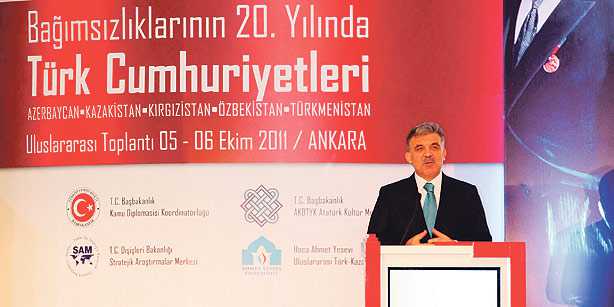
    President Abdullah Gül gives a speech at an international meeting to mark the 20th year of the independence of Turkic republics.

    As the 20th anniversary of independence arrives for the Turkic republics, Turkey is reviewing its connections with the countries it deems “brothers,” looking for a more institutionalized touch that speaks more to the mind than to the heart.

    Although these countries, namely Azerbaijan, Kazakhstan, Kyrgyzstan, Uzbekistan and Turkmenistan, have traditionally held priority of place amongst Turkey’s bilateral ties with other countries, the arrival of the 20th anniversary of their independence has prompted Turkey to review its long-standing policy toward them. What has been accomplished between the countries, popularly claimed to be “different states of the same nation,” in these 20 years is a clear indication that it might be high time for Turkey to build on the strong ties, but with solid accomplishment that speaks for the pledges.

    Turkey has been reviewing its policy in a way that looks to balance ties with regard to past issues to give birth to solutions, Turkish officials told Sunday’s Zaman on the sidelines of an international meeting Turkey hosted in celebration of the anniversaries. These statements confirm the obvious fact that in spite of the great importance Turkey attaches to its Turkic brothers, relations with these countries have not always evolved into solid cooperation; to the contrary, the ties have loosened due to Turkey’s naïve and mistaken conviction that they can be maintained without much effort because of the historic and ethnic ties. Now Turkey seems to be aligning its foreign policy in a way that would close the gap and revive old partnerships.

    Twenty years ago when the Turkic states acquired their independence after the collapse of the Soviet Union, Turkish political leaders were quite enthusiastic about the prospects this new state of affairs offered Turkey: The first initiatives towards the region were mainly based on emotions, in the process of which, Turkey emerged as a protective elder brother, which caused drawbacks over the long-run when the role was too much to deliver. Twenty years later, it is all the more clear for Turkey that it may not actually be the right way to build lasting relations, as for some time now the motivation behind relations between the “brotherly” countries has progressively evolved into a system where the interests of the parties involved are more important than emotions.

    As a result, cooperation between the Turkic countries has increasingly gotten better, although some problems still persist between these countries themselves, as a result of which the Nakhchivan Agreement was signed between Turkey, Azerbaijan, Kazakhstan and Kyrgyzstan, while the two others, Turkmenistan and Uzbekistan, remained outside, on Oct. 3, 2009. The agreement paved the way for the foundation of the Cooperation Council of Turkic Speaking States (CCTS), which became operational at a summit in 2010 in İstanbul, laying the groundwork to hopefully put the council on a more solid track.

    The next step in the council meetings is scheduled for Astana, where ministers of economy come together on Oct. 13, followed by another meeting of foreign ministers on Oct 21. Also that month the heads of the Turkic states will meet at the first get-together of the CCTS, proving that the long-desired institutionalization may now be under way for the Turkic republics and Turkey.

    Emotions cause for past disappointments

    Since the countries enjoyed a close bond and a common world vision without much effort from either side, heartfelt expectations sometimes melted into disappointment — a feeling Turkey is trying to eradicate by putting affairs on solid ground to foster political, economic, cultural and social ties between the states.

    The international meeting held in Turkey earlier this week on the occasion of the 20th anniversary of the independence of the Turkic republics is a clear indication that the countries are eager to come together on the diplomatic track and alternative avenues, define problems and look for solutions to existing issues. “Turkey’s dream in the ’90s of forming an economic union with the newly emerged Turkic countries did not come true,” Halil Akıncı, secretary-general of the CCTS and a former ambassador, noted as he co-chaired a session during the Ankara meetings of Oct. 5 and 6. Akıncı added that the formation of institutional bodies between the states makes it easier to track progress and ensures that problems do not only get “whined about” but are put on an agenda to be solved. “Past issues stemmed from over-emotional reactions between the Turkic republics; it is high time we emerge from that,” Akıncı stated at an evaluation session on Thursday.

    The Turkic Council, Akıncı noted, would initially deal with economic progress but continue with a second phase concerning the cultural and educational fields. To this end, Akıncı said a common history book would be published, presenting the shared history of the republics and that a Turkic Academy would be founded to study the culture of the Turkic republics. “The 20 years of relations between Turkic states have been fruitful,” commented Bülent Aras, chairman of Center for Strategic Research (SAM), a research body founded under the umbrella of the Turkish Foreign Ministry, in a quick interview with Sunday’s Zaman on the margin of the meeting. “There is a great tendency for cooperation, and steps we cannot downplay have been taken,” Aras noted but admitted that the current level of developments between the states was not enough. “We have developed a fresh perspective in our relations; more cooperation is sure to come in the future,” Aras added, hinting that Turkey is indeed changing its attitude toward the Turkic republics.

    Obstacles

    The bonds between the six states are also affected by a complex interwoven web of relations with each other, as well as with other parties, which have a claim on the dynamics of the region. The last instance of a dispute between Turkey and its major Turkic ally, Azerbaijan, erupted in 2009 when Turkey tried to normalize relations with Armenia through outlining a roadmap that would make the dysfunctional border between the neighbors operational again. However, Azerbaijan lashed out at the possibility of normalization before a solution is found to the Armenian occupation of a number of Azeri enclaves around Nagorno-Karabakh, which is why Turkey closed its border with Armenia in 1993 in the first place.

    In the case of waiving visa requirements between Azerbaijan and Turkey, it was Iran that intervened and blocked the prospect, saying that it would ask to benefit from the same privilege if Turkey was given the green light.

    An additional debate that usually comes up on the economic sidelines between the nations concerns energy prices, since Turkey is the buyer and transporter of large amounts of Azeri natural gas.

    Touching on difficulties facing Turkic states in their quest for better cooperation, Mehmet Seyfettin Erol, a professor of international relations at Gazi University in Ankara, told Sunday’s Zaman in an interview that under the surface, there was much to be considered for relations to evolve to the desired level. Hailing the establishment of the CCTS, founded with the Nakhchivan Agreement, which is “the best move Turkey has ever made in Central Asia,” Erol stated most plans to increase cooperation have remained at their initial stages due to a large number of obstacles.

    Lamenting difficulties the Turkic republics face in their diplomatic connections, Erol added that Turkey could only improve relations through deeply rooted diplomatic tracks, which necessitate more institutionalization from all ends. Although the academic stressed that the states wanted more institutionalization, he noted the current level of ties remained at the initial phase of intentions and should be backed by solid plans to move on to the next phase.

    His words were confirmed by Dr. Aydar Amrebaev, deputy director of the Kazakhstan Institute for World Economy and Politics (IWEP), at the Thursday session of the international meeting, as he spoke of the problems within the Turkic states. “There are no representatives from Uzbekistan and Turkmenistan. As the Turkic world, we need to solve the problems of the Caspian region,” Amrebaev stated. Not only Amrebaev but also Associate Professor Bulat Sultanov, director of the Kazakhstan Institute of Strategic Research, underlined that relations should be handled on an equal basis, implying that Kazakhstan has no need of aid from Turkey but needs cooperation in many fields, including defense and security.

    www.sundayszaman.com, 09 October 2011
  • IMPERIAL  NATIONALISM  &  TURKISH  UNION

    IMPERIAL NATIONALISM & TURKISH UNION

    Republic of Turkey , born from the ashes of a 600-year Empire and having the character of independence , has pioneered many freedom movements which resulted with the establishment of new free countries within the first half of 20th century . The founders of the Republic under the leadership of Ataturk set up this new state by giving the whole nation  , desolated and impoverished , the spirit of resistance and by getting their rights with force against the Western Allies at that time ; therefore , they deserve our feelings of gratitude and respect .

    Today , at this point , we , as Turkey , need to follow much more active government policies . Personally , I strongly believe that the nationalism concept taking place among the founding principles of the Republic  should be considered as Imperial Nationalism . In other words , Turkey , will exert its power and authority in every piece of land which it already exists or existed before and which it strongly wishes to exist in the future . No need to say , this is not an enlargement basing on the military power , but on the contrary , an enlargement policy by using all the historical and cultural close relations and by creating a land of attraction for other states and people . Military power must always be respected and must create hesitation among the possible enemies .

     First of all , I want to start wit a basic fact of creation : every entity in the universe has an energy and the power of this energy is directly proportional to its mass .

     If we apply this fact to politics , the way to gain power in world politics goes through creating unity , as our ancestors wisely said “union makes us strong” . Examples are many : USA today , Ottoman & Roman Empires in the past … Of course , the age of empires ended long time ago , but there is always a future for the unions . Even the United States , despite its present power and influence , continuously brainstorms about establishing a One-World-Government under the authority of the United Nations controlled & directed by the USA .

     Under the light of the basic reality above , Turkey , in order to be effective in world politics , needs to unite . The candidates for setting up a union stand next to us : Azerbaijan , Kazakhstan , Turkmenistan , Uzbekistan , Kyrgyzstan and , due to geographical and historical ties , Georgia and Tajikistan . Except the last two , all Turkish origin states … This unification process can first start with the establishment of confederation and may end up with a federation .

     Due to its historical experience and the effectiveness in state establishment , Turkey must perform a leadership for establishing “Eurasia Federation” consisting of the eight states above . This new Federation will represent  a union covering approximaely 5 million square kilometers and a population of 150+ million , which is hard to ignore .

     It is obvious that many of the other actors in the world politics will try every way in order to prevent such a powerful union . Moreover , the present administrators in these eight countries will be reluctant in giving up the power they currently use . However , nobody can claim that it will be easy . I personally do believe that the people forming the nations of those states will look at this unification idea with sympathy .

    Finally , the last but not least , this new “Eurasia Federation” will need a technology-creating reliable partner in order to set up a confederation . That partner is JAPAN . Imagine Japan and Turkey with their own distinctive and leading characteristics and , right beside them , all other participating countries with their natural and social wealth . The future lies in the united political and social entities .

    Even the idea itself is exciting !… Don’t you think this is worth trying ???

  • Customs Union Issues

    Customs Union Issues

    Mikhail Kozlov  Deputy Director of Operative Department on Customs Services  AsstrA Associated Traffic AG
    Mikhail Kozlov Deputy Director of Operative Department on Customs Services AsstrA Associated Traffic AG

    Development of the customs union is approaching the next landmark — actual formation of the unified customs territory of Belarus, Kazakhstan and Russia.

    Starting from July 1, 2011, customs control on the inner borders of the three countries will be abolished; veterinary, phytosanitary and transport control will be moved to the CU’s external borders. As of Jan. 1, 2011, there are unified forms and instructions on declaring goods.

    At the same time there are still unsolved problems connected with the functioning of the unified customs territory:

    1) The uniform application of international customs conventions. The agreement on TIR convention applications on the CU territory has not yet been signed because of the position of Kazakhstan that lies in the possibility of TIR procedures being applied for international goods transportation on the CU territory. At present by TIR procedure Kazakh carriers perform a great volume of cargo transportation from the Chinese-Kazakh border to Russia and Belarus. Unfortunately, in the CU customs code there is no analogue and quite simple guarantee system that can be used instead of the TIR procedure.

    Kazakhstan still has not joined the Istanbul convention on temporary import/export of goods, which is why the agreement on the application of this convention on the CU territory was not even developed. Meanwhile Belarus and Russia have not yet solved the problem of guaranteeing transportation of goods through the territory of Belarus to Russia by the Belarussian Chamber of Commerce and Industry.

    2) In the CU customs code the principle of residence is left for regular people participating in customs declaration in the CU: customs applicant of the customs procedure, customs representative and authorized economic operator, which makes the process of logistics optimization of commodity flows at the unified customs territory. For example, a freight forwarder of FLLC AsstrA Weisrussland — an approved economic operator in Belarus — cannot conduct the procedure of customs transit to Russia or Kazakhstan without payment of customs duties, taxes under his status of the AEO. Russian trade operator Perekryostok cannot put goods under the customs procedure of transfer for free turnover in Belarus in the immediate vicinity from the CU external border at TLC Brest-Beltamozhservice. With this purpose he has to register a residential company in Belarus.

    3) In the field of tariff regulations there are no unified trade rules of procedure and impressments of country-members of the CU with third countries. In Kazakhstan there are still transitional rates of customs duties by 400 commodity items, different from the rates of the CU customs duties. In customs services of the CU, the indicatives for application of additional measures of documental control by determination of customs prices of goods differ.

    4) In the field of non-tariff regulations there is the burning issue of developing unified technical rules of procedure for technical regulation. Belarus and Kazakhstan are against the transfer of veterinary control functions to the customs bodies at the border, which comes into force in Russia from July 1, 2011.

    We would like to mark the problem of absence of actual simplifications in the work of customs representatives in the process of declaring goods, of a higher level of trust on the part of the customs officials to their work, despite quite a big size (1 million euros) of provision of customs duty payment.

    The unified instruction for the CU on CMR note filling-in was developed as a simple sum of national instructions, it requires indication of the information not only for purposes of tariff and non-tariff regulation, statistics of foreign commerce and currency exchange regulations, but also the information necessary for different bodies of public administration, and that is why it is quite difficult and labor-intensive. All these factors led to the increase of prices for the services of customs representatives.

    via Customs Union Issues | The Moscow Times.

  • Achievements of Kazakhstan highly appraised in Turkey

    Achievements of Kazakhstan highly appraised in Turkey

    The conference dedicated to the 20th anniversary of independence of Kazakhstan and the Kazakh-Turkish relations was held in Istanbul. The conference was organized by the Embassy of Kazakhstan in Turkey.

    Kazakh Ambassador to Turkey Zhanseit Tuimebayev told about the achievements of Kazakhstan in political, socio-economic, cultural-humanitarian and other spheres that had been accomplished by Kazakhstan over the years of independence and about the relations with Turkey developing in the strategic partnership mode.

    The participants of the conference highly appraised the pace of development of Kazakhstan in so many spheres and processes of modernization democratization of society.

    The grand ceremony of awarding prizes to prominent figures, politicians and representatives of business community of Turkey for contribution to development and strengthening of friendship and cooperation between the two countries was organized within the framework of the event.

    via Eng.Gazeta.kz – Achievements of Kazakhstan highly appraised in Turkey.

  • Kazakh man cleans Menderes’ monumental tomb every day

    Kazakh man cleans Menderes’ monumental tomb every day

    Ramazan Keskin, a 60-year-old Kazakh man, has been cleaning the monumental tomb of late Prime Minister Menderes in İstanbul’s Topkapı district every morning for five years now. Keskin said he is grateful to Menderes because the late prime minister brought his family to Turkey in 1953 along with around 1,800 Kazakhs when they were experiencing hard times in their homeland.


    “May he rest in peace. We owe much to him,” Keskin told Today’s Zaman with teary eyes. The old man has been working at Menderes’ monumental tomb since 2006 and is assigned to keep the tomb and its vicinity clean. “I could not serve him [Menderes] when he was alive. Now I am serving him at his tomb,” he said.


    Keskin also said he does not start working without first praying for Menderes. “Before I start working, I go to Menderes’ tomb and greet him. Then I pray for him. People appreciate good men when they die. Turkey did not appreciate Menderes when he was alive. He was executed for nothing. We were very sorry when he was hanged, but we could not do anything other than pray for him.”


    Asked about his memories about the day of the 1960 coup, Keskin said he was a young boy when the coup was staged. “I was attending a primary school then. I learned about the coup from a radio broadcast. But I did not know what a coup meant. As I grew older, my elder family members told me that Menderes was a very good man. He said we were saved from death thanks to Menderes. Had he not brought us to Turkey, we would probably not be alive today,” the old man added.

    via zaman

  • Kazakh PM: Turkey has great ‘production potential’

    Kazakh PM: Turkey has great ‘production potential’

    Kazakhstan’s Prime Minister Karim Qajymqanuly Massimov lauded Turkey’s “production potential” at a meeting with the Central Asian nation’s leading businessmen on Friday.

    “Turkey is a country with great production potential,” said as part of his observations in Turkey last week. “With its noteworthy economic growth, Turkey is a country of interest for all,” he also said during the meeting.

    The Kazakh prime minister attended the Economic Cooperation Organization (ECO) summit on Dec. 22-24 in İstanbul. The summit hosted 10 member and guest countries, including the Turkish Republic of Northern Cyprus (KKTC), Iraq, Qatar, Jordan, Lebanon and Syria. Some of the leaders participating in the summit were Afghan President Hamid Karzai, Azerbaijani President Ilham Aliyev, Iranian President Mahmoud Ahmadinejad, Kyrgyz President Roza Otunbaeva, Pakistani President Asif Ali Zardari and Tajik President Emomali Rahmon. Turkey took over the ECO rotating presidency from Iran during the summit.

    Also as part of his meeting with the businessmen, Massimov said Kazakhstan could achieve success similar to Turkey. He finally noted that he had ordered the relevant national authorities to open a branch of the National Economic Chamber of Kazakhstan (ATAMEKEN Union) in Turkey. In response to a question after the meeting, the union’s president, Azat Peruashev, told reporters that efforts to open the Turkey branch had already been initiated.