ISTANBUL — A U.S. Navy destroyer is passing through Istanbul’s Bosporus straits on its way to the Black Sea for exercises near the fraught Crimean peninsula.
The Navy destroyer USS Truxtun is participating in exercises with Romania and Bulgaria and is expected to be in the Black Sea for several days amid a stand-off over Russia’s military incursion into Ukraine.
The exercises come as the U.S. and other Western nations are preparing sanctions against Russia for its recent move to send military troops into Ukraine’s Crimean Peninsula.
via ISTANBUL: US naval destroyer heading to Black Sea | World | The Sun Herald.
According Mary Dejevsky at the Chatham House, entry rules to the UK are a mess.
Mary Dejevsky is a columnist for The Independent, February 2014
The World Today, Volume 70, Number 1
Simple for the wealthy, a source of anger and resentment for the rest
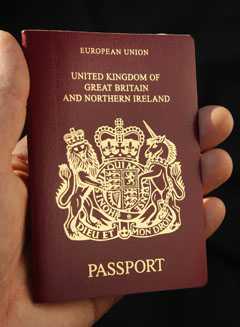
At least all those non-EU citizens wanting to live and work in the European Union now know where Malta stands. If they have a spare €650,000, plus more for dependents, they will be able to treat the whole family to Maltese passports. In so doing, they will effectively buy full access to all 28 EU countries – and the right to visit many others visa-free.
However Malta’s move is viewed – and Brussels is not happy, but currently has no mechanism to prevent it – there is virtue in clarity.
According to Chatham House for a brief period, a limited number of rich people will be able to obtain citizenship of an EU country by contributing to a Maltese development fund. Such paid-for provisions are not unheard of: Britain and others already offer a path to citizenship for £1 million-plus investors.
But Malta’s scheme, as originally concieved, differs in having no residence requirement. It really is offering a passport of convenience.
Some might reasonably object that the fuss about Maltese passports ignores the ease with which members of the global elite – aside from those expressly blacklisted – are already able to cross borders. It is the rest, including the new middle classes of the emerging economies, for whom visa restrictions are burdensome. And frustrated applicants reserve some of their most bitter complaints for Britain.
The point was made pithily a few years ago by the Russian liberal politician, Grigory Yavlinsky, when he spoke at Chatham House. After making a plea for Britain to relax visa restrictions on Russians, he remarked with heavy sarcasm that there were some Russians, including those with dubious pasts, for whom entry to the UK was no problem.
To judge by my inbox, the ill-feeling generated by the British visa system has only increased. Many complaints are about delays, costs and carelessness with crucial documents. But recurrent themes are the supercilious attitude of officials and a perception that the rules are applied both inflexibly – formulaic box-ticking – and arbitrarily.
In recent months, I have learnt of several individuals from former Soviet states whose applications to visit relatives for a short stay have been turned down, even though they have visited regularly over several years. I have also attended conferences where featured speakers have received their visas late or not at all.
Unfavourable comparisons are made with other EU countries in the Schengen zone – the 22 EU members which have abolished passport controls at their common borders – or even with the United States.
Part of the explanation may be the ambivalence and sheer muddled thinking that often seems to prevail at the very top. On the one hand, the British Government has an electoral mandate for a sharp reduction in immigration. Yet its toughest talk concerns prospective new arrivals from Romania and Bulgaria – about whom it can actually do nothing.
On the other hand, it is keen to attract ever more overseas (non-EU) students, while refusing them the right to stay after graduation.
Looking enviously across at France, it also wants many more tourists, especially those, such as high-spending Chinese, of whom France attracted six times more than Britain last year.
To this end, the Chancellor, George Osborne, recently proposed simplifying the visa rules for Chinese business people and tour groups if they were also applying for a visa from one of the Schengen countries. France has since gone one better by providing a 48-hour service. The race for the Chinese yuan is on.
However, Britain’s efforts to be competitive have only introduced more inconsistencies. Membership of Schengen has been rejected by successive UK governments on the grounds that it would mean contracting out border security to other EU countries. Yet, as is now tacitly acknowledged, nonmembership puts Britain at a disadvantage in the tourism stakes. So it has come close to accepting the Schengen visa process in practice, but only for well-heeled Chinese.
One consequence could be resentment on the part of others, including those from the Commonwealth and the former Soviet Union. Individual visitors – relatives, artists, performers or academics – already feel they receive short shrift. Positive discrimination for Chinese business people and shoppers could only make matters worse.
UK visas are a particularly sore point among Russians, with the British authorities stressing security concerns, and Moscow insisting that any liberalization be reciprocal. It would be facetious to suggest that the new arrangements for Chinese could be extended to others – by requiring, say, sponsoring organizations, to include generous shopping vouchers with their invitations.
But should the way to a British visa really lie through Harrods? There must be a more equitable, less mercenary, way.
Officials: ‘Air pirate’ claims bomb on board, tries to have plane go to Sochi
According to CNN, a passenger announced Friday “that there was a bomb on board” his plane and wanted it diverted to Sochi — the Russian city hosting the Winter Olympics amid terrorism fears — Turkish officials said.
Rather than abide by the request, the Pegasus Airlines’ crew sent a hijacking alert that Turkey’s Air Force Control Center received at 5:20 p.m. (10:20 a.m. ET), Turkey’s semiofficial Anadolu news agency reported.
About 20 minutes later, the same report claimed two F-16 fighter jets scrambled to intercept the Boeing 737-800 and escort it over the Black Sea.
Eventually, the airliner landed safely at Istanbul’s Sabiha Gokcen airport, where video shot soon thereafter showed police and security officials converging on it.
Istanbul’s governor tweeted around 10 p.m. that “the air pirate has been neutralized” and all other passengers “disembarked from the plane without any problems.” Special forces who boarded the plane took him into custody “in a swift operation” without finding a “bomb on him,” Gov. Huseyin Avni Mutlu later told reporters.
“The operation is complete,” the governor said.
Mutlu said that the suspect — who never made it into the cockpit and at one point apparently thought the aircraft was destined for Sochi — “didn’t seem to have consumed alcohol, (but) he may have used some other substances.” He’d brought a carry-on bag with personal electronics and other items onto the Pegasus plane, according to the governor.
The incident came at a tense time given the various threats surrounding the Winter Games, which kicked off in earnest Friday night with its opening ceremony.
Russian security forces have cracked down in recent weeks on suspected militants in the restive North Caucasus republic of Dagestan — which is located on the other side of the Caucasus Mountains from Sochi — and elsewhere in recent weeks after twin suicide bombings in the city of Volgograd in December.
There have also been concerns specifically about explosives-laden airlines. U.S. Rep. Michael McCaul said Wednesday night that the his nation’s Department of Homeland Security issued a bulletin to airlines flying into Russia warning that explosive materials could be concealed in toothpaste or cosmetic tubes.
Airlines warned of possible toothpaste tube bombs
Official: Suspect is Ukrainian
The flight started in Kharkov in Ukraine, and was headed to Istanbul, according to the Transportation Ministry.
While it was in air, “one of the passengers said that there was a bomb on board and asked the plane to not land in Sabiha Gokcen but rather to land in Sochi,” Transportation Ministry official Habip Soluk said on CNNTurk.
The man said the bomb was in the baggage hold, a Transportation Ministry official said.
The aircraft ended up touching down at the Turkish airport at at 6:04 p.m., according to Anadolu, at which point it was moved to a safe zone on the tarmac.
Cihan News Agency of Turkey published a photograph it claimed came from inside the plane showing a man standing in a number 11 sports jersey with empty seats around him and two people in uniform.
Turkish officials have not confirmed that this photograph is from inside the Pegasus airliner or that the man at the center of it is the alleged hijacker.
The Ukrainian foreign ministry issued a statement identifying the suspect as one of its citizens, something that Soluk also said was the case. The Ukrainian ministry said no explosives or guns were found aboard the plane and that the suspect “voluntarily turned himself into police.”
Mutlu, Istanbul’s governor, offered a different take on how the alleged hijacker was detained.
“We had to use force because we were trying to persuade him and he wasn’t persuaded,” said Mutlu, adding Turkish authorities did not use guns and that the suspect suffered “a light injury.”
The suspect never said anything about Circassians — the residents in the volatile region around the North Caucasus mountains — or having lived in the region, according to the governor.
CNN’s Gul Tuysuz reported from Turkey, and Greg Botelho reported and wrote from Atlanta. Journalist Victoria Butenko contributed from Kiev, Ukraine, while CNN’s Michael Martinez contributed from Los Angeles.
Iain Lobban the director of GCHQ (Reuters/UK Parliament via REUTERS TV)
The head of GCHQ, Britain’s electronic intelligence agency, will step down by year’s end, the Foreign Office said. Officials denied his departure was linked to public outrage over mass surveillance revelations by NSA whistleblower Edward Snowden.
Iain Lobban, 53, has served as GCHQ’s director since June 2008. His departure was officially described as a long-considered move, but comes just a few weeks after he was summoned to answer MPs’ questions about surveillance operations in an unprecedented televised open session of the UK parliament’s intelligence and security committee, along with the heads of MI5 and MI6.
“Iain Lobban is doing an outstanding job as director of GCHQ,” a spokesperson said. “Today is simply about starting the process of ensuring we have a suitable successor in place before he moves on, planned at the end of the year.”
Officials dismissed suggestions his decision was influenced by revelations made by Snowden, a former National Security Agency (NSA) contractor, whose leaks revealed details of a massive global surveillance network run by the NSA and other members of the so-called Five Eyes alliance – the US, UK, Australia, Canada and New Zealand.
Despite accounting for the bulk of Britain’s three intelligence agencies’ combined budget of £2 billion, GCHQ had previously attracted far less public attention than MI5 or MI6.
It was damaging media revelations regarding wide-scale collaboration between GCHQ and the NSA that resulted in Lobban being called to appear before the parliamentary Intelligence and Security Committee alongside the heads of MI5 and MI6 in November.
At the hearing, Lobban accused Snowden’s disclosures of seriously damaging Britain’s counter-terrorism efforts, saying extremists had discussed changing their communication methods following the revelations.
Critics, however, have accused GCHQ of working hand-in-hand with the NSA in massively intruding on the private communications of millions of citizens.
In June, the Guardian reported the NSA had secretly gained access to the network of cables which carry the world’s phone calls and internet traffic, and, by 2010, was able to boast the “biggest internet access” of any member of the Five Eyes alliance.
According to media reports, the NSA and GCHQ had a particularly close relationship, sharing troves of data in what Snowden called “the largest program of suspicionless surveillance in human history.”
Around 850,000 NSA employees and contractors with top secret clearance had access to the GCHQ databases, allowing them to view and analyze information garnered from such subtly titled programs as ‘Mastering the Internet (MTI)’ and ‘Global Telecoms Exploitation (GTE).’
Lobban, who first joined GCHQ in 1983, insisted in November that GCHQ did not spend its time “listening to the telephone calls or reading the e-mails of the majority” of British citizens.
Sir Iain’s counterpart at the NSA, General Keith Alexander, alongside his deputy, John Inglis, are also stepping down later this year.
There is also an ongoing campaign pushing for Director of National Intelligence James Clapper to resign for lying under oath by telling Congress the NSA did “not wittingly” collect data on hundreds of millions of Americans.
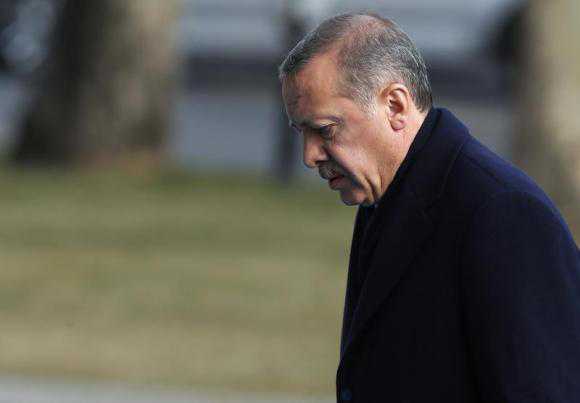
Turkey’s Prime Minister Tayyip Erdogan arrives at the cabinet meeting in Ankara
(Reuters) – Turkish Prime Minister Tayyip Erdogan’s government purged hundreds of police officers overnight, media said, as part of a crackdown on a rival he accuses of trying to usurp state power by tarring him with a specious corruption investigation.
Some of the officers, who included members of the financial and organised crime, smuggling and anti-terrorism units, were moved to traffic duties, according to the reports. Ankara police, chief focus of the action, declined to comment.
Despite the dismissals, among them senior commanders, police and prosecutors continued arrests, which on Tuesday targeted the state railway company and a western port.
Erdogan, facing the biggest challenge of an 11-year rule that has seen the army banished from politics, the economy booming and Ankara pressing its role in the Middle East, portrays the raids and arrests as a “dirty plot” by an Islamic cleric. The cleric backs no political party but exercises broad, if covert, influence in police and judiciary.
Details of accusations have not been made public, but are believed to relate to corruption in construction and real estate projects and Turkey’s gold trade with Iran, according to Turkish newspaper reports citing prosecutors’ documents. Prominent business people, the sons of three cabinet ministers and state officials are among those detained for questioning.
The government has hit back by sacking or reassigning hundreds of police across the country since the crisis broke with a day of raids and arrests on December 17.
A second investigation into large infrastructure projects championed by Erdogan, including a rail tunnel beneath the Bosphorus strait linking the European and Asian sides of Istanbul, has been blocked by government.
ECONOMIC IMPACT
Around 350 officers in Ankara, including members of the financial and organised crime, smuggling and anti-terrorism units, were dismissed or reassigned overnight to new roles including traffic or district duties, the media reports said.
According to the Hurriyet daily, some 1,700 police have been dismissed or reassigned in Istanbul and Ankara alone since the corruption investigations became public.
Some would have been directly linked to the inquiries, while others may have been removed because of links to the Hizmet (Service) movement of U.S.-based cleric Fethullah Gulen Erdogan now describes as an intolerable “state within a state”.
The two were close allies when Erdogan’s AK Party was first elected in 2002; but they have fallen out in the last couple of years over policy towards the United States and Israel and a recent attempt by Erdogan to close down the private schools that are the centre of a global Hizmet network.
Prosecutors meanwhile deepened their investigations, with at least 25 more people including public officials detained as part of an investigation into the activities of a port in the Aegean province of Izmir, broadcaster CNN Turk said.
Eight officials from the state railway company TCDD were among those detained in the raids, the company said in a statement, denying reports its headquarters had been searched.
“Neither side appears willing to give up at this stage in this high stakes battle for control of the state,” said Timothy Ash, head of emerging markets research at Standard Bank.
The corruption scandal is shaking investor confidence at a time when the lira currency is languishing around record lows, inflation is rising and growth slowing. As much as its Islamist-rooted ideology, AK Party’s support has relied on its avowed commitment to fight corruption and its economic record.
Erdogan and the Hizmet movement which exercises influence through a network of contacts built on sponsorship of schools and other social and media organisations, accuse each other of manipulating the police and compromising the independence of the judiciary. Hizmet denies unleashing the investigation.
“Purges, or more accurately massacres, are being carried out of civil servants who are fulfilling their duties defined by the law,” Gulen said in a letter to President Abdullah Gul, written as the row intensified in late December but published by the pro-government Yeni Safak newspaper on Monday.
Erdogan, who has won three general elections and remains widely popular, casts the scandal as an attempted “judicial coup”, a foreign-backed plot by those jealous of his success.
The scandal – which exploded on December 17 with the detention of businessmen close to the government and sons of three cabinet ministers – has weakened Erdogan’s AK Party just before local elections due in March and presidential polls in August.
(Additional reporting by Orhan Coskun in Ankara; Writing by Nick Tattersall; Editing by Ralph Boulton)
Documents detailing abuse at schools for aboriginal children taken from their families were withheld, say victims.
Toronto, Canada – When Edmund Metatawabin was five years old, he was sent to a remote church-run school for aboriginal children in Canada where he, and hundreds of others, say they faced years of abuse and torture.
Metatawabin spent about 10 years at the school, beginning in the 1950s. One morning, he says, he was feeling ill and threw up while eating porridge. He says he was slapped and told to go upstairs. When he felt better – four days later – he went back to the dining hall and was forced to eat his own vomit.
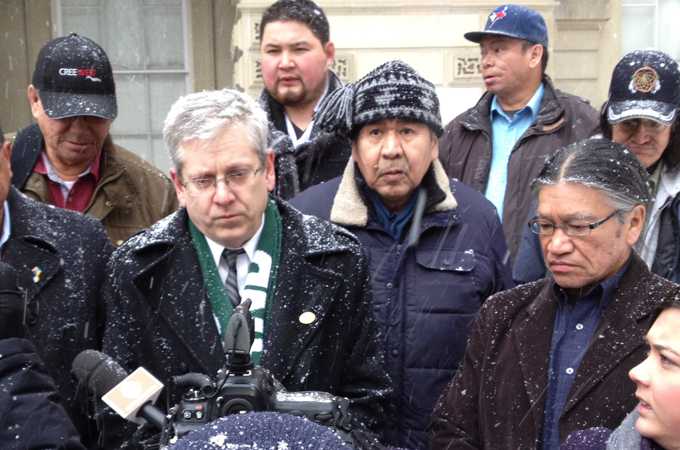
Edmund Metatawabin (right) seeks documents on abuse at a church-run school [Kristina Jovanovski/Al Jazeera]
Metatawabin, 66, says at times he and his classmates were forced to sit in an electric chair – either as punishment or as entertainment for the staff at St Anne’s Indian Residential School, which operated from the early 1900s to 1976 in northern Ontario province. “I was given that porridge I got sick on and I had to eat that … And if you don’t eat, then you’re going to get beat up some more, and you’re going to get punished – and if you throw up again you’re going to have to eat that too, so what choice do you have?”
Residential school students at Fort George cemetery in November 1946 [Truth and Reconciliation Commission]Now, Metatawabin says, the government is hiding information about the school.
St Anne’s was part of a government-supported school system to “assimilate” aboriginal children. About 150,000 indigenous children were forcibly removed from their families by the federal government for decades starting in the 1800s and put into church-run “residential schools”.
Many suffered physical and sexual abuse and squalid living conditions, and a Truth and Reconciliation Committee recently said at least 4,000 died children died – a number that could be much higher.
Not an isolated case
Dozens of former St Anne’s students are seeking documents they say will support their claims of abuse to present to private compensation hearings, in which victims tell their stories to an adjudicator.
Fay Brunning, a lawyer representing about 60 victims, says the Canadian government had been hiding evidence by withholding those documents, which include police files and transcripts from trials of alleged abusers.
There was such widespread abuse there I think they were afraid of how many claims they would get out of St Anne’s.
– Fay Brunning, lawyer
“There was such widespread abuse there I think they were afraid of how many claims they would get out of St Anne’s … they wanted to make sure they paid as few people as they could,” says Brunning.
In 1992, Metatawabin, who at the time was chief of the community where the school had been located, helped organise a conference of former students where they shared their stories.
An investigation by the Ontario Provincial Police followed, leading to charges against seven former employees. According to the Canadian Press news agency, five of them were convicted, including for assault causing bodily harm, indecent assault and administering a noxious substance.
Brunning says many abusers escaped justice because they died before charges were brought. She says the government obtained a significant amount of police files and trial transcripts in 2003, but only admitted it had them in 2013. The government is legally obliged to provide all documents relating to abuse at residential schools, says Brunning.
She argues having these documents would greatly support a victim’s story during hearings for compensation because the adjudicator would know about convictions of those accused of abuse, the evidence that was provided in court at the time, as well as the allegations made during the police investigation.
‘Re-victimisation’
Brunning says former students are being re-victimised because they are being put into vulnerable positions to face powerful lawyers without all the evidence to support their claims. “There’s an overall recognition [that] what happened to them is wrong – but then it’s happening again. The actual knowledge of proven abuse, proven in criminal courts of law, [has] been covered up … and it’s extremely unfair.”
Neither the department of justice or department of aboriginal affairs would grant Al Jazeera interviews for this report.
However, the office of the aboriginal affairs minister emailed a statement, saying: “Our government takes our obligations under the Indian Residential Schools Settlement Agreement seriously and we continue to ensure that the government fulfills its obligations under the Agreement. In order to bring clarity to these issues, we are seeking direction from the Ontario Superior Court with respect to the Ontario Provincial Police documents. We look forward to receiving the court’s decision.”
In a document submitted to the court, the government says the files are unlikely to be useful for claimants seeking compensation. The government has also argued there are privacy concerns in handing over documents detailing abuse.
I can’t for the life of me in 2013 understand why a government would choose to cover up the horrific abuse that happened at St Anne’s.
– Charlie Angus, MP
However, Brunning says the files would be kept confidential during the private hearings of victims.
New Democratic Party MP Charlie Angus, whose constituency includes the community where St Anne’s was located, says there are means in place to keep a victim’s privacy and the government is using such concerns to protect itself.
“I can’t for the life of me in 2013 understand why a government would choose to cover up the horrific abuse that happened at St Anne’s, why they would side with the perpetrators rather than the victims,” Angus says.
Metatawabin says aboriginal elders encouraged victims to tell their stories, and the community has not raised concerns of privacy in the government handing over the files. “Did we ever say anything about privacy? The government says that and that’s an excuse, privacy is just an excuse … to hide everything.”
Ultimately though, once the issue was brought to court in mid-December, the government did not oppose handing over the police files and trial transcripts, according to the Truth and Reconciliation Commission (TRC) on residential schools, which also requested the documents.
Brunning says while this was a major victory for victims, trust in the system has now been lost. She is asking the court to order an affidavit from the government – listing all the documents in its possession relating to abuse at St Anne’s – and to set up a neutral body to monitor the process. She says there could be other files the government is hiding.
Abuse was not limited to St Anne’s. In December, the CBC reported that a former supervisor at another residential school was given three years in jail for sexually abusing boys, drawing criticism from victims that the punishment was too lenient. The prosecutor had asked for 11 years in prison.
‘Like little white children’
In 2007, thousands of lawsuits from former students across the country led to Canada’s largest class-action settlement. The Indian Residential Schools Settlement Agreement was established to provide compensation to those abused. Between the 1860s and 1990s, 150,000 aboriginal children attended these schools, which were normally run by churches but funded by the government, according to a report by the TRC.
Residential school students in Wabasca, Alberta [Truth and Reconciliation Commission]
It states the widespread physical and sexual abuse – and loss of aboriginal culture – led to the traumatisation of generations of children, high mortality rates, low educational levels, and destruction of aboriginal families.
Metatawabin says the St Anne’s staff insulted his family and appearance to erode his identity. As was common in residential schools, he was banned from speaking his aboriginal language.
“We were supposed to come out of [a] residential school like little white children, speaking English and thinking like the way the English people think.”
All nine of his siblings attended the school, meaning his father had to send a child there every year for 10 years. Each sibling faced similar abuse.
The abuse at St Anne’s is considered among the worst that occurred within the residential school system.
“It represents the most extreme examples of abuse that certainly have come to my attention so far, short of murder. It’s obvious the children were tortured in horrific circumstances,”says Julian Falconer, a lawyer for the TRC.
It is not known when the court will hand down a decision, but Brunning says the judge knows the issue is urgent as some of the claimants are elderly. Time has run out for others, though. Of the 150,000 children sent to residential schools, the TRC estimates just 80,000 are still living.
As for Metatawabin, he is following the advice of aboriginal elders and sharing his story so that people can better understand the struggles of his people.
“Every time I do this, it’s not a threat anymore, and it doesn’t get me down anymore. I do it so that [people] will learn about what [we] went through … and that when you see a person on the street, you will know they were treated very badly as a child.”


![Residential school students at Fort George cemetery in November 1946 [Truth and Reconciliation Commission]](https://www.turkishnews.com/en/content/wp-content/uploads/2014/01/Residential-school-students.jpg)
