Category: Travel

  • Words behind the glass

    Words behind the glass

    On an edifying visit to the museum of literature tucked away in the garden of the Topkapi Palace in Istanbul.

    By Benny Ziffer Tags: Israel Turkey

    ISTANBUL – The guards at Topkapi Palace looked at me in surprise when I asked them the whereabouts of the Alay Kosku – the exhibition pavilion where, according to what I had read in the newspaper Zaman, a museum named for the Turkish writer Ahmet Hamdi Tanpinar had recently opened. Eventually, it was one of the clerks in the palace museum shop who directed me to the fancy building with the rounded-pointed roof in the back of the Topkapi garden, with a steep mound leading to its entrance. Only there, after the strenuous climb, was it possible to read clearly the sign stating that this was indeed the museum designed to celebrate Turkish writers in general, and hallow the name of Tanpinar specifically, a writer who died in 1962 and whose standing in the history of Turkish literature is akin to that of Agnon’s in Hebrew literature. Except that Tanpinar did not win a Nobel Prize.

    It was Tanpinar’s misfortune to be a writer in a language that has always had bad PR outside its own country. Precious few can appreciate the subtlety of the Turkish poetry written in the courts of the sultans during the same era as that of European Baroque poetry. Even fewer know that a national-romantic genre of poetry developed in Turkey concurrent with the national-romantic poetry of the Continent, and that it also had elements of symbolism and Dadaism and surrealism. And that, along with the emergence of realistic fiction in Europe, Turkey had its own Chekhov in the guise of short-story writer Sait Faik Abasiyanik, whose house on the little island of Burgaz in the Sea of Marmara serves today as a museum in his memory. And so on.
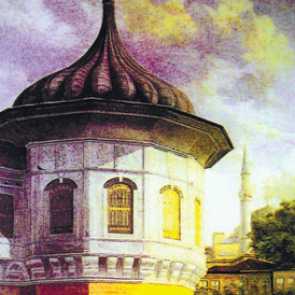
    The Alay Kosku.

    Truth be told, until writer Orhan Pamuk came along, and until the Nobel in literature that he received a half-dozen years ago brought Turkish literature into global awareness – Tanpinar’s name would also not have stood a chance of being known beyond the borders of his country. For Pamuk declared on every occasion that his spiritual father, and the person to whom he owed his talent, was Tanpinar, the father of modernism in the Turkish novel – the writer who combined in his great novel, “A Mind at Peace,” the emotional storminess of Dostoevsky with the refined artificiality and cruel psychological analysis of Marcel Proust.

    The protagonists of Tanpinar’s books wage a daily war on time, in the sense that they are incapable of adjusting to modernity and are frozen in molds that prevent them from being free. This is indeed the subject of Tanpinar’s other famous book, “The Time Regulation Institute,” a revered work in Turkey, a book of many riddles. As one reads it, one sees that while the novel mocks bureaucracy, it also tells the tragic story of Turkey, a land that has never managed to keep up with global times, and either falls behind or runs after them breathlessly.

    Glasses and pens

    What could a museum of literature possibly have to show? Literature, after all, is not something that can be locked up behind the panes of a display case. What can be displayed – and indeed this is precisely what you see – are literary “fetishes”: Tanpinar’s top hat, his glasses, his pens and his manuscripts in Ottoman Turkish – for he lived much of his life before the Arabic alphabet in Turkey was replaced by Latin characters. Each of the decorative, high-ceilinged halls in this museum, covered in wood paneling, are devoted to another canonical writer, including of course Pamuk, who has been honored with an impressive bust installed beside the display case that holds all of his books in their various translations (although I did not see Hebrew there ).

    It was moving to see the respect accorded here to the German-Jewish scholar Erich Auerbach, in the form of a glass cabinet full of manuscripts. Auerbach was the author of the seminal book of literary theory “Mimesis,” which he wrote in exile in Istanbul in the 1930s. He was one among an entire community of Nazi-persecuted scholars whom Turkey welcomed with open arms in those years. It is doubtful whether there are many in Israel today who know anything about Turkey’s contribution to saving Jewish intellectuals in those terrible times.

    In the basement are displayed original copies of the early works of the great communist poet Nazim Hikmet, and copies of the journals he published with his comrades in the anti-fascist underground in Turkey. These underground editions were printed on cheap paper, which has now yellowed. As the Germans advanced toward Turkey and the country’s relations with the Third Reich warmed up, Hikmet raised his voice in protest – and was thrown in jail; his leftist friends were sentenced to forced labor in Turkey’s hinterland. Hikmet himself was ultimately banished from his country and his writings banned there. He died brokenhearted in Moscow, in 1963, after writing beautiful homesick poems about the beloved Istanbul he was never to see again.

    Between the pages of these journals are hidden some of the things Hikmet and his friends wrote, from the depths of their hearts and souls, in condemnation of Turkey’s anti-Semitic and racist policies at the time. Those were indeed dark days, in which a property tax was levied on Jews and others “who are not Turks” at an impossible rate that was designed to bankrupt them. Whoever could not afford to pay was sent to perform forced labor in country’s east. So this, too, is a little-known fact: that there were those who put themselves and their freedom at risk to protest this discriminatory policy.

    Since I was the sole visitor to the museum, the docents swooped down on me. When I told one of them that I was from Israel, she passed the rumor along from hall to hall and from floor to floor. In my honor they called in the guy who is in charge of the cafeteria. He opened it up for me, and there they sat me down and served me tea.
  • Sultanahamet worth seeing in Istanbul

    Sultanahamet worth seeing in Istanbul

    Rita Gatlin & Jackson Vereen, Corte Madera

    We went because: On a previous trip to Greece, we ventured off to Istanbul. What an adventure. We had to go back – history, food, shopping.

    Don’t miss: Sultanahamet, the oldest section of Istanbul. And the Turquoise Coastline is a must-see. Spectacular. Breathtaking.

    Don’t bother: Going to Bodrum. Ho-hum. Too many tourists and trinket shops.

    Coolest souvenir: Turkish tea cups made by a local artisan in Kas.

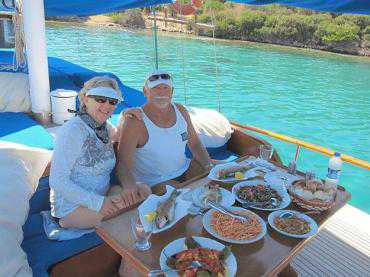
    Worth a splurge: Day of sailing to coves around Kekova, an ancient sunken city, with a local family. A feast and fresh fish prepared on deck.

    We wish we’d packed: Less clothing. We had to buy a suitcase to fit all the treasures we bought.

    Other comments: We enjoyed hiking to many ancient sites and were surprised at the stunning beauty of the coastline.

    This article appeared on page N – 2 of the San Francisco Chronicle

    via Sultanahamet worth seeing in Istanbul.

  • Video: Music marks 550 years of Istanbul’s Grand Bazaar

    Video: Music marks 550 years of Istanbul’s Grand Bazaar

    It has been dubbed the world’s oldest shopping mall.

    And to mark 550 years of the Grand Bazaar in Istanbul, a top Turkish musician has been doing what he does best, in an anniversary concert.

    “As a son of this land, together with the Turkish classical military band and representatives of three big religions, we will play and perform a Jewish psalm, then a Christian psalm and a Muslim psalm,” said classical pianist and composer Tuluyhan Ugurlu in a break from rehearsals.

    Euronews


  • I Put the Jew Back in Jewelry

    I Put the Jew Back in Jewelry

    Today I bought every piece of jewelry in Istanbul. Jill and I took a Grayline tour today to the Blue Mosque and the Hagia Sofya. There were both very beautiful and I have the pictures to prove it. OUr tour guide kept telling us that we had 20 minutes to “wisit” this and 15 minutes to “wisit” that. Jill and I were giggling. Of course, it wouldn’t be a guided tour without a stop at some store with “special prices”. We went to a jewelry/rug store and they did a rug demonstration about different weaving methods, materials, etc. They gave us all hot tea and it was apple flavored, it was delcious! Who wants a box? In Turkey it is good manners to offer tea to your guests, so every shop we stopped in to look, they offered tea to us.

    Most important of all, we went to the Grand Bazaar and boy, was it grand! Wikipedia Link I could be happy just exploring that the entire time I’m in Istanbul. You cannot imagine what it was like. Supposedly there are 4,000 shops inside; and it’s covered. It wasn’t like the markets in Asia that are “covered” by a tarp or a corrugated metal “roof”. You could walk around pleasantly. There are alleys or sections for each type of thing you want to buy. They have a jewelry section, a rug section, a leather section, and about a million other things. Unfortunately, we came in through the jewelry section and I literally could not walk 3 feet without looking in a window. Everything was so sparkly. They have the MOST gorgeous jewelry here, lots of unusual items. They have a lot of matte gold and oxidized silver and gold. EVERYONE should come to Istanbul and shop. You would think that each shop would have the exact same things as the other, but that wasn’t necessarily so. The men in the shops are very patient and schmooze with you but somehow they manage not to be pushy. Of course, everyone has “the best deal for you” and I walked out of there thinking I was the most beautiful person in the world, because they all told me so. I kept saying over and over how excited I was and how i’ve never seen so many goodies before in my life. Oh, how I wish I were in the market for a diamond piece of jewelry, they had so many beauties! I have to go back again. Maybe I will win the Turkish Lottery and they won’t allow me to take my money back to NY and I will have to spend it all here.. I could be so lucky!

    They have the worst tv here, no Animal Planet, Sara. They have 6 English channels here and one of them doesn’t work. Two of them are news channels and one of them is dedicated to showing only the worst movies ever made. Ones that even I wouldn’t see.

    Oh, and if I said everything smells like kebap yesterday.. today everything smells like cigarettes. The bazaar is sort of indoors but everyone is smoking. I had to take a shower the moment we got back to the room, which was around 5:00. After being on the go for about 9 hours today, we’d had enough.

    Tomorrow we have a tour at 2:00 and we are going to the Asian side of Istanbul and going to see the Bosphorus. We are going to try to go to the Topkapi Palace in the morning after a unrushed (you like that word?) morning.

    Have a wonderful day!

    via I Put the Jew Back in Jewelry – Istanbul, Turkey Travel Blog.

    This travel blog photo’s source is TravelPod page: I Put the Jew Back in Jewelry
  • Turkey’s RevPAR one of the strongest in Europe

    Turkey’s RevPAR one of the strongest in Europe

    The FINANCIAL — Istanbul, Turkey December 2011: Istanbul looks poised to enjoy a period of exponential growth in terms of revenue per available room and daily rate, accordingly to Jonathan Worsley, Chairman of Bench Events, co-organiser of the Central Asia and Turkey Hotel Investment Conference. From Strategic Solutions .

    Reports reveal year-to-date performance up to September 2011 of ADR growth of 34 per cent and RevPAR of 29 per cent. Meanwhile, other reports suggest Istanbul is the third-fastest growing tourist destination in terms of visitor numbers, surpassing New York and Amsterdam with most visitors travelling from Saudi Arabia, Iran and UAE closely followed by the United States and Europe.

    Worsley said that industry figures show Turkey as the hot spot of the region and sitting high on many ‘Top Destinations 2012’ guides.

    Quoting figures by STR Global, Worsley said that the hotel infrastructure in Turkey has undergone development, with an addition of 1,868 hotel rooms since 2011.

    “After a period of economic lull, Turkey is experiencing steady positive GDP growth. At the same time, the Turkish Lira’s flexibility against the Euro and US Dollar is very reassuring to the overall hospitality industry.” concluded Worsley.

    The Central Asia & Turkey Hotel Investment Conference will run from February 6 -8, 2012 at Ceylan InterContinental , Istanbul and is organised by Bench Events. The conference features a cast of speakers with knowledge and expertise in regional and international hotel development, finance, hotel branding and operations, plus sessions giving perspectives from industry analysts.

    Speakers include Cevdet Akcay, Chief Economist, Yapi Kredi Bank; Denis Hennequin, President & CEO, Accor SA; Eric Danziger, President & Chief Executive Officer, Wyndham Hotel Group; Angela Brav, Chief Executive Officer – Europe, IHG; Kurt Ritter, President & CEO, The Rezidor Hotel Group; Atilla Ozturk, CEO & Board Member, ASTAY; Serdar Bilgili, Chairman, Bilgili Holding; Simon Vincent, President – Europe, Hilton Worldwide; Roeland Vos, President EAME, Starwood Hotels & Resorts Worldwide; and Lado Sakvarelidze, Chief Financial Officer, Redix.

    The event also offers various networking opportunities, as well as an exhibition.

    via The FINANCIAL – Turkey’s RevPAR one of the strongest in Europe.

  • İstanbul receives 16 percent more tourists in first 11 months

    The number of tourists visiting İstanbul from January through November of 2011 has increased by 16 percent compared to the same period one year ago, according to official figures.

    İstanbul Provincial Culture and Tourism Directorate figures for 2011 reveal that İstanbul attracted 7,509,000 foreigner tourists from January through November. This number was 6,489,000 in the first 11 months of 2010.

    In the first 11 months of 2011, 6,959,291 tourists arrived in İstanbul via the city’s Atatürk and Sabiha Gökçen airports, while 550,046 tourists arrived via the ports of Haydarpaşa, Pendik and Karaköy.

    The port used most by tourists is Karaköy, which received 460,855 tourists in the first 11 months.

    İstanbul received the highest number of tourists in July — 916,486, whereas January saw the least number of tourist — 378,380.

    Germans made up the largest number of foreign tourists visiting the city, with 12.3 percent of the total number of tourists. Russia and the US ranked second and third, with respectively 6.1 and 5.6 percent of the total. Italian, French, English and Iranian nations followed on the list, respectively.

    The number of Arab tourists visiting İstanbul rose by 28.5 compared to 2010. The Arab tourists accounted for 11.1 percent of the tourists coming to İstanbul.

    Saudi Arabia is the country from which citizens coming to Turkey increased the most with an increase of 71.3 percent of the total. Iraq followed Saudi Arabia with 64.7 percent, and Kuwait followed Iraq at 40 percent.

    Arab interest in Turkish culture — from TV soap operas, pop music and food to Turkey’s rehabilitation of its Ottoman history — has helped bring in an influx of Arab tourists to Turkey in recent years.

    via İstanbul receives 16 percent more tourists in first 11 months.turizmtatilseyahat