Category: News

  • Turkish jets target PKK in Iraq

    Turkish jets target PKK in Iraq

    The Turkish military has said its warplanes have attacked Kurdish separatist targets in northern Iraq.

    The military, in a statement on its website, said 13 targets were “successfully hit” in the raids.

    There was no information on any casualties suffered by the Kurdistan Workers Party (PKK).

    Wednesday’s attacks, in the Zap region, were the latest in a series carried out by Turkey since it intensified operations at the end of last year.

    The Turkish statement said its military would press ahead with anti-PKK operations inside Turkey and across the border in Iraq “according to military needs”.

    Turkey accuses PKK rebels of using hideouts in northern Iraq as part of their campaign for self-rule in mainly Kurdish south-east Turkey.

    Some 40,000 people have been killed since the PKK launched its campaign in 1984.

    Source: BBC, 24 July 2008

  • Turkey, Georgia, Azerbaijan launch joint rail link

    Turkey, Georgia, Azerbaijan launch joint rail link

    By Hatice Aydogdu


    KARS, Turkey, July 24 (Reuters) – Leaders of Turkey, Georgia and Azerbaijan launched a railway project between the three countries on Thursday, building on links already forged by gas and oil pipelines.


    At a railway station in the eastern Turkish border town of Kars the presidents of the three countries held a ground breaking ceremony for the $290 million Turkish section of the railway.


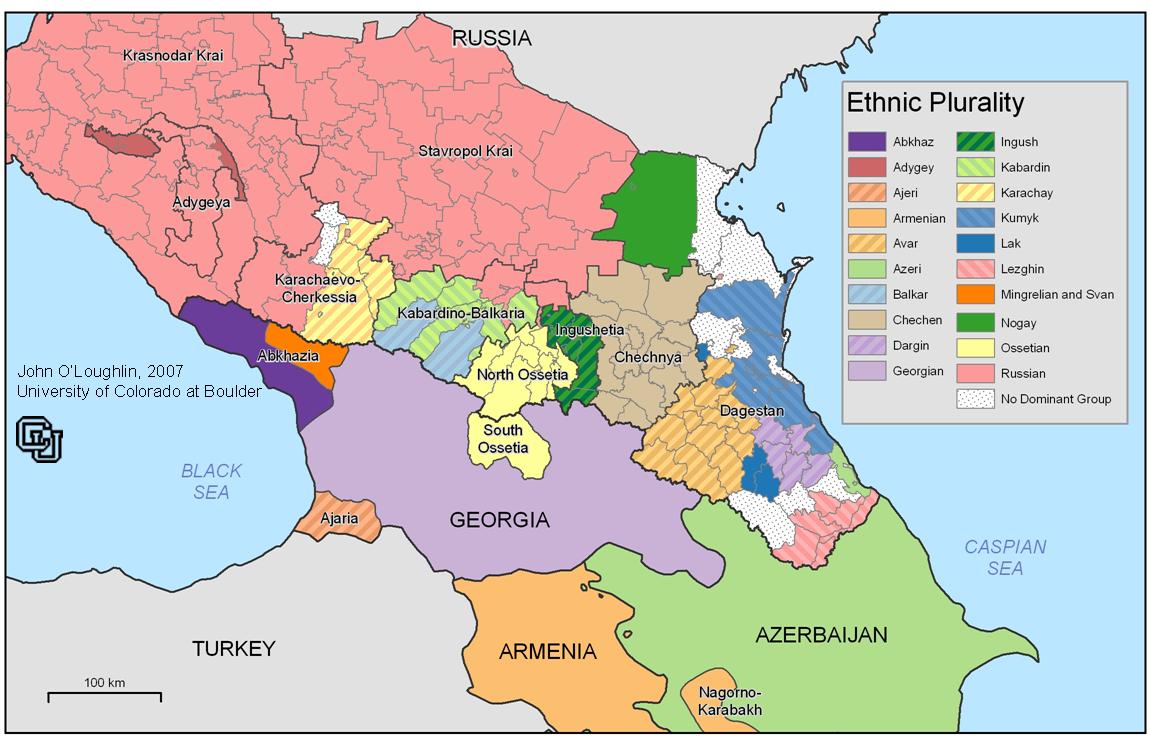
    The three countries are already linked by the BP-led Baku-Ceyhan oil pipeline and the Baku-Tbilisi-Erzurum gas line but trade links between Turkey and the Caucasus region are limited.


    Turkish President Abdullah Gul, Georgia’s Mikheil Saakashvili and Azerbaijan’s Ilham Aliyev placed three sections of railway track on a large map of the region in a symbolic launch of the project as confetti showered down.


    A tender last September for construction of the 76-km (47-mile) Turkish stretch of the railway was won by the Ozgun Yapi-Celikler joint venture with a bid of $289.8 million, the lowest of 14 bids.


    The project involves new track construction and renewal of existing track, and is expected to be completed in 2011. (Writing by Daren Butler; Editing by Jon Boyle)

  • Turkish stretch of railway linking Turkey, Georgia, Azerbaijan launched

    Turkish stretch of railway linking Turkey, Georgia, Azerbaijan launched

    ANKARA, Turkey: The Associated Press – The presidents of Turkey, Georgia and Azerbaijan have launched the construction of the Turkish stretch of a railway linking their nations.

    The US$600 million rail line will connect the Azerbaijani capital, Baku, with the eastern Turkish city of Kars, via the Georgian capital, Tbilisi.

    The project is one of several linking oil-rich Azerbaijan and Central Asia with Turkey and European markets while bypassing Russia.

    A groundbreaking ceremony in Kars Thursday marked the start of the 50 mile (76 kilometer) Turkish section of the 110 mile (180 kilometer) railroad.

    “We are launching the iron Silk Road,” Turkey’s Abdullah Gul said. “It will link China in Asia to London.”

    The Silk Road was an ancient Asian trading route. The railway will be operational in 2011.

    Source: International Herald Tribune, July 24, 2008

  • IF THE TURKISH SECULARITY GOES, SO GO THE TURKISH WOMEN’S RIGHTS

    IF THE TURKISH SECULARITY GOES, SO GO THE TURKISH WOMEN’S RIGHTS

    I read Mark Mackinnon’s article “Traditional head scarf unveils new rifts in Turkey”  (Globe, July 22, 2008) with interest.   There seems to be a chaos of concepts—and I mean it in the nicest possible way—involving the dichotomies  secularism and Islam, modern law  and  Islamic canon (Sharia,) the elites and the uneducated, the periphery and the center, black Turks and white Turks, old guard versus Islamic reformers, and more.  I  urge your readers to gain a deeper understanding of dichotomies before jumping into evaluating the recent issues about Turkey.   Let’s see if I can shed some light on all this. 

    While the Christian world is inherently endowed with separation of Church and State,  thanks to the age of enlightenment in history, the Islamic world continues to treat democracy and secularism as opposite sides of a coin.  Most Muslim countries today still enshrine in their constitutions the Shariah which is not compatible with secularism or democracy. Turkey, on the other hand, with its 99 percent Muslim population, was founded in 1923 as a secular republic. Thus, the development of democracy in Turkey was built on sound secular foundations.   Secularism is not “being opposed to religion”.  It reflects a profound respect for all faiths as secularism guarantees individual freedoms while rejecting superiority of one faith over another.  If Turkey’s secular foundations are demolished, then its democratic structure will soon collapse.  What does the AKP representative in your story say to that?

    The Turkish population and governments since 1923 had always been basically pro-Western, although some 5 -7 % of the voters, mostly from  various religious circles, seemed to always oppose any degree of Westernization.  The 1979 Iranian revolution had a considerable impact in the entire Muslim world.  In addition, some Middle Eastern countries (like Saudi Arabia) tried very hard to export their version of Islam and provided financial support to various Islamic circles in Turkey.  Combined, these two causes resulted in a religious explosion:  publishing companies started popping up, Islamic publications multiplied, mosques began to appear on every corner and soon turned into centers for enforcing Islamic lifestyle. Women were “trained” and sent to every Turkish low-income household to influence and instruct other women.  Koranic courses were organized to brainwash children at an early age.  High school and university students were financially and unconditionally supported.  Public demonstrations were staged demanding female students to enter university with Islamic attire, including the headscarves. The religious press stressed that women should  also cover up all of their body parts. Most of the militant female university students were well paid and insisted to attend classes dressed in chador (a dark traditional garment that covers head to toe.) They were  supported by Islamic extremist male school mates and lawyers.  All this, while the Koran only suggests but does not order women to cover their hair.  Most in the media supported Islamic women university students without knowing that those students wearing head scarves were hired.     (Fatma Benli in your story reminded   me of this.)         

    Erdogan’s government started to chip away at the secular system since 2002. Today, the big picture is not as innocent as some in western press portray:  there are 67, 000 secular schools versus  85,000 mosques.  Compare the 77,000 doctors trying desperately to dispense good health to 75 million Turkish citizens, with 90,000 well-paid religious appointees (or imams) happily dispensing faith at state’s (taxpayers’) expense.  While there is a single hospital serving 60,000 persons in Turkey, there is no problem finding a mosque for every 350 people.  There are 1,435 public libraries all over Turkey, but 3,852 Koran courses. The budget of the Religious Affairs is equal to the cost of 22 universities.    The          Erdogan government encourages his supporters (and their companies) to stimulate the Islamic way of life around them.  Growing number of hotels and municipalities have already built segregated swimming pools, the head-to-ankle swimsuit for women and “hasema” for men.  Secular advertisements aimed at women have been photo-shopped by some newspapers to lengthen sleeves and skirts of the models in photos.  Some hotels and restaurants have stopped serving alcohol.  There are reports of alcohol licenses being refused and internet porn sites being banned. And imams— Islamic preachers employed by government—continue to fire at will at women who dare to go out and work for an honest living.

    Equally disturbing is the various forms of public pressure put on women for not having dressed more “Islamic” or for sharing the public space with men. Islamic press insist that it is not appropriate for male doctors to examine female patients, and vice versa. Some medical students tried hard to apply these Sharia rules in Turkey, but were stopped by the secular establishment. All of the examples mentioned above are straight from the playbook of Iran and Saudi Arabia.  As we watch official Islamization programs in Malaysia, Morocco, Algeria, Indonesia, and Iran, we can clearly see how these once “Islamic countries” turned into “Islamic states.”   In each case, women first were ordered to cover-up their heads and bodies, and systematic changes in daily lifestyles were gradually instituted after that.  Sounds familiar?

    Headscarf is more than a piece of cloth:   Pinned carefully to conceal the neck, throat and hair, Islamic headscarf has become the unmistakable symbol of political Islam.  This is why secular people have been insisting on keeping it out of the universities and government institutions, as the secular laws require.  If still in doubt, the reader should know that the Turkish PM recently made a public statement saying something to the effect “…So what if the headscarf is a political symbol?..”.  This statement reveals his intentions and also those of his political Islamic party.   The European Court of Human Rights ruled in favor of the prohibition of head scarves in Turkish universities in November 2005, commenting that ”the head scarf appeared to be imposed on women by a religious precept that was hard to reconcile with the principle of gender equality”. The Turkish Constitutional Court also overturned a law, engineered by  the Islamist AKP that would have allowed women in the secular republic to wear Muslim headscarves in universities.     The Western world does not seem to be aware of the immediate and serious threat posed to women’s rights in Turkey.  There is not a single example of a Muslim country where women’s rights have advanced one iota after religion has been politicized. 

    The alternative to religious extremism is not military coup d’etat.  I do not justify a military intervention such as that of April 27th, 2008. However desirable it may be to preserve Atatürk’s secular legacy, that should not  come at the expense of overriding the normal process and institutions of democracy.

    Plainly put, therefore, head scarf is men’s tyranny over women.  Any attempt to justify this direct and brutal assault on women’s rights, whether  in the name of democracy, human rights, freedom of expression, or other principles, is simply taking part in this tyranny.

     Ozer Aksoy

    ex VP & acting President of “The Federation of the  Turkish Canadian Associations”,Toronto,Ontario CANADA
    VP of The Turkish World Congress, 821 United Nations Plaza,New York,NY USA

    Home Address:
    693 Windermere Road on the Thames,Suite #207
    LONDON,ONTARIO CANADA 
    N5X 2P1

    Home Phone:   519-438-9766
    Cell Phone   :   519-860-9096
    Car Phone    :   519-280-6054

  • REUTERS:  Turkey detains 26 in coup plan investigation

    REUTERS: Turkey detains 26 in coup plan investigation

    E-mail: [email protected] 

    REUTERS:  Turkey detains 26 in coup plan investigation

    Turkish police detained 26 people on Wednesday in connection with an investigation into an alleged plot to overthrow the government, state-run Anatolian news agency said. The raids were part of an operation against the shadowy, ultra-nationalist Ergenekon organisation, which has fuelled uncertainty in Turkey and unsettled financial markets. Eighty-six people have been charged with involvement in the plot against Prime Minister Tayyip Erdogan’s government, which hardline secularists accuse of Islamist subversion. Early on Wednesday, police staged simultaneous raids in five provinces from Istanbul in the west to Elazig in eastern Turkey, Anatolian reported. [link to article


    Rule on a case that could well plunge America’s most important (one could almost say only) ally in the Muslim Middle East into political chaos. The case pits Turkey’s ruling Justice and Development Party (the AKP) against the Republican People’s Party (the CHP). What the former stands accused of is violation of Turkey’s secular constitution, and if the court rules against the AKP the government will be overthrown and Prime Minister Recep Tayyip Erdogan, along with scores of his closest associates, will be banned from politics for at least five years. [link to article

    EPOCH TIMES:  Turkish Court to Hear AK Party Closure on July 28

    ANKARA-Turkey’s highest court will hold a final hearing in a case to close the governing AK Party for suspected Islamist activities on July 28, a court official said on Tuesday. The Constitutional Court’s verdict, nervously watched by financial markets, could be announced on the same day or soon after. Eleven judges will vote and seven votes in favour are needed to shut down the ruling party. The AK Party is on trial on charges of trying to introduce Islamic rule in Turkey, a predominantly Muslim but officially secular state. A chief prosecutor also wants to bar Prime Minister Tayyip Erdogan, President Abdullah Gul and 69 leading AK Party figures from party membership for five years on charges of seeking to introduce Islamic sharia law in Turkey. [link to article]
     
    AP:  Turkish Cypriot leader hopes for Cyprus reunification talks in September
     
    ISTANBUL, Turkey: The leader of Turks in Cyprus says he hopes talks on possible reunification of the divided island will start in September. In a live interview on CNN-Turk television, Turkish Cypriot leader Mehmet Ali Talat says: “I think these negotiations will start in September.” Cyprus President Dimitris Christofias and Talat will meet on July 25 to assess progress in preparatory negotiations and to decide when to restart direct peace talks. The last such talks were held four years ago. The Mediterranean island was split in 1974, when Turkey invaded after an Athens-backed coup aimed at union with Greece. The breakaway Turkish Cypriot north is only recognized by Turkey. [link to article

    AP:  Emre Belozoglu moves to Fenerbahce on four-year contract from Newcastle

    ISTANBUL, Turkey: Turkey midfielder Emre Belozoglu signed a four-year contract with Fenerbahce on Wednesday. Fenerbahce announced in May that it had agreed an undisclosed transfer fee with Premier League club Newcastle for Emre, but the signing of the contract was delayed due to the European Championship in Austria and Switzerland. Emre only played one game in five at Euro 2008 due to a leg injury as Turkey reached the semifinals. “I worked for many years to represent Turkish football in Europe,” Emre said. “Now, I’m happy to sign with Fenerbahce and I hope to serve them for many years.” Fenerbahce didn’t announce how much Emre would be paid, but television station NTV reported that he will receive an annual salary of €3.5 million (US$5.25 million). The 27-year-old midfielder transferred to Newcastle from Inter Milan in 2005. [link to article]
     
    TRAVEL POD:  It’s Istanbul Not Constantinople

    Flying into Istanbul was the start of an amazing realization of the size of this city. We were directly over the city 30 minutes prior to landing, and we still appeared to be in dense urban sprawl 30 minutes later at landing. The sheer awe and astonishment at the size of this city continued as we drove 70 kilometers on a coach to the city center. The entire 70 km drive was through city as densly populated as downtown San Francisco. Istanbul is by far the largest city either of us have been in. Its population is well over 16 million in the city limits proper and well over 20 milion in the metro area. [link to article]


  • Islam gains momentum after 9/11

    Islam gains momentum after 9/11

    In a recent interview with the BBC, British Home Secretary Jackoi Smith made some interesting observations about the unimaginable rapid spread of Islam in Europe.

    Islam, choicest religion in EU – 21 / 07 / 2008 12:49

    According to Smith, around 50,000 Britons are converting to Islam each year and since 2001, 400,000 Britons have converted to Islam.

    He said the Muslim population in Britain has reached 2 million and followers of Islam are now the second biggest population in Britain after Christians.

    He even suggested setting up an Islamic University in Britain given the overwhelming population of the Muslims in that country.

    The momentum and intensity with which Islam is spreading in the West has puzzled the policy makers, religious scholars, researchers and media there.

    The conversions have especially gained unimaginable momentum after 9/11. Most of the researchers believe that the fast erosion of the religious and cultural values in the Western societies is pushing its people towards Islam that offers a more comprehensive, well-knit and value-oriented cultural, social and family structure.

    According to a recent report in the prestigious Time magazine, hundreds of new mosques are coming up in the West and most of the European cities now get to hear Azan (call for prayer) five times a day.

    In Rome a grand mosque is coming up at a whopping cost of $30 million for which the land has been donated by the local government.

    According to Dr Mehmood Siddiqi Saidi, Director, European Muslim Minority Board, while as per a recent UN report the Muslim population in Europe is 21 million, in actual it could be around 50 million.

     As per the data available at islamicpopulation.com, in 2006 the Muslim population in Europe, including Russia, was around 50.70 million.

    With the increase in Muslim population in Europe, the number of mosques and Islamic centers is also growing speedily.

    While in Britain there were only 13 mosques in 1963, at present there are 600 mosques and 1400 Islamic organizations in the country.

    France, with a population of 6 million Muslims, has 1300 mosques and Islamic centers in addition to around 600 Islamic organizations. The Muslims in France have a 24-hour radio channel. The estimated population of Muslims in France would reach around 8 million during the next 15 years.

    Italy has a population of 1 million Muslims with 450 mosques and Islamic centers. According to reputed Italian magazine The Journal, in next 200 years the European society would almost entirely accept Islam as the only religion.

    Germany has a Muslim population of 4 million with 1400 mosques and Islamic centers. The Muslim population ration in Germany is around 4 per cent.

    In Canada the conversion rate to Islam has been almost 130 percent between 1991 and 2001.

    In Switzerland around 6000 Christians converted to Islam after 9/11.

    According to San Diego University researcher Jan Wax, by 2020, out of every four persons in Europe, one would be a Muslim.

    The ratio of Muslim youth (between 45 and 50% of the Muslims) to EU youth is between 16 and 20%.

     In other words, in a few years Muslims will constitute 16 to 20% of the European workforce, and could therefore influence policies and decision-making.

    Albania has proportionally the largest Muslim population in all of Europe, with the exception of Turkey, which is situated at the crossroads of Europe and Asia.

    According to the most recent census results, Albania’s Muslim population is estimated at 2.2 million, or 70% of the country’s total population.

    Although Albania was officially an atheist society during the Communist period, and all public expression of religious beliefs was banned, today most Albanians are practicing Muslims.

    Following Albania, Bosnia-Herzegovina has proportionally the second largest Muslim population in Europe, with 40% of Bosnians, or 1.5 million people, who practice Islam.

     In Western Europe, France is followed by the Netherlands, which has over 945,000 Muslims, making up 5% of the population.