Category: Culture/Art

  • Hussein Chalayan’s east-west fusion

    Hussein Chalayan’s east-west fusion

    By Peter Aspden

    Hussein Chalayan in the Lisson Gallery this week, before the installation of his new show

    You don’t have to be a regular at the Serpentine Gallery’s achingly cool annual summer party to know that the worlds of art and fashion collude in ever more explicit, and prosperous, ways. Galleries lead the urban regeneration of run-down neighbourhoods that become the new centres of bohemian mischief. Catwalks acquire the kind of audacious conceptual playfulness that would make Duchamp’s experiments look like Constable landscapes. London has led the way in the promiscuous flitting of designers whose chief imperatives are to be loved, to be new and to be seen.

    Now at the Lisson gallery comes an exhibition from one of the most daring figures from this twilight world: Hussein Chalayan, purveyor of sci-fi fabrics, wooden skirts, the fashion designer for whom the phrase “ready-to-wear” has never seemed entirely appropriate.

    Chalayan’s avant-garde credentials are impeccable, right from his justly famous 1993 graduation show from Central St Martin’s, featuring garments that he had buried in the ground to observe the chemical interaction between the ephemeral and the earthly-elemental (the collection was bought en masse by Browns), to his 1998 “Between” spring-summer display that showed models in various states of undress, covered successively by parts of a chador.

    The video of that not uncontroversial show makes riveting viewing, and could easily have been part of a gallery installation, festooned with portentous labels over Chalayan’s genuine interest in east-west dialogues, rather than part of a simple fashion collection.

    But then the words “simple” and “fashion” rarely come together in descriptions of the Turkish-Cypriot designer’s work. “I have always been ideas-led,” he tells me over coffee in Clerkenwell. “I have never thought of a garment differently from the way I think of, say, a film. I give them both the same attention. I used to think of fashion as an industrial process, whereas art is supposed not to be. But art is going that way too.”

    Perhaps surprisingly, but not to those who follow his unpredictable ways, his new piece at the Lisson is not directly related to fashion. “I am Sad Leyla” is an installation that features a performance of a traditional Turkish folk composition by Sertab Erener, one of Turkey’s most successful female singers, accompanied by an Ottoman orchestra.

    The work mixes audio, film, sculpture and musical notation. Hussein says he is interested in picking apart the various cultural influences – Persian poetry, Greek orthodox chanting, central Asian motifs – at play in the work. A de-construction of his ethnic heritage? “That’s too obvious a word. I like the image of a piece of music as a body. And I am disembodying it. It is such a layered piece, you can detect 10 to 15 different cultural things going on.”

    It is also a reminder that being Turkish “is a political, not a racial definition”, he says. “The piece comes from hundreds of years of migration, cross-breeding.”

    Chalayan is more than familiar with the strife that ethnic cross-pollination can bring. He was born in Nicosia in Cyprus in 1970, moved to England with his parents, but returned in 1975, by which time the city had been divided in the wake of the previous year’s Turkish invasion of the island. “We only grew up with the smell of it,” he says of those clamorous events, “but it was very much in our lives.”

    I ask if the Lisson installation refers back to some of those childhood memories. “They are innate,” he replies. “I was inspired by what I remember of Turkish culture back then – how everything was imbued with this institutional feel. It was to do with the Kemalist state, everything was geared towards this sense of nationalistic precision. There was something Soviet about it.”

    He describes it as a “stripped-down show”, not overtly related to his fashion work, but not without its visual moments either: “It is almost as if each moment should be enjoyed like a piece of jewellery.” He leaps to another analogy: “It is a framing device, framing something that already exists. How you choose to frame something: that is what a lot of my work is about.”

    London is both the perfect home from which to explore these issues, and the perfect venue for the show, he says. “Being here helps me dissect where I come from. It is like crossing to the other side of the road to see an amazing building.”

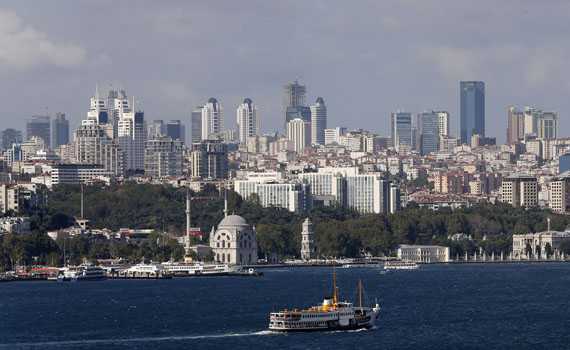
    His adopted city also hosted Chalayan’s most important exhibition so far, last year’s expansive survey of his work at the Design Museum, which also toured to Tokyo and is currently on show at Istanbul Modern. He seems a little bit in love with the city that bestrides the Bosphorus (“it’s the best city”), and a little disenchanted with London (“it never seems to hang on to its own talent very strongly”).

    I ask how he combines the worlds of art and fashion, and his rapid-fire response suggests it is a question that plays permanently on his mind. “Well, you have touse clothing. So something can be conceptual, or narrative, or visually charged, but it also has to be an item that you can use. But right from college, I didn’t just want to do nice tops. I wanted to work in a more monumental way.”

    But the imperative to sell consistently surely made fashion a more challenging environment?

    “The business side of fashion is super-difficult,” he confesses. “You have to rely on the loyalty of buyers. If you don’t sell one season, the next one is difficult. And the worst part of it is that fashion’s existence is based on the seasonal calendar, which is absolutely absurd.”

    For someone like him, who loves to experiment with fabric technology (he is currently creative director of the sport and leisurewear company Puma), “you can’t keep coming up with entirely new things twice a year. There are techniques that you will use for a few years. If you want to take techniques further, you just can’t jump around that fast.

    “I think our lives are a lot harder than [those of] artists. We have to constantly produce, we have financial restraints, we have to fund the production. It’s really tough.” Chalayan has already had to liquidate his company voluntarily once, when he split from a previous partner. “If you are asking me if I get a return, culturally speaking, the answer is ‘yes’, but as a business we are relatively small. It depends what you want from life.”

    He is, in any case, perfectly happy with the blend of his activities. “I must be the only person who can sell a film to a collector, and then put the money into a new [fashion] collection” – both of which have brought him acclaim. He was British Designer of the Year in 1999 and 2000, and represented Turkey in the Venice Biennale of 2005. He attributes his cross-disciplinary approach to his education in London. “Central St Martin’s was a proper art institution, fashion just happened to be one of its departments. It was a fantastic place in which to understand the body in a cultural context. We were like body artists, but we also had to learn how to make our clothes sell. It’s like someone who wants to be a film-maker but has to go into advertising to survive.”

    Of the worlds of art and fashion, he says they are “as cliquey as each other. I used to put the art world on a pedestal, but it is so market and money-driven now. You meet more interesting people in the art world, because fashion people tend not to question the world around them that much. But they are as power-driven.”

    There is a rare pause as he considers his upcoming exhibition. “You know as far as my fashion business goes, if it can just run itself I am happy. But I do just love doing these projects.”

    ‘I Am Sad Leyla’ by Hussein Chalayan is at Lisson Gallery, London, September 8 – October 2. www.lissongallery.com

    , August 27 2010
  • Azerbaijani, Turkish MPs to strengthen ties

    Azerbaijani, Turkish MPs to strengthen ties

    Azerbaijan, Baku, Aug. 25 / TrendK.Zarbaliyeva /

    Azerbaijani and Turkish MPs from the regions are strengthening ties, Parliamentary Assembly of Turkic-Speaking Countries (TurkPA) Secretary General Ramil Hasanov told Trend today.

    He added that an agreement was signed during Turkish President Abdullah Gul’s recent visit to Azerbaijan. The document seeks to establish cooperation between MPs from the Azerbaijani and Turkish regions of Sheki and Bursa.

    Hasanov said local entrepreneurs will also develop closer ties under the cooperation agreement.

    “It is important to establish cooperation in the economic, political, cultural and scientific fields,” he added. “Businessmen and MPs from the regions will also take part in the meetings.”

    Baku hosted the TurkPA’s first plenary meeting Sept.29, 2009.

    TurkPA’s main goal is to support Turkic-speaking countries in international organizations, as well as to help them share their experiences in legislative processes. The assembly also aims to preserve language, culture and history in Turkic-speaking countries, and to further strengthen political, economic and cultural ties between member countries.

    Do you have any feedback? Contact our journalist at [email protected]

    https://en.trend.az/news/politics/foreign/1740640.html, Aug. 25 2010

  • China Today magazine to launch Turkish edition

    China Today magazine to launch Turkish edition

    The Turkish edition of China Today magazine will go on sale in major cities of Turkey starting from Sept. 1, which is expected to promote mutual understanding between Turkish and Chinese people and facilitate the two countries’ business relations.

    “We believe the biggest problem for further development in the Turkish-Chinese relations is the lack of reliable sources of cultural and economic information on China,” Chief Executive Officer Sadi Zengin of Dijitek Group, which is in charge of editing and publishing the magazine, told Xinhua in an interview.

    As two large emerging economies, China and Turkey have a large potential to improve business relations but their economic ties were far from well developed, said Zengin.

    “More reliable sources of information on China are desperately demanded especially by the business people, civil servants, scholars and certain institutions in the country,” he said, adding “Dijitek Group intends to help the improvement of the relations through undertaking the publication of China Today-Turkey.”

    Dijitek Group signed an agreement in May with China’s state- owned China International Publishing Group (CIPG), which granted Dijitek the copyright of three English-language magazines, including China Today, Beijing Review and China Pictorial for ten years.

    China Today-Turkey will specifically focus on information about China mostly needed by the Turkish business circles, with 70 percent of the content selected from China Today, Beijing Review and China Pictorial and 30 percent contributed by Turkish journalists and analysts, according to the publisher.

    Chinese economy, management styles, economic regulations and the development of specific sectors and industries will be introduced in the magazine, while the magazine also intends to present a genuinely Turkish view of China, discuss the developments and problems in Turkish-Chinese economic, commercial and cultural relations and put forward suggestions, said Zengin.

    “We’d like to give Turkish people a chance to see China through the view of the Chinese people instead of through rumors,” he said.

    The first issue of the magazine features a cover story about China’s green energy industry, a subject on the economic development of Xinjiang Uyghur Autonomous Region and an analysis of the revaluation of the Chinese currency, according to Zengin.

    In the part contributed by the Turkish side, an interview with Chinese Ambassador to Turkey Gong Xiaosheng will be presented, together with the story of a Turkish silk company finding success in China and a macro-economic comparison of Chinese economy and other economies.

    Other aspects of China such as its culture, philosophy, geography and language will also be included in the magazine, said Zengin.

    Dijitek will publish 10,000 copies of the magazine per issue and distribute them in big bookstores and shopping malls of major cities, while its initial aim is to reach 2,000 subscribers in the first three months, said Zengin.

    The company will also work to increase advertisements, especially those for Chinese companies eager to enter the Turkish market, in order to overcome the difficulty in marketing and advertisement, he said.

    A launching cocktail of China Today-Turkey will be held on Sept. 24 with the hosting of the Chinese Embassy in Turkey ahead of the Chinese National Day, which falls on Oct. 1.

    Source:Xinhua

    ,

    August 25, 2010

  • Cat culture thrives in Istanbul

    Cat culture thrives in Istanbul

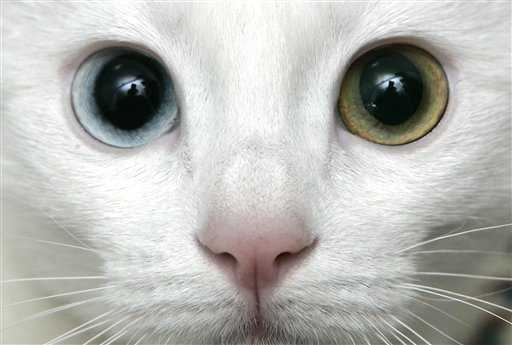
    In this Jan. 19, 2006 file photo a Turkish Van cat looks at the camera in the eastern Turkish city of Van. Many a visitor to Turkey has noted the abundance of stray cats in the old imperial capital of Istanbul. They amble and lounge around some mosques and have the run of a couple of universities. Facebook campaigns gather supplies for them, and it's easy to spot nibbles and plastic containers of water left discreetly on sidewalks for the felines. This month, cats will get a publicity boost when the world basketball championships begin in Istanbul and three other Turkish cities. The official mascot is "Bascat," a white cat with one blue eye and one green eye, similar to an unusual breed native to the eastern city of Van. (AP Photo/Pier Paolo Cito/File)

    By CHRISTOPHER TORCHIA

    (AP)

    ISTANBUL — When President Obama visited Turkey last year, he paused to stroke a tabby cat at the former Byzantine church of Haghia Sophia while Turkish Prime Minister Recep Tayyip Erdogan looked on with a smile. The cat, one of half a dozen living at the ancient site, seemed unfazed by the VIP attention.

    Many a visitor has noted the abundance of stray cats in the old imperial capital of Istanbul. They amble and lounge around some mosques and have the run of a couple of universities. Facebook campaigns gather supplies for them, and it’s easy to spot nibbles and plastic containers of water left discreetly on sidewalks for the felines.

    This month, cats will get a publicity boost when the world basketball championships begin in Istanbul and three other Turkish cities. The official mascot is “Bascat,” a white cat with one blue eye and one green eye, similar to an unusual breed native to the eastern city of Van.

    The special status of stray cats in Istanbul and elsewhere in Turkey reflects a tradition-bound country on the path to modernity. It partly derives from Muslim ideas about tolerance, and an urban elite with Western-style ideas about animal rights. It points to the freewheeling side of a society that seeks entry into the European Union’s world of regulation.

    Sevgin Akis Roney, an economics professor at Istanbul’s Bosphorus University, said the school is so well-known for adopting strays that people leave unwanted cats there, knowing they’ll get fed. Cats wander freely into classrooms at the school, perched on a hill over the strait that separates the Asian and European continents.

    “We should learn to live with these animals,” said Roney, who walks around with cat food for hungry strays.

    Turkey introduced an animal protection law in 2004, and state policy is to catch, neuter and release or find a home for street animals. Funds for such projects are limited. Alleged poisoning campaigns by some municipalities, usually targeting dogs, suggest laws are sometimes flouted altogether.

    Stray dogs are considered more of a nuisance and sanitation threat than cats, and Islamic tradition — while espousing tolerance for all creatures — labels them unclean. In 1910, Istanbul officials unloaded tens of thousands of stray dogs on an island in the Sea of Marmara, where they starved.

    Istanbul experienced an explosion of uncontrolled growth in the second half of the 20th century. Millions of people flooded from the countryside, cramming into cheap, illegal housing called “gecekondu,” which means “built overnight” in Turkish. Highways and shopping malls sprouted. That urban sprawl made Istanbul less hospitable for street cats, but pockets of the city kept the tradition of caring for strays — an easy option for Turks who don’t want the hassle of a pet at home.

    Cats benefit from their association with Islam in Turkey, where the population is mostly Muslim though the laws and political system are secular. A popular saying goes: “If you’ve killed a cat, you need to build a mosque to be forgiven by God.”

    Islamic lore tells of a cat thwarting a poisonous snake that had approached the Prophet Muhammad. In another tale, the prophet found his cat sleeping on the edge of his vest. Instead of shifting the cat, the prophet cut off the portion of the vest that was free and wore it without disturbing the pet.

    Nukhet Barlas, an environmental consultant, photographed cats for an online exhibition backed by the European Capital of Culture project, which focused on Istanbul this year. Her images show cats posing in front of mosques, ruins and iconic buildings, ceramics and the shoreline.

    “Most of these strays have developed friendly relationships with people. They have personalities and in many neighborhoods, they are almost part of the community,” Barlas wrote in an email.

    On her strolls, Barlas photographed long-haired Angora cats and “chalk-white/blue-eyed” Van mixes as well as non-Turkish breeds resembling Abyssinian or Egyptian Mau cats. She believes the variety stems from Istanbul’s role as capital of the continent-spanning Ottoman Empire and a transit point for trade over the centuries. “New breeds appear to continue,” she said. “I find stray cats that look like the popular British Shorthair, or Balinese.”

    One tourist hostel in Istanbul is called the Stray Cat. At the Kaktus Cafe in Istanbul’s Cihangir district, cats sit next to customers or doze on the chairs. Cat images decorate dishes and tablecloths.

    “Cats are lazy anarchists,” said Ozgur Kantemir, who has eight cats and lives in Ankara, the Turkish capital. “This might be one reason why they conform with us just fine in big cities.”

    While cats seep into the culture, they’re not always welcome. The yowls and whoops of cats in combat disturb the sleep of quite a few urban dwellers.

    “If you’re on the ground floor and leave your window open, you can come home to a cat looking up to you, asking ‘What are you doing here?”‘ joked Allen Collinsworth, an American business consultant.

    In 2004, Erdogan sued a cartoonist for Cumhuriyet newspaper after he depicted the prime minister as a cat entangled in yarn representing Islamic vocational schools that Erdogan backed. The image went to the heart of hostility between fiercely secular elites and Erdogan’s Islamic-oriented government that has since shaped Turkey’s political debate.

    Istanbul’s bounty of stray cats amazed Sir Evelyn Wrench, a former editor of Britain’s The Spectator magazine who wrote in 1935 that Turks thought drowning kitten litters was cruel, so they dropped them in the “dustheap” instead.

    “In every side street you meet the cats, old and emaciated cats, cats with one eye blind, kittens toddling with unsteady step, cats with skin diseases, cats eternally scratching themselves, dying cats run over by cars on the roadside, Wrench wrote. “When I asked residents in Istanbul what could be done about the cats, they shrugged their shoulders. ‘Istanbul was menaced in its old wooden houses by a plague of rats; cats were necessary.’”

    Associated Press Writer Ceren Kumova contributed to this report from Ankara, Turkey.


  • Missing works of Turkish sufi Haci Bektas Veli found in British museum

    Missing works of Turkish sufi Haci Bektas Veli found in British museum

    Haci Bektasi Veli’s Fatiha Commentary, which was one of his missing works, was found in the British Museum Library.

    In addition to this valuable commentary, there was another work of Haci Bektasi Veli named Forty Hadith Commentary missing as well. Assistant Professor Nurgul Ozcan prepared the book for publication. The book Forty Hadith Commentary is an excellent door to develop an understanding of Haci Bektasi Veli’s Sufi world.

    Throughout history writing a translation or commentary on “forty hadith” has continued on as an important tradition of Turkish scholars and poets. Important names like Ali Sir Nevâî, Fuzûlî, Nev’î, Nabi, Âsik Celebi, Sadreddin Konevi, and İbrahim Hakki Bursevi have written highly valuable works on this subject. Among these valuable works in Turkish literature is Haci Bektasi Veli’s Forty Hadith Commentary.

    Prepared for publication for the first time by Nurgul Ozcan, the book was released by Fatih University Publication. The story behind the book’s publication sounds a lot like a detective novel, Cihan news agency said.

    The story dates back to the years when Assistant Professor Huseyin Ozcan, who is a lecturer at Fatih University’s Faculty of Arts and Sciences, was still a student in college. During the course of his college education, Ozcan began researching the Fatiha Commentary with the encouragement of his professor Abdurrahman Guzel. He went to England in 2008 and searched for this book in every library he visited. While reviewing the manuscripts in the British Museum Library he came across a copy of the commentary and another work named Makalat. In addition to the Fatiha commentary, Ozcan found another missing work of Haci Bektasi Veli named Firty Hadith Commentary.

    In the first section of the book, Nurgul Ozcan provides information on the life and works of Haci Bektasi Veli. Noting that the works of Haci Bektasi Veli need to be studied in order to understand him Ozcan said ” The works of Haci Bektasi Veli which consists of Sufistic conversations between the mürsit (mentor) and his disciples (murid), which there are broad examples of in the Sufi tradition, are the main sources that directly reflect his ideas.” Ozcan explains that scholars and poets write commentaries on forty hadith for the purposes of obtaining the Prophet’s intercession, to find peace in the world, to be remembered with blessings, to find salvation in the hear after, to go to heaven, and to be free of troubles. According to Ozcan, Turks have shown the most interest in translations on forty hadith.

    The second part of the book is on the forty hadith tradition in Turkish literature and works that have been written in this area. There is also a review of hadith included in other works written by Haci Bektasi Veli. Haci Bektasi Veli’s commentary on forty hadith was written approximately in the 14th century. The commentary, which consists of 19 pages and is written in naskh calligraphy with vowel markings, includes forty hadith that explains the concept of poverty as a dervish. The main topics of Haci Bektasi Veli’s Forty Hadith is the importance of the concept of poverty, the virtues of poverty, the rewards of helping those who are poor and the punishments for those who despise the poor. At the end of the book, there is an original and Turkish translation of the Forty Hadith.

    , 23 August 2010

  • The great mediator

    The great mediator

    Sometimes Turkey really is a bridge between west and east

    Turkish foreign policy

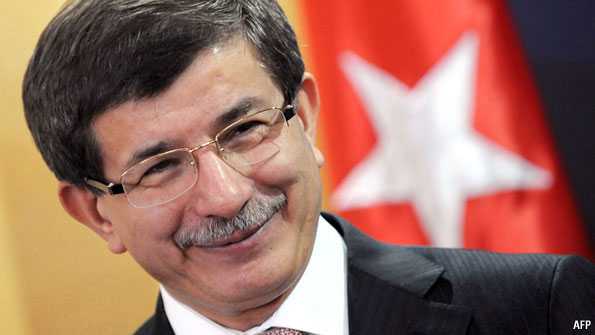
    How can Mr Davutoglu help you?

    IN JUNE 2006, days after a young Israeli private was captured by Hamas, Israel’s ambassador to Turkey paid a midnight visit to Recep Tayyip Erdogan, the prime minister. Gilad Shalit was feared to be gravely ill, perhaps even dead. Could Turkey help? Phone calls were made and favours called in. Mr Shalit turned out to be alive, and his captors promised the Turks they would treat him respectfully.

    Turkey’s relations with Israel, once an ally, have worsened of late, and hit a fresh low in May, when Israeli commandos raided a Turkish ship carrying humanitarian supplies to Gaza, killing nine Turkish citizens. Yet Turkey continues to lobby Hamas for Mr Shalit’s release.

    Turkey’s falling out with Israel has sparked a flurry of anguished commentary in the West about its supposed eastward drift under the mildly Islamist Justice and Development party, which has governed the country since 2002. Concern over its cosy relations with Iran, despite that country’s refusal to suspend suspect nuclear work, has run particularly high. Yet nobody complained in April 2007 when Turkey brokered the release of 15 British Royal Navy sailors who had been seized by Iran. Similarly, France was delighted in mid-May when a personal intervention by Turkey’s foreign minister, Ahmet Davutoglu, secured the release of Clotilde Reiss, a French teacher being held in Iran on spying charges.

    Turkey is the first stop for thousands of political refugees from Iran, Iraq, Afghanistan and Central Asia. These include Mohammed Mostafei, an Iranian lawyer who took up the case of Sakineh Ashtiani, a woman facing death by stoning in Iran for alleged adultery. Mr Mostafei fled to Turkey earlier this month after receiving death threats (he has since gone to Norway). Now Turkey has discreetly taken up his client’s case (although Iran has turned down a Brazilian offer of asylum for Ms Ashtiani). It is also pressing Iran for the release of three American hikers who were arrested, on suspicion of “spying”, near the Iraq border a year ago and who have been rotting in Tehran’s notorious Evin prison ever since.

    Turkey’s mediating skills have even aroused excitement in Africa. Mr Davutoglu recently revealed that Botswana had sought his help in fixing a territorial dispute with Namibia. Flattered though he was, however, Mr Davutoglu confessed that, for once, he was stumped.

    http://www.economist.com/node/16847136?story_id=16847136&fsrc=rss, Aug 19th 2010