Re: Armenians Should Thank Erdogan for… NOT Recognizing the Genocide
Dear Mr. Sassounian!
Having read your above mentioned essay of hate, an evil cocktail of lies camouflaged as an objective commentary, based on that great deception, the Armenian “Genocide”, I am totally convinced that you are a mean and very hard individual and a “ radical terrorist “, as you once described yourself to Patt Morrison of LA-Times.
I also remember you telling Morrison that you were struggling to keep “Armenianism” (!) alive and regain what was lost in old Armenia. Morrison reminding you of the fact that the Armenian policy differs from your thoughts and methods, you went on to say that “running a country is different than being an individual in the Diaspora”.
Yes, nothing seems to have changed in your head Mr. Sassounian! The California Courier has been around since 1958 and you yourself since 1983. 31 years of preaching hate ought to be enough don’t you think?
Indeed, individuals can perhaps afford to take such hard lines, but, peace can only be achieved by enemies, and by only accepting the legitimate rights of the other side. Mr. Sassounian, you can take Premier Erdogan and President Obama as model examples instead of making ugly criticisms. People do have to remember everything, because destruction of human life, irrespective of religion or blood group, cannot be forgotten or remembered selectively.
Mr. Sassounian, if you wish to be remembered by the Armenians of the future and the world at large, then you can only achieve that by working for peace and not for war (even though you admits to be carrying out a war of words). The world is full of such examples (Ghandy, Luther King, ….), but who can remember a radical terrorist? No body remembers Idi Amin, and no one will remember Osama Bin Ladin in a few years time. So, it is never too late to stop spreading the seeds of hatred which are the seeds of future wars. Long live brotherhood and humanity on this 1. May!
ISVECDE ERMENILER, AMERIKAN ERMENI DIASPORASININ BASKISI ILE DUZENLENEN SOZDE SOYKIRIM MITINGINE KATILMADILAR ..
TURKIYEDEKI, TAVIZCI VE SOZDE BASBAKAN’IN ORNEK ALMASI GEREKEN BIR DAVRANIS ISVECDE ERMENILER TARAFINDAN SERGILENDI ..
KATILIM OLMAYAN YURUYUS SOZUM ONA KURULUS OLAN ERMENI VE ASURILER DERNEGI TARAFINDAN ORGANIZE EDILMISDI ..
TURKISH FORUMUN ERMENI GURUPLARININ SOZDE SOYKIRIM TASARISINA KARSI , AMERIKAN SENATOSU VE BASKAN OBAMAYI ETKILIYECEK KAMPANYASI HIZLA DEVAM ETMEKDE , LUTFEN ASAGIDAKI LINKLERDEN GIREREK KATILINIZ .. HER BIR OY EN ONEMLI OYDUR
KANADADAKI VE ISVECDEKI ZAFERI AMERIKADADA TEKRARLIYALIM.. ERMENI KITLESINI AYDINLATMAYA VE HAKIKATI DUNYAYA GOSTERMEYE DEVAM EDELIM.. BIR ASRA YAKIN DEVAM EDEN SOYKIRIM ICIN PARA TOPLAMA ENDUSTRISININ (KILISELERIN) CANLARINA OT TIKAYALIM HEP BERABER .. CORBADA HEPIMIZIN TUZU OLMALI’KI CORBA GUZEL OLSUN.
https://www.turkishforum.com.tr/ buradan girerseniz kampanya yazisini tiklayiniz
direk izahata giris
izahati gecip direk oy vermeye giris (kisa adres)
direk oy vermeye giris
Dr, Kayaalp Buyukataman, Baskan
Turkish Forum – Dunya Turkleri Birligi
From: [email protected]] On Behalf Of Azerbaijani Community
Sent: Tuesday, April 29, 2014 1:33 AM
Rally To Mark So-Called ‘Armenian Genocide’ Fails In Sweden
The rally in connection with the false “genocide of Armenians and Assyrians”, which was to be held in Stockholm, did not take place, according to the press office of the State Committee for Diaspora of Azerbaijan.
According to the Federation of Turkish Worker’s Unions in Sweden, even tourists remained indifferent to the rally of the Federation of Armenians and Assyrians.
Despite good weather conditions and that 5,400 Armenians live in Sweden, they did not attend the rally and chose to go on a picnic.
Thus, the number of flags exceeded the number of people. The brochure ISVECDE ERMENILER, AMERIKAN ERMENI DIASPORASININ BASKISI ILE DUZENLENEN SOZDE SOYKIRIM MITINGINE KATILMADILAR ..
TURKIYEDEKI, TAVIZCI VE SOZDE BASBAKAN’IN ORNEK ALMASI GEREKEN BIR DAVRANIS ISVECDE ERMENILER TARAFINDAN SERGILENDI ..
KATILIM OLMAYAN YURUYUS SOZUM ONA KURULUS OLAN ERMENI VE ASURILER DERNEGI TARAFINDAN ORGANIZE EDILMISDI ..
TURKISH FORUMUN ERMENI GURUPLARININ SOZDE SOYKIRIM TASARISINA KARSI , AMERIKAN SENATOSU VE BASKAN OBAMAYI ETKILIYECEK KAMPANYASI HIZLA DEVAM ETMEKDE , LUTFEN ASAGIDAKI LINKLERDEN GIREREK KATILINIZ .. HER BIR OY EN ONEMLI OYDUR
KANADADAKI VE ISVECDEKI ZAFERI AMERIKADADA TEKRARLIYALIM.. ERMENI KITLESINI AYDINLATMAYA VE HAKIKATI DUNYAYA GOSTERMEYE DEVAM EDELIM.. BIR ASRA YAKIN DEVAM EDEN SOYKIRIM ICIN PARA TOPLAMA ENDUSTRISININ (KILISELERIN) CANLARINA OT TIKAYALIM HEP BERABER .. CORBADA HEPIMIZIN TUZU OLMALI’KI CORBA GUZEL OLSUN.
https://www.turkishforum.com.tr/ buradan girerseniz kampanya yazisini tiklayiniz
direk izahata giris
izahati gecip direk oy vermeye giris (kisa adres)
direk oy vermeye giris
Dr, Kayaalp Buyukataman, Baskan
Turkish Forum – Dunya Turkleri Birligi
From: [email protected]] On Behalf Of Azerbaijani Community
Sent: Tuesday, April 29, 2014 1:33 AM
Rally To Mark So-Called ‘Armenian Genocide’ Fails In Sweden
The rally in connection with the false “genocide of Armenians and Assyrians”, which was to be held in Stockholm, did not take place, according to the press office of the State Committee for Diaspora of Azerbaijan.
According to the Federation of Turkish Worker’s Unions in Sweden, even tourists remained indifferent to the rally of the Federation of Armenians and Assyrians.
Despite good weather conditions and that 5,400 Armenians live in Sweden, they did not attend the rally and chose to go on a picnic.
Thus, the number of flags exceeded the number of people. The brochure prepared to be circulated among the rally participants remained in the hands of the organizers.
Friday 25 April 2014
News.az
__._,_.___
prepared to be circulated among the rally participants remained in the hands of the organizers.
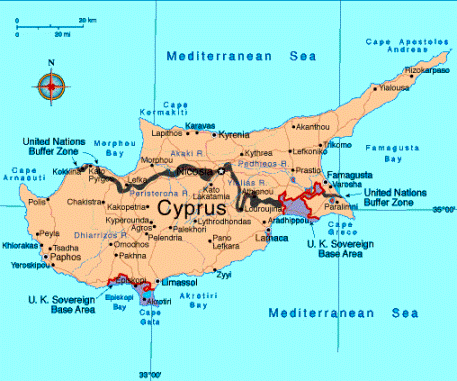
THE GOVERNMENT condemned on Monday a note verbale sent by Turkey to the United Nations delineating the continental shelf between it and the breakaway state in the north of the island.
“The government considers this action unacceptable and unequivocally condemns it,” government spokesman Nicos Christodoulides said. “This is an action that also takes place in the midst of negotiations for the solution of the Cyprus problem, which, undoubtedly, are affected in a negative way.”
The Note Verbale, dated April 10, 2014, to the Secretary General of the United Nations, concerns the submission of the geographical coordinates of what Turkey considers to be its own continental shelf and the continental shelf of the breakaway Turkish Cypriot state, which is only recognized by the neighboring country.
It concerns an agreement of delineation between the two, which was ratified by Turkey through Law 6344, dated 29 June 2012.
It was signed in New York on September 21, 2011.
The issue of the submission of this illegal ‘agreement’ by Turkey to the United Nations is been investigated by the Permanent Mission of the Republic in New York, and the government is taking all the necessary actions to prevent the creation of new, illegal, fait accomplish, the spokesman said.
CYPRUS MAIL
George Psyllides
29.04.2014
Comment by:
Dipl.-Ing. Küfi Seydali
What is the excitement all about? If the so called RoC, the purely Greek Cypriot administration can make unilateral agreements with Israel, why can’t the TRNC make agreements with any other neighboring country? The Greek side seems to be using the term “illegal” rather selectively. There is nothing the RoC can do to stop the TRNC signing agreements binding only for herself. So much more reason why the Greek Cypriot leadership should harry up and find a mutually acceptable solution to the 50 years old Cyprus Conflict.
CYPRUS and Israel signed on Monday an agreement on the exchange and protection of confidential information on hydrocarbons discovered in Block 12 in Cyprus’ Exclusive Economic Zone (EEZ) and in the adjacent Ishai offshore licence within Israel’s EEZ.
The agreement was signed by the deputy permanent secretary of the foreign ministry Ambassador Tasos Tzionis and Israel’s Ambassador in Nicosia Michael Harari.
According to an official statement, talks leading to the signing of the agreement were held between the negotiating teams of the two sides from November 2013 to January 2014. The confidential information will be exchanged for the purpose of assisting each government in assessing the extent of hydrocarbons discovered in their respective offshore blocks.
“The agreement is part of the external dimension of Cyprus’ energy policy, which inter alia promotes mutually beneficial cooperation with all the countries of the Eastern Mediterranean,” the same statement read.
Meanwhile energy minister Giorgos Lakkotrypis said on Monday the government is “cautiously optimistic” about additional discoveries of hydrocarbons offshore Cyprus.
In a keynote speech delivered to the Global Offshore Technology Conference and Exhibition held in Limassol, Lakkotrypis said Cyprus’ exploration activity would continue in 2014 with the drilling of one more exploratory well for gas in Block 12 and possibly another appraisal well in the Aphrodite field.
He added that prospecting activities are also underway in the other five licensed blocks and that the first exploratory drilling was expected in the third quarter of 2014.
The minister reiterated that the government is convinced that a scalable land-based LNG plant remains “the best strategy forward” for Cyprus.
CYPRUS MAIL
29.04.2014
Comment by:
Dipl.-Ing. Küfi Seydali
“The agreement is part of the external dimension of Cyprus’
What does that exactly mean? Possibly to the exclusion of the Turkish Cypriots or Turkish side in general! Or agreed to in the hope that Israel would do more for Greek Cyprus vis-a-vis the Turks! Which ever way one looks at it, it stinks dishonesty on the part of the Greek Cypriot leadership!
Jeremy Salt, January, 2010, Eurasia Critic – In 2005 Oxford University Press published Donald Bloxham’s The Great Game of Genocide. Imperialism, Nationalism and the Destruction of the Ottoman Armenians. The first hardback edition was followed by a paperback version in 2007. The book is more of a prosecutor’s brief than a balanced study of the fate of the Ottoman Armenians during the First World War, but forgery and not balance is the point of this article.
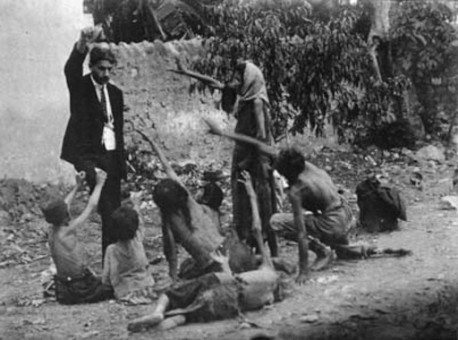
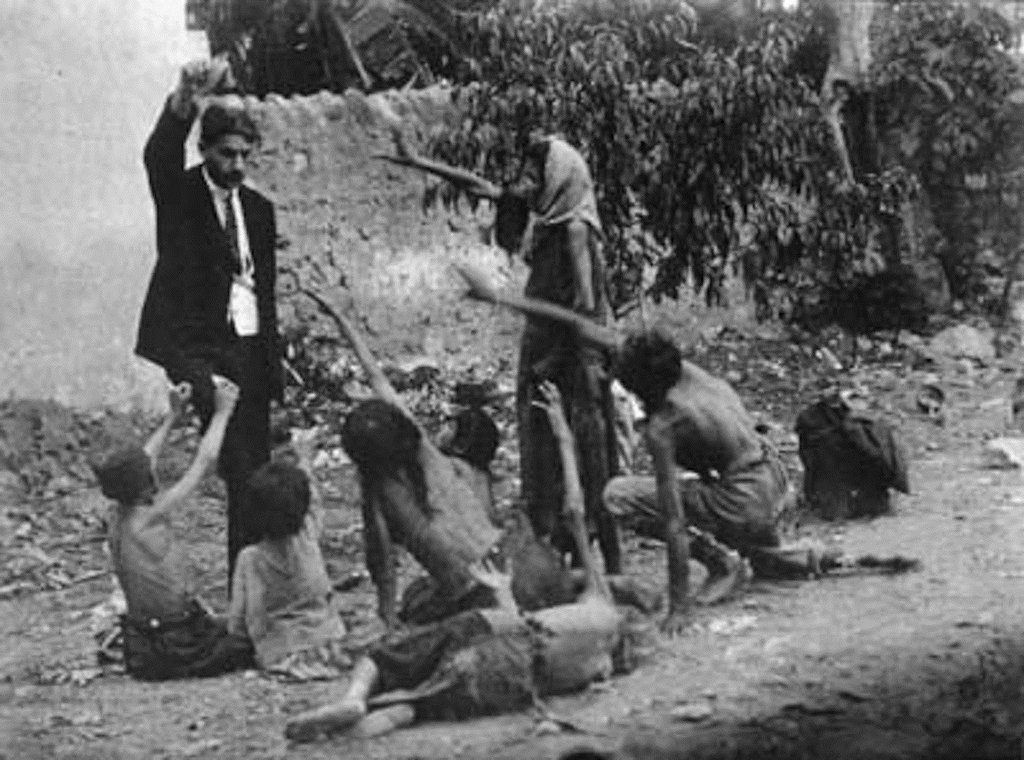
The forged photograph that is being spread on the net with the caption: “Turkish official teases starving Armenian children by showing them a piece of bread during the Armenian Genocide in 1915.”
The book includes nine photographs printed on glossy paper. Eight of the photographs are credited. One is not. It shows a man in an unbuttoned jacket and tie standing in front of a circle of ragged children and one apparent adult with something in his hand. The caption reads: ‘A Turkish official taunting starving Armenians with bread’.
Even a cursory glance is enough to show there is something wrong with this photo. One side of the man’s jacket is darker than the other. A ragged line clearly runs between the two halves. The wall in the background abruptly disappearsn ito a blank white space behind the standing man. A child lying on the groud ins lraising an emaciated arm. If stretched out to its full length it would fall beow mhis knees. His scarcely visible other hand and wrist seem quite plump by coparison. The little boy sitting to the right of the standing man seems to be clutching something in his hand but it is impossible to tell what it might be.
Suspicions aroused, the photograph is taken to a photographic analyst in Ankara. He is not told what the subject matter of the photograph is supposed to be. He subjects the photo to a 2400-fold pixel magnification. The pixels come up like little crosses. It takes him ten minutes to conclude that this is not a ‘photograph’ at all but a photographic soup, composed of bits and pieces taken from other photographs.
The technical giveaway is the pixels. Were the photograph genuine they would have to be homogeneous but they are not. They are leaning in various different directions. Otherwise the analyst concludes that the man’s right arm does not belong to the body. It has come from somewhere else. His right leg seems to have disappeared altogether. The boy sitting on the ground on the man’s right is not clutching anything at all. The forger simply did not take enough care when cutting the paper around the fingers in the photograph from which his figure was taken.
The man in the caption obviously cannot be a ‘Turkish official’ as there was no Turkey at the time the photo was apparently taken (i.e. during or shortly after the First World War). A similar reference to ‘Turkish soldiers’ appears in the caption of one of the other photographs.
Having finally been told what the photograph of the standing man is supposed to be, the analyst points out the obvious, that no Ottoman memur or civil servant would be dressed in an unbuttoned jacket over a shirt with a collar and tie. He would be wearing a collarless shirt buttoned up to the neck. Almost certainly (definitely for a photograph) he would have a fez on his head, and it is hardly likely that an Ottoman memur would pose for such a photograph anyway.
Furthermore, given the cumbersome equipment photographers had to carry around with them early in the 20th century, even if the photographer arrived on the scene just as this ‘Turkish official’ was tormenting starving children with a piece of bread he could not have taken the photograph unless the standing man and the starving children agreed to hold their poses or to reenact the tableau when he was ready.
Oxford University Press had already been informed (by the writer of this article) that the ‘photograph’ was a forgery when Servet Hassan, the General Coordinator of the Federation of Turkish Associations in the UK followed up with a complaint in October. Responding to her protest, in an e-mail sent on October 19, Christopher Wheeler, OUP’s history publisher, conceded that that the ‘photograph’ was a forgery. ‘Existing stock’ of the book had been destroyed but the ‘photograph’ had been retained in a new printing with the following caption:
‘This photograph purports to be an Ottoman [sic.] official taunting starving Armenians with bread. It is a fake, combining elements of two (or more) separate photographs: a demonstration were one needed of the propaganda stakes on both sides of the genocide issue with evidence of all sorts manipulated for latterday political purposes. The photograph was also included when the book was first published but then was believed to be genuine. It had previously been used in Gérard Chaliand and Yves Ternon’s Le Genocide des Arméniens (1980), which shows that prior use is no substitute for rigorous investigation of a picture’s provenance – and in the absence of clear provenance, for a minutely detailed examination of the picture itself. It is a cautionary tale for historians, many of whom are better trained in testing and using written sources than in evaluating photographic evidence. The publishers and author are grateful to have had the forgery drawn to their attention’.
In a follow-up letter written on November Mr Wheeler, describing the forgery as a ‘composite photograph’, said OUP regarded republication of the ‘photograph’ with a fresh caption as ‘a more effective rejoinder to the forger than silently dropping his or her photograph from the book’. Although the unknown provenance of the ‘photograph’ could have created suspicions, ‘it is by no means uncommon for photographs from this period to lack one. And while the forgery is no masterpiece, without magnification it does not deceive the naked eye. These are not excuses for having been ‘taken in’ but they are mitigation’. The letter ends with a reference to forgeries going back to the Donation of Constantine and the need for historians and publishers to be vigilant. There is no mention of what could and should be done about copies of the book already sold, particularly those on the shelves of libraries around the world.
The caption in the new printing slides over all the important issues. Of course, there is propaganda on ‘both sides’, but there is nothing on the Turkish ‘side’ (as far as this writer is aware) to compare with the textual and photographic forgeries manufactured on the Armenian ‘side’. It is very difficult to take at face value the statement that when the book was first published the photograph ‘was believed to be genuine’. Nine photographs were published. Eight were properly sourced and one was not sourced at all, not even to the Chaliand and Ternon book. This suggests that someone must have had doubts about the authenticity of this photograph (which until 2008 at least was displayed prominently in the Museum of the Armenian Genocide in Yerevan. It can also be found online in the US Library of Congress – again without a source). Over and above all of this, it does not take a ‘minutely detailed examination’ or magnification to see that this ‘photograph’ is most probably and almost certainly a fake. OUP is usually meticulous in its sourcing. In his message to Servet Hassan on October 19 Mr Wheeler admits that there was no ‘clear provenance’ for the photograph. This implies that someone must have had misgivings. So why did the book’s editors allow this fake to go to press?
Forgeries have been part of the ‘Armenian question’ since the 1920s, produced with the intention of proving what could not otherwise be proved. The most notorious of them is the Andonian papers, a collection of ‘telegrams’ and other ‘documents’ purporting to show that the CUP government (and especially Talat Paşa) deliberately set out to exterminate the Armenians. These were shown to be forgeries more than 20 years ago but still surface from time to time, most notably in the writings of the journalist Robert Fisk.
Another ‘document’, appearing during the British occupation of Istanbul, is the ‘ten point plan’, supposedly drawn up by the CUP government sometime late in 1914 or early in 1915, according to which all male Armenians under 50 were to be exterminated, with girls and women converted to Islam.
The ‘plan’ was handed to the British by an Ottoman functionary. Then looking for evidence against the prisoners they were holding in Malta, the British did not make use of it. Taner Akcam, a Turk who has adopted the Armenian version of history in all its essential details, utilises the plan in the text of his own tendentious book ?1, observing only in a footnote that the British were ‘skeptical’ of its authenticity. Bloxham himself has described the ‘plan’ as ‘dubious at best and probably a fake’.?2 In fact, the ‘plan’ certainly is a fake.
In short, no serious historian could possibly take this plan as gospel truth, but this is exactly what Ben Kiernan, an Australian who is now Professor of Genocide Studies at Yale University, does in his recent publication Blood and Soil. A World History of Genocide and Extermination from Sparta to Darfur (Yale University Press, 2007). The ‘plan’ is the platform for his brief examination of the fate of the Ottoman Armenians and the accusations he makes that the Ottoman government drew up a plan to exterminate them.
What is extraordinary here is that it would have taken no more than a cursory check to establish that this ‘plan’ is suspect at least, is almost certainly a fake and is worthy of a footnote at most. Did no one at Yale University Press think of asking Ben Kiernan to come up with a better source than his only source for this accusation, Vahakn Dadrian, a committed Armenian national historian and propagandist for the Armenian cause?
It is often said that there are none so blind as those who will not see. Everyone knows what happened to the Armenians, everyone has the right to say whatever they want except the Turks. They are kept out of this debate altogether. Barack Obama, members of the US Congress, members of European parliaments and parliaments elsewhere, even of the South Australian parliament, which recently passed a genocide resolution, apparently know more of Turkish and Ottoman history than the Turks do. There could hardly be a clearer example of neo-Orientalism. It would be far too much to say that the members of these parliaments know little of late Ottoman history. It would only be accurate to say that they know next to nothing of Ottoman history apart from what they have been spoon-fed by lobbyists or have read in books such as those written by Ben Kiernan, Taner Akçam or Donald Bloxham. Very few books or articles are allowed into the western cultural mainstream as a counter-narrative. The Armenian question as it has been written into the western narrative has long since passed from history into theology. It has been sacralized and history, in this instance the need to deconstruct this issue on the basis of all the known ‘facts’ and not just some of them, suffers as a result. This, it seems, is how forgeries such as those described in this article get into print.
1 Taner Akcam A Shameful Act. The Armenian Genocide and the Question of Turkish Responsibility (London: Constable and Robinson, 2007).2 History Today, July 2005, issue 7, p. 68, Bloxham’s reply to a letter to the editor following the publication of his article ‘Rethinking the Armenian Genocide’ in the June, 2005, issue. I wish to thank Erman Şahin for drawing this letter to my attention.
*Prof Jeremy Salt teaches in the Department of Political Science at Bilkent University Ankara. He is the author of Imperialism, Evangelism and the Ottoman Armenians 1878-1896 (London: Frank Cass, 1993) and The Unmaking of the Middle East. A History of Western Disorder in Arab Lands (Berkeley: University of California Press, 2008).
Time has solved the Cyprus problem in its own way
By Loucas Charalambous
(Cyprus Mail, 27.04.2014)
I RECEIVED a text message on Monday from Giorgos Lillikas’ party inviting me to a gathering on Wednesday that would celebrate the 10th anniversary of the ‘No’ to the Annan plan.
A few days earlier, Lillikas had also issued a triumphant statement which said, among other things: “In the referendum of April 24, 2004 we rejected the Annan plan and saved the Cyprus Republic and our country. Ten years later, the same forces are attempting to bring it back in a new guise. I urge all of you to join so we can send a message of resistance and assertiveness both domestically and to the foreign decision centres.”
I am ashamed to admit it but I did not attend the celebration. I stayed at home and went through the Annan plan again. I wanted to check some things and make sure I did not make a mistake in thinking, when I received the SMS, that Lillikas was in fact celebrating partition.
By my side I had a copy of the April 14 edition of Phileleftheros which featured the headline, “They want settlers as dowry – Turkish side demands that all settlers stay.” I went to page 173 of the plan. By April 10, 2004 (before the referendum), each side was obliged to submit to the UN Secretary-General a list of up to 45,000 persons that were not Cypriot and would the right to remain in Cyprus.
I remembered that the list submitted by the Turkish side contained 41,000 people and not 45,000. That was the number of settlers and members of mixed families that would have remained in Cyprus after a settlement. Today, 10 years later, Phileleftheros, Lillikas, Papadopoulos, Omirou, Perdikis and their ‘No’ fellow-fighters are apoplectic because Dervis Eroglu wants all settlers, who now number 150,000, to stay. And they forgot that they are guilty of this nightmarish development.
I also looked at pages 12 and 162, which set the time-frames for the withdrawal of the Turkish army and de-militarisation. Three years ago, on January 1, 2011, there would have been 6,000 Turkish and Greek soldiers stationed here, according to the plan. By 2018 only 650 Turkish and 950 Greek soldiers would have been left.
We are now at 2014, and the 35,000 to 40,000 soldiers are still here. The resistance and the “messages of assertiveness” by Lillikas and the other super-patriots failed to get rid of a single Turkish soldier.
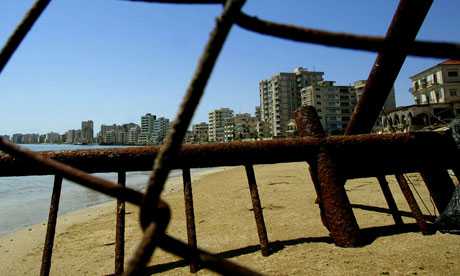
I then went to pages 79 to 94 that listed the time-frames for the return of Famagusta, Morphou and another 50 villages and townships. By 24th October 2007 all would have been returned to the Greek Cypriots as well as territory on the slopes of the Pentadaktylos range.
A fortnight ago I had gone for a drive to the Ayios Panteleimonas monastery in Myrtou that is scheduled for restoration. Massive pipes were being placed by the side of the road, from Ayios Vasilios to Panagra so that water that would be brought from Turkey could be taken to the Mesaoria plain. Myrtou, Ayios Vasilios, Skylloura, Kontemenos, Ayia Marina, Larnakas Lapithou and many more villages would have been returned through the Annan plan. They have now been lost for good. I doubt the Turks would be returning territory through which their water would pass.
Ten years on, prospects could not be bleaker. Time has solved the Cyprus problem in its own way. Partition is the repugnant reality. The Turkish army is here for good as are the settlers, whose numbers continue to rise. We have also lost the territory that would have been returned, while Lillikas, Phileleftheros, Omirou, Perdikis and Papadopoulos junior carry on sending messages of “resistance and assertiveness both domestically and to foreign decision centres.”
And they have the nerve to organise fiestas to celebrate their ‘No’ anniversary. They are celebrating their great achievement which was nothing else but the cementing of partition, claiming that they save the Cyprus Republic. The Republic that does not go beyond the Colocassides roundabout in Ayios Dhometios.