Category: Harut Sassounian

Harut Sassounian is the Publisher of The California Courier, founded in 1958. His weekly editorials, translated into several languages, are reprinted in scores of U.S. and overseas publications and posted on countless websites.<p>

He is the author of “The Armenian Genocide: The World Speaks Out, 1915-2005, Documents and Declarations.”

As President of the Armenia Artsakh Fund, he has administered the procurement and delivery of $970 million of humanitarian assistance to Armenia and Artsakh during the past 34 years. As Senior Vice President of Kirk Kerkorian’s Lincy Foundation, he oversaw $240 million of infrastructure projects in Armenia.

From 1978 to 1982, Mr. Sassounian worked as an international marketing executive for Procter & Gamble in Geneva, Switzerland. He was a human rights delegate at the United Nations for 10 years. He played a leading role in the recognition of the Armenian Genocide by the U.N. Sub-Commission on Prevention of Discrimination and Protection of Minorities in 1985.

Mr. Sassounian has a Master’s Degree in International Affairs from Columbia University, and a Master’s in Business Administration from Pepperdine University.

  • Questionable Writers Spread Anti-Armenia Propaganda

    Questionable Writers Spread Anti-Armenia Propaganda

    Armenians firmly condemn and reject individuals with questionable motives who repeatedly write articles full of hatred and lies about Armenia in the international press. The hostile content of these articles leads one to believe that they are not honest expressions of opinion, but reflect the writers’ sinister aims. If you go on the armeniapedia.org website and look under “Armenian Hall of Shame,” you will find the names of a couple of hundred such anti-Armenian writers.

    For example, James Wilson wrote an article last week titled “Why is France trying to play into Russia’s hands?” which was posted on the ‘EU Reporter’ website.

    Wilson claimed that “France is starting to supply weapons to Armenia. Initially, it involves the delivery of 50 armored vehicles, but in the future, deliveries of French Mistral surface-to-air missile systems are also possible.” This is pure speculation. Wilson quoted an unknown Artsakh Armenian who reportedly spoke on Armenian TV about French weapons coming to Armenia.

    Wilson revealed his real intent in writing this article by stating that Ukrainian and Moldovan media have reported: “Western military equipment supplied to Yerevan could be used by Russians to counter the Ukrainian Armed Forces’ counteroffensive.” This is utter nonsense. Wilson wrote that Armenia’s Defense Minister Suren Papikyan discussed French-Armenian military cooperation during his visit to Paris in September 2022. Even if this is true, nine months later, not a single French bullet has been sent to Armenia!

    Wilson then accused Armenia of “serving as a trans-shipment hub for Iranian weapons sent to Moscow.” This is fake news. Moscow does not need to use Armenia for such trans-shipments. Wilson then falsely claimed that Armenia used Iranian drones during its clashes with Azerbaijan. Without providing a shred of evidence, he alleged that French weapons shipped to Armenia can be transferred to Iran. Incredibly, Wilson concluded that French weapons shipments to Armenia “put France on a collision course with Israel,” because of its military alliance with Azerbaijan.

    Who is James Wilson and why is he writing such terrible things about Armenia? He is a Brussels-based British man who worked as a political consultant for mostly Eastern European clients, according to POLITICO. He spent almost two decades in the Hong Kong government. He founded MacMillan, a lobbying consultancy, first in Ukraine and then in Brussels, in mid-2000’s. He is the Publisher and Editor in Chief of EU Political Report in Brussels and co-founder of Brussels ThinkLab, a consultancy established in 2019.

    Mark Scott wrote a lengthy three-part series of articles in POLITICO, revealing the inner workings of consultants in Brussels, under the title: “The web of connections behind Brussels lobbying: Despite a longstanding transparency push, large swathes of the bubble remain opaque.”

    Here is how the EU Reporter’s publisher, Colin Stevens, presented his company on a YouTube video: “Our business model is to offer political parties, businesses, NGOs, industry associations, financial institutions and governments the opportunity to use EU Reporter to influence the European political decision-making process by sponsoring coverage and the placement of positive news stories and editorial comment related to them.”

    POLITICO replied: “Welcome to the murky world of EU lobbying dressed up as journalism. Stevens doesn’t appear to have a particular agenda, or to work as a lobbyist. But his company has provided a number of companies and governments with a space to publish paid-for content as straight news articles without disclosing those connections.”

    The EU Reporter’s website has posted dozens of anti-Armenia and pro-Azerbaijan articles. POLITICO disclosed that the EU Reporter published “a sponsored post by the Azerbaijani government…. Kazakhstan and Azerbaijan have both received extensive positive coverage on the site — raising questions about editorial standards and whether paid-for content is correctly labeled.”

    Here is how the pro-Azeri propaganda works: Following the 2020 Artsakh War, “Baku’s representative to the United Nations sent a letter to the secretary-general alleging that Armenia had relied on terrorists and foreign fighters during the months-long war. Among the evidence he cited were articles published in EU Reporter. In one article, written while the conflict was ongoing, the site accused Armenia of transporting Turkish fighters from Syria to train the country’s militia. In another, it criticized Western media reports that accused Azerbaijan, not Armenia, of relying on foreign militants…. Three Azerbaijani experts told POLITICO that allegations of foreign fighters siding with Armenia during the conflict did not match the reality on the ground, and that EU Reporter’s coverage of the conflict skewed significantly toward Baku’s perspective…. POLITICO was not able to confirm whether Azerbaijan had paid for the favorable coverage in EU Reporter. Stevens said that his site retains full independence, that it had been even-handed in its treatment of Azerbaijan and that all articles were labeled with an author’s name…. Still, the outlet and Baku have ties that date back almost a decade,” POLITICO wrote.

    The EU Reporter usually adds a sentence to its articles, stating: “EU Reporter publishes articles from a variety of outside sources which express a wide range of viewpoints. The positions taken in these articles are not necessarily those of EU Reporter.” This is nothing but a fig leaf to hide behind publishing articles of questionable origin.

    I wrote to the Publisher of EU Reporter asking if he had paid James Wilson to write his ‘article.’ If yes, how much did he pay him? Not surprisingly, I did not receive an answer.

  • Another Turkish Attempt to Attack Biden For Recognizing the Armenian Genocide

    Another Turkish Attempt to Attack Biden For Recognizing the Armenian Genocide

    When Turkey and its denialist supporters lose a battle to block the recognition of the Armenian Genocide, they resort to ridiculous attacks such as announcing their desire to impeach Pres. Biden after he is no longer in office, a laughable notion which I disclosed in my earlier article.

    In another equally hopeless Turkish attempt to counter the recognition of the Armenian Genocide, Attorney Bruce Fein, Counsel for Turkish Anti-Defamation Alliance, sent a lengthy letter to members of Congress on April 24, 2023, complaining about the statement Pres. Biden had issued earlier that day.

    Fein is president of the law firm Bruce Fein & Associates in Washington, D.C. Over the years, he has worn many hats to support Turkey’s campaign against the recognition of the Armenian Genocide. He has been Resident Scholar for the Turkish Coalition of America, Resident Scholar at the Assembly of Turkish American Associations, columnist for the Turkish Times newspaper, consultant to the Turkish Republic of Northern Cyprus, commentator on Turkish television, and Counsel for Turkish Anti-Defamation Alliance.

    Before I delve into the content of Fein’s letter, I would like to ask two basic questions:

    1) Why did Fein complain about Pres. Biden only after he recognized the Armenian Genocide on April 24? Shouldn’t he have written his letter before the President issued his statement? I don’t know if Fein got paid for his letter as Counsel for Turkish Anti-Defamation Alliance. If he did, the Turkish Alliance wasted its money.

    2) Why did Fein write to Members of Congress and not to Pres. Biden directly to complain about his April 24 statement? Fein’s letter is more than three years too late. The House of Representatives recognized the Armenian Genocide on October 29, 2019 by a vote of 405 to 11, and the Senate recognized it on December 12, 2019 in a unanimous vote. Pres. Biden issued his first statement recognizing the Armenian Genocide on April 24, 2021. Where has Fein been since 2019 and 2021?

    Turning to the content of Fein’s questionable letter, he shamelessly wrote that “Mr. Biden’s statement was bought and paid for by the Armenian National Committee of America (ANCA).” Since Fein provided not a shred of evidence in his defamatory letter, the ANCA has the right to sue Fein for libel. The ANCA did not even endorse Biden for President. Nevertheless, Fein went on: “But in politics, truth is helpless when assaulted by lavish campaign contributions and votes…. The Armenian genocide lie persists because of the rich backing of ANCA and their bought political toadies. It is contemptible that Pres. Biden has stooped so low.”

    Fein then goes on to make a number of false statements regarding the European Court of Human Rights, the United Nations, and several scholars, such as the controversial Prof. Bernard Lewis of Princeton University who had made conflicting statements on the Armenian Genocide. He was a recipient of the Ataturk International Peace Prize. The ANCA called him “an academic mercenary.”

    Here is what Wikipedia reveals about Lewis:

    “The first two editions of Lewis’s The Emergence of Modern Turkey (1961 and 1968) describe the Armenian genocide as ‘the terrible holocaust of 1915, when a million and a half Armenians perished.’ In later editions, this text is altered to ‘the terrible slaughter of 1915, when, according to estimates, more than a million Armenians perished, as well as an unknown number of Turks.’ …The change in Lewis’s textual description of the Armenian genocide and his signing of the petition against the Congressional resolution was controversial among some Armenian historians as well as journalists, who suggested that Lewis was engaging in historical negationism to serve his own political and personal interests…. In a 1995 civil proceeding brought by three Armenian genocide survivors, a French court censured Lewis’ remarks under Article 1382 of the Civil Code and fined him one franc, and ordering the publication of the judgment at Lewis’ cost in Le Monde. The court ruled that while Lewis has the right to his views, their expression harmed a third party and that ‘it is only by hiding elements which go against his thesis that the defendant was able to state there was no ‘serious proof’ of the Armenian Genocide.’”

    There are many other claims by Fein in his letter such as: “the Genocide Convention excludes politically motivated killings.” Thus, Fein admits that Armenians were indeed massacred, but for political reasons!

    By claiming that no court verdict has been issued regarding the Armenian Genocide, Fein must have forgotten about the death sentences issued by the Turkish Military Tribunal in Istanbul in 1919 against the masterminds of the Armenian Genocide.

    Fein also distorted the exile of Ottoman leaders to Malta by the British in 1919 in order to try them for their crimes. Great Britain released the 144 Turks in exchange for 22 British prisoners, stating that one British prisoner is worth a shipload of Turks.

    Finally, Fein’s ‘brilliant mind’ can be demonstrated by referring to his ridiculous article published on Nov. 25, 2022, in “The Hill,” suggesting that Congress “can end the war in Ukraine … by enacting a statute withdrawing the United States from NATO”!

  • Under Turkish Pressure, Armenia’s Leaders Make Excuses for Nemesis Monument Under Turkish Pressure

    Under Turkish Pressure, Armenia’s Leaders Make Excuses for Nemesis Monument Under Turkish Pressure

    Just when we thought that we had heard everything about the current Armenian government’s questionable positions on Artsakh, Armenia, and Armenian interests, we are now facing another monumental mistake by Armenia’s leaders.

    On April 25, 2023, the descendants of those who killed the Turkish masterminds of the Armenian Genocide inaugurated the Nemesis Monument in Yerevan. In attendance were opposition members of Parliament, and surprisingly, Tigran Avinyan, the Deputy Mayor of Yerevan, who is a member of Prime Minister Nikol Pashinyan’s political party.

    Nemesis was the name of the operation which was organized by the Armenian Revolutionary Federation to eliminate several Ottoman leaders who were responsible for the Armenian Genocide. This operation implemented the death verdicts issued in absentia by the Turkish Military Tribunal in Istanbul, in 1919, against the Genocide perpetrators, since they had fled from the country. Talaat Pasha, the main culprit in the Armenian Genocide, was killed by Soghomon Tehlirian in Berlin, in 1921. A German court found him not guilty due to Talaat’s massive crimes.

    Talaat’s remains were brought from Berlin to Turkey in 1943. The Turkish government ‘honored’ Talaat by naming avenues, mosques, schools, hospitals and a memorial after him in Istanbul. This would be just as shameful, had the German government named schools and avenues in Berlin after Hitler! Another Genocide organizer, Minister of War Enver Pasha, is buried in the same memorial in Istanbul. His remains were brought in 1996 to Turkey from Tajikistan where he was assassinated in 1922 by an Armenian.

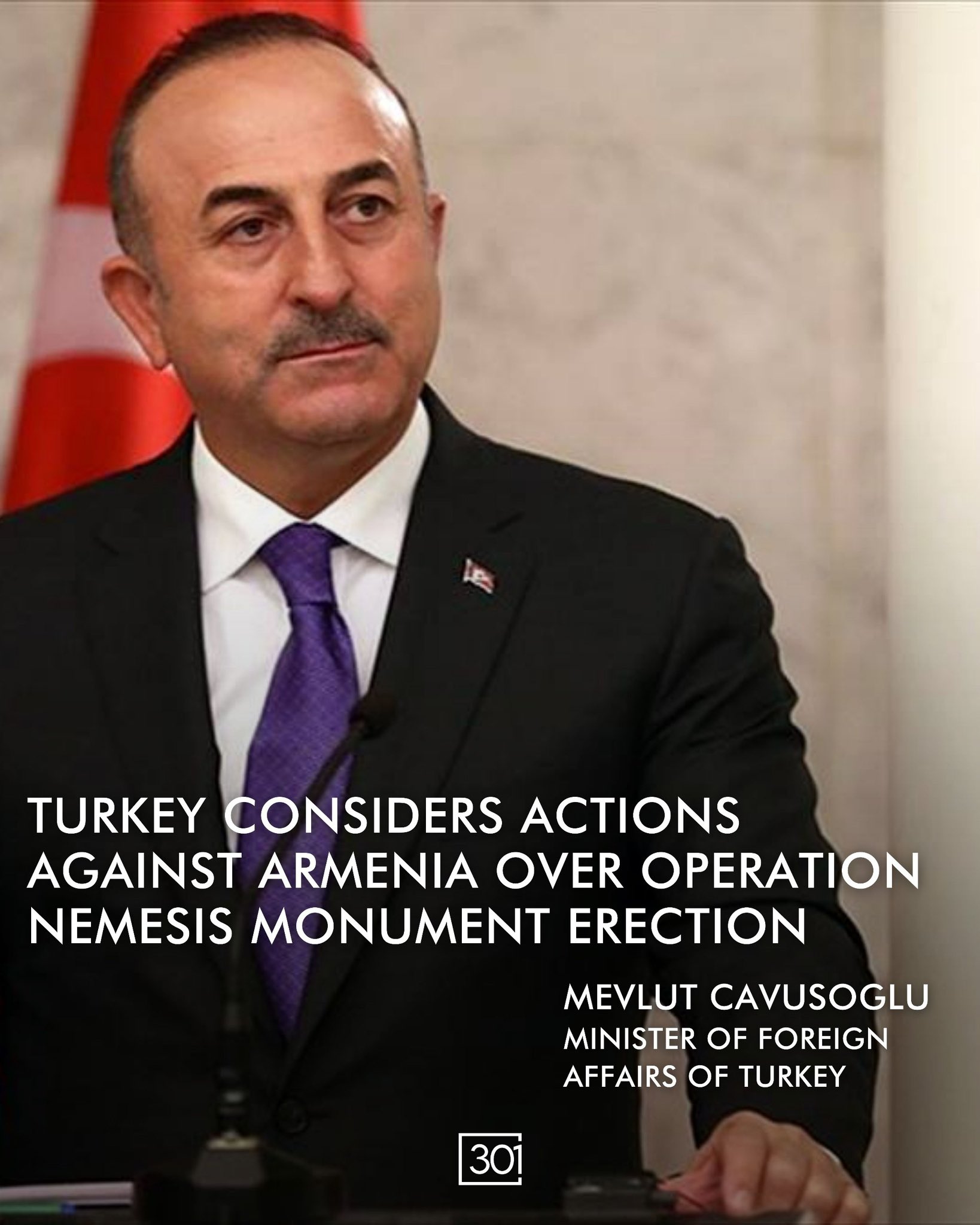
    Turkish Foreign Minister Mevlut Cavusoglu retaliated against the Nemesis Monument by announcing that Turkey banned overflights by Armenian airlines from Turkish skies. Furthermore, Cavusoglu brazenly announced that Turkey would take additional steps against Armenia, if the Nemesis Monument is not dismantled. Thus, Turkey violated the rules of IATA (International Air Transport Association) which states that countries cannot ban overflights for political reasons. Armenia should take legal action against Turkey under IATA rules and ban the overflights of Turkish Airlines over Armenia’s skies.

    This unwarranted Turkish retaliation is taking place at a time when the governments of Armenia and Turkey are negotiating for over a year to open their mutual border and normalize their relations. Even though it is announced that these negotiations are taking place “without any preconditions,” in reality, Turkey has made several demands, such as Armenia declaring that Artsakh is part of Azerbaijan by recognizing its territorial integrity, allowing the so-called ‘Zangezur Corridor’ to cross Armenia’s territory, linking mainland Azerbaijan to its exclave of Nakhichevan, which would mean that the ‘Corridor’ is under the sovereignty of Azerbaijan, not Armenia.

    Even if Turkey would open the border someday, it will shut it down again if Armenia does not meet any of Turkey’s future demands, thus continuously blackmailing the Armenian government. Turkey’s current demand to dismantle the Nemesis Monument is an early warning of more demands to come from Turkey, such as dismantling the Armenian Genocide Memorial Complex in Yerevan, banning the burning of Turkish flags on April 24, and removing from Armenia’s Declaration of Independence the paragraph that states: “The Republic of Armenia supports the task of achieving international recognition of the Armenian Genocide in Ottoman Turkey and Western Armenia in 1915.”

    This is the result of prostrating oneself in front of the unrepentant enemy and begging for peace. In response to the Turkish ban of Armenian overflights from Turkish skies, Armenia’s leaders criticized their own country for erecting the Nemesis Monument in Yerevan, rather than telling Turkey that they have no right to interfere in Armenia’s domestic decisions. In the process of trying to appease Turkey, Armenia’s Prime Minister and the President of the Parliament made a number of anti-Monument statements. So, it is OK for Turkey to glorify Talaat, the Turkish Hitler, but not OK for Armenia to honor those who killed the butcher. Armenia’s leaders, rather than making excuses for the Nemesis Monument, should have demanded that Turkey dismantle the Talaat Pasha Memorial in Istanbul.

    Prime Minister Pashinyan made the excuse that the Nemesis Monument was authorized by the City of Yerevan, not the government of Armenia. The Monument was approved by the Yerevan City Council on Sept. 14, 2021. Pashinyan contradicted himself by first telling the Armenian Parliament that the decision to authorize the Monument was made “to avoid being labeled traitors…. But by doing so, we actually keep betraying the state and national interests of our country.” He then went on to say that “a wrong decision was made and the implementation of that decision was wrong.” Pashinyan also stated that “one of the shortcomings of democracy is when the authorities or the government leader is not controlling everything and everyone.” This is a shocking statement from someone who came to power claiming to promote democracy, yet he does not seem to understand the basic principles of democracy. Pashinyan, in fact, controls everything and everyone in the country!

    Meanwhile, the President of the Armenian Parliament Alen Simonyan, during a press conference in Ankara last week, also made excuses by saying that Turkey should not view the Nemesis Monument “as an expression of the foreign policy of the government of Armenia nor as an unfriendly act. The Armenian government’s foreign policy is conducted by the Prime Minister and Foreign Minister.” Simonyan further said that only “opposition members of the Parliament had attended the inauguration of the Nemesis Monument.” Cavusoglu replied that the Armenian government’s excuses are “insincere and untrue. No one should try to deceive us by saying that it does not fall within their jurisdiction.”

    Armenia’s leaders need to draw an important lesson from this episode. Unless Armenia immediately rejects Turkey’s attempts to interfere in Armenia’s internal affairs, I fear that the Turkish government will be emboldened to impose further demands which will severely restrict Armenia’s sovereignty.

  • New Turkish Denial Tactic: Impeach Biden For Recognizing the Armenian Genocide!

    New Turkish Denial Tactic: Impeach Biden For Recognizing the Armenian Genocide!

    For over a century, successive Turkish governments have tried various tricks to deny the veracity of the Armenian Genocide. All of their attempts have miserably failed. Turkey exerted diplomatic pressure around the globe and spent tens of millions of dollars hiring high-priced lobbying firms to deny the undeniable. Contrary to post-war Germany which admitted its guilt in the Holocaust and made amends, the Turkish government, by continuing its denials, is labelled around the world as an unrepentant criminal regime. Turkey would have been better off coming clean by acknowledging and making restitution for the mass crimes of 1915 rather than perpetuating the disgraceful legacy of its barbaric past.

    The latest ridiculous Turkish denialist tactic is claiming that Pres. Joe Biden, by acknowledging the Armenian Genocide, “violated four articles of the U.S. Constitution.” If genocide was not a gruesome subject, such an accusation would have been amusing. However, the comedy does not stop there. In an interview with Turkish journalist Ugur Dundar, published in several Turkish media outlets, former Turkish Ambassador to the United States, Sukru Elekdag, suggested that Turkish groups try to impeach Biden after he leaves the White House, even though a president cannot be impeached after he is no longer in office.

    Amb. Elekdag is not a constitutional law expert. He studied economics in college and later became a diplomat. He knows nothing about the U.S. Constitution.

    When the Turkish journalist asked Elekdag how can Turks sue Biden since he referred to the Ottoman Empire as the perpetrator of the Genocide, not the Republic of Turkey, the Ambassador foolishly pointed out that “there is no ethnicity called Ottoman. Ottoman is the name of a dynasty. Those who founded the Ottoman state are Turks and they are our ancestors and we are their descendants.” So, Elekdag is suggesting that Turks sue Biden for accusing the Ottoman Empire of genocide. However, since Elekdag is associating the Republic of Turkey with the Ottoman Empire, then Turkey is naturally liable for the Ottoman crimes.

    Elekdag’s falsely alleged that Pres. Biden violated Article VI, the Fifth Amendment, Article 1 (Section 9), and the 14th Amendment to the US Constitution.

    Elekdag suggested that Pres. Erdogan of Turkey announce to the world that “Pres. Biden has committed a crime by violating the U.S. Constitution with his 24 April statements.” This is the most ridiculous part of the whole interview. Pres. Erdogan, who has committed massive crimes against hundreds of thousands of Turkish citizens, is the last person on earth to accuse anyone of committing a crime.

    At the end of his interview, Elekdag stated that he had contacted the leaders of the Assembly of Turkish American Associations (ATAA) who told him that they will consider his accusations of Pres. Biden.

    Elekdag suggested that an academic research be conducted on “whether or not to impeach and prosecute a former U.S. president” for his “constitutional offenses.” The ATAA is now planning to hold a symposium at an American university “with the participation of historians and lawyers.”

    I received a copy of ATAA’s letter to Pres. Biden dated April 18, 2023, telling him that his previous two years’ April 24 statements “disregarded at least four articles and amendments of the U.S. Constitution.” Nevertheless, a week after receiving ATAA’s letter, Pres. Biden once again issued an Armenian Genocide statement on April 24, 2023, ignoring the Turkish warnings. The ATAA told Pres. Biden that his April 24 statements were “motivated solely to gain political popularity among the strong Armenian diaspora.”

    At the end of its letter, the ATAA falsely claimed that there was an “initiative by the republics of Türkiye and Armenia to establish a Joint Historical Commission, composed of historians and legal scholars to be selected by Ankara and Erivan.”

    I would like to add a few thoughts to this Turkish onslaught of misrepresentations:

    I will be greatly pleased if the ATAA takes legal action against Pres. Biden which will result in publicizing worldwide the crime of Genocide committed by Ottoman Turkey. The ATAA’s lawyers will be happy to enrich themselves by getting paid to file such a frivolous lawsuit.

    If Elekdag was really a constitutional law expert, why didn’t he sue Pres. Ronald Reagan in 1981 and the U.S. House of Representatives in 1984, when they recognized the Armenian Genocide, while he was Ambassador in Washington, D.C.? Why didn’t the ATAA file lawsuits for the recognition of the Armenian Genocide by the House of Representatives in 1975, the Senate and House of Representatives in 2019, and all 50 U.S. states?

    The ATAA can save a lot of money and effort by simply asking Google’s Artificial Intelligence website if Turks can sue Pres. Biden for acknowledging the Armenian Genocide. Here is AI’s answer:

    “No, Biden did not violate the Constitution by recognizing the Armenian genocide. The Constitution does not explicitly prohibit the President from making such a declaration, and there is no precedent to suggest that it would be considered unconstitutional…. The Armenian genocide was the systematic extermination of Armenians by the Ottoman Empire during World War I. It is estimated that between 1.5 and 2 million Armenians were killed during the genocide. The Turkish government has long denied that the genocide took place, but there is overwhelming evidence to support the fact that it did. Biden’s recognition of the Armenian genocide was a long-overdue step in acknowledging one of the darkest chapters in human history. It is a powerful statement of America’s commitment to human rights and justice.”

  • Turkish Sergeant Provides Grisly Details Of Massacring Dersim Alevis & Armenians

    Turkish Sergeant Provides Grisly Details Of Massacring Dersim Alevis & Armenians

    Turkish Sergeant Ali Oz, who participated in the massacre of thousands of Alevi Kurds and Armenians in Dersim, Turkey, in 1937-38, wrote a shocking confession about his role in those killings. It is very disturbing to read the gruesome details of the killings.

    The source of Oz’s letter is the archive of Hasan Saltık who was the founder of Kalan Music which produced valuable records of Turkish and Armenian music. He passed away two years ago. Saltik had hundreds of Turkish governmental documents and photos which he shared with several researchers. One of them was Nevzat Onaran who wrote extensively about the confiscated Armenian properties. Prof. Taner Akcam gave me a copy of Oz’s letter which he had received from Onaran. Akcam thanked Nilufer, Saltik’s wife, for giving him permission to use the letter.

    Sergeant Oz wrote a letter on December 17, 1946 to Minister of Interior Sukru Kaya, thanking him for having helped him get a job at the intercession of powerful General Abdullah Alpdogan, who was the Governor-Commander of the Dersim region, sent by Ataturk to organize the Dersim massacre. Oz was Alpdogan’s bodyguard in Dersim.

    Oz told Minister Kaya in his letter that his army colleague, Ethem, who was with him during the Dersim massacre, had recently come to visit him. “He had lost his mind completely. He rose out of bed startled. He went out into the street screaming…. I could barely restrain him. The children they killed constantly troubled him. He couldn’t sleep or anything. With great difficulty I took him to Izmir, brought him to his family and handed him over to them. After I came back, I got the news. He cut his wrists and committed suicide.”

    Sergeant Oz described the impact of the crimes he had committed in Dersim. “This incident affected me profoundly. The saddening incidents that I experienced began one by one to return to my mind. The eyes of the children I killed pounded in my head, and I too began to not sleep, to not eat. I rise up shaking, I lose myself. It has become such that I don’t know where I have gone, what I have done.”

    Oz wrote that he was referred to a psychiatrist. “The doctor had me write everything that I had experienced and sign it. Now I am taking medicine. They gave me a leave [of absence] for three months. But my Minister, our General said, ‘don’t talk about what happened here [in Dersim] to any civilian, not even to your mother or father. Otherwise, you will all be hanged.’ I wrote those things and signed them. Now I have begun to fear whether something might happen to me. I asked the doctor to give me back what I wrote. It’s impossible, he won’t give it.”

    Oz told the Interior Minister exactly what he had written to his psychiatrist: “I participated in the Dersim operation of 1937-38. I was the bodyguard of my General. There was a lot of conflict with the bandits. Those bandits we caught or those who surrendered we killed, whether women or children. We poured petrol on them all and burned them. Sometimes the General said to pour petrol on them alive and burn them. Yelling and screaming they burned and turned to ashes, the smell of flesh burned our whole nasal passage.”

    Oz continued his horrible recollections: “News came to the General from Tersemek [Dersim]: ‘Women and children were hidden somewhere steep alongside the river, what shall we do?’ ‘Kill and burn them all,’ said the General. Two hours later the Lieutenant gave directions. But, no one wanted to harm the children. They didn’t listen to the orders. The General was very angry. We set out with a squad of soldiers. Everyone stood at attention. He began to hit the Lieutenant and the soldiers. Cursing, he said: ‘bring them all to where it’s flat.’ The women and children, yelling and screaming, wailing and moaning, begged at the General’s feet. There was nothing proper on them or their feet. He had all their hands and feet bound, their mouths gagged with cloth. ‘Now soldiers, I address you, these Qizilbash [Alevi] offspring are all the bastards of traitors, the bastards of those who killed your friends, and if they grow up they will continue to kill your brothers. They should be exterminated. We eradicated the Armenian offspring. All that’s left are these Kurds and Qizilbash. If you want your children to live happily in this country, you will kill without mercy. The government, our President, gave instructions to raze, burn, demolish. No one will be judged for the things done, I promise you,’ he said.”

    The General then ordered: “‘Everyone will take turns to kill one or two people.’ There was silence in the squad. ‘Lieutenant, begin, bring two people,’ he said. They brought two children, and he shot them in the head. They both died. When it came to the third soldier, Salih from Diyarbakir, he went to the children and fell in front of them. ‘My Commander, I can’t do it, I have children too. Children are innocent,’ he said, ‘these poor things.’ The General said, ‘you fucking Kurd, it’s your race, that’s why you take pity, isn’t it?’ He shot the soldier in the forehead. He said, ‘whoever doesn’t carry out the order will end up like him.’ So, everyone started to kill one or two women and children. After each execution, the General himself shot them once or twice in the head to make sure they were dead. Everyone had to do his duty. ‘Come to me Sergeant [Oz], it’s your turn.’ There were three little girls left. ‘You take care of them,’ he said. The children were hunched over on the ground and had soiled themselves. They were crying in their ragged state. I looked into their eyes. I killed the three of them. Their eyes pierced my depths. I can’t forget their eyes. 70 to 80 children and 30 women were executed that day. They were all thrown into the waters of the Murat. The river was soaked with blood. Many soldiers prayed for forgiveness. I killed and burned many people, but I’ve never seen eyes that pierced like those of the children.”

    Sergeant Oz concluded his letter with the following agonizing note: “How can I look my children in the face?”

  • Armenia Ranks Better Than Azerbaijan And Turkey in the Prosperity Index

    Armenia Ranks Better Than Azerbaijan And Turkey in the Prosperity Index

    The UK-based Legatum Institute published its comprehensive 2023 Prosperity Index for 167 countries, including Armenia, Azerbaijan and Turkey. The index covers 12 separate spheres or ‘pillars’ which are composed of 67 sub-sections.

    The Institute defined prosperity as people having “the opportunity to thrive by fulfilling their unique potential and playing their part in strengthening their communities and nations. Ultimately, prosperity is not just about what we have; it is also about who we become. Prosperity is underpinned by an inclusive society, with a strong social contract that protects the fundamental liberties and security of every individual.”

    Overall, Armenia is ranked in the Prosperity Index much higher than Azerbaijan and Turkey. Armenia is 61st place in 2023, slightly down from 59th in 2022, but considerably up from 76th in 2013. Meanwhile, Azerbaijan is ranked much lower at 92nd in 2023, the same as in 2012 — somewhat higher than 104th in 2013. Turkey is ranked even lower at 95th in 2023, the same as in 2012 — substantially down from 68th in 2013.

    The Legatum Institute described Azerbaijan as “the least prosperous country in the region,” despite its vast income from billions of petrodollars.” This means that the country’s wealth is not trickling down to the population.

    Here is how Legatum Institute described Turkey’s dismal Prosperity Index. “Turkey has seen its governance deteriorate significantly over the last 10 years, falling 60 places to 128th, with political accountability deteriorating at the greatest rate globally. Constitutional reforms in 2017 concentrated more power in the hands of the executive, removing key checks and balances. Personal Freedom has also deteriorated at the second greatest rate globally, with the government consistently suppressing dissent…. The current government has ruled Turkey since 2002. As noted by Freedom House, after initially passing some liberalizing reforms, the government has pursued a wide-ranging crackdown on critics and opponents since 2016. For example, Amnesty International points out that hundreds of people, including journalists, social media users and protesters, have been detained in Turkey in 2019 due to their criticism of Turkey’s military offensive in Syria.”

    Here are the rankings of Armenia, Azerbaijan and Turkey on each of the 12 pillars of the Legatum Institute’s Prosperity Index:

    1) “The Safety and Security pillar (War & Civil Conflict, Terrorism, Politically Related Terror & Violence, Violent Crime, and Property Crime) measures the degree to which war, conflict, and crime have destabilized the security of individuals, both immediately and through longer-lasting effects”: Armenia (75th), Azerbaijan (111th), and Turkey (147th).

    2) “The Personal Freedom pillar (Agency, Freedom of Assembly & Association, Freedom of Speech & Access to Information, and Absence of Legal Discrimination) measures progress towards basic legal rights, and individual liberties”: Armenia (70th), Azerbaijan (144th), and Turkey (152nd).

    3) “The Governance pillar (Executive Constraints, Political Accountability, Rule of Law, Government Integrity, Government Effectiveness, Regulatory Quality, and Institutional Trust) measures the extent to which there are checks and restraints on power and whether governments operate effectively and without corruption”: Armenia (64th), Azerbaijan (113th), and Turkey (128th).

    4) “The Social Capital pillar (Personal & Family Relationships, Social Networks, Interpersonal Trust, Social Tolerance, and Civic & Social Participation) measures the strength of personal and social relationships, social norms, civic participation in a country, and social tolerance”: Armenia (125th), Azerbaijan (132nd), and Turkey (137th).

    5) “The Investment Environment pillar (Property Rights, Investor Protection, Contract Enforcement, Financing Ecosystem, and Restrictions on International Investment) measures the extent to which investments are adequately protected and are readily accessible”: Armenia (75th), Azerbaijan (54th), and Turkey (68th).

    6) “The Enterprise Conditions pillar (Domestic Market Contestability, Environment for Business Creation, Burden of Regulation, Labor Market Flexibility, and Price Distortions) measures the degree to which regulations enable businesses to start, compete, and expand”: Armenia (44th), Azerbaijan (47th), and Turkey (65th).

    7) “The Infrastructure and Market Access pillar (Communication, Energy, Water, Transport, Border Administration, Open Market Scale, Import Tariff Barriers, and Market Distortions) measures the quality of the infrastructure that enables trade and distortions in the market for goods and services”: Armenia (71st), Azerbaijan (72nd), and Turkey (50th).

    8) “The Economic Quality pillar (Fiscal Sustainability, Macroeconomic Stability, Productivity & Competitiveness, Dynamism, and Labor Force Engagement) measures how well an economy is equipped to generate wealth sustainably and with the full engagement of the workforce”: Armenia (83rd), Azerbaijan (65th), and Turkey (71st).

    9) “The Living Conditions pillar (Material Resources, Nutrition, Basic Services, Shelter, Connectedness, and Protection from Harm) measures the degree to which a reasonable quality of life is experienced by all, including material resources, shelter, basic services, and connectivity”: Armenia (76th), Azerbaijan (65th), and Turkey (59th).

    10) “The Health pillar (Behavioral Risk Factors, Preventative Interventions, Care Systems, Mental Health, Physical Health, and Longevity) measures the extent to which people are healthy and have access to the necessary services to maintain good health, including health outcomes, health systems, illness and risk factors, and mortality rates”: Armenia (68th), Azerbaijan (85th), and Turkey (63rd).

    11) “The Education pillar (Adult Skills, Tertiary Education, Secondary Education, Primary Education, and Pre-primary Education) measures enrolment, outcomes, and quality across four stages of education as well as the skills in the adult population”: Armenia (59th), Azerbaijan (79th), and Turkey (74th).

    12) “The Natural Environment pillar (Preservation Efforts, Oceans, Freshwater, Forest, Land and Soil, Exposure to Air Pollution, and Emissions) measures the aspects of the physical environment that have a direct effect on people in their daily lives and changes that might impact the prosperity of future generations”: Armenia (99th), Azerbaijan (149th), and Turkey (86th).

    In addition to Armenia’s better ranking than Azerbaijan and Turkey in the overall Prosperity Index, Armenia exceeds its two neighboring countries in six categories. It is worse than both of them only in three categories, but better than Azerbaijan and worse than Turkey in three other categories.