Category: Harut Sassounian

Harut Sassounian is the Publisher of The California Courier, founded in 1958. His weekly editorials, translated into several languages, are reprinted in scores of U.S. and overseas publications and posted on countless websites.<p>

He is the author of “The Armenian Genocide: The World Speaks Out, 1915-2005, Documents and Declarations.”

As President of the Armenia Artsakh Fund, he has administered the procurement and delivery of $970 million of humanitarian assistance to Armenia and Artsakh during the past 34 years. As Senior Vice President of Kirk Kerkorian’s Lincy Foundation, he oversaw $240 million of infrastructure projects in Armenia.

From 1978 to 1982, Mr. Sassounian worked as an international marketing executive for Procter & Gamble in Geneva, Switzerland. He was a human rights delegate at the United Nations for 10 years. He played a leading role in the recognition of the Armenian Genocide by the U.N. Sub-Commission on Prevention of Discrimination and Protection of Minorities in 1985.

Mr. Sassounian has a Master’s Degree in International Affairs from Columbia University, and a Master’s in Business Administration from Pepperdine University.

  • Pashinyan and Partner Use Vulgar Slanders to Smear the Armenian Church

    Pashinyan and Partner Use Vulgar Slanders to Smear the Armenian Church

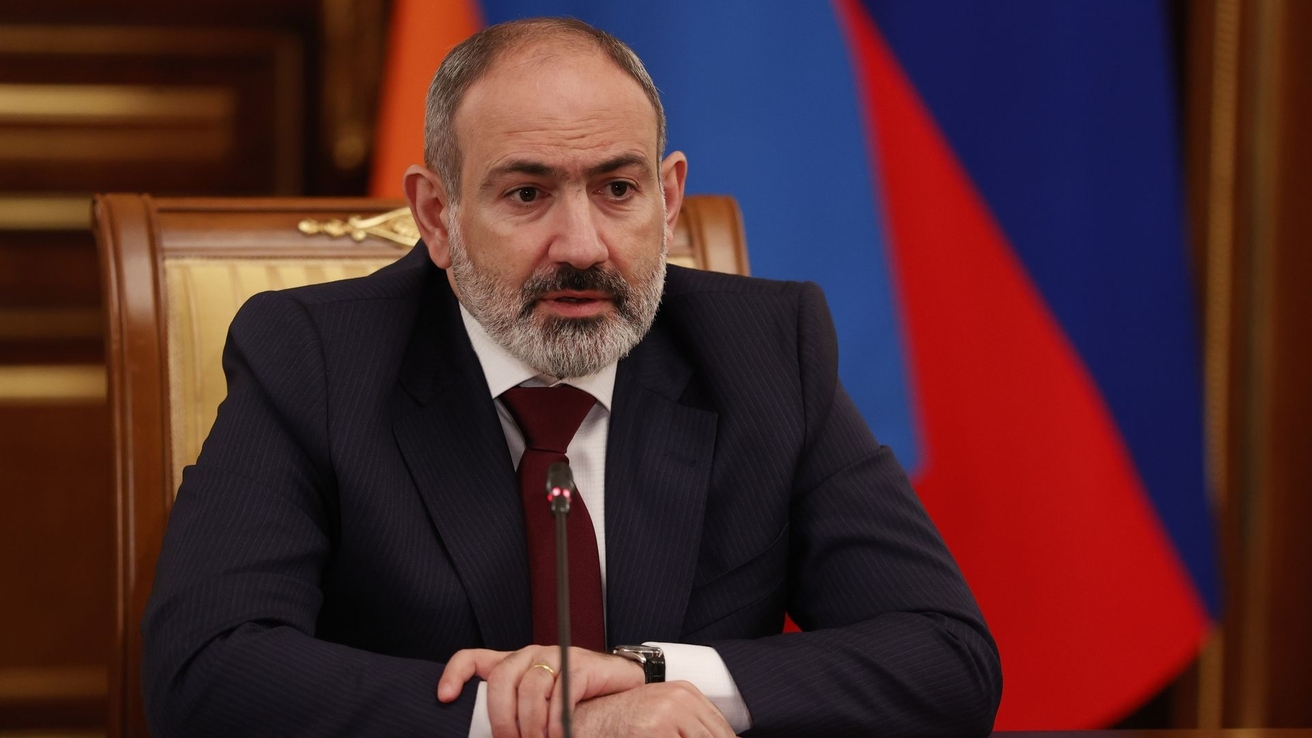
    In recent months, Prime Minister Nikol Pashinyan has exhibited frequent episodes of erratic behavior that raise serious questions about his mental stability. During parliamentary appearances, he screams at those who question him, wildly flailing his arms, and even threatens to jail his political opponents. Such conduct is both bizarre and wholly inappropriate for the head of Armenia’s government.

    Whatever Pashinyan’s mental state was before the Artsakh war, it has clearly deteriorated since the catastrophic defeat Armenia suffered in 2020 under his leadership. Typically, political leaders responsible for disastrous outcomes, generals who suffer major battlefield losses and corporate heads whose mismanagement drives their companies into bankruptcy swiftly resign or are replaced by a more competent person who can take over and do damage control. Regrettably, Pashinyan’s refusal to resign only deepens Armenia’s precarious situation.

    Pashinyan displayed another example of his irrational behavior during last week’s cabinet session, when he launched an unprovoked tirade against the Armenian Apostolic Church and its clergy. “I officially say our churches are storage rooms. S-t-o-r-a-g-e-r-o-o-m-s. Inside the church, there are piles of garbage, bags of cement, shoes, old clothes, old bed, leftover materials, and rusty rebar.” This statement constitutes a false and unwarranted attack on the Armenian Church, especially considering that he did not identify a single church in such a condition. The Prime Minister may have seen construction materials that are stored during church renovations.

    Pashinyan’s unnecessary outburst ignited a bitter exchange between himself joined by Anna Hakobyan (his partner, since they are not married), and several clergymen.

    In a series of inappropriate Facebook posts, Pashinyan asserted that “all clergymen who have violated their oath of celibacy must leave spiritual service.” This is none of the Prime Minister’s business. His statement clearly oversteps his authority and infringes upon the constitutional separation of church and state.

    Pashinyan then wrote on his Facebook page: “The Republic of Armenia must have a decisive vote in the election of the Catholicos of All Armenians. Candidates for Catholicos must pass a background check.” This too represents an unwarranted intrusion into the church’s internal affairs, violating the Constitution.

    The dispute worsened when Pashinyan used a shockingly vulgar remark to respond to a bishop who had called his earlier statement “disgraceful.” Incredibly, the Prime Minister posted on his Facebook page: “Srpazan [Eminence], go back to banging your uncle’s wife, what business do you have with me?” Such language is unbecoming of Armenia’s leader and more appropriate for a street thug.

    17 non-governmental organizations issued a joint statement condemning Pashinyan for exploiting women as sexual objects to attack his opponents. In my opinion, what Pashinyan wrote is libelous, providing ample grounds for legal action by the bishop. I have filed a complaint with Facebook against Pashinyan for violating its Community Standards by posting this defamatory statement.

    Not to be outdone, Anna Hakobyan, Pashinyan’s partner, escalated the conflict further. On her Facebook page, she proclaimed inappropriately: “The country’s main pedophiles are demonized by the word ‘storeroom.’ Of course, that’s how it should be. Aren’t storerooms the dark corners of the lives of black-vested maniacs? After all, it is in storerooms that perversions take place….” She also lambasted the World Council of Churches conference on Artsakh held last week in Switzerland, which was attended by Catholicos Karekin II and other dignitaries, by asking: “What are you doing in Switzerland?” She then ridiculed the efforts to assist Artsakh Armenians: “Whom are you sending securely to their native cradle, whom do you immediately free from captivity? Do you know what spirituality is? That’s news for you. The country’s chief spiritual mafia leader [referring to Catholicos Karekin II] is clearly indignant that a conversation has been opened about storerooms. Otherwise, why would they attack the elected leader of the state?” It appears that Anna was incensed by Catholicos’s attempts to reverse Pashinyan’s surrender of Artsakh.

    Anna Hakobyan then posted a vulgar and libelous statement on Facebook about an Armenian journalist who had criticized her. She wrote: “According to reliable information, [journalist] Boris Murazi is providing sexual services to [former President] Serzh Sargsyan and some of his favorite bishops. I have been told about this for several years. I did not believe it. Now it is obvious. I think the relevant agencies already have video recordings in the drawers.” This vicious attack crosses all red lines of morality and decency. Murazi should file a lawsuit for libel. I have already reported her falsehoods to Facebook.

    Had Pashinyan and Hakobyan expressed their disagreements with the Catholicos in a civilized language, it would have been somewhat understandable. However, using such vulgar language is utterly deplorable. Over the years, I have engaged in numerous disagreements with various high-ranking clergymen and former and current political leaders of Armenia, but I have never resorted to using abusive language. One can disagree without being disagreeable.

    Pashinyan ascended to power in 2018 by falsely assuring the Armenian public that he would lead a movement for “love and tolerance.” Yet, seven years later, it is evident that he has done the exact opposite. He has abused his authority to spread hatred and intolerance. Azerbaijan’s media gleefully reported the Prime Minister’s attacks on the Armenian Church, aligning him with Pres. Ilham Aliyev and Allahshukur Pashazade, the Grand Mufti of Azerbaijan, in their denunciation of the Church.Ultimately, Pashinyan and his partner appear to use these vulgar statements to divert the public’s attention from the regime’s array of damaging, anti-Armenian policies. After ceding Armenian control of Artsakh and parts of the Republic of Armenia to Azerbaijan and attacking the sacred symbols of Armenia’s statehood, this couple is now intent on undermining the 1,700-year-old religious institution that is central to Armenian identity.

    To get rid of this national scourge before he destroys Armenia, I suggest that Karekin II and Aram I Vehapars order all Armenian churches — in Armenia and the Diaspora — to toll their bells, urging hundreds of thousands of Armenians to gather in front of the Prime Minister’s building and remain until Pashinyan resigns.

  • Two Sensational Videos Presenting Armenia as a Muslim Nation

    Two Sensational Videos Presenting Armenia as a Muslim Nation

    On YouTube, I came across two fictional videos that distort Armenia’s history and identity. The first video, which runs for nine minutes and 53 seconds, is titled: “The world’s first Christian country now embraces Islam: Millions of its citizens convert to Islam” (https://www.youtube.com/watch?v=YRuBcYQ-0WA). The second video, lasting eight minutes and 24 seconds, is titled: “The first Christian country in the world: Now 99% Muslim” (https://www.youtube.com/watch?v=7qve3KR58xI).

    The two videos, which offer somewhat different content, are narrated by an unidentified individual with a professional voice. They tell the baseless story of how the entire population of Armenia supposedly converted to Islam. The videos contain many realistic-looking scenes of Armenia, likely created by artificial intelligence.

    The videos are produced by an unknown entity called ‘Light of Islam.’ When I first viewed these videos, YouTube displayed a note stating that they contained “altered or synthetically-generated content,” but that notice is now removed. YouTube shows on the screen a lengthy explanation requiring that videos disclose if the content is fictitious. I urge readers to file a complaint with YouTube.

    My objection is based on the fact that these videos contain false information, misleading non-Armenian viewers into believing that it is truthful.

    To illustrate the fabricated narrative presented in these videos, here are excerpts from one of the videos which I have transcribed:

    The video starts with an entirely fictional history of Armenia: “In the 17th century, churches became mosques, crosses were replaced by crescents, and Bibles were replaced by Qurans. Armenia, the world’s oldest Christian country, is now a devout Muslim country has its culture disappeared, [though] the art of stone-carving Khachkars has survived, now inscribed with holy verses. Armenian folk songs are still sung, but their lyrics praise God. Armenian is still spoken, but prayers are now recited in the name of Allah. In school, children memorize the Al-Fattah [one of the 99 names of Allah] and continue to learn about their nation’s history….”

    In the video, Armenia is portrayed as having “developed into a center of Caucasian Islamic culture. Large Madrassas [Islamic schools] were established in Gyumri and Yerevan. Armenian Muslim writers and poets emerged writing poetry in Armenian, Arabic, and Persian. A new spiritual capital grew up around Lake Sevan. It was there that the largest mosque in the Caucasus was built whose architecture combines the design of ancient Christian Khachkars with Islamic calligraphy…. Armenia is now a bridge between the Islamic world and the West. Armenia’s Muslim diplomats sit at the European negotiating table. They speak five languages, quote al-Ghazali [11th century Persian Muslim scholar] and Shakespeare in one sentence. They are respected, because they are the mirror of two worlds. This country is living proof that identities can grow without losing their roots, and that faith can change without killing culture. In universities, Armenian scholars study two great legacies: the Bible and the Quran, the cross and the crescent, not as symbols of conflict, but as two sides of their history. What makes a nation great is not whether it is Christian or Muslim. Today, in that alternative Armenia, the call to prayer still echoes from the minarets of mosques that used to be church bell towers. Children still dance folk dances singing the songs of their ancestors, now with verses praising God.”

    The narrator then introduces a fictitious individual which he calls ‘Harut’! “One day, Harut asked: ‘Mom, why is there a picture of a cross in our house? Aren’t we Muslims?’ His mother paused, then, she answered quietly, ‘because it’s part of who we are, son. We used to be Christians, then we became Muslims, but what never changes, we are always Armenian.’”

    The video continues: “At school, Harut learns to read the Quran and also learns about the ancient Armenian alphabet. In his small library, there are old leather-bound Qurans and a Bible in Krapar [classical Armenian], both inherited from his grandmother who was a nun before converting to Islam. When the harvest festival arrives, families gather in the town square. Mothers serve lavash and dolma, while children dance the Kochari to the accompaniment of zurna and davul [drum]. The Imam of the mosque and the caretaker of the old church stand side by side welcoming people who have come from the mountain villages.”

    “Outside the school, new buildings stand side by side with ancient ruins. A mosque with Ottoman style arches sat next to an Armenian church with its distinctive cone roof. The call to prayer echoed through the air, but the small toll of the bells that were still rung on special occasions, in honor, not in resurrection. Armenia’s new government created an impartial history curriculum. The National Museum showcases both the stories of Christian martyrs and the early spreaders of Islam in the region: in one room, an old icon of Jesus, in another, a torn 16th century prayer rug. In the middle, an inscription reads, ‘Here is where wounds and love learn to coexist.’”

    YouTube should be urged to delete both fictitious videos to prevent misleading viewers who are unaware of the true facts about Armenia’s culture and religion.

  • Armenians Think They are the Only Ones Who Lack Unity: That is not Correct

    Armenians Think They are the Only Ones Who Lack Unity: That is not Correct

    Armenians often lament that they are a divided nation, believing mistakenly that other people are far more united. This perception mirrors families who argue behind closed doors, while assuming that their neighbors live in harmony. It’s a classic case of “the grass is greener on the other side of the fence.”

    However, internal divisions exist everywhere, including in Azerbaijan and Turkey. Azerbaijan’s jails are filled with protesters and dissidents who oppose the Aliyev regime. Meanwhile, Turkey has seen millions take to the streets of Istanbul and other cities, outraged by the politically motivated arrest of Istanbul’s popular Mayor Ekrem Imamoglu. Pres. Recep Tayyip Erdogan ordered Imamoglu’s imprisonment, fearing he could be a formidable challenger in next year’s presidential elections.

    One of the most persistent Armenian misperceptions is the notion that Jews are totally united. In reality, Israeli political parties are deeply polarized and rival Jewish-American organizations often oppose each other. Years ago, I expressed my belief in Jewish unity in an editorial lamenting Armenian disunity, only to be corrected by Jewish Heritage newspaper publisher Herb Brin. He argued that the Jewish community experiences significant internal conflict, including lawsuits between leaders and violent episodes. A stark example is the assassination of Israeli Prime Minister Yitzhak Rabin in Tel Aviv in 1995, not by a Palestinian, but by an Israeli Jew.

    Perhaps the most extreme case of Jewish disunity occurred in 2008, when a dozen ultra-orthodox rabbis met in New York City with Iranian President Mahmoud Ahmadinejad, just a day after he had denounced “Zionist murderers” at the United Nations. These rabbis believe that the state of Israel should be dismantled, adhering to the Torah’s prohibition against founding a Jewish state before the Messiah’s arrival. They even support Palestinian sovereignty over the Holy Land.

    During the meeting, the Iranian President described Zionism as a political movement “that seeks wealth and power” and expressed his desire that “God willing, it will be destroyed soon.” The group’s senior rabbi, Moshe Ber Beck, told Ahmadinejad: “That we have the honor and privilege to meet with such a distinguished person who understands the difference between Zionism and Judaism is for us a tremendously happy occasion.” After the meeting in a Manhattan hotel, Ahmadinejad posed for photographs with the rabbis.

    Turkish Americans, too, face deep divisions. Recently, a major dispute erupted between the Assembly of Turkish American Associations (ATAA) and Turkish Ambassador Sedat Onal. The ATAA, the largest Turkish-American organization with over 50 chapters throughout the United States, hosts an annual conference and gala that “brings together ATAA members, Turkish Americans, community leaders, and scholars from across the nation, Canada and Turkey,” according to ATAA’s website.

    This year’s conference and gala, held at the Westin Crystal Hotel in Arlington, Virginia, on May 2-3, 2025, was followed by ATAA’s General Assembly on May 4. A reception was held at the Capitol House Office Building, at the Education Subcommittee Hearing Room, in the evening of May 2. One of the panel discussions was titled, “Dealing with the Armenian Diaspora: Challenges that Turkish Americans Face!” The keynote speaker was Ergun Kirlikovali, ATAA’s Former President (2011-13) and current Trustee. Kirlikovali is a notorious genocide denier. Years ago, at a hearing held by a California State Assembly Committee on the Armenian Genocide, he made the appalling remark that “the fish in the Euphrates River were spitting Armenian eyes.”

    This year, a serious problem arose that caused a split between the Ambassador of Turkey Sedat Onal and the ATAA after it issued on March 19, 2025, a public statement announcing that it “strongly condemns and protests the unjust detainment of Ekrem Imamoglu, the democratically elected Mayor of Istanbul Metropolitan Municipality. This politically motivated action is a direct attack on democracy, the rule of law, and the fundamental rights and freedoms of the Turkish people.”

    Turkish ambassadors usually attend ATAA’s annual conference and deliver a keynote speech. However, Amb. Onal, following ATAA’s criticism of the Turkish government’s arrest of Mayor Imamoglu, cancelled his participation in the conference.

    On April 19, 2025, Ibrahim Kurtulus, a self-described Turkish “community activist,” in a letter to Amb. Onal, applauded his withdrawal from the ATAA’s conference. Kurtulus also criticized the ATAA for organizing and promoting an “anti-Turkey sentiment” which serves to “delegitimize Turkey’s standing on the international stage.”

    Within days of Kurtulus posting his letter on the website of the Turkish Forum, another Turkish-American by the name of Murat, expressing his disagreement with Kurtulus, responded in the Turkish Forum: “What an absurd letter. You are confusing interests of the state and the country with the interests of one-man rule, a regime no longer a full democracy, increasingly oppressing its people. The ambassador has simply become a tool of this one-man rule naturally, extending the divisive policies all the way across the ocean.”

    In conclusion, Armenians are not the only ones who experience internal divisions. However, given the existential threats facing Armenia, unity is more crucial now than ever before. As Marco Antonio de Dominis famously declared in the 17th century: “in essentials unity; in non-essentials liberty.”

  • Pashinyan Shouldn’t Have Invited Turkish Journalists to Yerevan for an Interview

    Pashinyan Shouldn’t Have Invited Turkish Journalists to Yerevan for an Interview

    Prime Minister Nikol Pashinyan made yet another mistake last week by inviting 10 journalists from Turkey to Yerevan and speaking to them for one and a half hours.

    Before we go into the substance of Pashinyan’s remarks, I would like to point out some of the basic problems with his statements and those of his spokesperson.

    First of all, the spokesperson revealed that the Turkish journalists had been invited to Yerevan at the Armenian government’s expense. This violates journalistic ethics. Professional journalists are not offered and do not accept payment for their travel and accommodation to maintain their independence from the subject of the interview.

    Secondly, the spokesperson for Pashinyan said that Armenia had invited Turkish journalists from all sides of the political spectrum, including pro-government, opposition, and independent media. Anyone who follows the Turkish media knows that there are hardly any opposition journalists left in Turkey. President Recep Tayyip Erdogan has either taken over all the opposition media or shut them down and jailed the dissenting journalists. The invited journalists to Armenia were from: T24, Sozcu TV, Anadolu Agency, Hürriyet Daily News, Turkish Radio and Television, Medyascope, NTV, Agos Armenian newspaper, Ihlas News Agency, and CNN Turk. Only two out of the 10 invited Turkish news outlets, Sozcu TV and Agos, can be considered independent news outlets.

    Thirdly, Pashinyan proudly told the Turkish journalists that his meeting with them was an unprecedented event. A usual, his statements are not based on facts.

    The meeting with Turkish journalists in Yerevan was NOT unprecedented. There were several past meetings between Armenian officials and Turkish journalists. I remember one particular interview that took place in 2001 when prominent Turkish journalist Mehmet Ali Birand of ‘CNN Turk’ came to Yerevan and interviewed Pres. Robert Kocharyan. That interview created a lot of controversy because Birand distorted what Kocharyan had told him by mistranslating his words from Armenian into Turkish. I wrote an article in 2001 pointing out Birand’s distortions and criticized Pres. Kocharyan for agreeing to give an interview on sensitive political topics which he and his advisors should have known was going to be distorted by the Turkish journalist. Besides Birand, many other Turkish journalists have come to Armenia to interview Armenian officials in the past. In addition, a large number of Armenian and Turkish journalists visited each other’s countries as part of the “Armenia-Turkey Team Reporting Project” in 2007-08.

    Turkish journalists are notorious for distorting the words of the people they interview. For that reason, over the past 40 years, I have refused all Turkish requests for an interview.

    Fourthly, Pashinyan falsely claimed that during previous Armenian governments, there were no direct contacts between Armenian and Turkish officials. He cited his invitation to attend Pres. Erdogan’s inauguration in Ankara and meeting him in New York. He also mentioned the visits of Foreign Minister Ararat Mirzoyan to Ankara. He said that previously, Armenian and Turkish officials only learned of each other’s views through third parties. Pashinyan mentioned as “a concrete example of cooperation,” Armenia’s recent extradition to Turkey of two Turks accused of committing a crime.

    Pashinyan’s claims that before him there were no official contacts between Armenia and Turkey are completely false. He wants to leave the impression that nothing happened in Armenia before he assumed power in 2018. There have been dozens of contacts between the officials of the two countries long before Pashinyan became Prime Minister. Here are some of them:

    1) Foreign Minister Raffi Hovannisian went to Istanbul in 1992 to participate in the Black Sea Economic Cooperation Conference.

    2) Presidential Advisor Gerard Libaridian went to Ankara in 1992.

    3) Pres. Levon Ter Petrossyan met with Alpaslan Turkesh, the founder of the ultra-nationalist Grey Wolves group and member of the Turkish Parliament, in Paris in 1993.

    4) Pres. Ter Petrossyan, accompanied by Foreign Minister Vahan Papazyan and Presidential Advisor Gerard Libaridian, went to Ankara in 1993 to attend the funeral of Turkish Pres. Turgut Ozal. On that occasion, Ter Petrossyan met with Prime Minister Suleyman Demirel. During that visit, Ter Petrossyan also met with Azerbaijan’s Pres. Abulfaz Elchibey.

    5) Turkish Pres. Abdullah Gul came to Yerevan to watch with Pres. Serzh Sargsyan the football match between Armenia and Turkey in 2008.

    6) Pres. Serzh Sargsyan travelled to Bursa, Turkey, to watch the return football game between Armenia and Turkey with Turkish President Abdullah Gul in 2009.

    7) Foreign Minister of Armenia Eduard Nalbandyan and Turkish Foreign Minister Ahmet Davutoglu met in Zurich in 2009 to sign the Armenia-Turkey Protocols.

    8) Turkish Foreign Minister Ahmet Davutoglu came to Yerevan in 2013.

    9) Foreign Minister Nalbandyan went to Ankara in 2014 to attend the inauguration of Pres. Recep Tayyip Erdogan.

    Therefore, Pashinyan is not correct that in the past Armenian and Turkish officials had no direct contacts and communicated only through third parties.

    In my next article, I will comment on Pashinyan’s statements to the Turkish journalists who visited Yerevan last week.

  • My lecture in Boston on April 6

    My lecture in Boston on April 6

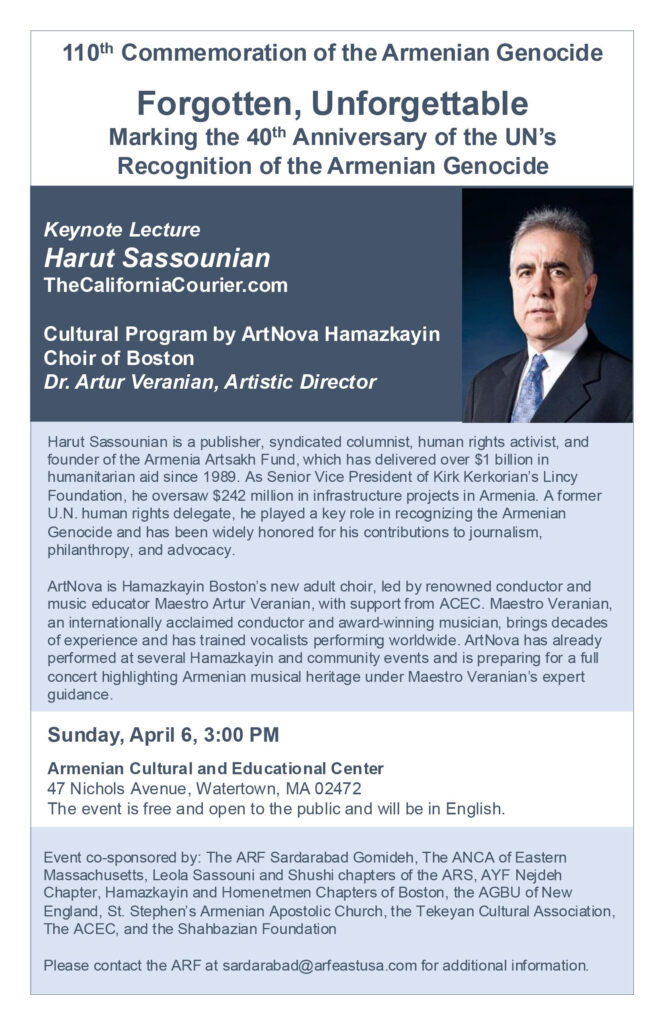
    “Forgotten, Unforgettable: Marking the 40th Anniversary of the UN’s Recognition of the Armenian Genocide”

    WATERTOWN, M.A.—The ARF Sardarabad Gomideh, the ANCA of Eastern Massachusetts, the “Leola Sassouni” and “Shushi” chapters of the ARS, the “Nejdeh” AYF Chapter, Hamazkayin and Homenetmen chapters of Boston, the ACEC, the AGBU of New England, St. Stephen’s Armenian Apostolic Church, the Tekeyan Cultural Foundation and the Shahbazian Foundation are co-hosting a commemorative event entitled “Forgotten, Unforgettable: Marking the 40th Anniversary of the U.N.’s Recognition of the Armenian Genocide.” The event will be held at the Armenian Cultural and Educational Center (47 Nichols Avenue, Watertown) on Sunday, April 6, at 3:00 p.m. The event will be in English and free and open to the public. 

    The commemoration will feature Harut Sassounian, the publisher and editor of the California  Courier, as a keynote speaker. It will also include a presentation of the flags by the Homenetmen Scouts and a cultural performance by the ArtNova Hamazkayin Choir of Boston under the directorship of Maestro Artur Veranian.  

    After over a decade of struggle in the halls of the United Nations by Armenians, countering intense efforts by Turkey and its allies in NATO and the Islamic Conference, the U.N. Sub-Commission on Prevention of Discrimination and Protection of Minorities in August 1985, by a vote of 14 in favor, one against and four abstentions, adopted a report that included an extensive reference to the Armenian Genocide. This is the first time that a U.N. body recognized the Armenian Genocide. 2025 is the 40th anniversary of that recognition. 

    Harut Sassounian is a publisher, syndicated columnist, human rights activist and founder of the Armenia Artsakh Fund, which has delivered over $1 billion in humanitarian aid since 1989. As Senior Vice President of Kirk Kerkorian’s Lincy Foundation, he oversaw $242 million in infrastructure projects in Armenia. A former U.N. human rights delegate, he played a key role in recognizing the Armenian Genocide and has been widely honored for his contributions to journalism, philanthropy and advocacy. 

    ArtNova is Hamazkayin Boston’s new adult choir, led by renowned conductor and music educator Maestro Artur Veranian, with support from ACEC. Maestro Veranian, an internationally acclaimed conductor and award-winning musician, brings decades of experience and has trained vocalists performing worldwide. ArtNova has already performed at several Hamazkayin  and community events and is preparing for a full concert highlighting Armenian musical heritage  under Maestro Veranian’s expert guidance.

  • Voting Against the New Constitution Is the Best Way to Get Rid of Pashinyan

    Voting Against the New Constitution Is the Best Way to Get Rid of Pashinyan

    Prime Minister Nikol Pashinyan announced last week that he has ordered the preparation of a new constitution which will need the approval of the citizens of Armenia in a referendum.

    I hope the majority of Armenian voters will reject the new constitution, thereby compelling him to resign. This is a golden opportunity to get rid of him. All previous efforts to remove him from office have failed over the past seven years because:

    1)  The split among the opposition groups has prevented them from forming a coalition large enough to remove Pashinyan from office. Even though his popularity has considerably decreased in recent years from 80% seven years ago to less than 10% now, nevertheless, his ruling party’s political rating is larger than any single opposition group. Many excuses have been made for not uniting, but none of these reasons are more important than the need to save the country. Regrettably, by being disunited, the opposition is the one that is keeping Pashinyan in power.

    2)  To form a successful anti-Pashinyan coalition, no one group should try to dominate it. The leadership of the coalition should be rotated until new elections are held.

    3)  A shadow government should be composed of all the opposition groups based on professional expertise.

    4)  The groups should temporarily set aside all of their internal differences and unite to save the nation. Should Armenia no longer exist, none of these groups’ ideologies will matter. Once they save the country, they can go back to pursuing their own goals.

    Knowing Pashinyan’s egotistical modus operandi, he will crisscross Armenia to ensure that the citizens vote for the new constitution. He will leave no stone unturned to achieve his objective by pressuring and threatening them. He has the resources of the government at his disposal to carry out such a vast campaign and resort to vote tampering or collecting a large amount of campaign contributions that exceed the legal limit, just as his party did during the last Yerevan City Council elections. This is a critical goal for Pashinyan because Pres. Aliyev has made it clear that without a new Armenian constitution, he will refuse to sign the “Peace Treaty” that Pashinyan has been begging for. Pashinyan needs that signed piece of paper to fool the voters in the 2026 elections into thinking that he has brought them “peace” even though it will not last long.

    Initially, Pashinyan dismissed Aliyev’s demand to change the constitution as interference in Armenia’s internal affairs. Furthermore, Pashinyan said that there is no such need as the draft of the peace treaty contains a clause that both countries agree to recognize each other’s territorial integrity. In the case of a dispute, the terms of the peace treaty will take precedence over their respective constitutions. Pashinyan added that Azerbaijan’s constitution itself contains indirect references to demanding territories from the Republic of Armenia. However, Pashinyan said that he will not ask Azerbaijan to revise its constitution!

    In addition to changing Armenia’s constitution, Pashinyan has accepted the following demands from Aliyev:

    — Armenia turning over certain villages located inside Armenia to Azerbaijan.

    — Allow Azeris who formerly lived in enclaves inside Armenia to return and live there.

    — To disband the OSCE Minsk group.

    — The departure of EU monitors from Armenia.

    — Armenia to drop its international lawsuits against Azerbaijan.

    — The road from the Eastern part of Azerbaijan to Nakhichevan to be a Corridor under Azeri sovereignty rather than a mere road. While objecting to the Corridor, Pashinyan has agreed to facilitate the access.

    — Even though the 2020 Agreement allows both Armenia and Azerbaijan to cross each other’s territory, Pashinyan has repeatedly said that Azeris are welcome to cross Armenia, without once stating that the agreement should be implemented reciprocally.

    Armenia’s Justice Minister Srbuhi Galyan said last week that the new constitution will be ready before the June 2026 parliamentary elections. It is not clear if the electorate will be asked to vote on the constitution at the same time as voting for the parliament members or after that election.

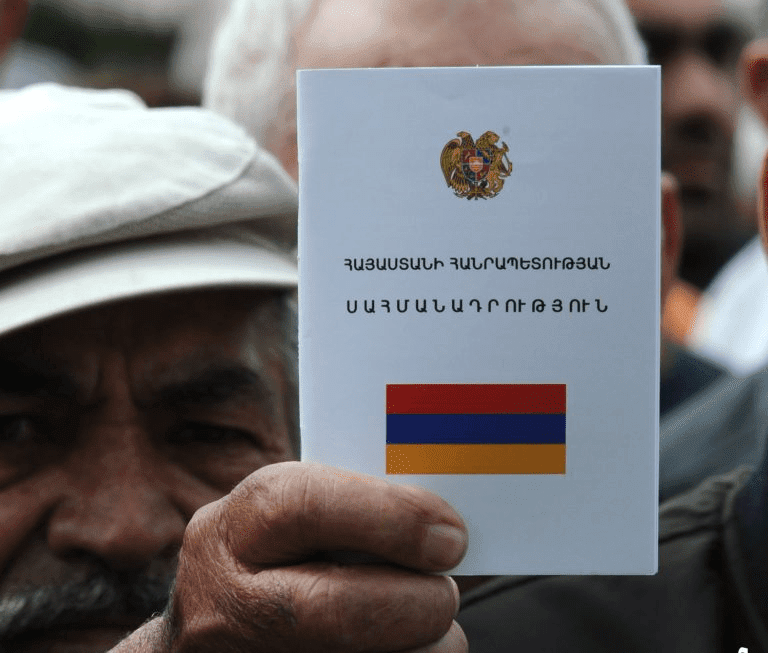
    There is nothing wrong with amending the constitution from time to time as the need arises, but to be compelled to write a brand new one at the enemy’s demand is totally unacceptable.

    It is critical that Armenian voters reject the new constitution. A no vote is a vote of no confidence in the Prime Minister. He can no longer continue to remain in his position after having been rejected by the people on his key initiative. He will have no choice but to resign.