US Secretary of State Marco Rubio
U.S. Department of State
2201 C Street NW
Washington, DC 20520
United States
April 5, 2025
Honorable Secretary of State
I write to address the so called concerns raised by American citizens of Greek heritage and Philhellenes
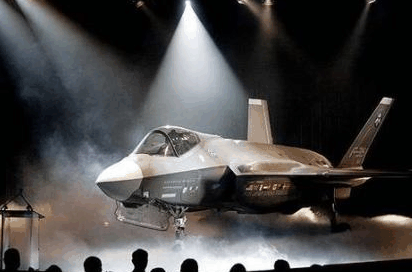
regarding the Republic of Türkiye and to provide a factual and balanced perspective that counters misleading narratives and unjustified accusations against our NATO ally. The argument against Türkiye’s procurement of F-35 fighter jets is based on outdated rhetoric, mischaracterizations of Turkish policies, and a failure to acknowledge Türkiye’s indispensable role in regional and global security.
1. Türkiye’s Commitment to Counterterrorism and Regional Stability
The assertion that Türkiye harbors or supports terrorist organizations is categorically false. As a nation that has suffered immensely from terrorism, Türkiye has been at the forefront of the fight against groups such as ISIS, the PKK/YPG, and other extremist elements. Contrary to the claims made, Türkiye has actively dismantled terrorist networks and conducted military operations to secure its borders and protect civilian populations.
On Hamas: Türkiye has engaged with Hamas as part of its diplomatic efforts to promote regional stability, much like other states in the region, including Qatar and Egypt. Diplomatic engagement does not equate to material support. Moreover, the recent normalization of Türkiye-Israel relations, including intelligence-sharing agreements, demonstrates Türkiye’s pragmatic approach rather than hostility toward Israel.
On Hezbollah: There is no factual basis to claim that Türkiye has exhibited “sympathy” toward Hezbollah. Türkiye has maintained a consistent position against Iran-backed militant groups that threaten regional security.
2. Türkiye’s Right to Defend Its Borders and Counter the PKK/YPG Threat
The claim that Türkiye’s military operations in Syria constitute aggression against U.S. allies ignores key realities:
The PKK is a U.S.-designated terrorist organization. The YPG, its Syrian branch, has been armed and supported under the guise of counter-ISIS operations. However, it continues to attack Turkish cities and civilians.
Türkiye has conducted counterterrorism operations in full compliance with international law and the right to self-defense under Article 51 of the UN Charter. No sovereign nation would tolerate terror threats emanating from its borders.
The argument conveniently omits that Türkiye was the only NATO country to engage in direct combat against ISIS in Syria, including the liberation of key cities such as al-Bab and Jarabulus, saving thousands of lives.
3. Türkiye’s NATO Commitment and Relations with Russia
Accusations that Türkiye has failed to impose sanctions on Russia ignore the complexity of Türkiye’s geopolitical position and strategic autonomy. It is important to note:
Türkiye has supplied Ukraine with Bayraktar TB2 drones, which have played a crucial role in resisting Russian aggression.
Unlike several European NATO members, Türkiye closed the Bosporus and Dardanelles Straits to Russian warships, limiting Moscow’s naval mobility.
Sanctions are not the sole measure of alignment; Türkiye’s diplomatic efforts, such as the Black Sea Grain Initiative, prevented a global food crisis by ensuring Ukrainian grain exports.
4. The F-35 and the S-400 Issue
The decision to sanction Türkiye under CAATSA due to its procurement of the Russian S-400 system was a strategic miscalculation that weakened NATO’s southern flank. The United States refused to sell Türkiye the Patriot missile system, leaving Türkiye with no choice but to seek alternatives for its air defense needs.
It is hypocritical to punish Türkiye while permitting other NATO countries like Greece, Bulgaria, Slovakia (NATO members) to operate(d) Russian-made S-300 systems without similar repercussions.
The exclusion of Türkiye from the F-35 program disrupts NATO’s interoperability and emboldens adversaries by weakening alliance cohesion.
5. Greek Provocations and the Eastern Mediterranean
The claim that Türkiye threatens Greece is a one-sided misrepresentation of the ongoing disputes in the Aegean and Eastern Mediterranean.
Greece has repeatedly violated international law by militarizing Aegean islands, contrary to the 1923 Lausanne and 1947 Paris Peace Treaties.
Greek airspace violations and unlawful expansionist policies under the “Blue Homeland” doctrine have escalated tensions, not Türkiye’s legitimate actions to protect its maritime rights.
Türkiye has consistently called for diplomatic dialogue, while Greece continues to seek unilateral military escalations and misrepresentations to international partners.
6. The Cyprus Issue: A Call for Equitable Solutions
Türkiye does not “occupy” Cyprus but rather protects Turkish Cypriots from historical ethnic violence that began in 1963, years before the 1974 intervention.
The international community has failed to hold Greece and the Greek Cypriot administration accountable for violating the rights of Turkish Cypriots.
The 2004 Annan Plan, which proposed reunification, was overwhelmingly rejected by Greek Cypriots while Turkish Cypriots supported it, proving who is the obstructionist party.
Conclusion: Türkiye is an Indispensable Ally
Denying Türkiye advanced defense capabilities weakens NATO rather than strengthening it. Türkiye has:
The second-largest military in NATO, securing the alliance’s southern flank.
Been a reliable partner in Afghanistan, Iraq, Syria, Libya, and the Black Sea in various military and humanitarian missions.
Played a vital role in counterterrorism, energy security, and regional stability, far outweighing the misleading narratives propagated by interest groups seeking to undermine U.S.-Türkiye relations.
Decisions on arms sales should be based on strategic security interests, not lobbying efforts rooted in historical grievances. Türkiye remains committed to its NATO obligations, counterterrorism efforts, and regional diplomacy, and it is in the best interest of the United States to reinforce this partnership rather than weaken it.
We must recognize that we are confronted by a highly coordinated and determined network of individuals who thrive on promoting hatred and misinformation.
These so-called “merchants of hate” have become adept at exploiting digital platforms and engaging with non-governmental human rights organizations in increasingly sophisticated ways to advance their agenda.
If this ongoing campaign of delegitimization is left unaddressed, it risks becoming a significant impediment to regional peace and stability.
While some may dismiss these smear campaigns as absurd, the consequences they produce are far from trivial. It is important to acknowledge that many of those perpetuating such narratives harbor longstanding grievances and nationalistic ambitions. Rather than examining their own domestic shortcomings, including the reality that Greece remains the only European capital without a functioning mosque and continues to draw condemnation from the European Court of Human Rights for its treatment of the Turkish Muslim minority, they attempt to shift attention through baseless accusations against the Republic of Türkiye.
Greece’s antagonism toward Türkiye is multifaceted—extending well beyond the political and military spheres. It encompasses direct attacks on the spiritual and cultural identity of the Turkish and broader Muslim communities, including deeply offensive acts such as the desecration of mosques and the burning of the Holy Quran.
Moreover, Greece has invested substantial resources in establishing a global apparatus of influence and propaganda. Through the strategic use of social media, transatlantic platforms, and well-funded lobbying efforts—particularly within the U.S. Congress—Greece has sought to shape international narratives to its advantage. These efforts are further supported by investments in academia, think tanks, and media outreach, all designed to undermine the legitimacy of the Turkish state.
This issue has become another weapon in the international campaign to de-legitimize the Turkish state and the Turkish people. Once again, Turkiye is painted as a villain.
What we are witnessing is not a simple diplomatic disagreement but a deliberate and sustained effort to target the very existence and sovereignty of the Republic of Türkiye. At the heart of this campaign is a singular and troubling objective: to demonize Türkiye at every opportunity. This orchestrated rhetoric has become yet another tool in a broader international campaign aimed at eroding the legitimacy of both the Turkish state and its people.
It is therefore imperative that we confront these efforts with unity, resolve, and strategic communication, firmly asserting Türkiye’s rightful place and reputation on the world stage.
Respectfully,
Ibrahim Kurtulus
Community Activist