Year: 2010

  • A Look at the Snarled Past of Armenians and Turks

    A Look at the Snarled Past of Armenians and Turks

    Books of The Times

    By DWIGHT GARNER
    Published: March 2, 2010
    Christopher de Bellaigue’s new book begins with the story of a journalistic blunder, the author’s own. In 2001 Mr. de Bellaigue wrote a long essay for The New York Review of Books about Turkey’s tangled history. It was a topic he thought he knew something about. At the time he was living in Istanbul and working as a foreign correspondent for The Economist.
    Bit Ghezelayagh
    His essay had barely arrived on newsstands, though, before complaints began to pour in. It turns out that Mr. de Bellaigue, while describing the age-old ethnic conflict between Turks and Armenians, declared that “some half a million” Armenians “died during the deportations and massacres of 1915.” Unknowingly, he had stumbled into bitterly contested territory. James Russell, a professor of Armenian studies at Harvard, was among those who wrote to rebuke him. Three times that many Armenians “were murdered,” Mr. Russell replied, “in a premeditated genocide.” Mr. Russell’s letter to The New York Review of Books continued: “If a reviewer wrote that only a third of the actual number of Jewish victims of the Holocaust had died, or that their deaths came about because they had rioted, or elected to make war against the German government, would you print it?” Mr. de Bellaigue was appalled at the tone of Mr. Russell’s letter, he writes, and at the possibility that he had made serious mistakes. He was shattered when Robert Silvers, the venerable editor of The New York Review of Books, scolded him over the telephone for appearing to be an apologist for the Turks. Chastened, Mr. de Bellaigue — a talented British journalist and the author of “In the Rose Garden of the Martyrs: A Memoir of Iran” (2005) — set out to discover the truth about what happened nearly a century ago between the Turks and the Armenians. The result of that quest is “Rebel Land: Unraveling the Riddle of History in a Turkish Town,” a deeply unconventional book that is as much memoir as proper history. It’s a murky and uneven book, too, one that Mr. de Bellaigue’s twitchy intellect and acid prose can’t quite rescue. Mr. de Bellaigue lets us know early on that “Rebel Land” is not going to be, at bottom, a research project. “I would not pore over books in libraries and faculties,” he declares, nor will he “solicit help from the Kurdish and Armenian lobbies.” He decides to “go to the back of the vessel and mix it in steerage with the forgotten peoples. From them I would get the story, gritty and unfiltered, of their loves, their losses and their sins.” What this jaunty bit of cultural condescension (mix it in steerage?) means in practice is that Mr. de Bellaigue begins to spend a lot of time in a small town in southeastern Turkey named Varto, in a district (also named Varto) that was caught up in the turmoil of 1915. Thousands of Armenians once lived there, and the ruins of their churches linger still. This place is a far cry from the cosmopolitan Turkey that Mr. de Bellaigue knew and loved in Istanbul. Speaking of that urban Turkey, the one that mostly prefers to deny its complicated past, he writes, “I would now go behind its back and betray it.” So Mr. de Bellaigue goes to Varto and begins to poke around. Because he is a keen observer and a natural satirist — I would like to read a novel by him — the parts of “Rebel Land” that are akin to travel writing are shrewd. He is good on people, observing one man’s “flowery nose” and “grenadine complexion,” another’s “white parabola” of a mustache, yet another’s “precarious nail-bitten superiority.” Mr. de Bellaigue is a mordant sensualist, noting how a river flows into “curvaceous oxbows” and how boots “sucked and popped” through mud. He is particularly attentive to his meals, enjoying “mezes of superlative quality,” “a delicious apricot cake” and noting how one local man enjoys deep-fried local trout with rocket and radishes. He describes Varto itself as “this curious place with a name like a cleaning detergent.” There is Kafkaesque humor, too, in the way the local authorities trail him, and in the way he tries (and usually fails) to get the locals to trust and to talk to him. Mr. de Bellaigue’s peppery asides rub up awkwardly, however, against the main story he is trying to tell in “Rebel Land,” one that doesn’t lend itself to pithy aperçus. The arc of his narrative becomes lost amid the place names and rumors and dimly remembered family stories. He complains that he “might be told three or four versions” of every event, and the reader begins to feel his pain. This is a book that has a two-page dramatis personae at the front, of the kind that makes your heart sink. Mr. de Bellaigue does not do enough to separate all these living and historical people, to make them distinctive, and they become a jumble on the page. As his book progresses, Mr. de Bellaigue begins to limit his focus to the crucial questions, notably this one: what happened to the Armenians of Varto? His book becomes a kind of intellectual, emotional and forensic detective story. He delivers, piece by piece, a summary of the Armenians’ case against the Turks and he blasts the Turkish historians who, he feels, have whitewashed a portion of their country’s history. Ultimately, he writes, “the big historical question is not whether very large numbers of Anatolian Armenians met with a violent end in the spring and summer of 1915, but whether or not the killings took place by fiat.” In other words, was it genocide or merely the actions of a few bad men? Mr. de Bellaigue worries that “a genocide fixation” has blinded both sides to all shades of gray. “What is needed is a vaguer designation for the events of 1915, avoiding the G-word but clearly connoting criminal acts of slaughter, to which reasonable scholars can subscribe and which a child might be taught,” he suggests. “By raising knowledge about this great wrong, a way might be opened to a cultural and historical meeting between today’s Turks, Kurds and Armenians, for they were not alive in 1915, and need not live in its shadow.” The gimlet-eyed and sensible Mr. de Bellaigue proposes all this, and then immediately realizes his cosmic folly. “But no; this is the prattle of a naïf,” he writes, “laughable, unemployable.”

  • CBS – BY DR. ROBERT B. MCKAY (TURK BOB)

    CBS – BY DR. ROBERT B. MCKAY (TURK BOB)

    From: ALI CINAR
    Subject: BOB MCKAYDEN CBS YORUMU

    To Les Moonves, President & CEO, CBS Corp.  [email protected]

    From: Robert McKay, PhD., P. O. Box 126, Eastford, CT 06242 860-974-0392

    Regarding:  Reply to the Bob Simon/Peter Balakian Story titled “Battle over History”

    Date:  February 28, 2010

    Bob Simon’s story being aired Sunday, February 28, 2010, on 60 Minutes with Peter Balakian is causing concerns about CBS by the Turkish community…concerns that I, too, share.

    50 Years ago my wife and I traveled to Turkey.  We lived there for 5 years as teachers at the Tarsus American College, Tarsus, Turkey.  Finding artifacts going back to 2500 B.C. opened our eyes to aspects of history that never seemed real in a sterile classroom on the rolling hills of eastern Connecticut, University of Connecticut.

    One of the many issues that interested me were the events of 1915 and the actions that surrounded them.

    However if we take 1915 out of context we do not see the relentless, persistent and predictable deaths that the Armenians have inflicted on their neighbors:  Jews, Kurds, Turks, Azeries, and all others who might disagree with them.

    A flow of history which shows a uniform and consistent pattern of atrocities by the Armenians would be the 3 periods listed:

    1.      1915 through WWI Armenian Russian conspiracy

    2.      1980’s Armenians begin worldwide assassinations:  Ambassadors and politicians

    they didn’t like.  The FBI credited Armenia with 25% of international terrorism in the USA.

    3.      1992—In the Nagorno=Karabakh region of Azerbaijan Armenian and Russian

    forces kill 400,000 Azaries leaving 1,000,000 (IDP’s) International Displaced

    Persons in Azerbaijan.

    Period I

    Let’s talk about 1915 through WWI.  It is well documented that Russia wished the demise of Ottoman Turkey and wanted access to oceans.  During this period Armenians living in the Ottoman Empire flocked to join Russian forces attacking the Ottomans from their eastern flank.  The Armenian Russian forces and guerilla forces with the Ottoman Empire blow up post offices, cut lines of communication and caused the Ottomans to move up to 400,000 troops from the southern flank to protect the Armenian Russian threat.  There were massacres and atrocities of equal magnitude on both sides.  Bones found in Turkish soil are both ethnically Turkic and Armenian.  However, today after all these years people like Peter Balakian, who never had first hand knowledge of the situation, claim that the Ottoman’s committed a genocide:  as a side note the term genocide was never used until it had political importance long after WWII.

    In brief your concern with the topic is appreciated, but telling only the pro-western/Christian side of the story is not appreciated.  In the minds of many scholars, writers and politicians, the Armenian perspective is wrong!  There are, in fact, two sides.

    Please note that a preponderance of scholars and politicians do not accept the genocide concept.  Interestingly the highest ranking Armenian, Hovhannes Katchaznouni, the first Prime Minister of the new independent Armenian Republic in 1923 did not accept the concept of genocide.

    a)      Dr. Katchaznouni in his report to the Dashnaq Party’s 1923 Congress clearly accepts Armenian responsibility for the tragedy that befell his country.  “We (Armenians) caused this tragedy.  Turks knew what they were doing (and) the (Ottoman Turkish) deportation (of Armenians) was right and necessary”

    This report has been hidden from researchers for years, however since being uncovered it has been published in a brief 125 page book titled “Dashnagtzoutiun Has Nothing to Do Anymore”, Kaynak Yayinlari (Kaynak Press)  pps. 125.

    b) The Malta Tribunal, held by England, immediately after WWI and initiated by the Armenian interest could not convict a single Ottoman military officer or politician of

    genocide and/or war crimes.

    c) U.S. Admiral Bristol, commander of the Sixth Fleet and later first Ambassador to the new Republic of Turkey (post WWI) traveled the country extensively and reported no genocide.

    d) Ambassador Elekdar went to England to intensively study a document produced by the English called the “Blue Book”.  The Ambassador has shown that most of the the documents were either fraudulently written or slanted so as to draw England into WWI.

    Ambassador Elekdar subjected himself to scholars from around the world on his findings. He has not been refuted.

    For brevity it is fair to say that the key scholars and leaders of the early 1900’s did not attribute a genocide to the Ottoman Turks.

    Period II

    During the 1980’s Armenians, who never at any time in the history of the Ottoman Empire had never had sovereignty over even a single square inch of the Anatolian peninsula were beginning to push for land claims and reparation based upon a made up genocide claim.

    During this time the Turkish archives were open to scholars.  No one has ever found a single note or sentence regarding a government policy of eliminating or getting rid of Armenians.

    Armenia would never open its archives.  In order to prevent conflicting view the Armenians began a worldwide campaign of assassinating ambassadors and others who disagreed with them.  In fact at one point during this period the FBI identified Armenia as being responsible for 25% of international terror casualties in the U.S.A.

    Period III

    In 1992 interest in oil drive an Armenian Russian genocide of Azeris.  As in Period I (1915) Armenians are pawns of Russia.

    However since the early 1800’s those people of the Transcaucuses:  Georgia, Armenia and Azerbaijan have been under the control of Russia.  The Armenians more that the others, have been willing to be the pawns of Russian geo-political interests.

    In the 1990’s Russia had decided that the oil rich region of Nagorno-Karabakh would be an autonomous section of Azerbaijan even though it had a high % of Armenians living there.

    The Armenians living in this Nagorno Karabkh region of Azerbaijan began killing any Azari that lived there.  In the village of Khojaly (about 7000 people) the Armenians killed every man, woman and child.  The Russian 366th Regiment participated.

    The result was that by 1992 Armenians were responsible for killing 400,000 people and leaving over 1,000,000 International Displaced Persons (IDP’s) in Azerbaijan.  Where is the popular media outrage?  Where is the political outrage?  These events are contemporary.

    As background information let’s remember that Armenia today is about the same population as Connecticut, slightly over 3 million.  Ten years ago the Armenian population was almost double that of today.  For economic reasons, Armenians are relocating around the world, a large percentage to Turkey.

    In Conclusion

    1. The long term actions of Armenia as an aggressor pawn of Russia lends credibility to the Turkish claims that there was no genocide.
    1. There is no doubt that more ethnic Turks died than ethnic Armenians,

    (International Red Cross figures state that more than 25% of all ethnic Turks died

    as a result of war, massacres, diseases and starvation.)

    1. There never was an Ottoman policy to exterminate Armenians.
    1. Ottoman Turks failed in World War I in large part because Armenian/Russian

    forces diverted their capabilities to the eastern part of the empire.

    1. At the beginning of the century Armenians were pawns of Russian attempts to

    gain seaports.  Armenia thought part of the Ottoman Empire would be given to

    them.

    1. Later in the century (1992) Armenia was a pawn of Russian oil interests.

    Again Russia gets oil, Armenia expands its borders into Azerbaijan.

    1. Armenian Russian killings in Azerbaijan are 400,000 dead and 1,000,000 IDP’s.

    Where is the outrage by the media and U.S. politicians.

    Personally I was very unhappy to see any program with Peter Balakian associated with it.  He is an Armenian nationalist who, as a “historian” has never attempted to see the truth of both sides.

    I could bring a wide range of resources to CBS that would acknowledge the suffering of Armenians and Turks and would like to do so if CBS has any interest in a broader look at history.

    Your 60 Minute piece either by plan or coincidence came at a very bad time:  the U.S. Congress is considering H. Res. 252 which agrees with the “non historical based claims of Armenia.”

    This resolution will harm U. S. Turkish relations and the Armenian-Turkish normalization process for years to come.  It will also harm Islam Christian trust for centuries around the world.  Alliances between Muslim and Christian countries will be less likely.  Certainly Turkish treaties with American backed Israel will be much

    less enthusiastically viewed.

    Cordially,

    Robert McKay

  • AMERIKAN RUYASI VE SAVCI CIHANER

    AMERIKAN RUYASI VE SAVCI CIHANER


    Savcı Cihaner’i apar topar aldılar, adliye bastılar, evini aradılar.

    Günlerdir gelişen olaylar zinciri neticesinde ‘devlet krizi’ bile çıktı.

    Konuyu ve gelişmeleri az çok herkes bildiği için bu kısımlara çok girmeyeceğim.

    Peki asıl neden neydi?

    Gerçekten başsavcı bir cemaat yapılanması hakkında yürüttüğü araştırma nedeniyle mi cezalandırılıyordu?

    Hayır, gerçekler şunlar:

    * AKP, olayın cemaat üzerine giden bir başsavcının kendileri tarafından cezalandırlıyormuş görüntüsünden memnun.
    * AKP, olayın Ergenekon davası vb. konularla ilişkilendirilmesinden ve siyasi bir olaya dönüşmesinden memnun. Bu sayede konunun aslı hiç araştırılmıyor, çünkü tribünler dolu, herkes maça odaklanmış durumda.
    * AKP, olayın bir yüksek yargı çatışmasına dönüşmesinden memnun. Çünkü AKP-Asker, AKP-Yargı, AKP-AdınıSenSöyle tartışmalarının hepsinde mağdur, mazlum rolünü kimselere kaptırmıyor. Bu süreçlerde basın yoluyla sürekli kurumlar yıpratılıyor.

    Olayın gerçek sebebi ne olabilir?

    Erzincan altın, gümüş ve diğer değerli metal varlıkları açısından çok zengin bir bölge. Sadece altın rezervinin ilk yapılan çalışmalarda bugünkü değerle 3milyar dolar (yaklaşık 80 ton) olduğu söyleniyor. Bu rakam uzmanlara göre ancak devede kulak.

    Erzincan’ın İliç ilçesinde altın madeni ruhsatı alan şirket tahmin edin kim?

    Sürpriz yok: Çalık Maden.

    Hani Holding’inin genel müdürü var ya, Başbakan’ın damadı. İşte o şirket.

    Ortağı kim?

    Sürpriz yok: Anatolia Minerals.

    İsmi Anatolia Minerals ama bir Kanada şirketi. İlginç değil mi? Kanada şirketinin adı Anadolu Madencilik.

    Ortakları kim dersek yine sürpriz yok: Ahmet Çalık. Artık Türkiye’de her taşın altında aynı ismi görmek mümküm.

    Çalık Holding’in maden konusundaki stratejik ortağı Ahmet Çalık’ın da member of board’da olduğu AMDL grubu. AMDL’nin açılımı Anatolian Minerals Development Limited.

    Kim bu AMDL diye sorarsak karşımıza yine sürpriz olmayan bir global şirket çıkıyor: Rio Tinto.

    Rio Tinto ismi yabancı değil, dünyada daha çok çevre katili olarak anılıyor. Kısaca Rio Tinto, 200 milyar dolarlık bir şirket, yaklaşık yarısının sahibi UK asıllı.

    Ayrıca geçtiğimiz yıl Çin’de bu şirketin 5 yetkilisi fesat ve casusluk suçlamasıyla (corruption and espionage) tutuklandı.

    Rio Tinto’nun büyük hissedarı Rothschild ailesi. İşte bu da hiç sürpriz değil.

    Rothschild ailesi 16. yüzyıldan beri avrupanın en köklü ailelerinden biri. Bankacılık ve finans piyasasında neredeyse her büyük şirketin ardında bu aileden biri var. Pek tabii ki Rothschild ailesi Musevi kökenli.

    İki büyük dünya savaşını da bu ailenin çıkardığı söyleniyor. Şaka gibi ama gerçek.

    Bu aile son 250 yıldır dünyanın en güçlü odağı, şu anki servetleri 10 triyon dolar civarında, yön verdikleri para büyüklüğü ise bunun en az iki katı. HSBC Bank, J.P.Morgan-Chase, De Beers, Rio Tinto, Aviva, Citigroup, Exxon-Mobil, Chevron…

    Un Rothschild qui n’est pas riche, pas juif, pas philanthrope, pas banquier, pas travailleur et qui ne mène pas un certain train de vie, n’est pas un véritable Rothschild. (Edmond de Rothschild)

    Bir Rothschild; zengin, musevi, banker ve hayata yön veren bir işadamı değilse, gerçek bir Rothschild değildir. (Edmond de Rothschild)

    Yani bizim savcı yaş tahtaya basmış.

    Savcının Çöpler köyündeki Çalık ve Anatolia Minerals ortaklığına ait Çukurdere Madencilik Şirketi konusunda yaptığı araştırmalar konuyu buralara getirdi.

    Anlayacağınız bizim savcının tek suçu Erzincan’da görev yapıyor olması.

  • Army Ebbs, and Power Realigns in Turkey

    Army Ebbs, and Power Realigns in Turkey

    By SABRINA TAVERNISE
    Published: March 1, 2010

    ISTANBUL — The detention of top military officers in Turkey last week was nothing less than a quiet piece of history. The military, long considered untouchable in Turkey, was pushed from its political pedestal with startling finality.

    Enlarge This Image

    Umit Bektas/Reuters

    Prime Minister Recep Tayyip Erdogan, left, and Gen. Ilker Basbug, at a funeral on Sunday, are thought to have good relations.

    The moment, years in the making, was more whimper than bang. But it still raises an existential question for this NATO member: What sort of country will Turkey be?

    The question goes to the very heart of modern Turkey, a Muslim democracy whose military was a potent force in the country’s political life for most of its 86-year history. Its strictly secular ideology permeated all aspects of public life, including the education system, the judiciary and the bureaucracy. The military, long considered the ultimate guardian of that secularism, has overthrown elected governments to protect it.

    Not only has the military been politically defanged, but it has also proved unable or unwilling to fight back. Dozens of officers were detained last week, and several senior ones were arrested. Top military leaders met and managed to produce only a brief statement, never mind a coup.

    “What came out of that?” said Baskin Oran, a professor of international relations at Ankara University. “A big nothing. This is finished. Turkey has crossed the border.”

    Now the country is shedding its skin, sloughing off an outdated doctrine, but nervous about what will take its place.

    “The old ideology is bankrupt, that much we know,” said Soli Ozel, a professor of political science at Bilgi University. “But what are we going to be putting in its stead? How will we filter the world around us? How will we see ourselves?”

    Turkey is moving into uncharted territory, causing deep anxiety among millions of secular Turks who fear that the country’s domineering prime minister, Recep Tayyip Erdogan — a former Islamist who won 47 percent of the vote in the last election and now controls many of the country’s institutions — will trample their rights.

    That worry deepened Monday, when the Turkish authorities made two more controversial arrests — of an active duty general and a state prosecutor who had investigated Islamic networks, Turkey’s Anatolian News Agency reported.

    How Turkey resolves this identity crisis will reverberate well beyond its borders. The country has the second largest army in NATO after the United States. It is strategically placed, with the former Soviet Union to the north and the Middle East to the south. It is a candidate for membership in the European Union. Decades of growth have made it the seventh largest economy in Europe.

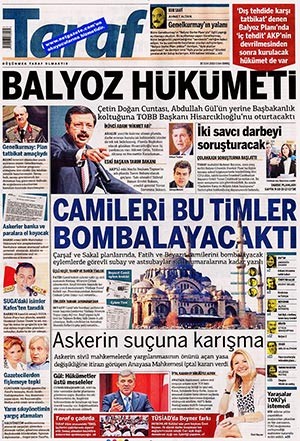
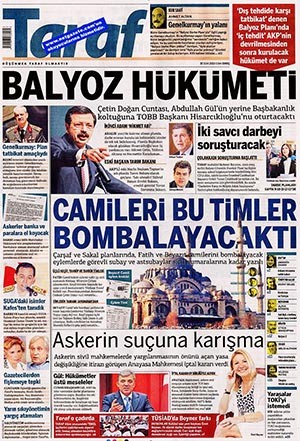
    Last week’s detentions and arrests capped a month of high political drama that began in January, when a small independent newspaper, Taraf, published what it said were military documents from a 2003 meeting describing preparations for a coup.

    The documents were brought in a suitcase, Taraf’s editors said, and included diagrams of two Istanbul mosques that were to have been bombed, creating an emergency that would justify a military takeover.

    The military acknowledged that a meeting had taken place, but said that it was focused only on external threats. The army chief vehemently denied plans for bombings or a coup.

    Even so, on Monday of last week, the Turkish authorities began detaining military officers and by the end of the week had more than 60 in custody, including two top retired generals.

    “Now the army is completely pacified, eliminated as a power from the political scene,” said E. Haldun Solmazturk, a retired general. “Now the military is touchable.”

    That is a profound historical change. Modern Turkey was founded in 1923 by an army general, Mustafa Kemal Ataturk, who imposed radical changes in language and habits on a largely illiterate, agrarian society. The military, together with the judiciary and state bureaucracy, wielded immense power, guarding Turkish democracy “as if the country was a perpetually immature child,” said Halil Berktay, a history professor at Sabanci University in Istanbul.

    “The military came to acquire a sense of, ‘this is our land, this is our Republic,’ ” he said. It deposed elected governments four times, most recently in 1997.

    That role began to change with the rise of Mr. Erdogan, a tough-talking Istanbul mayor representing a rising underclass of religious Turks. He was a confounding mix, from a background of political Islam, but with an agenda of bringing Turkey into the European Union, where his supporters did most of their business.

    Although he was despised by the secular establishment, his party, Justice and Development, won a national election in a landslide in 2007.

    The election vastly diminished the military’s role in politics, but that was changing anyway. None of the alleged coup plots cited by prosecutors ever came to pass because the top leadership stopped them.

    And the fact that the military has not responded to the arrests — which include a sprawling legal proceeding against 200 people that began in 2007 — reflects a leadership that is opposed to intervention. The current chief of the army, Gen. Ilker Basbug, has spoken out against military meddling and is believed to have had good relations with Mr. Erdogan.

    But to Mr. Erdogan’s critics, the arrests look suspiciously like raw efforts to silence the opposition. And now that he has control over most of the levers of power — the presidency, the government bureaucracy and Parliament — they worry that his impulses will be unchecked.

    Many believe that the police and prosecutors have been hijacked by an Islamic network led by Fetullah Gulen, a Turkish preacher who lives in the United States. Nedim Sener, a journalist who has written a book on the network, said the involvement of Mr. Gulen’s followers was an “open secret.”

    A looming fear is that the last remaining institution with any power to oppose him, the judiciary, will soon fall to his Islamic supporters, who are unlikely to be less ideological than their rigidly secular predecessors.

    Even those who are happy to see Mr. Erdogan prevail say he is a flawed leader with autocratic tendencies. His biggest critic, Aydin Dogan, a businessman and publisher, was slapped with a giant fine last year, and journalists who work for his newspapers say spunky criticism is dead.

    Mr. Ozel, the political scientist, described Mr. Erdogan’s party as “a democratizing force, but not necessarily a democratic one.”

    Yildiray Ogur, an editor at Taraf who worked on the exposé that led to last week’s arrests, defended the legal cases, saying today’s Turkey was a slow-motion version of the Soviet Union in 1991, when idols fell and people came out of the woodwork confessing secrets.

    For better or worse, Mr. Ozel says, former Islamists like Mr. Erdogan are the only ones engaged in the project of creating a new Turkey, with the secularist party “either incapable or unwilling to be part of the process,” routinely blocking legislation required for European Union membership.

    But Mr. Sener fears this new Turkey will exclude people like him. “They say this is about democracy, but it ends up increasing their hold on power,” he said.

    Mr. Oran of Ankara University dismisses those fears. Borrowing a thought from Marx, he noted that Mr. Erdogan’s supporters, once Islamist and working class, had grown comfortable, sowing the seeds of the party’s transformation. “It has become bourgeois,” Mr. Oran said. “They will always be Muslims, but they won’t be Islamists.”
  • Armenia Rejects Turkish Warnings To U.S. Congress

    Armenia Rejects Turkish Warnings To U.S. Congress

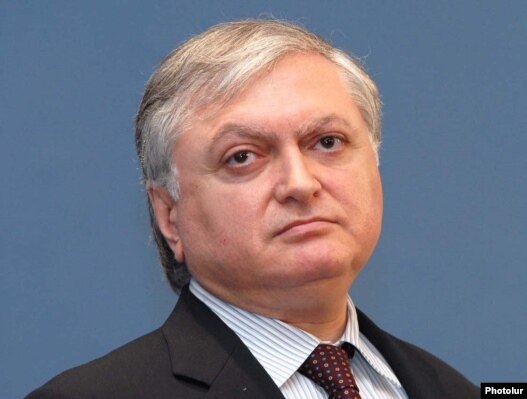
    Armenia — Foreign Minister Edward Nalbandian at a news conference on March 2, 2010.
    02.03.2010
    Emil Danielyan

    Official Yerevan dismissed on Tuesday Turkish warnings that a U.S. congressional resolution describing the 1915 massacres of Armenians in the Ottoman Empire as genocide would set back the normalization of Turkish-Armenian relations. (UPDATED)

    It also emerged that a group of mostly pro-government Armenian parliamentarians is heading to Washington in an apparent effort to facilitate the passage of the resolution introduced by pro-Armenian U.S. legislators a year ago.

    The Foreign Affairs Committee of the U.S. House of Representatives is scheduled to discuss and vote on the proposed legislation on Thursday. It urges President Barack Obama to “accurately characterize the systematic and deliberate annihilation of 1,500,000 Armenians as genocide.”

    The Turkish Foreign Ministry warned on Monday that its approval by the House committee would harm not only U.S.-Turkish relations but also efforts by Turkey and Armenia to normalize bilateral ties. “We would like to believe that the members of the committee are aware of the damage… the endorsement of the resolution will bring and, in this context, act responsibly,” the ministry said in a statement.

    Turkish Prime Minister Recep Tayyip Erdogan reportedly issued a similar warning over the weekend. He said passage of the genocide resolution to would bring the U.S.-backed Turkish-Armenian reconciliation process to a halt.

    Armenian Foreign Minister Edward Nalbandian brushed aside the warning, saying that the biggest threat to that process emanates from Ankara’s “preconditions” for the implementation of the Turkish-Armenian normalization agreements which were set by Ankara months before the House panel scheduled a debate on the resolution.

    “It is statements made in Turkey and the return to the language of preconditions that deal a blow to the process of normalizing Turkish-Armenian relations,” Nalbandian told a news conference. “We hope that Turkey will rid itself of artificial complexes created by the Turkish side and that we will be able to move forward in accordance with our understandings.”

    Nalbandian stopped short of explicitly urging U.S. lawmakers to recognize what many historians consider the first genocide of the 20th century. But in a sign of Yerevan’s tacit support for the resolution, four members of Armenia’s parliament will fly to Washington on Wednesday at the invitation of Frank Pallone and Mark Kirk, the two U.S. lawmakers co-chairing the congressional Caucus on Armenian Issues. The bipartisan group, currently numbering 150 House members, has long been pushing for Armenian genocide recognition.

    An official in the National Assembly told RFE/RL’s Armenian service that Pallone and Kirk asked their Armenian colleagues to “present their views on and approaches to issues of mutual interest” to U.S. legislators and foreign policy-makers. The genocide resolution will be the main focus of their meetings in Washington, said the official.

    A similar delegation of Turkish parliamentarians is already in Washington, meeting with U.S. officials and lobbying against the resolution. “My impression is that the (Obama) administration is not fighting against it very effectively,” one of them, Sukru Elekdag, said on Monday, according to Reuters.

    Obama has so far declined to openly endorse or, as past U.S. administrations did, oppose the measure. The Associated Press cited aides to senior Democratic and Republican lawmakers on the House Foreign Affairs Committee as saying last week there has been no pressure against the resolution from the White House yet. According to a spokesman for the pro-Armenian committee chairman, Howard Berman, the Obama administration was informed about Thursday’s vote ahead of time.

    Obama repeatedly pledged to recognize the Armenian genocide when he ran for president, earning the overwhelming backing of the Armenian Americans. However, he has refrained from using the word “genocide” since taking office, implicitly citing the need not to undermine the Turkish-Armenian rapprochement.

    “His view of that history has not changed,” US National Security Council spokesman Mike Hammer said last week. “Our interest remains the achievement of a full, frank, and just acknowledgement of the facts.”

    “The best way to advance that goal is for the Armenian and Turkish people to address the facts of the past as a part of their ongoing efforts to normalize relations,” said Hammer. “We will continue to support these efforts vigorously in the months ahead.”

    Some observers have speculated that Washington is using the prospect of U.S. recognition of the genocide to try to get the Turks to ratify the two Turkish-Armenian protocols signed in October. The Turkish ambassador to the United States, Namik Tan, seemed to give weight to this view on Saturday.

    “The greatest lobbyist in Washington is the administration,” Tan said, according to the Associated Press. “We have not seen them around enough on this.”

    Still, Erdogan expressed confidence on Tuesday that Obama will display “common sense” on the matter. Speaking before parliament deputies from his Justice and Development Party, he said he conveyed the Turkish concerns to U.S. Secretary of State Hillary Clinton at their recent talks in Qatar.

    “I separately discussed with her what would be the cost of an adverse result from that,” “Hurriyet Daily News” quoted the Turkish premier as saying. “I am calling on everyone once more to act with common sense. I’d like to say it would be more accurate to research genocide claims not at the House of Representatives but at universities and archives.”

    https://www.azatutyun.am/a/1972355.html
  • Crisis in Turkey

    Crisis in Turkey

    by Daniel Pipes
    National Review Online
    March 2, 2010

    The arrest and indictment of top military figures in Turkey last week precipitated potentially the most severe crisis since Atatürk founded the republic in 1923. The weeks ahead will probably indicate whether the country continues its slide toward Islamism or reverts to its traditional secularism. The denouement has major implications for Muslims everywhere.

    “Taraf” broke the Balyoz conspiracy theory on Jan. 22, 2010.
    Turkey’s military has long been both the state’s most trusted institution and the guarantor of Atatürk’s legacy, especially his laicism. Devotion to the founder is not some dry abstraction but a very real and central part of a Turkish officer’s life; as journalist Mehmet Ali Birand has documented, cadet-officers hardly go an hour without hearing Atatürk’s name invoked.

    On four occasions between 1960 and 1997, the military intervened to repair a political process gone awry. On the last of these occasions, it forced the Islamist government of Necmettin Erbakan out of power. Chastened by this experience, some of Erbakan’s staff re-organized themselves as the more cautious Justice and Development Party (AKP). In Turkey’s decisive election of 2002, they surged ahead of discredited and fragmented centrist parties with a plurality of 34 percent of the popular vote.

    Parliamentary rules then transformed that plurality into a 66 percent supermajority of assembly seats and a rare case of single-party rule. Not only did the AKP skillfully take advantage of its opportunity to lay the foundations of an Islamic order but no other party or leader emerged to challenge it. As a result, the AKP increased its portion of the vote in the 2007 elections to a resounding 47 percent, with control over 62 percent of parliamentary seats.

    Repeated AKP electoral successes encouraged it to drop its earlier caution and to hasten moving the country toward its dream of an Islamic Republic of Turkey. The party placed partisans in the presidency and the judiciary while seizing increased control of the educational, business, media, and other leading institutions. It even challenged the secularists’ hold over what Turks call the “deep state” – the non-elected institutions of the intelligence agencies, security services, and the judiciary. Only the military, ultimate arbiter of the country’s direction, remained beyond AKP control.

    Several factors then prompted the AKP to confront the military: European Union accession demands for civilian control over the military; a 2008 court case that came close to shutting down the AKP; and the growing assertiveness of its Islamist ally, the Fethullah Gülen Movement. An erosion in AKP popularity (from 47 percent in 2007 to 29 percent now) added a sense of urgency to this confrontation, for it points to the end of one-party AKP rule in the next elections.

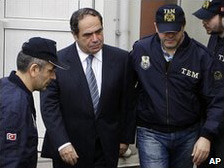
    Gen. Ibrahim Firtina, a former head of the air force, was questioned in court about a plot to overthrow the government.
    The AKP devised an elaborate conspiracy theory in 2007, dubbed Ergenekon, to arrest about two hundred AKP critics, including military officers, under accusation of plotting to overthrow the elected government. The military responded passively, so the AKP raised the stakes on Jan. 22 by concocting a second conspiracy theory, this one termed Balyoz (“Sledgehammer”) and exclusively directed against the military.

    The military denied any illegal activities and the chief of general staff, İlker Başbuğ, warned that “Our patience has a limit.” Nonetheless, the government proceeded, starting on Feb. 22, to arrest 67 active and retired military officers, including former heads of the air force and navy. So far, 35 officers have been indicted.

    Thus has the AKP thrown down the gauntlet, leaving the military leadership basically with two unattractive options: (1) continue selectively to acquiesce to the AKP and hope that fair elections by 2011 will terminate and reverse this process; or (2) stage a coup d’état, risking voter backlash and increased Islamist electoral strength.

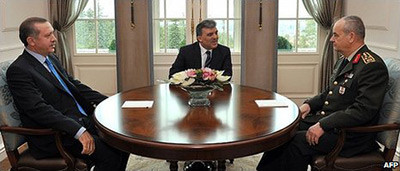
    Prime Minister Recep Tayyip Erdoğan, President Abdullah Gul and Armed Forces Chief of Staff Gen. İlker Başbuğ met on February 25.

    At stake is whether the Ergenekon/Balyoz offensives will succeed in transforming the military from an Atatürkist to a Gülenist institution; or whether the AKP’s blatant deceit and over-reaching will spur secularists to find their voice and their confidence. Ultimately the issue concerns whether Shari’a (Islamic law) rules Turkey or the country returns to secularism.

    Turkey’s Islamic importance suggests that the outcome of this crisis has consequences for Muslims everywhere. AKP domination of the military means Islamists control the umma‘s most powerful secular institution, proving that, for the moment, they are unstoppable. But if the military retains its independence, Atatürk’s vision will remain alive in Turkey and offer Muslims worldwide an alternative to the Islamist juggernaut.

    https://www.danielpipes.org/8009/crisis-in-turkey