Flights redirected to Baghdad after political objections and local protests
Owen Bowcott
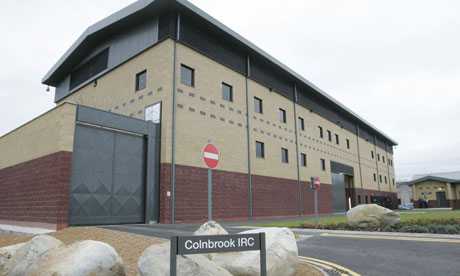
At least sixty people are being held at Colnbrook detention centre, near Heathrow, awaiting deportation to Iraq. Photograph: Tim Ockenden/PA
Home Office deportation flights are being prevented from taking failed asylum seekers directly to northern Iraq because of a diplomatic dispute with the Kurdish regional government (KRG).
A ban has in effect been placed on incoming flights from the UK landing forcibly returned Kurds at the regional airport in Irbil. Political objections and local protests have led to the UK Border Agency redirecting the planes to Baghdad.
Another round-up of failed Iraqi asylum seekers has been ordered in the past week. At least 60 people are now being held at Colnbrook detention centre, near Heathrow, awaiting removal by charter flight. Those about to be deported have been given tickets dated 1 or 6 September.
Thousands of Iraqi refugees remain in Britain, many having arrived before the 2003 invasion when Saddam Hussein was persecuting the Kurds.
The Home Office’s forced repatriation of asylum seekers denied permission to remain in Britain has been diplomatically fraught. The first flight to Baghdad last year led to airport officials in the Iraqi capital refusing to accept all but a handful of passengers. Most were denied entry and sent back to the UK.
To assuage political sensitivities, Iraqi interior ministry officials are permitted the unusual privilege of interviewing and screening detained asylum seekers in UK detention centres to confirm they will accept each individual.
The UK policy of sending deportees back to, or through, the central provinces of Iraq, which include Baghdad, is in defiance of guidelines issued by the United Nations high commissioner for refugees, which warns that the area remains unsafe due to suicide bombs and attacks by al-Qaida militants.
One Iraqi deported from the UK was killed by a car bomb in Kirkuk in 2007. The continuing violence claimed more than 60 lives following a series of co-ordinated blasts in Iraqi cities during just one day – 25 August – last week.
The KRG, the semi-autonomous administration that runs the Kurdistan region of north-east Iraq, controls its own militia. For many years, it has objected to forcible returns of failed asylum seekers from western European countries, threatening to withdraw diplomatic co-operation.
Many deportation flights from the UK have nonetheless been sent to Iribil; on the first flights deportees were ordered to wear flak jackets for their return to what was deemed a safe country.
An official at the KRG representative office in London said: “The KRG has asked the British government to send only those people who want to go back. It is opposed to forcible deportations.”
The last UK deportation flight to Kurdistan was about five months ago. The Home Office now accepts that it will have to send Kurdish Iraqis back via Baghdad unless the KRG agrees to reopen direct flights.
The border agency told the Guardian: “UKBA only ever returns those who both the agency and the courts are satisfied do not need our protection and refuse to leave voluntarily.
“Currently we have agreement with the government of Iraq to return all Iraqi citizens to Baghdad. We make arrangements for those who require onward travel to their home towns, and this includes those travelling to the KR [Kurdish region].
“These arrangements worked well on the recent charter flights to Baghdad and we are confident they will continue to do so.”
Political opposition to forcible deportations has been led by the International Federation of Iraqi Refugees, which has organised protests both in western European countries and within Kurdistan.
More than 2 million Iraqis fled the sectarian violence which erupted after the 2003 invasion. Most sought sanctuary in neighbouring Arab states but many were attracted by the opportunities of employment in the EU.
Richard Whittel, of the Coalition to Stop Deportations to Iraq, said: “It is inspiring that popular pressure in Kurdistan forced the government there to take a stand against these deportations but disturbing that our government persists with them, pandering to the myth that immigration is to blame for the country’s problems.”
Among the common complaints raised by opponents of forced removals have been persistent allegations that failed asylum seekers are mistreated by security guards when they are forced on to planes in Britain for flights back to Iraq.
https://www.theguardian.com/world/2010/aug/31/kurdish-uk-asylum-seekers-iraq, 31 August 2010
Turkish newspaper: IDF using eq uipment sold to Turkey in 2007 to listen in on Turkish citizens, including political activists, members of opposition parties and academics.
By Zvi Bar’el
A claim that Israel is using wiretapping equipment it sold Ankara to listen in on Turkish citizens is making headlines in that country.
According to the pro-government newspaper Taraf, the Turkish army’s deputy chief of staff, Aslan Guner, purchased sophisticated wiretapping equipment in Israel in 2007 to aid Turkey in fighting the Kurdish PKK, which is considered a terror group by Turkey.
However, the newspaper claims the Israel Defense Forces communications branch has allegedly used the equipment to listen in on 2,000 Turkish citizens, including political activists, members of opposition parties and academics.
According to information Taraf received from a senior army officer, Turkey gave Israel technical details of the GSM, or Global System for Mobile Communications, used in Turkish cell phones, so it could conform the equipment to it. This information, according to the officer, allows Israel to listen in on the cell phone conversations of any Turkish citizen.
In response to the allegations, Guner, who at the time was also head of military intelligence, said that the equipment purchase had been authorized by the Turkish Defense Ministry and that Prime Minister Recep Tayyip Erdogan had also signed it.
A banner featuring a picture of Turkey PM A banner featuring a picture of Turkey PM Recep Tayyip Erdogan outside a souvenir shop in Gaza City outside a souvenir shop in Gaza City, June 6, 2010.
Photo by: AP
“The equipment was purchased to fight terror but if someone listened to other people it should be exposed,” Guner said.
The Turkish army said in a statement that it has launched an investigation into whether the system was used illegally.
Political activists allegedly targeted by the wiretaps are planning to sue those responsible, as Turkish law prohibits the military’s electronic communications command from installing wiretapping equipment. Only Turkey’s national intelligence organization, the police and the gendarmerie, a branch of the military responsible for maintaining public order, may install such equipment, after receiving permission from the court and the Communications Ministry.
Though Israel supplies Turkey with aerial drones and electronics used to fight terror, Ankara has also accused Israel of being behind PKK attacks. PKK actions increased immediately after the flotilla to Gaza, and critics allege that Israel wants to use them to show that it can strike at Turkey’s soft underbelly.
Report: U.S. to cancel drills
The anti-government newspaper Hurriyet reported yesterday that the United States planned to cancel its participation in military exercises with Turkey in October, ostensibly to force Turkey to invite Israel, which has taken part in the exercises since 2001.
However, a spokesman for the U.S. Embassy in Ankara said the U.S. had already participated in two such exercises this year and traditionally did not take part in more than two per year.
The spokesman made no reference to Israel’s exclusion. But last year, after Turkey excluded Israel from a joint exercise, both the United States and Italy canceled their participation.
I was invited and attended a symposium organized by Armenians at the UN building on 29 July 2010. It was presented to look like it was under the auspices of the UN.
It turned out to be neither. It was a political pep rally of the Armenians. Enclosed you will find the invitation, my response to the organizers and a letter I wrote to the UN Secretary General.
As a Turkish born citizen of the US I would like to suggest that we need to represent the Turkish view in a more proactive way than be just reactive. If the Turkish Mission would organize a similar symposium at the UN grounds and it may even give the illusion that it was sanctioned by the UN as the Armenians did, I would be willing the assist in any way I can. My dear friend Sukru Aya travels to the US from time to time. His book “The Genocide of Truth” is a valuable reference book. I could ask him to present a lecture Surely there are others who are willing. Turkish Forum is a good source.
I extend my best wishes to you and the entire Turkish staff.
I was invited and attended a meeting by the UN Armenian delegation at the UN building on 29 July 2010 billed as a seminar and suggested that it was under UN auspices. Neither was correct.
In a seminar one discusses statements made by other speakers. I asked to be heard about an incorrect statement made by the Presenter. I was not allowed to complete my sentence. This meeting then turned out to be a political pep rally where other true facts were notallowed to be presented.
The Presenter incorrectly stated that the deaths of Turks during WWI were due only to the battle conditions. The truth is that the destruction of 22 villages and the killing of 500,000 Turks, Kurds and Jews were committed by the Hinchak and Dashnak terrorist organizations. Excavations of mass graves since 1980 are still continuing. The names of the killed and the vanished families are known and are being classified. The background of the two Armenian terrorist organizations is clearly explained by William Langer [1] who received a Medal of Merit from President Truman and at the time was considered as the dean of historians. Katchaznouni, [2] the first prime minister of Armenia, in his report to the Dashnak Party conference in 1923 also describes their war efforts and puts the blame for the outcome of the failure to create an independent State to the Armenian extremists’ excesses and not on the Turks.
The speaker also made a summary judgment of her own in assigning the crime of Genocide to the Turks making it an Un-American statement. In the US and in all civilized Nations there is the concept of due process. We do not call a person criminal until the person is convicted in a court of law. We use the word alleged. In some cases the person is acquitted. At the end of WWI the western allied Nations occupied Turkey. The English prosecutors imprisoned more than 100 prominent Turks such as Governors, Cabinet members and Army Generals and sent them to Malta for trial accusing them of crimes against humans, war crimes and torturing Armenians. These trials were the same kind as the WWII trials in Nuremberg. For two years the prosecutors of the occupying Nations searched the archives of the Ottomans for evidence. They found none. They asked the US Government for evidence. The US Government’s reply was that they did not have any evidence either. The documents regarding these trials are available in the archives of the British and US archives. All one needs to do is to be willing to learn the truth. This then brings up the other unethical attitude of the Armenian speaker. In the US we have a concept called “double jeopardy” which prohibits a second trial after an acquittal.
Due process was applied by the Bosnians charging Serbia with genocide in the International Criminal Court. UN Human Rights Organizations did not announce that genocide was committed in Darfur but just recently charged El-Basher with genocide in Courts. An individual like the Presenter in this meeting cannot assume they represent the UN and make criminal accusations.
Another clearly incorrect statement by the Presenter was that 1-1.5 million Armenians were killed. At the Paris Conference in 1918 the Armenian representative Nubar Pasha suggested that the Armenians be recognized as a group who fought alongside the Allies and helped the Russians to advance into Turkey. At that conference on behalf of the Armenians Venizelos claimed that 2,100,000 Armenians (an exaggeration) were living before the War. In the US a relief organization to assist Armenians was approved by the President on Aug. 6, 1918 and the report on the “Near East Relief” [3] gives the status and audits up to Dec. 31, 1921. The report states that 400,000 Armenians fled Near East Cities such as Van and Kars and went to Transcaucases with the Russians when they retreated. Also stated is that in 1921 there were 1,000,000 (One Million) Armenians living in the Near East. Also stated is that 200,000 Armenians who joined the French returned after the French occupation of Cilicia ended but then left again. The US government is accounting for 1.6 million living Armenians in 1921 out of at most 2 million in 1912. Ottoman State census of 1905 puts the population of the Armenians in their territories at 1,294,851. The Armenians make an impossible claim that their population grew by 800,000 in 10 years. Those interested in learning more of the truth may read the works indicated below:
References:
[1]. “The Diplomacy of Imperialism,” by William L. Langer, published by A. Knoff, NY 1935. The author was awarded the Medal of Merit by President Truman.
[2] “There is nothing more the Tashnak Party Can Do,” by Hovhannes Katchaznouni, 1923. This report was written by the first Prime Minister of the Armenian Republic and was presented to the Tashnak Party conference in 1923.
[3] “Near East Relief,” Report Doc# 192, presented by Mr. Lodge on67th session of Congress-Senate, on April 22, 1922” was printed in 1923 by US Government Printing Office. The relief organization was approved by the President on Aug. 6, 1918 and the report gives the status and audits up to Dec. 31, 1921.
[4] “The Armenians,” by C.F. Dixon-Johnson, published by G. Toulmin, UK 1916. The author was a Captain in the British Army and was designated as a hero in the Boer War. He wrote:
“Give a lie twenty-four hours’ start and it will take a hundred years to overtake it.”
[5] “Revisiting the Armenian Genocide,” by Guenter Lewy, Middle East Quarterly, 1925. Available on www.meforum.org/article/748.
[6] Admiral M. L. Bristol US High Commissioner in the near East after in depth investigation of the conditions in the region wrote in his report on 21 March, 1921 that “. . .such Armenian reportsare absolutely false.” This shows that Morgenthau who did not visit any Anatolian provinces, relied solely on the unsubstantiated and biased interpretation of the events by his Armenian assistant.
[7] Most prominent historians such as Mango, McCarthy, Shaw, etc dispute the term genocide as it applies to the events of WWI.
Political, legal, and mind-body-spirit Perspectives
Thursday, 29 July, 11 AM – 12:30 PM
UNITED NATIONS Conf. room B, 46th street @ First Avenue, new building, kindly enter from visitor’s entrance
Honoring all victims and survivors
SPEAKERS: Hansdeep Singh, LLM, Legal Associate Director for Voices for Freedom
Martin Harrich, MBA, PhD cand. UN OCHA
Representative of Office of Prevention of Genocide
Dr Ani Kalayjian, ATOP of Meaningfulworld, Mind-Body-Spirit perspectives
Chair and Facilitator, Dr. Ani Kalayjian
26 June 1987, the UN Convention Against Torture and Other Cruel, Inhuman or Degrading Punishment or Treatment came into force. June 26 is commemorated as the
International Day in Support of Victims of Torture
UN Definitions: Any act by which severe pain or suffering, whether physical or mental, is intentionally inflicted on a person for such purposes as obtaining from him/her, or a third person, information or a confession, punishing him/her for an act s/he or a third person has committed or is suspected of having committed, or intimidating them.
Gratitude for the following cosponsoring organizations: THE PERMANENT MISSION OF THE REPUBLIC OF ARMENIA TO THE UNITED NATIONS, Association for Trauma Outreach & Prevention ATOP of Meaningfulworld; Armenian American Society for Studies on Stress & Genocide; Voices for Freedom, UN Office of the High Commissioner for Human Rights (INVITED); Office of the Special Adviser of the Secretary-General on the Prevention of Genocide (INVITED)
If you do not have a UN ID kindly contact Garen by July 26 to secure a UN ID at: [email protected]
For information contact Dr. Kalayjian at 201 941-2266, E-mail: [email protected]
Published: August 23 2010 21:59 | Last updated: August 23 2010 21:59
You can gauge the importance of Turkey to the western world by the fact that both Barack Obama and David, Cameron gave speeches to the Turkish parliament in Ankara within months of taking office.
The west cares about Turkey because it is a hinge state between east and west and a rare example of a majority Muslim state that is also a secular democracy. Turkey is a neighbour of both Russia and Iran, and is also a member of.Nato. It has a rapidly growing and dynamic economy. And yet these days Turkey is also increasingly a source of anxiety to the west.
The country voted against new UN sanctions on Iran, and has a dangerously antagonistic relationship with Israel. But it is Turkey’s faltering effort to join the European Union that has come to symbolise the country’s uncertain relationship with the west.
“Talking Turkey” is meant to mean speaking frankly and getting to the heart of the matter. But, in the European Union, “talking Turkey” has become a synonym for double-talk and evasiveness.
Since 2005, the EU and Turkey have been negotiating a treaty that is meant to get Turkey into the EU -a prospect that was first dangled in front of the Turks in 1963. But Angela Merkel, the chancellor of Germany, and President Nicolas Sarkozy of France, have made it clear that they oppose Turkish membership. The Turkish government says it still wants to “join Europe”, yet its foreign policy betrays understandable impatience.
So perhaps it is time really to “talk Turkey” – and to be frank. It would indeed be a wonderful thing if Turkey were to join the EU. But if that is to happen, Turkish membership has to be agreed on a new basis. It cannot involve total free movement of people between Turkey and the rest of the EU.
At present, citizens of all the current 27 members of the EU enjoy visa-free travel around the union -and can move to any other country to work. There are transition arrangements for recent members
such as Bulgaria and Romania, which mean that complete free movement of people will not kick in until they have been in the club for seven years. But the rules are clear. Eventually, all citizens of the EU have to enjoy equal rights.
It is those rules that will have to change if Turkish accession to the EU is ever to become a reality. Creating special rules for the Turks would be denounced as unfair, and even racist. But, as long as Turkish membership raises the prospect of mass emigration to the rest of the EU, it will be impossible to sell it to western European voters.
This stark fact has been pretty clear since the enlargement of the EU to central Europe triggered large-scale migration westwards. The British government infamously suggested that about 13,000 Poles would move to Britain to work after Poland joined the union. The real number was well over half a million. The French government is currently, controversially deporting gypsies
GIDEON RACHMAN’S BLOG
Read and post comments on this column by going to www.ft.com/rachman To follow Gideon’s blog, go to www.ft.com/rachmanblog
who have moved to France, following Romanian accession to the EU. The surge in the vote for the radical, anti-immigration right in the recent Dutch elections demonstrated that mass migration, particularly from Muslim countries such as Turkey, is unpopular enough to transform domestic politics in some western European countries.
In the face of all this evidence, European politicians would simply be irresponsible to press ahead with negotiations to bring Turkey into the European Union without addressing the issue of immigration. In the long run, they will not do it. In the short run, they take refuge in double-talk and hypocrisy.
On his recent trip to Ankara, Mr
Cameron carefully positioned himself as a champion of Turkish membership of the EU, claiming that he was “angry” that Turkey was being so badly treated. The very next day, Mr Cameron re-iterated his determination that the number of immigrants coming into Britain should be sharply reduced. Logically, he cannot have it both ways.
Western European leaders would doubtless argue that now is not the time to deal with these contradictions and hypocrisies. Even on the best-case scenario, Turkish membership is still many years off. The difficult issues can be dealt with later.
But that is far too complacent. The fact is that Turkey is an important country whose relations with the west are deteriorating fast.
It would be a gamble to try to revive the Turkish-EU conversation by finally facing up to the question of immigration. The Turks might walk away in a huff. But even without complete free movement of people,
Turkey would still have a great deal to gain from joining the EU.
As the second most populous nation in the union – and perhaps soon the largest – it would have a huge weight in the framing of European law, and a big delegation at the European Parliament. Turkey would also get the financial and structural aid that the EU lavishes on poorer, new members. It would have unfettered access to the European single market, a big say in the framing of EU foreign policy and the legal and diplomatic protections that come with EU membership. Under the new deal Turkish citizens would not get the automatic right to work anywhere in the EU; but they could expect travel to become significantly easier.
Membership of the EU, without complete free movement of people, is a deal Turkey might choose to reject or accept. But, at least it is an offer, that could be made in good faith.
Gideon Rachman
You can gauge the importance of Turkey to the western world by the fact that both Barack Obama and David, Cameron gave speeches to the Turkish parliament in Ankara within months of taking office.
The west cares about Turkey because it is a hinge state between east and west and a rare example of a majority Muslim state that is also a secular democracy. Turkey is a neighbour of both Russia and Iran, and is also a member of.Nato. It has a rapidly growing and dynamic economy. And yet these days Turkey is also increasingly a source of anxiety to the west.
The country voted against new UN sanctions on Iran, and has a dangerously antagonistic relationship with Israel. But it is Turkey’s faltering effort to join the European Union that has come to symbolise the country’s uncertain relationship with the west.
“Talking Turkey” is meant to mean speaking frankly and getting to the heart of the matter. But, in the European Union, “talking Turkey” has become a synonym for double-talk and evasiveness.
Since 2005, the EU and Turkey have been negotiating a treaty that is meant to get Turkey into the EU -a prospect that was first dangled in front of the Turks in 1963. But Angela Merkel, the chancellor of Germany, and President Nicolas Sarkozy of France, have made it clear that they oppose Turkish membership. The Turkish government says it still wants to “join Europe”, yet its foreign policy betrays understandable impatience.
So perhaps it is time really to “talk Turkey” – and to be frank. It would indeed be a wonderful thing if Turkey were to join the EU. But if that is to happen, Turkish membership has to be agreed on a new basis. It cannot involve total free movement of people between Turkey and the rest of the EU.
At present, citizens of all the current 27 members of the EU enjoy visa-free travel around the union -and can move to any other country to work. There are transition arrangements for recent members
such as Bulgaria and Romania, which mean that complete free movement of people will not kick in until they have been in the club for seven years. But the rules are clear. Eventually, all citizens of the EU have to enjoy equal rights.
It is those rules that will have to change if Turkish accession to the EU is ever to become a reality. Creating special rules for the Turks would be denounced as unfair, and even racist. But, as long as Turkish membership raises the prospect of mass emigration to the rest of the EU, it will be impossible to sell it to western European voters.
This stark fact has been pretty clear since the enlargement of the EU to central Europe triggered large-scale migration westwards. The British government infamously suggested that about 13,000 Poles would move to Britain to work after Poland joined the union. The real number was well over half a million. The French government is currently, controversially deporting gypsies
GIDEON RACHMAN’S BLOG
Read and post comments on this column by going to www.ft.com/rachman To follow Gideon’s blog, go to www.ft.com/rachmanblog
who have moved to France, following Romanian accession to the EU. The surge in the vote for the radical, anti-immigration right in the recent Dutch elections demonstrated that mass migration, particularly from Muslim countries such as Turkey, is unpopular enough to transform domestic politics in some western European countries.
In the face of all this evidence, European politicians would simply be irresponsible to press ahead with negotiations to bring Turkey into the European Union without addressing the issue of immigration. In the long run, they will not do it. In the short run, they take refuge in double-talk and hypocrisy.
On his recent trip to Ankara, Mr
Cameron carefully positioned himself as a champion of Turkish membership of the EU, claiming that he was “angry” that Turkey was being so badly treated. The very next day, Mr Cameron re-iterated his determination that the number of immigrants coming into Britain should be sharply reduced. Logically, he cannot have it both ways.
Western European leaders would doubtless argue that now is not the time to deal with these contradictions and hypocrisies. Even on the best-case scenario, Turkish membership is still many years off. The difficult issues can be dealt with later.
But that is far too complacent. The fact is that Turkey is an important country whose relations with the west are deteriorating fast.
It would be a gamble to try to revive the Turkish-EU conversation by finally facing up to the question of immigration. The Turks might walk away in a huff. But even without complete free movement of people,
Turkey would still have a great deal to gain from joining the EU.
As the second most populous nation in the union – and perhaps soon the largest – it would have a huge weight in the framing of European law, and a big delegation at the European Parliament. Turkey would also get the financial and structural aid that the EU lavishes on poorer, new members. It would have unfettered access to the European single market, a big say in the framing of EU foreign policy and the legal and diplomatic protections that come with EU membership. Under the new deal Turkish citizens would not get the automatic right to work anywhere in the EU; but they could expect travel to become significantly easier.
Membership of the EU, without complete free movement of people, is a deal Turkey might choose to reject or accept. But, at least it is an offer, that could be made in good faith.
Sometimes Turkey really is a bridge between west and east
TN JUNE 2006, days after a young Israeli J. private was captured by Hamas, Israel’s ambassador to Turkey paid a midnight visit to Recep Tayyip Erdogan, the prime minister. Gilad Shalit was feared to be gravely ill, perhaps even dead. Could Turkey help? Phone calls were made and favours called in. Mr Shalit turned out to be alive, and his captors promised the Turks they would treat him respectfully.
How can Mr Davutoglu help you?lawyer who took up the case of Sakineh Ashtiani, a woman facing death by stoning in Iran for alleged adultery. Mr Mostafei fled to Turkey earlier this month after receiving death threats (he has since gone to Norway). Now Turkey has discreetly taken up his client’s case (although Iran has turned down a Brazilian offer of asylum for Ms Ashtiani). It is also pressing Iran for the release of three American hikers who were arrested, on suspicion of “spying”, near the Iraq border a year ago and who have been rotting in Tehran’s notorious Evin prison ever since. Turkey’s mediating skills have even aroused excitement in Africa. Mr Davutoglu recently revealed that Botswana had sought his help in fixing a territorial dispute with Namibia. Flattered though he was, however, Mr Davutoglu confessed that, for once, he was stumped.
Turkey’s relations with Israel, once an ally, have worsened of late, and hit a fresh low in May, when Israeli commandos raided a Turkish ship carrying humanitarian supplies to Gaza, killing nine Turkish citizens. Yet Turkey continues to lobby Hamas for Mr Shalit’s release.
Turkey’s falling out with Israel has sparked a flurry of anguished commentary in the West about its supposed eastward drift under the mildly Islamist Justice and Development party, which has governed the country since 2002. Concern over its cosy relations with Iran, despite that country’s refusal to suspend suspect nuclear work, has run particularly high. Yet nobody complained in April 2007 when Turkey brokeredthe release of 15 British Royal Navy sailors who had been seized by Iran. Similarly, France was delighted in mid-May when a personal intervention by Turkey’s foreign minister, Ahmet Davutoglu, secured the release of Clotilde Reiss, a French teacher being held in Iran on spying charges.
Turkey is the first stop for thousands of political refugees from Iran, Iraq, Afghanistan and Central Asia. These include Mohammed Mostafei, an Iranian
A special constable has been jailed for three years after being convicted of a vicious assault on a drunken off-duty soldier while trying to arrest him.
Peter Lightfoot attacked Lance Corporal Mark Aspinall outside a bar in Wigan, Greater Manchester, in the early hours of July 27, 2008.
The attack, which was captured on CCTV, was described as “violent, excessive and unjustified” by the police watchdog.
Lightfoot, 40, was filmed pushing the soldier’s head into the ground and hitting him with a police helmet.
He was found guilty of the assault on the soldier, who had served in Afghanistan and Iraq, by a jury at Manchester Minshull Street Crown Court last month.
Two other officers involved in the incident, Sergeant Stephen Russell, 34, and Pc Richard Kelsall, 29, were cleared of assaulting the soldier.
L/Cpl Aspinall was himself initially charged and convicted of two counts of attacking the police officers by Wigan Magistrates, who did not view the CCTV.
He later won an appeal to have the verdict quashed at Liverpool Crown Court, where the judge cited concerns about the actions of the officers.
Haulage driver Lightfoot was also convicted of one count of perjury, in relation to the evidence he gave during the soldier’s trial.
He was jailed for one year for perjury, and two years for assault, to run consecutively.
Lightfoot, a twice-divorced father of two, had been given a warning about using excessive force during an arrest in 2007, the court heard.
However, he was nominated for a bravery award for confronting a robber who was wielding an imitation handgun and won a Special Constable of the Year award in 2003.
Police were called to the Walkabout bar in Wigan town centre after L/Cpl Aspinall was thrown out for causing trouble and allegedly shouting racial abuse at door staff.
Lightfoot used “unacceptable” force when making the arrest, Judge Lewis said, and it was lucky the soldier had not suffered a head injury.
“However badly he behaved, he did not deserve to be treated as you treated him during this short-lived bout of violence,” the judge added.
The judge rejected a claim for compensation for L/Cpl Aspinall.
Lightfoot’s father Jim said his son did nothing wrong: “I don’t think the video tells the story,” he said.
“I did 24 years as a Special Constable. I’ve been in the same position. You didn’t get a true picture from the video.”
Greater Manchester Police Assistant Chief Constable Garry Shewan said: “The judge’s sentence is a reflection of how serious this abuse of trust was.
“The conduct of Peter Lightfoot that day fell well below the standard we expect.
“His actions in no way reflect the committed and professional attitude shown by the vast majority of our Special Constables, who are highly trained in the best ways to safely detain prisoners.”
However badly he behaved, he did not deserve to be treated as you treated him
during this short-lived bout of violence.