: Cenk Uygur of YoungTurks at MSNBC


By Peter Aspden
You don’t have to be a regular at the Serpentine Gallery’s achingly cool annual summer party to know that the worlds of art and fashion collude in ever more explicit, and prosperous, ways. Galleries lead the urban regeneration of run-down neighbourhoods that become the new centres of bohemian mischief. Catwalks acquire the kind of audacious conceptual playfulness that would make Duchamp’s experiments look like Constable landscapes. London has led the way in the promiscuous flitting of designers whose chief imperatives are to be loved, to be new and to be seen.
Now at the Lisson gallery comes an exhibition from one of the most daring figures from this twilight world: Hussein Chalayan, purveyor of sci-fi fabrics, wooden skirts, the fashion designer for whom the phrase “ready-to-wear” has never seemed entirely appropriate.
Chalayan’s avant-garde credentials are impeccable, right from his justly famous 1993 graduation show from Central St Martin’s, featuring garments that he had buried in the ground to observe the chemical interaction between the ephemeral and the earthly-elemental (the collection was bought en masse by Browns), to his 1998 “Between” spring-summer display that showed models in various states of undress, covered successively by parts of a chador.
The video of that not uncontroversial show makes riveting viewing, and could easily have been part of a gallery installation, festooned with portentous labels over Chalayan’s genuine interest in east-west dialogues, rather than part of a simple fashion collection.
But then the words “simple” and “fashion” rarely come together in descriptions of the Turkish-Cypriot designer’s work. “I have always been ideas-led,” he tells me over coffee in Clerkenwell. “I have never thought of a garment differently from the way I think of, say, a film. I give them both the same attention. I used to think of fashion as an industrial process, whereas art is supposed not to be. But art is going that way too.”
Perhaps surprisingly, but not to those who follow his unpredictable ways, his new piece at the Lisson is not directly related to fashion. “I am Sad Leyla” is an installation that features a performance of a traditional Turkish folk composition by Sertab Erener, one of Turkey’s most successful female singers, accompanied by an Ottoman orchestra.
The work mixes audio, film, sculpture and musical notation. Hussein says he is interested in picking apart the various cultural influences – Persian poetry, Greek orthodox chanting, central Asian motifs – at play in the work. A de-construction of his ethnic heritage? “That’s too obvious a word. I like the image of a piece of music as a body. And I am disembodying it. It is such a layered piece, you can detect 10 to 15 different cultural things going on.”
It is also a reminder that being Turkish “is a political, not a racial definition”, he says. “The piece comes from hundreds of years of migration, cross-breeding.”
Chalayan is more than familiar with the strife that ethnic cross-pollination can bring. He was born in Nicosia in Cyprus in 1970, moved to England with his parents, but returned in 1975, by which time the city had been divided in the wake of the previous year’s Turkish invasion of the island. “We only grew up with the smell of it,” he says of those clamorous events, “but it was very much in our lives.”
I ask if the Lisson installation refers back to some of those childhood memories. “They are innate,” he replies. “I was inspired by what I remember of Turkish culture back then – how everything was imbued with this institutional feel. It was to do with the Kemalist state, everything was geared towards this sense of nationalistic precision. There was something Soviet about it.”
He describes it as a “stripped-down show”, not overtly related to his fashion work, but not without its visual moments either: “It is almost as if each moment should be enjoyed like a piece of jewellery.” He leaps to another analogy: “It is a framing device, framing something that already exists. How you choose to frame something: that is what a lot of my work is about.”
London is both the perfect home from which to explore these issues, and the perfect venue for the show, he says. “Being here helps me dissect where I come from. It is like crossing to the other side of the road to see an amazing building.”
His adopted city also hosted Chalayan’s most important exhibition so far, last year’s expansive survey of his work at the Design Museum, which also toured to Tokyo and is currently on show at Istanbul Modern. He seems a little bit in love with the city that bestrides the Bosphorus (“it’s the best city”), and a little disenchanted with London (“it never seems to hang on to its own talent very strongly”).
I ask how he combines the worlds of art and fashion, and his rapid-fire response suggests it is a question that plays permanently on his mind. “Well, you have touse clothing. So something can be conceptual, or narrative, or visually charged, but it also has to be an item that you can use. But right from college, I didn’t just want to do nice tops. I wanted to work in a more monumental way.”
But the imperative to sell consistently surely made fashion a more challenging environment?
“The business side of fashion is super-difficult,” he confesses. “You have to rely on the loyalty of buyers. If you don’t sell one season, the next one is difficult. And the worst part of it is that fashion’s existence is based on the seasonal calendar, which is absolutely absurd.”
For someone like him, who loves to experiment with fabric technology (he is currently creative director of the sport and leisurewear company Puma), “you can’t keep coming up with entirely new things twice a year. There are techniques that you will use for a few years. If you want to take techniques further, you just can’t jump around that fast.
“I think our lives are a lot harder than [those of] artists. We have to constantly produce, we have financial restraints, we have to fund the production. It’s really tough.” Chalayan has already had to liquidate his company voluntarily once, when he split from a previous partner. “If you are asking me if I get a return, culturally speaking, the answer is ‘yes’, but as a business we are relatively small. It depends what you want from life.”
He is, in any case, perfectly happy with the blend of his activities. “I must be the only person who can sell a film to a collector, and then put the money into a new [fashion] collection” – both of which have brought him acclaim. He was British Designer of the Year in 1999 and 2000, and represented Turkey in the Venice Biennale of 2005. He attributes his cross-disciplinary approach to his education in London. “Central St Martin’s was a proper art institution, fashion just happened to be one of its departments. It was a fantastic place in which to understand the body in a cultural context. We were like body artists, but we also had to learn how to make our clothes sell. It’s like someone who wants to be a film-maker but has to go into advertising to survive.”
Of the worlds of art and fashion, he says they are “as cliquey as each other. I used to put the art world on a pedestal, but it is so market and money-driven now. You meet more interesting people in the art world, because fashion people tend not to question the world around them that much. But they are as power-driven.”
There is a rare pause as he considers his upcoming exhibition. “You know as far as my fashion business goes, if it can just run itself I am happy. But I do just love doing these projects.”
‘I Am Sad Leyla’ by Hussein Chalayan is at Lisson Gallery, London, September 8 – October 2. www.lissongallery.com
, August 27 2010
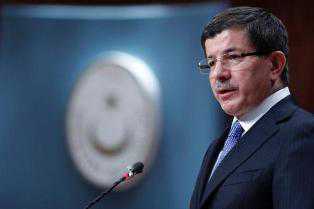
The withdrawal of Armenian troops from Azerbaijani lands is a key prerequisite to achieve order in the Caucasus, Turkish FM Ahmet Davutoglu said in an interview with private Azerbaijani ANS TV station.
He also noted that in the course of recent diplomatic contacts Russia and Turkey discussed situation in the Caucasus, in particular “occupied territories of Azerbaijan.”
According to him, Turkey wants to restore relations with Armenia and between Armenia and Azerbaijan, Today’s Zaman reported.
“We want a solution through peaceful, diplomatic means, not military,” the Turkish daily quotes Davutoglu. The Turkish FM stressed that the occupied territories do not bring wealth to Armenia, adding that citizens are leaving the country. Unlike Azerbaijan, Armenia is going poorer day-by-day. “I am proud of Azerbaijan. There is a rapid growth in Azerbaijan, it is getting richer,” he stated.
He also touched upon Azerbaijani-Turkish strategic partnership agreement, stressing that it “is not directed against any country.”
As to possible opening of the Armenian-Turkish border, Davutoglu reassured Azerbaijan that there is no ground for concern. The opening is not on the agenda, he concluded.
https://news.am/eng/news/29106.html, August 28, 2010
 Turkish FM Davutoglu said he spoke with Iranian FM regarding Iranian Vice President Baghaei’s statements on Armenians in the Ottoman Empire time.
Turkish Foreign Minister Ahmet Davutoglu said he spoke with Iranian foreign minister regarding Iranian Vice President Hamid Baghaei’s statements on Armenians in the Ottoman Empire period.
When a reporter said, “at a conference in Tehran, Baghaei claimed that a genocide was committed against Armenians during the rule of Ottoman Empire,” Davutoglu said, “our ambassador in Tehran held talks with Iranian foreign ministry which made a statement on the matter, as you know.”
Davutoglu said he has just spoke with Iranian foreign minister (Manuchehr Motaki) and asked for an explanation.
“Iranian foreign minister told me that the statement (of Baghaei) was not like as it was published in media. He said the conference (in Tehran) was about the World War II and he (vice president) made a reference regarding the World War I. He said Iran did not change its position on the matter. I told him that Iranian vice president should make a statement,” he said.
Davutoglu said Iranian foreign minister told him that vice president would make a statement on the issue.
AA
, 28 August 2010
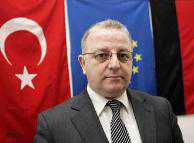
A leader of Germany’s Turkish community has urged Chancellor Angela Merkel to fire the Bundesbank’s controversial board member Thilo Sarrazin over comments that Muslims are undermining German society.
Chairman of Germany’s Turkish Federation, Kenan Kolat, called for central bank board member Thilo Sarrazin to be removed from his post after fresh comments criticizing Muslims in Germany.
“I am calling upon the government to begin a procedure to remove Thilo Sarrazin from the board of the central bank,” Kolat told the German daily newspaper Frankfurter Rundschau on Saturday, August 28.
In his book “Deutschland schafft sich ab” (“Germany does away with itself”), Sarrazin claims that members of Germany’s Muslim community pose a danger to German society.
Sarrazin, a member of the Social Democrats (SPD) and Berlin’s former finance chief, was reported in June as saying that members of the Turkish and Arab community were making Germany “more stupid.” With his book, Kolat said, Sarrazin had overstepped a boundary.
“It is the climax of a new intellectual racism and it damages Germany’s reputation abroad,” Kolat said.
High birth-rates
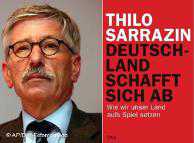
In a serialization of the forthcoming book in the German popular daily newspaper Bild, Sarrazin said that Germany’s Muslim community had profited from social welfare payments far more than they contributed, and that higher birth-rates among immigrants could lead to the Muslim population overtaking the “indigenous” one in terms of numbers.
Merkel’s chief spokesman Steffen Seibert said on Wednesday that many people would find the remarks “offensive” and “defamatory,” adding that the chancellor was concerned.
Members of the SPD have distanced themselves from Sarrazin’s comments, while Germany’s Green and Left parties have called for his removal from the central bank’s board.
A Bundesbank spokesman said that Sarrazin’s latest remarks were personal opinions, unconnected with his role on the board.
Blanket generalizations
Lower Saxony’s minister of social affairs, Ayguel Oezkan, Germany’s first-ever female Muslim minister, accused Sarrazin of doing damage to the Muslim community with blanket generalizations.
“There are a vast number of hard-working immigrants,” she told the weekly German newspaper Bild am Sonntag ahead of its publication on Sunday. “They deserve respect, not malice.”
“All of those who are involved in society, those who encourage their children, who learn German, who work and pay taxes and those who, as entrepreneurs, provide jobs – all of them deserve respect.”
In June, 65-year-old Sarrazin was reported as saying that Germany was “becoming on average more stupid” because immigrants were poorly educated.
‘Distorted image, half-truths’
Maria Boehmer, the government’s commissioner for integration, accused Sarrazin of giving “a distorted image of integration in Germany” that did not bear up to academic scrutiny.
“In his comments, he states only half truths,” she told Bild am Sonntag. “It is indisputable that, in education, there are currently a lot of immigrants with a lot of catching up to do. It does not take Sarrazin’s comments to establish that.”
In a lengthy interview with weekly newspaper Die Zeit, Sarrazin defended himself against the charge he was encouraging racism.
“I am not a racist,” he told the newspaper. “The book addresses cultural divisions, not ethnic ones.”
Last year, Sarrazin caused a storm by claiming that most of Berlin’s Arab and Turkish immigrants had no useful function “apart from fruit and vegetable trading.” As a result, the central bank stripped Sarrazin of some of his duties.
Author: Richard Connor (Reuters/dpa/AFP)
Editor: Toma Tasovac
https://www.dw.com/en/turkish-leader-calls-on-berlin-to-sack-central-bank-official-over-racism/a-5951829, 28.08.2010
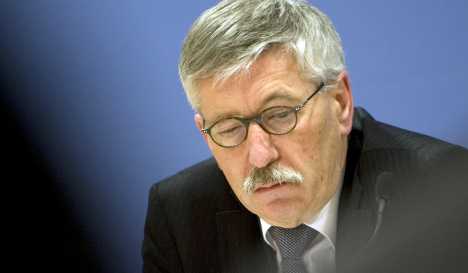
Bundesbank official Thilo Sarrazin faced increasing pressure from across the political spectrum due to his controversial views on Muslims and immigrants on Thursday, as calls grew for him to leave the Social Democrats (SPD) and his central bank post.
More politicians joined in the chorus of outrage over Sarrazin’s comments regarding foreigners in a new book he has written and which are widely seen as inflammatory and xenophobic.
In an excerpt from his book published by daily Bild on Thursday, Sarrazin said there were “good grounds” for reservations against Muslims across Europe.
“There is no other religion with such a flowing transition to violence, dictatorship, and terrorism,” he claimed, before making the equally provocative assertion that Muslim immigrants were “associated with taking advantage of social welfare state and criminality.”
Along with members of the Greens and the Left party, politicians from the conservative Christian Democrats are now calling for him to give up his seat on the central bank’s board. Members of his own party said Sarrazin was “abusing” the SPD’s name.
“Those who pour blanket scorn on individual groups are playing a perfidious game with fears and prejudices,” said SPD General Secretary Andrea Nahles on Thursday. “That has nothing in common with the values and convictions of the SPD.”
Justice Minister Sabine Leutheusser-Schnarrenberger of the pro-business FDP party called Sarrazin’s theories “confused and unbearable.”
“Germany is a country of immigration and we can be proud of the liberal values and openness of our society,” she said.
The head of the Social Democrats in Berlin, Michael Müller, said it was possible the party would take new steps to kick the 65-year-old former Berlin’s finance senator out of the party. Sarrazin survived a previous attempt this year to revoke his party membership for previous controversial comments.
Sarrazin’s new book, called Deutschland schafft sich ab – Wie wir unser Land aufs Spiel setzen, or “Abolishing Germany – How we’re putting our country in jeopardy,” is due to be released on Monday. In the book, Sarrazin warns that Germans could become “strangers in their own country” because of integration. He plans to begin a book tour beginning next week.
The Green party has said it wants to begin a parliamentary procedure in which the Bundesbank and the government recommend Sarrazin be dismissed from his central bank position, a motion which would then be accepted by Germany’s president. The Left party has also called on Bundesbank directors to distance themselves from their controversial colleague.
“A top official who tries to agitate people is unacceptable,” said Left party head Gesine Lötzsch.
This is not the first time Sarrazin has sparked controversy with his views. In September 2009 he made anti-immigrant remarks against Arabs and Turks in an interview with Lettre International magazine.
He claimed that “a great many Arabs and Turks in [Berlin], whose numbers have grown because of the wrong policies, have no productive function other than as fruit and vegetable grocers.”
Though he apologised for those remarks, Sarrazin refused to step down from the Bundesbank’s board despite pressure to do so. He was however symbolically punished when the institution stripped him of some responsibilities after the incident, which caused widespread outrage.
“With Thilo Sarrazin, it’s just a continual offence,” said Green party parliamentary group leader Renate Künast on Thursday.
, 26 Aug 10