Month: July 2010

  • Afghans to Form Local Forces to Fight Taliban

    Afghans to Form Local Forces to Fight Taliban

    Allauddin Khan/Associated Press

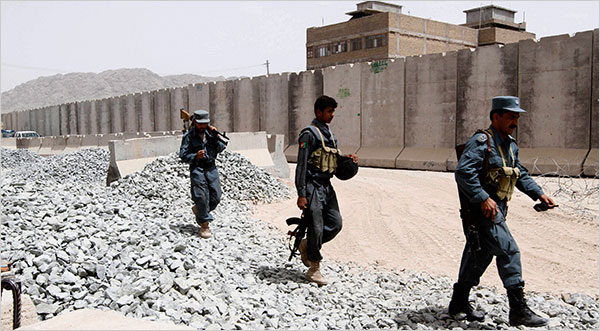
    Afghan police officers on Wednesday secured the perimeter of a police base in Kandahar after an attack on the base on Tuesday.

    By ALISSA J. RUBIN
    Published: July 14, 2010

    KABUL, Afghanistan — After intensive negotiations with NATO military commanders, the Afghan government on Wednesday approved a program to establish local defense forces that American military officials hope will help remote areas of the country thwart attacks by Taliban insurgents.

    Related

    • Times Topic: Afghanistan

    Details of the plan are sketchy, but Americans had been promoting the force as a crucial stopgap to combat rising violence here and frustration with the slow pace of training permanent professional security forces — the bottom-line condition for the American military to begin pulling back from an increasingly unpopular war. Many parts of Afghanistan have no soldiers or police officers on the ground.

    Over 12 days of talks, Gen. David H. Petraeus, the new NATO commander, overcame the objections of President Hamid Karzai, who had worried that the forces could harden into militias that his weak government could not control. In the end, the two sides agreed that the forces would be under the supervision of the Afghan Interior Ministry, which will also be their paymaster.

    “They would not be militias,” said Geoff Morrell, the Pentagon spokesman, at a briefing in Washington on Wednesday. “These would be government-formed, government-paid, government-uniformed local police units who would keep any eye out for bad guys — in their neighborhoods, in their communities — and who would, in turn, work with the Afghan police forces and the Afghan Army, to keep them out of their towns.”

    It is, he added, “a temporary solution to a very real, near-term problem.”

    The program borrows from the largely successful Awakening groups that General Petraeus created in Iraq, though the two programs would not be identical. Unlike the Iraqi units, the Afghan forces would not be composed of insurgents who had switched sides. They would be similar as a lightly armed, trained and, significantly, paid force in a nation starving for jobs.

    In fact, the program runs the risk of becoming too popular — it will create a demand in poor communities around the nation that could turn it into an unwieldy and ineffective job creation program.

    While some American officials said the forces could have as many as 10,000 people enrolled, Afghan officials indicated that they wanted to keep them small, especially in the beginning.

    Questions remain, too, about whether the Interior Ministry will be able to manage the forces. While the ministry’s leadership in Kabul has been working recently to reduce graft, the police at every level are widely viewed as corrupt and, in many places, incompetent.

    American military officials said, however, that they would be intimately involved, and that United States Special Forces units, which have created smaller-scale programs locally, especially in southern Afghanistan, would continue to set up and train the forces.

    The agreement was hammered out during a particularly violent spasm in the war here. Seven American service members were killed on Tuesday and Wednesday in southern Afghanistan, and one NATO soldier died of wounds received earlier in the week in the unstable south of the country.

    The negotiations were an early test for General Petraeus, appointed overall commander in Afghanistan last month, both in pushing a difficult war forward and forging ties with Mr. Karzai, an often prickly and unpredictable partner against the Taliban.

    The relatively fast agreement on this new force could give momentum to the general’s efforts to work closely with Mr. Karzai’s government and move forward on other, still harder issues, including improving Afghan governing skills and decreasing corruption.

    Depending on how quickly the program starts running, it could also help NATO forces control the Taliban in areas where there are few NATO soldiers. People close to Mr. Karzai said he had resisted earlier efforts to expand another iteration of the program that was largely created by the Americans and organized by Special Forces units because he feared that it could undercut his government’s power and foster the creation of militias.

    “We have tribal rivalries, and tribes may think they can benefit from this, and it could strengthen rivals in a village,” Waheed Omar, the spokesman for the Afghan president, said in an interview this week. “We don’t want a short-term objective to endanger a long-term objective for security.”

    Another worry was creating any government structures reminiscent of the period of Communist rule here, when Muhammad Najibullah, then the president, created local armed forces to help bolster the government’s fight against rebels — a move that alienated many Afghans.

    This week, General Petraeus offered a new proposal that included a number of elements to help make the program more acceptable to Mr. Karzai. Mr. Omar said that the president was looking for agreement on safeguards to ensure that the program did not get out of control.

    It was particularly important to Mr. Karzai that it come under his government’s jurisdiction, that the forces be uniformed and that their chain of command run through the Interior Ministry because several other local forces created during nearly nine years of war here had only a tangential relationship to the Afghan authorities — or undermined them.

    The new Afghan forces will be armed, but their role will be “purely defensive,” said a senior NATO official, who spoke on the condition of anonymity because he was not authorized to speak on the record.

    “In some cases people may bring their own stuff, but part of the goal of getting government support is to standardize equipment,” he said. “They will be armed and equipped and trained to defend their communities.”

    Community defense has deep cultural roots in Afghanistan, where local men form village watch groups to keep out foes. The hope is that villagers will be comfortable with the new units because they are familiar with the concept.

    There are now several different semiofficial armed forces operating in the country; they would all be “gradually disbanded and reintegrated” into a single new force named the Local Police Force, according to a statement released Wednesday by the Afghan National Security Council.

    One major risk of the program, which all sides tacitly acknowledge, is that it will multiply the number of well-armed people in Afghanistan, which even with safeguards could foster fighting rather than quell it.

    For that reason, perhaps, both Mr. Karzai’s administration and the American military are describing it as a short-term remedy to the problem of a lack of police officers and soldiers in many areas of the country.

    “Our position has been to develop a solution that bridges between having nothing and having Afghan National Police, and this program does that,” said the senior NATO official. “So it’s a good development and especially so since it has consensus within the Afghan government and the ownership that come with that,” he said.

    Richard A. Oppel Jr. contributed reporting from Kabul, and Thom Shanker from Washington.
  • Grade Obama’s First Year in Office

    Grade Obama’s First Year in Office

    Posted by CBSNews.com Leave Comment

    (AP)
    With President Obama completing his first year in office this week, we are giving you the chance to weigh in on how you think he has done on the job. Below are 10 categories for you to give the president your grade (in A-F format), including an overall grade at the end. Cast your grades below, and then explain your marks in the comments area below. Special Report: Obama's First Year
    NOTE: This is not a scientific poll. The results are for information purposes only, and should not be confused with the results of the scientific polls conducted by CBS News.
    • Quick Poll
    The Economy A B C D F Foreign Policy A B C D F Health Care A B C D F Afghanistan A B C D F Iraq A B C D F Threat of Terrorism A B C D F Energy and the Environment A B C D F Social Issues A B C D F Bipartisanship A B C D F Obama's Overall Job as President A B C D F
    New User Poll: Grade Elena Kagan's Confirmation Hearings More Coverage of Obama's First Year in Office: Poll: Obama Ends First Year with 50% Approval Rating Jeff Greenfield: Obama's Decline in Popularity -- What Caused It? A Year After Obama, Republicans Take Stock How Obama Became a Commander in Chief Photos: Obama's First Year

    NOTE: This is not a scientific poll. The results are for information purposes only, and should not be confused with the results of the scientific polls conducted by CBS News.
    • Quick Poll
    The Economy A B C D F Foreign Policy A B C D F Health Care A B C D F Afghanistan A B C D F Iraq A B C D F Threat of Terrorism A B C D F Energy and the Environment A B C D F Social Issues A B C D F Bipartisanship A B C D F Obama's Overall Job as President A B C D F
    New User Poll: Grade Elena Kagan's Confirmation Hearings More Coverage of Obama's First Year in Office: Poll: Obama Ends First Year with 50% Approval Rating Jeff Greenfield: Obama's Decline in Popularity -- What Caused It? A Year After Obama, Republicans Take Stock How Obama Became a Commander in Chief Photos: Obama's First Year

  • July 20Th: Protest Turkish Embassy: Turkish occupiers OUT OF CYPRUS

    July 20Th: Protest Turkish Embassy: Turkish occupiers OUT OF CYPRUS

    GREEK CYPRIOT THUGS are disappointed that they could not have a “Srebrenica” on the Turkish Cypriots in the early 1960s and 70s..

    July 20Th: Protest Turkish Embassy: Turkish murderers, rapists, thieves, invaders, occupiers OUT OF CYPRUS

    Contact: Nikolaos Taneris , New York . Tel. (917) 699-9935
    WHERE: Turkish Embassy 2525 Massachusetts Ave., NW , Washington , DC

    WHEN:  July 20, 2010, Tuesday, 9AM-5PM
    “Turkish Delight – but not for the Oppressed” by Victor Sharpe, The Jerusalem Connection Report US.  Published on June 20, 2010–  “In 1974, a flotilla set sail from Turkey . No, it wasn’t destined for the Gaza coast carrying thugs and jihadists masquerading as human rights activists – as ill armed Israeli commandos discovered to their cost. No, this was a flotilla of naval ships sailing towards Cyprus as a fully-fledged invasion force, illegally employing U.S. arms and equipment. Later, after Greek Cypriot resistance had been crushed in the north of the island, Turkish forces began to ethnically cleanse almost half of the island from its Greek population, The Turkish military employed hundreds of U.S. tanks and airplanes and 35,000 ground troops, with the result being a land grab by Turkey of 37.3% of Cyprus. Turkey later sent additional flotillas to the island; ships containing 150,000 Turkish settlers who proceeded to colonize the land after some 200,000 Greeks had been driven out and made into refugees.”
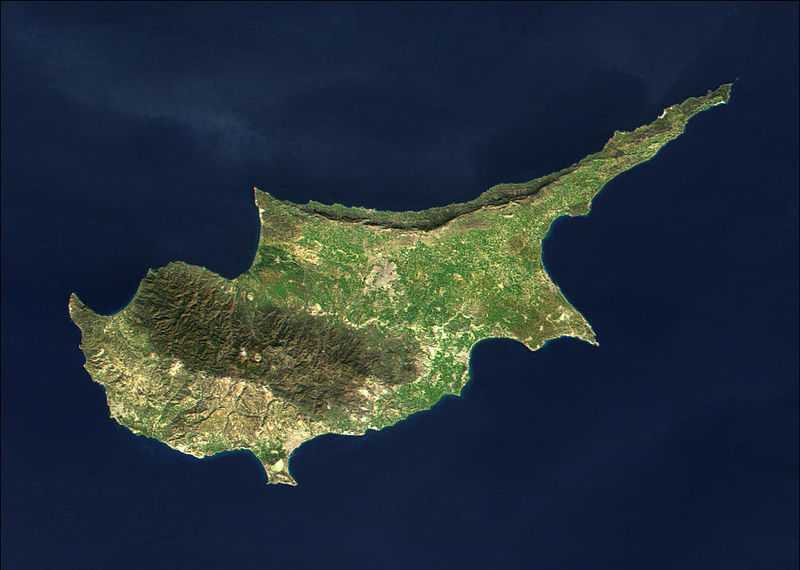
    The Cyprus Action Network of America (CANA) will be demonstrating directly in front of the Turkish Embassy in Washington DC , to demand justice for the criminal Turkish invasion of Cyprus that began on July 20th 1974.

    For 36 years Greek-Cypriots suffer an ongoing HOLOCAUST of our culture, heritage and people. Turkey’s crimes include the rape of 800 Greek-Cypriot women, the murder of thousands of Greek-Cypriots, the theft of half of the Greek-Cypriot peoples homeland, the forcible displacement of hundreds of thousands, and the ongoing illegal occupation of a culture, a sovereign territory a homeland.

    Over 100 United Nations resolutions have declared the ongoing Turkish-military-occupation of Cyprus illegal, and call for the speedy withdrawal of all Turkish troops from Cyprus . Turkey continues to mock international law and human rights and continues to exploit the theft of our land by spending millions to illegally convert it into luxury hotels and casinos. Turkey has brought over 150,000 illegal Turkish settlers into our stolen homes to commit cultural genocide by forcibly changing the demographic of Cyprus .

    Turkey’s illegal occupation regime is an offshore base for the Turkish deep state, and uses Turkish-occupied-Cyprus to export illicit narcotics and international terrorism.

    We call upon all Greek-Cypriots and people of conscience who care for justice to join us, to bring their own noisemakers and flags, and to not give the criminal a moment’s rest on July 20th the 36th Anniversary of our trail of blood and tears. Look the Turkish murders, rapists, thieves, invaders, occupiers right in the eye, and join us chanting loud and proud TURKEY OUT OF CYPRUS .

    In 2008 the CANA July 20 Turkish Embassy protest managed to get coverage by CBS. Our protest sends the strong message around the world that, no matter how hard the Turkish murderers, rapists, thieves, invaders, occupiers  and their allies try to sell us their Turkish racist bizonal, bicommunal plans: WE WILL NEVER FORGIVE, WE WILL NEVER FORGET the perpetrators of the HOLOCAUST of the Greek-Cypriot people.”
    ————————————————–
    ——————————————-
    ΑΙΜΑΤΗΡΗ ΑΛΗΘΕΙΑ – BLOODY TRUTH (Download the Greek and English PDF book) Learn the Truth about the Turkish terrorist organizations Volgan and TMT and the Turkish Bizonal Bicommunal Federation plan. Volunteer for our information tables to distribute the book.

    ————————————————————–
    ####
    ========================
    Cyprus Action Network of America (CANA)
    2578 Broadway #132
    New York, NY 10025
    New York: Tel. 917-699-9935
    Email: [email protected]
    www.cyprusactionnetwork.org
    ========================
    The Cyprus Action Network of America (CANA) is a grass-roots, not-for-profit movement created to support genuine self-determination and human rights for the people of Cyprus .

    To be added to CANA’s Action Alert e-mail distribution list, or to introduce CANA to a friend or colleague, please forward the pertinent name and e-mail address, with the subject heading “Add e-mail to CANA distribution list”, to [email protected]

    You are encouraged to forward this action alert to five or more individuals who may have an interest in our e-distributions or in CANA’s mission.

    You may post any CANA article, press release or action alert on the internet as long as you credit CANA and the author(s).

  • MESS Report / IDF probe of Gaza flotilla carefully avoided placing real blame

    MESS Report / IDF probe of Gaza flotilla carefully avoided placing real blame

    Giora Eiland’s conclusions on the takeover of the Gaza-bound flotilla are as ineffectual as those he provided four years ago after investigating the abduction of Gilad Shalit.

    By Amos Harel

    Every four years Maj. Gen. (res. ) Giora Eiland is called to the flag. He retrieves his general’s epaulets from storage, squeezes into his fatigues and sets out to investigate the army. The results are fairly similar.

    Maj. Gen. (res.) Giora Eiland speaking to reporters in Tel Aviv, June 12, 2010.a
    Photo by: Daniel Bar-On

    His conclusions on the takeover of the Gaza-bound flotilla, released yesterday, recall those he provided four years ago this week after investigating the abduction of Gilad Shalit: a clear and detailed analysis identifying numerous mistakes, and no recommendations regarding the individuals involved.

    Eiland describes a series of mistakes, but none reflecting dereliction of duty. There were not enough soldiers on deck to face off against the violence of the Turks and the unpredicted magnitude of their opposition.

    The naval commandos who arrived by boat were met by violence (including live fire ) that stopped them from boarding, leaving the 15 commandos who had slid down ropes from a helicopter at a disadvantage.

    Coordination problems among intelligence agencies created gaps in information before the operation started. The navy, according to Eiland, did not properly consider alternatives to the original plan. It was not clear under what circumstances a decision could be made to delay the operation (for instance, an encounter on deck with activists armed with axes and clubs ). After all, the operation was taking place a few miles from Israel’s shores. Tel Aviv was in no immediate danger.

    The report also reveals that Chief of Staff Gabi Ashkenazi had warned in a letter to government officials on May 13 – two and a half weeks before the operation – that the military option should be a last resort.

    Should he have done more than that? Eiland did not say so.

    Amazingly, a few hours after the report’s release, someone leaked to Channel 2 that Defense Minister Ehud Barak had warned the army of insufficient intelligence about the intentions of the flotilla’s participants. Barak’s office denies any connection to the report.

    The Eiland report correctly praises the restraint and expertise of the commandos under difficult circumstances and the navy’s preparation efforts.

    He determined – and in the international arena this is important – that the Turks fired first, apparently from weapons they later threw overboard. But the bottom line, four years after the Second Lebanon War, is that the entire defense establishment had planned for the wrong scenario in the flotilla affair, and this is something to worry about.

    Eiland’s approach not to make recommendations about individuals may be right. Does every probe have to end with rolling heads? In any case, the head of the navy, Maj. Gen. Eliezer Marom, is ending his term soon. An impressive career should not be stained by a single incident.

    And yet it is hard to align the harsh findings with the soft recommendations. Armed with a scalpel and kid gloves, Eiland chose his words carfully. There are mistakes; there are no guilty parties.

    The story arrived half dead to the evening news. If the probes headed by Jacob Turkel and State Comptroller Micha Lindenstrauss do not resuscitate the saga, it seems the main party responsible for the failure, our political leaders (who were much slower than the chief of staff in its willingness to investigate themselves ) will also survive the flotilla affair.

  • ISRAEL: Army probe of flotilla raid finds mistakes; blogger finds a big one

    ISRAEL: Army probe of flotilla raid finds mistakes; blogger finds a big one

    July 12, 2010 | 12:09 pm
    The committee appointed by the Israeli army to examine the military’s performance in the ill-fated takeover of the Mavi Marmara, part of a Gaza-bound aid flotilla, submitted its report Monday. Giora Eiland, a former major general who headed Israel’s national security council and served in senior military posts, had been tapped by Israel Defense Forces Chief of Staff Gabi Ashkenazi to head an internal team of experts a few days after the high-profile operation.

    The report cites faults in planning, intelligence and information integration, among other things, but also said commandos acted well under the circumstances. Eiland’s team found no negligence but did find mistakes, including at senior levels. He chose his words very carefully.
    But really, instead of spending five weeks on a 100-page report, Eiland could have just published this instead:

    The cartoon made the cyber-rounds June 1, reaching Israel even before Eiland’s appointment. It seems to have originated from Abu Muqawama, the nom-de-blog of an expert at the Center for New American Security with a blog on contemporary insurgency issues and a good sense of humor. He posted “Fast-Roping 101” the day after the raid, with a one-liner asking if it was “‘too soon.”  Nope, not too soon, said one reader. Another commented it was too late, and others said the cartoon absolutely begged a T-shirt.

    So, here it is again.

    Now commandos may be waiting for the next commission to decide which decision-maker put them in the fast-roping-for-dummies situation to begin with.

    — Batsheva Sobelman in Jerusalem
    Image credit: Abu Muqawama

  • EU and Turkey accession talks advance at snail’s pace

    EU and Turkey accession talks advance at snail’s pace

    VALENTINA POP

    01.07.2010 @ 08:05 CET

    EUOBSERVER / BRUSSELS – EU countries have agreed to open a minor chapter in Turkey accession talks, in a move portrayed as proof of EU commitment following US criticism of Europe’s treatment of Ankara.

    EU officials went to great lengths to reassure Turkey that the opening of negotiations in the field of food safety and veterinary health is a significant step forward in the enlargement negotiations, which began in December 2004.

    Turkey is a natural bridge between Europe and Asia but would shift the power balance inside the union (Photo: zz77)

    “These are technical issues, but they carry great political importance as well, because they show that the negotiation process is still very much alive and making progress,” Spanish foreign minister Miguel Moratinos said during a press conference on behalf of the EU.

    His remarks were echoed by enlargement commissioner Stefan Fuele, who called food safety a “heavyweight chapter.”

    “There should be zero doubts about EU’s commitment,” he said.

    Only 13 out of 35 chapters have been opened in the past five and a half years, partly due to Turkey’s pace of reform and partly due to opposition from France, Germany, Greece and Cyprus. Eight chapters are on ice until Turkey resolves its territorial dispute with Cyprus.

    The Obama administration recently criticised the EU over the slow pace of progress, with defence secretary Robert Gates saying Europe is “pushing” Ankara to closer relations with Islamic states such as Syria and Iran.

    Traditionally the only Muslim ally of Israel, Turkey last month froze diplomatic relations with the Jewish state following the deadly attack on a Turkish ship carrying humanitarian aid to Gaza.

    Asked by a German journalist if giving a political boost to Ankara might send the wrong message to Israel, Mr Moratinos said “the commitment for EU negotiations is very clear and no event should change this strategic goal.”

    He added that the bloc had condemned the “disproportionate use of force” by Israel and adopted a “tough stance” following the death of nine Turkish citizens on the Gaza boat.

    Speaking at the same press conference, Turkish foreign minister Ahmet Davutoglu said the attack was not only a bilateral issue with Israel, but a European one: “On this flotilla there were members of parliaments from European countries. It was an attack on a convoy of citizens. Nobody should see this as a problem only for Turkey and Israel, but also for the EU as a whole.”

    He added that Turkey expects to its EU entry to be judged on merits, not “political criteria,” in an allusion to the Franco-German idea that it should be a “privileged partner” but not an EU member.

    The 72-million-strong Muslim country would drastically alter the power balance in the EU Council the day it enters the union.

    But its geopolitical value – as a cultural bridge, a model of Islamic democracy and a territorial bulkhead into the Middle East – has created many supporters of accession.

    Mr Moratinos and his predecessor during the Swedish EU presidency last year, Carl Bildt, both support Turkey’s EU membership. The upcoming Belgian EU presidency, which takes over the baton from Spain on Thursday (1 July), has also said it will push to open more negotiation chapters, with the energy and education dossiers next in line.

    The EU on Wednesday also opened the last three chapters in Croatia’s accession talks, covering Judiciary and Fundamental Rights, Competition and Foreign, Security and Defence Policy.

    The judiciary chapter should prove the toughest to complete due to corruption problems in the country. But Wednesday’s move puts the country firmly on the path to EU membership, with signature of the accession treaty expected in January or June next year.