Month: April 2010

  • The other side of the Caucasus story

    The other side of the Caucasus story

    By Anca Gurzu

    Published April 21, 2010

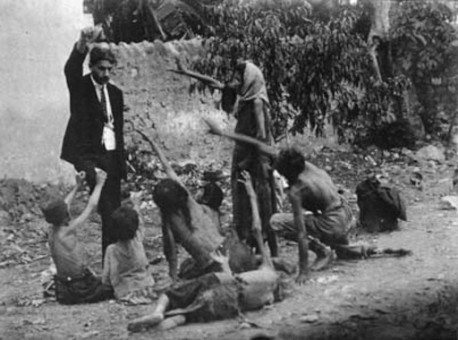
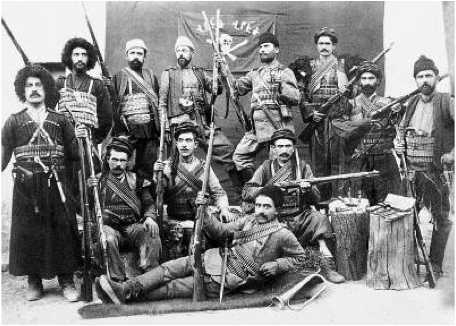
    In 1915, the region of Eastern Anatolia was being threatened by czarist Russian troops and the Ottaman Empire was crumbling. The Ottomans decided to forcibly relocate about 700,000 Armenians from the eastern region to create a buffer zone against the Russians. This resulted in horrific death and suffering as people starved and faced harsh wartime conditions. The Armenian diaspora, and many other Western countries, describe the events as a genocide—organized killings meant to eliminate the Armenians.

    Scott Taylor believes there are always two sides of history, and he has tried to put the events in a deeper context in his new book Unreconciled Differences: Turkey, Armenia and Azerbaijan by highlighting Turkey’s explanation of the events, and, implicitly, how little we know about this conflict.

    Mr. Taylor, a war correspondent and the editor and publisher of Ottawa-based military magazine Esprit de Corps, is also critical of Canada’s decision to formally refer to the 1915 deportation as genocide.

    He also discusses the 1992-94 conflict between the post-Soviet republics of Azerbaijan and Armenia over the sovereignty of Nagorno-Karabakh province. This conflict resulted in the displacement of about 800,000 Azeris and thousands of deaths.

    Embassy spoke with Mr. Taylor this week, and the following is an edited transcript of that conversation:

    What drew your interests to these two specific conflicts in the Caucasus?

    “I think the biggest thing for me was to realize how little I knew. I hadn’t ever heard about the war between Azerbaijan and Armenia. When I was heading to Azerbaijan for the first time in 2006 and they told me there is a frozen conflict, I said ‘what?’ It never made our newspapers, there were some reports, but I certainly didn’t pick up on them.

    “These are really two overlooked conflicts of World War One and the present day, and it’s almost embarrassing that a war of that scale was happening while I was a war correspondent and covering places like Cambodia, Croatia, Bosnia, etc., and didn’t really know about it.

    You are trying to tell Turkey’s side of the story in the 1915 departation, which you say is not well known worldwide because of the strong Armenian diaspora. Why do you think that was necessary?

    “There is a discussion on whether this was a deliberately-ordered genocide or a completely botched relocation and deportation of the Armenians…. Everyone can agree that the aftermath was horrific, there is no discussion on that. No one denies that hundreds of thousands of Armenians perished at that particular point in time.

    “What the Turks point out is that the Armenians were also openly engaged in warfare against the Turks and the Kurds in the region and fought alongside the Russians, and in many cases committed atrocities and barbarous acts themselves.”

    “So this is part of the problem. You begin to realize that there are two divergent sides of the story. [The Armenians] managed to somehow present themselves as a singular victim and I think that’s the thing that’s important. There wasn’t just one victim. Was there human suffering? Absolutely. But at the same time, what were they doing? Burning down villages and houses.

    “[The situation] isn’t as clear-cut as it is meant to be believed here, as the diaspora presents it. What holds the diaspora together is that they were the survivors of a genocide. That’s become part of their folklore, their myth, of who they are. That’s what bonds them.”

    Throughout your book you’re critical of Canada’s resolution to refer to the 1915 displacement of Armenians as genocide. What’s the impact of such resolutions?

    “They make it tougher to close that gap. Because now [the diaspora] can say, ‘Well look, it’s been decided by other countries [that it was a genocide].’

    “How many issues are there where people are demanding things to be recognized? Even the Poles could be demanding that the Russians recognize what happened in the Katyn forest. Why should our Parliament be determining these things? We have two very different histories in our own country as well. For us to declare ourselves on one side or another seems kind of pompous and pretentious given how little we know.”

    Why did you decide to address the more recent Azeri-Armenian conflict in the same book and how are they connected?

    “I think it was the comparison of massive deportation. [The Armenians] cleansed out some 800,000 Azeris in neighbouring provinces, they went beyond just the disputed territory of Nagorno-Karabakh. They were able to cleanse out a huge region, and there still so many people living in refugee camps today….

    “I asked the Armenians, ‘How can you say that the the Turks forcibly relocated you to create a buffer zone for security, and then you forcibly relocate 800,000 Azeris to, in your own words, create a buffer zone? How can you not compare the two?’ They did the same thing. There are similarities in what happened.”

    Many of your chapters begin with personal narratives, memories of your trip to the regions or even of your background. What role do they play in your book?

    The goal is to find a common ground between the facts and the reader, who is going to discover the way I did, without having any idea about it. My background, and seeing other sides of conflicts, being in Belgrade during the bombing and seeing the dehumanizing of the Serbs, even to this day and age, that has led me to pursue the other side of the story. There are no evil people. There are evil persons, but not people. You cannot declare Turks evil.”

    Unreconciled Differences: Turkey, Armenia and Azerbaijan

    By Scott Taylor

    Esprit de Corps Books

    176 pp. $19.95
    [email protected]

  • Yerevan Set To Announce Key Decision On Turkey

    Yerevan Set To Announce Key Decision On Turkey

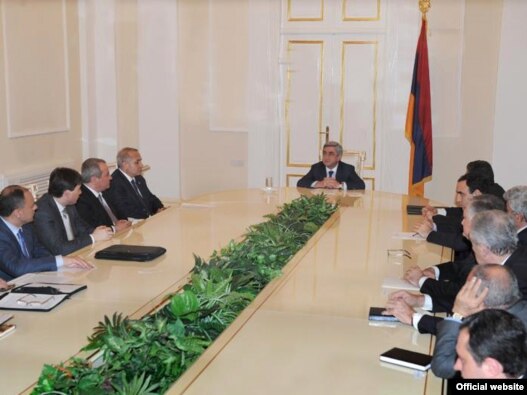
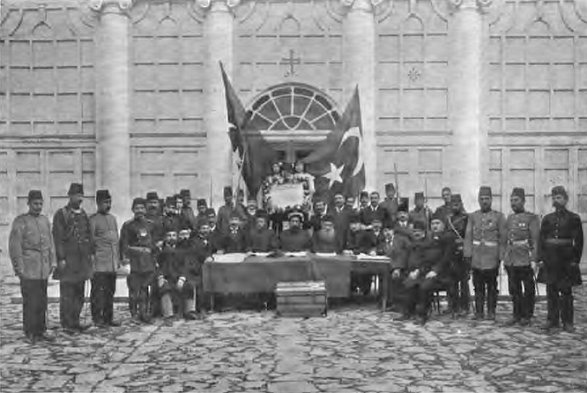
    Armenia -- President Sarkissian holds a meeting of National Security Council, 21Apr2010Armenia — President Sarkissian holds a meeting of National Security Council, 21Apr2010
    21.04.2010

    President Serzh Sarkisian will address the nation on Thursday to announce a promised crucial decision on the future of Armenia’s frozen normalization agreements with Turkey, his office said on Wednesday.

    In a written statement, the presidential press service said Sarkisian discussed that decision at a special meeting with the top state officials sitting on his National Security Council. It said he briefed them on the results of his latest visits to Washington and Moscow that reportedly focused on the stalled Turkish-Armenian normalization process.

    “Members of the Security Council discussed the latest developments in the process of normalizing relations between Armenia and Turkey,” said the statement. “President Sarkisian said that he has held a series of consultations on this issue with the leaders of the parties making up the [governing] political coalition.”

    “The president of the republic will address the people on the results of the decision made as a result of the discussions,” it added without elaboration.

    Sarkisian has repeatedly threatened to scrap the Turkish-Armenian protocols if Turkey fails to ratify them “within a reasonable time frame.” Turkish Prime Minister Recep Tayyip Erdogan reiterated after his Washington talks with Sarkisian that the Turkish parliament will not validate the deal before a resolution of the Nagorno-Karabakh conflict. Erdogan’s statements were a clear indication that the two sides failed to agree on how to kick-start their historic rapprochement.

    Sarkisian said before flying to the U.S. capital that he has all but decided what to do next in the U.S.-backed process. His foreign minister, Edward Nalbandian, told journalists after the ensuing U.S.-Turkish-Armenian negotiations that Yerevan is now even more confident about the wisdom of that move.

    https://www.azatutyun.am/a/2020637.html
  • Pro-Armenian Turks Urged To Mark Armenian ‘Great Catastrophe’ In Istanbul

    Pro-Armenian Turks Urged To Mark Armenian ‘Great Catastrophe’ In Istanbul

    Armenia — Screenshot, Turkish intellectuals call for commemorating victims of 1915 events, 21Apr2010

    21.04.2010

    Prominent Turkish intellectuals have urged their countrymen to join them in marking on Saturday the 95th anniversary of the start of mass killings and deportations of Armenians in the Ottoman Empire with a silent protest in Istanbul.

    “We call upon all peoples of Turkey who share this heartfelt pain to commemorate and pay tribute to the victims of 1915. In black, in silence. With candles and flowers,” they said in an online petition signed by dozens of other Turks.

    “For this is OUR pain. This is a mourning for ALL OF US,” reads the petition posted at .

    The gathering, if it is allowed by the Turkish authorities, will take place in Istanbul’s central Taksim square and mark the first-ever public commemoration of more than one million Armenians massacred by Ottoman Turks in 1915-1918.

    The unprecedented action was initiated by renowned intellectuals challenging the official Turkish version of those events, which holds that the Armenian death toll is inflated and denies a premeditated government effort to exterminate the Armenian population of the crumbling empire. The signatories include journalist Ali Bayramoglu, historians Halil Berktay and Taner Akcam, and other scholars such as Cengiz Aktar and Baskin Oran.

    The petition stops short of calling the massacres a genocide, using instead the Armenian phrase “Great Catastrophe.” “In 1915, when we had a population of only 13 million people, there were 1,5 to 2 million Armenians living on this land,” it says, adding: “They were the grocer in our neighborhood, our tailor, our goldsmith, our carpenter, our shoemaker, our farmhand, our millwright, our classmate, our teacher, our officer, our private, our deputy, our historian, our composer…

    “Our friend. Our next-door neighbors and our companion in bad times. In Thrace, in the Aegean, in Adana, in Malatya, in Van, in Kars…In Samatya, in Sisli, in the Islands, in Galata…

    “On April 24th, 1915 they were ‘rounded up.’ We lost them. They are not here anymore. A great majority of them do not exist anymore. Nor do their graveyards. There EXISTS the overwhelming ‘Great Pain’ that was laid upon the qualms of our conscience by the ‘Great Catastrophe.’ It’s been getting deeper and deeper for the last 95 years.”

    Thousands of Turks signed a similar online petition that was initiated by mostly the same public figures in December 2008. It offered Armenians a personal apology and called for the Turkish government to acknowledge the killings.

    Turkish prosecutors threatened to bring criminal charges against the authors of the appeal under Article 301 of the Turkish penal code, which criminalizes “insulting the Turkish people.”

    The Turkish government has scrambled in recent weeks to prevent further progress of a U.S. congressional resolution recognizing the Armenian genocide. It has also pressed U.S. President Barack Obama to again avoid using the word “genocide” in a statement on the massacre anniversary due on April 24.

    Obama has been receiving diametrically opposite messages from leaders of the influential Armenian community in the United States as well as pro-Armenian U.S. lawmakers. More than a dozen members of the U.S. Senate have signed this week a letter calling on him “to stand on the right side of history and unequivocally affirm the Armenian Genocide.”

    “While we fully acknowledge the importance of the U.S.-Turkey relationship, we should never, for any reason, fail to call a tragedy of this magnitude by its rightful name,” the senators said.

    https://www.azatutyun.am/a/2020635.html
  • Excluding Azerbaijan Can’t Bring Stability To The South Caucasus

    Excluding Azerbaijan Can’t Bring Stability To The South Caucasus

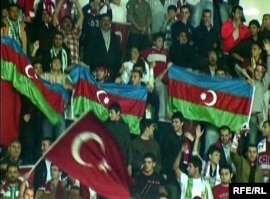
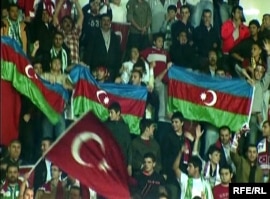
    Azerbaijani football fans at the Turkey-Armenia World Cup qualifying match in Bursa in October 2009
    April 21, 2010
    By Novruz Mammadov
    The United States has recently stepped up efforts to repair relations between Turkey and Armenia. Turkey closed its border with Armenia in 1993 in response to the occupation of Nagorno-Karabakh and surrounding Azerbaijani territories by Armenian forces. Lately, U.S. officials have been urging Turkey to ignore Armenia’s continuing occupation and reopen the border. While Washington says that its aim is to improve stability and development throughout the region, in reality U.S. policies have become increasingly pro-Armenian — and exclusive of Azerbaijan.

    Washington believes that a Turkish-Armenian rapprochement could kill two birds with one stone. First, it might smooth over — at least temporarily — one of the major trouble spots in U.S.-Turkish relations: the issue of Armenian genocide claims. Second, some U.S. officials argue that improving ties between Armenia and Turkey will ultimately contribute to a resolution of the Nagorno-Karabakh conflict. They appear to believe improved relations will lead to a moderation of Armenian policies and open the way to new initiatives on Karabakh.

    However, we must disagree. Armenia continues to occupy almost 20 percent of Azerbaijan’s internationally recognized territory. It is ironic that while claiming to be the first victim of genocide in the 20th century, Armenia itself carried out one of the century’s major ethnic-cleansing campaigns in Europe — a campaign that resulted in thousands of deaths and the displacement of nearly 1 million Azerbaijanis. Many members of the Armenian political elite — including President Serge Sarkisian — rose through the ranks because of their personal involvement in the Nagorno-Karabakh war. They have used the war as a pretext for strengthening their own hold over Armenian politics, so it is not surprising that they have not been constructive in settlement talks.

    Pretext For Occupation

    Azerbaijan has proposed granting the highest form of autonomy to Nagorno-Karabakh and is prepared to invest heavily in the region’s development once a peace deal is reached. Baku has been cooperating closely with the Minsk Group of the Organization for Security and Cooperation in Europe (OSCE) to resolve the conflict peacefully.

    However, Armenia remains intransient, and this creates the suspicion that Yerevan wants to keep the conflict unresolved as an excuse for indefinite occupation.

    In this context, Armenia’s closed borders are the main form of leverage that might compel Yerevan to engage seriously in the resolution of the conflict. There is no reason to believe that opening the borders will make Armenia more willing to compromise; on the contrary, removing this sole punishment will only increase Armenia’s interest in further entrenching the status quo.

    We understand that Armenia has a powerful diaspora and that justice does not necessarily always prevail. Over the last 15 years, despite maintaining the occupation of part of a neighboring country, Armenia has received preferential treatment from the West, which has actually punished Azerbaijan. The infamous Section 907 of the U.S. Freedom Support Act, which banned direct U.S. aid to Azerbaijan, is a clear example of this. Western governments and media have largely been silent on the plight of the nearly 1 million Azerbaijanis who were displaced by Armenian aggression. This has naturally led the Azerbaijani public to think that the West’s talk of democracy and human rights is nothing more than a selectively applied method of promoting its own interests.

    In Defense Of Justice

    It is high time for the United States and Europe to adopt a fair position and to prevent the narrow interests of their Armenian lobbies from prevailing over justice and their own national interests.

    In any event, attempts to pressure Ankara to abandon Azerbaijan are shortsighted and likely to backfire. Azerbaijan and Turkey are strategic allies with deep historical ties. Turkey has played an important role in Azerbaijan’s partnership with the West on key security and energy projects. Azerbaijan spearheaded the opening of Caspian energy resources to the West and insisted that major oil and gas pipelines be routed through Georgia and Turkey.

    Baku has also wholeheartedly supported U.S. security initiatives by sending troops to Kosovo, Iraq, and Afghanistan. Azerbaijan also provides supply-transit support for the NATO effort in Afghanistan. Those who know the region understand the significant risks Azerbaijan took and the pressure it overcame in order to pursue close cooperation with the West on energy and security issues.

    Long-term peace and normalization of relations in the South Caucasus cannot be achieved by rewarding aggression and by excluding the region’s strategically most important country. By pushing Turkey to abandon Azerbaijan, the United States risks alienating one of its most important and reliable partners in a critical region of the world.

    Novruz Mammadov is head of the Foreign Relations Department of the Presidential Administration of Azerbaijan. The views expressed in this commentary are the author’s own and do not necessarily reflect those of RFE/RL

    https://www.rferl.org/a/Excluding_Azerbaijan_Cannot_Bring_Stability_To_The_South_Caucasus/2020228.html

  • Iran working to avoid tougher sanctions

    Iran working to avoid tougher sanctions

    Iran seeks to persuade Security Council not to back tough nuclear sanctions

    By Thomas Erdbrink

    Washington Post Foreign Service
    Wednesday, April 21, 2010

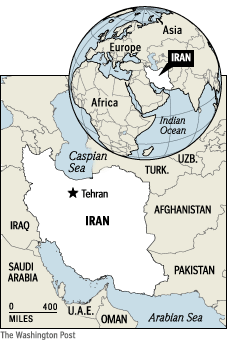
    TEHRAN — Facing increasing momentum behind a U.S.-backed bid for new sanctions against it, Iran is launching a broad diplomatic offensive aimed at persuading as many U.N. Security Council members as possible to oppose tougher punishment for its nuclear program.

    Iran wants to focus on reviving stalled talks about a nuclear fuel swap to build trust on all sides, according to politicians and diplomats in Tehran. But leaders of Western nations say that unless Iran alters its conditions for the deal, they will refuse to discuss it again. Under the arrangement, aimed at breaking an impasse over Iran’s uranium-enrichment efforts, Tehran would exchange the bulk of its low-enriched uranium for more highly enriched fuel for a research reactor that produces medical isotopes.

    As Iranian diplomats fly around the world to discuss the swap, they are lobbying some of the Security Council’s rotating members to vote against a fourth round of sanctions proposed by the United States, officials said.

    The Obama administration is seeking unanimous support for further Security Council sanctions against Iran. Three previous rounds of sanctions were accepted by all members, except in 2008, when Indonesia abstained. This time, Iran is actively working to get more Security Council members to oppose the U.S. initiative.

    “In the coming 10 days, the Islamic republic’s delegations will travel to the capitals of Russia, China, Lebanon and Uganda to pursue talks,” Foreign Minister Manouchehr Mottaki said. “Other countries will be visited in the near future.” He said that “nuclear issues” will be on the agenda.

    Iran also plans to try to rally support during an international conference to review the nuclear Non-Proliferation Treaty (NPT). In Tehran’s view, the gathering, scheduled for May in New York, is shaping up as a confrontation between nuclear powers and developing nations.

    Iran’s official stance is that the U.N. sanctions are not effective. But unofficially, any vote against a new sanctions resolution would be welcomed as a great diplomatic victory.

    “The groups we are sending out will be focusing on the correct implementation of the NPT, the disarmament trend and fuel-swap issues,” said Kazem Jalali, a member of the Iranian parliament’s national security and foreign policy committee. “Naturally, our explanations during the trips will have a positive effect against the efforts by the United States in trying to impose new sanctions.”

    To start its diplomatic offensive, Iran held a nuclear disarmament conference last weekend that several Security Council members attended. The meeting, with its motto of “nuclear energy for all, nuclear weapons for none,” focused on what Iran and other developing nations call “double standards” and “discriminatory elements” in the Non-Proliferation Treaty.

    Participants in the Tehran conference shared complaints that world powers are using proliferation fears as a reason to prevent developing nations from establishing independent nuclear energy programs.

    Iran’s diplomatic effort seems especially aimed at developing nations such as Brazil, Nigeria and Turkey, which hold rotating seats on the 15-member Security Council. Iran is also betting that council members Lebanon — which has a government that includes members of Iran-backed Hezbollah — and Uganda might vote against new sanctions or abstain.

    As a part of the campaign, President Mahmoud Ahmadinejad will begin a two-day state visit Friday to Uganda, where he is expected to promise help in building an oil refinery.

    Brazil and Turkey already have said they are wary of imposing additional punishment on Tehran. Turkish Foreign Minister Ahmet Davutoglu, visiting Iran on Tuesday, announced that his country is ready to mediate on the uranium swap proposal and other nuclear issues.

    The U.N.-backed arrangement, proposed in October, was the subject of promising initial negotiations. But it was soon shelved after Iran repeatedly changed its conditions, saying the exchange should take place on Iranian soil and demanding more Western security guarantees.

    With Western nations insisting that the swap occur outside Iran, Turkey offered last year to act as a neutral location for the exchange, but Tehran was not interested, diplomats said.

    Asked Tuesday about the proposal, Iranian Foreign Ministry spokesman Ramin Mehmanparast told reporters, “The venue of any fuel swap will be in Iran.”

    Special correspondent Kay Armin Serjoie contributed to this report.

  • LETTER TO PRESIDENT OBAMA FROM AMERICAN TURKISH COUNCIL

    LETTER TO PRESIDENT OBAMA FROM AMERICAN TURKISH COUNCIL

    Dear ATC Members,

    ATC Chairman, Ambassador Richard Armitage, sent a letter today to President Obama urging him to avoid in his April 24 Armenian Remembrance Day Statement tagging the Ottoman Empire and its successor state, Turkey, with the crime of “genocide”.  This is an opportunity, Chairman Armitage writes, to promote Turkish and Armenian healing and to “encourage open borders and regional peace, and American security and commerce.”

    A copy of Chairman Armitage’s letter is attached.

    It is our intention, once we are past April 24, to embark immediately on several activities that demonstrate the health and vitality of Turkish – American relations, and not least of all, the potential for substantially increased bilateral commerce.

    Ambassador James H. Holmes
    President
    American-Turkish Council

    ================================================================

    AmericanTurkish Council

    – [ Bu sayfanın çevirisini yap ]ATC The leading business association in the US dedicated to the promotion of US-

    Turkish commercial, defense and cultural relations.
    www.americanturkishcouncil.org/ – ÖnbellekBenzer