Month: April 2010

  • Greek sues over photo on ‘Turkish’ yoghurt in Sweden

    Greek sues over photo on ‘Turkish’ yoghurt in Sweden

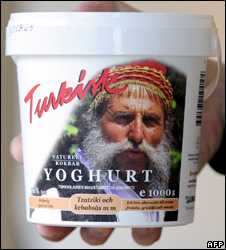
    A Greek man is suing a dairy in Sweden for 50 million kronor ($6.9m; £4.5m) for using his image on pots of Turkish-style yoghurt, Swedish media report.


    The man only found out his moustachioed face featured on the containers of Turkisk Yoghurt made by Lindahls when a friend living in Stockholm told him.

    Athanasios Varzanakos told Swedish Radio his friend “was annoyed and asked how it was possible” when informed.

    The dairy said it bought the photograph in good faith from an image library.

    Chief executive Anders Lindahl said it had come as a shock when the Greek man lodged a 40-page legal complaint saying that the company had used a misleading image because he had no links with Turkey.

    “We bought it from a photo agency so we assumed that everything was in order,” Mr Lindahl told the AFP news agency.

    The image remains on the Lindahls website despite the legal action.

    Relations between Greece and Turkey have long been strained and at times have turned into outright hostility.

    BBC

  • EVENT CANCELLED: Genocide and Activism, April 20

    EVENT CANCELLED: Genocide and Activism, April 20

    Ergun Kirlikovali ATAA President elect, Ali Cinar ATAA VP ,Ibrahim Kurtulus, President of Young Turks and myself we have contacted the Center about this program.
    Lemkin coined the word genocide after the Holocaust which was very appropriate. Erroneously he used the Armenian case as an early example. One wonders about how much he knew about the Ottoman history of early 1900s. It appears that he fell victim to the propaganda machine of the Armenians .. Oya Bain

    Having trouble viewing this email? Click here

    We regret to announce that the panel discussion Genocide and Activism: Lemkin’s Legacy for the 21st Century has been CANCELLED.  If you ordered tickets via SmartTix, you will receive a refund for the full amount.  We apologize for any inconvenience.

    Center for Jewish History | www.cjh.org
    15 West 16th Street, between 5th and 6th Avenues
    New York, New York 10011

    —– Original Message —– From: Ergun To: [email protected] ; [email protected] Cc: [email protected] Sent: Sunday, January 10, 2010 7:45 PM Subject: THE TURKISH-AMERICANS SEND CONCERNS ON JEWISH-ARMENIAN TIES

    Michael Glickman

    Chief Operating Officer, Center for Jewish History

    15 W 16th,

    New York, NY 10011

    Tel:  212-294-8301

    Bruce Slovin

    Member of the BOD, American Jewish Historical Society
    Chairman, YIVO Institute for Jewish Research

    Re:  History Of Genocide Initiative – Sunday, January 10, 11:00am at CJH. ”Imagination and Catastrophe: Art and the Aftermath of Genocide”.   (For details: http://www.cjh.org/lemkin/ )

    THE TURKISH-AMERICANS SEND CONCERNS ON JEWISH-ARMENIAN TIES

    “ (U.S.) Senators send concerns on Turkey-Israel  ties” was the catchy title of a recent newspaper article at JTA, a trusted source of news and opinion on events and issues of interest to the Jewish people (source:  http://jta.org/news/article/2009/12/14/1009721/senators-concerned-about-turkey-israel-relations ) which inspired me to use the title of our letter to you.

    I wonder if those US Senators are aware of the unfortunate defamation efforts of the Armenians inexplicably solicited by the Center for Jewish History, demonizing Turkey, Turks, and Turkish-Americans.

    I am of course referring to the event  on January 10, 2010, HISTORY OF GENOCIDE INITIATIVE,  Imagination and Catastrophe: Art and the Aftermath of Genocide  (source: www.cjh.org/lemkin ) , where filmmakers, writers, and musicians allegedly discussed the complexity of art that deals with genocide and its aftermath.

    But what if one of the items was deliberately misrepresented to unsuspecting guests as the settled history of a genocide whereas, in fact, it is neither settled, nor genocide?

    What if such falsifications and deception were conducted solely to defame and demonize an entire nation and a country?

    Would that come under dishonesty in advertising?

    Or would it be considered malicious mass propaganda (i.e. ethocide) ?

    Or even libel?

    Sincerely,

    Ergün KIRLIKOVALI
    President-Elect, ATAA


    If you are intrigued by the above and wish to learn more, please read on:

    IS IT FAIR OR PROPER TO HOST INFAMOUS ARMENIAN FALSIFIERS AND TURK-HATERS AT A RESPECTABLE JEWISH INSTITUTION?

    I am , of course, referring to at least two of the speakers of Armenian descent infamous  for their anti-Turkish bias and premeditated distortion of Turkish history:  Peter Balakian and Atom Egoyan.

    I read one of Balakian’s books which was REPLETE WITH FALSIFICATIONS and slurs.  I alo saw Egoyan’s boring film which was equally deceptive and fallacious.  It is not remarkable that some Armenians resort to slurs, outrageous claims, deceivingly poor math, and plain bad history to exploit others’ feelings.  What is remarkable is the fact that such crude propaganda material can find access to mainstream events.

    Would CJH, for instance, find it fit to organize an event full of anti-Semitic slurs and lies?

    Why then do it for anti-Turkish slurs and lies?

    Isn’t it time we all realize that anti-Semitism is not unlike anti-Turkism?

    And that they are both motivated by the same type of bias, bigotry, anger, and hate?

    And that they both produce same type of  religious and ethnic discrimination ignited and fueled by hate speech?

    And  they both hurt  their victims just as much?

    Falsification, embellishment, and insults seem to be a family tradition at the Balakian family.  Here is  what Holger H. Herwig, a professor of history at the University of Calgary, Canada, wrote in his review of the book “Armenian Golgotha” written by grandfather Balakian and translated by grandson Balakian,

    “…those seeking a scholarly history of the  Armenian genocide will be disappointed.   Balakian revels in stereotypes…  The book would have lost none of its impact with careful editing, removing countless repetitious accounts… and correcting the many historical inaccuracies for the non-professional reader… Its greatest shortcoming, of course, is the lack of source materials.  Throughout, and especially in Chapter u of Vol. ı, Balakian refers to the ‘Plan for the Extinction of the Armenians in Turkey,’ yet he offers no solid evidence for the existence of such a formal national ‘plan’ …”

    Source:   http://74.125.95.132/search?q=cache:Xf9W8GIY5PUJ:www.edmontonjournal.com/news/genocide%2Bsurvivor%2Briveting%2Bstory/1854142/story.html+Holger+H.+Herwig+Balakian&cd=4&hl=en&ct=clnk&gl=us

    WOULD CJH HOST A KHOJALY EXHIBITION TO EXPOSE CURRENT ARMENIAN WAR CRIMES?

    I wonder if the CJH would be kind and considerate enough to also display a set of Khojaly paintings to expose Armenian atrocities of 18 years ago in Azerbaijan, for fairness and balance, if not also for friendship and empathy.  After all, those Azeri women and children saw their houses burn, their loved ones slaughtered until it was their turn to be killed.  The loved ones left behind grieve their dethas at the hands of Armenian thugs and terrorists.  And there is an element of art in the photo exhibition, too.

    HOLOCAUST IS A FACT;  GENOCIDE,  A CLAIM
    Jewish Holocaust is a court-proven fact;   Armenian Genocide is a discredited political claim.  To equate them would be an insult to the silent memory of six million Jews who lost their lives just for being Jews.  Armenians, on the other hand, took up arms against their own government; attacked their own neighbors; joined the invading enemy armies; all in efforts to establish an apartheid, where an Armenian minority would rule over a Turkish majority in a so-called greater Armenia on Turkish soil.  But do not take our word for it.  Let’s listen to some powerful Jewish voices:

    “…We reject attempts to create a similarity between the Holocaust and the Armenian allegations. Nothing similar to the Holocaust occurred.  It is a tragedy… what the Armenians went through, but not a genocide.”

    Source:  Israeli Foreign Minister and 1994 Nobel Peace Prize winner Shimon Peres, Turkish Daily News, April 10, 2001, Ankara, Turkey

    ***

    “…An appropriate analogy with the Jewish Holocaust could be the systematic extermination of all the Moslem population in the Republic of Independent Armenia, which represented at least 30 to 40 % of the total population of this republic…”

    Source:  The Jewish Times, June 21, 1990, Circulation: 470,000

    ***

    “…This issue [of the Armenian Genocide] should be dealt with by historians and not politicians. We do not support the comparison of the Armenian tragedies to the Jewish Holocaust. Israel will not take a historical and political stance on the issue…”

    Source:  The Israeli Consulate, Los Angeles, USA, April 15, 2001, confirming the Perez statement in response to inquiries from Armenian-American daily Asbarez to the Israeli Consulate in Los Angeles, asking whether the Israeli Foreign Minister Shimon Peres did actually say the Armenian genocide was meaningless and reject any similarities between the Holocaust and the alleged genocide.

    “…Israel recognizes the tragedy of the Armenians, however, these events cannot be compared with a genocide…”  Source:  Israeli Foreign Office, Official statement, February 19, 2002

    “HITLER QUOTE IS A HOAX”

    Dr. Robert John, a historian of Armenian heritage from New York City stated, according the news article, that a commonly used quotation of an alleged statement by Adolf Hitler about the Armenian massacres was a forgery and should, therefore, not be used.  Dr. John demonstrated how he had traced the original document in the Military Branch of the National Archives of the U.S.A. after being handed a folder bearing the quotation at a rally outside the United Nations building in New York following the Turkish invasion of Cyprus. ..

    To read more:
    http://216.239.57.104/search?q=cache:6ztdC2UPN9sJ:www.tallarmeniantale.com/hitler-quote.htm+historian+Armenian+descent+Hitler&hl=en&ie=UTF-8

    ***

    ARMENIAN LEADER’S CONFESSIONS

    ‘… The war with us was inevitable… We had not done all that was necessary for us to have done to evade war. We ought to have used peaceful language with the Turks…We had no information about the real strength of the Turks and relied on ours. This was the fundamental error. We were not afraid of war because we thought we could win… Our army was well fed and well armed and [clothed] but it did not fight. The troops were constantly retreating and deserting their positions ; they threw away their arms and dispersed in the villages. …In spite of the fact that the Armenians had better material and better support, their armies lost. ….. the advancing Turks fought only against the regular soldiers ; they did not carry the battle to the civilian sector. ….the Turkish soldiers were well-disciplined and that there had not been any massacres…’

    Source:  The 1923 Bucharest Manifesto of Hovhannes Katchaznouni, the first PM of the Independent Armenian Republic, published by the Armenian Information Service Suite 7D, 471 Park Ave., New York 22 – 1955.

    VERDICT WITHOUT DUE PROCESS IS LYNCHING

    Those who take the Armenian “allegations” of genocide at face value seem to also ignore the following:

    Genocide is a legal, technical term defined by the U.N. 1948 convention and genocide verdict can only be given by a “competent court” after “due process” where both sides are properly represented and evidence mutually cross examined.

    For a genocide verdict, the accusers must prove “intent” at a competent court and after due process.  This could never be done by the Armenians whose evidence mostly rely on hearsay and forgeries.  Such a “competent court” was never convened in the case of Turkish-Armenian conflict and a genocide verdict does not exist  (save a Kangaroo court in occupied Istanbul in 1920 where partisanship, vendettas, and revenge motives left no room for due process.)

    Armenian Genocide claim is a long discredited political claim, not a historical fact.  It reflects bias against Turks. Therefore, the  term genocide must be used with the qualifier “alleged”, for scholarly objectivity and truth.

    ISRAELIS ARE SPEAKING OUT AGAINST GENOCIDE

    “…During WWI, the Russians invaded the Caucasus, and with the help of local Armenians, they have chased Turks and Jews, killed whoever they could catch, and then pillaged and plundered Turkish and Jewish villages. He was about 10 years old and my father-in-law was only 3 and he said there is no way he could forget that exodus, that fleeing. Turks and Jews brought with them to Anatolia whatever they could pack with them. Jewish families first went to Van (a city by the lake Van in Eastern Anatolia). While some Jewish families settled there, others continued their travel to settle in Adana and other places, and still others went as far as Palestine. What I am trying to my Armenian friends is this: everything has a prior history. If the Armenian attack and kill Turks, Turks, in their quest to avenge those Armenian atrocities, may have caused massacres in their counter attacks and chases. Aren’t these ‘eye for an eye’ feuds conventional and normal under the conditions of those days? In contrast, what the Germans did to 6 million Jews cannot be explained by such feuds, chases, or civil wars; there was absolutely no reason for the Holocaust. I never quite understood how the Armenians want to be included in the same category as the Jews of Holocaust. Let’s leave those old issues and the old world behind. Let’s look at the present. Let’s talk about what we can do to create a beautiful, happy new world… We should learn from those old stories and history; we should talk about the truth and agree on it; and let’s together build a more secure world to hand over to our children…Nobody benefits from feuds, hatred, and animosity; one can only gain tears that way; let’s worry about tomorrow, brothers, tomorrow! “

    When permission was requested from the writer for quoting him, he responded:

    “…I see no problem in your quoting my story…. Those who create all this fuss around the Armenian issue do not want to understand one thing:  instead of teaching love and brotherhood to their kids, they are teaching grudge and hatred (like the Palestinians do). What do they want to achieve with this attitude? Enough of this animosity already…The age old Armenian issue no longer interests me.  My children’s future is more important…”

    Momo Asafrana, December 09, 2004, responding to a request for permission to publish his story above.

    ***

    “…We have first hand information and evidence of Armenian atrocities against our people (Jews). Members of our family witnessed the murder of 148 members of our family near Erzurum, Turkey, by Armenian neighbors, bent on destroying anything and anybody remotely Jewish and/or Muslim… Armenians were in league with Hitler in the last war, on his premise to grant themselves government if, in return, the Armenians would help exterminate Jews. Armenians were also hearty proponents of the anti-Semitic acts in league with the Russian Communists…”

    Source:  Elihu Ben Levi, Vacaville, California. San Francisco Chronicle, December 11, 1983

    ***

    When the most powerful nation in the world, 15th century Spain, openly and publicly threatened genocide against the Jewish people for the stated crime of practicing their own religion-Judaism, it was a Muslim government, the Ottoman Empire, which stepped in and saved the Jewish people from destruction. It was the Ottoman Empire that saved the Jews of Spain and to a great extent, Portugal, from certain death which the government threatened them with.   Unlike the Christian kingdoms of Spain and Portugal, the Ottoman Empire never had a system of government-sponsored hatred against the Jewish people. Even though Jews were dhimmis, the government of the Ottoman Empire never set in place specific targeted anti-Jewish policies such as those that existed in Christian Europe. It is a sad reality that today many people only remember the Ottoman Turks for alleged bad treatment of minorities, when clearly, they have done many positive things that we today hundreds of years later should continue to praise.

    Source:  HOW THE TURKS SAVED THE JEWS FROM GENOCIDE ,  by Shelomo Alfassa, www.alfassa.com,  Israel Insider Magazine / October 10, 2007

    ***

    “…To validate a spurious genocide allegations, the Armenians curry favor with the Jewish people, and manipulate the Holocaust tragedy to gain some undeserved recognition from this uniquely Jewish experience. Historical evidences point to a devious Armenian collusion with Hitler to exterminate the Jews during WW II. Today, no matter how much the Armenians try to conceal this heinous episode from the public knowledge the Armenian conspiracy with Hitler is in the history books — indelibly. Soon it will be in the public conscience too… In early 1930s, when Hitler ascended to power, he began cultivating the Armenians to use their long-standing and strong anti-semitic feelings in his plans and policy. The Armenians, through their publications, radio broadcasts and meetings supported and cheered the Nazis on their attacks on Jews. Alfred Rosenberg, who was to become later Hitler’s Minister of the Occupied Territories, declared that the Armenians were Indo-European, or Aryans, which honored them and put them in the same league with the Nazis. In Hitler’s foreign policy the Armenians fitted very nicely too. Hitler’s future invasion plans of Russia provided a golden opportunity for the Armenians to liberate what they considered to be “Historic Armenia” from the Soviet as well as the Turkish rule…”

    Source:  Ayhan Ozer , THE ARMENIAN-NAZI COLLABORATION IN WW II  : http://www.tallarmeniantale.com/Nazi-Collaboration.htm

    WHAT THE WORLD NEEDS NOW IS TRUTH AND HONESTY,  NOT SELECTIVE MORALITY.

    If one cherishes values like objectivity, truth, and honesty, then one should use the phrase  “Turkish-Armenian conflict”.  Asking someone “Do you accept or deny Armenian Genocide” shows anti-Turkish bias. The question, in all fairness, should be re-phrased: “What is your stand on the Turkish-Armenian conflict?”

    Turks believe it was a civil war within a world war, engineered, provoked, and waged by the Armenians with active support from Russia, England, and France, and passive support from the U.S. diplomats, missionaries, media, and others with anti-Turkish agendas, all eyeing the vast territories of the collapsing Ottoman Empire. [1]
    Most Armenians claim that  the wartime Tereset (temporary resettlement) of the Armenians was genocide, based on dubious evidence, hearsay, forgeries, and highly refutable arguments, totally ignoring the Armenian complicity in war crimes ranging from raids, rebellions, and terrorism to treason, causing many casualties in the Muslim, mostly Turkish, community, all of which which triggered the Tereset.   Genocide is  a legal term with a very specific definition requiring, not a political, but a LEGAL judgment, which the Armenians lack.  There is massive evidence to the contrary, clearly pointing to a civil war fought by Muslim and Christian irregulars.
    GENOCIDE ALLEGATIONS IGNORE “THE SIX T’S OF THE TURKISH-ARMENIAN CONFLICT”

    While some amongst us may be forgiven for taking the ceaseless Armenian propaganda at face value and believing blatant Armenian falsifications [2] merely because they are repeated so often, it is difficult and painful for people like us, sons and daughters of  the Turkish survivors most of whose signatures you see below. [3]

    Those seemingly endless “War years” of 1912-1922  (seferberlik yillari) brought wide-spread death and destruction on to all Ottoman citizens. No Turkish family was left untouched, those of most of the signatories’ below included.  Those nameless, faceless, selfless Turkish victims are killed for a second time today with politically motivated and baseless charges of Armenian genocide.

    Allegations of Armenian genocide are racist and dishonest history.

    They are racist because they imply only Armenian (or Christian) dead count, the Turkish (or Muslim) dead do not.  [4]  The former must be remembered and grieved; the latter must be ignored and forgotten.  Do you know how many Muslims, mostly Turks, were killed during World War One?  Answer: About 3 million, including half a million of them at the hands of well-armed, well-motivated, and ruthless Armenian revolutionaries and para-military thugs. [3,5]  Compare that with less than 300,000 Armenian casualties [8] which number is gradually magnified to 1.5 million over the years through Armenian propaganda.

    And the allegations of Armenian genocide are dishonest because they simply dismiss

    “THE SIX T’S OF THE TURKISH-ARMENIAN CONFLICT”

    1) TUMULT (as in numerous Armenian armed uprisings between 1890 and 1920)  [6,7]

    2) TERRORISM (by Armenian nationalists and militias victimizing Ottoman-Muslims between 1882-1920)  [8,9]

    3) TREASON (Armenians joining the invading enemy armies as early as 1914 and lasting until 1921)  [6,7,8,9,10]

    4) TERRITORIAL DEMANDS (from 1877 to present, where Armenians were a minority, not a majority, attempting to establish Greater Armenia.  Ironically, if the Armenians succeeded, it would be one of the first apartheids of the 20th Century, with a Christian minority ruling over a Muslim majority )  [1-11]

    5) TURKISH SUFFERING AND LOSSES (i.e. those caused by the Armenian nationalists: 524,000 Muslims, mostly Turks, met their tragic end at the hands of Armenian revolutionaries during WWI, per Turkish Historical Society. This figure is not to be confused with 2.5 million Muslim dead who lost their lives due to non-Armenian causes during WWI. Grand total: more than 3 million, according to Justin McCarthy) [7-10]

    6) TERESET (temporary resettlement) triggered by the first five T’s above and amply documented as such; not to be equated to the Armenian misrepresentations as genocide.)  [12]

    Armenians, thus, effectively put an end to their millennium of relatively peaceful and co-habitation in Anatolia with Turks, Kurds, Circassians, and other Muslims by killing their Muslim neighbors and openly joining the invading enemy. Muslims were only defending their home like any citizen anywhere would do.

    VERDICT WITHOUT DUE PROCESS AMOUNTS TO LYNCHING

    Those who take the Armenian “allegations” of genocide at face value seem to also ignore the following facts concerning international law:

    1- Genocide is a legal, technical term precisely defined by the U.N. 1948 convention (Like all proper laws, it is not retroactive to 1915.)   [13]

    2- Genocide verdict can only be given by a “competent court” after “due process” where both sides are properly represented and evidence mutually cross examined.  [14]

    3-  For a genocide verdict, the accusers must prove “intent” and “motive” at a competent court and by allowing due process to run its natural course.  This was not, perhaps cannot ever be, done by the Armenians, whose evidence mostly fall into five major categories:  hearsay,  mis-representations, exaggerations, forgeries, and “other”.  [15]

    4- Such a “competent court” was never convened in the case of Turkish-Armenian conflict and a genocide verdict does not exist  (save a Kangaroo court in occupied Istanbul in 1920 where partisanship, vendettas, and revenge motives left no room for due process.)  [8]

    5-  Genocide claim is political, not historical or factual.  It reflects bias against Turks. Therefore, the  term genocide must be used with the qualifier “alleged”, for scholarly objectivity and truth. [1-15]

    6- Recognizing Armenian claim as genocide will deeply insult Turkish-Americans  as well as Turkish-Europeans, and Turks around the globe.  Such a conduct would negatively influence the  excellent relations currently enjoyed between the U.S. and Turkey, if not the West and Turkey.  It will, no doubt, please Armenian lobbies in the U.S. Europe and Turkey but disappoint, insult, and outrage Turkey,  one of America’s closest allies since the Korean War of  1950-53. Turks stood shoulder to shoulder with Americans in Gulf War, Somalia, Bosnia, Kosovo, Afghanistan, and more.   Armenian lobbies will have been allowed to poison  the U.S.-Turkey relations.  American gratitude and thanks will appear to come in the form of the worst insult that can be dished out to an entire nation.

    7- History is not a matter of “conviction, consensus,  political resolutions, propaganda, or public relations.” History is a matter of research, peer review, thoughtful debate, and honest scholarship. Even historians, by definition, cannot decide on a genocide verdict, which is reserved only for a “competent tribunal” with its legal expertise and due process.

    8- What we witness today, therefore, amounts to lynching [14] of the Turks by Armenians and their supporters to satisfy the age old Armenian hate, bias, and bigotry.  American values like fairness, presumption of innocence until proven guilty, objectivity, balance, honesty, and freedom of speech are stumped under the fanatic Armenian feet.  Unprovoked , unjustified, and unfair defamation of Turkey, one of America’s closest allies in the troubled Middle East, the Balkans, and the Caucasus, in order to appease some nagging Armenian activists runs counter to American interests.

    9- Hate-based, divisive, polarizing, and historically biased proclamations, such as Schiff’s HR 106, have never been an American way to do business. Why start now?

    10- Those who claim genocide verdict [14]  today, based on the much discredited Armenian evidence, are actually engaging in “conviction and execution without due process”, which is the dictionary definition of “lynch mobs”.

    Those who claim Turks are in the wrong need to show sensitivity to victims of WWI and/or their descendants—without remembering or respecting the Muslim, mostly Turkish, victims of the same WWI due to same wartime conditions—are insulting the silent memory of millions of Muslim, mostly Turkish, victims of WWI tragedy.  They are also engaging in Ethocide [16],

    A new term coined by a Turkish-American in 2003, Ethocide means “systematic extermination of ethics via malicious mass deception for political, economical, religious, social, and other gain.”  Ethocide comes with a new Turkish companion term: “AHLAKKIRIM”  [17]

    If an apology is needed today, then the entire humanity should apologize for the mistakes and excesses of the past generations, without resorting to “selective morality” and discrimination on the basis of ethnicity, race, or religion.  And if more sensitivity is required, then it should be provided by all for all, without resorting to division, polarization, hostility, bias, or bigotry.  Our accounts of WWI are replete with expressions of sadness and sympathy for all the victims of WWI, Turk, Kurd, Laz, Circassian, Armenian, Arab, Greek, Jew, and all others.  We do not feel we should segregate the Armenians or others from this lot and grieve only for their dead.

    If an apology is needed today, we should all start apologizing for the world hunger, global warming, aids epidemics, endless wars, inequity in income distribution, plundering human and natural resources, violation of civil rights of women, children, and some cases all humans, global lack of education and health care,  and more.

    ISN’T IT TIME TO STOP FIGHTING THE FIRST WORLD WAR AND GIVE PEACE A CHANCE?

    I would like to conclude with a heartfelt message of peace:  I wish the entire world just and lasting peace, good health, happy life in a balanced and thriving nature, and prosperity  in the coming years.

    As Ataturk so ably put it for all of us:  “Peace at home, Peace in the World.”

    IN CONCLUSION,

    I ask that such ethocidal treatment of the alleged Armenian genocide–which has all the tell-tale signs of some sort of retaliation for the “one minute” incident last year at Davos between Erdogan and Perez–be abandoned at the Center for Jewish History.   Multi-faceted human tragedies of yesterday ought not be the one-sided propaganda tools to settle political scores of today.

    Peace

    Ergun Kirlikovali

    Son of Turkish survivors from both paternal and maternal parents

    www.turkla.com

    www.ethocide.com

    ………………………..

    References:

    [1]  History of the Ottoman Empire and Modern Turkey, Vol I & II, Stanford Shaw (Cambridge University Press, London, New York, Melbourne, 1976)

    [2]  The Story Behind Ambassador Morgenthau’s Story, Heath W. Lowry ( The Isis Press, Istanbul, Turkey, 1990)

    [3]  The Ottoman Peoples and the End of Empire, Justin McCarthy (Arnold, London, U.K., 2001

    [4]  Declaration Signed by 69 Prominent North American Academicians, New York Times and Washington Post, may 19, 1985 (for a copy:  http://www.turkla.com/yazar.php?mid=338&yid=4

    [5]  Ermeniler:  Sürgün ve Göç, Türk Tarih Kurumu (Ankara, Turkey, 2004)

    [6]  Houshamatyan of the Armenian Revolutionary Federation, Centennial, Album-Atlas, Volume I, Epic Battles, 1890-1914 (The Next Day Color Printing, Inc., Glendale, CA, U.S.A., 2006)

    [7]  The Armenian Rebellion at Van, Justin McCarthy, Esat Arslan, Cemaletting Taskiran, Omer Turan (The University of Utah Press, Salt lake City, USA, 2006)

    [8]  The Armenian File, Kamuran Gurun (Rustem Bookshop, Mersin, Turkey, 1985)

    [9]  The Armenians in History and the Armenian Question, Esat Uras (Documentary Publications, Istanbul, Turkey, 1988)

    [10]  Free E-Book : “Genocide Of Truth” by Sukru Server Aya, Based On Neutral or Anti-Turkish Sources ( Istanbul Commerce University, Turkey, 2008)  For a copy:  http://armenians-1915.blogspot.com/2008/04/2429-new-e-book-genocide-of-truth-based.html

    [11] “Pursuing the Just Cause of Their People”, Michael M. Gunter (Greenwood Press, New York, USA, 1986)

    [12]  “Ermenilerin Zorunlu Göçü, 1915-1917, Kemal Cicek (Turk tarih Kurumu, Ankara, Turkey, 2005)

    [13]  Convention on the Prevention and Punishment of the Crime of Genocide, Adopted by Resolution 260 (III) A of the United Nations General Assembly on 9 December 1948: http://www.hrweb.org/legal/genocide.html

    [14]  Article 6, Convention on the Prevention and Punishment of the Crime of Genocide, Adopted by Resolution 260 (III) A of the United Nations General Assembly on 9 December 1948: http://www.hrweb.org/legal/genocide.html

    [15]  Article 2, Convention on the Prevention and Punishment of the Crime of Genocide, Adopted by Resolution 260 (III) A of the United Nations General Assembly on 9 December 1948: http://www.hrweb.org/legal/genocide.html

    [16]  Ergun KIRLIKOVALI,  2003, “It Was Not ‘Genocide’; It was – and still is – ‘Ethocide’ “, http://www.turkiye.net/bbasol/gorusler27.htm ;

    [17]  Ergun KIRLIKOVALI, 2003, “SOYKIRIM DEGIL, AHLAKKIRIM ”
    ( http://www.turkla.com/yazar.php?mid=323&yid=4 )

  • Ottawa demonstration Friday, April 16

    Ottawa demonstration Friday, April 16

    “Sen gelmezsen, biz bir eksigiz”
    Dernek yetkililerimizin ve Toplum uyelerimizin dikkatlerine…
    Yonetim Kurulu-Kanada Turk Dernekleri Federasyonu
    ————————————————————————————-
    Update on the Ottawa event:

    Date:  Friday, April 16
    Time: 12:00 ~ 5:30

    Event:  Commemorating genocide against Azerbaijanis (March 31, 1918; Khojaly Feb 1992,…)
    Venue: Gather in front of the Parliament building and then walk to the Ermen Embassy,
    Toronto departure:
    Location: Finch Subway Station
    Time: 7:00 AM (please kindly arrive by 06:45 for timely departure)
    Toronto contact (only if needed about the bus, etc): Murat bey  416-371-1111
    [chartered bus and breakfast will be provided]
    Montreal departure:
    Please contact Mesut bey <[email protected]>  if need to arrange ride to the event.
    Misc:
    – Due to potential rain, please come prepared with umbrellas and proper clothing.
    Please inform any and all of your contacts and invite them to join this important event.  This is our right and opportunity to let our voice and concerns heard as well.
    THANK YOU ALL….
  • Hundreds Dead in Earthquake in Northwest China

    Hundreds Dead in Earthquake in Northwest China

    By ANDREW JACOBS

    BEIJING — A powerful earthquake in northwest China killed at least 300 people, injured 8,000 and left many others buried under debris on Wednesday, Chinese state media reported.

    Enlarge This Image

    Zhang Hongshuan/Xinhua, via Reuters

    A photo taken by a mobile phone showed destroyed houses after an earthquake hit the Tibetan Autonomous Prefecture of Yushu, northwest China’s Qinghai province on Wednesday.

    The New York Times
    Enlarge This Image

    Zhang Hongshuan/Associated Press

    Rubble from destroyed houses fills the streets.

    Enlarge This Image

    Zhang Hongshuan/Associated Press

    People gathered in open areas after the quake hit.

    The quake, which struck at 7:49 a.m. in Qinghai Province, had a magnitude of 7.1 according to China’s earthquake administration.

    According to the China Earthquake Networks Center, the earthquake struck in Yushu County, a remote and mountainous area sparsely populated by farmers and herders, most of them ethnic Tibetans. The region is pocked with copper, tin and coal mines and rich in natural gas. A government Web site said the county’s population was around 80,000.

    China National Radio said that more than 80 percent of the homes in the area had collapsed but that schools and government buildings had largely remained standing.

    Karsum Nyima, an employee of a local television station in Yushu, told the national television broadcaster, CCTV, that the quake had sent people running into the streets.

    “All of a sudden, the houses collapsed,” he said. “It was a terrible earthquake. In the park, a Buddhist pagoda fell down. Everyone is in the street in front of their houses. They are trying to find family members.”

    In the same broadcast, Wu Yong, an officer in the Chinese Army, said that the road to the airport was impassable and that soldiers were digging out people from collapsed homes by hand.

    “The most important thing now is that this place is far from everything, with few accessible rescue troops available,” Mr. Wu said. “I feel like the number of dead and injured will keep going up.”

    Local officials said that phone service was limited and that rescue efforts were stymied by a lack of heavy equipment. Medical supplies and tents, they added, were in short supply.

    State news media reported that 700 paramilitary officers were already working in the quake zone and that another 3,000 troops would be sent to the area to assist in search and rescue efforts. The civil affairs ministry said it would also send 5,000 tents and 50,000 blankets.

    Last August, Golmud was hit by a 6.2 magnitude earthquake that destroyed dozens of homes but caused no deaths. Qinghai is an ethnic melting pot of Tibetans, Mongols and Han Chinese. It is adjacent to Sichuan Province, where at least 87,000 people died in a powerful earthquake in 2008.

    Xiyun Yang contributed research.

  • Kerkuk and the Kurdish aspiration

    Kerkuk and the Kurdish aspiration


    Mofak Salman Kerkuklu
    [email protected]
    2010 / 4 / 14

    Kerkuk and the Kurdish aspiration

    By Salman Mofak
    Ireland- Dublin
    [email protected]

    Mofak Salman Kerkuklu graduated in   England with a BSc Honors in Electrical and Electronic Engineering from Oxford Brookes University and completed MSc’s in both Medical Electronic and Physics at London University and a MSc in Computing Science and Information Technology at South Bank University.  He is also a qualified Charter Engineer from the Institution of Engineers of Ireland. Mr. Mofak Salman is an author of books “Brief History of Iraqi Turkmen” and “Turkmen of Iraq”. He is the Turkmeneli Party representative for both Republic of Ireland and the United Kingdom. He has written a large number of articles that were published in various newspapers and electronic website.He is a distiquished Author withinTurkish Forum.

    related article

    The US and TURKEY: END OF AN ALLIANCE

    One of these ethno-linguistic groups is the Türkmen [ ], who have made a major effort to define themselves, both internally and to the world community. Their real population has always been suppressed by the authorities in Iraq for political reasons and is officially estimated at 2%, whereas in reality their number should be put between 2.5 and 3 million, i.e. 12% of the Iraqi population. The Türkmen of Iraq settled in Türkmeneli. [ ]
    The Türkmen are a Turkic group with a unique heritage and culture, as well as linguistic, historical and cultural links with the surrounding Turkic groups, such as those in Turkey and Azerbaijan. Their spoken language is closer to Azeri but their official written language is similar to the Turkish spoken in present-day Turkey. The Türkmen of Iraq settled in Türkmeneli in three successive and constant migrations from Central Asia, and increased their numbers; this enabled them to establish six states in Iraq.

    The Kerkuk city holds strategic as well as symbolic value for the Iraqi people in general and for the Türkmen especially! The Türkmen consider the city of Kerkuk as pumping mechanisms for their survival. The city contains about 60% of Iraq s oil reserves, and 4% of the world oil reserves and it is one of the finest types of crude oil in the world. The city is important because gas and the ocean of oil beneath its surface. Since 25% of the Iraqi oil lies beneath the city of Kerkuk and expert estimate, the oil and natural resources in Kerkuk would be enough to fuel independent Kurdistan, the ultimate goal for many Kurds. Thus, the city is important for the Kurds only for economical reason and sources for independent homeland.

    In the view of many historians, the Kurds have no historical link in the city but the Kurdish migration and settlement in the city of Kerkuk could be summarized in several stages. Firstly, the establishment of the Iraqi Petrol Company “IPC “ by the British in the twenties had encouraged the Kurdish population to move to the city of Kerkuk seeking for an employment as a workers in the IPC oil company. In the view of many Iraqi’s and historians. This Kurdish migration considered as the first wave of Kurdish settlement in the city.
    The second wave of Kurdish migration and settlement in the city of Kerkuk were due to the commercial and business reasons, especially when Kurdish middle classes businessmen migrated to Kerkuk from the city of Erbil and Sulymaniya to sale their product in general and especially smuggled cheap products from Iran to be sold in Kerkuk and surrounding region.
    The third wave of the Kurdish migration to the city of Kerkuk occurred after the establishment of the Kerkuk to Erbil railway line, which encouraged and facilitated the migration of large number of Kurds to Kerkuk, seeking jobs and affording an opportunity for a better life.
    The fourth waves of Kurdish migrations to the city of the Kerkuk were due to the establishment of the military command for the Iraqi army in Kerkuk that resulted the establishment of several military camps in and around of Kerkuk.
    The establishment of the military compounds in city of Kerkuk had encouraged several thousand of Kurds to be recruited by the Iraqi Army as soldiers and overwhelming majority of these recruited soldiers were accommodated in the military compounds. In addition, these soldiers brought their families to settle in Kerkuk.
    The fifth wave of Kurdish migration to Kerkuk was after the coup of 1958, when the General Abdul-Karim Qasim Socialist Government built several neighbourhoods in Kerkuk and these neighbourhoods were filled with the Kurds. Moreover, the Kurdish revolt and rebellion against the Iraqi government caused the Iraqi government to retaliate against the Kurdish rebels by bombarding their villages and forcing them to leave their villages. They have settled in the Turkmen populated towns as a safe place this happened when thousands of Kurdish families were forced by the Saddam Hussein regime during the Enfal era. They were settled in the Türkmen sub district of Tuz Khormatu.

    The final Kurdish migration and settlement were after the fall of the Saddam Hussein government when the Kurdish parties brought over 700,000 Kurdish settlers into the city of Kerkuk with the help of the US forces under the pretext these settlers were expelled by the previous Saddam Hussein government during the Arabization policy, s the matter of fact overwhelming majority the expelled Kurds were not originally from the town but they have been brought by the both Kurdish parties to change the demography of the town.
    In the view of many Iraqis, Kerkuk is belonging to the Iraqis and it is a part of Iraq. During of a successive Arab government that has ruled Iraq, most of the lands of Kerkuk are belong to the Türkmen. Throughout the history of Iraq, the Kurds had no historical link to the city of Kerkuk and the city itself was never being a part of Kurdish regional government as the Kurds claims. The Kurdish militia’s hope is to make the city of Kerkuk and its vast oil reserves part of an autonomous Kurdistan, whereas the Türkmens, Chaldo Assyrians, and Arabs are fiercely and staunchly opposing the inclusion of Kerkuk into Kurdish autonomous region. For the Kurds Kerkuk is important because for the Kerkuk oil and gas. Expert estimate the oil and natural resources would be enough to fuel independent Kurdistan.

    After the fall the Saddam Hussein regime in 2003. The Türkmens, Arabs and Chaldo Assyrians had high expectations, of the interim administration established after 9th of April 2003. The Türkmen expected to see democracy, justice, equality, fairness, an end to discrimination, the right to self-determination and an end to violence. Unfortunately, the opposite has occurred regarding the human rights situation in Iraq, in particular concerning the Iraqi Türkmen.
    In order to suppress the Türkmen voice in northern Iraq, the Kurdish militias have established several puppet Türkmen parties to serve their own purpose. All the Türkmen parties, which were established by the Kurdish militia, are of Kurdish origin and working for the Kurdish party and all the bodyguards are from the Kurdish militia. The Türkmen parties established by the Kurds are designed to divide the Türkmen people and are used to smear the name of the Türkmen Republic in Iraq and to discredit the real representatives of the Türkmen.

    The changing demography that was carried out by the Kurds after 2003. Saddam Hussein was not able to do it within 35 years. The city has been changing, a wave of Kurdish migrants moving to Kerkuk since the 2003. With the help of both Kurdish parties stretches of the recently build house pup up everywhere, there visual testimony the city is shifting demographics. The Türkmen and the Arab see the mass Kurdish migration is a potential political moneverouse and attempt a demographic takeover. The majority of the returned Kurds are not from Kerkuk and even lived in Kerkuk before if they are really genuine from Kerkuk they should claim their properties since they are not thus they settled in lived in the football stadium and properties which is belonging the previous government, military camps and houses belonging to the previous Iraqi army compound.
    The economic, political, and cultural aspects for the Türkmen completely changed when the Kurds brought over approximately 700,000 settles’ to Kerkuk from North of Iraq, Syria, Turkey and Iran. The majority of the returning Kurds settlers were not originally from Kerkuk but were brought to Kerkuk with the help of two Kurdish parties. In the meantime, both of the Kurdish parties have utilizing more aggressive ethnic cleansing policy by changing the demography of the Kerkuk. For instant the Kurds who were deported by the Saddam Hussein government from Kerkuk and currently are working as a civil servant at the Kurdish controlled province such as Sulymaniya were forcibly transferred to Kerkuk against his willing, they were also prevented to purchase a land or properties in the city of Sulymaniya and they were also forced to register their children in Kerkuk although they were born in Sulymaniya this clearly shows the degree of the demographic changes that have been utilized by the Kurds in north of Iraq.
    The demographic structure of Kerkuk have changed seriously and distorted as Kurds, backed by armed Peshmerga forces, migrated into the city in large groups claiming to be original residents. After 2003, thousands of Kurdish settlers backed by the Kurdish militia have poured into Kerkuk and occupied houses, government building, football stadium, military camps, Ba’ath party Head Quarters. After the toppling of Saddam Hussein regime, the Kurds intensified their Kurdization campaign in the city of Kerkuk. The Türkmen have been subject to campaigns by the Kurds in Türkmeneli in an often more brutal fashion than carried out on Kurds by Saddam Hussein. Türkmen and Arabs have been kidnapped, assassinated, imprisonment and, arbitrary arrested.

    During the Arabization policy, Saddam Hussein regime expelled Türkmen and Kurds from Kerkuk to change the demography of the town by encouraging the Arab population to migrate and settle in the city of Kerkuk.
    On 10 April 2003, Kerkuk had 810,000 inhabitants. Today, seven years after the occupation of Kerkuk by the Kurdish militia and the massive influx of Kurds to Kerkuk, the population in the city of Kerkuk has exceeded 1.5 million. Kurds brought over approximately 700,000 Kurdish settlers from Northern of Iraqi, Turkey, Syria and Iran.
    The demographic structure of Kerkuk have changed seriously and distorted as Kurds, backed by armed Peshmerga forces, migrated into the city in large groups claiming to be original residents but in the reality the majority of the returning Kurds were not originally from Kerkuk but they have been brought to Kerkuk with the help of the two Kurdish parties in order to change the demography of the city and to win the referendum that was planned to be carried out by December 2007. Whereas the Kurds claims that these returnees were forcibly expelled from their homes by the government of Saddam Hussein during the 1980s and 1990s. Mr. Barzani declared that 250,000 Kurds, including Türkmen were expelled from Kerkuk while in fact and according to the official information that was obtained from Saddam Hussein regime showed the actual numbers of the deportees from all ethnic groups in Kerkuk according to the ration cards until 30/3/2003 was 11,568 people.
    In addition to, an article was published in the Kurdish Al_taakhi newspaper reported prior of the fall of the Saddam Hussein government the number of people that were expelled from Kerkuk by Saddam Hussein exceeded 60,000 whereas the sstatistical data were taken from the Ministry of Commence, showing the number of people who have been transferred to/out of Kerkuk according to ration cards.

    1- The number of people registered in Kerkuk according to the ration cards up to 19/3/2003 was 834,973 persons.
    2- The last ration card number that was transferred before 20/3/2003 to outside of Kerkuk is 136512 and was issued under the name of Delir Hassan Ibrahim.
    3- The last ration card number that was transferred to Kerkuk before 20/3/2007 is 179898 and was issued to Azad Kadir Jaber.
    4- The number of ration cards transferred to Kerkuk up to 30/9/2004 was 43,386.
    5- The number of people transferred to Kerkuk according to the ration cards is 347,818 persons, all of whom originate from Suleymaniyah, Erbil and Duhok towns.
    6- The actual numbers of the deportees from all ethnic groups in Kerkuk according to the ration cards until 30/3/2003 was 11,568 people.

    After the fall Saddam Hussein government, the Kurdish militia ransacked the Municipality building in Kerkuk and the land deeds for the Türkmen were deliberately taken from Registry Office making it difficult for the Türkmen to establish themselves as original inhabitants of the province.
    Moreover, the Kurdish parties have brought huge numbers of Kurds to the city of Kerkuk. The Türkmen are worried that the country drag into another phase was deliberate migration to Kerkuk within the last few years; this mass migration to Kerkuk has changed the city demography. The new Kurdish settlers have been paid $4000 (5millions Dinar) to each repatriated Kurdish family and promised a piece of land to build small house. Tens of thousands” of Kurds have resettled in the city and surrounding villages with the help of the both Kurdish parties. These Kurds are brought to Kerkuk in order to vote for referendum under article 140.
    The article 140, dealt with very important and sensitive issues, not only for the Türkmen of Iraq but also for all Iraqis. Furthermore this article 140 deals with the normalization process of the situation in Kerkuk governate, a process which consists of three major steps, each one with it is time limit:-
    • The return to Kerkuk of all its forcefully displayed inhabitants by the Ba’ath Regime during the Arabisation processes of the province by the regime and the recuperation of their confiscated lands and properties shall be completed before 31 March 2007.
    • A new population census for the original population of the province to be held before 31 August 2007.
    • A referendum for the future of Kerkuk to be attached to the Kurdish Autonomous Region or not, to be voted before 31 December 2007.

    One of the anomalies of this article 140 of the New Permanent Iraqi Constitution is that it imposed a fixed time limit for its implementation, stating that it must be completed before 31 December 2007. The fate of the city of Kerkuk has been one of the thorniest issues of Iraq s constitutional process. Under Article 140 of the document that was ratified by Iraqis on 15th Oct.2005, a referendum on the status of Kerkuk implemented in the province no later than Dec. 31, 2007. This will happen only after the Iraqi government takes measures to repatriate former Arab residents and resettle Türkmen and Kurds or compensate them, carry out the normalization and census.

    The 140th article expired on the 31st Dec.2007, and according to the Iraqi constitution that was established after the fall of the Saddam Hussein regime, article 140 should not be modified or extended since it was imposed a fixed time limit for its implementation, stating that it must be completed before 31st December 2007, therefore at the end of the 2007 it was automatically expired and had lost its constitutional validity since the article was not fully implemented before the end of the 2007.

    In addition, the Iraqi constitution clearly stated that any extension or amendment on the article needs an approval of 2/3 of the Iraqi parliament’s members and the approval of the public in form of a referendum. However, unfortunately the UN representative in Erbil Mr. Staffan de Mistura recommended extending the expiry date of article 140 for a further six months, this happened. Mr. Staffan de Mistura’s suggestion among the Türkmen was considered unwise and biased, since he failed to pay any attention to the Iraqi constitutional but Prime Minister of Iraq Mr. Nuri al-Maliki did not support the initiative because he stated that any extension of the work to rule 140 after the time limit was unconstitutional.

    In addition, the article is an Iraqi internal matter and the UN representative was not entitled and had no full authority and constitutional right to change, extent and even to modify any article within the Iraqi constitution. Iraq is sovereign country and it was not under the UN mandate therefore a UN employee working in Iraq had not an authority to suggest, recommend and an extension for any article within the Iraqi.
    In the middle of July 2008, Iraq s parliament reached an agreement on the Provincial Council Election Law, particularly with regard to Paragraph 24 of the law, which deals with the election mechanism in the Kerkuk Governorate. The postponement of the elections and adaptation of the division of Kerkuk to the three constituencies that include the proportion of 32 % for Arabs, Kurds, and Türkmen and 4% for Assyrians. Türkmen, Arab and Assyrians proposed equal distribution of provincial council seats in the Kerkuk region – which is outside the Kurdish territory.
    On 22 July 2008, decision was made by 127 Iraqi members of parliament they voted in favour of the Provincial Council Election Law, particularly with regard to Paragraph 24 of the law, which deals with the election mechanism in the Kerkuk Governorate. The distribution of power that include the proportion of 32 % for Arabs, Kurds, and Türkmen and 4% for Assyrians. Moreover, the central government rather than the current military forces that are stationed in the town shall control the security of the town and the security forces that are linked to the political parties have to leave.
    The number of the deputies attended the meeting were 140 and 127 out of 140 deputies that attended the meeting approved the bill and the Iraq s parliament still passed the law. President Jalal Talabani and his deputy, Adel Abdul Mahdi, vetoed this.
    Nevertheless, the Kurdish Brotherhood List at the Kerkuk Governorate Council held meeting on 31 July 2008. The 24 members of the 41-member of the Kerkuk Governorate Council presented a request to the Kurdistan Region Government and the Iraqi parliament to make the governorate part of Kurdistan Region. Whereas the Türkmen and Arabs regarded this extraordinary session as illegal. In addition, the Türkmen leadership has requested to replace the Kurdish police in Kerkuk with army forces from central and southern Iraq.

    The Kurds considered as a minority in the city of the Musul comparison to the Sunni Arabs and large size of Türkmen population in the province of the Musul. However, after the fall of the Saddam Hussein government by the occupation forces of US forces, both the Türkmen and Sunni Arab have boycotted the election that was carried out in year 2005 in protest of the USA occupation for Iraq thus the Kurdish parties took the advantageous of the absent the Türkmen and Sunni Arab and thus they Musul governor was controlled by the minority of Kurds who is belonging to the KDP party. While the Kurds minority were in power they commenced to take advantageous of their position in the government by changing the demography of the city and , , takeover more land that are not belong to them and ethnic cleansing a large number of villages ad districts and especially in the Türkmen populated area of Telafer.

    However, in the provincial election in 2009 the Sunni Arabs and Türkmen have decided to participate in the election as the consequences the Sunni Arabs and the overall whelming majority of seat won by the Sunni Arabs. In response of the Sunni Arabs, victory the Kurdish politician and parties have rejected the Sunni Arab won and have refastened to participate in the collation government that was established by the Arabs. In the view of many of Iraqi and international observer the Kurds has a dream to establish to establish a state of Kurdistan and Sunni Arab won a setback to Kurdish dream. In the view of many Iraqi the Kurds should realise, accept the reality that the province of Musul is not a part of Kurdistan, and accept the provincial election result as democratic election. The Kurds should accept the result of the fair election and democracy.
    Many Iraqis believe that greater Kurdistan cannot be achieved without controlling more strategic areas such as Kerkuk and Mosul, which the Kurds do lay claim to, Kerkuk and Mosul are disputed territories. At present, the Kurds cannot realize their dream, due to the weakness of the economical resources, lack of the geographical interconnectedness, lack access of the seaport and opposition of the neighboring countries. The Kurds have a plan for a great Kurdistan but at the present time, it would not be suitable for the Kurds to declare it.

  • Looking beyond the Golan Heights: Baku as a possible mediator in the Middle East

    Looking beyond the Golan Heights: Baku as a possible mediator in the Middle East

    Gulnara Inandzh
    Director
    International Online Information Analytic Center Ethnoglobus,

    related info www.turkishnews.com

    [email protected]

    Syrian President Bashar Asad’s visit to Baku, which took place immediately after Israeli President Shimon Peres visited Azerbaijan and which Asad said bore a strategic character, points to a possible mediating role for Azerbaijan in negotiations between Syria and Israel. [1] That is all the more the case because over the last several years, both Israel and the United States have pushed for the strengthening of the position of Azerbaijan in the Middle East in order to have another partner there alongside Turkey.

    Indeed, now a suitable time has arisen as a result of that effort, and consequently, Tel Aviv and Washington have offered Azerbaijan a mediating mission in the Middle East and the role of a gas transit route to Europe bypassing Russia.  For the first role, Azerbaijan is a key to American and Israeli efforts to reduce Russian influence in Iran and Syria and more precisely to cut the tie among the members of this triangle.  And consequently, Israel and the US have offered concessions and attractive proposals.

    In the dialogue between Damascus and Jerusalem, the primary focus is on the return to Syria of the Golan Heights which have been under Israeli occupation since the Six day way in 1967.  During his visit to Baku, President Peres said that “Syrian President Bashar Asad must understand that he cannot  receive on a silver platter the Golan Heights if he continues his ties with Iran and his support of Hezbollah. [2] At the same time, he sent a message to Tehran with whom a discussion on the Syrian question appears to be in the offing.

    If it is able to achieve its goals, Israel may return the Golan Heights, but having given up these territories, Tel Aviv must receive a security guarantee for Israel.  However, Damascus cannot completely break its ties with Teheran and its satellite Hezbollah and give a full guarantee that after the return of the strategically important Heights, Iran will not terrorize Israel.  Only Tehran can give a guarantee of non-aggression against Israel whether or not the Golan Heights are returned. [3]

    The Golan Heights are only the visible part of a game behind which stand the economic security of the Middle East and the West.  After Peres and Asad visited Baku, US Deputy Secretary of State James Steinberg arrived, along with Philip Gordon, the assistant secretary for Europe and Eurasia.  During the visit, they discussed with Azerbaijan’s leadership the issue of US support for the diversification of energy supplies.  Stressing that the US is not seeking to exclude Russia from this process, he pointed to a variety of energy plans that would involve Azerbaijan with Syria and Iran.  At the same time, with this set of talks, conversations about the Nabucco gas pipeline, which would reduce Europe’s dependence on Russian gas, took off.

    And at the same time, US President Barak Obama decided to reopen the American embassy in Damascus which had been closed four years ago.

    All these statements and actions help explain why Damascus has now declared its readiness to be part of the Baku-Tbilisi-Erzurum gas pipeline and to purchase oil from Iraq.

    Of course, the US and Israel, by attracting Syria to their side, intend to isolate Iran, but since all the major Iranian gas fields remain beyond the control of the West, it is hardly possible to gain the complete isolation of Iran.  Therefore, for the US and Israel, it is important to involve Iran in a dialogue through one or another third country, including among them Azerbaijan.  But the most important link in this chain is the freeing of Iran from Russian manipulation.  For that, Iran must become involved in one of the Western gas projects, otherwise the Iranian-Armenian gas pipeline through Georgia will become tied to Russia and Iranian gas will be under the control of the Kremlin.

    In addition to this, the time has come for the development of new gas fields in the Caspian, part of which are in disputed areas.  And here too it is necessary to free Iran from Russian influence since official Iranian circles consider that not Tehran but rather Russia is preventing the resolution of the status of the Caspian.  Therefore, a mediating role for Azerbaijan among the US, Israel and Syria will require the intensification of negotiations between the presidents of Azerbaijan and Iran.

    Notes

    [1] “Azerbaijan will reconcile Syria with Israel” [in Russian], 11 July, available at: (accessed 3 August 2009).
    [2] RosBalt (2009) “Israel: Syria will not be able to both get the Golan Heights and continue its friendship with Iran” [in Russian], RosBalt, 6 July, available at: (accessed 3 August 2009).

    [3] IzRus (2009) “Azerbaijan is ready to mediate in reconciling Israel with Syria and Iran”, 19 July, available at: http://izrus.co.il/dvuhstoronka/article/2009-07-19/5372.html (accessed 3 August 2009).