Month: October 2009

  • CANADA: Scholarly Conference “Azerbaijan in the Caspian Geopolitical Context”

    CANADA: Scholarly Conference “Azerbaijan in the Caspian Geopolitical Context”

    The Norman Paterson School of International Affairs, Carleton University

    Embassy of the Republic of Azerbaijan in Canada

    “Azerbaijan in the Caspian Geopolitical Context”

    November 12, 2009

    2017 Dunton Tower, Carleton University

    1125 Colonel By Drive, Ottawa

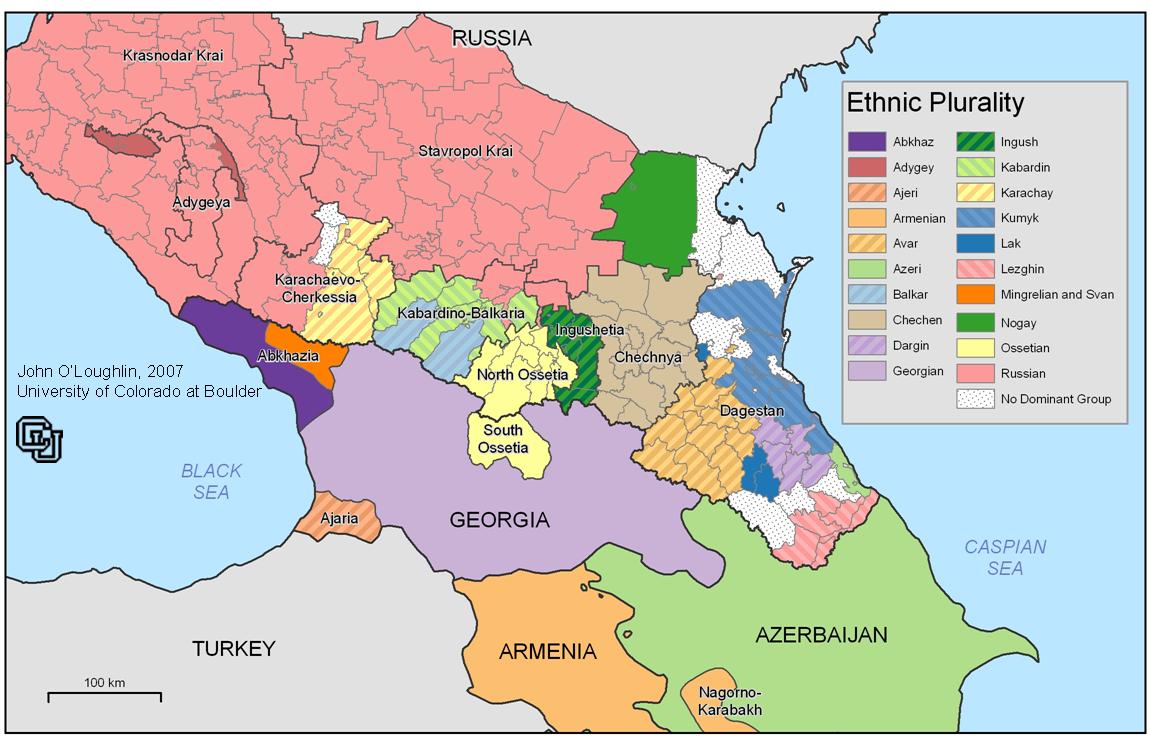
    Azerbaijan has become a key player in the Caspian region which emerged as a vital energy and transportation link between Central Asia and Europe. Due to Azerbaijan’s geostrategic location and energy resources, it attracts attention of policy makers and business circles. Yet, region’s security environment remains the subject of concerns for statesmen, experts and scholars. Despite difficulties Azerbaijan is developing and enhancing trad e and investment relations with Europe, Asia and North America.

    The conference will focus on the two dimension of Azerbaijan’s geopolitical and geoeconomic environment: security and energy with a view to highlight issues and formulate expert recommendations for strengthening peace and international strategic partnership in the region. Last year’s August war in Georgia and its impact on the South Caucasus security, Armenian-Azerbaijani negotiations, Turkish-Armenian rapprochement, the Nabucco energy project and other matters will be discussed at the conference.

    AGENDA

    9:30 10:00 Registration and Coffee

    10:00 10:20 Welcoming Remarks

    Dr. Dane Rowlands, Associate Director of the Norman Paterson School of

    International Affairs, Carleton University

    H.E. Farid Shafiyev, Ambassador of the Republic of Azerbaijan to Canada

    10:20 12:00 Panel 1: Security and Energy Environment in the South Caucasus

    Chair

    Dr. Joan DeBardeleben, Chancellor’s Professor and Director of the Institute of European, Russian and Eurasian Studies, Carleton University

    Speakers

    10:30 -10:50 Mr. Paul Goble, Director of Publications, the Azerbaijan Diplomatic Academy, “Evolving Security Environment in the South Caucasus”

    10:50 – 11:10 Dr. Robert Cutler, Research Associate, Institute of European, Russian and Eurasian Studies, Carleton University, “European-Caspian Energy Links”

    11:10 -11:30 Mr. Taleh Ziyadov, Assistant Dean of Academic Affairs, the Azerbaijan Diplomatic Academy, Energy and Transportation projects in South Caucasus”

    11:30 – 12:00 Questions & Answers

    12:00 – 13:00 Lunch

    13:00 14:30 Panel 2: Armenia-Azerbaijan conflict and Turkish-Armenian Rapprochement

    Chair

    Dr. Fen Hampson, Chancellor’s Professor and Director of the Norman Paterson School of International Affairs, Carleton University

    Speakers

    13:10 -13:30 Dr. Thomas Ambrosio, Associate Professor, Political Science Department,

    North Dakota State University, “Obama’s Foreign Policy toward Nagorno-Karabakh: Continuity or Change?”

    13:30-13:50 Mr. Tofig Musayev, Counsellor, Permanent Mission of Azerbaijan to the UN, “The International Legal Framework for the Settlement of the Conflict between Armenia and Azerbaijan”

    13:50 -14:10 Mr. Hashim Gafarov, PhD Candidate in Political Science at the School of Political Studies of the University of Ottawa, “The Implications of Recent Rapprochement between Turkey and Armenia for the South Caucasus”

    14:10 – 14:30 Questions & Answers

    14:30 14:35 Closing Remarks

    Dr. Fen Hampson, Chancellor’s Professor and Director of the Norman Paterson School of International Affairs, Carleton University

    For space reasons, please contact Mr. Tural Ganjaliyev if you intend to attend the conference at [email protected] or telephone 613-288 0497 ext. 248& nbsp;

    Please send an email with the subject line “Azerbaijan Conference.” In the message body include your full name and institutional affiliation.
  • Improbable Embrace – Turkey and Armenia

    Improbable Embrace – Turkey and Armenia

    Hubble-Bubble
    pic
    Melik Kaylan, 10.23.09, 12:01 AM ET

    Turkey and Armenia are about to restore diplomatic relations. At the very least, they signed a landmark agreement to do so on Oct. 10 in Switzerland–after some tense last-minute wrangling in a Zurich hotel room with Hillary Clinton mediating. An astonishing development. A marvel to see in one’s lifetime, not unlike the fall of the Soviet Union. Two ancient peoples in eternal enmity. Sounds utterly implausible. Ancient hatreds never go away.

    That, at any rate, is the narrative–an arguably fraudulent one–that we’ve been fed for several generations. In fact, depending on how you calculate it, Turks and Armenians lived peaceably together for almost 600 years–or almost 900 years–until the 20th century. The calculation depends on whether you date their time together from the Seljuks or the later Ottomans–and where you end the timeline. Either way, it was an epoch or two, possibly an unprecedented achievement. Then, according to the prevailing interpretation, the Turks turned suddenly on their cheek-by-jowl neighbors, unprovoked, and wished to obliterate them from the Earth entirely as a people. It’s possible. Strange things have happened in the annals of genocide, though not after that long a duration of mutual tolerance. If so, why then? What changed?
    Here you enter into difficult terrain. Because you can easily slip into an alternate viewpoint, one that goes something like this: Turks and Armenians lived in peace until Czarist Russia began to move southward down the Caucasus, purging Muslims downward into Turkish territory–throughout the 19th century. All those fiery Daghestanis, Chechens, Abkhaz, Kurds. Many ended up in Ottoman lands, some say half a million. At one point, Russia actually occupied a whole swath of Turkey, including the provincial capital of Kars, for several decades until World War I ended. The Russians did their conquering explicitly as a Christian Crusade, claiming the complicity of all Eastern Christians (including Armenians) in that part of Turkey, an area seething with displaced Caucasus Muslims and Muslim Kurds. In short, if you are curious about a proximate cause for catastrophic bloodshed, look no further than Russkie provocation–a plausible scenario considering their conduct right up to the present in Georgia–of stirring one ethnicity against another for imperial ends.
    Discretion being the better part of valor, let us leave the historical dispute delicately hanging there for professional historians to sort out. The present is complicated enough. What happens if Turkey and Armenia bury the hatchet? Azerbaijan gets upset, for sure, and Azeris are close kin to the Turks. Why does that matter to America and the West? The Armenians carved out a slice of Azerbaijan in a secessionist war with Russian help during the post-Soviet chaos in the Caucasus. Azeris want it back. Armenians wish to keep it. Azeris don’t want Turkey to make peace with Armenia. Azerbaijan is a critical source of non-Middle Eastern oil to the West via pipeline through Turkey. Azeri oil will help liberate Europe from Moscow’s oil. No wonder foreign minister Sergei Lavrov attended the signing ceremony in Switzerland: Russia would benefit from driving a wedge between Turkey and Azerbaijan. The Azeris are already threatening to re-route their oil through Russia. So why is Turkey ready to alienate Azerbaijan?
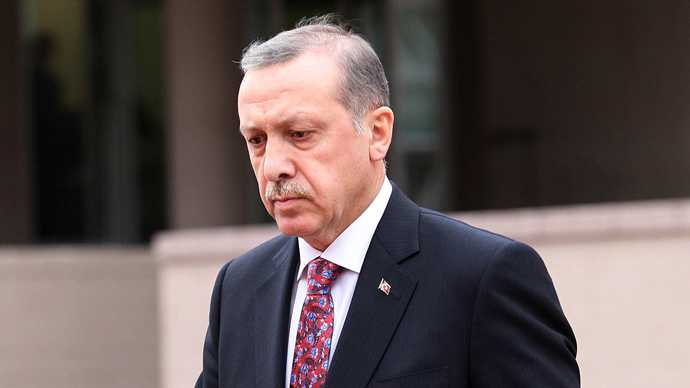
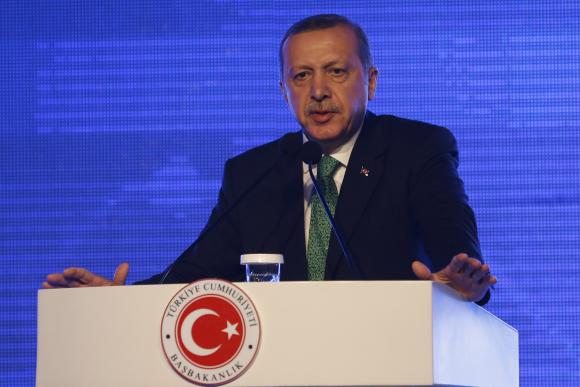
    As many have observed, Turkey is pushing a neo-Ottoman strategic vision under Prime Minister Erdogan and his busybody foreign minister Ahmet Davutoglu. Until their collapse in the 20th century, the Ottomans pursued a centuries-long game of diplomatic promiscuity with other world powers, allowing Venetians and Genoese trading rights early on, giving Sephardic Jews a new home after their expulsion from Spain, letting the British help them against the Czars and against Napoleon, inviting the Russians and Hapsburgs to compete over privileges in Ottoman lands.
    As the Ottomans declined militarily they used the country’s strategic position diplomatically to stay afloat. Under the more insular nationalist republic of Ataturk, Turkey allied exclusively with NATO and stayed out of regional engagement. Now Ankara is making friends with all its neighbors. Suddenly, the minefields along the Syrian border are being lifted and Syrians may enter Turkey with minimal red tape. Georgians have similar status. Baghdad and Ankara have just signed a slew of deals involving water, oil and trade. Greece and Turkey are friendlier than they’ve been in, say, 200 years with Greece actually backing Turkey’s candidacy to the E.U. Natural gas comes in from Russia while Turkish construction companies are doing more than anyone to build infrastructure across the Russian Federation. In short, a neo-Ottoman approach means that Ankara is allowing all the neighbor countries to gain so much benefit from Turkey’s evenhandedness that all are invested in keeping the country stable and prosperous.
    There are side benefits too. A Syria dependent on Turkey may become less dependent on Iran economically. Ankara’s deals with Baghdad show Iraq’s Kurds that hostility to Turkey will only leave them out of the loop economically. In the past, almost all neighboring capitals had a hand in aiding the Kurdish insurrection within Turkey–Moscow, Athens, Damascus, Baghdad and all the Iron Curtain belt nearby played that game. These days only the E.U. and the U.S. are pushing the issue of Kurdish rights. Prime Minister Erdogan calculates that as Turkey gains increasing leverage through befriending one and all indiscriminately while shifting an inch this way or that (such as publicly snubbing Israel), even the U.S. and E.U. will have to ease pressures or risk pushing Ankara further into the arms of rivals. The Erdogan government may calculate that Azerbaijan, too, will come around and realize that it will only lose from a rift with the Turks as the Azeris can, in reaction to the Armenia demarche, only befriend the Russian bear–and only for a while before it swallows them whole.
    Meantime, Ankara is going about eradicating the leverage of outside powers over Turkey over such matters as ethnic rights. The Kurds now have broadcasts in Kurdish. Armenia may finally have a partner other than Russia to trade with–that’s a lot of incentive. It’s a lot of incentive for the U.S. to climb on board too. Turkish-Armenian amity in the region will soon de-fang the various genocide bills so beloved of the Armenian diaspora.
    All this comes under the rubric of “neo-Ottoman” for another reason. The Ottomans held Islam’s Caliphate for five centuries, and it was under Islamic laws that they extended rights to religious minorities while ostensibly treating all Muslims as equals with no preference to ethnicity. Erdogan’s slide toward Islamist inclusiveness ironically stirs a beneficent echo in the hearts of Armenians in the region. They have flourished relatively unhindered in the Middle East under countries hostile to the West, such as Syria and Iran. They’ve had no problem living under anti-Western regimes such as the Soviet Union. Their historical sense of identity is anchored in ambivalence toward the West going way back to their doomed alliance with the Persians against Roman power. Throughout the Middle Ages they identified with Eastern Christianity against the Vatican. The Armenian patriarch showed no friendship toward proselytizing Protestant missionaries in the Ottoman era. In short, Armenians of the region feel no discomfort with Mid-eastern traditions or Islamization, and certainly not Erdogan’s apparently moderate version of it.
    One can only dream and hope for the day when Armenians, like Greeks do now, interact with Turkey in large numbers and perhaps even settle back into their interrupted history there. But that it happens under an Islamizing umbrella–and there’s the rub. For it’s not at all clear that once you drift in that direction, there can be any way back–that is, short of a Kemalist or, much worse, a Soviet-style enforced secularism. Erdogan’s strategy of giving all comers a stake in the stability of Turkey also anchors them in Turkey’s renewed Islamist pull. Israel is unlikely to benefit from this, except perhaps in the leverage it gives Turkey to negotiate for Israel with Islamic countries. The Europeans will soon lose all purchase on Turkey’s cultural and political center of gravity as the Turks learn that money from non-Western allies outdoes any expected benefits from the E.U.
    Erdogan’s policies are neo-Ottoman in this way too: in decline, Ottoman state policy, the Sultan or the Sublime Porte in Western parlance, was open to the influence of the highest bidder outside or inside the country. Everyone may benefit in the short term, especially the Turks with their new-found diplomatic clout. But in the long term, that kind of polity cannot be transparent. It can be enlightened in all sorts of ways except a fully Westernized one. Erdogan’s government is already swallowing up independent news media a la Putin. Backroom deals fill his party’s coffers and reward party loyalists at all levels of the economy. This kind of thing went on aplenty under the secularists too, but you can manifestly turn back from secularism, whereas Islamism looks like a one-way street and derives larger financial benefits from Saudi and Gulf investment. As money flows in–the IMF ranked Turkey as the world’s 17th-largest economy last year–the Turks can easily leave off struggling for their own freedoms.
    Republican Turkey has offered the single example, thus far, of a Muslim country living under Western democratic laws, however clunkily. But Islamic nostalgia is a powerful and insidious force. What people forget is that, from the 1400s onward, Turkey was as much based in Europe as in Asia. The Turks do not harbor a fundamentally eastern identity as many in the West mistakenly believe. The U.S. and E.U. can still keep the Turks in their camp. But first they must want to do so. And finally, they must start bidding higher.
    Melik Kaylan, a writer based in New York, writes a weekly column for Forbes. His story “Georgia In The Time of Misha” is featured in The Best American Travel Writing 2008.
    Read more Forbes Opinions here.

    __________________________________________________

  • Controversy and chaos but BBC is delighted by BNP leader’s ‘humiliation’

    Controversy and chaos but BBC is delighted by BNP leader’s ‘humiliation’

    The BBC said that it was delighted with the outcome of Question Time last night, insisting that the decision to change the format of the show to focus almost entirely upon Nick Griffin had humiliated the British National Party leader.

    But the reaction from viewers suggested that the gamble had not been a complete success, with many of the audience writing on internet messageboards that they felt the programme was one-sided and allowed Mr Griffin to claim that he had been victimised.

    Four out of the five questions the panel were asked directly related to the BNP, with the fifth focusing on Jan Moir, the Daily Mail columnist, who attracted more than 20,000 complaints for a piece about Stephen Gately, the deceased Boyzone singer.

    BBC sources said that the show had been skewed to ensure that the corporation would not be accused of giving Mr Griffin an easy ride.
    Writing on the BBC website, one viewer said: “A political debate programme or a chance to bully a man? Give him a chance to answer the questions put to him. I have never been so angry about a programme in my life.”

    Both the BBC and Ofcom, the broadcasting regulator, are expecting a barrage of complaints from viewers who were offended by Mr Griffin’s presence on the show.

    Peter Hain, the Welsh Secretary, who campaigned to block the broadcast, said after the show: “This decision could end up blighting the lives of many decent people just because they are not white. The BBC should be ashamed of single-handedly doing a racist, fascist party the biggest favour in its grubby history. Our black, Muslim and Jewish citizens will sleep much less easily now the BBC has legitimised the BNP by treating its racist poison as the views of another mainstream party when it is so uniquely evil and dangerous.”

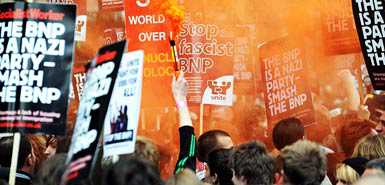
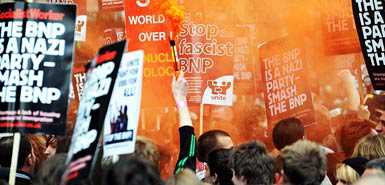
    Mr Griffin had to be smuggled in and out of the BBC via a back entrance last night after about 25 anti-fascist protesters broke into Television Centre, cheered on by hundreds more who were blocking the road outside.

    About 600 demonstrators expressed their disgust as the BNP leader was ushered towards BBC Studio Six surrounded by bodyguards for the recording of Question Time.

    His chaotic arrival at the entrance on Frithville Gardens was delayed because his car had to struggle through the crowd. “It seems the police do not have this mob under control,” Mr Griffin said.

    An initially peaceful demonstration soured late in the afternoon when police responded to a breach of security by physically restraining protesters. Wooden poles were torn from placards and hurled into the four-deep line of officers.

    Scotland Yard said that six arrests were made at the protest, two for violent disorder, one for a public order offence, one for actual bodily harm and one for assault on a police officer. The sixth was for a person wanted on a warrant. One of those held was Martin Smith, 43, a national officer with the Unite Against Fascism pressure group.

    As the demonstration became more heated, Heathcote Rughven, 19, a drama student, said that he had been struck on the head with a police baton. He said: “The police were being the more aggressive of the two parties. A few people got hit. I feel it was undeserved because we were just chanting and being peaceful and the police charged.”

    Between 25 and 30 protesters broke off from the main demonstration and charged the BBC’s main entrance gate as a vehicle was allowed through.

    Backed by chants of “BBC, shame on you” and “Nazi scum off the streets” the small gang, believed to be predominantly from Unite Against Fascism, slipped through security and ran on to BBC property.

    Rachel Parish, 20, a philosophy student, made it through the security barrier but was stopped in the car park. “The BBC should be ashamed. How can you give a platform to Nazis?” she asked. Dozens more demonstrators got as far as the stage door in the reception area. Paramedics treated three police and three protesters for minor injuries.
    The Times

  • BNP on Question Time: Nick Griffin uses BBC to attack Islam and defend the Ku Klux Klan

    BNP on Question Time: Nick Griffin uses BBC to attack Islam and defend the Ku Klux Klan

    The BBC was under siege last night after the leader of the BNP used his appearance on Question Time to attack Muslims and homosexuals while defending the Ku Klux Klan.

    By Robert Winnett and Rosa Prince

    Nick Griffin said Islam was not compatible with life in Britain, while describing homosexuals as “creepy”.

    However, he admitted sharing a platform with the Ku Klux Klan, which has carried out racist attacks across America’s Deep South, and defended leaders in the organisation as “non-violent”.

    The remarks provoked indignation from other members of the BBC panel and hostile parts of the audience, some of whom booed, calling him “a disgrace”.

    The BNP leader said he could not explain for legal reasons why he had previously sought to play down the Holocaust and had now changed his mind. He was challenged by Jack Straw, the Justice Secretary and a fellow panellist, who said there was no such law.

    Mr Griffin defended his use of Sir Winston Churchill on BNP literature on the basis that his father had fought in the Second World War. He claimed that Churchill would have been a member of the BNP and was “Islamophobic” by “today’s standard”.

    Asked whether he denied that millions of Jews and other minorities had been killed by the Nazis, Mr Griffin would only reply: “I do not have a conviction for Holocaust denial.”

    He was then chastised by David Dimbleby, the host of the programme, for smiling.

    The controversial statements were made in response to intense questioning by members of the audience from ethnic minorities.

    BBC Television Centre in west London came under siege as filming took place, with MPs joining hundreds of protesters behind lines of police. There were six arrests as dozens of protesters attempted to storm the studio.

    BBC studios in Hull, Scotland and Wales were also targeted by demonstrators. The cost of the police operation was estimated to have been more than £100,000.

    The BBC was certain to be questioned over why it allowed Mr Griffin to air such controversial views but executives were hoping that the intensive questioning that he faced would justify their decision to invite him on the Question Time panel for the first time.

    The BBC, which Mr Griffin denounced on the programme as “ultra-Leftist”, had claimed that impartiality rules meant that it had little choice but to invite him on to the programme after the BNP won seats in the European Parliament in elections this year.

    He was joined on the panel by Mr Straw, Baroness Warsi, the Tory spokesman on community cohesion, Chris Huhne, the Liberal Democrats’ home affairs spokesman, and Bonnie Greer, a black American playwright.

    Mr Griffin was seated next to Miss Greer.

    One of the most controversial moments came when Mr Dimbleby asked the BNP leader why he had been pictured with David Duke, the former leader of the Klan. Mr Griffin claimed that parts of the racist group, officially classed as a “hate organisation” in America, were “non-violent”.

    However, he insisted: “I’m not a Nazi and never have been.” He claimed that he was “the most loathed man in Britain” among British fascists.

    He was questioned over his views on Islam and said it had “good points” but “does not fit in with the fundamental values of British society”.

    He described white Britons as “aboriginals here”. “The indigenous people of these islands, the English, the Scots, the Irish, the Welsh, the people who have been here for the last 17,000 years, are the aboriginals. The majority of British people are descended from people who have been here since time immemorial.

    “You people wouldn’t allow us to have our name on the census form — that’s racism.”

    Amid angry scenes, one Asian member of the audience asked Mr Griffin where he would like him to be sent, and added: “You’d be surprised how many people would have a whip round to buy you and your supporters a ticket to go to the South Pole — that’s a colourless landscape, it’ll suit you fine.”

    Questioned over whether he believed that British people had suffered genocide at the hands of successive governments, Mr Griffin said: “That is the case. It’s about destroying a culture.”

    On the subject of homosexuality he said “a lot of people find the sight of two men kissing in public really creepy”. “That is how a lot of us feel, a lot of Christians, a lot of Muslims,” he said. “I don’t know why, that’s just the way it is.”

    Speaking after filming had finished, Mr Griffin claimed that he had been able to “land some punches” and acknowledged that his appearance would “polarise normal opinion” but expressed confidence that it would have an impact.

    “A huge swath of British people will remember some of the things I said and say to themselves they’ve never heard anyone on Question Time say that before,” he said. “Millions of people will think, ‘That man speaks what I feel.’ ”

    About one million people voted for the BNP at the European elections, leading to Mr Griffin taking up one of its two seats in the European Parliament. As a result, the BBC said impartiality rules effectively forced it to include the party in Question Time.

    Mark Thompson, the director-general, said the Government should ban the BNP if it felt that Mr Griffin should not have been allowed to take part in the broadcast.

    “If there is a case for censorship, it should be decided in Parliament,” he said. “Political censorship cannot be outsourced to the BBC or anyone else.”

    He said the BNP had “demonstrated a level of support that would normally lead to an occasional invitation to join the panel on Question Time”.

    Politicians from minor parties, including George Galloway, the Respect MP, and Caroline Lucas, the leader of the Green party, regularly appeared on Question Time.

    Mr Thompson insisted that Mr Griffin had been invited so that the public could challenge his views, rather than any “misguided desire to be controversial”.

    Speaking before the programme, Gordon Brown said the BNP’s appearance was a matter for the BBC and that he was confident that Mr Griffin would be exposed for his “unacceptable” views.

    “I hope that the exposure of the BNP will make people see what they are really like,” the Prime Minister said.

    However, there were fears that Mr Griffin’s appearance would lead to an increase in support. He had said he was hopeful his party would be propelled into “the big time” as a result of the broadcast.

    The Telegraph

  • Menendez, Ensign Introduce Genocide Resolution in Senate

    Menendez, Ensign Introduce Genocide Resolution in Senate


    Oct 21st, 2009 @ 11:52 am › Asbarez Staff
    ↓ Skip to comments
    Senators Menendez (left) and Ensign (right)

    WASHINGTON—The Armenian National Committee of America welcomed the introduction Wednesday of the Armenian Genocide Resolution in the U.S. Senate by Robert Menendez (D-NJ) and John Ensign (R-NV).

    The measure is similar to legislation in the U.S. House, H.Res.252, introduced earlier this year by Representatives Adam Schiff (D-CA), George Radanovich (R-CA), and Congressional Armenian Caucus Co- Chairs Frank Pallone (D-NJ) and Mark Kirk (R-IL).  This measure already has more than 130 cosponsors.

    In introducing the measure, Sen. Menendez noted, “Only when history’s darkest hours are acknowledged and understood can we truly learn from them and build a peaceful future upon those lessons.  One and a half million Armenians experienced Hell on Earth, and to sweep their plight under the rug is to insult their memories and their descendants. It is long past time that our nation help set the historical record straight and provide a foundation of understanding that helps prevent future atrocities.”

    Senator Ensign explained, “It’s inconceivable that after so many years the international community has yet to affirm that the deportation, expropriation, abduction, torture, massacre and starvation of the Armenian people was genocide.  By joining together and affirming that genocide was committed on the Armenian people, we send a strong message to the international community that we will not turn a blind eye to the crimes of the past simply because they are in the past.”

    “On behalf of all Armenian Americans, we thank Senators Menendez and Ensign for their tireless leadership in moving America toward a full and proper commemoration and condemnation of the Armenian Genocide,” said ANCA Executive Director Aram Hamparian. “This legislation, in seeking to end U.S. silence in the face of Turkey’s
    denial of this crime, not only honors the past, but also, very powerfully, helps make Armenia and all the world safer from future genocides.”

    Earlier this month, Senator Menendez spoke out about the importance of international affirmation of the Armenian Genocide, and condemned provisions in the Turkey-Armenia protocols, which would create a historical commission as “frankly absurd” and an “insult to the Armenian people.”  He went on to note, “It is time that Turkey recognizes it [the Armenian Genocide] and accepts it. It is time that the world acknowledges this fact of history and moves on towards a viable peace that honors the true history of the Armenian people.”  His complete remarks, delivered at an event supporting the efforts of the ANCA Eastern Region can be viewed at:

    The resolution introduced today calls upon the President to ensure that the foreign policy of the United States reflects appropriate understanding and sensitivity concerning issues related to human rights, ethnic cleansing, and genocide documented in the United States record relating to the Armenian Genocide.”  The resolution includes extensive findings from past U.S. hearings, resolutions and Presidential statements on the Armenian Genocide from 1916 through the present, as well as references to statements by international bodies and organizations.

  • Genocide conference in NYC

    Genocide conference in NYC


    As Genocide Continues to Shape World History, Landmark Conference will Seek Answers and Understanding

    International Group of Scholars Gather to Focus Lens on Genocide through examination of Raphael Lemkin, Advocate and Initiator of United Nations Genocide Convention in 1948
    Wed Oct 21, 2009 8:30am EDT

    NEW YORK, Oct. 21 /PRNewswire/ — Current news headlines are a sad reminder
    that genocide has been, and continues to be, a stain on human existence in all
    corners of the world, from Rwanda to Armenia, to Darfur and beyond. Those
    headlines also underscore the urgency of addressing every instance of the
    crime, particularly in light of a statement made by Adolf Hitler before
    invading Poland in 1939: “… I put ready my Death’s Head units, with orders
    to send to death, mercilessly and without compassion, all men, women, and
    children of the Polish race or language. … Who, after all, still talks
    nowadays of the extermination of the Armenians?”

    Inscribed on the wall of the Holocaust Museum in Washington, D.C., that quote
    illustrates that Hitler was emboldened by the lack of international response
    to Turkey’s killing of more than a million ethnic Armenians during World War
    I. By contrast, however, that episode in human history was also the spark that
    led to the tireless efforts of one man to define the crime of genocide under
    international law and enable perpetrators, such as a recently arrested suspect
    in the Rwandan genocide, to be charged and brought to justice. That man was
    Raphael Lemkin, whose life-long devotion to the cause not only coined and
    defined the word “genocide,” but led to the 1948 United Nations Convention on
    the Prevention and Punishment of the Crime of Genocide.

    The invaluable contributions of Lemkin will be the focus of an international
    public conference, “Genocide and Human Experience: Raphael Lemkin’s Thought
    and Vision,” to be held Sunday, November 15, from 9:00 a.m.-6:30 p.m., at the
    Center for Jewish History, 15 West 16th Street in New York City. Bringing
    together for the first time an international group of historians, political
    scientists, anthropologists, philosophers, philanthropists, and legal
    authorities to explore the tremendous legacy and impact of Lemkin’s work, the
    landmark conference will also delve into perpetually relevant questions of
    human rights and the nature of human behavior.

    “Raphael Lemkin died in 1959, and while few people today may recognize his
    name, most feel the impact of his work,” said Michael Glickman, Center for
    Jewish History COO. “As a young Jewish lawyer in Warsaw almost 90 years ago,
    Lemkin could not understand why it was a crime for an Armenian youth to murder
    the Turkish official responsible for the attempted destruction of the Armenian
    community in the Ottoman Empire, but not a crime for the government to murder
    more than a million Armenians. That question inspired Lemkin to devote the
    rest of his life to fight against such horrors and to wage a campaign of
    international advocacy that led to the United Nations Genocide Convention.”

    A wealth of Lemkin’s correspondence, along with papers documenting Lemkin’s
    work as an activist, are housed in the archives of the American Jewish
    Historical Society at the Center for Jewish History. The documents include
    correspondences with public figures such as Eleanor Roosevelt, General Dwight
    D. Eisenhower, and Pearl S. Buck; Lemkin’s unfinished manuscript History of
    Genocide; and archival footage of interviews from the 1950s. The Lemkin
    archives will also be the subject of a special exhibition at the Center for
    Jewish History in partnership with Yeshiva University Museum scheduled to run
    from November 16, 2009, to March 19, 2010.

    Even though the crime of genocide is often understood as mass murder alone,
    Lemkin viewed genocide as a nuanced concept, which shapes and is determined by
    the spheres of economics, law, society, and culture. Through Lemkin’s archival
    writings, the conference will focus on these gradations of genocide, as Lemkin
    understood them.

    Opening the conference will be an historical overview and brief biographical
    account of Lemkin’s life, legal and other accomplishments, and perspectives on
    the human condition, setting the context for the panel discussions to follow.
    Topics to be explored by three different panels fall under the broad subjects
    of Lemkin’s perspective on cultural genocide, the complex economic and social
    issues surrounding genocide, and the challenging relationship between
    international law and genocide.

    Among the distinguished list of presenters are Vartan Gregorian, President,
    Carnegie Corporation of New York;  Peter Balakian, Colgate College; Donna-Lee
    Frieze, Deakin University, Melbourne, Australia; Alexander Laban Hinton,
    Rutgers University; Jim Fussell, PreventGenocide.org; Tanya Elder, American
    Jewish Historical Society; Berel Lang, Wesleyan University; Benjamin
    Valentino, Dartmouth College; Lawrence Woocher, US Institute of Peace; Hilary
    Earl, Nipissing University, North Bay, Ontario; Benedict F. Kiernan, Yale
    University; Muhamed Mesic, Bosnia; William A. Schabas, National University of
    Ireland; and Steven Leonard Jacobs, University of Alabama.

    “It is the hope of the Center and the conference sponsors that this historic
    gathering will not only provide some clearer understandings of both the
    extraordinary courage and dynamic intellect of one individual, but will also
    clarify the challenges that lie ahead in confronting the evil of genocide in
    the modern world,” continued Mr. Glickman. “It is said that those who do not
    learn from history are doomed to repeat it. ‘Genocide and Human Experience:
    Raphael Lemkin’s Thought and Vision’ represents one small step to teach the
    lessons humankind so desperately needs, as history continues to repeat itself
    in the 21st century.”

    The conference is open to the general public. For more information, visit
    www.cjh.org/lemkin; or to register, log on to www.smarttix.com or call
    212-868-4444.

    SOURCE  Center for Jewish History

    Cathy Callegari, +1-212-579-1370, [email protected]

    URL: