Month: May 2009

  • The Ottoman Revival

    The Ottoman Revival

    Foreign Policy dergisinin son sayisinda Turkiye ve Osmanli gecmisi uzerine enteresan bir makale yayinlandi. Ingilizce versiyonu asagiya kopyaliyorum umarim keyifle okursunuz.
    En iyi dileklerimle, Akin Aytekin [[email protected]]

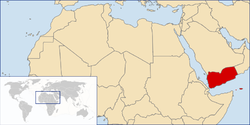
    One clear day in February, when Ali Babacan visited Yemen, his hosts brought him to a centuries-old, mud-brick building outside Sanaa, the Yemeni capital. There, about a dozen tribal leaders were waiting for the Turkish foreign minister with curved daggers drawn. If Babacan was at first startled, he soon realized that he was being greeted in a way once reserved for newly arrived Ottoman governors-complete with drums and a traditional dance that had probably not been performed for a Turkish official in almost a century.

    Not so long ago, top Turkish officials didn’t bother to visit Yemen, or for that matter most other countries in the Middle East. In the nearly 90 years since the founding of the modern Turkish Republic, its leaders have tended to equate the East with backwardness, and the West with modernity-and so focused their gaze primarily on Europe. Meanwhile, Arab countries, once ruled by sultans from Istanbul, looked upon Turkey with a mixture of suspicion and defensive resentment.

    Today that’s changing. Not only is Turkey sending emissaries throughout the region, but a new vogue for all things Turkish has emerged in neighboring countries. The Turkish soap opera Noor, picked up by the Saudi-owned MBC satellite network and dubbed in Arabic, became a runaway hit, reaching some 85 million viewers across the Middle East. Many of the growing number of tourists from Arab countries visiting Istanbul are making pilgrimages to locations featured in the show. In February, Asharq Alawsat, a pan-Arab newspaper based in London, took note of changing attitudes in a widely circulated column, “The Return of the Ottoman Empire?”

    This new mood started at home. Since it first came to power seven years ago, Turkey’s government, led by the liberal-Islamic Justice and Development Party, has taken a different approach to its role in the region. The mastermind of this turnaround-“neo-Ottomanism,” as some in Turkey and the Middle East are calling it-has been Ahmet Davutoglu, the Turkish prime minister’s chief foreign-policy advisor. In his 2001 book, Strategic Depth, he argued that in running away from its historical ties in the region, Turkey was also running away from political and economic opportunity. His strategy has paid off, literally, for Turkey. Trade with the country’s eight nearest neighbors-including Syria, Iran, and Iraq-nearly doubled between 2005 and 2008, going from $7.3 billion to $14.3 billion. And, from being on the verge of war with Syria a decade ago, Ankara is now among Damascus’s closest allies in the region.

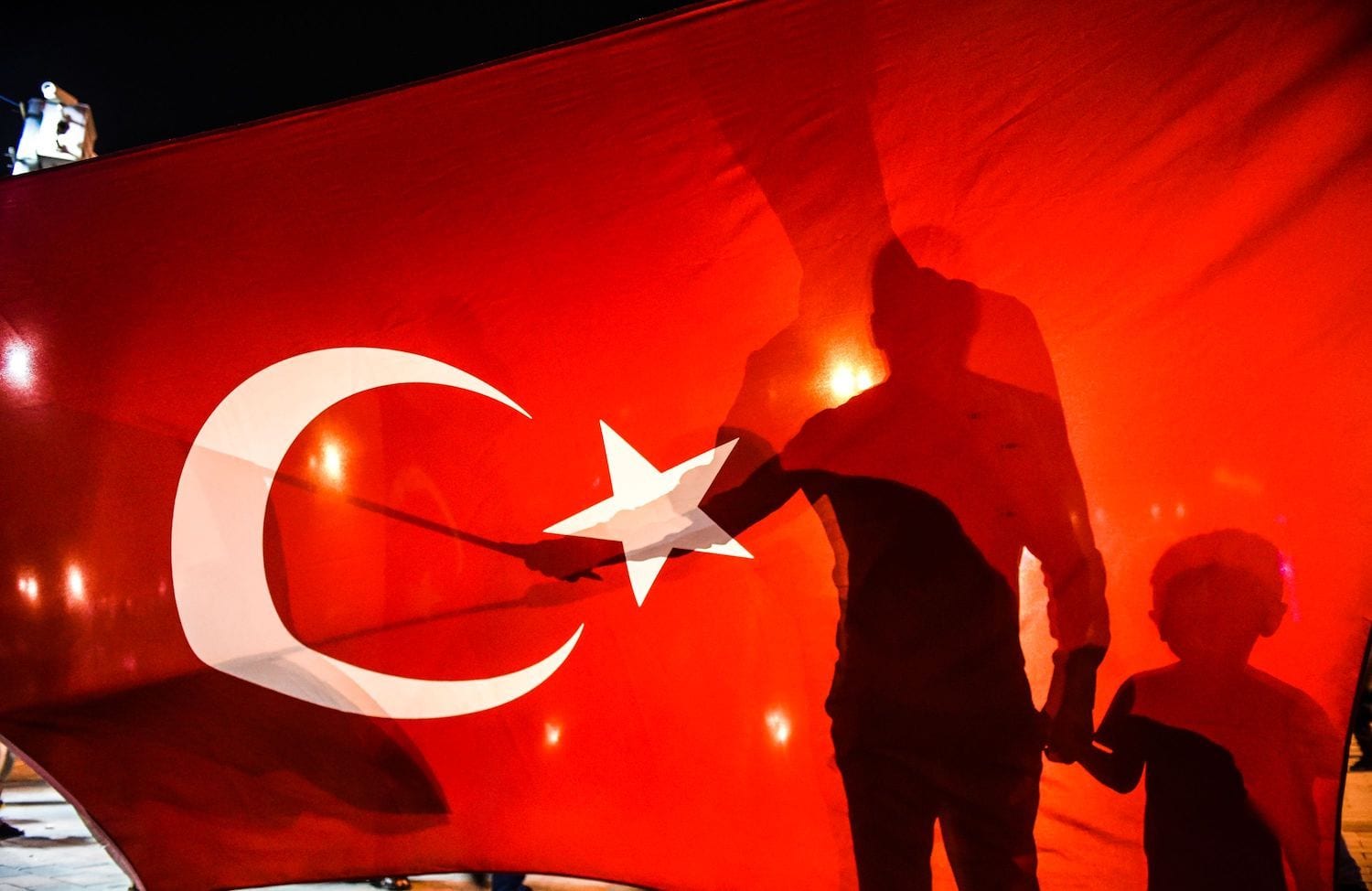
    The Ottoman past is also in the air in Turkey. At a recent government rally, one enthusiastic supporter unfurled a banner proclaiming the prime minister “the last sultan.” Moviegoers have been flocking to see a new spate of Ottoman-themed films, from The Last Ottoman, an action flick set during World War I, to Ottoman Republic, a comedy imagining daily life in modern Turkey if the sultans were still in charge.

    Istanbul’s newest cultural attraction is the municipal-run Panorama 1453 History Museum, a granite-clad building just outside the city’s ancient walls that tells the story of the Ottomans’ conquest of Byzantine Constantinople. In the gift shop, visitors can buy everything from cuff links emblazoned with the sultans’ seal to a 1,000-piece puzzle showing Mehmet the Conqueror entering Constantinople on horseback.

    On a recent visit, I met a group of head-scarved women who were taking in the sights and sounds of the museum’s main exhibit: a circular diorama depicting Mehmet the Conqueror’s victorious final assault on Constantinople’s walls. “This is beautiful, most beautiful,” said one 28-year-old schoolteacher with a big smile, as the sound of thunderous cannon fire played in the background. “We must know our history.”

    Nationalism is nothing new in Turkey. Yet for much of the last century, it has meant rejecting the country’s Ottoman history. Today it means claiming it.

  • Ex-Turkish army chief says “e-coup” justified

    Ex-Turkish army chief says “e-coup” justified

    Fri May 8, 2009

    By Ibon Villelabeitia

    ANKARA (Reuters) – Turkey’s former army chief has defended a 2007 website intervention on presidential elections, branded an ‘e-coup’ by critics, as a justified defense of secularism against Islamist incursions.

    The comments marked a rare public explanation by a senior military figure of General Staff action in the political realm.

    The EU expects Turkey to reduce the influence of its military as part of terms for membership. While reforms by the Islamist-rooted government have cut their formal powers, the ‘e-coup’ affair confirmed the generals still saw themselves as ultimate guarantors of secularism, using all channels available.

    It also drew an unprecedented public rebuke for the military from the government.

    “I myself wrote this,” General Yasar Buyukanit, who retired in 2008, said late on Thursday in his first public comments on the subject. “It was Friday evening and I personally wrote it. The April 27 (2007) declaration puts emphasis on the Turkish armed forces’ sensitivity toward secularism.”

    Turkey’s military was criticized by the government, rights groups and the European Union for the statement posted hours after an inconclusive parliamentary vote on electing ex-Islamist Abdullah Gul as president. The wording suggested the army would not stand on the sidelines if it saw secularism threatened.

    The military has frequently intervened in Turkish politics in the past, sometimes by discreet communications to leaders, sometimes by public declarations and, on two occasions since 1960, by outright armed coups. The ‘e-coup’ acquired distinction as the first time the General Staff had used the internet.

    Turkey, predominantly Muslim, has a secular constitution. The military regards itself as the guardian of Turkey’s secular principles based on founder Mustafa Kemal Ataturk.

    Buyukanit’s 2007 statement said the military had been watching the election situation with concern and reminded politicians the military was the ultimate guardian of secularism.

    Tensions between the ruling AK Party, which has roots in political Islam and was first elected to power in 2002, and the secularist establishment, including army generals, judges and academics, has heightened political tensions in Turkey.

    The secularist elite had campaigned hard against the appointment of Gul as president. They said his appointment would undermine the strict separation of state and religion and would allow the AK Party too strong a grip on power.

    Gul, who denies harboring any Islamist designs for Turkey, was finally elected president on August 28, 2007 after several attempts and court challenges.

    The row moved the government to call an early parliamentary election in July 2007, which produced an overwhelming victory for the AK Party.

    COURT RULING VINDICATION

    Buyukanit told broadcaster Kanal D in a rare interview that a ruling by Turkey’s top court in 2008 to fine the AK Party for anti-secular activities had vindicated the armed forces’ position.
    “The Constitutional Court’s decision justified us. We thought that what we did was the right thing,” he said.

    Hardline secularists accuse the AK Party of harboring a hidden Islamist agenda by seeking to ease restrictions on religion in public life, such as its failed attempt to ease a ban on Muslim headscarves at universities.

    The AK Party, Turkey’s most popular party with a strong following in the Anatolian conservative heartland, denies this.

    The military has since toned down its public criticism of the AK Party. But tensions remain due to a controversial investigation into a shadowy, right-wing group accused of plotting to overthrow the AK Party government.

    Retired generals and active military officers have been charged for alleged links to the alleged organization. The military has denied any links. (Editing by Paul de Bendern and Ralph Boulton)

  • SOUTHERN CORRIDOR – EU signs deal on new gas pipeline

    SOUTHERN CORRIDOR – EU signs deal on new gas pipeline

    It is hoped that the piepline will start pumping gas to Europe by 2014 [EPA]

    The European Union has just signed an agreement with Turkey, Azerbaijan, Georgia, and Egypt in a bid to press ahead with a gas pipeline that would reduce its reliance on Russian energy. That shows the determination on the part of EU to end Europe’s energy dependence on Russia.

    Mirek Topolanek, the Czech prime minister, said the aim to open up a “southern corridor” for supplies was “not just a one-way street for pipelines…We envisage this as a new silk road where we’ll see the flow of information, goods, people and energy in both ways.” () (Aljazeera, MAY 08, 2009)

    “Two suppliers — Azerbaijan and Egypt — and two key transit states — Turkey and Georgia — agreed to give “the necessary political support,” and, where possible, “technical and financial assistance” to the construction of planned pipelines and transport routes needed to bring gas from the Caspian Basin region and the Middle East to the European market.”
    (RADIO FREE EUROPE, Antoine Blua, May 08, 2009)

    Here is the text of this important declaration ushering in a new age of energy diplomacy:

    ***

    DECLARATION: SOUTHERN CORRIDOR
    Prague Summit, May 8, 2009

    We, the Participants of the Southern Corridor Summit held in Prague on the 8th of May 2009;

    express our political support to the realization of the Southern Corridor as an important and mutually beneficial initiative, which will lead to the promotion of common prosperity, stability and security of all countries involved;

    understand the Southern Corridor as an area of mutual interest providing opportunities for cooperation of the various entities in our public and private sectors. The trigger but not the sole focus of this process of strengthening relations among the Southern Corridor countries will be enhancing our mutually beneficial energy cooperation, which has the potential to serve as a cornerstone for the overall cooperation among countries involved;

    acknowledge that infrastructure projects which interconnect the countries along the Southern Corridor will act as a catalyst for further co-operation in other areas. The successful cooperation in the field of energy will encourage investments also in transport area. The development of transport infrastructure, including for energy, will lead to an intensification of people-to-people contact, which is the fundamental prerequisite to further social, economic and political cooperation in the whole region;

    intend to overcome the main remaining commercial and non-commercial obstacles by coordinating on common progressive strategy, individual commitments of the countries concerned, namely energy producer, transit and consumer countries, and clear scheduling for the completion and functioning of concrete energy and transport projects to be realized and operated within the Southern Corridor, including the Trans-Caspian energy transportation projects;

    consider the Southern Corridor concept as a modern Silk Road interconnecting countries and people from different regions and establishing the adequate framework, necessary for encouraging trade, multidirectional exchange of know-how, technologies and experience.

    We consider

    The Southern Corridor concept as a synergy of the following documents:

    – the Partnership and Co-operation Agreements between the EU and Azerbaijan, the EU and Georgia, the EU and Kazakhstan, and the EU and Uzbekistan;
    – the Association Agreement between the EU and Turkey and the EU and Egypt;
    – the European Neighbourhood Policy, including the Action Plans, the Eastern Partnership, EU-Central Asia Strategy and the Black Sea Synergy;
    – the Memoranda of Understanding on strategic energy partnership between the EU and Egypt , EU and Kazakhstan, EU and Turkmenistan and EU and Azerbaijan;
    – the Declaration of the Budapest Nabucco Summit of 27 January 2009;
    – the Declaration of the Sofia Energy Summit of 24-25th April 2009;
    – The Baku Initiative and the Energy Road Map endorsed on the occasion of the Astana Ministerial Conference of 30 November 2006;
    – The Baku Energy Summit Declaration of 14th November 2008;
    – The Ministerial Statement on the Nabucco gas pipeline project of 26th June 2006;
    – Agreements on transportation of oil and gas through the Baku-Tbilisi-Ceyhan and Baku-Tbilisi-Erzurum oil and gas pipelines of 1999 and 2001 respectively;

    – Agreement among the Republic of Turkey, the Hellenic Republic and Italian Republic concerning the development of the Turkey, Greece, Italy Transportation Corridor of 26 July 2007 in Rome;
    – the European Council Conclusions of 8-9 March 2007, 16 October 2008 and 20th March 2009;
    – the European Commission’s Second Strategic Energy Review of 13 November 2008;

    – Decision No 1364/2006/EC of the European Parliament and of the Council concerning trans-European energy networks (TEN-E);

    – Commission Decision granting financial aid for an action of 2.12.2008 in the field of the trans-European energy networks (TEN-E);
    – the EU-financed INOGATE technical feasibility studies on the Trans-Caspian-Black Sea Gas Corridor as well as the feasibility study on the Caspian Development Corporation (CDC);
    – the European Commission’s Communication on the extension of the major trans-European transport axes to the neighbouring countries, of 31 January 2007;
    – the transport cooperation and initiatives involving the EU and the countries of the Southern Corridor ;
    – And bearing in mind international treaties and obligations, including those arising from the Energy Charter Treaty, the Energy Community Treaty as well as the existing bilateral and multilateral agreements fostering the development of projects of the Southern Corridor;

    We declare

    That the concept for the Southern Corridor is complementary to other existing energy and transport partnerships and projects of the EU and is open for the participation and contribution of third countries on a case-by-case basis in concrete projects, upon agreement of all the Parties to this declaration directly involved.

    That one of the basic prerequisites for developing the Southern Corridor is cooperation to establish interconnections starting with direct energy and transport links among the countries concerned as appropriate. We therefore agree to promote a common initiative to develop the conditions necessary for more effective transportation networks, including of energy resources, goods and people as well as an improved exchange of know-how and technologies within the Corridor with the participation of all the interested countries, international political conditions permitting. This should make the maximum use of the existing regional initiatives on energy and transport.

    On the basis of declared principles in the field of energy we,

    agree to give necessary political support and, where possible, technical and financial assistance to the construction of the Southern Corridor, including the Trans-Caspian energy transportation projects, in order to support the diversification of energy sources, markets and transport routes, which will not only enhance the energy security of the participating countries , but also will simultaneously constitute fair and profitable opportunities for energy producers, consumers and transit countries, while recognizing the need for this to be feasible, economically competitive, technically and environmentally sustainable and timely.

    welcome transparency, competitiveness, long term predictability and stable regulatory conditions to underpin the realization of concrete infrastructure projects in the framework of the Southern Corridor. This should include

    * firstly, the means to provide producers with reliable commitments of the consumers on their aggregate demand and the identification of non- committed natural gas and oil volumes by producer countries that can be dedicated specifically to the EU as well as the Corridor countries markets with a precise timetable for their availability on the basis of their commercial profitability;

    * secondly, the establishment of necessary and appropriate transit and environmental arrangements in line with the Parties’ international commitments;

    * thirdly, the need for companies to ensure direct, industry-standard commercial agreements between producers and consumers.

    envisage a mechanism for aggregating sufficient volumes to be transported through the Southern Corridor, and, take note of the feasibility study on the Caspian Development Corporation initiative that should lead to concrete proposals in this respect. In this context, eventually consider devoting, as appropriate, public and private financial resources necessary for the realization of the Southern Corridor, including encouraging the market-based participation of public and private companies.

    attain the energy security of all parties including consumer and transit states, such as Turkey, Georgia and Azerbaijan, on the basis of commercial agreements that are in line with the Parties’ international commitments.

    welcome that the countries concerned will endeavor to:

    – implement a clear, transparent, cost-based, stable and non-discriminatory transportation regime for natural gas or oil across the territories of the Corridor countries to end consumer markets, in line with the Parties’ international commitments.

    – establish direct connections between both sides of the Caspian Sea as one of the main important elements of the effective energy cooperation and favour the interconnection of the Southern Corridor with the EU through strategic infrastructure projects necessary for carrying natural gas by pipelines or ships. In the gas sector, interconnection will be established among others through the Nabucco project and the ITGI project both of which are financially supported in the EU Recovery Plan endorsed by the European Council of March 2009 as well as other projects within the Corridor. In the oil sector, an extension of the already operating transportation system between Kazakhstan and Azerbaijan could be developed in the Mediterranean and the Black Sea regions, taking into account the constrains of the Turkish straits.

    – promote the activities of public and private companies that are involved or willing to participate in the realization of the Trans-Caspian energy link.

    – achieve maximum energy efficiency and use of renewable energies as an important element for successful cooperation in the field of energy.

    Therefore, we express our readiness to share technologies, knowledge and know-how in order to reach efficient fuel use and further development of alternative energy sources to allow long-term and sustainable growth for all Corridor countries;

    – share technologies, knowledge and know-how for the development of energy resources, their transportation and technical upgrading within the Corridor.

    In the field of transport we endeavour,

    To support the promotion of regional and cooperative approaches to transport challenges in the Southern Corridor, which includes appropriate projects in the Mashreq, in particular Egypt and Iraq.

    To intensify cooperation in view of promoting the implementation of relevant infrastructure projects and of policy measures to facilitate exchanges, to support efforts to make transport projects within the Southern Corridor an effective and responsive instrument of cooperation and enhancing public-private partnerships and other ways of attracting investments.
    To implement the extension of transport trans European Networks to Turkey and South Caucasus and beyond to Central Asia along the Southern corridor, including connections to the Middle East.

    To encourage, with respect to high importance of railway transport in economies of Corridor countries, all parties involved to further develop the strategic railway networks and their interoperability. In this regard we support the railway and maritime corridor connecting the Caspian Sea Region with the EU, as well as a roll-on roll-off ferry connections between the EU and the relevant countries of the Southern Corridor, including Georgia.

    To share technologies, knowledge and know-how for technical upgrading of transport facilities within the Corridor in order to increase the transport efficiency.
    To harmonize technical norms and standards, ensure transparent and competitive tariffs, and to simplify custom procedures and border crossing in order to ensure fluent movement of all kinds of goods as a basic condition for deepening of trade among the involved countries.

    In the field of overall cooperation we agree,

    That strengthening of mutual relations must go hand in hand with following principles: transparency, non-discrimination , market economy and commercial profitability.
    To favour stable regulatory framework ensuring clear and predictable investment environment, which contributes to mutual trust necessary for successful realization of all strategic projects within the Southern Corridor.

    With respect to implementation and follow-up, we agree to strongly support the following steps:

    On energy:

    * The European Commission, together with the Council of the EU and the signatory partner countries, will monitor the implementation of this declaration and, in particular, work on developing an Action Plan seeking the implementation of the necessary conditions and the
    appropriate supporting measures for the Southern Corridor.

    * For the EU Member States concerned and Turkey to finish the negotiations of the intergovernmental agreement on Nabucco as quickly as possible, to sign it by the end of June 2009 in Turkey, and to continue to support the necessary steps for its implementation inter alia by identifying gas volumes available for marketing in the EU and Turkey.

    * For the EU Member States concerned and the relevant countries to progress further on the timely realisation of the ITGI project.

    * For the EU and the concerned countries to conclude the feasibility study on the Caspian Development Corporation initiative by the end of 2009 in view of the possible identification of relevant actions for the implementation.

    * For the EU and Iraq to sign an MoU on Energy as soon as possible, and for the EU and Egypt to cooperate and agree on specific projects in developing Egypt’s gas reserves and export potential for the EU, including via the Southern Corridor and encouraging energy investment, transfer of know-how for this purpose.

    On transport

    * To cooperate on the objective of promoting the extension of the trans-European transport networks to the countries of the Southern Corridor;

    * To work on developing an action plan on possible additional appropriate measures, including safety and security, to facilitate transport and transit flows along the Southern Corridor;

    * To work on a list of priority projects and policy measures for the development of the Southern corridor, and attract funds to implement them.

    Done and signed in Prague on 8th May 2009 in the presence of the representatives of Kazakhstan, Turkmenistan and Uzbekistan.

    For the EU,
    H.E. Mirek Topolánek, President of the European Council

    H.E. Jose Manuel Barroso, President of the European Commission

    For the Republic of Azerbaijan,

    H.E. Ilham Aliyev, President of the Republic of Azerbaijan

    For the Republic of Georgia,
    H.E. Mikheil Saakashvili, President of Georgia

    For the Republic of Turkey,

    H.E. Abdullah Gül, President of Turkey

    For the Arab Republic of Egypt,
    H.E. Sameh Fahmy, Minister of Petroleum of the Arab Republic of Egypt

    ***

    00000000000000000


    The European Union has signed an agreement with four countries in a bid to press ahead with a gas pipeline that would reduce its reliance on Russian energy.

    Azerbaijan and Egypt, which can both supply gas, and Turkey and Georgia, which are able to carry it, signed up to the Nabucco gas pipeline scheme on Friday at a meeting in Prague, capital of the Czech Republic.

    In return for their commitment to supply gas to Europe, the EU offered to provide more trade and stronger transport links to the gas producers and transit countries involved.

    Three key nations – Kazakhstan, Turkmenistan and Uzbekistan – refused to sign the text, diplomatic sources told the AFP news agency.

    ‘New silk road’

    Mirek Topolanek, the Czech prime minister, said the aim to open up a “southern corridor” for supplies was “not just a one-way street for pipelines.”

    He said: “We envisage this as a new silk road where we’ll see the flow of information, goods, people and energy in both ways.”

    Representatives from the United States, Russia and Ukraine also attended the summit as observers to the agreement.

    Dosya:Nabucco Gas Pipeline-tr.svg

    Iraq, which was also invited to the meeting, did not send any officials.

    The summit was called to help kick-start the Nabucco pipeline, which would link the EU to gas rich nations on and beyond the Caspian Sea, bypassing Russia and Ukraine.

    The pipeline, which once completed would stretch 3,300km from Turkey to Austria, could transport up to 31bn cubic metres of gas each year to western Europe.

    It is hoped that it will start pumping gas to Europe by 2014.

    The EU is keen to speed up the construction of the pipeline after a dispute between Russia and Ukraine in January over gas prices left large areas of Europe without  supplies of the resource for two weeks.

  • Turkish-Syrian Security Cooperation Testing Turkish Foreign Policy

    Turkish-Syrian Security Cooperation Testing Turkish Foreign Policy

    Turkish-Syrian Security Cooperation Testing Turkish Foreign Policy

    Publication: Eurasia Daily Monitor Volume: 6 Issue: 84
    May 1, 2009
    By: Saban Kardas

    On April 27, Turkey and Syria launched their first joint military exercise on their border. The three-day long land exercises between border forces involved an exchange of units to enhance joint training and interoperability, and are expected to be followed by similar exercises in the future. On the same day, during the 9th International Defense Industry Fair in Istanbul, both countries signed a bilateral security cooperation agreement to deepen collaboration between their defense industries (www.tsk.tr, April 26, Hurriyet, April 28). These developments once again strained Turkish-Israeli ties, re-opening the debate on Turkey’s commitment to its Western orientation.

    Israeli Defense Minister Ehud Barak, called the exercises disturbing, though noting that Turkish-Israeli strategic relations will survive this challenge (www.ynetnews.com, April 27). Israel’s Ambassador to Turkey, Gabby Levy, told reporters that Tel Aviv was following the drill closely to understand its goal and content (Cihan Haber Ajansi, April 28). DEBKAfile reported that, to protest against this development Israel was preparing to “slash its military exchanges with Turkey to prevent the leakage of military secrets to an avowed Arab enemy” and it would “discontinue sales of its … drones and sharply reduce its military ties with Turkey” (DEBKAfile, April 27).

    Moreover, an Israeli strategic analyst Efraim Inbar, referring to unnamed Turkish military officers, maintained that the joint exercise not only raised questions over Turkey’s relationship to Israel, the United States and NATO, but also “the Turkish military is not happy about this. It does not like Syria, and views it as a problematic state” (Jerusalem Post, April 27).

    During his second press briefing within the past fortnight, Turkish Chief of Staff General Ilker Basbug was asked to comment on Israel’s reaction to the Turkish-Syrian exercise. Basbug criticized the remarks of the Israeli sources by saying “Shall we ask for Israel’s approval? Israel’s reaction does not concern us. This is between Turkey and Syria” (www.cnnturk.com, April 29). Other Turkish military officers talking to the press reportedly held similar views (Star, April 30).

    In addition, though noting that it was only a small-scale exercise, Basbug described it as important because it was held for the first time. A Turkish military analyst Nihat Ali Ozcan, added that “Turkey has similar deals with more than 60 countries. Besides, the exercise involved at most a total of 60 men from both sides. If it is held only at platoon level as reported, then really it holds only a symbolic value aimed against smugglers and the Kurdistan Workers’ Party, or PKK, operating along the border” (Hurriyet Daily News, April 29).

    Although the exercise might be inconsequential militarily, it has enormous political significance, which partly explains Israel’s reaction. Turkey and Syria came to the brink of war ten years ago over the latter’s harboring of PKK militants, their new security cooperation heralds a significant transformation in Turkish foreign policy. More importantly, it highlights the changing alignments of Turkey within the region.

    One explanation for the flourishing of the so-called Turkish-Israeli alliance throughout the 1990’s, which led to the establishment of closer military cooperation, was the common threat perceptions concerning Syria. Turkey was so frustrated by Damascus supporting the PKK that in 1998 it had to amass its army along the border and threaten to use force unless Damascus ceased its support. Following the expulsion of the PKK from Syria in the late 1990’s diplomatic relations improved, reflecting Turkey’s new policy of normalizing relations with the Middle East. The real push came with the accession to power of the Justice and Development Party (AKP) in 2002. Fostering closer ties with Turkey’s Middle Eastern neighbors became one of the cornerstones of the AKP’s new multi-dimensional foreign policy -which is attributed to Ahmet Davutoglu, chief foreign policy advisor to the Prime Minister Recep Tayyip Erdogan (EDM, March 25).

    Under the AKP, Ankara and Damascus have overcome their differences and promoted the growth of economic, social and cultural ties between the two countries, as expressed symbolically in the close personal ties between Erdogan and Syrian President Bashar al-Assad. Turkey resisted attempts to isolate Syria diplomatically, and has served as the conduit for opening Damascus to the outside world. Most significantly, it has acted as a mediator between Israel and Syria by arranging indirect talks between the two countries.

    Diplomatic analysts had once discussed a Turkish-Israeli axis against Syria, while clearly the interests of Turkey and Syria are now converging, which permits the development of military cooperation. These alternating roles have naturally raised questions as to whether Turkey might be trading its strategic ties with Israel for a new partnership with Syria. Although many Western analysts argue that Turkey may be drifting away from the West under the AKP’s new foreign policy, the crucial support of the secular Turkish military must be considered before reaching any conclusion.

    Israeli and some Western sources criticize the AKP for following an ideological foreign policy agenda and seeking to decouple Turkey from its traditional transatlantic orientation, instead increasingly serving Islamist and Arab interests. The AKP, in contrast, presents its search for autonomy and normalization of its relations with its neighbors as reflecting geopolitical reality, and argues that this serves both Turkish and Western interests in the surrounding regions.

    The military leadership’s expression of support comes to the aid of the AKP as it pursues several controversial foreign policy initiatives. These include the rapprochement with Syria and criticism of Israel, notably during the Gaza crisis. This approach does not represent parochial “Islamist” concerns, but rather they enjoy the backing of broader segments of the Turkish political and military elite. Despite their occasional differences of opinion over domestic political issues, particularly on the question of secularism, the government and the military have managed to reach a consensus over foreign policy, which suggests that a simple distinction along Islamist versus secular might no longer be relevant to understand Turkish foreign policy.

  • US Gulen Movement Organizational chart

    US Gulen Movement Organizational chart

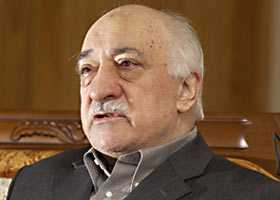
    fetullah-gulen

    Here’s what Gulen had to say in a sermon in 1999 aired on Turkish television:

    You must move in the arteries of the system without anyone noticing your existence until you reach all the power centers … until the conditions are ripe, they [the followers] must continue like this. If they do something prematurely, the world will crush our heads, and Muslims will suffer everywhere, like in the tragedies in Algeria, like in 1982 [in] Syria … like in the yearly disasters and tragedies in Egypt. The time is not yet right. You must wait for the time when you are complete and conditions are ripe, until we can shoulder the entire world and carry it … You must wait until such time as you have gotten all the state power, until you have brought to your side all the power of the constitutional institutions in Turkey … Until that time, any step taken would be too early-like breaking an egg without waiting the full forty days for it to hatch. It would be like killing the chick inside. The work to be done is [in] confronting the world. Now, I have expressed my feelings and thoughts to you all-in confidence … trusting your loyalty and secrecy. I know that when you leave here-[just] as you discard your empty juice boxes, you must discard the thoughts and the feelings that I expressed here.

    Simply put, he is brilliantly and patiently employing taqiyya on a global scale, because this strategic approach is not confined to Turkey.

    Here in the U.S. the FGC runs over 90 charter public schools in at least 20 states.


    source:

  • Armenian, Azeri Leaders Report More Progress In Karabakh Talks

    Armenian, Azeri Leaders Report More Progress In Karabakh Talks

    07.05.2009
    Gevorg Stamboltsian

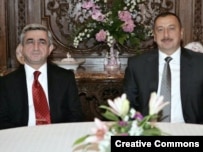
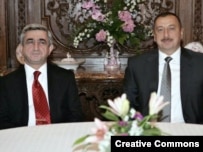
    The presidents of Armenia and Azerbaijan reported further progress towards the resolution of the Nagorno-Karabakh after holding fresh talks in Prague on Thursday.

    Presidents Serzh Sarkisian and Ilham Aliev met there on the sidelines of a European Union summit that offered their nations as well as four other former Soviet republics to forge closer ties with the EU. The meeting began in the presence of their foreign ministers and the American, French and Russian diplomats co-chairing the OSCE Minsk Group.

    Aliev and Sarkisian then spoke one on one for more than two hours. Neither leader made any public statements afterwards, leaving it to the three mediators to present the results of the talks to journalists. Matthew Bryza, the chief U.S. negotiator, said the presidents made “significant progress” towards finalizing a framework peace agreement along the lines of the basic principles put forward by the co-chairs.

    “Presidents Aliev and Sarkisian were able … to reduce their differences on our basic principles and generally agree on the basic ideas that they came here to discuss,” Bryza said. “We had some specific ideas and elements of the basic principles we are trying to finalize and they do agree on the basic approach.”

    “We plan in coming days and weeks to work together with the foreign ministers to finalize the details of these key remaining concepts within the basic principles,” added the diplomat.

    “We are preparing a breakthrough,” said Bernard Fassier, the group’s French co-chair. “We are in a position to identify what could be the break, but we are not yet through. So we need to progress and we are expecting to realize that in the following weeks.”

    Fassier, Bryza and their Russian opposite number, Yuri Merzlyakov, refused to disclose what specifically Aliev and Sarkisian have agreed on.

    In a written statement, Sarkisian’s office confirmed that the two presidents have narrowed their differences over “some points” of the proposed settlement. It said they instructed their foreign ministers to continue to work on its details with the mediators and to prepare for another Armenian-Azerbaijani summit.

    Merzlyakov said Aliev and Sarkisian will likely meet again in Saint-Petersburg, Russia early next month. The two leaders held their first face-to-face talks there in June last year.

    https://www.azatutyun.am/a/1623675.html