Month: February 2009

  • Would ‘Washington Post’ writer David Ignatius put his arm on President Obama during a debate?

    Would ‘Washington Post’ writer David Ignatius put his arm on President Obama during a debate?

    Phil Weiss

    […]

    And yes, while Ignatius has been forward-thinking/realist since, he can be justly scored, I think, for putting his hand on the Turkish Prime Minister to stop the debate so everyone could go to dinner the other night at Davos. It’s easy to say this in retrospect, but there was no sense on Ignatius’s part of the Moment. Ignatius should have extended the time to let both men finish their points, Peres and Erdogan. Let the stomachs grumble. As it is, he appeared to dis the P.M.–and as we see, appearance is everything in these matters–and failed to recognize that when you give a stage to a man defending the slaughter of 450 children, the placement of the salad fork should not be the highest concern, a structural problem with the Establishment, in my humble opinion.

    […]

    …and I'm to blame?

    Source: www.philipweiss.org

  • Turkey’s Opposition CHP backs PM in Davos

    Turkey’s Opposition CHP backs PM in Davos

    Turkey’s CHP backs PM in Davos, blames for using issue for elections

    What was done against Turkish prime minister during a Gaza session in Davos was injustice, Deniz Baykal, the leader of main opposition Republican People’s Party (CHP) said on Sunday, but added the issue is being used by the premier as a material for upcoming local elections.

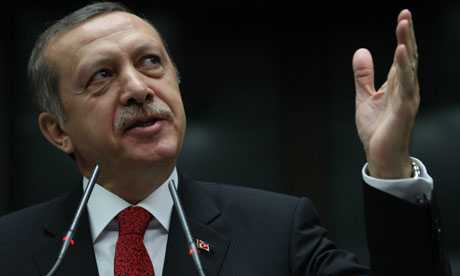
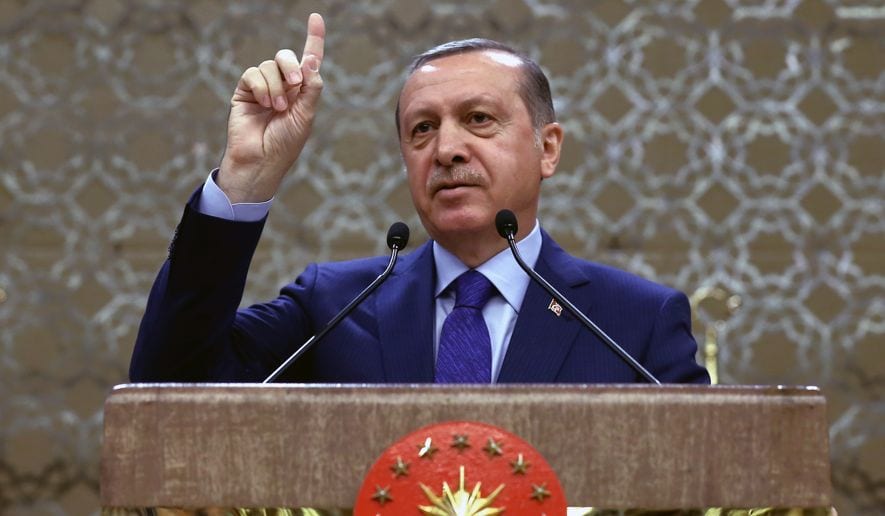
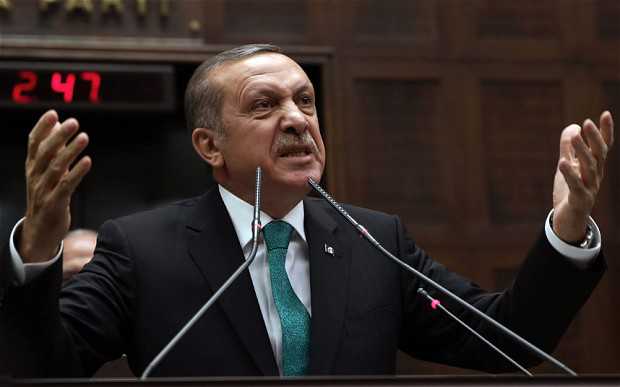
    Turkish Prime Minister Tayyip Erdogan had stormed out of the tense Gaza session with Israel’s President Shimon Peres on Thursday in Davos after the moderator, Washington Post columnist David Ignatius, refused to give him floor.

    Source:  Hurriyet, 01 Feb 2009

  • “A New World Leader”

    “A New World Leader”

    Yet Another Crisis in Turkey-Israel Relations

    Emrullah Uslu

    In an earlier EDM analysis it was observed that since Israel’s Gaza offensive began, Turkish Prime Minister Recep Tayyip Erdogan’s harsh criticism of the operation has made him the champion of the man in the street in the Muslim world (see, EDM, January 7, 15). Despite the fact that Turkish diplomats and ministers have tried in the last three days to repair the “Gaza damage” (see, EDM, January 27), Erdogan condemned Israeli policies in Gaza in the presence of Israeli President Shimon Peres in a panel discussion at the World Economic Forum in Davos on January 29. In response, Peres raised his voice, pointed his finger at Erdogan, and fiercely defended his country’s incursion into Gaza:

    What would you do if rockets were fired at Istanbul every night? …Do you understand the meaning of a situation where hundreds of rockets are falling a day on women and children who cannot sleep quietly, who need to sleep in shelters? What is the matter with you? You don’t understand, and I am not prepared for lies (Jerusalem Post, January 30).

    Erdogan wanted to respond to Peres but the moderator unsuccessfully tried to end the panel. Erdogan, however, had a minute of response in which he slammed Peres back by saying:

    You are raising your voice, because I know it is a sign of expressing a guilty feeling. When it comes to killing, you know very well how to kill. I know very well how you killed children on the beaches. Two of Israel’s Prime Ministers personally told me—if asked I could reveal their names—that they feel happy when they enter into Gaza… (“The Great Game Revisited,” , January 29).

    After he left the panel Erdogan said that his anger was toward the moderator but he did not step back from his remarks on Israeli policies on Gaza. Later it was reported that Peres phoned Erdogan and apologized about raising his voice and explained that “I raised my voice because I am told that it was difficult to hear if you do not speak loudly” (Yeni Safak, January 30).

    The heated debate in Davos immediately resonated in Turkey. The people of Turkey, who had already demonstrated their anger toward Israel over the Gaza crisis (see EDM, January 7), showed their support for their prime minister. Within a few hours, 97.5 percent of the respondents (36344 votes) to an opinion poll in the Internet said they supported Erdogan, while only 1.7 percent (620 votes) said that Erdogan’s response was not right (www.haber7.com, January 29). Thousands of people went to the airport to welcome Erdogan when he arrived in Istanbul at 2:20 AM in the morning. TV channels began live broadcasting upon his arrival. Erdogan said at a press conference that:

    I do not want to be a leader who made his decision on Turkish-Israeli relations at a time of anger. We should know that Turkey should not determine its policies with the attitude of who says what. The other side should think “what happens if we lose Turkey?” Turkey is a big country and should act with this perspective (NTV, January 30).

    After his press conference Erdogan delivered a speech to thousands of joyful people carrying signs saying “welcome conqueror of Davos” and “a new World leader.” Erdogan told them that “I understand the feelings of you who came here in the middle of the night. Turkey should not make its decisions on the basis of who says what if Turkey takes this step or that step. The other sides should think about what happens if they lose Turkey” (NTV, January 30). While Erdogan was outlining Turkish-Israeli relations on the basis of the idea that “the other side [Israel] should think what happens if it loses Turkey,” an Israeli official outlined Israel’s position: “Erdogan’s actions in Davos show that he doesn’t want to miss an opportunity to further harm Turkish-Israeli relations. …Israel’s strategic relationship with Turkey is important to us, but it is no less important to Turkey.” The official warned that Israel was growing increasingly tired of Erdogan’s tirades, and was unlikely to make any more efforts to “chase after the Turks” (Jerusalem Post, January 30).

    Political observers in Turkey and around the world wonder why Erdogan stormed off the stage. The first reason may be found in his psychological makeup. Even he himself admits that he is not one to use diplomatic language. When he feels he is being attacked, he responds fiercely. Second, and more important, if Erdogan had not responded to Peres’s “loud and finger-pointing response,” it could have meant his political demise in Turkey. Not only would the opposition parties use Peres’s angry response against him but majority of his admirers, who see him as a straight- talking, fearless leader, would abandon him permanently. Erdogan’s strident criticism of Israel may have put him in a situation from which he cannot step back. An opinion poll by the Genar poling company from January 9 to 19 showed that 71.9 percent of the respondents approved of Erdogan’s stance toward Israel; 59 percent supported the idea of sending Turkish troops to Gaza for a peace-keeping mission; 59.4 percent felt that volunteers should be allowed to go to Gaza; and 63.2 percent of those who approved of the volunteers wanted to go Gaza themselves (www.haber7.com, January 30).

    It will be interesting to see how Turkish and Israeli diplomats will manage to normalize relations again, but on the domestic level, Erdogan has become a hero of the masses. With this popularity one can assume that Erdogan is already assured of victory in the municipal elections in March.

    On the international level, Erdogan’s condemnation of Israel may harm Turkish foreign policy positions, but in the streets of the Arab world Erdogan is becoming a “new Nasser.” A Turkish TV channel reported that Palestinians would organize rallies after Friday prayers to show their appreciation for what Erdogan said (Ulke TV, January 30).

    Source:  Eurasia Daily Monitor, The Jamestown Foundation – January 30, 2009 — Volume 6, Issue 20
  • Serge Sargsian, Recep Tayyip Erdogan meet in Davos

    Serge Sargsian, Recep Tayyip Erdogan meet in Davos

    Published: Friday January 30, 2009

    Prime Minister Recep Tayyip Erdogan of Turkey meets with President Serge Sargsian of Armenia on the sidelines of the World Economic Forum in Davos, Jan. 29, 2009. Press office of the President of Armenia

    Yerevan – The president of Armenia and prime minister of Turkey met on the sidelines of the World Economic Forum taking place in Davos, Switzerland, this week.

    According to The Associated Press, Mr. Sargsian said that talks with Mr. Erdogan were “very useful.” Speaking to reporters following their meeting, Mr. Sargsian said, “I’ve seen a willingness of the prime minister to solve our issues. I think this is a positive signal.”

    According to Reuters, Mr. Erdogan said that talks between the two countries could yield a roadmap for relations if Yerevan shows a “sincere” attitude. The Turkish prime minister during a panel session at the forum said, “It would be a shame if all these efforts are made a victim of [the Armenian] diaspora’s works.” This was not the only time Mr. Erdogan tried to drive a wedge between Armenia and the diaspora. According to Today’s Zaman, Mr. Erdogan also had the following to say: “The Armenian diaspora is plotting. But we can see very clearly and sharply that their efforts are aimed at utilizing [this issue]. This is obvious. But I also see that the current administration in Armenia doesn’t take part in this,” Mr. Erdogan stressed.

    Relations between Armenia and Turkey began to thaw after Mr. Sargsian invited Turkey’s President Abdullah Gül to Yerevan to watch the World Cup qualifying match between the two country’s national soccer teams in September 2008.

    Source:  The Armenian Reporter,  January 30, 2009

  • ESREF ARMAGAN: THE BLIND TURKISH PICASSO

    ESREF ARMAGAN: THE BLIND TURKISH PICASSO

    Give yourself a uniquely uplifting, thought provoking, and inspiring gift today. Click on this link to watch an extra-ordinary artist at work:

    An artist that helped recreate concepts like vision, perspective, and light in concert with scientists from Harvard University and the University of Toronto.

    A 42 year old blind Turkish painter that outdid the renaissance master Filippo Brunelleschi (1377 – 1446), one of the most important architects of the Italian Renaissance, the creator of the concept of perspective, in a test in Florence, Italy, conducted by J. M. Kennedy, Professor of Perception Psychology at the University of Toronto.

    Sitting on the steps of the cathedral of Florence and looking at the Baptistery, an octagonal Roman building, just like Brunelleschi did 600 years earlier, Armagan recreated perspective of the building, using only finger touch, no vision.

    “ Mr. Armagan is an important figure in the history of picture-making, and in the history of knowledge. His work is remarkable. I was struck by the drawings he has made as much as by his work with paint. He has demonstrated for the first time that a blind person can develop on his or her own pictorial skills the equal of most depiction by the sighted. This has not happened before in the history of picture-making.” said John M. Kennedy, Professor, Perception/Cognition Psychology, University of Toronto at Scarborough, to describe Armagan’s role in revolutionary redefining of picture, not as the sole product of vision, but also a product of touch.

    Esref Armagan , born without eyes due to a genetic mutation, in Ankara, Turkey, has taught himself to write and print. He draws and paints better than most sighted people by using his hands and primarily oil paints. He wants to be remembered, not as a blind man who could paint, but as a great artist with unique works of art who happened to be blind. (For his biography, click: )

    Until Armagan came along, science has assumed that picture was a product of vision only. After all, how could a person, having never seen light in his life, draw objects in proper colors, place shadows on them, give the correct scale, and show all in perspective? Impossible.

    A battery of tests changed all that. First, a team of Harvard neurologists scanned Armagan’s brain while he was drawing, only to be stunned by the results that those areas in a human brain associated with vision that were supposed to be dormant for a blind man were actually lighting up like Christmas trees! That changed all previous assumptions, information, and beliefs.

    Then came the mother of all tests: could a blind man, solely relying on the sense of touch, recreate perspective of an object he has never seen or known about, under the watchful eyes of scholars in a meticulously designed test? (And for good measure, don’t tell the blind man that the test is of historic proportions as it recreates the invention of perspective during the Renaissance, pitting him against the Italian master Filippo Brunelleschi, the inventor of perspective in 1413, on the exact same location in Florence and the drawing same object.)

    I will not steal the video clip’s thunder on how the test was conducted and what the results were. I took the time to bring it to your attention. Now you should take the time to see the phenomenal video. You’ll be thanking me that you did.

    A Turkish artist’s revolutionary and multi-faceted contributions to science and art:

    1- Picture is not solely the product of vision, but also of touch.

    2- A blind man can beat his visual challenge to become a great artist and a painter.

    3- There is really no limit to human achievement!