Month: January 2009

  • A New Russia Upon a Hill

    A New Russia Upon a Hill

    By Igor Panarin

    The United States, which is at the epicenter of the global financial tsunami, will suffer the most damage in 2009. In a worst-case scenario that has a roughly 50 percent chance of coming true, the dollar and the entire U.S. economy will crash by November. As a result, the country’s dire political and economic problems could lead to fierce competition between the states in which wealthier states will withhold funds from the federal government and threaten secession and civil war. This in turn could lead to disintegration of the country into six parts by the summer of 2010 as the leading foreign powers take their pieces of the fallen giant. Under this scenario, California and six western states would fall under Chinese influence; Alaska would go to Russia; Hawaii would go to Japan or China; 15 states in the Midwest and Great Plains would be under Canadian influence; Texas and eight other southern states would be under Mexican influence; and the eastern seaboard states might join the European Union.

    Russia must take advantage of the U.S. crisis by expanding its influence and power both domestically and globally in the following areas:

    •Pacific Doctrine

    Russia needs regions that can produce breakthrough technological innovations, and Primorye is a leading candidate to fulfill this role. While preserving its military and political importance, Primorye should become a powerful financial and economic outpost in the Asia-Pacific region in the 21st century. By 2012, it can and should become one of the main centers of international business activity, a hub for investment and innovation.

    The political future of Russia’s leaders, as well as its ability to become a leader in innovation, will largely depend on whether Primorye’s political elite can — with Kremlin support — adapt to the reality of world politics.

    This primarily means supporting the concept of a fifth “I” — intellect — in addition to President Dmitry Medvedev’s four I’s of institutions, infrastructure, investment and innovation. This would entail developing a partnership between government and the private sector that will ensure Russia’s position as a world leader.

    •Former Soviet Republics

    A U.S. collapse would lead to a political and military vacuum among former U.S. allies in Eastern Europe, the Caucasus and Central Asia. Russia should declare its intention to return to the foreign policies of Catherine the Great.

    •The Middle East

    Russia should start by building a strategic partnership with Turkey, which supported Russia in its war with Georgia in August. Russia should take over all of the former U.S. military bases on Turkish territory. In addition, Russia should take full advantage of the U.S. withdrawal from Iraq and Afghanistan by deploying forces from the Shanghai Cooperation Organization to provide peace and stability.

    •South Asia

    Russia should try to become the main arbiter in the dispute between India and Pakistan. It would also make sense to include Iran and China in the settlement process.

    •South America and the Caribbean

    Moscow should focus on strengthening its ties and influence in Brazil, Venezuela and Cuba. Russia should direct colossal economic and military resources to those three countries.

    The year 2010 should see the re-establishment of Russia’s radar station at Lourdes in Cuba that Moscow abandoned in 2001 with 750 technicians and 2,000 troops. At a December meeting of leaders from 33 South American states — which was held without the participation of the United States for the first time — Mexican President Felipe Calderon proposed creating an organization called the Union of South American and Caribbean Basin States that would facilitate political and economic change on the continent. If such an organization is established, Russia should strive to become a strategic economic and informational-ideological partner.

    By expanding its influence in the above areas, Russia can integrate Eurasia and strengthen its political, economic and military influence in the world. The U.S. decline offers Russia a golden opportunity to replace the United States as the world’s leading superpower.

    Igor Panarin, former analyst with the KGB, is dean of the international relations department at the Foreign Ministry’s Diplomatic Academy.

    Monday, January 12, 2009
    Updated at 12 January 2009 1:39 Moscow Time.
  • Armenia denies receiving $800 mln worth of Russian arms

    Armenia denies receiving $800 mln worth of Russian arms


    YEREVAN, January 12 (RIA Novosti) – Armenia’s Defense Ministry on Monday denied a report from Baku alleging that Russian arms had been handed over to Yerevan.

    Azerbaijani media previously reported that arms worth a total of $800 million had been transferred to Armenia from a Russian military base in the country.

    “That is yet another piece of disinformation by Azerbaijani propaganda. I don’t think there is a need to comment on it,” said the Armenian defense minister’s press secretary, Col. Seiran Shakhsuvaryan.

    Azerbaijan’s Foreign Ministry said earlier on Monday that it was studying the report.

    “As soon as the necessary information is obtained, the Foreign Ministry will formulate its position,” said Elkhan Polukhov, first secretary of the Azerbaijani Foreign Ministry.

    Relations between Azerbaijan and Armenia became strained when Nagorny Karabakh, a region in Azerbaijan with a largely Armenian population, declared its independence from Azerbaijan to join Armenia in 1988. The enclave has been a source of conflict ever since.

  • Georgia Stops Gas Flow to Armenia

    Georgia Stops Gas Flow to Armenia

    Monday, January 12, 2009
    Updated at 12 January 2009 1:39

    Moscow Time.
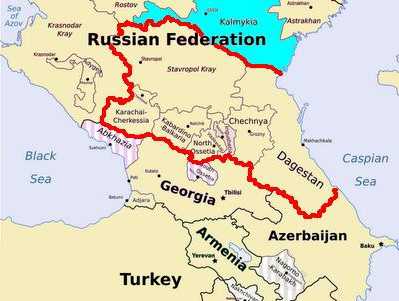
    Georgia stopped Russian natural-gas transit flows to Armenia on Friday after a pipeline was damaged.

    Georgia said the stoppage was to carry out emergency repair work on the main Kazakh-Saguramo gas pipeline.

    Repair work on the pipe “will take approximately five days, the transit will continue after that,” Georgian Energy Minister Alexander Khetaguri said in an interview Sunday. The damage occurred in the town of Gardabani, about 40 kilometers south of the capital Tbilisi.

    Gazprom ships its gas to Armenia through Georgia, which gets 10 percent of transit volumes as fees.

    Gazprom and its Armenian venture ArmRosgazprom offered to help Georgia repair the damaged link to resume supplies “in the shortest time,” it said Sunday.

    Armenia has some gas reserves that it could use while repairs are being made, Khetaguri said.

    Source:  The Moscow Times » Issue 4061 » 12 January 2009

  • Heydar Jamal: “Like Russia US-Israeli tandem is absolutely not interested in the resolution of the Karabakh conflict”

    Heydar Jamal: “Like Russia US-Israeli tandem is absolutely not interested in the resolution of the Karabakh conflict”

    Today Russia is the main obstacle on the way to the resolution of the situation in the South Caucasus, said famous Russian political scientist and chairman of the Islamic Committee of Russia Heydar Jamal, speaking about the supply of arms to Armenia by Russia free of charge. He said if not for Moscow the Karabakh conflict could have been settled long ago.

    (more…)

  • Kazan Institute Seeks to Link Tatarstan to the World

    Kazan Institute Seeks to Link Tatarstan to the World

    Paul Goble

    Vienna, January 7 – The Center for Eurasian and International Research of Kazan State University provides a brain trust for the leadership of Tatarstan in its efforts to develop ties with foreign countries in much the same way that several research centers in Ukraine did before that republic gained its independence.
    In an interview posted on the Islamrt.ru site, the center’s director Bulat Yagudin describes what he calls “the only scientific research center in Tatarstan” which focuses on foreign policy issues in general and those across the Eurasian landmass in particular (www.islamrt.ru/htm/interv_yagudin.htm).
    (Because the word “Eurasian” in the institute’s name might lead some to think that it is associated with either classical Eurasianism or the neo-Eurasianism of Aleksandr Dugin, Yagudin hastens to say that is not the case and that researchers at his institute has no specific ideological agenda.)
    The center’s goal, Yagudin says, is to be an interdisciplinary institute where researchers will be able to provide broad assessments f social, economic and political phenomena across Eurasia and thereby be in a position to help the peoples and governments of these regions find “adequate paths for the resolution of problems.”
    To that end, he continues, the center “does not avoid cooperation with politicians, political scientists, religious activists and even charlatans,” a commitment that “requires much time and effort” but one that reflects “the principle of openness” on which the center was founded two years ago.
    The center earns its own way by doing contract research and transfers up to 40 percent of its earning to the university. But what is particularly important, Yagudin continues, is that the center provides “young specialists, graduate students, and even volunteers” of various kinds with the change to work “for the well-being of the entire republic.”
    The center already has an active program of publications and conferences. It launched a newspaper, “Eurasian Horizons,” last year and has now converted it into a monthly publication. In addition, it publishes a journal, “Eurasian Research,” a yearbook, “The Year in Eurasia,” and occasional papers.
    And Yagudin listed the following upcoming conferences: Later this month, the center plans a symposium on Tatarstan in 2008. In February, it will host on Islamic Studies in Post-Soviet Russia and the CIS. In March, it will be the venue for a meeting on the Caspian Region. And in July, it will host a forum on Geopolitics and Economics in Eurasia Today.
    As is often the case with new institutions, the Kazan Center reflects the personality and experience of its organizer. Born in Kazakhstan in 1957, Yagudin grew up in the Fergana valley, studied in a German language school, and served in the Soviet army in Ukraine, Armenia and Azerbaijan.
    Subsequently, he studied at the historical faculty of the Fergana State Pedagogical Institute. There he worked with the internationally known David Achildiyev, an Afghanist who later moved to the United States, where he published a highly regarded two-volume history of the Jews of Bukhara.
    With the collapse of the USSR, Yagudin, like many other members of the Tatar diaspora in the former Soviet space, returned to Tatarstan in order to support his nation. And on arrival, he became a graduate student at the historical faculty of Kazan State University, from which he graduated in 1992. Since that time, he has taught courses there on Africa and Asia.
    Yagudin is much less well-known abroad than many other scholars in Kazan, but his aspirations for his institute and his ability both to raise funds and organize publications and conferences suggest that he and his center are going to be increasingly important players in Kazan’s growing efforts to reach out to the broader world.

    http://windowoneurasia.blogspot.com/2009/01/window-on-eurasia-kazan-institute-seeks.html

  • Poor Richard’s Report

    Poor Richard’s Report

    GUTTING SECURITY: O’S DANGEROUS ANTI-TERROR PICKS

    By DICK MORRIS & EILEEN MCGANN

    Published in the New York Post on January 8, 2009

    President-elect Barack Obama’s appointments to Homeland Security, the Justice Department and now the CIA indicate a virtual abandonment of the War on Terror.

    As Homeland Security chief, he’s named a governor whose only experience has been with the US-Mexican border. His attorney general pick, meanwhile, took the lead in pardoning FALN terrorists. Now he has rounded out his national-security and Justice Department teams by naming ultraliberals.

    Leon Panetta, his choice for CIA chief, is as liberal as they come. Though originally a pro-Nixon congressman, he long ago embraced the left with the fervor of a convert and brings these values to the CIA.

    As President Bill Clinton’s chief of staff (a tenure that coincided with my own work with Clinton), he was a dedicated liberal, opposing accommodation with the Republicans who ran Congress and battling hard against a balanced-budget deal. After winning re-election, Clinton jettisoned Panetta for the more moderate Erskine Bowles in order to reach a deal with the GOP.

    Plus, Panetta was a prime mover in the 1995 appointment of John Deutch to head CIA, replacing hardliner Jim Woolsey. Deutch eventually needed a presidential pardon after being caught committing a massive security breach by taking home his laptop, laden with secret files.

    Choosing Panetta to head the CIA culminates liberals’ 35-year crusade to take over the agency, humble its operatives and rein in its operations. In 1977, President Jimmy Carter named liberal JFK adviser Ted Sorenson to head CIA, only to have the nomination killed. In 1997, Clinton tried to name his ultraleftist National Security Adviser Tony Lake (who had quit Secretary of State Henry Kissinger’s staff over Vietnam), only to have that nomination rejected as well.

    Each time, the intelligence community acted to protect its own and curbed the liberal president’s inclinations. But now, under Obama, the Democrats will finally have their way and appoint a liberal zealot to head the agency.

    Panetta will, presumably, curb such practices as waterboarding, rendition and warrantless wiretapping. So we won’t gather much intelligence – but our spies will dot all the i’s and cross all the t’s.

    Over at Justice, Obama is naming four liberals to staff the agency, each determined to rein in effective intelligence-gathering.

    Professor Dawn Johnsen of Indiana University Law School is to head the Office of Legal Counsel. She distinguished herself by writing a law-review article taking issue with President Bush’s efforts to keep us safe. It was titled, “What’s a President To Do: Interpreting the Constitution in the Wake of the Bush Administration Abuses.” Presumably, she’ll bring back the days of the wall between criminal and intelligence investigations, which led to our failure to examine the computer of “20th hijacker” Zacharias Moussaoui, which contained wire-fund-transfer information on the other hijackers.

    No less an authority than Harvard Law professor Laurence Tribe, who taught Elena Kagan, the new solicitor general, predicted that she and Johnsen would “freshly re-examine some of the positions the previous administration has taken.”

    Obama’s other Justice appointments, David Ogden as deputy attorney general and Thomas Perrelli as associate AG, bring back Clinton/Reno Justice Department retreads. Both participated eagerly in the constraints on intelligence-gathering that left us so vulnerable on 9/11.

    Bush’s legacy shows one clear achievement: He kept us safe after 9/11. Now his successor’s policies are about to eradicate that singular achievement. The liberals will, of course, all cheer these appointments and the policies they’ll pursue once in office, but these appointments make it frighteningly more likely that we will, indeed, be hit again.

    Go to DickMorris.com to read all of Dick’s columns!
    __________________________________________________________________________________________________________________________________________

    PLEASE FORWARD THIS E-MAIL TO FRIENDS AND FAMILY AND TELL THEM THEY CAN GET THESE COLUMNS E-MAILED TO THEM FOR FREE BY SUBSCRIBING AT DICKMORRIS.COM!

    THANK YOU!