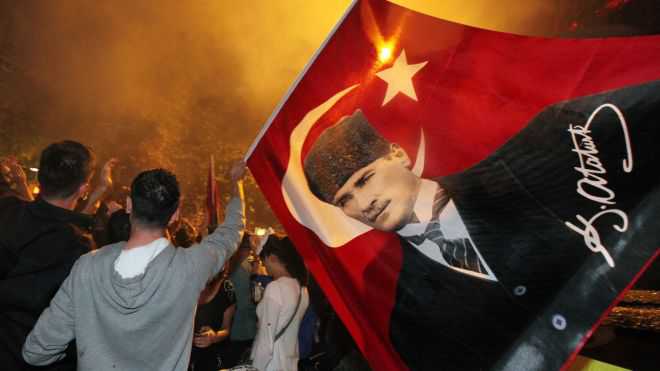
Ankara – A court in south-east Turkey on Friday banned Turkish internet users from accessing Blogger, the world’s largest free blog hosting service. Internet users in Turkey discovered Friday afternoon that the site, which hosts millions of blogs, or web logs, had been blocked. When users tried to view a blogger’s page they were redirected to a message which said: “Access to this website has been suspended in accordance with decision no. 2008/2761 of the TR Diyarbakir First Criminal Court of Peace.” No reason for the ban was given. Turkish internet users are used to court-ordered bans of a large range of websites, including the video-sharing site Youtube, which was barred for hosting a video insulting the founder of the Turkish republic, Mustafa Kemal Ataturk. Adnan Oktar, an Islamic creationist has also been successful in getting a variety of sites banned by court decisions, including blog hosting website WordPress and the personal website of renowned biologist and atheist Richard Dawkins.
Month: October 2008
-
THE DEPKA REVIEW
Summary of DEBKAfile’s Exclusives in the Week Ending Oct. 23, 2008No high priority for Palestinian issue if Obama elected US president 17 Oct.: The Democratic presidential candidate Barack Obama has decided not to list the Palestinian issue as a top priority if he wins the Nov. 4 election, DEBKAfile’s Washington exclusive sources reveal. The Middle East experts on his transition team advised him there was no hurry to address the issue in the early stages of his presidency because the Palestinian side cannot field any leaders authoritative enough to sign a peace accord. Their internal divisions are too profound for such a leader to emerge in the foreseeable future, said those advisers. Their chief recommendation was to address with high urgency the issues of a nuclear Iran and relations with Syria, according to our sources.
While nothing is being said publicly, DEBKAfile’s sources report that some of Senator Obama’s advisers have remarked that Presidents Clinton and Bush discovered too late that over-involvement in the Palestinian-Israel dispute led nowhere and in fact caused them to neglect more consequential Middle East business. This misplaced concern hurt their reputation for effectiveness as international statesmen.
By setting the Palestinian question aside, the Democratic candidate if elected will terminate Bush’s 2007 Annapolis initiative and the subsequent on-and-off negotiations with Palestinian leaders conducted by outgoing prime minister Ehud Olmert and his would-be successor foreign minister Tzipi Livni. Those talks anyway achieved very little.
Russian missiles for Syria may be riposte for US FBX-T radar in Israel
DEBKAfile Exclusive Report 18 Oct.: DEBKAfile’s military sources report that a large-scale arms deal for Syria, paid for by Iran, is in advanced negotiation in Moscow and Damascus. It includes fighter-bombers and an assortment of anti-air, anti-missile and anti-tank missiles, as well as substantial upgrades of Syria’s antiquated Russian tanks. Our sources disclose that the S-300PMU-2 and Iskander-E are still on the list under discussions.In the broader context of its contest with Washington, the Kremlin regards the US radar system installed in the Negev to be an integral part of the US missile shield deployed in the face of Russian protests in Poland and the Czech Republic.
Positioning missile systems at Syrian ports would be part of Russia’s overall military payback for the array of US missile and radar installations in Europe and the Middle East. Therefore, DEBKAfile’s military sources report, the Kremlin may decide against handing the missiles to the Syrian army but prefer to install them to guard the Mediterranean naval bases Russians are building at the Syrian ports of Tartus and Latakia.
Barak urges kiss of life for moribund Saudi 2002 peace plan
19 Oct.: Defense minister Ehud Barak proposed in coalition talks with Kadima leader, foreign minister Tzipi Livni serious consideration for the 2002 Saudi plan which offered pan-Arab recognition of Israel in exchange for full Israeli withdrawal from all lands captured during the 1967 war: the West Bank, Gaza, Jerusalem and the Golan.“There is definitely room to introduce a comprehensive Israeli plan to counter the Saudi plan,” he said. “Moderate Arab leaders” share an interest in containing Iran’s nuclear ambitions, limiting Hizballah’s influence in Lebanon and bringing the Palestinian Hamas under control in the Gaza Strip.
DEBKAfile’s sources note that much water has run under Middle East bridges since 2000 when Barak as prime minister engineered Israel’s pullout from its south Lebanese security zone, and 2005, when his successor Ariel Sharon ordered Israel’s unilateral disengagement from the Gaza Strip, making way for Hamas to move in. “Moderates” no longer dominate regional affairs but a radical coalition of Iran, Syria, Hizballah and the Palestinian Hamas and Jihad Islami, making Barak’s kiss of death for the Saudi peace plan pointless.
Outbreaks by Arab citizens spread as Israeli police stand aside 19 Oct.: Saturday morning, Oct. 18, two Israeli Arabs broke into a military base, beat up the sentry and stole his gun. Police called it a “criminal” incident.
DEBKAfile’s security sources report: Mixed and “seam” communities are beset by a rising level of violence involving Israeli Arab citizens. But local police forces tend to react by brushing aside Jewish complaints and even failing to respond to appeals for help against Arab threats, in the interests “communal co-existence.” For lack of a controlling hand, coexistence is crumbling, inter-communal clashes spreading and an Arab uprising emerging.
McCain pledges Jerusalem will remain undivided capital of Israel 20 Oct.: The Republican candidate John McCain promised never to press Israel into concessions that endangered its security.
Lieberman later in the call noted the trip he and McCain had taken to the Jewish state in March, and stressed that McCain knows the “historic Jewish claim” to the city and “it’s clear he will not be included in efforts to divide Jerusalem.” Lieberman later emphasized McCain’s promise to move the U.S. Embassy to Jerusalem “as soon as he becomes president.
The Jewish vote in battleground states, including Florida and Pennsylvania, is being courted aggressively by both presidential campaigns.
US, Russian military chiefs hold unannounced fence-mending talks 21 Oct.: The top-secret meeting aimed at putting US-Russian bilateral relations back to their pre-Georgian crisis track. US sources said the meeting which took place at Helsinki on Oct., 21 was requested by Moscow.
While US officials expected the Russian side to raise the issues of Georgia and America’s anti-missile interceptors in Poland and the Czech Republic, DEBKAfile’s sources anticipated that the American side would broach stepped up Russian nuclear assistance to Iran, especially its commitment to finish the Bushehr reactor by the end of the year, and refusal to go along with sanctions.
Also at issue are Moscow’s massive arms deals with Iran and Syria and the new naval bases the Russians are building at Syrian ports.
Arab Websites report Mossad chief assassinated in Amman. Israel sources deny 21 Oct.: DEBKAfile reports that Arab Internet sites claim that, 10 days ago, Meir Dagan, the head of Israel’s Mossad, was targeted by assassins while visiting Amman. Some say an explosion against his convoy left him hurt or even dead and his guards injured. DEBKAfile’s sources have no knowledge of any visit by Meir Dagan to the Jordanian capital.
Cont. next column
One rumor claimed a hit-man or team linked to Hizballah or Iran attacked Dagan to avenge the death of Hizballah military chief Imad Mughniyeh in Damascus last February. The Arab world sees Dagan as master of the hidden Israeli hand which reached into Syria to target Mugniyeh and destroyed Syria’s plutonium reactor in September 2007.
US intelligence: Iran will be able to build first nuclear bomb by February
DEBKAfile Exclusive Report 21 Oct.: US intelligence’s amended estimate, that Iran will be ready to build a bomb just one month after the next US president is sworn in, was relayed to the Middle East teams of both presidential candidates, Senators John McCain and Barack Obama. It prompted the Democratic vice presidential nominee Joseph Biden’s remark in Seattle Sunday, Oct. 19: “It will not be six months before the world tests Barack Obama like they did John Kennedy.” (McCain rebutted that statement Tuesday, Oct. 21 by saying: “America does not need a president that needs to be tested. I’ve been tested. I was aboard the Enterprise off the coast of Cuba. I’ve been there.”)According to the new US timeline, by late January, 2009, Iran will have accumulated enough low-grade enriched uranium (up to 5%) for its “break-out” to weapons grade (90%) material within a short time. In February, they can move on to start building their first nuclear bomb, for which US intelligence believes Tehran has the personnel, plans and diagrams. The UN International Atomic Energy Agency in Vienna last week asked Tehran to clarify recent complex experiments they conducted in detonating nuclear materials for a weapon, but received no answer.
Israel’s political and military leaders can no longer put off deciding whether to strike Iran’s nuclear installations in the next three months, or take a chance on coordination with the next president.
NATO general warns Afghan war effort is wavering 21 Oct.: US Army General John Craddock, supreme allied commander in Europe, warned that NATO’s operations in Afghanistan are affected by a shortfall of troops and more than 70 caveats on soldiers’ deployment. In a speech in London, Monday, Oct. 20, Craddock said: “The conflict in Afghanistan cannot be won by military means alone.” Good governance, reconstruction and development are essential. For now, NATO members are “wavering” in their political commitment to defeat the Taliban.
DEBKAfile adds: This confirms former statements by British and French commanders that the 8-year Afghan war is unwinnable under present circumstances and that Taliban is gaining ground all the time. More and more tribal leaders in the Kabul region are bidding for Taliban protection for lack of government funding, stability and law and order – even against marauding robbers.
Barak orders all Gaza crossings closed from Wednesday 21 Oct.: A Qassam missile from Gaza exploded in southern Ashkelon Tuesday night, causing no casualties on damage.-
Some 50 missiles and mortars have been fired from Gaza since June ceasefire which expires in December. A comprehensive Palestinian national dialogue organized by Egypt opens in Cairo on Nov. 9.
An Israeli Air Force instructor and cadet killed in training plane crash in Negev 22 Oct.: Reserve Major Mattan Assa, 24, from Yavne, and Private Ilan Carmi, 19, Herzliya, were killed Wednesday, Oct. 22, when their training plane crashed 30 minutes after takeoff from the IAF’s Hatzerim base near Beersheba. The plane, a French-made Fouga Magister, remodeled and renamed Zukit, was on a low-flying exercise. No emergency signal was received by the control tower before the crash.
IAF commander Maj.-Gen Ido Nehushtan has set up a team of inquiry.
Israeli motorist injured by Palestinian firebomb near Yakir, West Bank-
22 Oct.: The firebomb cache found on the spot of the incident included a pipe bomb. This marks an escalation of the violence of routine firebomb ambushes.
A Palestinian stopped at Hawara checkpoint south of Nablus carried a pipe bomb and several firebombs.
In Gaza, a Jihad Islami terrorist was killed during mock attack exercise on an IDF position.
Early election likely after Tzipi Livni fails in coalition negotiations 23 Oct.: Foreign minister Tzipi Livni calls on President Shimon Peres next Sunday to inform him that she has not been able to form a viable coalition government. The most probable outcome is an early election.
Only Labor initialed a deal with her Kadima, but its leader, defense minister Ehud Barak, said it is not final. Labor and other potential partners, the ultra-religious Shas and Pensioners, are holding out for substantial extra allocations for large families, senior citizens and healthcare, before signing on. Finance minister Ronnie Bar-On, Livni’s mainstay in their Kadima party, is standing firm against reopening the budget for this purpose.
On the horns of this dilemma, Livni is beset with a revolt in her own party to a minority government, which is all she may be able to scrape together in the time left her. The Olmert government stays on as caretaker until a new government is formed.
Palestinian murders Israeli octogenarian, injures border guard in Jerusalem suburb of Gilo 23 Oct.: The assailant stabbed a Police Border Guardsman who found him loitering around schools on Vardinon Street at the center of the southern Jerusalem suburb of Gilo. He then set upon 86-year old Avraham Ozri, a local resident, who died of his injuries later in hospital. A bystander wrestled the assailant to the ground after the injured policeman shot him. He was taken into custody.
Riots greeted police and Shin Bet officers who arrived later at the terrorist’s village near the West Bank town of Bethlehem to search for accomplices. Eight Palestinians were injured in clashes and several arrested.
-
Turkish court defends quashing Muslim scarf reform
By Ibon Villelabeitia
REUTERS
8:17 a.m. October 22, 2008ANKARA – Lifting a ban on women wearing the Muslim headscarf at university violates Turkey’s secular constitution, the country’s top court said on Wednesday, defending a decision against the ruling AK Party.
In a legal reasoning that appeared to end any hope for the Islamist-rooted AK Party to revive the sensitive headscarf issue, the Constitutional Court said that while wearing a headscarf was ‘an individual choice and a freedom’, lifting the ban was ‘openly against the principles of secularism’.The Constitutional Court, a bastion of Turkey’s secular founding principles, overturned in June a constitutional amendment sponsored by the AK Party to lift the restriction, but only issued its long-awaited reasoning on Wednesday.The AK Party, which denies accusations by secularist opponents of harbouring an Islamist agenda, said it would respect the constitution. It had first reacted angrily to the ruling, accusing the court of violating the constitution.
‘We do not have any intention of undermining the republic’s essential principles,’ Justice Minister Mehmet Ali Sahin said.
The headscarf issue is one of the most highly charged in Turkey, a predominantly Sunni Muslim country with a secular constitution, and has long been a source of political instability in the European Union applicant.
Foreign investors, already dumping emerging markets assets due to the global financial crisis, are monitoring signs of political instability that could delay market-friendly reforms.
The AK Party, which has its roots in political Islam, sees it as a question of religious freedom, while securalists see it as proof the government wants to impose sharia law by stealth. The party repeatedly denies those charges.
The AK Party, which has a huge majority in parliament, passed the amendment earlier this year, angering a secularist establishment of judges and army generals.
Another attempt to lift the headscarf ban would require a constitutional reform and broad social consensus, an unlikely event in a country deeply polarised over the role of Islam.
‘The amendments in articles 10 and 42 are openly against the principle of secularism because procedurally they mean using religion as a tool in politics, and breach other people’s rights and cause public disorder by content,’ the court said.
The headscarf reform was seen as a catalyst for a separate case, in which the same court narrowly voted in July not to close the AK Party on charges of Islamist activities. The court is expected to issue the reasoning of that case this week.
Cengiz Aktar, a professor at Istanbul’s Bahcesehir University, said the court’s reasoning ends any hope of bringing the headscarf issue back until a new constitution is written.
‘This ruling not only ends the headscarf debate, but also any attempt to reform the constitution and the secularist regime,’ Aktar said.
-
Visiting founder of EU think tank lauds Turkey’s strides toward democracy
By Andrew Wander
Daily Star staff
Friday, October 24, 2008BEIRUT: Despite the two-year power struggle between Turkey’s governing Justice and Development Party (AKP) and the secular elite, basic democratic freedoms in the country are developing, the founder of a European think tank said during a visit to Beirut on Wednesday.
Gerald Knaus, who heads the European Stability Initiative, told delegates at a seminar hosted by the Carnegie Center that although the opposition’s fears about the party’s Islamic identity often grabs the headlines, the AKP has in fact ushered in a period of increasing freedom in the country.
“Everything in Russia that has gone backward over the past five years has gone forward in Turkey,” Knaus said.
Under the AKP, newspapers have become more comfortable in criticizing the government and despite more people considering themselves “quite religious” or “very religious” in Turkey, support for the implementation of Sharia law – which the secular opposition claims is the AKP’s hidden agenda – has dropped by more than half.
Knaus compared the Muslim democrats who support the AKP to the Christian Calvinist movement in the way they embrace both faith and business, pointing out that the AKP is supported by many successful provincial businessmen whose religion remains central to their lives.
But he warned that while the benefits of rapid industrialization in Turkey have reached many of the population, others are missing out.
“Changes reach the heartland, but bypass the southeast,” he said.
Source : Daily Star
-

Karabakh Mediators Set To Resume Shuttle Diplomacy
International mediators plan to visit Armenia and Azerbaijan next week to keep up the momentum in their efforts to broker a framework peace agreement on Nagorno-Karabakh before the end of this year.
The U.S., Russian and French diplomats co-chairing the OSCE’s Minsk Group met with the two countries’ foreign ministers in New York less than a month ago. The talks reportedly focused on the possibility of holding another meeting of the Armenian and Azerbaijani presidents shortly after Azerbaijan’s October 15 presidential election.
“The elections are over and I think we can continue to work on the points of interest to us,” the group’s French co-chair, Bernard Fassier, the Azerbaijani APA news agency on Tuesday. “For that reason the Minsk Group co-chairs plan to visit the region next week. But I can not yet give the precise date of the visit.”
The Armenian Foreign Ministry did not confirm the information, with a spokesman saying that no dates have been agreed for the co-chairs’ trip yet.
The mediators hope that President Serzh Sarkisian and his reelected Azerbaijani counterpart, Ilham Aliev, will bridge their differences on the basic principles of a Karabakh settlement that were formally proposed by mediating troika in November last year. Russian Foreign Sergey Lavrov said earlier this month that that Aliev and Sarkisian need to work out “two or three unresolved issues,” notably the future of the Lachin corridor linking Armenia to Karabakh.
Russia on Tuesday indicated its desire to take the initiative in the Karabakh peace process when its President Dmitry Medvedev publicly expressed hope that the next Armenian-Azerbaijani will take place in his country and in his presence “very soon.”
“This is a very interesting idea, but we need to discuss everything,” Fassier said, commenting on the Medvedev’s remarks statement made during an official visit to Yerevan.
-
TURKEY COURTS CENTRAL ASIA
By John C. K. Daly
Wednesday, October 22, 2008
In the aftermath of the Georgian-Russian confrontation, Ankara sees an opportunity to expand its trade relations with Central Asia, particularly the rising petro-states of Kazakhstan and Turkmenistan. Seeking to capitalize on the changing geostrategic environment for Caspian energy exports, Turkish Parliamentary Speaker Koksal Toptan, accompanied by other MPs, has undertaken a tour to Kazakhstan and Kyrgyzstan. On October 19 Toptan began his tour with a four-day official visit to Astana (Aksam, October 20).Not surprisingly, energy was a major theme of Toptan’s visit. Turkey has already profited from Astana’s commitment to use the Baku-Tbilisi-Ceyhan pipeline, as BP-Azerbaijan executives announced that later this month Kazakhstan would begin pumping Kazakh oil from its massive Tengiz field into the BTC (UPI, October 15).
Under the arrangement, Kazakh tankers will ship about 98,000 barrels per day (bpd) of Tengiz oil, or slightly less than 10 percent of BTC’s one million bpd throughput capacity, across the Caspian to the BP-led consortium’s Sangachal Terminal on Azerbaijan’s Abseron Peninsula for pumping into the BTC pipeline and transmission to Turkey’s Mediterranean port at Ceyhan. Building on the Kazakh commitment, Toptan told a group of Kazakh academicians and students at the Public Administration Academy, “I invite Kazakhstan to participate in big energy projects such as the Samsun-Ceyhan oil pipeline and the Ceyhan refinery”(Anadolu Ajansi, October 21). Following his discussions with Toptan, Nazarbayev in turn urged Turkish businessmen to invest in Kazakhstan.
The 345-mile-long, 1.5 million bpd Samsun-Ceyhan oil pipeline (SCP, also known as the Trans-Anatolian Pipeline) is designed to link Turkey’s Black Sea port of Samsum with Ceyhan. It will parallel the BTC by using its corridor from Sariz, and has an added advantage of providing an alternative route for Russian and Kazakh oil exports from Russia’s Black Sea port of Novorossiysk. The SCP, given that its throughput capacity would be 50 percent greater than BTC, could greatly ease the tanker traffic through the Bosporus and Dardanelles, a rising environmental and security concern for Turkish officials.
Toptan’s trade agenda is hardly limited to energy issues, however. During his meeting with Kazakh Parliament Senate Chairman Kassym-Jomart Tokayev, Toptan told a press conference, “Our trade volume currently stands at $2.5 billion. We aim at bringing it up to $5 billion by the year 2010. Direct investments by Turkish businessmen in Kazakhstan amount to $2 billion, and their construction services total $8.5 billion”(Anadolu Ajansi, October 20).
Turkey’s trade with Kazakhstan’s eastern neighbor Turkmenistan is also growing. According to Turkmen President Gurbanguly Berdimukhamedov, Turkish investment in Turkmenistan has slowly and steadily increased, reaching $2.7 billion in the past 18 months. Berdimukhamedov noted, “Our countries have always had good relations. In the new stage of its development, Turkmenistan plans to make cooperation with Turkey more intensive” (EDM, October 8).
In Ankara’s calculations it is critical to diversify its energy imports in order to sustain the economic growth of the last four years, during which the Turkish economy has grown annually by more than 7 percent, making the country the 6th biggest trading partner of the European Union and giving Turkey the world’s 20th largest economy (www.deik.org.tr).
While current Turkish trade with Central Asia is dwarfed by its $38 billion annual turnover with Russia, the energy assets of former Soviet republics Azerbaijan, Kazakhstan, and Turkmenistan are impelling Ankara to make a determined effort to acquire a significant portion of their energy assets, or, failing that, to ensure that they transit Turkey on their way to the global market.
Furthermore, despite the three nation’s long association with Moscow, Turkey has the added negotiating advantage of deep linguistic, cultural, and religious ties that Russia signally lacks. The most notable sign that Turkey is determined to play its cultural card is the fact that Nazarbayev and Toptan discussed the efforts of Turkey and Kazakhstan to establish a Parliamentary Assembly of Turkish Speaking Countries, first broached by Nazarbayev in November 2006 (EDM, February 29).
Turkey’s other rising rival for Caspian energy assets is China. According to Guoxiang Sun, the Chinese ambassador to Ankara, in 2007 bilateral trade between Turkey and China totaled $14.26 billion, and Beijing “expects it to increase by 50 percent” (www.deik.org.tr).
Further east in the “Stans,” distance and geographical isolation serve to diminish Turkish trade ties, resulting in less than a quarter of Ankara’s trade with Kazakhstan. In Uzbekistan there are over 470 Turkish-Uzbek joint ventures, with annual bilateral trade between Uzbekistan and Turkey now standing at about $600 million per annum (Informatsionnoe Agenstvso, www.fergana.ru, August 31, 2007). Tashkent’s conservative fiscal policies have combined with the country’s geographical isolation from Turkey to limit a dynamic increase in bilateral trade for the foreseeable future.
Turkish-Tajik bilateral trade is also growing slowly, hampered by Tajikistan’s geographic isolation, political and economic instability, corruption, and an underdeveloped domestic financial system. In 2007 bilateral trade between Tajikistan and Turkey reached $500 million, only a 16 percent increase over the previous year (Avesta, July 7). In 2006 Turkish-Tajik bilateral trade totaled $420 million (Avesta, January 10, 2007). Tajikistan nevertheless remains keenly interested in cooperating with Turkey in the economic, hydroelectric power generation, and tourism sectors; but the aforementioned constraints will preclude dynamic growth.
Kyrgyzstan has the smallest trade turnover with Turkey of all the “Stans.” Speaking last month in Ankara at the Fifth Turkey-Kyrgyzstan Joint Economic Commission, Turkish Minister of Industry and Commerce Zafer Caglayan noted, “Although relations with Kyrgyzstan are improving in all areas, we do not think they have reached adequate levels,” commenting that while bilateral Turkish-Kyrgyz trade would reach $250 million by the end of 2008, “There is nothing stopping us from reaching an annual trade volume of $1 billion” (Zaman, September 6).
While Turkey’s pressing needs for energy import diversification have in the short term led it to focus its attention on the westerly “Stans” with the most abundant energy resources, both Ankara and the Central Asian nations share a common interest in resisting both Moscow’s influence and China’s growing economic dominance.
Given that Turkey and the “Stans” share a common linguistic, religious, and cultural heritage, the Parliamentary Assembly of Turkish Speaking Countries, which by its very definition would exclude Russian and Chinese membership, may well develop a dynamic of its own among the politicians in Turkey, Kazakhstan, Kyrgyzstan, Tajikistan, Turkmenistan, and Uzbekistan.
As NATO and the Shanghai Cooperation Organization increasingly stake out their claims to Eurasian spheres of influence, the Parliamentary Assembly of Turkish Speaking Countries, by concentrating on cultural and economic issues, may well prove a haven for its members who might well wish to sit out the opening stages of the new Great Game.