Month: October 2008

  • Twists and turns in Turkey’s censorship story

    Twists and turns in Turkey’s censorship story

    The country has long had draconian censorship laws – but things are more interesting than the western media suggests

      • guardian.co.uk,
      • Monday October 20 2008 13.30 BST

    At last week’s Frankfurt book fair, where Turkey was this year’s guest of honour, Orhan Pamuk used his keynote speech to alert the world to the fact that hundreds of writers continue to be prosecuted in Turkey. Numerous articles in the Turkish penal code make it an offence to insult Turkishness, the memory of Ataturk, the judiciary, or the army. He went on to lament the consequences: “A century of banning and burning books, of throwing writers into prison, killing them or branding them as traitors and sending them into exile, continuously denigrating them in the press; none of this has enriched Turkish literature – it has only made it poorer.”

    His remarks were widely reported in the US and European media, and somewhat less widely here in Britain. Most noted that President Gul was in the audience; some also noted that when he stood up to give his own scripted speech, he made no mention of 301, the infamous article under which Pamuk was prosecuted for insulting Turkishness three years ago. Quite a few also expressed surprise about something else Pamuk mentioned in passing – that residents of Turkey cannot access YouTube. This despite the fact that the problems with YouTube go back more than a year. Almost all reports were phrased in such a way as to suggest that censorship in Turkey is getting worse, not better. As usual, the story is larger than that – and a great deal more interesting.

    But before we go there, a few facts might come in handy. Since the beginning of the republic, Turkey has had draconian censorship laws. Its first penal code was modelled on that of Mussolini. It was replaced by a new penal code in 2005, ostensibly to bring Turkey closer to European social democratic norms, but as we all know now, it, too, goes to extraordinary lengths to protect the state, its official history, and its ideology from criticism. However, at no point have Turkey’s penal codes wholly suppressed democratic debate. The proof is in the roster of Turkish scholars, journalists, writers, politicians and human rights activists who have been prosecuted and persecuted for their words, having openly exercised their right to free speech. It is to this long tradition that Pamuk referred in his Frankfurt speech. In almost all western accounts of Turkey and censorship, this is left out.

    Here we come to another problem that is, in my view, as serious as the ones we see in Turkey – the coverage of Turkey in the western media, which is very poor. This is not the fault of individual journalists or editors – in Britain, as in the US and Europe, there are many who understand the story and seize any and every opportunity to communicate what they know. The problem is larger and more amorphous and has to do with the overall perception of Turkey, not just in the media and centres of power but in the general public. Most in the west assume that (because Turkey is a country with a predominantly Muslim population, currently ruled by an Islamist party) censorship serves mostly to advance a Muslim agenda. And yes, sometimes it does – this week, for example, a religious conservative succeeded in his bid to have the website of a prominent newspaper shut down because it offended his Creationist sensibilities. But the more important censorship story this week was not about the blocking of a leading paper, and not about the blocking of YouTube – it was about open threats made by General Bazbug, to those responsible for a report in a pioneering new newspaper called Taraf, which claimed that the Turkish army had advance knowledge of a PKK raid on a military post that claimed 14 lives. Since the dawn of the republic, it has been Turkey’s army and very powerful state bureaucracies – the great champions of secularism – that interfere with free expression most effectively. And as Pamuk said, there are hundreds of writers being prosecuted under its censorship laws even today.

    We don’t hear about them because they’re not prominent names in the west. Even Hrant Dink, the most charismatic spokesman for democracy in Turkey, had no profile in the west until he became a story in the worst possible way. In 2007 he was assassinated, and a 100,000 attended his funeral. That was news all over the world. The trial of his assassins continues; though his assassins’ names have been linked to powerful elites inside the state, thereby ensuring it a high profile in the Turkish media, the trial has not attracted much interest outside Turkey. Neither has what many in Turkey call the “trial of the century”, which begins today.

    This is the Ergenekon trial: 86 members of an alleged “state-sponsored terrorist organisation” are charged with trying to overthrow the government, so as to restore Turkey to its own ultranationalist, authoritarian, censoring and censorious version of secularism. They include some of Turkey’s most prominent retired generals (including those who were in charge of counter-guerrilla activities in the south-east, during the army’s long struggles with Kurdish separatists during the 1990s) as well as leading police chiefs, columnists, and scholars, and Kemal Kerincsiz, the lawyer who launched the prosecutions of Orhan Pamuk, Hrant Dink and so many other proponents of democratic change. The Ergenekon 86 have been linked with just about every “deep state” scandal in the past 12 years; since the first swoop of arrest in January of this year, they have also been ardently defended by media organisations with strong links to the secular establishment. These allege that the entire case is an invention of the ruling Islamist party. However, it may be harder to make this claim as the trial moves forward: the indictment, which includes damning evidence from some of the most senior members of the secular establishment, is 2,500 pages long.

    At every twist and turn, the quest for the truth will be complicated by the same political battles that led to Ergenekon being founded in the first place. Whatever the outcome, it will determine just how free Turkey’s writers and scholars can hope to be in future. Whatever the covert activities of the Ergenekon 86, many of its most prominent members have been openly persecuting and prosecuting writers for decades. Now it is their turn to stand before a judge. As we wait to hear what they say, perhaps we could put our own house in order. Because censorship has two modes. There is pernicious, active censorship, which results in outrages like the blocking of YouTube in Turkey, but there is also passive censorship, the kind that makes it so difficult for the blocking of YouTube to be understood in its proper context by the outside world.
  • Turkish and Armenian historians met in Yerevan

    Turkish and Armenian historians met in Yerevan


    Monday, 20 October 2008

    It is learned that Turkish and Armenian scientists met in Yerevan after President Abdullah Gul’s Armenia visit. Scientists decided to study for a project together and publishing Armenian and Turkish archives side by side and making public opinion researchs in both countries. President of the Turkish committee of scientists, Professor Dr. Dogu Ergil said, “We started an second channel diplomacy. And as being parties we will leave decision to the Turkish and Armenian people”.

    Ergil replied the questions of daily journal “aksam” about the meeting in Yerevan. Ergil stated that the organization is arranged by German DVV International foundation which is centered in EU and doing studies in Caucasia. Ergil said that German foundation was studying about Turkish-Greek reconciliation for years. “They came to me with this idea, and we attended to the meeting in Yerevan. We were four scientists from Turkey, in the meeting” said Ergil. Ergil said that it is always said for Historians to solve the issue, and they were in there to do that. He said that scientists from Sabancı and Bilgi Universities attended to the meeting, who have international degrees on their branches.

    Ergil said, “This is second channel diplomacy that is started by President Abdullah Gul. We think that this door is opened and we are hopeful about the process. Project is being prepared and studies may start in 2009”.

    www.historyoftruth.com

  • Babacan eyes three-way cooperation against PKK

    Babacan eyes three-way cooperation against PKK


    Tuesday, 21 October 2008

    Foreign Minister Ali Babacan (R) and his Spanish counterpart, Miguel Angel Moratinos, address a joint press conference in Ankara on Monday.Foreign Minister Ali Babacan yesterday welcomed proposals for the creation of a three-way mechanism between Turkey, the US and Iraq to fight the outlawed Kurdistan Workers’ Party (PKK), which has been attacking Turkey from its bases in northern Iraq, but stressed its ongoing bilateral cooperation platforms with the Iraqi central government and the US should continue to function on their own.

    Babacan, speaking at a joint press conference with his Spanish counterpart, Miguel Angel Moratinos, said Ankara was working on the proposal, suggested by Iraqi President Jalal Talabani during a telephone conversation with Turkish President Abdullah Gül earlier this month. The two leaders spoke to discuss cooperation over antiterrorism after a deadly attack by the PKK on a military outpost near the border with Iraq on Oct. 3, killing 17 soldiers.

    “Such a trilateral structure may prove to be important in the sharing of intelligence and coordination of military activities,” said Babacan. “But this trilateral format is not something that will replace our bilateral cooperation with the US or our talks with the Iraqis. All the efforts and talks currently under way will continue. Whether we can have more cooperation as part of such a trilateral mechanism is something we will study.”

    The US is sharing intelligence with Turkey over the movements of the PKK in northern Iraq and allows Turkish jet fighters to use Iraqi airspace in cross-border aerial strikes on the terrorist group. Ankara has refused to include Iraqi Kurds, who run the administration in northern Iraq, in anti-PKK talks, saying they support the PKK. Ankara is urging the administration in Baghdad and the US to take action instead.

    But anti-PKK cooperation with the Iraqi Kurds is now a possibility, following talks between senior Kurdish officials and Turkish authorities. In May, Turkey’s special envoy to Iraq, Murat Özçelik, and Prime Minister Recep Tayyip Erdoğan’s foreign policy advisor, Ahmet Davutoğlu, met with Nechirvan Barzani, the prime minister of the Kurdish administration. Last week, Özçelik had talks with Massoud Barzani in Baghdad.

    Babacan said a new phase had begun in relations with the Kurds. “Until recently, we had no contact with the administration in northern Iraq,” he said. “We have crossed a major threshold and established direct dialogue.” The foreign minister said talks with the Kurds are addressing measures to be taken to remove the PKK from northern Iraq and end its terrorist activities.

    Also speaking at the press conference, Moratinos said Turkey and Spain were cooperating against terrorism but Babacan requested that this cooperation should be maintained in a more systematic way. Moratinos said an agreement could be signed to combat organized crime and terrorism. He also welcomed Turkey’s election to the UN Security Council, saying it will be a “guarantee” for peace in the world.

    On the subject of the Middle East, Babacan said he wanted Turkish-mediated talks between Syria and Israel to resume, expressing hope that Israel will decide to resume meetings once a new government is established.

    Border change to be discussed with Baghdad, not Kurds The Turkish government has no intention of discussing a possible change in the border with Iraq with the Iraqi Kurdish administration that runs the country’s north, Foreign Minister Ali Babacan indicated yesterday, saying the issue will be discussed with Iraq’s central administration.

    Iraqi Chief of Staff Babakir al-Zibari, an ethnic Kurd, had been quoted in the Turkish media as saying that Iraqi Kurdish leader Massoud Barzani would agree even to change the borders to better deal with infiltration of Kurdistan Workers’ Party (PKK) terrorists from northern Iraq if Turkey agreed to maintain dialogue with him. Barzani would consider possible Turkish demands to create a buffer zone inside northern Iraq or change the border to ensure border security, al-Zibari had told the Hürriyet daily.

    Asked to comment on al-Zibari’s comments, Babacan said such issues should be addressed by politicians. “These are not issues that are only up to the local administration in Iraq’s north. Baghdad’s stance is important, the stance of the central government is important,” Babacan said during a press conference with his Spanish counterpart, Miguel Angel Moratinos. “It will be important which issues will be discussed with whom,” he added.

  • Barzani: Recent meeting brings down walls with Turkey

    Barzani: Recent meeting brings down walls with Turkey

    Tuesday, 21 October 2008

    In his first public comments after a meeting with Turkish officials last week, Iraqi Kurdish leader Massoud Barzani said the contact removed obstacles standing in the way of dialogue with Ankara and that the sides have turned a new page in ties.”The walls between us have been brought down. The channels are open for dialogue,” Barzani told reporters in the northern Iraqi city of Arbil. “Before, Turkey refused to have any kind of contact with us. Now, Ankara has taken a step to improve relations with us and the Baghdad government.”

    Turkey’s special envoy to Iraq Murat Özçelik and Foreign Ministry bureaucrats met with Barzani in Baghdad last week, the first public contact with the Kurdish leader since the US-led war on Iraq. No detail concerning the content of talks has been revealed but both sides said the meeting was positive. Barzani said neither the outlawed Kurdistan Workers’ Party (PKK) presence in northern Iraq nor any other issue were specifically on the agenda, adding that problems will be discussed in more detail in future talks.

    “The meeting was a beginning. This is a beginning to find positive solutions to problems between us,” he said. Barzani also said the talks will continue but did not elaborate on the timing or level of the new talks. “These will be announced later. But talks will take place both here and in Turkey,” he said.

    The PKK presence in Kurdish-run northern Iraq has been a major irritant in Turkey’s ties with the semi-autonomous Kurdish administration that runs the mountainous region. Ankara has long accused Barzani of supporting the PKK and had refused to have dialogue unless he proved his commitment to help Turkey in its fight with the terrorist group.

    But the no-talk policy is apparently changing. In May, Özçelik and Prime Minister Recep Tayyip Erdoğan’s foreign policy advisor Ahmet Davutoğlu met with Nechirvan Barzani, the prime minister of the Kurdish administration. Turkey has been launching cross-border raids on PKK targets in northern Iraq since last December. The United States is sharing intelligence with Turkey on the terrorist group.

    “We don’t want our relations to be confined to the PKK issue only. We want extensive ties in all areas,” said Nechirvan Barzani on Sunday in Arbil. He said more contacts between Turkey and the Iraqi Kurds were possible in the near future but did not elaborate. He also revealed that he had a meeting with Özçelik in London in July, discussing his planned meeting with Massoud Barzani.

    Barzani to discuss PJAK in Iran

    Massoud Barzani is expected to visit neighboring Iran this week and the presence of a PKK offshoot in northern Iraq will be on the agenda of his talks, which will focus on border security, Iranian news reports said yesterday. The Party for a Free Life in Kurdistan (PJAK), which has organic links with the PKK, uses northern Iraqi bases to attack Iran. Turkey and Iran coordinate cross-border attacks on PKK and PJAK targets. Four PJAK members were killed in clashes with the Iranian security forces over the past two weeks. Three Iranian soldiers also died in the clashes.

  • Forward To The Past: Russia, Turkey, And Armenia’s Faith

    Forward To The Past: Russia, Turkey, And Armenia’s Faith

    Russia, too, must deal with Armenia in good faith.

    October 21, 2008
    By Raffi K. Hovannisian


    The recent race of strategic realignments reflects a real crisis in the world order and risks triggering a dangerous recurrence of past mistakes. Suffice the testimony of nearly all global and regional actors, which have quickly shifted gears and embarked on a collective reassessment of their respective strategic interests and, to that end, a diversification of policy priorities and political partnerships.

    It matters little whether this geopolitical scramble was directly triggered by the Russian-Georgian war and the resulting collapse of standing paradigms for the Caucasus, or whether it crowned latently simmering scenarios in the halls of international power. The fact is that the great game — for strategic resources, control over communications and routes of transit, and long-term leverage — is on again with renewed vigor, self-serving partisanship, and duplicitous entanglement.

    One of the hallmarks of this unbrave new world is the apparent reciprocal rediscovery of Russia and Turkey. Whatever its motivations and manifestations, Turkey’s play behind the back of its trans-Atlantic bulwark and Russia’s dealings at the expense of its “strategic ally” Armenia raise the specter of a replay of the events of more than 85 years ago, when Bolshevik Russia and a Kemalist Turkey not content with the legacy of the great Genocide and National Dispossession of 1915 partitioned the Armenian homeland in Molotov-Ribbentrop fashion and to its future detriment.

    Time To Face Up

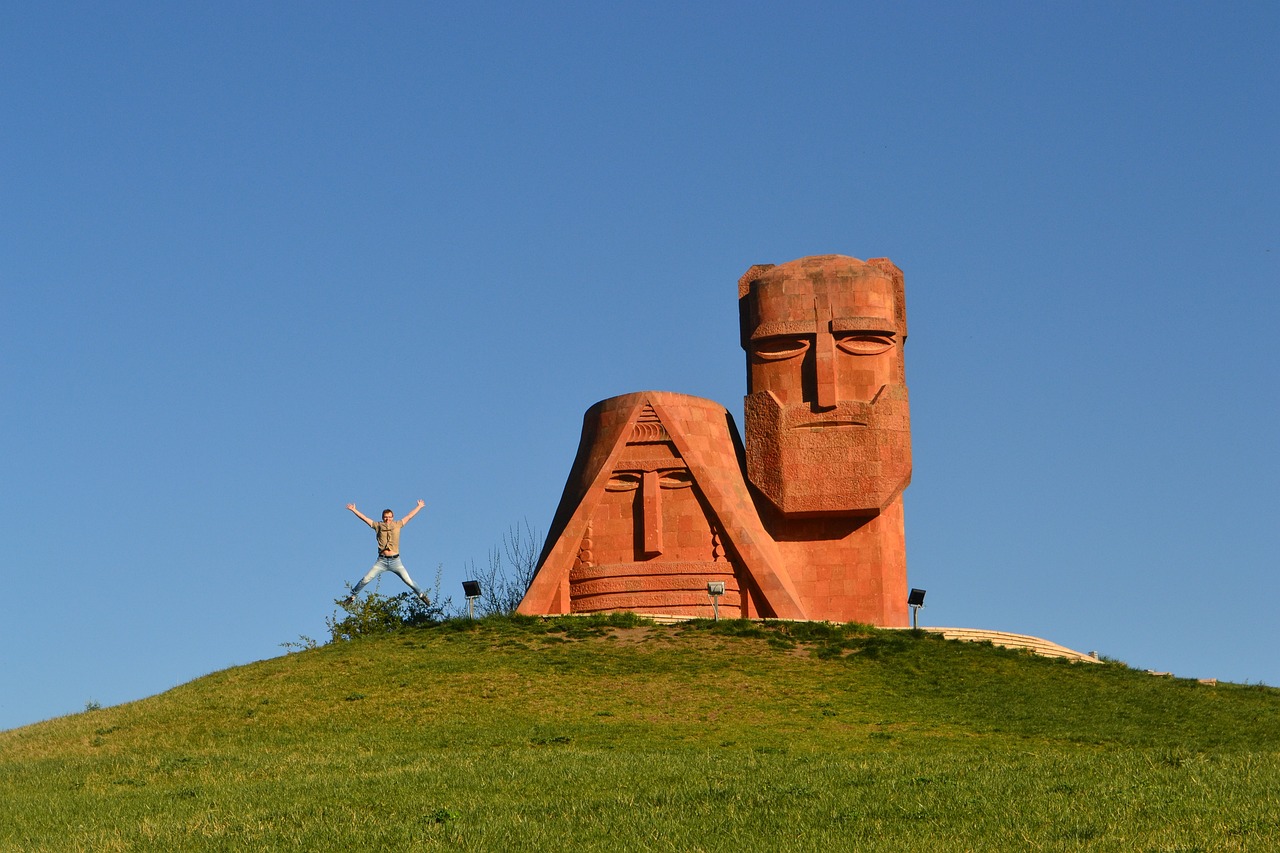
    Nagorno-Karabakh (Artsakh, in Armenian) was one of the territorial victims of this 1921 plot of the pariahs, as it was placed under Soviet Azerbaijani suzerainty together with Nakhichevan. That latter province of the historical Armenian patrimony was subsequently cleansed of its majority Armenian population, and then of its Armenian cultural heritage. As recently as December 2005, Azerbaijan (like Armenia, a member of the Council of Europe) completed the total, Taliban-style annihilation of the medieval Armenian cemetery at Jugha that contained thousands of unique cross-stones.

    Nagorno-Karabakh, by contrast, was able to turn the tide on a past of genocide, dispossession, occupation and partition and defend its identity, integrity, and territory against foreign aggression. In 1991 — long before Kosovo, South Ossetia, and Abkhazia became buzzwords — it declared its liberty, decolonization, and sovereignty in compliance with the Montevideo standards of conventional international law and  with the Soviet legislation in force at that time.

    Subsequent international recognition of Kosovo, on the one hand, and the later withholding of such recognition for South Ossetia and Abkhazia, on the other, demonstrate that there exists no real rule of law applied evenly across the board. On the contrary, such decisions are dictated by vital interests that are rationalized by reference to selectively interpreted international legal principles of choice and exclusivist distinctions of fact which, in fact, make no difference.

    It’s time to face up to the farce — and that goes for Moscow and Ankara too, judging by recent pronouncements by high-level officials. And if the two countries are driven by the desire for a strategic new compact, then at least their partners on the world stage should reshift gears and calibrate their policy alternatives accordingly. Iran, the United States, and its European allies might find here an objective intersection of their concerns.

    What Is Needed

    Russia and Turkey must never again find unity of purpose at the expense of Armenia and the Armenian people. The track record of genocide, exile, death camps, and gulags is enough for all eternity.

    These two important countries, as partners both real and potential, must respect the Armenian nation’s tragic history, its sovereign integrity and modern regional role, and Nagorno-Karabakh’s lawfully gained freedom and independence.

    Football diplomacy is fine, but Turkey can rise to the desired new level of global leadership and local legitimacy only by dealing with Armenia from a “platform” of good faith and reconciliation through truth; lifting its illegal blockade of the republic and opening the frontier that it unilaterally closed, instead of using it as a bargaining tool; establishing diplomatic relations without preconditions and working through that relationship to build mutual confidence and give resolution to the many watershed issues dividing the two neighbors; accepting and atoning, following the brilliant example of post-World War II Germany, for the first genocide of the 20th century and the national dispossession that attended it; committing to rebuild, restore, and then celebrate the Armenian national heritage, from Mount Ararat and the medieval capital city of Ani to the vast array of churches, monasteries, schools, academies, fortresses, and other cultural treasures of the ancestral Armenian homelands; initiating and bringing to fruition a comprehensive program to guarantee the right of secure voluntary return for the progeny and descendants of the dispossessed to their places and properties of provenance; providing full civil, human, and religious rights to the Armenian community of Turkey, including the total abolition the infamous Article 301, which has served for so long as an instrument of fear, suppression, and even death with regard to those courageous citizens of good conscience who dare to proclaim the historical fact of genocide; and finally, exercising greater circumspection in voicing incongruous and unfounded allegations of “occupation” in the context of Nagorno-Karabakh’s David-and-Goliath struggle for life and justice, lest someone remind Ankara about more appropriate and more proximate applications of that term.

    As for Russia, true strategic allies consult honestly with each other and coordinate their policies pursuant to their common interests. They do not address one another by negotiating adverse protocols with third parties behind each other’s back; they do not posture against each other in public or in private; and they do not try to intimidate, arm-twist, or otherwise pressure each other via the press clubs and newspapers of the world. Russia, too, must deal with Armenia in good faith, recognizing the full depth and breadth of its national sovereignty and the horizontal nature of their post-Soviet rapport, its right to pursue a balanced, robust, and integral foreign policy, as well as the nonnegotiability — for any reason, including the sourcing and supervision of Azerbaijani oil — of Nagorno-Karabakh’s liberty, security, and self-determination.

    The Armenian government, in turn, must of course also shoulder its share of responsibility for creating a region of peace and shared stability, mutual respect and open borders, domestic democracy, and international cooperation. An ancient civilization with a new state, Armenia’s national interests can best be served by achieving in short order a republic administered by the rule of law and due process, and an abiding respect for fundamental freedoms, good governance, and fair elections, which, sadly, has not been the case to date.

    Armenia urgently needs a new understanding with its neighbors that will preclude once and for all its being cast again in the role of either fool or victim.

    Raffi K. Hovannisian served from 1991-92 as foreign minister of the Republic of Armenia. He is the founder of the Armenian Center for National and International Studies and represents the opposition Heritage Party in the Armenian parliament. The views expressed in this commentary are the author’s own, and do not necessarily reflect those of RFE/RL