Category: News

  • The Ottomans: A Cultural Legacy

    The Ottomans: A Cultural Legacy

    This video celebrates the cultural legacy of the Ottoman Empire, from “its aesthetics and architecture to its scientific and medical innovations, including the first vaccinations.” This video is based on Diana Darke’s book, The Ottomans: A Cultural Legacy, which “presents the magnificent achievements of an empire that lasted over 600 years and encompassed Asian, European, and African cultures, shedding new light on its complex legacy.”

    Diana Darke is a Middle East cultural expert with special focus on Syria. With degrees in Arabic from Oxford University and in Islamic Art & Architecture from SOAS, London, she has spent over 30 years specializing in the region, working for both government and commercial sectors.

    You can get her book from Thames and Hudson and other retailers

  • Turkey’s Democratic Crisis Is Becoming a Security Crisis

    Turkey’s Democratic Crisis Is Becoming a Security Crisis

    For years, discussions about Turkey’s democratic decline were largely confined to the language of human rights, constitutional law, and domestic politics. International observers viewed the erosion of democratic institutions as a troubling but primarily internal matter; a challenge for Turkish citizens to confront within their own political system.

    That era is over and a darker chapter has begun.

    Turkey’s democratic crisis has evolved into something much larger. It is now becoming a security crisis with implications far beyond our borders. What is unfolding in Turkey today should concern not only those who care about democracy, but also those who care about the long-term stability of Europe, NATO, the Black Sea region, the Eastern Mediterranean, and the Middle East.

    The reason is simple: Turkey is too strategically important to become politically unstable.

    Turkey is now facing a profound political and economic unraveling: President Recep Tayyip Erdogan’s government, having captured much of the state apparatus, is attempting to eliminate the last meaningful democratic alternative while society sinks deeper into economic hardship, social frustration, loss of trust in public institutions and distrust in the future.

    Over the past year, Erdogan’s government has intensified an unprecedented campaign against the democratic opposition. This assault on democratic choice accelerated after the Republican People’s Party (CHP), the main opposition party, achieved a historic municipal victory in 2024, becoming Turkey’s leading political force for the first time in decades. As a result, the government increasingly turned to judicial intervention rather than political competition.

    The most visible target has been Istanbul Mayor Ekrem Imamoglu, our presidential candidate and President Erdogan’s strongest challenger, arrested in March 2025 on absurd, politically motivated allegations and now facing a sentence measured not in years, but in millennia.

    Turkey’s Republican People’s Party (CHP) ousted leader Özgür Özel stands atop of a bus as he delivers a speech during a rally, days after a court dismissed him from office in Izmir on May 26, 2026. The protest came two days after police battered their way into the CHP’s headquarters in Ankara, firing tear gas and beating party members before throwing them out, Özel told AFP. (Photo by Murat Kocabas / AFP via Getty Images)

    Since 2025, around 20 CHP mayors and hundreds of municipal officials have been imprisoned without final convictions and all subjected to pre-trial detention. We have responded to this onslaught by mobilizing citizens in massive rallies across the country, bringing together millions of people far beyond our party lines.

    Most recently, a court invoked the extraordinary doctrine of “absolute nullity” to void the CHP’s 2023 Congress, remove me as the party’s elected leader, and reinstall the previous leadership that had lost the congress and was discredited after 13 consecutive electoral defeats. Basically, aiming to place Turkey’s largest opposition party under judicial control—with the apparent cooperation of figures willing to accommodate Erdogan’s master plan for Turkey’s political order. Whatever this system is called—single-party regime or one-man rule—its governing logic is the same: eliminating any meaningful challenger as well as replacing the real opposition with a managed and compliant one.

    Democracy is about preserving credible pathways through which citizens can peacefully change their government. When those pathways disappear, political frustration does not disappear with them. It builds beneath the surface until it erupts.

    If Erdogan succeeds in dismantling meaningful opposition, for the first time in modern history, Turkey would face deep popular discontent, a severe legitimacy crisis, and no meaningful institutional mechanism through which citizens could peacefully demand political change.

    This is not only a scenario of authoritarian consolidation. It is a scenario of profound instability.

    History teaches a consistent lesson: political systems do not become stable when alternatives disappear; they become stable when citizens believe peaceful change remains possible. The Soviet Union, the Shah’s Iran, the Eastern Bloc, and much of the Arab world all appeared stable during the Cold War—until they suddenly did not. Systems are often most fragile precisely when they look most unchallengeable.

    Turkey’s strategic importance makes this danger especially acute: as gatekeeper of the Black Sea, NATO’s second-largest military power, and a crossroads of Europe, Eurasia, the Middle East, and the Eastern Mediterranean, its role in migration, energy, and regional security means democratic collapse would not remain within its borders.

    History also shows that governments facing domestic instability and declining legitimacy often externalize their crises. Foreign policy confrontation, militarized rhetoric, and geopolitical adventurism become substitutes for the democratic consent and economic success they can no longer provide. Under such conditions, foreign policy crises are framed as questions of national survival.

    As the leader of Turkey’s main opposition party, I firmly believe our country can become one of Europe’s most valuable partners—and ultimately a full member of the European Union at a moment when Europe is building a new security architecture. But sustainable partnerships require democratic legitimacy.

    A country cannot indefinitely serve as a pillar of regional stability while simultaneously dismantling the democratic foundations that sustain internal stability.

    If current trends continue, Turkey risks becoming something unprecedented in NATO’s history: a strategically indispensable member that no longer functions as a democracy, while millions of its citizens grow increasingly dissatisfied with a political and economic order they have no peaceful democratic means to change. This would not merely be a domestic crisis. It would be a profound security challenge.

    The democratic struggle we are waging will shape not only Turkey’s democratic future and the stability of one of the world’s most strategically important countries, but also the security of our region, Europe, and NATO. Democracy and stability cannot be separated for long. The outcome could establish a precedent with consequences far beyond our borders, encouraging either democratic renewal or further authoritarian consolidation across a region already under immense strain.

    Özgür Özel: Turkey’s Democratic Crisis Is Becoming a Security Crisis | Opinion

    Özgür Özel is the leader of the main opposition party in Turkey and a member of Parliament from Manisa province.

    The views expressed in this article are the writer’s own.

    https://www.newsweek.com/turkeys-democratic-crisis-is-becoming-a-security-crisis-opinion-12015939

    Newsweek is a Trust Project member
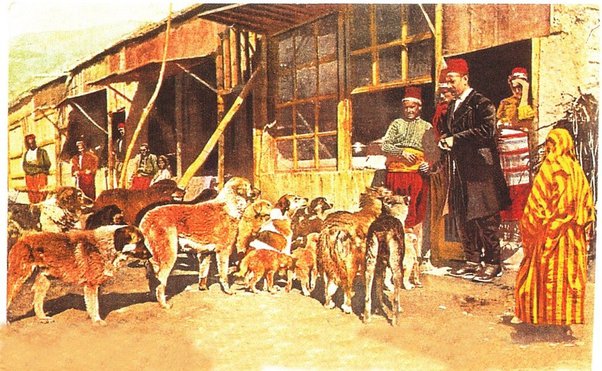
  • The titles chosen by the Ottoman sultans, signifying their claim to the Roman legacy

    The titles chosen by the Ottoman sultans, signifying their claim to the Roman legacy

    1. Mehmed II “Sultan of the two lands, Emperor of the two seas, and Emperor of Rome” “Sultan of two lands, Emperor of two seas, and Emperor of Rome.” “Heir to the realm of Caesar”=>
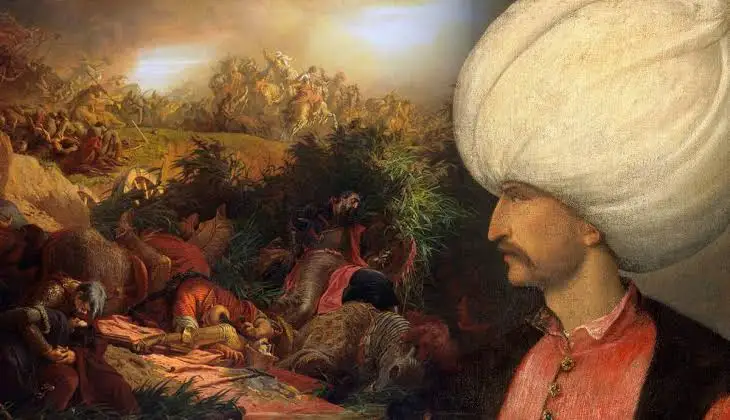
    2. Suleiman I Among the titles used by Suleiman the Magnificent in his letters to European rulers: “I, the Emperor of Rome…”
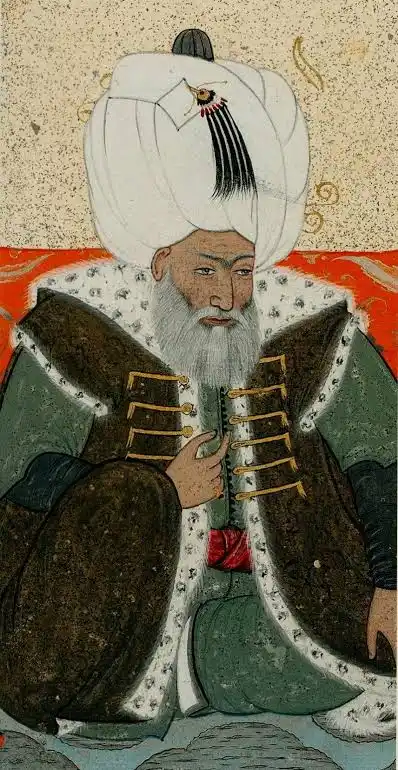
    3. Bayezid II “Basileus Basileon” (“King of Kings”“Megistos Basileus” (“The Greatest Emperor”)

    =======================

    Suleiman I (Suleiman the Magnificent)

    II Beyazıt

  • The Uzun Hüseyin Well

    The Uzun Hüseyin Well

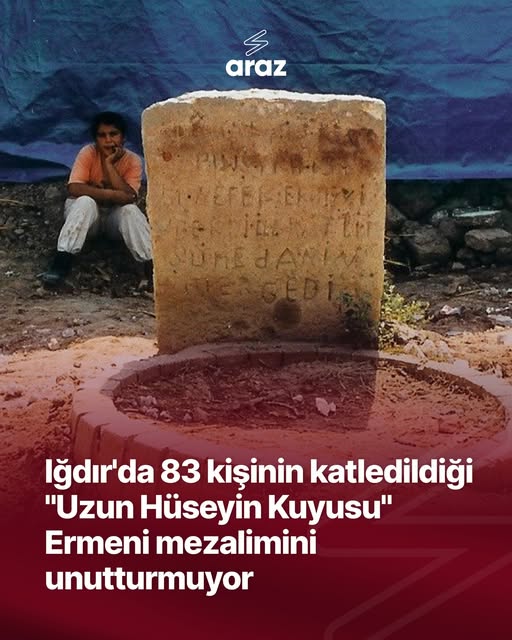
    The Uzun Hüseyin Well, discovered during excavations in Hakmehmet village, where 83 people were allegedly murdered and thrown into the well, reveals the Armenian atrocities that took place in the region.

    The well, approximately 13 meters deep, is located on land belonging to Hüseyin Duman, nicknamed “Uzun Hüseyin,” who lived in Hakmehmet village.

    According to historical sources and accounts from the local people, in 1919, thousands of Armenians who came to the region gathered all the men from the families living in the village in the village square, using various tricks or coercion.

    The Armenian gangs tied the hands of those gathered there, tortured some to death, and threw others alive into the well. Hüseyin Duman, who was thrown into the well during the massacre perpetrated by the Armenians and managed to escape, ensured that the events of that day became known to this day.

    Uzun Hüseyin‘s son, Felemez Duman, recounted his father’s and the villagers’ experiences during the massacre perpetrated by the Armenians. Duman, who still lives in a house next to the mass grave, said, “My father used to say that Armenians surrounded the village, raided everyone’s houses, gathered all the men in the mosque, and tied the hands of the elders. My father told the others, ‘Let‘s escape,’ thinking, ’Our relatives, our families are here, what will happen to them?’ My father managed to escape, and they fired a few shots after him, but they missed.” Duman explained that his father hid in the barn because he couldn’t leave the village due to the Armenian guards around him, and continued, “They brought the men they had tied up to the well near the barn, threw them into the well one by one, some headfirst, and shot them. Finally, they covered them with stones. My mother used to say that we escaped, we survived, we went to Iran, and after a long time, we returned to our village, and blood was still coming out of the well.”

  • The math behind ChatGPT

    The math behind ChatGPT

    A Russian mathematician invented the math behind ChatGPT in 1906 while trying to humiliate a priest in an academic feud, and he died 16 years later without knowing any of it.

    His name was Andrey Markov. His nickname was Andrey the Furious. And the thing he built was never meant to be about language at all.

    Here is the story almost nobody tells you.

    Russia in 1905 was fracturing. The Russo-Japanese War was bleeding the country. Revolution was in the streets. And inside the Imperial Academy of Sciences, two mathematicians were tearing each other apart over a question that had nothing to do with either of them professionally.

    The priest was Pavel Nekrasov, a theologian turned mathematician who believed numbers could prove God’s design. His argument was this: the Law of Large Numbers, the foundational rule of probability theory, only works when events are independent of each other. Like coin flips. No connection between them. And if human decisions follow the same pattern, he said, then human beings must be making truly free, independent choices. Mathematics, in his telling, proved free will. Which meant it proved the soul. Which meant it proved God.

    Markov found this professionally offensive and personally infuriating.

    He was a fierce atheist who had been excommunicated from the Russian Orthodox Church by choice, sending a letter demanding they remove him after they refused to recognize Tolstoy’s excommunication. He had no patience for what he called the abuse of mathematics. The idea that a priest was using probability theory to smuggle theology into science made him furious in the precise way his nickname suggested.

    So he set out to destroy the argument.

    His proof was elegant and brutal. He showed that the Law of Large Numbers does not require independence at all. Averages can stabilize even when every event is connected to the one before it. Free will had nothing to do with it. The soul had nothing to do with it. Nekrasov’s entire theological superstructure collapsed on a mathematical technicality.

    But Markov needed a real-world demonstration. Something concrete. Something that would make the proof undeniable.

    He picked up a copy of Alexander Pushkin’s Eugene Onegin.

    Not to read it. To count it.

    He sat in his study in St. Petersburg and wrote out the first 20,000 letters of the poem in one continuous string, stripping out every space and every punctuation mark until it was just a raw chain of characters. Then he began counting. Vowel or consonant. What follows what. How often does a vowel follow a vowel. How often does a consonant follow a vowel. Week after week, letter by letter, by hand.

    What he found was that the letters were deeply dependent on each other. A vowel is far more likely to follow a consonant than to follow another vowel. The sequence is not random. Each letter is influenced by what came before it. And yet across 20,000 letters, the overall frequency of vowels converged to a stable number. Dependence and statistical regularity could coexist.

    Nekrasov was wrong. The math worked without independence. Free will was not hiding inside probability theory. Markov had proven it on the back of a love poem.

    He called the structure he had discovered a chain. What we now call a Markov chain.

    The idea is simple enough to explain in one sentence. The next state of a system depends only on its current state, not on everything that came before it. Each step carries just enough memory to take the next step. No more.

    What Markov could not have imagined is what that idea would become.

    Every language model that exists today is built on this exact logic. When ChatGPT reads your prompt and generates the next word, it is doing a vastly more sophisticated version of exactly what Markov did with Pushkin’s letters. It looks at the current state of the conversation and calculates what should come next based on patterns in everything it was trained on. The core mathematical intuition, that sequences have structure, that the next element depends on what came before, that you can model language as a chain of dependent probabilities, is Markov’s. It has been Markov’s since 1913.

    His paper on Eugene Onegin was presented to the Imperial Academy of Sciences on January 23, 1913. The audience was mathematicians. The context was a dispute about free will. Nobody in that room was thinking about computers. There were no computers. The first electronic computer would not exist for another three decades.

    He died in 1922, nine years after the paper, in the early chaos of the Soviet era. He was 66. He had spent his final years watching the Tsar fall, the revolution rise, and his country become something unrecognizable. He never saw a transistor. He never imagined a machine that processes language. He thought he had settled an argument with a priest.

    The argument he actually settled was one nobody had asked yet.

    Today his chains are inside every search engine, every voice assistant, every spam filter, every autocomplete. The 2024 paper Large Language Models as Markov Chains shows formally what practitioners have known informally for decades: the inference mechanism of GPT-4, Claude, and Gemini can be characterized as a Markov chain operating over sequences of tokens. The math is his. The name on the paper is someone else’s.

    There is a version of this story where Nekrasov wins the argument. Where Markov decides the priest is not worth his time. Where nobody counts 20,000 letters in a poem to settle a theological dispute.

    In that version, the chain is never invented. Or it is invented later, by someone else, for different reasons, on a different timeline.

    We got this version instead. The furious atheist. The love poem. The weeks of counting. The proof that destroyed a man’s theology and accidentally handed the 21st century its most important mathematical tool.

    Nekrasov wanted to find God in the numbers.

    What he found instead was Markov. And Markov found something neither of them was looking for.

    Source: Ihtesham Ali

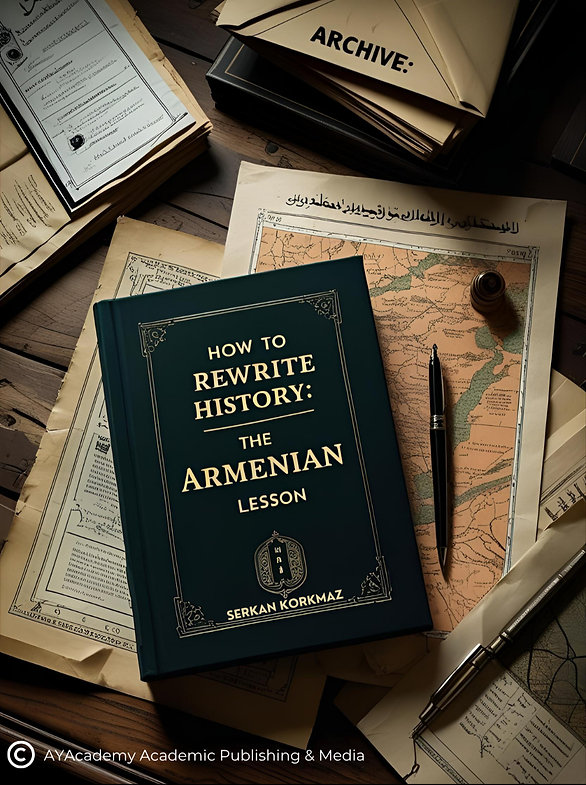
  • How to Rewrite History, Distortion of Reality: Armenian Lesson

    How to Rewrite History, Distortion of Reality: Armenian Lesson

    This book critically examines the global campaign to label the 1915 Ottoman relocation of Armenians as “genocide,” arguing that such a designation lacks both legal foundation and historical accuracy. Drawing upon primary academic sources, international law instruments, and archival documents, the study deconstructs the ideological mechanisms used to rewrite history through selective narratives and politicized memory.The book argues that the portrayal of the 1915 events as “genocide” is a product of political lobbying, diaspora activism, and a growing trend of parliaments assuming judicial roles in historical controversies. Relying on the Genocide Convention of 1948, the principle of non-retroactivity, and the doctrine of legal positivism, the study finds that the events fail to meet the definitional threshold of genocide under international law.Furthermore, the research explores how diaspora-driven narratives, coupled with terrorism and propaganda during the 20th century, have reshaped public memory and influenced parliamentary decisions in especially Western states. The misuse of legislative platforms to issue historically and legally non-binding declarations on “genocide” is identified as a distortion of both history and justice.This book provides a legal, historical, and political refutation of the genocide allegations by examining both Turkish and Western scholarly perspectives. It offers a “lesson” in how history can be manipulated for ideological ends, emphasizing the importance of juridical processes, objective scholarship, and archival integrity in confronting such claims.
    AYACADEMY

    Serkan KORKMAZ