Month: October 2009

  • STREAMS TAKING DOWN OBSTACLES

    STREAMS TAKING DOWN OBSTACLES

    Tribuna
    October 29, 2009

    Fortunately, Russia has powerful allies in Europe nowadays
    Author: Giulietto Chiesa
    SOME EUROPEAN COUNTRIES HAVE THE PRESENCE OF MIND TO DISREGARD WASHINGTON’S ORDERS IN THE MATTER OF ENERGY COOPERATION WITH RUSSIA

         As soon as Nord Stream negotiated all bureaucratic and
    technological obstacles, Europe and the United States initiated
    debates or, rather, mounted a campaign aiming to circumvent the
    whole project. It was then that Premier Vladimir Putin organized
    informal meetings with his Italian counterpart Silvio Berlusconi
    and Gerhard Schroeder of Germany.
         Nord Stream is the largest project Moscow designed in years.
    It is a gas pipeline across the Baltic Sea to Germany that will
    spare Russia inconveniences of transit via Ukraine. Victor
    Yuschenko’s reign made the situation absolutely intolerable. The
    so called Orange Revolution put Kiev under Brussels’ and
    Washington’s protective wing and set it on a course into NATO via
    the European Union. In other words, it fomented a deliberate
    confrontation with Moscow. Why would Russia continue to try and
    appease Kiev? Past friendship is kaput. Besides, not even all of
    Europe is prepared to put up with the Ukrainian blackmailers. That
    their methods lack finesse is putting it mildly. Whenever gas
    bound for Europe disappears somewhere in Ukraine, Moscow turns the
    valve. As a result, both Kiev and Europe remain without gas. Sure,
    it costs Russia too but what really counts is that Europe is
    swindled out of one fourth of the gas it needs.
         Moscow’s pragmatic policy secured it another prospective
    buyer, one who desperately needs all energy it can lay its hands
    on. This new customer can well reroute the channels still going to
    the West in its own direction. The matter concerns China, of
    course. Gas pipelines to China are already built.
         In other words, Putin has found someone interested and
    prepared to pay. Nord Stream in the meantime costs more than 10
    billion euros. Germany was the first country where the Kremlin’s
    voice was finally heard. Ex-Chancellor Schroeder became the head
    of the project. Frau Merkel backed him. Sarkozy in France wants
    his slice of the pie too. There is South Stream as well, an
    alternative to Nabucco. South Stream will send Russian gas via the
    Black Sea to Bulgaria, Balkans, Greece, Italy. Putin’s plans found
    enthusiastic supporters in official Rome – Berlusconi and Eni. So,
    there is a new situation to be taken into account. It is in
    Moscow’s power now to deliver gas, Russian and Central Asian, to
    Europe without fearing that Ukraine will pull something off.
         Needless to say, official Washington does not take to all
    these developments. Pretty well forgotten, Jimmy Carter’s National
    Security Advisor Zbigniew Brzezinski raised his voice again.
    Washington plainly announced that Moscow was out to divide West
    and East Europe. Its satellites joined the critical chorus.
    Estonia began complaining that the Baltic states had been
    “ignored”. A bunch of exes (former heads of states and
    governments) condemned Moscow for the intention “to restore its
    sphere of influence”. All projects promoted by Moscow seek to
    undermine economic stability of East Europe – that’s the most
    popular tune in East European capitals, these days. The Kremlin is
    condemned for what is called “energy blackmail”.
         But why wouldn’t Brussels itself rearrange gas in accordance
    with market realities? Russia will keep exporting gas in any
    event. East Europeans claim that Moscow has planned some foul play
    and that demands will be put forth soon enough. Sikorski in Warsaw
    went so far as to equate Nord Stream with the Molotov-Ribbentrop
    Pact. (To listen to these guys, construction of gas pipelines must
    be thwarted no matter what.) European allies sing hosannah to
    Nabucco, a project lobbied by the United States. Nabucco is about
    giving Russia the mitten and having the Central Asian work for the
    West. Besides, Nabucco is to be built across Turkey and Georgia.
    By and large, that’s a great plan, but… but Putin and Medvedev
    have already struck back. They have powerful (not to say decisive)
    allies in Europe now.
         Some events of considerable magnitude and importance are
    bound to follow. Since Putin, Berlusconi, and Schroeder decided to
    meet informally in St.Petersburg, it can only mean that a
    counteroffensive is about to be mounted.
         

    Translated by Aleksei Ignatkin
  • Crimean Tatar Leader Claims FSB Behind Murder Plan

    Crimean Tatar Leader Claims FSB Behind Murder Plan

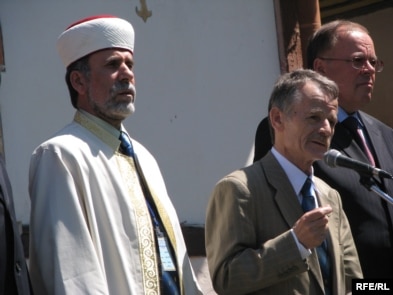
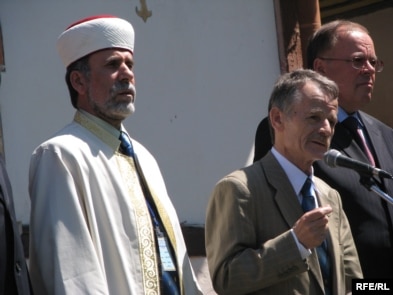
    Mustafa Dzhemilev (center) said he knows from diplomatic sources about FSB plans to have him killed.


    October 29, 2009
    KYIV — Crimean Tatar leader Mustafa Dzhemilev says he believes Russia’s Federal Security Service (FSB) is behind a special operation to assassinate him, RFE/RL’s Kazakh Service reports.

    Two members of the Islamist group At-Takfir wal-Hidjra were arrested on October 26 during a special operation in several parts of the Ukrainian region.

    Leaders of the movement are alleged to have issued a fatwa to kill Dzhemilev and some of his associates for their criticism of radical Islam.

    Dzhemilev told RFE/RL that members of a radical Islamic movement who were recently arrested “could hardly” initiate such an assassination plan.

    Dzhemilev said the spiritual direction of the Crimean Muslims and radical Islamist organizations share a “mutual enmity.” He added that radical Islamists have nothing in common with Islam and should be called extremists.

    But Dzhemilev said he knows from diplomatic sources about FSB plans to have him killed. He said “some states who are not interested in allowing democratization in Ukraine” might be sponsoring the extremist Islamic organizations.

    Ukrainian Interior Minister Yuriy Lutsenko said the arrested members of the Islamist group are refusing to talk. He said they refuse to recognize Ukrainian laws and say they are subordinate only to their religion.

    Crimean police chief Gennady Moskal told RFE/RL that an estimated 100 members of extremist organizations are active in Crimea. He said security forces are searching for At-Takfir wal-Hidjra’s leader.

    Moskal added that some refugees from Uzbekistan join up with Ukrainian extremist organizations.

    He said he does not believe there is “a Russian trace” in any assassination plan for Dzhemilev.

    Dzhemilev, who is the chairman of the Crimean Tatar Assembly and spent many years in the gulag as a Soviet dissident, had previously called on the Ukrainian government to allow the 33 Crimean Tatar parliament members to carry arms due to threats from Islamic extremists.

    https://www.rferl.org/a/Crimean_Tatar_Leader_Claims_FSB_Behind_Murder_Plan/1864556.html
  • Turkey Reveals True Intentions in Protocols Game

    Turkey Reveals True Intentions in Protocols Game

    Asbarez Post
    Tuesday October 27, 2009

    Forward this email to a Friend


    WATCH NOW

    Turkey Reveals True Intentions in Protocols Game

    Protocols Ratification to Be Held Hostage For Concessions on Karabakh

    Turkey’s parliament will not ratify the normalization agreements with Armenia unless international efforts to resolve the Nagorno-Karabakh conflict yield a breakthrough that favors Azerbaijan, according to Foreign Minister Ahmet Davutoglu.

    “In order to get a yes [vote,] we need to have some progress in the [Karabakh] peace talks because Azerbaijan is a strategic ally and almost a domestic issue for Turkish foreign policy,” Davutoglu said in an interview with Al Jazeera television aired on Monday. The international community should help to end “the illegal occupation of 20 percent of Azerbaijani territories” if it wants a speedy normalization of Turkish-Armenian relations, he said.  More…


  • CONNECTICUTT TURKISH REPUBLIC DAY; OCT. 30

    CONNECTICUTT TURKISH REPUBLIC DAY; OCT. 30

    hareketli29ekimresim

    ATATURK3

    ATATURK2

    CUMHURIYET BAYRAMI

    TURKISH REPUBLIC DAY

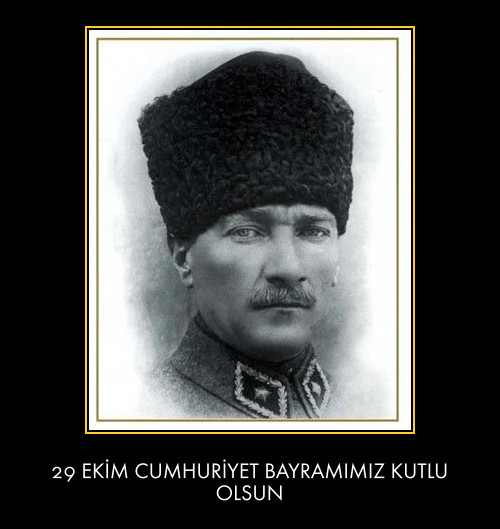
    “Sovereignty belongs unconditionally to the people.”
    Mustafa Kemal Ataturk

    86cı Cumhuriyet Bayramınız Kutlu Olsun!

    86th Annual Republic Day celebrations commemorating the establishment of the secular, democratic and modern Republic of Turkey.

    Friday, October 30, 2009
    2:00 P.M. – 4:00 P.M.

    Connecticut State Capitol, 3rd floor, Old Judiciary Room

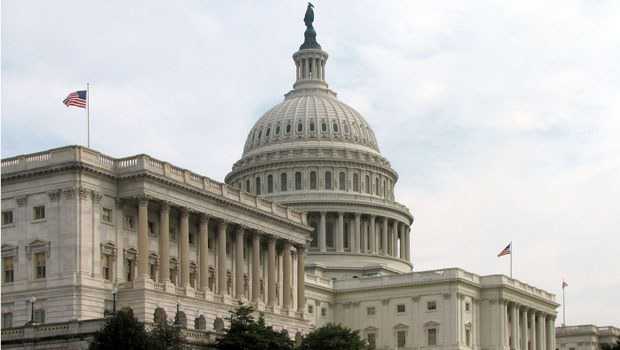
    The Turkish flag flies over the Connecticut State Capitol and Town Hall of Wolcott

    The modern Turkish Republic was founded exactly 86 years ago on October 29, 1923. The Grand National Assembly proclaimed the Republic of Turkey. Mustafa Kemal Atatürk was named its president and Ankara its capital, and the modern state of Turkey was born out of the ashes of the Ottoman Empire.

    ==========================================================

    CONNECTICUTTDA

    CUMHURIYET BAYRAMI KUTLAMALARI

    CONNECTICUTT EYALETI

    17inci Sene Ananevi Cumhuriyet Bayramı Kutlamaları.

    Türk Bayrağı

    24 Ekim – 1 Kasım tarihleri

    arasında Connecticutt eyaletinin

    Hartforddaki Eyalet merkezi ve Meclis  binasında ve

    Wolcott Sehrindeki Belediye Binasında

    Amerikan Bayraginin yani sira dalgalanacak.

    Cumhuriyet töreni

    Hartford sehrinin merkezinde olan,  Vilayet-Meclis

    binasında, Dorduncu katda

    Tarihi Meclis Salonunda (Judiciary Room)

    30 Ekim Cuma günü

    saat 14:00’de başlayacak.

    Kokteyl ve Türk müziği saati 16:00 ve 17:00

    arasında aynı odada gerçekleşecek.

    Connecticut valisi, Newyork basKonsolosumuz,

    Birlesmis Milletlerin Turkiye ve Kıbrıs

    Buyukelcileri (temsilcileri), Connecticut eyaletinin

    Senator ve Milletvekilleri, Congressman

    Murphy, Himes, Courtney and Rosa

    Delauro, Turk Nufusunun yogun oldugu

    Hartford, Newington ve

    Wolcott Sehirleri Belediye Baskanlari, TURKISH FORUM,

    ATAA, ve FTAA temsilcileri ve Tum Dernek Uyelerimiz törene davet edildi.

    Toren ve Kokteyl Katilmak isteyen her dostumuza acikdir – hepinizi bekliyoruz

    Connecticutt Üniversitesi öğretim

    üyelerinden Prof. Dr. Okşan Bayülgen’in

    “Türk Kimliği” konulu bir konuşmada

    yapacağı töreni Dernegimizin Kurucularindan

    Dr. Robert B.  McKay son 16 senedir oldugu gibi

    bu sene de törenin Acilisini, yönetimini, takdimlerini ve Kapanisini  yapacaklardir..

    Acilis Konusmasi ise Dernek Baskanimiz sayin Goknur McAvoy tarafindan yapilacakdir.

    Dr. Kayaalp Buyukataman

    SNE-TACA Kurucu Baskani,  SNE-TACA Onursal Baskani

    NOT: 75 INCI YIL CONNECTICUTT CUMHURIYET BAYRAMI KUTLAMALARININ BIR MISALI https://www.turkishnews.com/29Ekim/  ADRESINDEN GORULEBILIR.

    ===================================

    The Southern New England Turkish American Association was established in 1992 and is a non profit organization. Our mission is to foster, promote, plan and execute programs aimed at improving the social, cultural, educational, economic and general welfare of the Turkish-American community in Connecticut and adjacent states. Application for membership is open to anyone 18 years or older who is willing to abide by the principles and aims of the Association The structure of the Association built by the General Assembly, Board of Directors, and Executive Committee: Officers of the Association: Göknur McAvoy—President Evgin Heath—Vice President Zeynep Akkan—General Secretary Güzin Biro—Treasurer

    ========================================================

    Southern New England Turkish American Association cordially invites you to celebrate the Turkish Republic Day “Cumhuriyet Bayramı” celebration commemorating the establishment of the secular, democratic and modern Republic of Turkey, on Friday, October 30, 2009 2:00 – 4:00 P.M. It will be held at the Connecticut State Capitol building on the third floor in the Old Judiciary Room The modern Turkish Republic was founded exactly 86 years ago on October 29, 1923. The Grand National Assembly proclaimed the Republic of Turkey. Mustafa Kemal Atatürk was named its president and Ankara its capital, and the modern state of Turkey was born out of the ashes of the Ottoman Empire. Respectfully, Mrs. Göknur McAvoy President Program of the Turkish Republic Day and Proclamation Ceremony Introduction – MC National Anthems Opening Remarks Official Statements and Presentation of Proclamations Theme of the Ceremony – Turkish Identity Achievement Awards Recognition Awards Cocktails and Turkish Music Turkish Republic Day Cumhuriyet Bayramı

    ——————————————————————————————–

    SNETACA Southern New England Turkish American Cultural Association P.O. Box 6009 Wolcott, CT 06716 E-mail: [email protected] Web Site:

  • Turkey to recompense $1.1 billion for low-priced Azeri gas

    Turkey to recompense $1.1 billion for low-priced Azeri gas

    TURKISH-ARMENIAN PROTOCOLS ARE AT WORK


    [ 28 Oct 2009 15:18 ]

    Trend News Agency

    Baku. Rashad Suleymanov – APA-ECONOMICS. Turkey will pay the difference between the old price it has paid for Azeri gas since April 2008 after the gas agreement expired and the new price to be agreed on with Azerbaijan, said Turkish Energy Minister Taner Yilldiz.

    According to him, Turkey has continued to import natural gas from Azerbaijan although the gas supply agreement expired in April 2008.

    “Today we no longer buy low-priced gas from Azerbaijan. In accordance with the new price to be agreed upon, we will pay the difference”, he said, adding that Turkey is continuing talks with Azerbaijan’s SOCAR on natural gas, and hopes to reach an agreement soon.

    Turkish media report that Turkey will have to pay at least $1.1 billion to Azerbaijan as price difference compensation if the new gas price is around $250 per 1,000 cubic meters, compared to the current price of $120. .

  • Turkey: An Ally No More

    Turkey: An Ally No More

    by Daniel Pipes
    Jerusalem Post
    October 28, 2009


    the Middle East Forum, headed by Daniel Pipes

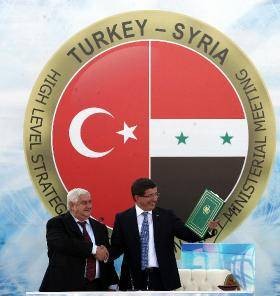
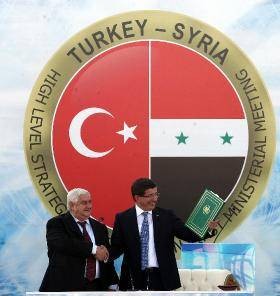
    The foreign ministers of Turkey and Syria met in Aleppo in October 2009.

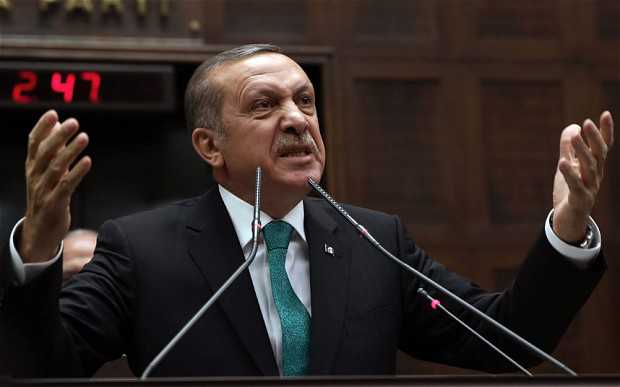
    “There is no doubt he is our friend,” Turkey’s prime minister, Recep Tayyip Erdoğan, says of Iran’s president Mahmoud Ahmadinejad, even as he accuses Israel’s foreign minister Avigdor Lieberman of threatening to use nuclear weapons against Gaza. These outrageous assertions point to the profound change of orientation by Turkey’s government, for six decades the West’s closest Muslim ally, since Erdoğan’s AK party came to power in 2002.

    Three events this past month reveal the extent of that change. The first came on October 11 with the news that the Turkish military – a long-time bastion of secularism and advocate of cooperation with Israel – abruptly asked Israeli forces not to participate in the annual “Anatolian Eagle” air force exercise.

    Erdoğan cited “diplomatic sensitivities” for the cancelation and Foreign Minister Ahmet Davutoğlu spoke of “sensitivity on Gaza, East Jerusalem and Al-Aqsa mosque.” The Turks specifically rejected Israeli planes that may have attacked Hamas (an Islamist terrorist organization) during last winter’s Gaza Strip operation. While Damascus applauded the disinvitation, it prompted the U.S. and Italian governments to withdraw their forces from Anatolian Eagle, which in turn meant canceling the international exercise.

    As for the Israelis, this “sudden and unexpected” shift shook to the core their military alignment with Turkey, in place since 1996. Former air force chief Eytan Ben-Eliyahu, for example, called the cancelation “a seriously worrying development.” Jerusalem immediately responded by reviewing Israel’s practice of supplying Turkey with advanced weapons, such as the recent $140 million sale to the Turkish Air Force of targeting pods. The idea also arose to stop helping the Turks defeat the Armenian genocide resolutions that regularly appear before the U.S. Congress.

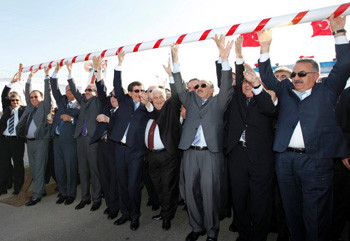
    Ministers of the Turkish and Syrian governments met at the border town of Öncüpınar and symbolically lifted a bar dividing their two countries on October 13.

    Barry Rubin of the Interdisciplinary Center in Herzliya not only argues that “The Israel-Turkey alliance is over” but concludes that Turkey’s armed forces no longer guard the secular republic and can no longer intervene when the government becomes too Islamist.

    The second event took place two days later, on October 13, when Syria’s Foreign Minister Walid al-Moallem announced that Turkish and Syrian forces had just “carried out maneuvers near Ankara.” Moallem rightly called this an important development “because it refutes reports of poor relations between the military and political institutions in Turkey over strategic relations with Syria.” Translation: Turkey’s armed forces lost out to its politicians.

    Thirdly, ten Turkish ministers, led by Davutoğlu, joined their Syrian counterparts on October 13 for talks under the auspices of the just-established “Turkey-Syria High Level Strategic Cooperation Council.” The ministers announced having signed almost 40 agreements to be implemented within 10 days; that “a more comprehensive, a bigger” joint land military exercise would be held than the first one in April; and that the two countries’ leaders would sign a strategic agreement in November.

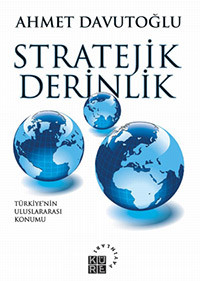
    The cover of Ahmet Davutoğlu’s book, “Strategic Depth: Turkey’s International Position.”

    The council’s concluding joint statement announced the formation of “a long-term strategic partnership” between the two sides “to bolster and expand their cooperation in a wide spectrum of issues of mutual benefit and interest and strengthen the cultural bonds and solidarity among their peoples.” The council’s spirit, Davutoğlu explained, “is common destiny, history and future; we will build the future together,” while Moallem called the get-together a “festival to celebrate” the two peoples.

    Bilateral relations have indeed been dramatically reversed from a decade earlier, when Ankara came perilously close to war with Syria. But improved ties with Damascus are only one part of a much larger effort by Ankara to enhance relations with regional and Muslim states, a strategy enunciated by Davutoğlu in his influential 2000 book, Stratejik derinlik: Türkiye’nin uluslararası konumu (“Strategic Depth: Turkey’s International Position”).

    In brief, Davutoğlu envisions reduced conflict with neighbors and Turkey emerging as a regional power, a sort-of modernized Ottoman Empire. Implicit in this strategy is a distancing of Turkey from the West in general and Israel in particular. Although not presented in Islamist terms, “strategic depth” closely fits the AK party’s Islamist world view.

    As Barry Rubin notes, “the Turkish government is closer politically to Iran and Syria than to the United States and Israel.” Caroline Glick, a Jerusalem Post columnist, goes further: Ankara already “left the Western alliance and became a full member of the Iranian axis.” But official circles in the West seem nearly oblivious to this momentous change in Turkey’s allegiance or its implications.

    The cost of their error will soon become evident.

    Mr. Pipes is director of the Middle East Forum and Taube distinguished visiting fellow at the Hoover Institution of Stanford University.