Month: October 2009

  • Chomsky: Palestine and the region in the Obama era: the emerging framework.

    Chomsky: Palestine and the region in the Obama era: the emerging framework.

    Date: 29.10.09
    Time: 14:00
    Location: Logan Hall, Institute of Education, Bedford Way
    Speakers:
    Prof. Noam Chomsky – Professor Emeritus in Linguistics at MIT; world renowned author and leading intellectual
    Tariq Ali – Historian, Author and well known political commentator

    The Imperial College Political Philosophy Society, in association with Palestine societies at UCL, SOAS, Goldsmiths, LSE, Imperial and Kings, proudly present one of the greatest political philosophers of all time: MIT Professor Emeritus Noam Chomsky, for what could be his last trip to London.

    The Imperial College Political Philosophy Society

    To Watch the video:

    Chomsky: Palestine and the region in the Obama era: the emerging framework. from ICU Political Philosophy Society on Vimeo.

    Chomsky: Palestine and the region in the Obama era: the emerging framework. from ICU Political Philosophy Society on Vimeo.

  • Serious Turkish diplomacy

    Serious Turkish diplomacy

    By: Flynt Leverett & Hillary Mann Leverett
    October 29, 2009 05:25 AM EST

    Turkey’s prime minister, Recep Tayyip Erdogan, was expected to come to the White House on Thursday for a meeting with President Barack Obama. Erdogan’s visit has now been postponed, and the decision to postpone comes on the heels of the Turkish leader’s high-profile visit to Iran this week.

    When Erdogan does come to Washington, Obama would do well to listen to his Turkish visitor about the current state of play in the strategically vital Middle East. Erdogan will come to Washington not only at a time of strong domestic support for his government and the ruling Justice and Development Party, a moderate Islamist party that has dominated Turkish electoral politics in this decade, but also at a time of increasing influence for Turkey in the broader Middle East — while America’s influence in the region continues to decline.

    We spent several days in Turkey last week, where we heard Erdogan describe his country’s “zero problems” policy vis-à-vis its neighbors. Regarding the Middle East more specifically, Erdogan’s chief foreign policy adviser explained to us that Turkey’s approach to the region is based on four principles:
    1. Engage all actors;
    2. respect the results of all democratic elections (including those in the Palestinian territories in 2006 and Iran in 2009);
    3. increase cultural and economic relations among countries in the region; and
    4. work with regional and international organizations to maximize possibilities for engagement.

    Turkey is, of course, a member of NATO and has long had a positive economic and strategic relationship with Israel. But, working from these four principles, the Erdogan government has in recent years effected major improvements in Turkey’s relations with a much wider range of Middle Eastern states, including Iran, Iraq and Syria.

    This opening to the broader Middle East has been very strongly in Turkey’s interest. Expanding trade and investment links to Iran, Iraq, Syria and other regional states has boosted the growth of Turkey’s economy and reinforced its status as an “emerging market” of international significance. Moreover, closer ties to Middle Eastern countries, along with links to Hamas and Hezbollah, have made Ankara an increasingly important player across a wide spectrum of regional issues.

    Erdogan wants to position Turkey to act as a mediator between its Muslim neighbors and the West — including the United States, which needs to move beyond nice speeches by Obama and undertake concrete diplomatic initiatives to repair its standing in the Middle East.

    But if Washington is too shortsighted to see the necessity of realigning its relations with key Middle Eastern actors such as Iran, the Erdogan government’s opening to the broader Middle East gives Ankara a wider array of strategic options for pursuing Turkish interests — the essence of successful diplomacy.

    During his visit to Tehran this week, Erdogan met with Supreme Leader Ali Khamenei — a rare honor for a foreign leader. (In 2007, Russia’s then-President Vladimir Putin was also accorded a meeting with Khamenei.) Turkey’s expanding ties to the Islamic republic — including gas supply contracts and preliminary agreements for major upstream and pipeline investment projects — are essential to consolidating Turkey’s role as the leading transit “hub” for oil and gas supplies to Europe. While in Iran, Erdogan said that he hopes Turkish-Iranian trade — currently valued at roughly $10 billion — will double by 2011 and strongly supported Iranian participation in the Nabucco gas pipeline. Meeting with Iranian President Mahmoud Ahmadinejad, Erdogan criticized international pressure on Tehran over its nuclear activities as “unjust and unfair” while other states maintain nuclear weapons.

    These statements signal that Turkey may well move ahead and conclude significant upstream and pipeline contracts in Iran despite U.S. opposition. The U.S. position on this issue is detached from economic reality. However much the Obama administration resists admitting it, the Nabucco pipeline will almost certainly not be commercially viable in the long run without Iranian gas volumes. In the end, Turkey’s approach to Iran does more for Western interests than does the U.S. approach. Under the Erdogan government, Ankara is increasingly confident that it can pursue its interests in the Middle East without either succumbing to U.S. pressure or fundamentally sacrificing its relationship with Washington. Erdogan’s planned visit to the White House strongly suggests that this confidence is eminently justified.

    Israelis and some of Israel’s friends in the United States decry what they see as the expansion of Turkey’s ties to other important Middle Eastern states at the expense of Turkey’s ties to Israel. Ankara has indeed been sharply critical of Israel’s military campaign in Gaza and its role in the continuing humanitarian crisis there — a posture manifested in Erdogan’s highly publicized walkout from a joint event with Israeli President Shimon Peres at the World Economic Forum and the postponement of NATO military exercises in Turkey that would have included Israeli forces. But criticism of Turkey from pro-Israel circles misses an important reality: At this point, Israel arguably needs a relationship with Turkey more than Turkey needs a relationship with Israel.

    There is an important lesson here for the Obama administration. America no longer has the economic and political wherewithal to dictate strategic outcomes in the Middle East. Increasingly, if Washington wants to promote and protect U.S. interests in this critical region, it will have to do so through serious diplomacy — by respecting evolving balances of power and accommodating the legitimate interests of others so that U.S. interests will be respected. Turkey’s Middle East policy provides a valuable model of what that kind of diplomacy looks like.

    Flynt Leverett directs the New America Foundation’s Iran Project and teaches international affairs at Penn State. Hillary Mann Leverett is CEO of Stratega, a political risk consultancy.

    © 2009 Capitol News Company, LLC
  • Fights at anti-fascist protest at Leeds

    Fights at anti-fascist protest at Leeds

    Hundreds of anti-fascism protesters have gathered in a city centre to demonstrate against a planned protest by a far right-wing group.

    Minor scuffles broke out between police and protesters as around 400 Unite Against Fascism activists descended on Leeds.

    Officers were trying to shepherd them towards a square outside the city’s art gallery to ensure they were kept apart from rival English Defence League demonstrators who are due to meet later this afternoon a short distance away.

    A large number of police officers, including a mounted section, were deployed in the city centre to keep the rival groups apart.

    A police helicopter circled above while activists from Unite Against Fascism shouted slogans.

    Demonstrators carried placards and banners and shouted “Fascist scum off our streets”.

    The scuffles broke out as police officers linked arms and moved the protesters towards the gallery.

    One protester was grabbed by officers and dragged towards a nearby police van.

    Several streets in the city were closed as the demonstrations took place.

    Press Association

  • Turkey leads the Muslim world

    Turkey leads the Muslim world

    Ankara has healed relations with and between its neighbours. But it cannot bring itself to be diplomatic with Israel

    • Stephen Kinzer
      • Stephen Kinzer
      • guardian.co.uk, Tuesday 27 October 2009 17.00 GMT
      • Article history

    This week’s visit to Iran by the Turkish prime minister, Recep Tayyip Erdoğan, is to be warmly welcomed. Turkey is playing a highly positive new role in the Middle East. It seeks to be a conciliator, a mediator, a peacemaker. Reaching out to Iran is an ideal way for it to play this role.

    Turkish leaders have spent several years pursuing a goal they call “zero problems with neighbours“. They have been highly successful. Turkey is on good terms with Greece, Bulgaria and Iraq. As for Syria, with which it almost went to war a decade ago, visa requirements have been abolished, and foreign minister Ahmet Davutoğlu asserted in Aleppo earlier this month that the two countries share “a joint destiny, a joint history and a joint future”. This came just days after Turkey’s highly promising breakthrough with Armenia, under which their border is to be reopened and diplomatic relations restored after a 16-year break.

    Now Turkey is moving to a second, even more ambitious stage of its regional policy: “no problems between neighbours.” Its leaders realise that Turkey’s future prospects depend on regional stability, and are actively seeking to resolve disputes in the neighbourhood. Because of its size, its economic power, its history and its well-developed though still incomplete democracy, Turkey is uniquely placed to be both a model and a broker.

    For most of Turkey’s modern history, the Muslim world has seen it as an apostate. Atatürk’s reforms pulled it so far from Islam that it seemed to have no religious legitimacy. Besides, it was perceived as Washington’s lackey, stigmatised by its embrace of American policies that many Muslims found abhorrent.

    Neither of those objections applies to Turkey today. It is governed by pious Muslims and has its own foreign policy. Its leaders are warmly welcomed in many places where, in the past, they would not even have cared to visit.

    Under other circumstances, Egypt, Pakistan or Iran might have emerged to lead the Muslim world. Their societies, however, are weak, fragmented and decomposing. Indonesia is a more promising candidate, but it has no historic tradition of leadership and is far from the centre of Muslim crises. That leaves Turkey – which, by happy coincidence, is eager to play this role.

    One dark spot, however, has emerged to blot this happy picture. Turkey has begun to distance itself from Israel. This month it cancelled its participation in a joint military manoeuvre with the Israeli defence forces. Its leaders speak out angrily against Israeli policies – most notably prime minister Erdoğan, who at this year’s Davos conference denounced Israel’s invasion of Gaza as a “crime against humanity”. One of the region’s most important relationships is fraying.

    Turkish leaders are allowing emotion to affect their attitude toward Israel. They are understandably angry over Israeli misdeeds. If Turkey is to be a bridge among nations, though, it cannot afford gratuitously to alienate any. The United States has brought itself much grief by isolating Iran; it would be just as foolish for Turkey to reject Israel.

    Like Iran, Israel is a pariah in many circles, and is frozen out of Middle East security arrangements. This is bad for all parties. Pushing Israel into a corner, or making Israel feel that it is alone and friendless, does not serve the cause of peace.

    Turkey has a history of excellent relations with Jews, and was one of the first countries to recognise Israel. Turning its back on that legacy, as it has apparently begun to do, contradicts its new diplomatic role as a broker of compromise. The contribution Turkey can make by playing that role is far greater than the feel-good effect of lashing out emotionally at Israel’s excesses.

    For Turkey to strengthen ties with Iran is good – as long as it does not turn its back on the United States. For it to cultivate relations with Hamas and Hezbollah is also good – but not if it breaks with Israel. Turkey shows unique promise as a regional peacemaker. To play that role, however, it must follow a cardinal rule that the US has for years ignored: shape foreign policy according to national interest, not emotion.
  • Fireworks for Turkish Republic Day

    Fireworks for Turkish Republic Day

    Istanbul has hosted a massive fireworks display to mark the 86th anniversary of the Turkish Republic.


    Click on the link to watch:

    http://news.bbc.co.uk/2/hi/europe/8333035.stm

  • European Court decision gives hope to Turkish travellers

    European Court decision gives hope to Turkish travellers

    Published: Thursday 29 October 2009   

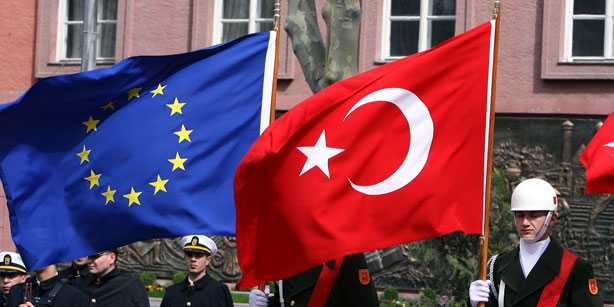
    A recent European Court of Justice ruling has increased the chances of speeding up the abolition of visa requirements for Turkish citizens visiting the EU, the president of Turkey’s Economic Development Foundation (IKV), Professor Haluk Kabaalioglu, told EurActiv Turkey in an interview.

    Professor Kabaalioglu, who is dean of the Faculty of Law at Yeditepe University and has worked as a high-ranking diplomat in the Turkish Mission to the EU, called for the removal of visa barriers for Turkish nationals in the Schengen space, which he finds inconsistent with the country’s status as a candidate for membership of the Union. 

    The Turkish lobbyist described at length the difficulties faced by various professional groups affected negatively by cumbersome visa-issuing procedures. He cited many cases of people who had lost business opportunities, failed to attend conferences or even missed the chance to study abroad, just because visas were not issued on time. 

    More significantly, Prof. Kabaalioglu insisted that the visa requirement is in breach of existing treaties signed between Ankara and the EU. He illustrated this by alluding to a recent ruling by the European Court of Justice (ECJ), the so-called ‘Soysal’ case. 

    Mehmet Soysal and Ibrahim Savatl worked as drivers for a Turkish company, driving lorries owned by a German company. When their visa renewal applications were rejected by a Berlin court, they filed an appeal in the Berlin Higher Administrative Court, which decided to refer the case to the ECJ. On 19 February 2009, the ECJ ruled that visas were not required for the Turkish citizens, for whom such a restriction did not apply at the time of the entry into force of the Additional Protocol to the Association Agreement, concluded between the EEC and Turkey on 23 November 1970. 

    The Soysal case, which attracted great interest in Turkey, had various repercussions for Turkish public opinion, the professor said. He explained that from the Turkish perspective, this ruling covers businessmen, lawyers, sportspeople, doctors and academics, as well as Turkish citizens who wish to travel to EU countries for touristic, study-related or medical purposes. 

    He also explained that the visa requirement would still apply in the case of countries which ratified the Additional Protocol at a later date, when the visa obligation with Turkey was in force. As an example he cited Germany, where the Additional Protocol came into force in 1973, Spain, where this happened in 1986, and Romania and Bulgaria in 2007, when the latter two countries joined the EU. 

    “What needs to be done as a first step is to ensure that all member states implement the Soysal decision in a uniform manner to all Turkish citizens,” Prof. Kabaalioglu insisted.