Month: June 2009

  • EU tells Turkey: No ‘cruise control’ on accession

    EU tells Turkey: No ‘cruise control’ on accession

    Published: Monday 29 June 2009   

    As leading EU countries are advocating alternatives to full EU membership for Turkey, Enlargement Commissioner Olli Rehn told Turkish Prime Minister Recep Tayyip Erdogan last week that Ankara should speed up reform instead of breeding unrealistic expectations during its accession process.

    “No one should be mistaken: There is no cruise control in the accession negotiations. Each step forward requires hard work and intense preparations by the candidates for EU membership,” Rehn said, speaking at forum held in Brussels on Friday (26 June).

    The enlargement commissioner acknowledged progress made by Turkey in the accession process, but stressed that no such advance was visible in the last six months. 

    He stressed the “pressing need” to reform the legal and constitutional framework governing the closure of political parties, as well of guaranteeing freedom of expression and the independence and pluralism of the media. 

    Recent reports by the European Commission and the Parliament have warned of a continuous slowdown in the reform process in Turkey (EurActiv 12/02/09). 

    But Erdogan rejected the view that his country had not made enough efforts to meet the accession criteria, considering instead that the EU maintained double standards vis-à-vis his country compared to other candidates. He called the situation “abnormal” and slammed anti-Turkish rhetoric during the European election debate. 

    “Some narrow-minded politicians used Turkey as election material [over the EU elections]. This is very wrong, very populist,” he said, speaking to the press through a translator. 

    Erdogan also strongly rejected hints of possible alternatives to his country’s EU membership (EurActiv 11/05/09). 

    “We cannot accept the positions France and Germany have taken,” Erdogan said, adding: “There is no such type of [privileged] partnership. Our goal is full membership.” 

    Hard line on Cyprus 

    In his speech, Rehn had called for drawing inspiration from the 20th anniversary of the fall of the Berlin Wall, for another “historic opportunity” to end the division of Cyprus. 

    But the Turkish prime minister said that the EU view of a “2009 final rendez-vous” for completing the talks was “wrong”. He made it clear that his country did not accept blame for the stalemate in Cyprus, and called for a greater EU involvement in ongoing reunification talks, under the watch of Alexander Downer, the UN’s special advisor on Cyprus and a former Australian foreign minister. 

    Mild optimism on Nabucco 

    Erdogan said he was optimistic about a “signing ceremony” on the EU flagship pipeline project, intended to reduce the Union’s dependence on Russian gas, to be held in July. Recently Ankara signalled that it would help push Nabucco ahead of Russia’s rival ‘South Stream’ project (EurActiv 29/05/09). 

    However, he warned of certain question marks regarding the project, as several “serious steps” had not been taken and the gas committed was in his words insufficient – 15 billion cubic metres, less than half of the planned capacity of 31 bcm. He added that he hoped that during the July signing “at least a roadmap to begin construction” could be determined. 

  • Rome Archaeologists ‘Find St Paul’s Remains’

    Rome Archaeologists ‘Find St Paul’s Remains’

    29 June  2009

    Nick Pisa, in Rome

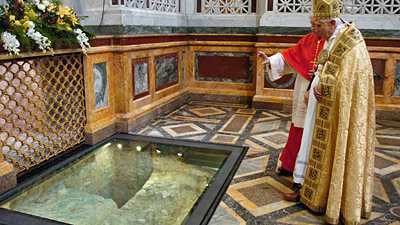
    Bone fragments found in a Rome basilica are said to belong to St Paul, Pope Benedict XVI has said.


    The analysis was carried out after a tiny probe was pushed through into the tomb beneath the Basilica of St Paul Outside the Walls, which is said to have been built on the site where he was buried.

    Vatican archaeologists uncovered the tomb in 2006 in a crypt under the basilica and said the fact that it was positioned exactly underneath the epigraph “Paulo Apostolo Mart” (meaning “Paul the Apostle and Martyr”) at the base of the main altar was conclusive proof that it was his final resting place.

    The tomb also has a hole in the top through which which pieces of cloth could be pushed, touching the relic and becoming holy in their turn.

    There has been a shrine on the site since the 3rd Century after the Emperor Constantine consecrated a basilica at the spot where, according to Christian tradition, Paul’s body was buried in a vineyard by a Roman woman.

    Pope Benedict said: “The sarcophagus under the altar dedicated to St Paul has recently been the object of detailed scientific analysis.

    “It had not been opened in centuries and a tiny hole was made in it, through which a special probe was passed which found traces of a precious purple lined, decorated with gold sequins and a blue fabric with linen.

    “Within the sarcophagus were also tiny bony fragments and these were put through carbon 14 testing by experts who did not know where they were from and they revealed that they were from a person who lived during the 1st or 2nd Century AD.

    “This seems to confirm the unanimous and uncontested tradition that they are the mortal remains of the Apostle Paul. All this fills our souls with deep emotion.”

    Monday is the feast of St Peter and Paul, who are the patron saints of Rome and a bank holiday in the city, and the news was expected to attract increased visitors to the basilica.

    It was the second announcement from the Vatican regarding St Paul in as many days – earlier it was revealed that the oldest known icon of the saint had been found in a nearby catacomb.

    Experts said the icon – which showed the traditional image of St Paul, with large eyes, sunken features and a long beard – was from the 4th Century AD.

    St Paul was a Roman Jew, born in Tarsus in modern-day Turkey, who started out persecuting Christians but later became one of the greatest influences in the Church.

    He did not know Jesus in life but converted to Christianity after seeing a shining light on the road to Damascus and spent much of his life travelling and preaching.

    St Paul wrote 14 letters to Churches which he founded or visited. His epistles tell Christians what they should believe and how they should live but do not say much about Jesus’ life and teachings.

    He was executed for his beliefs around AD 65 and is thought to have been beheaded, rather than crucified, because he was a Roman citizen.

    SKY

  • PROVOCATION AGAINST TURKEY

    PROVOCATION AGAINST TURKEY

    ARMENIAN COMMUNITY IN US MAKES ANOTHER PROVOCATION AGAINST TURKEY

    Saturday, 13 June 2009
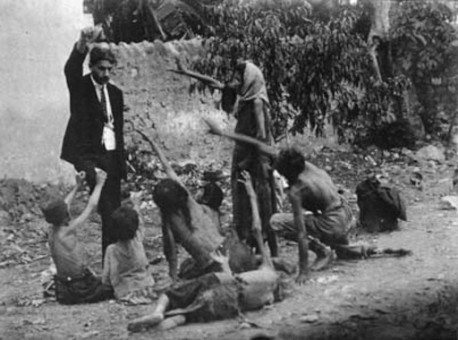
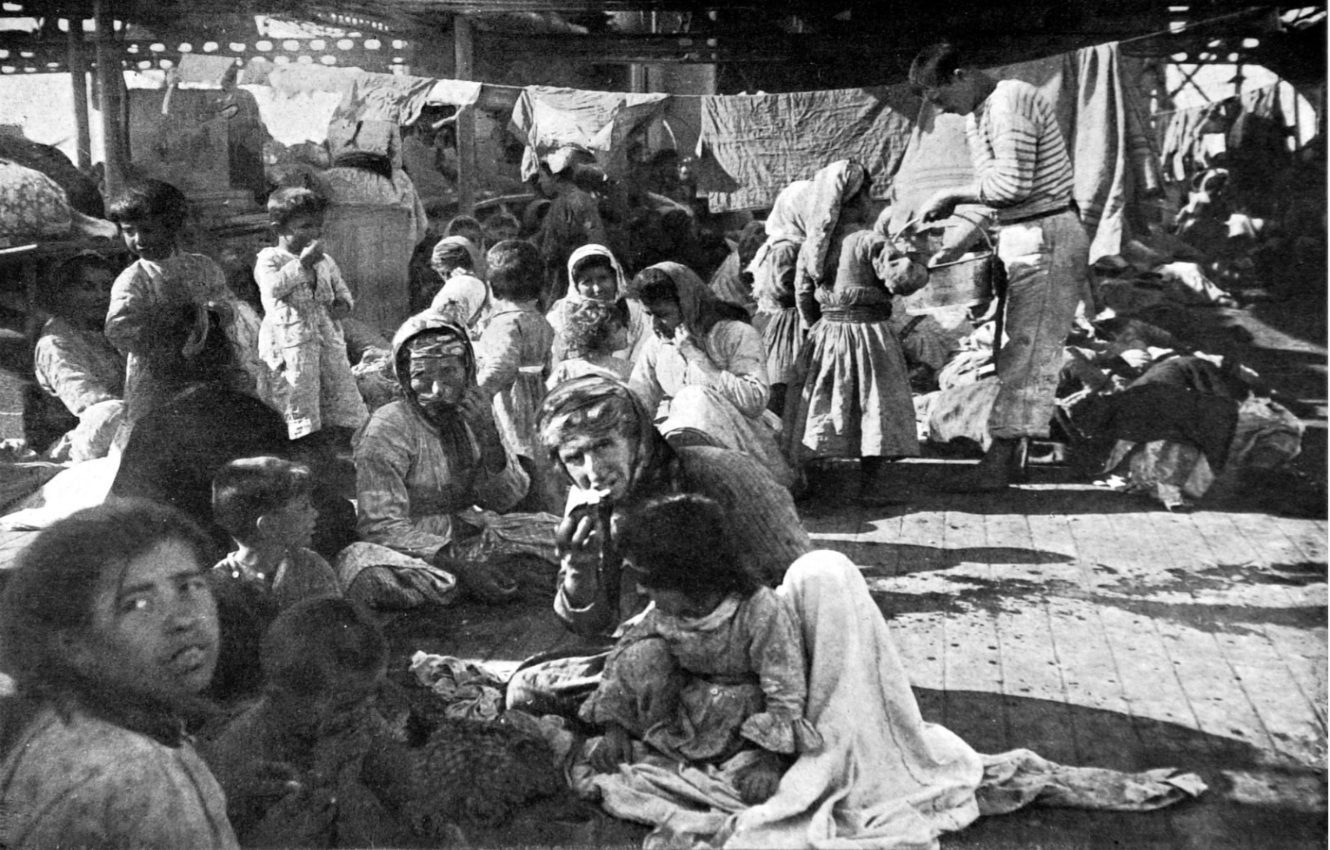
    APA’s US bureau reports that the US-based law office of Geragos & Geragos owned by famous lawyer of Armenian descent Mark Geragosian addressed heirs of Ethnic Greek New York Life Policy Holders who “were murdered” in the Genocide perpetrated by the Ottoman Turks between 1915 and 1921.

    “Prior to 1915, New York Life sold life insurance policies to thousands of Greeks living in the Ottoman Empire. Countless Greek policyholders were among the hundreds of thousands of Greeks who perished in the first Genocide of the twentieth century. In the ensuing chaos, many of the rightful heirs were unable to produce the documentation required to claim the insurance proceeds while others were unaware that they were entitled to any insurance benefits. In 2004, a class action settlement of $20 million which involved 2,300 Armenian New York Life policyholders with unpaid claims was awarded to the descendents of the victims massacred in the Armenian Genocide of 1915,” Geragos & Geragos noted in the special webpage launched for this purpose.

    This is not the first campaign launched by the US Armenian community to damage Turkey”s image. Earlier, California State Assembly member of Armenian descent Paul Krekorian presented a bill “Justice for Genocide Victims” and wanted prohibition of investments in Turkey and other states that committed “genocide.”

  • Turks increasingly turn to Islamic extremism

    Turks increasingly turn to Islamic extremism

    By Sebastian Rotella
    June 28, 2009

    Al Qaeda’s reliance on Arabs is altering as recruits from Turkey and Turkic-speaking areas of Central Asia form a recent wave of trainees, experts say.By Sebastian Rotella

    June 28, 2009

    Reporting from London – In an audio message from a hide-out in South Asia this month, an Al Qaeda chief did something new: He sang the praises of an ethnic group that once barely registered in the network.

    “We consider the Muslims in Turkey our brothers,” said Mustafa Abu Yazid, the network’s operations chief. Lauding Turkish suicide bombers killed in recent attacks near the Afghan-Pakistani border, he declared, “This is a pride and honor to the nation of Islam in Turkey, and we ask Allah to accept them amongst the martyrs.”

    The message is the latest sign of the changing composition of Islamic extremism, anti-terrorism officials and experts say. The number of Turks in Al Qaeda, long dominated by Arabs, has increased notably, officials say. And militant groups dominated by Turks and Central Asians, many of whom share Turkic culture and speak a Turkic language, have emerged as allies of and alternatives to Al Qaeda in northwestern Pakistan.

    “We are aware of an increasing number of Turks going to train in Pakistan,” said a senior European anti-terrorism official who asked to remain anonymous because the subject is sensitive. “This increase has taken place in the past couple of years.”

    Turkey’s secular tradition and official monitoring of religious practice for years helped restrain extremism at home and in the diaspora. But the newer movements churn out Internet propaganda in Turkish as well as German, an effort to recruit among a Turkish immigrant population in Germany that numbers close to 3 million.

    “We are seeing almost as much propaganda material from these Turkic groups as we are from Al Qaeda,” said Evan Kohlmann, a U.S. private consultant who works with anti-terrorism agencies around the world. “Turks were perceived as moderate with few connections to Al Qaeda central. Now Germany is dealing with this threat in a community that could be a sleeping giant.”

    Germany is especially vulnerable because it has troops in Afghanistan. The threat could also intensify in other countries with Turkish populations, such as France, Belgium and the Netherlands, whose anti-terrorism agencies focus on entrenched extremism in large North African communities.

    And the implications are serious for Turkey, a Muslim ally of the West and a longtime gateway to battlegrounds in the Middle East and Asia.

    As Al Qaeda’s multiethnic ranks burgeoned in the 1990s, Turks trained in Afghanistan and fought in Bosnia-Herzegovina and the Russian republic of Chechnya. In 2003, Al Qaeda suicide bombers killed 70 people in attacks on synagogues and British targets in Istanbul, Turkey’s largest city.

    Despite Turkey’s population of more than 70 million, however, Turks were once among the smallest contingents in the network.

    “I used to tell the Germans they are very lucky because you couldn’t find much radicalization among Turks,” said Zeyno Baran, a Turkish-born expert on Islam at the Hudson Institute, a think tank in Washington. “No one was paying much attention to Turks because they were considered the safe group.”

    Although Turkey works closely with Western anti-terrorism forces, some officials say it devotes more energy to fighting Kurdish separatists. Baran expressed concern that the moderate Islamist government in power since 2002 has lowered its guard.

    “With the government’s reluctance to talk about the problem of Islamist ideology, Al Qaeda and groups like that seem to think there’s an opening in Turkey and with Turks,” said Baran, whose forthcoming book is titled “The Other Muslims: Moderate and Secular.”

    Combat-hardened Central Asians have adopted a global agenda and tapped a new recruitment pool. Only five years ago, Kohlmann said, there was little need for Turkic-language translators to monitor extremist Internet traffic; now they are in demand.

    “These groups are trying to establish their pedigree and catering their propaganda to Turkic speakers who don’t speak Arabic or Pashto,” the dominant language in the Afghan-Pakistani border region, he said. “Their media organizations are saying: We are the equivalent of Al Qaeda for Turks.”

    The Islamic Jihad Union, an Uzbek-led group, has alternately competed and worked with Al Qaeda. The organization trained and directed two Turks and two German converts who have agreed to plead guilty in a 2007 bomb plot against U.S. targets in Germany.

    Last year, the group announced that another recruit, a 28-year-old Turk born in Bavaria, killed two U.S. soldiers in a suicide bombing in Afghanistan.

    During the same period as the attack last year, half a dozen French and Belgian militants were training in Al Qaeda compounds in the Waziristan region of Pakistan. The subsequent description by a French trainee of the nationalities of the fighters he encountered departs from the commonly held image of an essentially Arab movement.

    “It’s possible to join different groups: a big Turkish group, an Arab group (the smallest of all the groups), a group of Uighurs from . . . northwest China, the biggest group,” the trainee, Walid Othmani, said during an interrogation by French police after his arrest in January of this year.

    Othmani, who is of Tunisian descent, said he trained with a mixed group of Arabs and North Africans that was led by an Egyptian and numbered 300 to 500 fighters.

    The Uzbeks, meanwhile, totaled about 3,000, according to Othmani’s confession. He said a Turkish contingent of 1,000 to 2,000 was commanded by a Turk.

    It’s not clear how precise his estimates are, investigators say. Some numbers seem accurate, others larger than expected based on previous intelligence. Overall, his account is regarded as credible, investigators say.

    The mix of nationalities may reflect the future in the making. Yazid, Al Qaeda’s veteran financial chief, runs the network’s day-to-day operations while Osama bin Laden and his deputy, Ayman Zawahiri, devote themselves largely to avoiding capture, officials say. Yazid used his recent audio message to make an urgent appeal for money.

    “And here we, in the battlefield in Afghanistan, are lacking a lot of money and a weakness in operations because of lack of money, and many mujahedin are absent from jihad because of lack or absence of money,” he said, according to a translation by Kohlmann’s organization, the NEFA Foundation.

    As Al Qaeda weathers hard times, the appeal geared to Turkic speakers suggests that audience is seen as a source of rejuvenation, experts said.

    “They are attempting to broaden their appeal, and it certainly looks like an instinctual competitive reaction to the sudden flourishing of Turkic-speaking jihadi groups in the Afghanistan-Pakistan theater,” Kohlmann said. “It’s an evolving recruitment and financing market for them, and they don’t want to be left out in the cold.”

    [email protected]
  • Amerika’nin degismeyen plani:

    Amerika’nin degismeyen plani:

    [email protected]


    Kuzey Irak ile Guneydogu Anadolu’yu “ortak bir ekonomik bolge”de birle$tirmek.
    Boylece “Buyuk Kurdistan”In, yani BOP Merkez Ussu’nun altyapIsInI kurmak.

    Guneydogu Anadolu ile Kuzey Irak’I kapsayacak
    “Nitelikli Sanayi Bolgesi” Projesi

    ABD’nin Turkiye analistlerinden kIdemli istahbaratcI Prof. Henry Barkey, Wall Street Journal’da, Obama’nIn Turkiye’deki Kurt sorununun cozulmesi icin devreye girmesini istedi.

    Barkey, ABD’nin ekonomik i$birliginin geli$tirilmesi amacIyla da “Kurtlerin ya$adIgI Guneydogu ve Kuzey Irak’I kapsayacak bir Nitelikli Sanayi Bolgesi’nin kurulmasInI” onerdi. (Wall Street Journal, 22 Haziran 2009)

    ABD’nin eski Ankara Buyukelcisi Robert Pearson, “Turkiye’nin Dogu ve Guneydogusu ile Kuzey Irak’In tek bir ekonomik bolge haline getirilmesi gerektigini” soylemi$ti.

    Pearson’In da, Barkey’in de acIkca dile getirdikleri aslInda ABD’nin “Turkiye himayesinde Kurdistan” planIdIr.

    Bu planIn uygulanabilmesi icin bugune kadar AKP eliyle cIkarIlan yasalardan en onemli ucu $unlardIr:

    1-Ikiz sozle$meler TBMM’den gecirildi.
    BM’nin ikiz sozle$meleri diye bilinen “Ekonomik, Sosyal ve Kulturel Haklar Sozle$mesi” ve “Medeni ve Siyasi Haklar Sozle$mesi” ba$lIklI uluslararasI sozle$meler, 4 Haziran 2003 gunu TBMM’de onaylandI.

    Bu sozle$meler, Turkiye’yi etnik ve ekonomik parcalama yasalarI olarak degerlendiriliyor.
    a) DiyarbakIr Buyuk$ehir Belediye Ba$kanI Osman Baydemir, “bolgenin su ve enerji kaynaklarInI bize bIrakIn” derken, arkasInI AKP’nin TBMM’den gecirdigi bu ikiz sozle$melere dayIyordu!

    b) Ba$bakan Erdogan’In Bush’la goru$mesinin ardIndan ekranlardan verdigi $u mesaj da yine ikiz sozle$melerin eseridir: “$u anda Amerika’nIn da Buyuk Ortadogu Projesi var ya, Geni$letilmi$ Ortadogu, yani bu proje icerisinde DiyarbakIr bir merkez, bir yIldIz olabilir. Bunu ba$armamIz lazIm”.

    2-AKP, Kamu Yonetimi Temel Kanunu’nu 15 Temmuz 2004 tarihinde TBMM’den gecirdi. Bu yasa da, bolgelerdeki iktidar odaklarIna yerel hukumetler kurma zemini olu$turuyor.

    3-KalkInma AjanslarI yasasI TBMM’den gecirildi.

    AKP Turkiye’yi 12 “eyalet”e bolen yasayI, 25 Ocak 2006 tarihinde TBMM’den gecirdi. ABD ve AB’nin cIkmasI icin yogun baskI uyguladIgI yasa,  Turkiye’yi etnik ve ekonomik temelde bolgelere ayIrIyor.

    ABD’nin “Turkiye himayesinde Kurdistan” planI tum boyutlarIyla yururlukte…

    Once AKP iktidara getirildi. Yasalarla zemin olu$turuldu. Irak i$galiyle cografya duruma hazIr hale getirdi. Cuval operasyonuyla TSK’ya silah gosterildi. Ergenekon tertibiyle direnecek kuvvetler oyun dI$I bIrakIldI… $imdi sIra Irak’In kuzeyindeki yonetimi resmi olarak tanImakta… Yani Kukla Devleti kabul etmekte…

    Cumhurba$kanI Gul aracIlIgIyla ba$latIlan “acIlIm” i$te bu a$amanIn enstrumanIydI

  • Saakashvili pays tribute to the Armenian Genocide victims

    Saakashvili pays tribute to the Armenian Genocide victims


    25.06.2009 16:25

    Accompanied by Armenian Foreign Minister Edward Nalbandian, Deputy Mayor of Yerevan Kamo Areyan and other officials, the President of Georgia, Mikhail Saakashvili visited the Tsitsernakaberd Memorial Complex.

    The Georgian delegation paid a tribute of respect to the victims of the Armenian genocide and laid a wreath at the memorial.

    President Saakashvili watered the fir tree he had planted at the Memory Alley during his visit to Armenia a few years ago.

    ! Reproduction on full or in part is prohibited without reference to Public Radio of Armenia